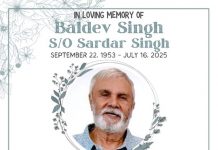
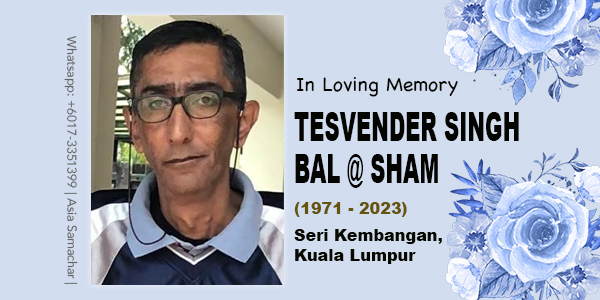
TESVENDER SINGH BAL @ SHAM S/O MDM PALOK KAUR & LATE SWARNA SINGH BAL
16.4.1971 – 25.4.2023
Age 52, Village: Suttowal | District: Amritsar Passed away peacefully on 25th April 2023
He will be deeply missed & his memories will stay in our hearts forever
Grandson of Late Arjan Singh Bal & Late Mata Perkash Kaur Late Keshar Singh Johal & Late Mata Tej Kaur Brother: Rajinder Singh Bal Sister: Sharenjit Kaur | Brother-in-Law: Paramjeet Singh Gill Niece: Reinajeet Kaur Gill | Nephew: Manvir Singh Gill Uncles & Aunties Cousins
Path da Bhog: 6th May 2023 (Saturday), from 10 am – 12 noon, at Gurdwara Sahib Serdang, Jalan Besar, Serdang Lama, 43300 Seri Kembangan, Selangor
For more enquires, pls contact: Rajinder: +6019 3199 003 | Sharenjit: +6016 284 6564
| Entry: 29 April 2023 | Source: Family
ASIA SAMACHAR is an online newspaper for Sikhs / Punjabis in Southeast Asia and beyond. When you leave a comment at the bottom of this article, it takes time to appear as it is moderated by human being. Unless it is offensive or libelous, it should appear. You can also comment at Facebook, Twitter, and Instagram. You can reach us via WhatsApp +6017-335-1399 or email: asia.samachar@gmail.com. For obituary announcements, click here
The EKTA YDLL (Youth Development and Life Long Learning) team conducted another successful round of its signature Personal Branding workshop for 16 high school/college students on the 23rd April. The success was dependent on a number of factors – our dependable partner, our precious facilitators and our amazing participants.
Gurdwara Sahib Petaling Jaya was an invaluable partner as both the President, Sardar Awtar Singh and Sardar Baldev Singh (committee member in charge of education) provided integral support to the workshop – setting up a comfortable venue and encouraging students. GSPJ must be commended for their efforts to provide Punjabi Sikh youth with innovative programs that help them maximise their potential.
EKTA YDLL’s 4 facilitators (Jeswant, Indergeet (Indra), Kuljinder & Ajinder) under the leadership of former UKM deputy vice-chancellor Dato’ Dr. Saran Kaur Gill, demonstrated great dedication and patience. They guided the participants, from a journey of discovering their personal strengths and values to crafting their winning personal brand profiles.
The Punjabi Sikh youth at the workshop rocked their values and achievements by sharing amazing personal brand stories.
There was a personal story of a Punjabi Sikh youth educated in a Chinese medium school and how she overcame daily challenges through mindfulness, learning to breathe deeply and being in the present. Another was an international hockey player who reminded us that success is attained by working on the mantra of “Practice For Improvement” before it gets to perfection.
And a quiet personality who showed us all how valuable it is to be an introvert – one listens more, has time to think and articulates thoughts clearly. He made such a strong case for all introverts. All 16 of this wonderful group of youth, gives tremendous hope to the future of our community and nation.
Jasniel Singh Sharma, a participant, expresses his appreciation, “the workshop helped us discover ourselves – about the values that we own but might have overlooked. It was such an informative workshop especially for the youth as we were able to learn how to write impactfully with the help of professionals. Looking forward to more events with EKTA YDLL in the future.” (Report from the organising team)
ASIA SAMACHAR is an online newspaper for Sikhs / Punjabis in Southeast Asia and beyond. When you leave a comment at the bottom of this article, it takes time to appear as it is moderated by human being. Unless it is offensive or libelous, it should appear. You can also comment at Facebook, Twitter, and Instagram. You can reach us via WhatsApp +6017-335-1399 or email: asia.samachar@gmail.com. For obituary announcements, click here.
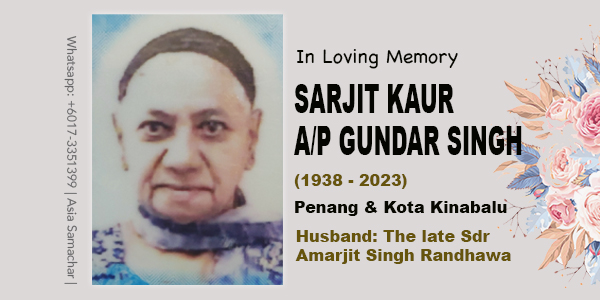
Brothers / Sisters Naranjan Kaur Khaira (wife of the late Baksis Singh Deo – Pg) The Late Harbans Kaur Khaira (wife of the late Bachan Singh Johl – Sg Petani) The Late Niranjan Singh Khaira (UK) Gurcharan Kaur Khaira (wife of the late Hardial Singh Gill – KL) Nermal Singh Khaira The Late Darshan Singh Khaira Saran Singh Khaira Gurunam Singh Khaira
Path da Bhog: 12 noon, 7th May 2023 (Sunday) at Wadda Gurdwara Sahib Penang
She rose to the challenges life threw her way steadfastly with what little she had. She never saw a lack of education and finance as a barrier. Instead, she focused on her positive attributes such as her excellent cooking and entrepreneurship skills to support her family in the best way she could. She was a compassionate gutsy person, a devoted daughter and a kind, loving mom to us.
| Entry: 28 April 2023 | Source: Family
ASIA SAMACHAR is an online newspaper for Sikhs / Punjabis in Southeast Asia and beyond. When you leave a comment at the bottom of this article, it takes time to appear as it is moderated by human being. Unless it is offensive or libelous, it should appear. You can also comment at Facebook, Twitter, and Instagram. You can reach us via WhatsApp +6017-335-1399 or email: asia.samachar@gmail.com. For obituary announcements, click here
Parkash Singh Badal funeral on 27 April 2023 – Photo: Shiromani Akali Dal Facebook
By Prabhjot Singh | Opinion |
If politics was his passion, contesting elections was his pastime. From panchayat to gurdwara elections, state legislature to parliament, Parkash Singh Badal figured prominently in almost every election that took place in Punjab at least since the reorganisation of the State in 1966.
His slogan “raaj nahin sewa” met with same overwhelming popularity as were his “atta-daal” and “free water for farmers” schemes.
He was a master appeaser. He knew people’s pulse. Staying in power was his biggest ambition that he successfully achieved by serving this border State as Chief Minister for five times, besides leader of Opposition thrice and Member of Parliament and Union Agriculture Minister in Morarji Desai’s government.
His demise at the age of 95 will make a huge difference not just to Punjab or Akali politics but also to national polity and coalition politics. He scripted the success of coalition politics in the country, first with the Jana Sangh, then during JP’s movement Janata Party and later with the Bharatiya Janata Party. Though subjects like centre-state relations were dear to his heart, he died seeing Centre becoming more powerful than what it was at the early stages of his political career. The decision to walk out of the SAD-BJP coalition was not by choice but by compulsion. And the defeat in the 2022 assembly elections to an unknown political entity of Aam Aadmi Party (AAP) marked an end to a glorious political career that shaped the destiny of present Punjab.
He was no different than most of other Akali stalwarts or “Taksali” leaders. He, too, started his political career as a Congressman. He, however, moved to the Shiromani Akali Dal fairly early, but always remained a “moderate” without allowing himself to be swayed by the demand for a separate Sikh State or Khalistan.
Though the Shiromani Akali Dal came out with the Anandpur Sahib resolution in 1973 for more rights to States, he was one leader who refused to give in to separatists. If the Shiromani Akali Dal, the oldest regional party in the country, witnessed divisions and partitions as the State of its influence, Punjab, did, he always stood for cordial centre-state relations.
Various initiatives of the Centre, including Indira Gandhi award, Shah Commission report and even the Rajeev-Longowal accord saw the moderates confronted both in Punjab and SGPC politics, he remained steadfast and was the last to get into politics of confrontations. It is why lots of criticism was heaped on him for not getting any of the long standing demands of the State conceded by the centre.
He always believed that the Akali Dal was the political face of one of the most affluent, patriotic and hardworking minority communities that made more than 80 percent of total sacrifices in the freedom struggle and was not only left without a capital but also lost some of its prestigious projects it built after independence.
As a staunch supporter of peaceful negotiations for resolving the long standing demands, he was successful in carrying not only the Sikh community but also the Hindu community in the State as well. With the centre dilly dallying on conceding any of the demands, he had the difficult job of representing the interests of a minority community that had at times the growing influence of hardcore elements demanding separate Sikh state without being in opposition to the majority community, or seeking to mobilise its own support in hostility to the majority community. This was a herculean task that not many Akali Dal leaders, including only other Akali Chief Minister in last more than four decades, Surjit Singh Barnala, tried to handle with tact while performing this balancing act.
The demand for a separate Sikh state, Khalistan, even after more than 75 years of independence, has refused to die down. Governments of the time may have tried to dismiss it as an extremist slogan but none has ever tried to resolve it amicably. Sikh leaders, especially those representing the Shiromani Akali Dal, have never lent any support to the demand but also did nothing to get the other long standing demands of the State, including transfer of Chandigarh and water works to Punjab.
Parkash Singh Badal always played safe and subscribed to the philosophy of peaceful coexistence maintaining universal brotherhood, tranquillity and peace after more than two decades of bloodshed that ravaged the State. Intriguingly, his name remained associated with some of the major controversies, including the start of Sikh-Nirankari clashes on Baisakhi day that ultimately pushed the State into militancy as the demand for the acceptance of Sri Anandpur Sahib resolution grew louder and clearer.
He always believed that peace and progress would put behind the demand for Khalistan. He needed the centre’s support that came at times but conditionally.
Punjab is the only state in the country that has witnessed two partitions in the last 75 years. First of these came with the Independence, and second followed Sikhs’ continuous demand for a separate Punjabi speaking or lingual State.
The Akalis, who in coalition with Congress were generally ruling the State between the first and the second partition in 1966, had their political aspirations upped and parted ways with Congress before an interim government was stalled in the State. As a sequel to that clarion call, many Sikh leaders came out of the Congress government and Parkash Singh Badal was one of them.
After non-Congress governments took over from where Congress left before the 1966 reorganisation, Akali’s started gaining political ground. After initial reluctance, the Centre too was forced to reorganise some states on linguistic basis. The Centre, however, played a game by drawing a long list of concurrent subjects, in which the Centre and the states both have the right to legislate, and the automatic right of the Centre to prevail over a state in any concurrent legislation.
Some of the demands Punjab subsequently raised were at the core of the 1973 Anandpur Sahib resolution. There was a lot of hue and cry after the resolution hit the public domain. It had several additional points that sought to placate more extreme elements which wanted to combine regional autonomy with religious exclusivity. In 1978, fresh resolutions that proclaimed themselves to be based on the Anandpur Sahib resolution were passed, but they eschewed ambiguous language that could lend itself to separatist interpretations. The Akalis became champions of states’ rights, and it was during this time that the baton passed into the hands of Badal.
Events elsewhere in the country set in motion a debate over centre-state relations. A few non-Congress governments supported the federal structure before various Opposition-led states came together to demand restructuring of Centre-state relations. This led to the appointment of the Sarkaria Commission. The recommendations were just shelved in the cold store. The only positive, though theoretical, was the creation of the Inter-State Council. Badal had been a votary of implementation of the Sarkaria Commission recommendations, especially with regard to the consultative appointment of a state’s Governor. But then his efforts bore no success and he continued to enjoy power.
Badal’s alliance, first with the Jan Sangh, and later with its successor party, the BJP, stood at odds with his championing of states’ rights. Still, until last year, continued to stand by his alliance partners.
Badal as a man had a multi-faceted personality. Reading newspapers was his very priority every morning. Clips of news reports were regularly filed and maintained at his instance.
OPEN TO CRITICISM
I used to interact with him regularly. He was not averse to criticism but at times insisted on getting his version played prominently. Sukhbir Singh Badal, after a brief stint in central politics, wanted to make a flashy arrival in State politics. Those days, lots of stories were planted and played prominently about his imminent elevation as Chief Minister. He started calling meetings of bureaucrats and even Ministers and legislators. The old man stood cool and calm and made certain decisions that made it obvious who was the boss. Besides, it also cleared all speculations of his making room for his son. I did a special story saying that Badal remains firmly saddled. To my pleasant surprise I got a couple of calls early in the morning from CM’s house. Since I used to go for my morning game, and there were still no cell phones, I got a message that he wants to talk to me.
I called and he quickly came on line to acknowledge my story saying that factual position has been highlighted.
Otherwise, there were only a couple of other occasions when I got calls from him. One such occasion was when I was doing my story on how politicians were holding the public transport system to ransom. He called to say that he would love his version to go as prominently as parts of my serialised stories were going. Afterwards, the government went with full page ads in support of its transport policy rather than seeking a rejoinder to my series. Our relationship, as always, remained truly professional and criticism, if any, was taken sportingly.
One of his programmes, Sangat Darshan, though popular with masses, provided a lever to opposition parties to criticise him for diverting public funds to serve political constituencies of his party members. Since, some parties, including Congress, also held him responsible for accepting money for the controversial SYL canal, he tried to silence his critics by notifying the acquired land and returning it to original owners. It, however, did not end the ongoing dispute between Punjab and Haryana.
Staunch supporter of ideology and commitment to public services, he always denounced vendetta politics.
Whatever his critics may have to say, he was not one of but the tallest of all politicians the State has produced in the post-independence era. It is one reason he commanded respect from leaders of all opposition parties for his secular and national outlook.
Tailpiece: He always held he was doing “sewa” and not “raaj”. Interestingly, this “sewa” mostly came when he was in “satta” (raaj).
(Prabhjot Singh is a veteran journalist with over three decades of experience of 14 years with Reuters News and 30 years with The Tribune Group, covering a wide spectrum of subjects and stories. He has covered Punjab and Sikh affairs for more than three decades besides covering seven Olympics and several major sporting events and hosting TV shows.)
ASIA SAMACHAR is an online newspaper for Sikhs / Punjabis in Southeast Asia and beyond. When you leave a comment at the bottom of this article, it takes time to appear as it is moderated by human being. Unless it is offensive or libelous, it should appear. You can also comment at Facebook, Twitter, and Instagram. You can reach us via WhatsApp +6017-335-1399 or email: asia.samachar@gmail.com. For obituary announcements, click here.
I have just now read your story on appointment of Dr. Jasjit Singh as first visiting Professor for Sikh study chair at the National University of Singapore. I agree with you that this is the major milestone towards Sikh studies initiated by Central Sikh Gurdwara Board Singapore. Dr. Jasjit Singh is a well known Sikh scholar in U.K. who has earned his name in the University Leeds.
The Singapore Sikhs are pioneers in the field of spreading message of Guru Nanak and have always unitedly took new initiatives.
I visited Singapore in 1982 when people all over the world were showing interest to get Kirtan cassettes which were first produced in Singapore. I am also aware that it was in Singapore that modern technology was used to teach Punjabi to the students. This was a great help to the Sikh youth all over the world.
In spite of a meager population, there are Sikh Members of Parliament, Sikh Ambassadors, a Sikh chief Justice and S. Kartar Singh Thakral was declared man of the year. It was again a Singapore Sikh Amardeep Singh Rangher who had made 23 episodes on the travels of Guru Nanak which is now an asset of the community.
I may not be wrong to comment that Sikhs in eastern countries — Singapore, Thailand, Malaysia and Indonesia — are involved in promoting Sikhism and are not indulging to waste time in uncalled for agitations. Australia and New Zealand are source of positive news for the community.
I thank Asia Samachar for always circulating motivational news.
(Tarlochan Singh, Ex-M.P, Former Chairman of National Commission Minorities)
ASIA SAMACHAR is an online newspaper for Sikhs / Punjabis in Southeast Asia and beyond. When you leave a comment at the bottom of this article, it takes time to appear as it is moderated by human being. Unless it is offensive or libelous, it should appear. You can also comment at Facebook, Twitter, and Instagram. You can reach us via WhatsApp +6017-335-1399 or email: asia.samachar@gmail.com. For obituary announcements, click here.
Citi has appointed Vikram Singh as the chief executive officer of Citi Malaysia effective from May 1.
Vikram will lead the country team of the Malaysia franchise and will also have oversight of the Citi Solutions Centers in Malaysia.
He will report directly to Amol Gupte, the South Asia and Asean head of Citi, according to a statement issued by the banking group yesterday.
Vikram joined Citi in 1999, and has 24 years of corporate banking experience managing 18 markets in Asia-Pacific, where he has held various leadership roles in India and the Phillippines, covering corporate and investment banking.
While serving as the head of corporate and investment banking in the Phillippines from 2016 to 2021, Vikram achieved double-digit revenue growth by devising and deploying robust business strategies, said Citi.
He most recently held the position of the head of Asia-Pacific regional account management, global subsidiaries group in Singapore.
He has a Bachelor’s degree in economics from Delhi University, New Delhi, and a Master’s degree in management from International Management Institute, New Delhi.
“Malaysia is a key market for Citi and has a strong institutional franchise. Vikram’s long career and experience with the firm will be invaluable in leading the next stage of growth in a market that also supports many of our global businesses and functions,” said Gupte in the statement.
ASIA SAMACHAR is an online newspaper for Sikhs / Punjabis in Southeast Asia and beyond. When you leave a comment at the bottom of this article, it takes time to appear as it is moderated by human being. Unless it is offensive or libelous, it should appear. You can also comment at Facebook, Twitter, and Instagram. You can reach us via WhatsApp +6017-335-1399 or email: asia.samachar@gmail.com. For obituary announcements, click here
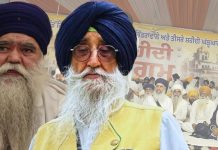
Parkash Singh Badal, a five time chief minister of Punjab and patriach of what is probably the richest family in the northern Indian state, passed away today (April 26). He was 95.
He passed away on Tuesday at a private hospital in Mohali and is scheduled to be cremated in Muktsar tomorrow (Thursday).
He leaves a divided legacy, with some quarters critical of his politics.
Take, for example, this entry on social media by @theNSYF: “One of the longest serving client politicians of New Delhi has died today. He will be remembered as a traitor of the Panth and Punjab, the Sikh face of the Delhi Darbar always serving Indian interests for which Punjab suffered and his family gained. Parkash Badal who died in reality died the true death in 1984 and became a walking corpse.”
In 2022, at the age of 94, he entered his 13th electoral battle when he ran for a Punjab state assembly seat from home turf Lambi in Punjab’s Muktsar district under the banner of Shiromani Akali Dal (SAD). He became the oldest person to fight an election in the county. In this fight, Parkash and his son Sukhbir Singh Badal both lost.
Easily the grand old man of Punjab politics, Parkash first became chief minister in 1970 when he headed a coalition government which did not last long. He had also served as CM 1977-80, 1997-2002, 2007-12 and 2012-2017.
Born on December 8, 1927 in Abul Khurana near Malout, Badal graduated from the Forman Christian College in Lahore. His first political posts were the sarpanch of Badal village and the chairman of the block samiti.
He entered the state assembly from Malout in 1957 as the Congress nominee. In 1969, he won the Gidderbaha assembly seat on the SAD ticket.
The Badal family is said to have their tentacles in various businesses in Punjab. The family was said to own a vast business empire, which included several transport companies, a hospitality firm, and a media business, reported The Indian Express in 2015.
His daughter in law Harsimrat Kaur Badal had also served a minister in the federal government.
ASIA SAMACHAR is an online newspaper for Sikhs / Punjabis in Southeast Asia and beyond. When you leave a comment at the bottom of this article, it takes time to appear as it is moderated by human being. Unless it is offensive or libelous, it should appear. You can also comment at Facebook, Twitter, and Instagram. You can reach us via WhatsApp +6017-335-1399 or email: asia.samachar@gmail.com. For obituary announcements, click here
ASIA SAMACHAR is an online newspaper for Sikhs / Punjabis in Southeast Asia and beyond. When you leave a comment at the bottom of this article, it takes time to appear as it is moderated by human being. Unless it is offensive or libelous, it should appear. You can also comment at Facebook, Twitter, and Instagram. You can reach us via WhatsApp +6017-335-1399 or email: asia.samachar@gmail.com. For obituary announcements, click here
A woman of courage and passion. A devoted wife , loving mother and grandmother. A dedicated caregiver who has selflessly served her patients.
Mother, you have been a constant pillar of strength and inspired all of us.
| Entry: 24 April 2023 | Source: Family
ASIA SAMACHAR is an online newspaper for Sikhs / Punjabis in Southeast Asia and beyond. When you leave a comment at the bottom of this article, it takes time to appear as it is moderated by human being. Unless it is offensive or libelous, it should appear. You can also comment at Facebook, Twitter, and Instagram. You can reach us via WhatsApp +6017-335-1399 or email: asia.samachar@gmail.com. For obituary announcements, click here
We sincerely thank everyone for their condolences, prayers, assistance, love & support during this bereavement.
| Entry: 24 April 2023 | Source: Family
ASIA SAMACHAR is an online newspaper for Sikhs / Punjabis in Southeast Asia and beyond. When you leave a comment at the bottom of this article, it takes time to appear as it is moderated by human being. Unless it is offensive or libelous, it should appear. You can also comment at Facebook, Twitter, and Instagram. You can reach us via WhatsApp +6017-335-1399 or email: asia.samachar@gmail.com. For obituary announcements, click here.