If you’re a movie fan, here’s a chance to catch something different. A Panjabi film with local Malaysian tastes is set to hit the cinemas on Dec 15.
Mundey Kampung Dey is a story of three childhood friends from a backwater village move to Kuala Lumpur in search of a better life. However, their optimistic plans are cut short when they come across a parcel belonging to a huge player in KL’s dark underworld. There’s something valuable inside the parcel, and this boss lady will kill to get it back.
The comedy features Anwaar Beg Moghal, Nipun C, Hemant Shergill, Sanjna Suri, Chamkaur Singh, Mansher Singh and Sharmini Ramesh.
“Being in film and TV industry for more than 15 years, I always wanted to do a Panjabi film with local taste. My inspiration was the late P. Ramlee. He likes to showcase the true Malaysian in his movies,” movie director Mansher Singh told Asia Samachar.
“We, Punjabis in Malaysia, have contributed a lot to our country in various areas. It’s time to contribute our talents in films,” he added.
ASIA SAMACHAR is an online newspaper for Sikhs / Punjabis in Southeast Asia and beyond. When you leave a comment at the bottom of this article, it takes time to appear as it is moderated by human being. Unless it is offensive or libelous, it should appear. You can also comment at Facebook, Twitter, and Instagram. You can reach us via WhatsApp +6017-335-1399 or email: asia.samachar@gmail.com. For obituary announcements, click here.
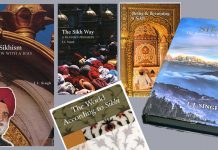
Getting a firm grip on Sikhi concepts and understanding the true meaning of shabads popularly sung will certainly boost your take on the teachings of the Sikh Gurus. Help is on the way. Two newly released books on Sikhi aim to do exactly that.
Prolific speaker and author Karminder Singh Dhillon has just released ‘Selected Sikhi Concepts’ and ‘Selected Gurbani Shabds‘ that promises to assist readers to debunk prevailing misconceptions on Sikhi (also commonly called Sikhism).
The 315-page ‘Selected Sikhi Concepts’ book focuses on pre-existing concepts that have to do with notion of afterlife. It explains key concepts like death, after life, reincarnation, heaven and hell, salvation, end of life dreams and hukumnama.
“The basic argument of the book is that all the concepts that pre-existed the advent of Gurbani were redefined. In the words of the author, they were redefined to fit the Spiritual Canvas of Guru Nanak. They were given new meanings to breathe new life into the paradigms of the spirituality of Sikhi,” argues the foreword in the book.
The arguments presented are expected to challenge Sikhs in many of their prevailing ideas anchoring their understanding of Sikhi.
The two books were launched along with three others – Understanding Salok Bhagat Kabir Jio Kay (272 pages), Understanding Salok Sheikh Fareed Kay (164 pages) and Understanding Salok Mahala 9 (112 pages) – in Kuala Lumpur on Oct 30, 2022. The five books are sold as a set and not available individually.
This is the second set of five-books from the author. They are sold at RM100 in Malaysia. (See details below).
In late-2020, Karminder released The Hijacking of Sikhi along with four other books: Understanding Nitnem: Jup, Sodar, and Sohela (308 pages), Understanding Sidh Goshat (271 pages), Understanding Anand (162 pages) and Understanding Asa Di Vaar (289 pages).
(To purchase the books for delivery in Malaysia, drop a WhatsApp to Bhai Pritam Singh at +6016-216 2474. For dispatching to other countries, click here)
ASIA SAMACHAR is an online newspaper for Sikhs / Punjabis in Southeast Asia and beyond. When you leave a comment at the bottom of this article, it takes time to appear as it is moderated by human being. Unless it is offensive or libelous, it should appear. You can also comment at Facebook, Twitter, and Instagram. You can reach us via WhatsApp +6017-335-1399 or email: asia.samachar@gmail.com. For obituary announcements, click here.
By Fiona Sun | South China Morning Post | Hong Kong |
Wearing his black lawyer’s gown and Sikh headgear, Saajandeep Singh, 25, stood out when he took his oath at Hong Kong’s High Court last month. He is believed to be the city’s first locally trained turbaned solicitor.
“I felt a range of emotions. It was a culmination of years of work,” said the young man, the only member of an ethnic minority community among 23 new solicitors admitted on October 29.
Singh’s grandfather came from Punjab, India, to work in Hong Kong in the 1960s. His father, a Correctional Services officer born and raised in the city, brought his bride from India and she now works in a bank.
Both parents emphasised the importance of education as they raised Singh and his older brother, now 26 and a doctor at Queen Mary Hospital.
Singh said his father had longed to go to university, but was forced to begin working at a young age to support the family.
Growing up in their home next to Stanley Prison, where his father worked, Singh could see prisoners playing basketball or mowing the grass. That often made him wonder why some people ended up in jail and what decided their fate.
That, and an interest in philosophy, led him to decide on law as a career.
ASIA SAMACHAR is an online newspaper for Sikhs / Punjabis in Southeast Asia and beyond. When you leave a comment at the bottom of this article, it takes time to appear as it is moderated by human being. Unless it is offensive or libelous, it should appear. You can also comment at Facebook, Twitter, and Instagram. You can reach us via WhatsApp +6017-335-1399 or email: asia.samachar@gmail.com. For obituary announcements, click here.
Scientist Hargurdeep Saini has been tapped to become the principal and vice-chancellor of McGill University, a Montreal-based institution of higher learning with the highest percentage of PhD students of any Canadian research university.
Popularly known as Prof H Deep Saini, who is the current president/VC of the Nova Scotia-based Dalhousie University, will serve a five-year renewable term effective April 1, 2023.
Prof. Saini was chosen by a unanimous vote of the board of governors, following a recommendation of an Advisory Committee formed to lead an extensive, international search, according to a statement released by the university.
Prof Saini grew up in India, where he completed his Master of Science (Honours) in Botany from Punjab Agricultural University in Ludhiana. He then moved to Australia to earn a PhD in Plant Physiology from the University of Adelaide. He has also served as President and Vice-Chancellor of the University of Canberra in Australia.
A trusted and respected leader whose Canadian experience includes working at four of the top 15 research-intensive universities of the country, Prof. Saini has a keen understanding of Quebec culture, having lived close to two decades in Montreal. He is fluent in four languages, including English and French, the statement added.
“He exemplifies the rare mix of strong academic leadership with a wide-ranging and international perspective. He is the perfect choice for McGill as it embarks on its third century,” said McGill’s Board of Governors chair Maryse Bertrand.
Prof. Saini’s distinguished career has earned him several awards and recognitions, including honours from the Canadian Society of Plant Physiologists, Nanjing University, the Royal Society of New South Wales, the Punjab Academy of Sciences, and the Indo-Canada Chamber of Commerce. He is also the recipient of the Queen Elizabeth II Platinum and Diamond Jubilee Medals, in recognition of his service to education and Canada.
The University extends a heartfelt thanks to the Chair of the Board for leading this process, the Chancellor and all other members of the Advisory Committee for their many months of hard work and dedication. “I am grateful to all members of the University community, both internally and externally, who participated in this process and provided valuable input”, says Board Chair Bertrand.
RELATED STORY:
(Asia Samachar, x 2022)
ASIA SAMACHAR is an online newspaper for Sikhs / Punjabis in Southeast Asia and beyond. When you leave a comment at the bottom of this article, it takes time to appear as it is moderated by human being. Unless it is offensive or libelous, it should appear. You can also comment at Facebook, Twitter, and Instagram. You can reach us via WhatsApp +6017-335-1399 or email: asia.samachar@gmail.com. For obituary announcements, click here.
Guru Tegh Bahadur Memorial in New Delhi, India. – Photo: TripAdvisor
By Karminder Singh Dhillon | OPINION |
The Sikh world celebrates the Shaheede Diharra – the Supreme martyrdom of Guru Teg Bahadur ji on the 24th of November. The Global Sikh Council appeals to the Sikh world to ponder on the following three issues.
1) What was this event about?
2) What is the truth of it? And
3) What were the message behind this event?
Guru Teg Bahadur ji was put to death – by the order of then Emperor Aurangzeb – in the public square of Chandni Chowk, Delhi on the 11th of November 1675. The ninth Guru thus became the second of the two Guru martyrs in the Sikh faith. The first was Guru Arjun ji.
While commemorating the martyrdom of Guru Teg Bahadur ji on the 24th of November, our clergy – granthis, parcharaks, ragis and dhadees will tell us that Guru Teg Bahadur ji gave his life in defense of a particular religion and particular symbols of that religion. And that the ninth Guru did so at the behest of 500 Kashmiri Brahmins who had come to him to save themselves, their religion and their symbols.
While commemorating the martyrdom, our clergy will sing – as kirtan – poems that are taken from compositions that are not contained within the Sri Guru Granth Sahib. Poems that they have been singing for decades. Poems that are not Gurbani. But poems that fit the narrative that Guru Teg Bahadur laid his life to protect particular symbols of a particular religion. The verses of this poem are:
Tilak Janju Rakha Prabh Taka. Kino Bdo Klu Meh Saka…
Dharm Heyt Saka Jin Keeya. Sees Diya Par Sirer Na Diya.
Translated they mean: The massive event of the sacrifice in Kalyug was in defense of the sacred mark (tilak) and the sacred thread Janju. Tilak Janju Rakha Prabh Ta(n)ka. He gave his head in the name of religion (Dharam Heyt) for these symbols, but not his faith in them (Sirer na diya)
Our ragis and parcharaks have told us the lie that Guru Gobind Singh penned these verses. Based on the messages of these verses – the Sikh world has been told that Guru Teg Bahadur is Hind Dee Chador – the protector of Hind – protector of the Hindu nation to whom the symbols of tilak and Janju belong.
Click here for the video in English entitled ‘The Truth of Guru Teg Bahadur Ji’s Martyrdom’ by Karminder Singh Dhillon
The dishonor of singing – as kirtan – compositions that are not from within the Sri Guru Granth Sahib aside; the messages that are contained within this composition – are the greatest of disservice to what Guru Teg Bahadur stood for. The messages are in fact a betrayal of the sacrifice. One wonders if this poem was composed by the same people who wanted to imprison Guru Teg Bahadur within their own narrowness. And then claimed – falsely – that it was Guru Gobind Singh who gave us this narrative. And our ragis, kirtanias and parcharaks have regurgitated this fiction unthinkingly.
Young Sikhs belonging to the generation of the millennials as the custodians of Guru Nanak’s Sikhi in the next generation ask – if indeed we have understood and presented the reasons for the martyrdom of our beloved Guru in the real and accurate sense. Or if we have presented the martyrdom in a way that reduces its significance and narrows its importance. More importantly our youth ask of the real messages that emanate from the supreme sacrifice. Messages that are relevant to Sikhs in particular and humanity in general.
These questions give us reason to pause and reflect. To say that the Guru gave his life in defense of two symbols of a particular religion is to reduce the enormity of the sacrifice. To say that the Guru sacrificed himself in defense of any one particular religion is to severely narrow the magnanimity of the sacrifice. To propagate such may indeed be the agenda of people who want us to believe that Sikh gurus were no more than defenders of a particular religion and its symbols. But the truth is something else.
And we can only get to the truth if we seek the truth. And seek it courageously and judiciously. And if our clergy – ragis, granthis, kirtanias and parcharaks – stop preaching these narrow and agenda based messages to our sangats. And stop singing poems that are composed with the aim of propagating these same narrow messages. And stop narrating the untruth that these poems are written by Guru Gobind Singh. He could not have written what was never the truth. And the truth is that Guru Teg Bahadur’s martyrdom had nothing to do with any two symbols or any one religion. It had everything to do with the freedom to practice one’s faith. It had everything to do with celebrating diversity as a divine characteristic of the creator.
In 1670 Emperor Aurangzeb announced his policy of Ek Mazhab – or one religion. The foundational justification of this policy was that the only way to have peace and unity was for everyone to profess just one religion. Aurangzeb had decreed the destruction of all places of worship and education belonging to faiths other that the one he subscribed to. He further ordered the discontinuance of all customs, rituals and practices that contravened his ek mazhab dictate.
In the mind of Guru Teg Bahadur, the notion of a single mazhab was anti-thesis to the foundational principle of nature – which was diversity. This principle of diversity was a foundational belief of Guru Nanak’s Sikhi as encapsulated in the verse on page 385 of the SGGS:
Eyk Bageecha Peyd Ghan Kariya. Amrit Nam Tha Meh Faliya.
Meaning: The Orchard – meaning Humanity – is One, But the Vegetation Within it – meaning the people – is Diverse Aplenty. It is Within Such Kind of a Diverse Creation That Divinity Comes to Fruition.
Here is yet another verse on page 1056 that says that diversity was the foundational tenet of creation.
Mairaiy Prabh Sachaiy Ek Kheyl Rchaya. Koye Na Kis Hee Jeha Upaya.
Meaning: The creation of my Master Lord is such. None is like the other.
Guru Teg Bahadur thus decided to take a stand on the issue in a very public way – the purpose of which was not just to send a message to Aurangzeb that his One Mazhab dictate was unacceptable, but to convey to the humanity at large that defending the right to one’s beliefs was an unassailable right. And for such a stand and message he laid down his life.
The narrative of standing up for one particular religion and laying down his life for two particular symbols is akin to encapsulating the depths of an ocean into a tea-cup. It’s an attempt to fit the heights of a mountain into a wheelbarrow.
It wasn’t a particular religion or its symbols that Guru Teg Bahadur stood for. It could have been any religion. It could have been any belief or symbol. It could have been 50 Jainis from Gujrat in place of 500 Kashmiri brahmins who had called upon Guru Teg Bahadur. It could have been a group of Buddhists from, Bengal, or Yogis from Utrakhand. The particular religion, belief or symbol was inherently irrelevant. What was relevant was standing up for the oppressed – no matter their faith and beliefs. What was relevant was to stand up even when faced with certain tyranny and death. And he stood up on his own, not at the behest of any number people from any particular religion.
HONOURING THE SACRIFICE
Having said that, the question that the Sikh world needs to answer is this. Have we honored the sacrifice of our beloved Guru? Have we inculcated the messages and lessons of the Shaheedee within our lives?
A cursory look around us tells us that we have not. We have reduced a sacrifice of earth-shattering proportions and equally great messages to the giving up of life in the defense of two symbols. We have accepted the narrow narrative of Tilak Janju Rakha Prabh Ta(n)ka as all there was to it. We have reduced Guru Teg Bahadur ji to Hind Dee Chadur, when even to address him as Manukhta Dee Chadur or Insaniyat Di Chadur would be an understatement.
Come the 26th of November, it would be 347 years to the event under discussion. To honor the great sacrifice of Guru Teg Bahadur ji, I urge all Sikhs to awaken and enlighten ourselves on the real lessons and messages behind. I urge you to read my recent book on this issue titled Understanding Salok Mehla 9. In this book you will find the biography of Guru Teg Bahadur Ji, a chapter containing a commentary of his bani as contained within the SGGS and a full and complete translation of his bani Salok Mehla 9. The link to this book is https://sikhivicharforum.org/store/. The Global Sikh Council wishes you a meaningful and purpose filled Shaheedee Diharra of Guru Teg Bahadur ji our beloved ninth Guru.
Sikh thinker, writer and parcharak Karminder Singh Dhillon, PhD (Boston), is a retired Malaysian civil servant. He is the joint-editor of The Sikh Bulletin and author of The Hijacking of Sikhi. This article appeared in The Sikh Bulletin – 2022 Issue 3 (July-September 2022). Click here to retrieve archived copies of the bulletin. The author can be contacted at dhillon99@gmail.com.
ASIA SAMACHAR is an online newspaper for Sikhs / Punjabis in Southeast Asia and beyond.Facebook | WhatsApp +6017-335-1399 | Email: asia.samachar@gmail.com | Twitter | Instagram | Obituary announcements, click here
Wife of Jeswant Singh S/O Fujah Singh Nagoke (Ex Perak River Hydro / LLN, Malim Nawar)
Please join us for the prayers with commencement of Sukhmani Path, Kirtan and Sahej Path Da Bhog followed by Guru ka Langgar.
9.00 AM TO 12:00 PM
Dec 17, 2022 (Saturday)
Gurdwara Sahib Malim Nawar 31700 Malim Nawar, Perak.
Your presence will be highly appreciated
Please treat this as our personal invitation.
| Entry: 23 Nov 2022 | Source: Family
ASIA SAMACHAR is an online newspaper for Sikhs / Punjabis in Southeast Asia and beyond. When you leave a comment at the bottom of this article, it takes time to appear as it is moderated by human being. Unless it is offensive or libelous, it should appear. You can also comment at Facebook, Twitter, and Instagram. You can reach us via WhatsApp +6017-335-1399 or email: asia.samachar@gmail.com. Forobituary announcements, click here.
Swaranjit Singh Khalsa (2nd from right) and visitors to the Norwich “Sikh Genocide Remembrance Day”
By Local News | United States |
Norwich ― Although it was 38 years ago, many religious community members who practice Sikhism continue to feel the effects of what they call a government-backed genocide.
Community members were welcomed to the Sikh Art Gallery on Saturday to learn about the 1984 Anti-Sikh Riots for an exhibition on “Sikh Genocide Remembrance Day” and to hear personal accounts by survivors.
Swaranjit Singh Khalsa, a city council member and the gallery’s director, said the local Sikh community has done events in Hartford and at city hall but now they want to focus more on educational initiatives, especially as campaigns from opposing Indian groups claim Sikhs are terrorists.
He added Saturday’s event allowed Sikh people to share their experiences as the gallery is working on an oral history project.
During a presentation for attendees, Khalsa said Sikhs had their own country, known as the Sikh Empire, from 1799 to 1849, then a partition in 1947 divided the nation, splitting it between India and Pakistan. Khalsa said more than one million Sikhs were displaced.
Khalsa said Sikhs were not treated fairly in India. He said it led to the June 1984 attack of the Sikh Golden Temple in the state of Punjab by the Indian army as well as the widespread violence and murder of Sikhs across India in November 1984. The violence is said to have started after the assassination of Prime Minister Indira Gandhi by her Sikh bodyguards.
The violence included burning and beating deaths and rapes of Sikh civilians and destruction of homes and businesses. He said the Indian government has denied the genocide in the aftermath of violence as politicians and congressmen were allegedly involved. “We know what happened to us,” Khalsa said.
Even after investigations, Khalsa many still hold power and the Sikh continue to seek recognition of the genocide, justice and the sovereignty of Punjab, also known as Khalistan― translating to “land of the pure.”
He noted that the state of Connecticut has passed legislation recognizing Sikh Genocide Remembrance Day on Nov. 1.
Other members of the Sikh community were invited to talk as well as local officials who have faced opposition for supporting the Sikh community. Mayor Peter Nystrom and the city council have had emails, texts, phone calls and letters circulated by the Indian community demanding that they rescind their proclamation declaring April 29 as Sikh Declaration of Independence Day.
In August 2022, U.S Department of Justice team members of Connecticut visited the Sikh Art Gallery in Norwich. The gallery thanked the department for all the work they do on daily basis to protect minorities and vulnerable communities like Sikh community that choose America as their home after 1984 Sikh Genocide. – Photo: Sikh Art Gallery – Connecticut
ASIA SAMACHAR is an online newspaper for Sikhs / Punjabis in Southeast Asia and beyond. When you leave a comment at the bottom of this article, it takes time to appear as it is moderated by human being. Unless it is offensive or libelous, it should appear. You can also comment at Facebook, Twitter, and Instagram. You can reach us via WhatsApp +6017-335-1399 or email: asia.samachar@gmail.com. For obituary announcements, click here.
s/o Late Sardar Ram Singh & Late Sardarni Parkash Kaur
Grandson of Late Sardar Mohinder Singh Chakarvarthy
Dearly Loved & Deeply Missed by Family, Relatives & Friends
Kirtan & Katha followed by Guru Ka Langgar
Sunday, 27th November 2022, from 10.00 a.m. to 12.00 noon at
Darbar Sri Guru Granth Sahib Ji, Malaysia No. 10, Lorong 51A/227B, Section 51A, 46100 Petaling Jaya
Please treat this as a personal invitation. Your kind presence is much appreciated. Thank You
| Entry: 22 Nov 2022 | Source: Family
ASIA SAMACHAR is an online newspaper for Sikhs / Punjabis in Southeast Asia and beyond. When you leave a comment at the bottom of this article, it takes time to appear as it is moderated by human being. Unless it is offensive or libelous, it should appear. You can also comment at Facebook, Twitter, and Instagram. You can reach us via WhatsApp +6017-335-1399 or email: asia.samachar@gmail.com. Forobituary announcements, click here.
The ‘Bhagat Kabir Niwas’ is almost in the final stages. Once ready, it will provide 16 air-conditioned rooms at a low price to assist cancer patients and their attendants who travel from outstation.
Located in Sri Guru Singh Sabha in Pant Nagar, Ghatkopar (East) in Mumbai, the local Sikh community has plans to bump the beds available from 450 to 550.
“A couple of years ago, we celebrated the 550th birth anniversary of Guru Nanak Sahib. We are looking to touch that figure. We are already close to that figure as we have around 450 to 500 beds in the city at different places in Dadar, Pant Nagar and Chunabhatti among others,” said Sri Guru Singh Sabha president Manmohan Singh, reports the Free Press Journal.
The new facility will provide beds at a nominal cost to patients irrespective of communities they belong to.
“The influx of patients is very high. Many have to go away because they cannot afford to stay or care. After chemo (therapy), they need better environment. We chose an air-conditioned facility because there was a high demand for one,” he said.
Manmohan said the charitable facility will be run on a no-profit, no-loss basis. At the moment, they are considering Rs1,000 for one room, which will come up to Rs250 per bed for now. Community kitchens that serve free meals will also provide space for cancer patients if they want to their food.
ASIA SAMACHAR is an online newspaper for Sikhs / Punjabis in Southeast Asia and beyond. When you leave a comment at the bottom of this article, it takes time to appear as it is moderated by human being. Unless it is offensive or libelous, it should appear. You can also comment at Facebook, Twitter, and Instagram. You can reach us via WhatsApp +6017-335-1399 or email: asia.samachar@gmail.com. For obituary announcements, click here.
Last respects at Shamshan Bhoomi Hall (Jalan Loke Yew Crematorium, Kuala Lumpur) from 2.30 pm onwards on 23 November 2022 (Wednesday).
Saskaar / cremation: 4pm, 23 November 2022 (Wednesday) at Shamshan Bhoomi Hall (Jalan Loke Yew Crematorium, Kuala Lumpur)
Path da Bhog: 3 December 2022 (Saturday), from 10am to 12pm, at Gurdwara Sahib Mantin, Negeri Sembilan
Contact:
Harmesh – 0176233784
Sheetal – 0122512280
We mourn the loss of a loving mother, doting grandmother and great-grandmother. She will always be remembered as a warm, resilient, kind-hearted and selfless person.
“Thank you Nani for all that you have done for us. We are forever grateful” You will be deeply missed and forever remain in our hearts”
We thank our relatives and friends for their love and support.
| Entry: 22 Nov 2022 | Source: Family
ASIA SAMACHAR is an online newspaper for Sikhs / Punjabis in Southeast Asia and beyond. When you leave a comment at the bottom of this article, it takes time to appear as it is moderated by human being. Unless it is offensive or libelous, it should appear. You can also comment at Facebook, Twitter, and Instagram. You can reach us via WhatsApp +6017-335-1399 or email: asia.samachar@gmail.com. Forobituary announcements, click here.