My mother was 85. One fine day I received our daily phone call from her, but this one was to inform me that she was planning to complete a sehaj paatth (reading of Guru Granth Sahib, beginning to end) commenced a few months earlier and single-handedly done since then. She wanted the whole family to gather at her place the following Sunday for the bhog (completion). Could I be there by 11:00 am?
“Of course” I replied. “Are you marking any special occasion?”
“Yes. But I’ll explain when all of you get here. Your brother and sisters will be here too. This is important, so I want everyone to be here on time.”
Once we were all seated in her living room, she calmly proceeded to explain.
“I’ve been thinking … I’m getting on in years. I’ve been blessed with a wonderful life, and a long and healthy one at that. Time is running out …”
A few loud gasps. Someone interrupts her. “Are you okay, Biji? What’re you saying?”
“I’m perfectly fine. I was at my doctor’s only the other day. Given my age, she said all is well.”
She scours our faces.
“I assure you it’s true. You know I wouldn’t lie.”
My brother and his wife, both are medical doctors and have always closely liaised with her physician. They look puzzled, but nod in agreement.
Biji raises her hand and smiles.
“I didn’t mean to alarm you. There’s absolutely no reason to be concerned. But please hear me out first. Life is uncertain. I could be around for a while, or I could be gone tomorrow. I’m ready. And I’m at peace, especially since all of you get along so well with each other, and I get to see you as often as I want to.
“But I’m also cognizant that all of us are scattered, hundreds of kilometers away from each other. And all have busy lives. Don’t get me wrong, that pleases me immensely. But I want to be practical. I’ve given it a lot of thought. My only worry now is that when I do go, I don’t want you to get into days and days of mourning …”
“Wait a second,” someone pipes up again. “What’re you saying, Biji?”
‘Hear me out. I’ve decided to do my funeral rites now and get done with it … while I’m here.”
Long-drawn sighs. And some uncomfortable laughter.
“We’ll say my final prayers this morning, and we’ll be done with it. I don’t want you to worry about all of that when I’m gone. I’ve been to a funeral home, made all the arrangements. And paid for them. When I go, after you’re done with what has to be done, all I want is to have you spend loving time together. I simply want to get all of this out of the way …”
She addresses our moans and groans by assuring us that she is simply being herself.
She does the bhog. My sisters sing a few shabads of her choosing. She does the ardas, calling it her ‘antim ardas’. Last rites. She insists on personally serving the karrah parshad.
We partake in langar that she has cooked on her own. Sprinkled with jokes and laughter.
Today, Biji is hale and hearty. We’re blessed: she’ll turn 92 shortly.
T. Sher Singh, born September 11, 1949, at Patna, Bihar, India. Have worn various hats (actually, turbans), including as Police Commissioner, Lawyer/Attorney, Speaker, TV Host, Radio commentator, Newspaper Columnist on current affairs for Toronto Star et al, World Traveler, and travel writer. Canadian citizen, and resident of Canada since 1971.He was also the editor and publisher at sikhchic.com. This article was adapted from his LinkedIn posting. Go here for more of such entries.
ASIA SAMACHAR is an online newspaper for Sikhs / Punjabis in Southeast Asia and beyond.Facebook | WhatsApp +6017-335-1399 | Email: editor@asiasamachar.com | Twitter | Instagram | Obituary announcements, click here
The Shiromani Akali Dal chief Sukhbir Singh Badal must have heaved a sigh of relief after his hand-picked Harjinder Singh Dhami won his second term in office as the President of the Shiromani Gurdwara Parbandhak Committee.
His once loyalist and the first woman chief of the Apex Sikh body controlling affairs of historic Sikh Gurdwaras of Punjab, Haryana, Himachal Pradesh, Bibi Jagir Kaur, had given him hard times as his repeated requests failed to convince the Bibi from Bholath to relent.
Bibi Jagir Kaur stood firm in her fight against what she described as “lifafa culture” of which she herself remained a beneficiary. She was least remorseful in her defeat.
Open revolt against the party that had been running the affairs of the SGPC for decades, Bibi Jagir Kaur’s bold initiative, was nothing new. There have been several instances that saw powerful Sikh politicians, including longest serving SGPC chief Gurcharan Singh Tohra, standing up against the Shiromani Akali Dal (SAD) leadership for wresting top position in the Sikh temporal body.
The apex Sikh Gurdwaras management committee has a history of witnessing dissensions and factional politics. Now when Shirormani Akali Dal, fighting for its revival, has successfully met the revolt and challenge of Bibi Jagir Kaur, it has to chart out its future line of action.
Will Sukhbir Singh Badal repeat what his father and patron of Shiromani Akali Dal, Parkash Singh Badal, did in 2003 or go aggressively against those raising their heads?
Going by my experience of covering Sikh affairs and Akali politics for more than four decades, Sukhbir Singh Badal finds himself in the same piquant situation as his father was 20 years ago.
Will he wait or ride the recent and first major political success after several debacles to stem the further revolt in the party aggressively?
There are numerous precedents when those revolting in the Shiromani Akali Dal go about seeking the tacit help of foes, both old and new, to loosen Badal family’s stranglehold over the SGPC.
In 2002, no one would have even imagined that Punjab Chief Minister Amarinder Singh and Gurcharan Singh Tohra, who had remained poles apart in the State politics, would actually join hands to oust Badal from the control of the SGPC. It is the SGPC that manages the affairs of the cash-rich and historical gurdwaras in Punjab, Haryana, Himachal Pradesh and Chandigarh.
Now that jurisdiction, too, stands challenged following the Apex Court’s grant of recognition to the Haryana Sikh Gurdwaras Management committee. The SGPC has already decided to challenge the recent verdict before a bigger bench.
The decision may have added to the problems of Sukhbir Badal and his SAD as members elected from Haryana were generally supportive of the Apex Court directions. Besides the rebels led by Bibi Jagir Kaur, the SAD leadership also had to tackle these SGPC members from Haryana in a crucial executive committee election held in November every year.
The sequence of events followed those 20 years ago. In the month before the elections, the then Punjab Chief Minister Captain Amarinder resorted to all possible tricks to keep at bay Badal’s supporters in the 176-member SGPC. All of them, elected to the committee during Badal’s tenure, were still solidly behind him. When Amarinder found he could not convince them to shift loyal-ties, he reportedly resorted to force.
To help Gurcharan Singh Tohra, the chief minister allegedly the state police to scare the Badal loyalists into joining the Tohra camp. There was tension in and around Amritsar. The Golden Temple complex was under a virtual police siege.
There were fears of violence before and during the meeting. At that time Badal nominee Professor Kirpal Singh Badungar, was re-elected SGPC chief, defeating Tohra’s nominee, Sant Bir Singh by 23 votes.
After the elections, Parkash Singh Badal ascribed the peaceful voting to the intervention of Congress President Sonia Gandhi. “She realised that Amarinder’s actions were offending the Sikhs and she did not want to lose their votes in the Lok Sabha elections,” he was quoted saying in media afterwards..
Subsequently, Parkash Singh Badal was very careful in his statements about Gurcharan Singh Tohra. He avoided heaping any direct criticism of the former SGPC chief.
Less than seven months later, the then SGPC chief, Professor Kirpal Singh Badungar, quit his post to make room for Gurcharan Singh Tohra to head the SGPC again.
In 1986, too, GS Tohra got back to head the SGPC with the tactic support of Parkash Singh Badal and his men. At that time the then Shiromani Akali Dal President and Punjab Chief Minister Surjit Singh Barnala was supportive of Kabul Singh for the key SGPC position. Senior Badal was at the back of Gurcharan Singh Tohra who won 75-58 against Kabul Singh.
Now it is for Sukhbir Singh Badal to decide how to tackle the outburst and defiance of Bibi Jagir Kaur?
Prabhjot Singh is a veteran journalist with over three decades of experience covering a wide spectrum of subjects and stories. He has covered Punjab and Sikh affairs for more than three decades besides covering seven Olympics and several major sporting events and hosting TV shows. For more in-depth analysis please visit probingeye.com or follow him on Twitter.com/probingeye
ASIA SAMACHAR is an online newspaper for Sikhs / Punjabis in Southeast Asia and beyond.Facebook | WhatsApp +6017-335-1399 | Email: editor@asiasamachar.com | Twitter | Instagram | Obituary announcements, click here
Guru Nanak the founder of Sikhi was born on Vaisakh 1, 1469 (April 15,1469). This day is better known as Vaisakhi day. This date was recorded in most historical manuscripts (sakhies) presently available. Bhai Pal Singh Purewal, the author of the Nanakshahi calendar confirmed this date by applying the most logical calculations and methodology. However, Sikhs all over the world celebrate Guru Nanak’s Avtar Divas in the middle of November with no fixed date. That is seven months delay from the actual date of birth. The purpose of this article is to explain the reasons to celebrate in November. Historically, during and after the Guru period for 346 years, Sikhs were celebrating Guru Nanak’s birthday on Vaisakhi day each year.
REASONS TO CELEBRATE IN NOVEMBER
There is a large number of reasons but I will only list the obvious ones as follow:
Bala Janam Sakhi:
This is a mythical book written approximately 120 years after Guru Nanak’s departure from this world. It was masterfully orchestrated by anti-Sikh groups to dishonour Guru Nanak. This useless book was published with financial support from the ruling regime of that time. And it was distributed free of charge to all Sikh religious places and Sikh religious groups. This book is full of myths, rituals and superstitions including Guru Ji’s Avtar Divas. It’s written in this book that Guru Nanak was born on Kattak di puranmasi instead of Vaisakh 1st. In a matter of fact, the Kattak puranmasi date of birth belonged to Baba Siri Chand son of Guru Nanak. Baba Siri Chand was a rebellion against Guru Nanak’s philosophy. He had nothing to do with Sikhi. However, Sikhs all over the world celebrate his birthday and claim it as Guru Nanak’s birthday.
FOR MORE STORIES ON GURU NANAK’S BIRTHDAY, CLICK HERE
They titled this Janam Sakhi “Bala” in which Bala was a fictional character. In reality, there was no person named Bala who was Guru Nanak’s companion. Guru Nanak had only one companion during his life, that was Bhai Mardana. Presently, there are similar anti-Guru Nanak philosophy groups with different names and objectives. These groups are SGPC, RSS, Taksals, Deradars, Babas, Sants and most of the Gurduara management committees who promote this Bala Janam Sakhi. It is true but sad, the majority of Sikhs are not aware of the actual Avtar Divas of their founder.
Udasis:
Udasis were followers of Baba Siri Chand and they claimed Siri Chand was the second Guru of Sikhs as well. After Banda Singh Bahadur, when Sikhs were facing religious persecution, genocide, forced to live in jungles, the Udasis took control of Sikh shrines and they started celebrating Guru Nanak’s birthday on Kattak di puranmasi (November), which was the birthday of Baba Siri Chand who was their Guru.
Nirmlas:
The Nirmlas were disguised Brahmins, who studied Vedic religion (Hinduism) at Banaras (Kashi). Over time, they took control over Sikh religious institutions and started their mission against Sikh principles. According to M.A. McAuliffe a historian, it was the first time in 1816, when Guru Nanak’s Avtar divas was celebrated in Kattak (November) at Nankana Sahib. It is said, that, the Hindu community used to celebrate their religious festival in Kattak at Ram-Tirath, a place about 5 miles from Amritsar. Local and nearby area Sikhs used to join this celebration as well. Gyani Sant Singh a Nirmla, head granthi of Darbar Sahib, Amritsar was not happy with Sikhs attending this Hindu festival. So to prevent Sikhs from going to Ram-Tirath, he convinced Maharaja Ranjit Singh to have Guru Nanak’s Avtar divas celebration in Kattak.
Singh Sabha Movement:
The Singh Sabha movement was to reform Sikhi and free the Gurduaras from Nirmlas. The movement was very successful and in 1925 the Gurduaras were freed from Nirmlas. However after they were removed from Gurduaras they moved into Deras, Taksals and become Sants and Babas. Presently all Deras, Taksals, SGPC, majority Gurduara management committees practice Nirmla ideology. This means approximately 16,000 Deras in Punjab with all their Sants, Babas and their ignorant followers continue to celebrate Guru Nanak’s Avtar divas in Kattak instead of Vaisakh 1st (Vaisakhi Day).
Lack of Correct Information:
It is a fact that the Sikh community has been receiving fake information for more than 200 years. This was because of the Sikh leadership (SGPC) and religious institutions such as Gurduaras and Deras being in hands of Nirmlas. The main objective of the Nirmlas was to make Sikhi part of Hinduism, that was the reason they have been providing false information to the Sikh community. The Sikh community trusted the corrupt leadership without realizing they are not honest in their commitments to society. The Preachers, Kathakars, Dhadies, Sants and Babas all tell Sikh Sangat not to criticize or raise any question about anything they hear in Gurduaras, just take it as a Gospel truth. The Sikh Sangat relied on these people with full trust and confidence without searching the facts themselves. It seems, that, the Sikhs forgot that Sikhi was based upon logic, purpose, relevance and practicality. Having the wrong information for more than 200 years, now become a reality in Sikh society, such as celebrating Guru Nanak’s birthday in Kattak (November), Bala being Guru Nanak’s companion and so many fake ritualistic traditions and miraculous stories labeled with Guru Nanak.
Historically Sikhs were celebrating Guru Nanak’s birthday on Vaisakhi day as the following two very important events were held on Vaisakhi day simply because it was Guru Nanak’s Avtar divas.
Guru Amar Das held the opening ceremony of Baoli in Goindwal on Vaisakhi day, because it was Guru Nanak’s birthday.
Guru Gobind Singh created Khalsa on Vaisakhi 1699 because he knew it was Guru Nanak’s birthday. Guru ji could have picked any other day otherwise.
It is a historical fact, that, the publishing cost of mythical, blasphemous Bala Sakhi was 330 rupees at that time which is now equivalent to 330,000 rupees. Whereas SGPC, Deras and other religious institutions wasted approximately one thousand crores* rupees of public money with very little or no benefits to the Sikh society during Guru Nanak’s 550th-anniversary celebrations. One wonders, the main objective of Sikh religious leadership for these extraordinary celebrations was to reconfirm Guru Nanak’s birthday in Kattak (November) and nothing else.*unofficial report
REASONS TO CELEBRATE ON VAISAKHI
The most important reason is that it’s the correct day of Guru Nanak’s Avtar Divas. Presently, Sikhs are the only nation in the modern world that celebrate their founder’s birthday 7 months after the actual date of birth. Sikh Gurus, their principles and Guru Granth Sahib are indeed unique in the world and that’s why Sikhi is called the most modern society. However, practicing ritualistic traditions and the founder’s birth celebration 7 months late is against being modern. This indicates that Sikhs are not aware of or informed of their heritage.
Sikhs are very fortunate to be part of Canadian society, where most provinces declared April is a “Sikh Heritage Month”. At present, the celebrations are limited to Akhand Paths, langar in the Gurduaras and Nagar kirtans. Adding Guru Nanak’s Gurpurab on Vaisakhi and Guru Tegh Bahadur’s birthday on April 1st will boost the month-long celebrations. It’s time to start organizing seminars and conferences open to the public on Sikh heritage such as Sikh Gurus, Philosophy and accomplishments. It would be an excellent opportunity for Sikhs to share their heritage with the Canadian public.
HOW TO MAKE THE CHANGE?
All Gurduaras outside India are independent, built and maintained with public funds (the Sikh community’s hard-earned money). SGPC has no legal jurisdiction on Gurduaras outside Punjab. Sikh Sangat has all the rights to suggest/recommend the management committees to make the required changes in the Gurduara functions. One can say that Sikh Sangat is the real governor of a particular Gurduara. Presently, all Gurduaras take part in Guru Nanak’s Avtar divas celebrations on a fake date. My humble request to Sikh Sangat is to make recommendations to the Gurduara committees to have the Gurpurab celebration on the actual day of Guru Ji’s birth (Vaisakhi day). In other words, we are already celebrating it but on the wrong date, so why not do it on an actual day?
Sources:
Janam Sakhi Parampra Di Janam Dati; Sakhi Mehl Pehle ki (A Critical Edition of an Earlier account of Guru Nanak’s Janam Sakhi) edited by S. S. Padam, May 2014.
Pal Singh Purewal; Birth Date Guru Nanak Sahib; The Sikh Bulletin, issue 4 (October- December 2021).
Dr. Karminder Singh PhD; Editorial: A Wrong Celebration on A Wrong Date; The Sikh Bulletin, issue 4 (October – December 2021).
Karam Singh Historian; Kattak Ke Vaisakh, edition 2008.
Gurcharan Singh Jiwanwala; Guru Nanak Da Asli Gurpurab Dehharra Kehhrra? (what day is the real birthday of Guru Nanak); Singh Sabha Canada, November 19, 2021.
The article was first published at Singh Sabha International Canada website in April 2022. Click here.
ASIA SAMACHAR is an online newspaper for Sikhs / Punjabis in Southeast Asia and beyond. When you leave a comment at the bottom of this article, it takes time to appear as it is moderated by human being. Unless it is offensive or libelous, it should appear. You can also comment at Facebook, Twitter, and Instagram. You can reach us via WhatsApp +6017-335-1399 or email: asia.samachar@gmail.com. For obituary announcements, click here.
WE all know how it goes during the campaigning period: every candidate and political party is promising the moon and the stars if they win.
I appreciate the letter by the Penang Hindu Association – published in The Star on Nov 8 – putting forward the grievances faced by minority ethnic groups in Malaysia . There was also a letter published on May 14 discussing minority languages (“Plight of minority languages’, The Star, May 14).
There are many other minorities, like Punjabis, Sindhis, Brahmins, Telegus, Malayalees, Ibans, and a host of others. Malaysia is a multiracial, multireligious and multicultural country.
While the major races are always well represented in Parliament by their MPs, minorities are usually left out. Now, I’m not saying minorities are totally ignored, but our grievances tend to be tackled on an ad hoc basis.
Our needs are basic and elementary, like preserving our language, citizenship, equal opportunities, and recognition.
The minorities have, in our own way, also contributed immensely towards nation-building, such as in areas like the construction of roads and railways, the rubber industry, and security. We have also sacrificed and given our lives in defence of this nation during WWII and the Emergency.
Have any federal governments considered setting up a ministry for minorities? Such a ministry could have one or two representatives from each minority group to bring up our issues and needs with the government of the day.
Sadly, some political parties play up racial and religious issues to garner votes, leaving disharmony, animosity, distrust and disunity in their wake.
Recently, Perak’s Sultan Nazrin Shah wisely reminded the leaders of our nation – a number of times – not to harp on issues of race and religion that could create animosity and disunity among races. The Sultan wants leaders to create an atmosphere of friendliness, harmony and unity. Wise words!.
Coming back to the promises, I hope the parties don’t forget all these promises they are making right now and make us minorities wait for another five years. We want the promises to be translated into action and our needs seriously looked into.
Good luck to all, and may the best candidates and parties win!
SANTOKH S. RANDHAWA President, Khalsa Diwan Malaysia
Khalsa Diwan Malaysia is one of the oldest Indian NGOs in the country, and was entrusted by other Sikh NGOs and the Sikh community to promote and develop the use of the Punjabi language.
ASIA SAMACHAR is an online newspaper for Sikhs / Punjabis in Southeast Asia and beyond. When you leave a comment at the bottom of this article, it takes time to appear as it is moderated by human being. Unless it is offensive or libelous, it should appear. You can also comment at Facebook, Twitter, and Instagram. You can reach us via WhatsApp +6017-335-1399 or email: asia.samachar@gmail.com. For obituary announcements, click here.
Ravinder Singh on nomination day for Malaysia’s 15th General Election. Photo on left courtesy of FMT
By Predeep Nambiar | FMT | Malaysia |
GEORGE TOWN: Having dealt with close to 100,000 public complaints in his lifetime, consumer activist and Bayan Baru candidate Ravinder Singh says he is ready to take on more grouses and push for better consumer policies in the Dewan Rakyat.
The 80-year-old Parti Rakyat Malaysia (PRM) hopeful said he began as a problem solver for estate workers in the 1960s when he was posted as a teacher to Batu Kawan.
“The first complaint I attended to was over a defective watch of an estate worker. The matter was resolved without much fuss. I then started to hear more complaints,” he told FMT.
Ravinder said he became a voluntary worker for the Consumers’ Association of Penang (CAP) in 1972, fighting for grouses of the laymen. He would cycle from Simpang Ampat, where he lived, to the CAP office on the island some 40km away every Saturday afternoon bearing the complaints.
“Saturday was half-day so that was the only free time I had after teaching. It was not about attending to complaints alone. We taught people their rights as consumers and helped draft letters on their behalf so they could independently make complaints in the future,” he said.
In his teaching career, Ravinder served as a lecturer at the Sultan Abdul Halim Teachers’ Training College in Kedah, and was later made a school senior assistant before opting for early retirement in 1993. He taught Malay and English. After retirement, he obtained a law degree.
He served CAP for 50 years, with the first 30 as a volunteer and then as its complaints bureau chief, a post he retired from two years ago due to downsizing.
He is also a prolific contributor to the ‘Letter to the Editor’ section in major news outlets since the 1970s. He has written thousands of letters on consumer complaints and national issues and continues to do so to this day.
ASIA SAMACHAR is an online newspaper for Sikhs / Punjabis in Southeast Asia and beyond. When you leave a comment at the bottom of this article, it takes time to appear as it is moderated by human being. Unless it is offensive or libelous, it should appear. You can also comment at Facebook, Twitter, and Instagram. You can reach us via WhatsApp +6017-335-1399 or email: asia.samachar@gmail.com. For obituary announcements, click here.
The Nirvair Khalsa Jatha (NKJ) has donated the cash collections at its programmes for the centennial celebration of a Malaysian gurdwara in Kajang which ended today (Nov 13, 2022).
The UK-based jatha was a crowd puller at the programmes to celebrate the 100th anniversary of Gurdwara Sahib Kajang (GSK), a gurdwara located about 25 kilometeres from the Kuala Lumpur city centre.
“This was a last minute programme,”NKJ leader Harinder Singh told at its final programme at Kajang, noting that the Kajang gurdwara has to settle RM900,000 out of the RM4.2 million cost for the construction of the new gurdwara complex.
When contact, GSK committee president Ranjit Singh said he was delighted to see the big crowd at events.
“I saw many young boys and girls attending the kirtan darbar and had very good things to say and they expressed their full satisfaction to the kirtan and message from Nirvair Jatha Group and they said they will come back to Gurdwara more often now,” he said when contacted yesterday.
HISTORY
The gurdwara’s history goes back to the early 1920s. The earliest two Sikh pioneers who settled near Kajang were brothers known as Sardar Bhan Singh, later appointed as the first Sikh Justice of Peace in Selangor and Sardar Dhan Singh. Due to their efforts, a piece of land in the town of Kajang was gazetted as a Sikh Temple Reserve by the resident of Selangor on the 4 November 1921.
In 1922 the Sikh community in Kajang and its surrounding areas donated generously to build the GSK, a single storey wooden structure with concrete pillars and tiled roof and it was completed end of 1922. However, in 1970 the building was in state of despair, and it was demolished and the new Gurdwara single storey brick building was built.
In 2002, the Punjabi Education Center Kajang (PECKJ) commenced with only two registered students and one teaching staff. Today, it some 50 registered students enrolled along six teachers and a principal. Prior to the Covid-19 pandemic, PECKJ had 80 students.
In 2004, it purchased a land, almost 1 acre in size, beside the GSK for RM0.83 million which is today valued at RM5m. It has the capacity of 200 parking bays and for future development.
In 2015, GSK built a new 3.5 storey building which consists of 13 classrooms, a second darbar, a well equipped library, an office, a condo style apartment for granthi and counseling room.
GSK makes it a practice to upload to its website its audited accounts with specific details.
NKJ will be in Seremban next for two programmes (Sun, 13 Nov 2022, 6pm-8pm & Mon, 14 Nov 2022, 7pm-9pm).
ASIA SAMACHAR is an online newspaper for Sikhs / Punjabis in Southeast Asia and beyond. When you leave a comment at the bottom of this article, it takes time to appear as it is moderated by human being. Unless it is offensive or libelous, it should appear. You can also find us atFacebook, Twitter and Instagram. You can reach us via WhatsApp +6017-335-1399 or email: editor@asiasamachar.com. Forobituary announcements, click here.
I believe the objective of any religious practice or spiritual activity is to realize the meaning and purpose of life, and to find our true selves and true nature. It is about changing our thought, behaviour and beliefs, and becoming spiritually awakened. It is about rising above thoughts, gaining freedom from mind dominance, and achieving a conscious transformation so that we can enjoy peace and happiness. It is about connecting with the SOURCE. Meditation is a practice where an individual uses a technique- such as mindfulness, yoga or focusing the mind on a particular object, thought or activity -to train our attention and awareness to achieve a mentally clear and emotionally stable state. Below, I will discuss in some detail the meaning of meditation according to the spiritual philosophy of Sri Guru Granth Sahib (SGGS), Sikh Scriptures.
I understand there are literally hundreds of meditation techniques from different traditions, cultures, and religions. These may include: different postures and controlled breathing exercises; being aware of where we are and observing our emotions and thoughts but letting them pass without judgement; chanting a mantra or word; visualization of images; and evoking centres of energy and spiritual power in our body. The primary goal is to build or increase self awareness, to promote mental clarity, emotional calmness, and mental stillness. Common benefits of meditation include reduced stress, controlled anxiety, greater self awareness, better motional health, improved sleep, and control over pain.
Nanak says
ਪ੍ਰਭ ਕਾ ਸਿਮਰਨੁ ਸਭ ਤੇ ਊਚਾ॥Prabh Ka Simran Sabh Te Oocha (SGGS, page 263)
meaning meditation on SHABAD and universal reality is the best practice for achieving spiritual awakening, inner peace and happiness.
meaning through meditation on SHABAD (DIVINE WISDOM), we rise above collective mind patterns that have kept humans in ego bondage for ages, destroy that which is false within us, realize our enlightened state of consciousness and achieve lasting peace and happiness. Meditation according to the spiritual philosophy of Guru Nanak is about freeing yourself from enslavement to the mind (EGO).
(FROM THE SAME AUTHOR: 7-part series on ‘MISINTERPRETATION OF GURBANI’. Click for Part 1, Part 2, Part 3, Part 4, Part 5, Part 6 and Part 7. Click here for all articles by the same author)
I do not know if traditional meditation techniques achieve an enlightened state of consciousness. The spiritual philosophy of SGGS (Sikh Scripture) does not subscribe to traditional methods of meditation. Most Sikhs, though, meditate using the traditional methods. They get up early in the morning, take a cold bath, wear loose clothing, find a quiet place in the house, dim the light, and repeatedly chant WAHEGURU, meaning wondrous God. The goal is to reach a state of complete silence (SAMADHI). It is commonly believed by Sikhs that one in a million achieve this state of samadhi. Other Sikhs in a daily routine recite a collection of hymns from Sikh Scriptures. This is called NIT NEM, performed early morning and evening. For many people, this can involve a mechanical reading without understanding meaning. In these circumstances, it is hard to understand the benefits of such religious practice other than to memorise the hymns.
I can speak from my personal knowledge and observations that there is little change in their behavior, thoughts and beliefs after years of such practice. I witness patterns of anger, greed, jealousy, hatred, stress and depression. The reason is that the focus is not on change but rather on mechanical repetition.
Nanak says
Path Pario Aur Bed Vichario Niwal Bhuangam Sadai. Panch Jana Sio Sang Nah Chhootkio Aadhik Ahambudh Badhai (SGGS, 641) ਪਾਠੁ ਪੜਿਓ ਅਰੁ ਬੇਦੁ ਬੀਚਾਰਿਓ ਨਿਵਲਿ ਭੁਅੰਗਮ ਸਾਧੇ ॥ ਪੰਚ ਜਨਾ ਸਿਉ ਸੰਗੁ ਨ ਛੁਟਕਿਓ ਅਧਿਕ ਅਹੰਬੁਧਿ ਬਾਧੇ ॥੧॥
meaning one can perform all kinds of religious practices and rituals with the hope of purifying thoughts, changing behaviour, and achieving conscious transformation, but by mechanically doing these actions one will not be able to destroy ego, anger, greed and craving. In fact, Guru Nanak says the ego grows bigger because one keeps boasting about his or her religious devotion.
Here, I am taking one hymn from SGGS to explain the meditation technique according to spiritual philosophy of Nanak. Saint Kabir illustrates beautifully the meaning of meditation. He says
meaning our mind is the collection of thoughts, ideas and emotions (SANSKARS) in our head. Thoughts and ideas in our head control our world. Our thought process is the basis of our daily living and life functions. Thousands of thoughts run through our mind every day.
ਮਨਹਿ ਮਾਰਿ ਕਵਨ ਸਿਧਿ ਥਾਪੀ ॥੧॥Mannhe Maar Kawan Sidh Thapee
meaning if the goal of meditation is to silence the mind and lower frequency of thoughts, what do we gain by blocking those thoughts and trying to silence mind? How can we function without thinking? How does a certain posture and type of concentration achieve an enlightened state of consciousness? The problem is that we are slaves to the mind, where most of our thoughts are negative, not constructive, and rise from the falsehood that is within us.
ਕਵਨੁ ਸੁ ਮੁਨਿ ਜੋ ਮਨੁ ਮਾਰੈ ॥Kawan So Munn Jo Mann Marai
Saint Kabir says tell me who has been successful in silencing the mind, reaching a state of no-mind or thoughtlessness, or uninterrupted succession of thoughts. Nanak says CHUPAI CHUP NA HOWAEE JE LAAI RAHA LIVTAR (SGGS page 1), meaning you can sit in silence for hours but cannot block the thinking process. Numerous thoughts run through the mind every minute. Guru Nanak here disagrees with the prevalent Indian belief that the mind can be silenced by sitting quietly.
ਮਨ ਕਉ ਮਾਰਿ ਕਹਹੁ ਕਿਸੁ ਤਾਰੈ ॥੧॥ ਰਹਾਉ ॥Mann Ko Maar Kaho Kichh Tarai (Rahao)
meaning if the goal of meditation, mindfulness and yoga is uniting with the SOURCE and achieving conscious transformation, we will not succeed. Certainly, this practice will bring body relaxation and better physical health and other such benefits. However, Kabir questions the usefulness of this practice in conscious transformation and building positive thought process.
ਮਨ ਅੰਤਰਿ ਬੋਲੈ ਸਭੁ ਕੋਈ ॥Mann Untar Bolai Sabh Koee
meaning ideas and thoughts in our head control our actions and daily behaviour. Our actions reflect the quality of thoughts and ideas in our consciousness and, as a result, also reflect who we are.
ਮਨ ਮਾਰੇ ਬਿਨੁ ਭਗਤਿ ਨ ਹੋਈ ॥੨॥Mann Marai Bin Bhagat Na Hoee
Here is the fundamental difference between common meditation methods and meditation according to the teachings of SGGS. Saint Kabir is saying the focus of all meditation techniques is to achieve an enlightened state of consciousness and inner transformation, and uniting with THE SOURCE, which is the seed of enlightenment within us. It is about realising and killing the falsehood within us. It is about rejecting mind slavery. He says our focus should be to change the quality of our thoughts. Our good or bad actions in life are driven by the quality of our thoughts, and reflect who we are. Guru Nanak says MANN JITAI JAGJIT, meaning we need to rise above thoughts, and free ourselves from compulsive thinking. Kabir says meditating on divine wisdom and godly virtues brings about spiritual enlightenment and purer thoughts. Let the thoughts flow, but have thoughts of love not hatred, tolerance not discrimination, equality not division, peace not anger, harmony not violence. Without a conscious transformation, realizing our true nature, we cannot be at peace with ourselves.
Kabir says those who understand this concept of meditation realize the purpose and meaning of life, and become spiritually enlightened. Without this change in our thoughts, behaviour and beliefs, achieving a conscious transformation and having real peace, joy and happiness is not possible.
In the above hymn, Saint Kabir explains that the purpose and focus of meditation should not be to achieve a thoughtless state of mind; rather, it should be to change the quality of thoughts, in order to facilitate a conscious transformation and spiritual awakening. However, Kabir does not explain how to achieve this change. Guru Nanak gives us a simple and practical technique for conscious transformation.
Kaam Krodh Doai Karo Basolai Godo Dharti Bhaee. Jio Godo Tio Tum Sukh Pawho Kirt Na Metia Jaee. (SGGS, 1171) ਕਾਮੁ ਕ੍ਰੋਧੁ ਦੁਇ ਕਰਹੁ ਬਸੋਲੇ ਗੋਡਹੁ ਧਰਤੀ ਭਾਈ ॥ ਜਿਉ ਗੋਡਹੁ ਤਿਉ ਤੁਮੑ ਸੁਖ ਪਾਵਹੁ ਕਿਰਤੁ ਨ ਮੇਟਿਆ ਜਾਈ ॥੩॥
KAAM means creating love or deep desire for virtues, positive thoughts. KRODH means creating disliking for vices, evil thoughts, negativity. BASOLAI means garden hoes, tools. KIRT means contemplation.
By using metaphors, Guru Nanak explains that our life is like a garden of beautiful, healthy flowers with no weeds. This is our real self and our true nature: no vices, hatred, animosity, stress, worries and anxiety. Our true self is all love, compassion, tolerance, and kindness. When the gardener stops caring for the garden, large weeds start growing and suck away energy from the plants. Flowers begin to wilt and thus many die. Guru Nanak says when we are ignorant of truth, when we are in an unconscious state, when we are identified with mind and ego, all kinds of vices, evil thoughts, greed, hatred, intolerance, jealousy and craving pollute our consciousness. We face spiritual death here and now. I believe this is the story of modern society, i.e. the wilted and polluted flowers in the garden.
Guru Nanak also shows us the way to fix this. Kaam Krodh Doai Karo Basolai Godo Dharti Bhaee ਕਾਮੁ ਕ੍ਰੋਧੁ ਦੁਇ ਕਰਹੁ ਬਸੋਲੇ ਗੋਡਹੁ ਧਰਤੀ ਭਾਈ, meaning through contemplation of divine wisdom and knowledge, we create desire and determination to be spiritually awakened, to become a person of godly virtues, compassion, kindness, tolerance, love and harmony. Through this process we create disliking towards vices, hatred, intolerance, discrimination, greed, jealousy, violence and craving. We have to weed out the vices, negativity from life one by one, in order to realize our true nature, positive thought process.
JIO GODO ਜਿਉ ਗੋਡਹੁ meaning when we internalize good virtues and weed out the vices, we can achieve a conscious transformation. TUM SUKH PAWHO ਤੁਮੑ ਸੁਖ ਪਾਵਹੁ, life becomes joy, peace, happiness and bliss, free of stress, depression, worries, anxiety and pain. KIRT NA METIA JAEE ਕਿਰਤੁ ਨ ਮੇਟਿਆ ਜਾਈ. Once you are on this journey your efforts certainly bear fruit and, finding the purpose and meaning of life, you can achieve pure ecstasy. You become one with the Divine and experience a true liberation from mind domination.
Even in this state of awakened consciousness, sometimes undesirable, negative thoughts arise; this happens with everybody. However, because we are spiritually awake, alert and not in reactive mode, we can drop these thoughts immediately without letting them affect our actions.
In the context of what I have discussed, the objective of meditation, whatever method we use, is to be a good human, to realize the purpose and meaning of life, and to live a life full of peace and happiness that is free of stress, depression, worries and anxiety. This can only be achieved through change of thoughts, behaviour and beliefs, and freedom from mind dominance and attachment to form. This conscious transformation happens through contemplation of divine wisdom, knowledge, godly virtues and learning to live in the present. This is the spiritual journey to self awakening. This means living a happy and healthy life, enjoying happy and healthy relationships, and creating pleasantness all around.
Unfortunately, what we witness is that millions do meditation every day but inner peace and happiness remains a distant dream. In fact, stress, depression and mental problems are increasing among society. This is because our goal of meditation is misplaced and misunderstood. The focus is on achieving a state of thoughtlessness, rather than on the quality of thoughts.
Many complain that they cannot concentrate. How can one concentrate when a million things are on the to do list? I have so many bills to pay, what will happen at work tomorrow, what about my investments, my kids are not listening, business is slow. When all this is happening, how is it realistic to stop thinking? This is the problem: our focus is misplaced.
Saint Kabir rejected the practice of sitting at quiet place in complete silence with the goal of conscious transformation. What Kabir is saying is that man is but a product of his thoughts (SANSKARS). The average human has 50 thoughts per minute. Most of these thoughts are negative and repetitive. This is the cause of human stress and depression. Kabir says we need to change the quality of our thoughts, one by one, bringing positivity in our thought process. It is only possible to achieve conscious transformation when the majority of our thoughts are positive. Even when a negative thought crops up, a spiritually awakened person is able to recognize it and drop it immediately.
Harbans Singh Kandola. Born in Ludhiana, Punjab, he read Ph.D. in Agriculture from Punjab Agriculture University in 1972. He moved to Canada in 1973 and retired as senior bank manager in 2005. He reads Gurbani passionately to understand its spiritual message and how it matters in his daily life. He read Prof Sahib Singh’s ‘Sri Guru Granth Sahib Darpan’ (SGGS translation) in five years, with complete notes. In the past two decades, Harbans has engaged in Gurbani discussion in radio and television programmes, as well as newspapers and the Sikh Bulletin. He believes that we now have literature with the true and real message of Gurbani which has to be presented to Sikhs and non-Sikhs. This article is from his unpublished book ‘Renaissance of Sikhi’.
ASIA SAMACHAR is an online newspaper for Sikhs / Punjabis in Southeast Asia and beyond. When you leave a comment at the bottom of this article, it takes time to appear as it is moderated by human being. Unless it is offensive or libelous, it should appear. You can also find us atFacebook, Twitter and Instagram. You can reach us via WhatsApp +6017-335-1399 or email: editor@asiasamachar.com. Forobituary announcements, click here.
Kuldip Singh Sahota. Background: Introduction to the House of Lords on 7 Nov 2022
By Asia Samachar | Britain |
A Sikh councillor who helps out in his wife’s cafe earlier this week joined the House of Lords, holding the distinction as the first turban bearing Sikh to be appointed by the Labour Party.
On Nov 7, Kuldip Singh Sahota was introduced to the British upper house of parliament as Baron Sahota of Telford.
The 71 year-old former leader of Telford and Wrekin Council works at the family cafe in Wellington market.
“I hope they know what they’re getting into, because I am a radical politician,” he was quoted in a BBC report.
Also present in the house during his introduction was Inderjit Singh, the The Lord Singh of Wimbledon, who became the first member of the House of Lords to wear a turban when introduced on 24 October 2011.
VIEW HIS FIRST APPEARANCE AT HOUSE OF LORDS HERE (GO to 14:43:00)
Lord Sahota came to the UK from India at the age of 14 and went to Hadley School before spending 15 years working at the local GKN factory. After leaving GKN he set up his own business, and has served on Telford and Wrekin Council for two decades. He joined the Labour Party, but said his ambition initially went no further than becoming a councillor. Since then he has served as council leader and sat on the board of the West Midlands branch of the Labour Party, according to the BBC.
Lord Sahota also plans to continue working at his wife’s cafe, serving food, washing dishes and cleaning the tables.
“There’s nothing wrong with an honest day’s work,” he told the British news outlet. “I wasn’t born with a silver spoon in my mouth, I haven’t got an estate.”
ASIA SAMACHAR is an online newspaper for Sikhs / Punjabis in Southeast Asia and beyond. When you leave a comment at the bottom of this article, it takes time to appear as it is moderated by human being. Unless it is offensive or libelous, it should appear. You can also comment at Facebook, Twitter, and Instagram. You can reach us via WhatsApp +6017-335-1399 or email: asia.samachar@gmail.com. For obituary announcements, click here.
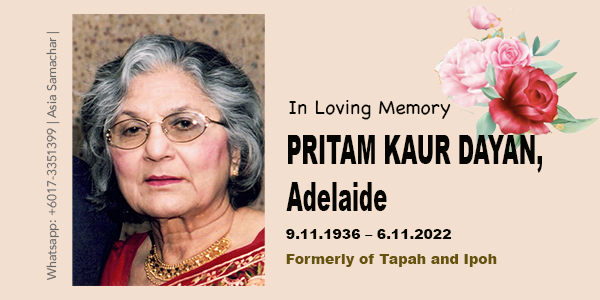
w/o late Mr. Teja Singh ‘Teddy’ Dayan (Adelaide, Australia), d/o late Sardar Harbak Singh, A.M.N. (Telecoms, KL) and late Sardani Sarjit Kaur.
Born in Taiping, Malaysia in 1936, Mummy passed away peacefully in Melbourne, Victoria. She was blessed with loving Parents and Siblings, was much loved ‘Mummyji’, doting Naniji and Dadiji, adored Sister-in-law, Auntyji, Cousin and Friend.
She will be greatly missed and always remembered by family and loved ones as a strong optimistic woman with a friendly, kind and generous disposition.
Rest in peace Mummyji,
Children and In-Laws: Iqbal (Dolly) and David Tivey, Jaspal (Mangoo) and Sunita Dayan, Kirpal (Ranee) and Ravinder Kumar, Rajpal (Renju) and Daryl Talbot, Sukhpal (Honey) and Sukhvinder Singh
Grandchildren: Aanchal, Ashvin, Zara Peet and Jai Karan
Siblings and In-Laws: Savinder Kaur (dec) and Kernail Singh (dec) (Singapore) Sarwan Singh and Kiranjit Kaur (Subang Jaya) Kalwant Kaur (dec) and Harcharan Singh Tara (PJ) Jagdev Singh (dec) and Manjit Kaur (Shah Alam) Sukhdev Singh (dec) and Harvinder Kaur (TTDI) Bhagvinder Singh and Surinder Kaur Sohanpal (PJ)
In-Laws and Family: Jaswant Kaur (dec) and Teja Singh Bamotra (dec) (Ipoh, US) Harbans Kaur and Jaswant Singh Bamotra (Ipoh) Lakhbir Bamotra and family (LA, USA)
Cousin, Aunt, Grand-aunt and Friend to many who will miss her……
The final rites, ceremonies and Saskaar will be held at Centennial Park Cemetery, South Australia on Monday, 14th November 2022 at 9.30am.
Thereafter, Path Da Bhog and Antim Ardaas will be at Gurdwara Sahib Glen Osmond, Adelaide, followed by guru ka langgar at the same venue.
Messages of condolence and remembrance may be shared with the family via sukhpal.dayan@hotmail.com.
“A mother is with us always, first in her lifetime, then forever in our memory.”
| Entry: 9 Nov 2022 | Source: Family
ASIA SAMACHAR is an online newspaper for Sikhs / Punjabis in Southeast Asia and beyond. When you leave a comment at the bottom of this article, it takes time to appear as it is moderated by human being. Unless it is offensive or libelous, it should appear. You can also comment at Facebook, Twitter, and Instagram. You can reach us via WhatsApp +6017-335-1399 or email: asia.samachar@gmail.com. Forobituary announcements, click here.
Retired civil servant Dr Amerjit Singh was bestowed the Public Relations Fellowship Award in recognition of his outstanding and distinguished service to the PR profession in Malaysia.
The award was given under the authority of the Council of the Institute of Public Relations Malaysia – a national professional body overseeing PR practitioners in Malaysia.
He had served in various ministries over the years, with his last posting as the Director of Media and Corporate Communications at the Department of Information, Putrajaya, till his retirement in June 2022.
Amerjit’s passion and commitment to the profession is also evidenced by his teaching of the PR subject at several government and private universities and his presentation of papers in seminars and events hosted by various government departments. In addition, he has delivered numerous talks and conducted training related to the field of communications and PR.
He was also the recipient of the Bronze Medal Winner for Malaysia for Best PR Practitioner Award in conjunction with The 3rd ASEAN Public Relations Excellence Awards 2021 presented by the Institute of Public Relations Malaysia (IPRM) and the Asia PR Academy in November 2021.
ASIA SAMACHAR is an online newspaper for Sikhs / Punjabis in Southeast Asia and beyond. When you leave a comment at the bottom of this article, it takes time to appear as it is moderated by human being. Unless it is offensive or libelous, it should appear. You can also comment at Facebook, Twitter, and Instagram. You can reach us via WhatsApp +6017-335-1399 or email: asia.samachar@gmail.com. For obituary announcements, click here.