The Punjab government is ramping up efforts to claw back land illegally occupied by influential people including politicians, bureaucrats and police officials.
In the latest update, the state government on Friday (July 29) announced taking possession of 2,828 acres of encroached land, estimated to be worth Rs 350 crore, in Majri, Mohali.
And some big wigs were allegedly implicated, including Sangrur MP Simranjit Singh Mann’s son, his son-in-law, daughter and former minister Gurpreet Singh Kangar’s son.
Punjab Chief Minister Bhagwant Singh Mann was reported to have led the drive.
Rural Development Minister Kuldeep Singh Dhaliwal shared details of the seizure at a press conference.
“The illegal occupants included Imaanjit Singh Mann, son of Simranjit Singh Mann, who had allegedly encroached upon 125 acres, and former minister Gurpreet Singh Kangar’s son Harmandeep Singh Dhaliwal, who had allegedly encroached upon 5 acres. The daughter and son-in-law of the Sangrur MP had also occupied 28 acres of prime land illegally,” he said, according to TNS.
Since May 1, the government had so far taken possession of 9,053 acres, the CM said.
Earlier media reports said that rural development and panchayat department data suggests around 18,000 acres of public land, also known as panchayat land, have been illegally occupied. The minister had earlier said after the land was freed from illegal occupation, priority was being given to immediate occupiers while leasing it out for agricultural purposes.
An earlier report by former Supreme Court judge Justice Kuldip Singh had named politicians, cops and bureaucrats in connection with land-grabbing.
ASIA SAMACHAR is an online newspaper for Sikhs / Punjabis in Southeast Asia and beyond.Facebook | WhatsApp +6017-335-1399 | Email: asia.samachar@gmail.com | Twitter | Instagram | Obituary announcements, click here
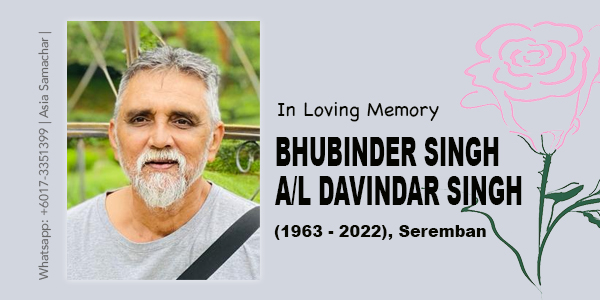
Saskaar / Cremation: 2pm, 31 July 2022 (Sunday) at Hindu Crematorium, Jalan Templer, Seremban
Cortège leaves from residence No 1915, Jalan Nusari Bayu 7/3A, Nusari Bayu 3, Seremban 71950, Negeri Sembilan at 1.15pm, 31 July 2022 (Sunday)
Path da Bhog: 7 August 2022 (Sunday) at Gurdwara Sahib Seremban (time to be decided)
He has been a supporting and loving husband throughout his life. A very good and responsible father and grandfather.
Contact:
Pradeep Singh – 0122925488
Ravinder jit Singh – 011-10358035
Brianjit Singh – 012-5015971
| Entry: 31 July 2022 | Source: Family
ASIA SAMACHAR is an online newspaper for Sikhs / Punjabis in Southeast Asia and beyond.Facebook | WhatsApp +6017-335-1399 | Email: asia.samachar@gmail.com | Twfffitter | Instagram | Obituary announcements, click here
MAAJI NANI KAUR (NANTI) W/O LATE SARDAR KEHAR SINGH
19.07.1922 – 25.07.2022
The Loss is Immeasurable but so is the Love Left Behind….
Deeply missed, forever cherished and fondly remembered by:
Children – Spouses:
Harbhajan Singh – Late Awtar Kaur
Late Sher Kaur – Late Bachan Singh
Late Joginder Singh – Dial Kaur
Late Gurbachan Singh – Late Manjit Kaur
Late Savinder Kaur – Late Dalip Singh
Late Minder Singh – Ranjit Kaur
Grandchildren, Great-Grandchildren, Great-Great-Grandchildren, and Nephews, Nieces and host of relatives.
Path Da Bhog: 6 August 2022 (Saturday), from 10am to 12noon, at Wadda Gurdwara Sahib Ipoh
Contact:
Harbhajan – 019 313 3644
Sarjit – 017 594 2558
Talvin – 019 515 3798
| Entry: 31 July 2022 | Source: Family
ASIA SAMACHAR is an online newspaper for Sikhs / Punjabis in Southeast Asia and beyond.Facebook | WhatsApp +6017-335-1399 | Email: asia.samachar@gmail.com | Twfffitter | Instagram | Obituary announcements, click here
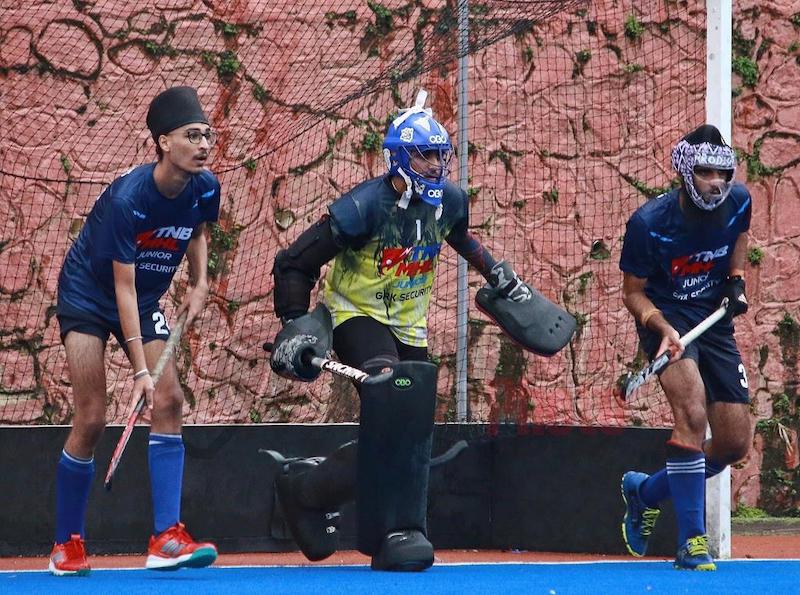
IN ACTION: KLSSRC goalkeeper and defenders all eyes in the game against DBKL – Photo: Naveen Singh
ByJagdesh Singh | Opinion |
This only happens in one generation during our lifetimes. And it would be a sin to not soak it up, and bathe in the joy it brings. Ever since the news went viral a couple of weeks back, I can’t help but smile being reminded about it, my heart swelling with pride just knowing.
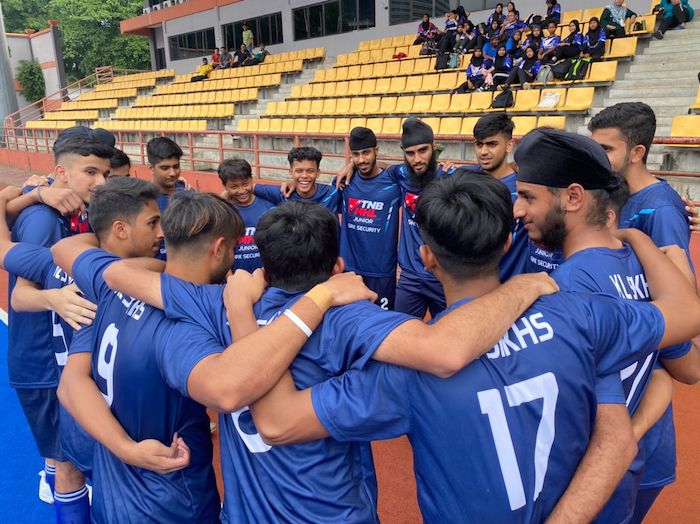
The KL Sikh Sports Recreational Club (KLSSRC) team has been raising many an eyebrow playing in the Malaysian Junior Hockey League. A team of Punjabi Sikh boys, born and bred as Malaysians, as a minority of the minorities, almost forcing any sports enthusiasts in our local community to take notice.
Their brand of hockey is a mixture of 3-3-4 and 3-3-3-1, with some really attractive playmaking from a few outstanding players. This has gotten them some really decent results, bagging 2 impressive wins right at the start of their campaign. But this makes it so easy to forget that this team is as new as it gets. The boys had less than a handful of training sessions prior to the tournament, while the rest of the teams have been built with strong foundations, structured training for months prior. The fact that they’ve gelled so well, fitting into their roles so easily to resemble a somewhat well oiled machine, is a whole conversation on its own. There’s always room for improvement but they’ve got a great springboard-ed start.
UPDATE: KLSSRC today (July 30) defeated Franciscan Hockey Club 2-0 in Malacca. They are now third in their group league, with one game in hand. More photos at Asia Samachar Facebook and Insta
MORE UPDATE: The club received donations from Gurdwara Sahib Seremban, Negeri Sembilan Sikh Union and Gurdwara Sahib Malacca
ALL SET: KLSSRC players before a game – Photo: Naveen Singh
Of course, it has taken many committed individuals to put together the building blocks for this great start. As they say, it takes a village to raise a child. These young lions come from families passionate about sports and particularly hockey. Their parents, uncles and aunties, siblings have inculcated the fundamentals required. I personally know of a couple of ex-national and ex-state players who are fathers to some of the key players in the team.
Then there are the coaches, Baljit Singh Charun and Inspector Kevinder Singh, both are of elite hockey pedigree. Their tactics, their coaching and their passion have been seamlessly and organically transferred into the young lions.
But what’s recognizable to us all, is that never say die attitude ingrained in each of them individually and collectively as a team. As Sikhs, that character of ours is relatable no matter the sport or endeavour. Our DNA. To see it collectively in a team or group of young ones, makes our hair stand – as we like to say in Punjabi.
And then, as vitally important, is the support they’ve been receiving from the community in the form of sponsorships and moral support. Gurudwaras in Seremban and Melaka have taken it upon themselves to drum support from their Sanggat, sending out personal WhatsApp messages asking every family to get down to the stadiums and go cheer for the young lions. Special food from the Langgar like ‘Singapore’ fried Bee Hoon and vegetarian chicken curry with potato have been prepared to be served for families at the stadium. Lastly, it’s no proper support without our loud dholl players adding our own flavor into the game day atmosphere, and the atmosphere has been brilliant.
The sense of togetherness at the games so far is palpable, not just within the team but from the families supporting. This is something we don’t experience as often as we should.
There’s togetherness in celebrating the youth from our very small community. Togetherness in celebrating our heritage of great lion-hearted sportsmen now evident with these youngsters. Togetherness in enjoying our community being represented not just by a token player but by a strong team of players competing with the best.
I must say, that ‘village’ raising this team is pretty impressive. As impressive as the young lions making us proud. Come, let’s get down to the stadium, and cheer them on as hard as we can.
Results: KLSSRC 4-1 KLSS-CS KLSSRC 4-0 D’Touch KLSSRC 2-1 PHNS Seniors KLSSRC 1-2 DBKL HT KLSSRC 2-0 Franciscan Hockey Club
KLSSRC fixtures: SSN Seri Kota Predator (Aug 3, 3pm, at Bukit Seridit 3, Malacca), PPHT Thunderbots (Aug 6, 3pm, at Pantai Stadium), TBSS / PHNS (Aug 10, 3pm, at Seremban 2) and Malacca High School (Aug 13, 4pm, at Pantai Stadium).
Jagdesh Singh, a Kuala Lumpur-based executive with a US multinational company, is a father of three girls who are as opinionated as their mother
* This is the opinion of the writer, organisation or publication and does not necessarily represent the views of Asia Samachar.
ASIA SAMACHAR is an online newspaper for Sikhs / Punjabis in Southeast Asia and beyond.Facebook | WhatsApp +6017-335-1399 | Email: editor@asiasamachar.com | Twitter | Instagram | Obituary announcements, click here |
IN STYLE: Myanmar Sikhs gathered in style for the 550th birth anniversary of Guru Nanak in Mandalay in 2019
By Manjit Kaur (UK) | OPINION |
Today we live in the age of Instagram and the selfie. Whereas in the past perhaps the only time somebody might see their image would be in front of a mirror or a photo, today, because of smartphones, we are almost constantly looking at ourselves and others. Unless we completely go off-grid, we cannot avoid participating in a culture where we are being bombarded with all kinds of images, sending out all kinds of messages about appearance and dress. Dressing and appearance has all kinds of practical and social meanings. I would like to explore some of these issues.
Think of a Sikh and the immediate image that comes to mind is a turban and beard, or in the case of women, a turban/keski, chunni and salwar kameez. And increasingly, for a whole complex set of reasons, we also regularly see Sikhs, especially the youth, both men and women, dressed in traditional Sikhi bana, specifically, kurta pyjama, cholla and dummala. And this is especially the case during particular occasions when we attend the Gurdwara, festivals, gurmat smagams, nagar kirtans and Sikhi camps.
Even though we have seen a renewed interest in reclaiming Sikh culture, history, tradition, heritage and bana or dress amongst Sikh youth, both in India and amongst the global diaspora, it is still the case that most Sikhs, men and women, most of the time, will wear what might be termed modern western attire, such as Jackets, jeans, trainers, t-shirts, sweatshirts, dresses, hoodies, shorts etc. And as for the headdress, whilst the turban is still prominent, even Keshadhari Sikh youth tends to wear bandanas, whilst the rest will not cover their heads at all.
These differing practices can be a source of conflict and confusion amongst Sikhs in terms of deciding what is and what is not acceptable dress for a Sikh. And to answer this question we need to look both at the fundamental question that, unlike all other animals, why do we human beings dress up? And secondly, what does Sikhi say about an appropriate dress? Asking the question of why we dress, seems obvious, but when you look into it, it is quite complex. For sure, there is a practical dimension to dressing, footwear and head covering, but equally, if not more significantly, there is the cultural aspect of dress, which we can’t ignore.
I think we can all agree that one of the reasons we dress up is to maintain our privacy and modesty. In most, if not all, countries of the world, walking down the street fully exposing your body would not be tolerated and could lead to prosecution or worse. Yes, the laws and restrictions vary from country to country, but the general principle does apply, that choosing what to wear in public is not a completely free choice; you must have some regard for others and the wider cultural norms of the society you live in.
Whilst some people may think imposing certain dress restrictions denies them freedom of choice, others will argue that covering our body, especially parts associated with ones sexuality, is about self-respect and dignity. In a culture where women are still very much seen as sexual objects, one way to challenge this is to allow women to be valued for their intelligence, creativity, and ability, rather than just their bodies. You could apply the same argument to men and boys as there is plenty of evidence suggesting that pressure to have and display perfect bodies is causing considerable mental health problems for them as well, though the pressure on women and girls is much greater.
WHO DECIDES
So, while we can agree that we should always think about modesty, the question remains, who decides what is the appropriate dress? I feel that women who show their private parts are just as degrading as women who are covered up from head to toe. For me, these extremes represent a view that what women wear should be decided by men and their fears and desires, rather than women exercising their right to chose.
No doubt making your own choice to dress how you want can boost your self-confidence. It’s like feeling in control and not being pressured by what others might think. But, in a culture where we are bombarded with images of ‘perfect’ models selling clothing, brands and styles, there is a thin line between choosing for yourself and being influenced by media and advertising. Ultimately, I think you should be happy within yourself rather than following trends when choosing what to wear. If we are driven by trends, rather than feeling happy, ultimately, we will become trapped in the constant desire to look good and chase the fantasy of perfection.
However, as social animals we like to fit in and sometimes to stand out; we do have one eye on the how others will respond to how we dress. That’s ok, but not be led by the images of models in the ads who seemingly have ‘perfect’ bodies. Why? because they are simply fake and have been photoshopped, and the models as far from being healthy, but can suffer from all kinds of eating disorders. Beauty is not to be found on the surface but is something that one can only realise within. As Bhagat Kabeer Ji says, “Do not be so proud of your body, after all, it is just a bundle of bones wrapped up in skin”. (SGGS, 1366). Further, surface beauty is a very temporary thing, whereas inner beauty can serve you for a lifetime. And true beauty, according to Gurbani, is released in your state of mind and is linked to anand (bliss), gian (wisdom), love (piar) and critical thinking (bibek).
So, when we accept that beauty is about how we feel within ourselves, then we become liberated to make our judgement about what to wear rather than simply follow the norms of society. So, for me when I think about the appropriate dress for Sikhs I turn to a shabad by Guru Nanak in Siree Raag, (SGGS, 16) in which he discusses all kinds of daily routines, including what one should eat. And the message is very simple: wear those clothes that do not cause suffering to your body or corrupt the mind. Note here that Guru Ji does not provide a detailed list of items but, by establishing a general principle, allows you according to the society you live in to make sensible choices.
For example, if you live in a very cold country, it makes sense to wear warm clothes, and if you live in a very hot country or if the season is hot, then one should wear loose light-coloured clothes. So, when we think about comfort, all kinds of considerations need to be made, such as what fabrics suit your skin. I am allergic to polyester. So, I always try to buy cotton or linen. As for colour, there is a lot of theory that links certain colours to moods and our state of mind. So, we know that pastoral colours can make you feel calmer and relaxed, brighter colours with stripes and or flowery patterns create energy and can be up-lifting.
What we wear also sends out powerful messages. So, for example, dark formal clothes send the message that you are serious and mysterious. In some professional workplaces, such as the police, you may be required to wear a uniform and there is also the phenomenon of ‘power dressing’. This idea emerged in the 70s when women were starting to find jobs in the corporate sector, which was historically dominated by men. Though they were now in powerful roles, they were still treated by men as lacking authority and as a result they were not getting the respect that men were getting; the reason given was that they need to project their power and the solution came from power dressing. Though things have changed, then it was mostly about adapting typically male clothing and styles and colours.
So, when I decide what to wear, I follow the guidance given by Guru Nanak and I think first and foremost about my own comfort. As noted earlier, our choice of dress is in part determined by external factors like weather, occasion and place. I would not go on a mountain walk wearing a dress and shoes with big heels. Likewise, I would not go to a wedding dressed in combats and boots. It’s all to do with the weather, place and occasion.
Because of all kinds of social pressures, I was brought up to believe that the appropriate dress for a ‘good’ Sikh woman is salwar kameeze and chunni/dupatta. I was made to feel that ‘western’ clothes, such as jeans and t-shirts, were immoral and that ‘doing fashion’ was wrong because it was about drawing attention to yourself! The irony is that if you go to any Gurdwara programme, especially a wedding, you will see many of the women dressed in all kinds of traditional Punjabi clothing which appear to be uncomfortably tight and very revealing.
But times are changing, and the hypocrisy and double standards of Punjabi/Indian culture are now fully exposed. Today, young women are much more assertive about their right to choose what they dress. But I do feel that because of the massive external pressures, not all, but many young girls and boys will break both the two principles set out by Guru Nanak, of comfort and morality. Freedom to choose what to wear is not an absolute right and there are many other considerations one must make. But that does not mean telling somebody what to wear. I feel I have managed to reach the right balance, between exercising my freedom, comfort, and personal morality.
Manjit Kaur, a UK-based therapist and counsellor, is a presenter of the 1 Show on Akaal Channel. She can be contacted via email at manjitkaur1show@gmail.com
ASIA SAMACHAR is an online newspaper for Sikhs / Punjabis in Southeast Asia and beyond.Facebook | WhatsApp +6017-335-1399 | Email: editor@asiasamachar.com | Twitter | Instagram | Obituary announcements, click here |
The Singh Thattha technique – Photo: RMH / Journal of Hospital Infection
By Asia Samachar | Australia |
The beard has been coming in the way, or so it is claimed, in the medical profession. This has affected Sikhs who maintain their beard as part of the tenets of their faith, as well as a host of other people who maintain the beard for religious, cultural or medical reasons.
With the issue in mind, an Aussie hospital has embarked on an investigation to solve the problem. A tecnique developed by some Sikh medical practitioners may be the answer they are looking for.
Researchers at the Royal Melbourne Hospital (RMH) are conducting a 12 month clinical trial to see whether a new mask fit technique is suitable for healthcare workers and students who cannot shave their beards for religious, cultural or medical reasons.
The reasoning behind the study is due to the increasing number of clinical staff required to wear an N95 mask, according to an entry at the RMH website.
Charles Bodas, an occupational hygienist in the RMH Respiratory Protection Program, is exploring a new technique after seeing a number of staff with beards failing their mask fit test.
“An under-mask elastic band beard cover, also known as the Singh Thattha technique, has been identified as a potential option that would enable the use of tight-fitting respirators for those unable to shave,” said Charles.
“We need all hands on deck as healthcare workers at the moment, and we had to come up with a practical solution that did not require a lot of training,” he was quoted in the news update.
The RMH respiratory protection program has been working closely with the Australian Sikh Doctors Association and other religious groups and healthcare organisations to help promote the study to any relevant groups, it added.
The Victorian Department of Health is also supporting the study by encouraging referrals to the RMH and through ongoing collaborations with Worksafe, Safer Care Victoria, health services, universities and state-based infection prevention bodies.
MEDICAL STUDENT IMPACTED
The problem is real and it is already impacting individuals.
A bearded medical student who requested to be known only as Mr Singh is facing a dilemma that threatens his very identity. Like many other Sikh health professionals and nursing students from across Australia, he was told to get “clean-shaven” to meet mask fit requirements, reportsSBS Punjabi.
“I have unfortunately been barred from continuing my studies and there is currently no guarantee that there will be any changes next year or any time in the future,” he tells SBS Punjabi.
Singh said he submitted a complaint to the Ombudsman only to receive a reply that the issue lies with his institution, not the Department of Health. “Under the current system, Sikh healthcare workers like myself will not be able to work in a hospital setting if fit testing remains long-term without any accommodations made,” he was quoted in the report.
New South Wales (NSW), Western Australia (WA) and South Australia (SA) have all given the green light to the new Singh Thattha technique, which involves using an under-mask elastic band beard cover for donning respirator masks. However, this technique is not currently endorsed by WorkSafe Victoria for use in passing fit-test protocols, the report added.
PROVEN EFFICACY
A quantitative fit testing has returned promising results, reported the Journal of Hospital Infection.
“The under-mask beard cover technique may be used to achieve a satisfactory seal with tight-fitting P2/N95 respirators in health workers with facial hair that cannot shave,” concluded a report published in May. See here.
Tight-fitting respirators are a critical component of respiratory protection against airborne diseases for health workers. However, they are not recommended for health workers with facial hair. Some health workers are unable to shave for religious or medical reasons. Under-mask beard covers have been proposed as a solution to allow health workers with facial hair to wear tight-fitting respirators. However, studies to date have been limited by their predominant reliance on qualitative rather than quantitative fit testing techniques, the study noted.
Thirty subjects were assessed in the testing. No subject had an adverse reaction to the under-mask beard cover, according to the report.
The Clinical Excellence Commission’s (CEC) Infection Prevention and Control said its team played a key role in research and guidance development to improve the safe use of P2/N95 respirators among health workers in the Sikh community. It noted that the research was of value for health workers with facial hair which cannot be shaved due to cultural, religious or medical reasons.
In an update at its website, CEC Principal Advisor Dr Susan Jain said the pandemic had heightened the entire health system’s awareness of infection prevention and control procedures while also being mindful of cultural diversities.
“At all times we want staff to stop the spread of airborne disease and for staff to be using personal protective equipment which is safe and effective,” Dr Jain said.
“Developing and assessing the effectiveness of procedures like the beard wrapping in this research means a broader cohort of health workers can safely care for patients in challenging circumstances like a pandemic.
“Typically, beards are not allowed for health workers using a respirator because without a ‘seal’ between the skin and respirator there can be a risk of exposure for the workers.
“The research shows beard wrapping may be another effective option for some of these health workers and this has excellent benefits not just for the individual health workers but for the entire system because we have found another way to keep valuable staff working safely in the system.”
ASIA SAMACHAR is an online newspaper for Sikhs / Punjabis in Southeast Asia and beyond.Facebook | WhatsApp +6017-335-1399 | Email: asia.samachar@gmail.com | Twitter | Instagram | Obituary announcements, click here
15th Anniversary. Passed away peacefully on 30th July 2007.
Wife of Late Lawyer Markhan Singh
Deeply missed, forever cherished and fondly remembered by children and grandchildren, in-laws and nephews.
Mummy you have never gone away, u walk beside me everyday, unseen, unheard but always near, still so much loved and missed – Dharamjit
| Entry: 30 July 2022 | Source: Family
ASIA SAMACHAR is an online newspaper for Sikhs / Punjabis in Southeast Asia and beyond.Facebook | WhatsApp +6017-335-1399 | Email: asia.samachar@gmail.com | Twfffitter | Instagram | Obituary announcements, click here
from 5th – 7th August 2022 at Gurdwara Sahib Petaling Jaya.
Programme Details:
Sri Akhand Path Sahib commences at 8.00am on Friday, 5th August 2022. Guru ka Langgar (Vegetarian Meal) will be served throughout the Sri Akhand Path Sahib.
Path da Bhog at 8.00am on Sunday, 7th August 2022.
Diwan and Kirtan Programme commences at 10:00am, followed by Ardaas and Guru ka Langgar.
The live telecast of the Programme on Sunday, 7th August 2022 will be available via https://youtu.be/UXNPR_WsVhc or click here
ASIA SAMACHAR is an online newspaper for Sikhs / Punjabis in Southeast Asia and beyond.Facebook | WhatsApp +6017-335-1399 | Email: asia.samachar@gmail.com | Twfffitter | Instagram | Obituary announcements, click here
Serving hot food in Poland to Russia-Ukraine war refugees – Photo: ST
By Asia Samachar | Singapore |
Two Singaporeans who were moved to help the refugees fleeing from the Russian invasion of Ukraine are the first picks for an award run by a local newspaper.
Priveen Suraj Santakumar and Charanjit Singh Walia are first off the block the Singaporean of the Year 2022, an annual award now in its ninth year run by The Straits Times.
Priveen, 34, was moved by the plight of those displaced by the Russia-Ukraine war that he flew to Poland to do something. There, he met Charanjit Singh Walia, who has been based in Poland for the past 25 years, and was helping to provide food to Ukrainian refugees at the Polish border.
A former nurse, Priveen now owns a cleaning business. An avid cook in his spare time, he stirred up potfuls of Singapore-style fried rice, and helped to feed thousands of refugees. He would start his day at 8am and end past midnight, partly due to a lack of volunteers, according to a ST report.
Charanjit, who is divorced, said he was at home in Warsaw in February when his Ukrainian neighbour came running to his door with news of the war.
On his first day at the border with Ukraine, he distributed more than 350 meals. His latest distribution session on July 21 saw around 700 people get fed. “I think that everyone deserves a hot meal. That’s what my religion taught me,” he told the newspaper.
ASIA SAMACHAR is an online newspaper for Sikhs / Punjabis in Southeast Asia and beyond.Facebook | WhatsApp +6017-335-1399 | Email: asia.samachar@gmail.com | Twitter | Instagram | Obituary announcements, click here
SKA tops the SHF National Division League Two 2022 league – Photo: Supplied
By Asia Samachar | Singapore |
With one game in hand, Singapore Khalsa Association (SKA) team has already clinched the SHF National Division League Two 2022 title. Finishing top of the men’s league was no mean feat for a team that started with little to show.
Two solid performances and six points over the weekend turbo charged the team to the top.
“It is a historic occasion for the club as this is the first time we have achieved this accolade,” the club celebrated in an entry at its social media platform.
A crucial 2-1 win over Singapore Cricket Club on 23 July boosted the confidence of the committed and disciplined players and they delivered another outstanding performance on the following day by beating Tannibellies Hockey Club 5-1, thereby sealing the title, it added.
On Aug 14 (6pm), they will face Hockey Innovative at Sengkang stadium.
“The league is won, but the work is far from complete as we set our sights on the greater and more challenging things to come in the future,” one of the team officials told Asia Samachar.
ASIA SAMACHAR is an online newspaper for Sikhs / Punjabis in Southeast Asia and beyond.Facebook | WhatsApp +6017-335-1399 | Email: asia.samachar@gmail.com | Twitter | Instagram | Obituary announcements, click here