| Entry: 18 May 2022; Updated: 22 May 2022 | Source: Family
ASIA SAMACHAR is an online newspaper for Sikhs / Punjabis in Southeast Asia and beyond.Facebook | WhatsApp +6017-335-1399 | Email: asia.samachar@gmail.com | Twfffitter | Instagram | Obituary announcements, click here
Jehya Chiri Likheya, Teyha Hukam Kamahey As His Decree is Issued, So Is His Command Obeyed Ghaley Aavey Nanka, Sadhey Utthi Jahey Those Who Are Sent, Come O’ Nanak; When They Are Called Back, They Depart and Go
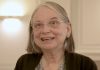
MATA SURJIT KAUR D/O LATE SARBAN SINGH W/O LATE GAJAN SINGH (GAJAN SINGH TRANSPORT NILAI)
20.06.1934 – 18.05.2022
Pind: Pabiah
We are saddened to announce the departing of Mata Surjit Kaur on 18th May, 2022, a strong, hardworking matriarch of the family, who will be deeply missed by family, grandchildren, great grandchildren, relatives and friends.
Husband: Late Gajan Singh Gill
Pind: Heran
Path Da Bhog: 5 June 2022 (Sunday) at Gurdwara Sahib Mantin, Negeri Sembilan
Programme:
9.30am-12noon: Path Da Bhog, Kirtan, Antim Ardas and Guru Ka Langgar.
The family express sincere appreciation and heartfelt thanks to relatives and friends for their condolences, prayers and throughout support directly and indirectly.
Contacts:
Jagjit Singh 012 972 8659
Kelvinder 016 – 277 8545
| Entry: 18 May 2022; Updated: 30 May 2022 | Source: Family
ASIA SAMACHAR is an online newspaper for Sikhs / Punjabis in Southeast Asia and beyond.Facebook | WhatsApp +6017-335-1399 | Email: asia.samachar@gmail.com | Twfffitter | Instagram | Obituary announcements, click here
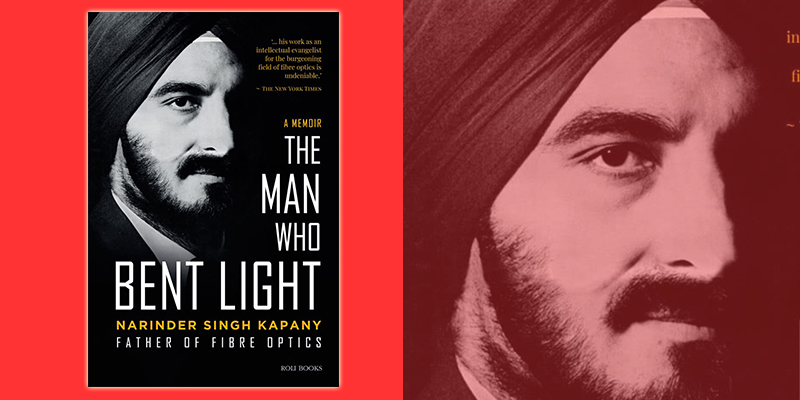
Book: The Man Who Bent Light: Father of Fibre Optics Author: Narinder Singh Kapany Roli Books, 2021 | ISBN: 978-81-952566-0-0 | 290 pages
Review by Bhupinder ‘Bo’ Singh | Book Review|
We can all remember being taught in schools that the light travels in a straight line, accepted it as the universal truth, and it is firmly ingrained in our minds. But there was someone who was not willing to accept this axiom, and his dogged determination to prove it otherwise, unleashed a new field of study called ‘Fiber Optics’ and he became known as its father. He was not just a scientific trailblazer, but also had a rare privilege of writing his own autobiography. So, such a unique combination makes this book ‘The Man Who Bent Light: Father of Fibre Optics‘ by Dr. Narinder Singh Kapany an interesting read on a fascinating life. Dr. Kapany was born on October 31, 1927.
There are 12 parts in the book. The entire book covers all the phases of Dr. Kapany’s life starting from Boyhood and ending in Family Matters. The author claims that he captured “memorable moments and scenes” from his life at the behest of his son and daughter. It is amazing that even in his nineties he could recall in detail the scenes from his early childhood, when he was three. In the first chapter titled Property, he describes in detail the young Narinder overhearing his Grandmother Manji discussing their ancestral property with Aunt Nuntal. The sight of the vast land mass made him wonder: “How can one family possess so much?” The next chapter Sodhi-wala describes the journey on a wagon drawn by two white bullocks when one-wheel careens off making him and his older brother fall to the wagon floor and both of them fall into half-sleep. In the next chapter, Ring, the author shares a fascinating story of a ‘lucky ring’ which his father got from a Russian woman for helping her to safety during World War 1. His mother gave this ring to him as a good luck charm, when his name was not on the newspaper list of people who had successfully passed the college degree. The ring’s charm surely seems to have worked as next day the newspaper carried an apology along with an amended list for the omissions from the list released in the day earlier. Sure enough, his name was on the top of this revised list.
The chapter ‘Here Bino, take my hand’ describes how he, as a kid of 6 or 7, was awestruck by the sheer size and the magnificence of Darbar Sahib (also known as Harmandar Sahib or Golden Temple). There, her mother urged him to ‘Go with your father’ into the holy water sarovar for a dip. The chapter ‘Stolen Fruit’ is not just a tale of a childhood prank, but that enkindled a pride of being a Sikh in him. The Chapter ‘Almost True Stories’ details how two volumes of Janam Sakhis of Guru Nanak’s inheritance of the family nurtured the taste of exquisite art which germinated the idea of becoming a collector and giving it a lasting home in the form of San Francisco’s Asian Art Museum.
The chapter ‘Chain Reaction’ beautifully captures the faith of the teacher Mr. Zacharich in his pupil Narinder, despite his naughty pranks in the school in Dehradun. The chapter ‘Deadheading’ captures the faith of the father in his blossoming son when he says that “I’m certain you’ll discover something valuable.” Narinder’s insight that “we weren’t carrying a load home” helped his father double the income.
The chapter ‘Partition’ besides sharing some details of the carnage that took place also shares a vital insight. “So powerful and effective was Ranjit’s Singh rule that the British knew they could do nothing to change it;” which lay crumbled after his death.
The chapter ‘Obsessed’ shares how the professor’s statement in the classroom that “Light can travel in a straight line” not just woke up Narinder from his nap but seared him to the core and set him for life’s work and on a mission to prove otherwise. After graduating from the college, he joined the ordnance factory where he expressed to his boss his desire; “I want to learn everything I can about light. About optical instruments.” That same impulse took to him in 1952 to Imperial College in London where he met Professor Harold Hopkins, his mentor. Narinder and his professor were both obsessed by the idea “that light and images could be transmitted through flexible axes.” There he met Satinder whom he eventually married in 1954 at Shepherd’s Bush Gurudwara, London, in a Sikh wedding ceremony. He took a position of a Researcher with Bart & Stroud, Glasgow for few rainy months. But the lure of furthering his research and a PhD with full scholarship, including a stipend for personal expenses, from Dr. Hopkins brought him back to Imperial College. Here he was re-obsessed setting up a laboratory to conduct experiments at age 25. As a part of his research, he had black mask with cut-out the word ‘Fibre’ taped to the lens and switched the light source. There it was on the screen in a single line of the letters Fibre – Bingo a successful experiment – the light has been bent. This test was featured as Rope ‘Scope in the September 1955 issue of the Popular Mechanics – a scientific journal.
He completed his course in PhD with 3 years of basic research and 6 months to author his thesis and prepare for the orals.
The chapter ’80-Pound Car’ details his sojourn to an international optics conference in Florence, Italy; with his wife and two friends in a car from London. His pioneering research had already garnered a great deal of interest in fiber optics field. The organizers had allotted a 15-minute time slot for his presentation, but with the heightened interest from the attendees he was given 40 minutes to fill, which he did. Here, Dr. Robert Hopkins from University of Rochester, NY asked them out for lunch. He first asked Narinder what his future plans were, before offering him to come to the USA and further his research. He came to New York on a ship and his period there was a “Very Good Year” for his research as well as an opportunity to collaborate with doctors of John Hopkins University. His team’s pioneering work presented at the meeting of Optical Society of America in 1956 at Lake Placid, New York. It was there Dr. Leonard Reiffel, managing director of the Physics Department at Illinois Institute of Technology, Chicago; offered him to come and work for him. In the summer of 1959, about 3 years into what was an initially agreed to a two-year stay, Narinder with his family embarked on an extended vacation. He says that period in Chicago was the most productive period of his career.
Dr. Kapany with members of the Palo Alto Chamber of Commerce at the opening of his company, Optics Technology, in 1960. – Photo: Kapany family
The phone call from Maharaja Yadavindra Singh of Patiala, asked him to come to NY for an urgent meeting. There he met India’s Defense Minister Krishna Menon; who offered him to become his scientific advisor. After few months interval he went back to India on a vacation. There he had an hour’s meeting with the Prime Minister Nehru, which in his own words was most refreshing and personally rewarding hour. This offer for the position of scientific advisor was approved by Nehru, but the official appointment papers arrived after a year. India’s loss turned out to be America’s gain, as Narinder decided to set up his own venture Optics Technology in Palo Alto, near San Francisco. Here, they developed endoscopes to look at the insides of everything. This was followed by the development of laser eye surgery and card readers using fiber optics. Interestingly these initiatives were underwritten by NIH to the tune of US$250,000 a year for the first time. The trail blazing additions were Retinal Coagulation, Cardiac Oximeter, and HeNe (Helium-Neon) laser. As a side note, I would like to add here that during Covid-19 pandemic, Oximeter was widely used to detect Oxygen levels.
In 1970, while he was looking for something new to excite him, on a tour of his own facility he uncovered a piece of discarded cluster of fiber optics cables in a trash can. He picked it up excitedly and took it home, transforming it into a sculpture and named it “The Caged Serpent.” Now a new initiative was blossoming and soon he had made some more sculptures. Somehow the word got out to Frank Oppenheimer from S F. Exploratorium who called him and envisaged an interest in looking at the creations. Impressed after the tour of exhibits at Narinder’s house he proposed that they hold an exhibition of his creations. The fun thing done by Narinder as a hobby had garnered a new name called “Dynoptic” from Oppenheimer. His sculptures were first displayed in a one-man show at the Exploratorium of the Palace of Fine Arts in San Francisco in 1972. In 1973 he sold his share of the company to his colleagues at the Young Presidents Organization (YPO). Looking for new gigs, an opportunity for posting as the second-in-command to the incoming US ambassador to India, Danial Moynihan, opened up, but it failed to materialize.
In late 1973 he found himself in a situation where he had leisure to explore the world for other provocative opportunities. The backseat of a taxicab in Paris proved to be the place of birth of a new company which was called Kaptron with a major French telecommunication firm. That venture soon blossomed into a thriving telecommunications device designer and a manufacturer. He sold Kaptron in 1975 second time to AMP Inc. In 1975 he was invited to spend 6 months at the University of California, Santa Cruz (UCSC) as Regents Professor. This tenure is offered to those who bridge the academic and non-academic worlds. With his turban, long beard, and deep voice; his was not a low-profile appointment. As the Regent he gave public lectures on innovation, productization of ideas, creativity, productivity, and entrepreneurship. At the end of 6 months when Narinder went to visit university’s chancellor Robert Sinsheimer to say goodbye, but he was not ready bid him goodbye. Narinder asked for months’ time and came back to him with a proposal for Center of Innovation and Entrepreneurial Development (CIED), pronounced ‘seed.’ He stayed as the Director of the center for 7 years which were some of the most gratifying times of his professional life.
The Part VI titled ‘Farming’ appears like a regression from innovative technology of Fiber Optics. But soon he discovers; “that science was a lot less complex than human relationships.” However, the notion technical regression is soon put to rest as he says that; “Again not to work the soil, but to be part of the growing process.” From a young boy pilfering oranges from the Maharaja Bhupinder Singh’s orchard in Patiala, to owning farms growing fruits in California valley reflects the passion of the person obsessed with a notion of bending the light. The chapter ‘Wine and Oil’ makes an interesting read on his purchase of three thousand acres of an old vineyard in the central valley near Fresco, CA. How luck favored this man of science can be gauged from the fact that not only did he and his partners got the mineral rights for this parcel of land, but also mineral rights on an additional seven thousand acres. To me this is like Midas touch, where all investments turned into gold. Within 2 years the investment was earned back, thanks to the oil well’s royalty.
Narinder Singh Kapany (1926-2020): Father of Fiber Optics
The Part VII titled ‘Being Sikh’ enshrines his unique contribution in setting up Chair on Sikh Studies-Department of Religion at University of California Santa Barbara (UCSB); Chair on Optoelectronics-UCSC, Santa Cruz; Chair on Entrepreneurship- UCSC, Santa Cruz. He also became an avid art collector of ‘Sikh Art’, the term he coined to describe unique Sikh art. The collection found a permanent house at the Asian Art Museum called Satinder Kaur Kapany Gallery in honor of his wife. All these efforts gave birth to a book called Sikh Art from Kapany Collection. The Sikh Foundation that he was instrumental in setting up back in 1967, celebrated its 50th anniversary with a special program from 5th to 7th May in 2017.
In Part IX and X of the book, he describes his yearning for a home in London and being selected as a Fellow of Royal Academy of Engineering – quite an honor. Besides the above mentioned Fellowship, he was associated with Young President’s Organization (YPO), Cosmos Club, and National Invention Council (NIC).
The Part XI titled ‘Massacre’ makes a very tragic reading on how the Indian Government attacked the Darbar Sahib (Golden Temple) complex and other Sikh gurdwaras on June 3rd, 1984. By the end of the 1984, about 6,000 Sikhs had succumbed to the violence and prejudice in India. Unfortunately, his mother passed away in India and his visa application was refused and he could not attend her funeral. The last Chapter, titled ‘Family Matters’, shares some details of family vacations and the passing of his wife Satinder from Parkinson on June 25th, 2016. He completed the writing of this autobiographical account in March 2020.
This is the story of a larger-than-life man, who lived life passionately. He predominantly wore blue and black turbans, but the colors of life’s turban (pardon for using the term instead of the commonly used term hat) were – scientist, innovator, entrepreneur, manufacturer, sculpture artist, farmer, philanthropist, and avid Sikh Art collector. His life’s story is a true inspiration worthy of emulation.
ASIA SAMACHAR is an online newspaper for Sikhs / Punjabis in Southeast Asia and beyond.Facebook | WhatsApp +6017-335-1399 | Email: asia.samachar@gmail.com | Twitter | Instagram | Obituary announcements, click here
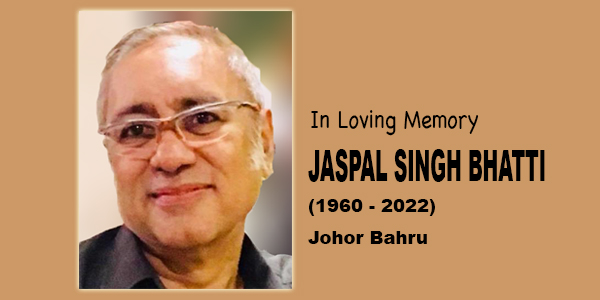
Sukhmani Sahib prayers will commence at 1 PM on Thursday, 19th of May 2022 at the residence No. 7, Jalan Kuel, Johor Bahru. Cortege leaves residence to the Hindu Crematorium Johor Bahru at 3 PM for Saskar/Cremation at 4 PM.
Akhand Paath will be held at Gurdwara Sahib Johor Bahru from 1 PM on Friday, 20th of May 2022 followed by Path da Bhog at 12 PM on Sunday, 22nd of May 2022.
ASIA SAMACHAR is an online newspaper for Sikhs / Punjabis in Southeast Asia and beyond.Facebook | WhatsApp +6017-335-1399 | Email: asia.samachar@gmail.com | Twfffitter | Instagram | Obituary announcements, click here
Deputy Sheriff Shagundeep Singh Virk – Photo: Niagara County Sheriff
By Asia Samachar | United States|
Shagundeep Singh Virk is the newest deputy sheriff at the Niagara County Sheriff.
He is an experienced member of the Army Reserve, and holds a variety of specialised certifications. He will begin his training at the Niagara County Law Enforcement Academy in the near future, according to an entry at a Niagara County Sheriff social media platform.
Niagara County is one of the 62 counties that comprise the State of New York. The county is known for its agriculture and tourism industries as well as its long manufacturing history. Given its proximity to Canada, Niagara County is important to international trade and commerce.
ASIA SAMACHAR is an online newspaper for Sikhs / Punjabis in Southeast Asia and beyond.Facebook | WhatsApp +6017-335-1399 | Email: asia.samachar@gmail.com | Twitter | Instagram | Obituary announcements, click here
Savinder Kaur wins bronze for 800m at SEA Games 2022 in Hanoi on 16 May. Right: The final moments with Vietnam’s Anh Khuat Phuong leading the pack
By Aftar Singh | Malaysia |
It was a dream come true for Malaysian national middle distance runner Savinder Kaur, who won her first ever medal in the SEA Games after her third attempt.
The Selangor athlete clocked a personal best time of 2:10.24 to bag bronze in the women’s 800m at the My Dinh National Stadium in Hanoi on Monday (May 16). Her previous best time was 2:10.45 she did in the Philippines SEA Games in 2019.
Anh Khuat Phuong of Vietnam hit the tape first in 2:08.74 to clinch the gold while Agustina Mardika of Indonesia clocked 2:09.90 to settle for silver.
Savinder, who will turn 25 on June 19, was delighted with her efforts.
“It feels really nice to win my first medal in the Games. Winning the medal was a big relief for me after failing to be on the podium in the last two SEA Games in Kuala Lumpur (2017) and in the Philippines (2019),” Savinder, who hails from Selayang, tells Asia Samachar.
“I am also thrilled to clock a personal best and must thank coach Dwayne Miller (of the United States), who played a big part in helping me improve my time. I have made steady progress under the guidance of coach Miller since training with him last year January.
“I will continue to train under coach Miller for next year’s SEA Games in Cambodia (2023) and my target next year is to go one better in the Games with another personal best time.
“The medal was an early birthday present for me and it has motivated me to compete at least another three more SEA Games (Cambodia in 2023, Bangkok in 2025 and KL in 2027),” said Savinder, who wants young Punjabi girls to focus on athletics.
“There are hardly any upcoming Punjabi girls focusing on sports. I hope my medal will inspire them,” said Savinder, who is the youngest from five siblings.
Savinder featured in the 800m and 1500m in the last two SEA Games but in Hanoi she will not compete in the 1500m.
“I will focus on the 800m as it is my pet event andI believe that I can deliver a gold in the two laps event next year,” said Savinder.
ASIA SAMACHAR is an online newspaper for Sikhs / Punjabis in Southeast Asia and beyond.Facebook | WhatsApp +6017-335-1399 | Email: asia.samachar@gmail.com | Twitter | Instagram | Obituary announcements, click here
Sharanjeet Kaur is the new executive director at the medical school of Toronto Metropolitan University (formerly Ryerson University).
“Now I look forward to working together with government, hospital, and community partners to build a new kind of Medical School in Brampton – grounded in equity, community health, and innovation!” she said in an entry at her LinkedIn page.
Prior to this, she was the director of executive projects and operations director at William Osler Health System, an acute care hospital system serving Brampton and North Etobicoke.
Among her previous stints were as strategic integrated planning director at Sheridan College and public health manager for the Region of Peel.
Sharanjeet has a Master of Public Administration (MPA) from Queen’s University – School of Policy Studies and a Bachelor of Science (Honours) in Applied Health Studies from University of Waterloo.
ASIA SAMACHAR is an online newspaper for Sikhs / Punjabis in Southeast Asia and beyond.Facebook | WhatsApp +6017-335-1399 | Email: asia.samachar@gmail.com | Twitter | Instagram | Obituary announcements, click here
A warm welcome sign for students at entrance of Punjabi Education Centre Subang, located on one of the floors of Gurdwara Sahib Subang – Photo: Asia Samachar
By Santokh Singh Randhawa | Malaysia| Letters |
I refer to the article “School blasted for not allowing students to take Tamil subjects” (The Star, May 12).
That students face difficulty in taking Tamil, one of the vernacular languages listed in the national curriculum, is concerning as minority languages which are not on the list face way too many obstacles.
Khalsa Diwan Malaysia (KDM), one of the oldest Indian NGOs in the country, was entrusted by other Sikh NGOs and the Sikh community to promote and develop the use of the Punjabi language in Malaysia. Beginning in 2000, KDM embarked on a long-term and ongoing programme to achieve this goal.
It now operates almost 50 centres nationwide that provides Punjabi language education from pre-primary to Form Five levels to more than 2,500 students with the assistance of almost 250 teachers. Besides inculcating noble values to make them useful citizens of the country, the centres also prepare the students to sit for the Punjabi paper in the Form Three Assessment (PT3) and SPM examinations.
When we first started, we had no curriculum, no textbooks, no trained teachers, no classrooms, and, above all, no money. But we persevered thanks largely to dedicated and committed people, donations from well-wishers, and in recent years, grants from state and federal governments. Today, we have a fine mechanism in place to provide Punjabi education. We have a centralised body which coordinates the teaching of the Punjabi language nationwide. We have a detailed curriculum and syllabus, we have written our own textbooks, we provide teacher development courses, we have centralised exams, we have motivational seminars for students, and we have an Inspectorate Board to ensure all centres comply with core directives. In short, we have an amazing unit that is on the right track to develop and promote the use of the Punjabi language.
The Punjabi paper has been offered in public examinations since pre-independence days in Malaya. Although it is not on the list of vernacular languages in the national curriculum, it is sill offered in the PT3 and SPM examinations.
However, year in, year out, certain school administrators choose to not allow their students to sit for the paper. The usual reasons . given for doing so are that the subject is not being taught in schools, it does not fit in the school-based assessment, and clashes in the timetable. KDM has met several units under the Education Ministry, including the Exam Syndicate, to resolve this issues. For the record, the Education Ministry has no objection to students sitting for the paper regardless of whether the subject is taught in schools or not.
Why then are students disallowed from taking the Punjabi paper? We believe it has something to do with a school’s overall performance index. Many administrators fee] that students who sits for papers not taught in their schools will fare badly in the exam, which in turn will affect their schools’ performance index. This fear, however, should not apply to the Punjabi paper. Our students have an almost 100% passing rate yearly, with more than 60% passing with distinction.
KDM has worked very hard to teach Punjabi through the collective effort of the Punjabi community. Our students go through 11 years of regular weekly classes at the pre-primary. primary and secondary levels. Imagine the frustration of students, their teachers and parents, KDM and the Punjabi community when a student who is well-prepared is not allowed by school administrators to sit for the Punjabi paper!
We strongly urge the Education Ministry to look into this matter with great urgency, and deal with school administrators who continue to deprive students of their basic rights, which are clearly enshrined in the National Philosophy of Education and in the Federal Constitution.
Santokh Singh Randhawa President, Khalsa Diwan Malaysia (KDM)
(The letter was published at The Star, a Malaysian newspaper, on 14 May 2022, under the title ‘Plight of minority languages’)
ASIA SAMACHAR is an online newspaper for Sikhs / Punjabis in Southeast Asia and beyond.Facebook | WhatsApp +6017-335-1399 | Email: asia.samachar@gmail.com | Twitter | Instagram | Obituary announcements, click here
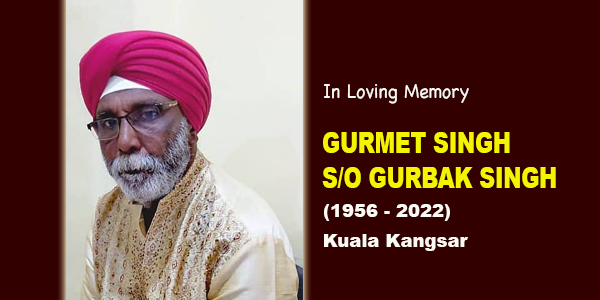
Son of LATE GURBAK SINGH S/O LATE JERTA SINGH (KOT SIVIYAN, TARN TARN) & LATE PAR KAUR D/O LATE JUWAN SINGH (ACHINT KOT, AMRITSAR II)
11.1.1956 – 9.5.2022
Will be missed dearly by children, siblings, daughter-in-laws, nieces, nephews, relatives and friends
Path da Bhog: 22 May 2022 (Sunday), from 9.30am to 12pm, at Gurdwara Sahib Kuala Kangsar, Perak
Contact:
ISVENDER SINGH – 0165977825
SAALVENDERR SINGH – 0165012855
Death leaves a heartache no one can heal, love leaves a memory no one can steal. We will miss you dearly beloved Papa Ji.
| Entry: 16 May 2022 | Source: Family
ASIA SAMACHAR is an online newspaper for Sikhs / Punjabis in Southeast Asia and beyond.Facebook | WhatsApp +6017-335-1399 | Email: asia.samachar@gmail.com | Twfffitter | Instagram | Obituary announcements, click here
The need to believe seems to me to be a universal phenomena. Indeed, the absence of belief or faith can be associated with an existential crisis leading to serious mental health problems and worse. It is commonly asserted that those who do not believe are lost souls living pointless lives. To live is to hope and one cannot hope if one doesn’t have some belief!
What somebody believes in can, of course, vary considerably. For some, the focus may be on faith, religion and God; for others their belief/s may be secular in nature. For them, the object may be famous people, heroes, performers, sports clubs, nationalism, science fiction, etc. And yet, for others, beliefs may be both religious and secular.
So it is reasonable to suggest that it is healthy and normal to believe, and in this regard we are all believers, or we should be! However, the problem with faith arrises when we become too rigid or certain in our beliefs. A prime example is religious fundamentalists who have a tendency to reduce the complex and arguably limitless aspects of the divine to a set of rigid actions, rules and rituals. For them, anybody who does not follow their reductive interpretation of the faith is a non-believer and/or sinner!
Of course the same can apply when it comes to secular beliefs. For example, we see nationalists or racists often reducing human diversity to a set of simple stereotypes, racist tropes and binary opposites. Religious fanatics do not have a monopoly on oversimplification. One only needs to see the terrible suffering that secular nationalism and communism has cased to realise that blaming God for the sins of humanity is a little unfair.
Ultimately, belief is about our identity. And just like healthy indentity development requires one to expand and develop one’s sense of self, similarly, we need to do the same when it comes to our beliefs. One of the unique features of the human mind is that we are able to develop a self-concept, an identity and a sense of time and space. This is what makes us quite different from all living beings. Our beliefs are ultimately psychological constructs that enable us to develop a sense of belonging and navigate the social world.
And in this regard, it’s worth thinking about our beliefs as being determined and not determined. That is as relatively fixed in the sense that we may be able to identify with a belief, such as believing in a scripture, prophet or holy person, but also fluid in that we are constantly discovering deeper insights into those beliefs and our existence.
A crisis of belief does not occur when one is developing or expanding one’s understanding of self, but when one becomes convinced one has the answer and therefore is a ‘true’ believer. Life is about ‘being’, which requires a limited degree of certainty, but also ‘becoming ‘, which requires a willingness to engage with the world, learn and expand one’s horizons.
Unsurprisingly, one of the central features of Sikh teaching is to engage in lifelong learning, after all the word Sikh roughly translates as a ‘learner’ or ‘student’. More precisely, it refers to somebody who learns from the Guru, which in this case would be Guru Granth Sahib and Gurbani. And when one does engage in such learning one quickly realises, because it is a living thing, there are no simple understandings of Gurbani. For sure the words are the same, but overtime, because nothing stands still, the meanings and insights can change.
Certainty about belief may provide comfort in the short term, but in the long term it is a road to nowhere! Though this seems counter intuitive, as we question, discover and learn, our beliefs and faith get stronger. Our appreciation of what we believe and the value those beliefs have for our lives becomes richer.
How do I know this to be true? Because I have experienced it in my life. Though I am much less certain what it means to be a Sikh nowadays, this was not the case when I adopted Sikhi over 40 years ago. Then, practicing Sikhi was a kind of self inflicted suffering designed to secure a place in heaven and also to experience some magical spiritual revelation.
Today, though I am much less certain about what meeting God might be, what God is, and whether or not there is an after life, I feel much stronger in my beliefs. The more I question, the stronger my love for Gurbani becomes. I am sure my 20-year-old self would have condemned me as a weak Sikh or worse. Yes, we can lead by example, but we cannot tell another how to live their life. We all have to travel our own journey and find our own meaning of life. I am still searching and I am enjoying every minute in my quest.
Gurnam Singh is an academic activist dedicated to human rights, liberty, equality, social and environmental justice. He is an Associate Professor of Sociology at University of Warwick, UK. He can be contacted at Gurnam.singh.1@warwick.ac.uk
* This is the opinion of the writer and does not necessarily represent the views of Asia Samachar.
ASIA SAMACHAR is an online newspaper for Sikhs / Punjabis in Southeast Asia and beyond.Facebook | WhatsApp +6017-335-1399 | Email: editor@asiasamachar.com | Twitter | Instagram | Obituary announcements, click here |