

















UA-56202873-1
Page 354

Sikh mayor charms Hoboken, elected unopposed

Ravinder Singh Bhalla swears on a Sikh prayer book for second term mayor of Hoboken – Photo: Personal Facebook

By Asia Samachar Team | United States |

Ravinder Singh Bhalla made history again when he was reelected as the Hoboken mayor, unopposed this time around.

When he first ran for the post in 2017, his campaign encountered racial undertones, including doctored campaign fliers attacking him with the message “Don’t let TERRORISM take over our town!”

That seems to have fizzled far away. Four years later, the fourth densest city in the country elected him unopposed for a new four-year term. The 47-year-old lawyer was sworn in yesterday (2 Jan 2022).

“It is the honor of a lifetime to be sworn in for a second term as Hoboken Mayor. I’m looking forward to the next four years as we continue to make Hoboken an even better place to live. Thank you to my family and all of the supporters who have been a part of this journey. I know that for Hoboken, the best is yet to come.

“I was sworn in today with my hand on the Gutka, a book of Sikh scriptures and spiritual hymns, as I was four years ago, with my wife, kids and extended family by my side,” he said in a social media entry.

When first elected in 2017, he became the United States’ only directly elected turbaned Sikh mayor.

His younger brother, Amardeep Singh, a vice president at Proteus Fund, was elated to see how in four years, his ‘calm, hard-working, different looking introvert’ brother went from ‘Mr. Unelectable’ to ‘Mr. Unopposed.’

“Who would have thought that a self-described introvert, who likes to listen more than talk, who absorbed a racist whisper campaign about being “unelectable” because of his turban, and whose parents began their journey in this country in a trailer park, would not only win re-election but be the first Mayor in 64 years to run unopposed in Hoboken,” he said in a separate social media entry.

Ravi, as he’s known amongst his friends, was born and raised in New Jersey. He lived in a two-bedroom apartment with his parents and older brother in West Paterson, about 45 minutes outside of New York City. He played tennis growing up and was an all-state doubles player his senior year in high school. He was also president of his local Junior State of America chapter – a youth organization that focuses on public issues. See Born to Run.

He then went to University of California, Berkeley. After Berkeley, Bhalla earned his masters at the London School of Economics, before returning to the U.S. for law school at Tulane University in New Orleans.

One for the album: Ravinder Singh Bhalla and family after swearing in as Hoboken mayor – Photo: Personal Facebook

Cutting the ribbon with Mayor Bhalla and former Mayor Dawn Zimmer at the grand opening of the 7th and Jackson Resiliency Park in 2019 – Photo: RavinderBhalla.com

RELATED STORY:

Ravi Bhalla becomes N.J.’s first Sikh mayor (Asia Samachar, 8 Nov 2017)

ASIA SAMACHAR is an online newspaper for Sikhs / Punjabis in Southeast Asia and beyond.Facebook | WhatsApp +6017-335-1399 | Email: editor@asiasamachar.com | Twitter | Instagram | Obituary announcements, click here 

Richmond Sikhs help hospitals in India, Canada flood victims

By Kirsten Clarke | Richmond News | Canada |

Gurdwara Nanak Niwas in Richmond has helped victims of B.C.’s floods as well as purchased needed equipment for hospitals in India’s Punjab state. Submitted photo

Members of Richmond’s Sikh community have been working to help B.C. flood victims and to purchase much-needed equipment for hospitals in India’s Punjab state.

India Cultural Centre of Canada Gurdwara Nanak Niwas, on Richmond’s Highway to Heaven, has raised $100,000 to help purchase and install eight kidney dialysis machines in Punjab.

Three machines are being installed at Guru Nanak Mission Hospital in Jalandhar, and five machines are being installed at the Raja Sahib Majara/Rehpa hospitals, said Balwant Sanghera, general secretary of the India Cultural Centre.

He said the funds were raised by Gurdwara Nanak Niwas’ congregation as well as generous donors.

The fundraiser was initially launched after learning about the need for oxygen machines in hospitals in the Punjab last year, due to COVID-19, said Sanghera. However, by the time the $100,000 had been raised, Gurdwara Nanak Niwas learned there was enough oxygen equipment in the Punjab and that kidney dialysis machines were in greater demand in certain hospitals.

The dialysis machines were purchased through the Nargis Dutt Cancer Foundation.

Gurdwara Nanak Niwas also worked with the Sarbat Da Bhala Trust, a charitable organization, to launch the fundraising campaign and with the Raja Sahib organization in Canada and India to install machines a the Raja Sahib Majara/Rehpa hospitals.

“Every dollar raised by us has been used to pay for these machines. There was no middleman or commission paid to anyone,” said Sanghera.

Read full story, ‘Kudos: Richmond Sikh community helps hospitals in India, B.C. flood victims’ (Richmond News, 2 Jan 2021), here.

RELATED STORY:

The day after flooding, Shah Alam gurdwara gets cracking, cooking 5,000 hot meals a day (Asia Samachar, 21 Dec 2021)

ASIA SAMACHAR is an online newspaper for Sikhs / Punjabis in Southeast Asia and beyond.Facebook | WhatsApp +6017-335-1399 | Email: editor@asiasamachar.com | Twitter | Instagram | Obituary announcements, click here 
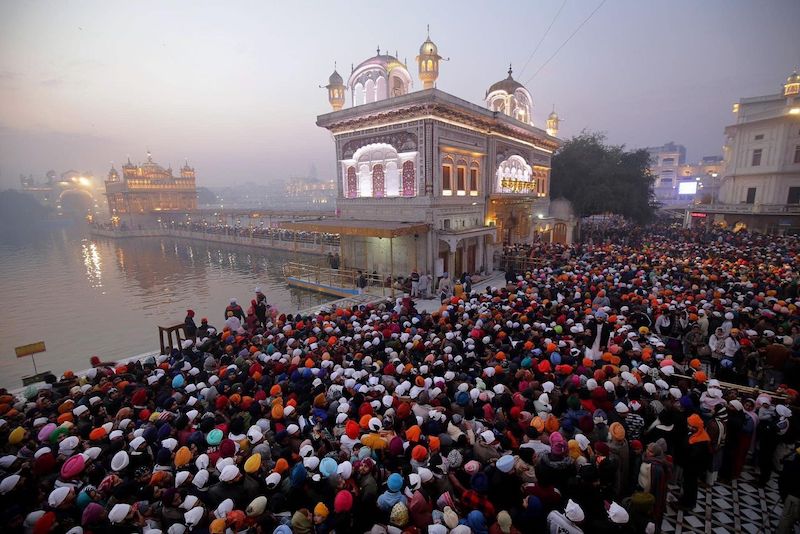
Sikhs throng Darbar Sahib on Jan 1

0

Huge crowd at Darbar Sahib, Amritsar, on 1 January 2022. Photo: Sikh Channel Facebook page

ASIA SAMACHAR is an online newspaper for Sikhs / Punjabis in Southeast Asia and beyond.Facebook | WhatsApp +6017-335-1399 | Email: editor@asiasamachar.com | Twitter | Instagram | Obituary announcements, click here 

Sikh artist works CGI magic for Nihang warrior

0

Nihang in CGI – Source: Chamandeep Singh Batra

By Asia Samachar | India |

A Sikh sketch artist and digital painter worked his magic to produce computer-generated imagery (CGI) model of a Nihang Sikh. And the result is pretty stunnng.

Chamandeep Singh Batra, a Delhi-based 3D artist at world’s largest commercial printer RR Donnelley, shared his work to celebrate the onset of 2022.

CGI is the application of computer graphics to create or contribute to images in art, printed media, video games, simulators, computer animation and VFX in films, television programs, shorts, commercials, and videos.

Nihangs or Nihang Singhs, originally known as Akalis or Akah Nihangs, are endearingly designated the Guru’s Knights or the Guru’s beloved, for the military ambience they still carry about them and the heroic style they continue to cultivate. They constitute a distinctive order among the Sikhs and are readily recognized by their dark blue loose apparel and their ample, peaked turbans festooned with quoits, insignia of the Khalsa and rosaries, all made of steel. They are always armed, and are usually seen mounted heavily laden with weapons such as swords, daggers, spears, rifles, shotguns and pistols, according to an entry at the Sikh Encyclopedia.

See more of Chamandeep’s work here.

RELATED STORY:

Sikh sisters powering Art and Kraft (Asia Samachar, 16 July 2021)

ASIA SAMACHAR is an online newspaper for Sikhs / Punjabis in Southeast Asia and beyond.Facebook | WhatsApp +6017-335-1399 | Email: editor@asiasamachar.com | Twitter | Instagram | Obituary announcements, click here 

Sikhs are different. Routinisation of ‘sewa’ primes them to help others. The pandemic demonstrated this

0

Reader’s Digest India in its June 2021 issue features an India-based Sikh group providing medical oxygen ‘langgar’ to Covid-19 patients when hospitals were overwhelmed

By Dipankar Gupta | The Times of India | Opinion |

Think of Sikhs and the mind conjures a barrel of laughs, a chest full of medals and a well-stocked bar. Or, to recall the old joke: Neil Armstrong lands on the moon expecting to be the first, only to find a Sikh taxi driver had beaten him to it.

That was then, but what about now? This pandemic has changed the popular image of Sikhs, not just in India, but the world over. People from distant Croatia and Syria acknowledged the help Sikhs gave them during their nightmare moments, and neither did US hesitate to rename New York’s 101 as Punjab Avenue to honour the contribution of Sikhs to the city.

Nearer home, in India, the impressive contribution of Sikh organisations in fighting the ongoing pandemic has been cited in the press and in the media in the most glowing terms. From providing oxygen, to ambulatory service, to feeding the poor, the Sikhs are nearly always the first to help. Even when relations quail to pick up a Covid corpse, Sikh volunteers willingly, and unhesitatingly, come forward.

There has to be a special reason for this. The answer lies in Sikh religion. Yes, of course, Sikhism, like every religion professes universal love, encourages altruism and promotes compassion. But it does something more which no other religious denomination does and that aspect is lodged in Sikhism’s main frame. It is in Sikhism alone that service to others is an important aspect of devotional practice for the laity, especially for the laity, within the temple premises.

True, other religions have saints, healers and preceptors too, yet in Sikhism alone it is the laity and not the virtuosos, it is the everyday worshipper and not the ordained priests, who are the heroes. It is they who uphold the fundaments of their religion, its absolutely essential core, by serving others and performing ‘sewa’.

It begins with the person who puts away your shoes at the temple gates, to the person who assiduously sweeps the temple floors, to those who stand over hot fires in the kitchen ‘langar’. It is the routinisation of these everyday acts of service that primes Sikhs to reach out to others even where there is no gurdwara in sight. They still call that ‘kar sewa’, or serving the house of God, because God is everywhere.

In Sikhism, it is not the great, the gifted, the sage who serves ordinary people but it is ordinary people who serve ordinary people. Nor is there a special premium reserved in Sikhism for serving the guru, the maulvi, the deacon, which is above serving everyday people including those who are non-Sikhs too.

If Sikh gurdwaras are spotlessly clean, langars bountiful, and there is shelter for all, then that is because devotees practise service as a routine religious act and not as a deliberated heroic act.

For such ‘sewa’ to be performed, Sikhs don’t need the ‘granthi’, the priest, or the ‘raagi’, nor sundry virtuosos to sign up. The communion, or the ‘sangat’, does not just pray together, but serves together as well. Nor does this service happen on special occasions determined by the movement of heavenly bodies. ‘Sewa’ is a routine daily activity without which everyday worship by everyday Sikhs is incomplete.

Charity is not a standalone attribute in Sikhism. When Sikhs step out to help others they do not do it as charity, but as service first. Charity is not uppermost in their minds as it may be in other religions. Service is more immediate and has to be done at close quarters. Charity and almsgiving are not quite the same for they can be performed at a distance. To perform service trumps plain charity, because when service begins at home, especially at the home of God, can charity be far behind?

It is this unique aspect of Sikhism that makes Sikhs stand out in times of trouble. It is not because Sikhs are brave, for some mysterious genetic reason, that they jump into the fray and face dangerous wars and viruses without a thought. There are brave people in all communities, the Marathas, the Gorkhas, the Rajputs, and the list goes on. Sikh bravery is not bravery first, but service first and that is where the difference lies. A Sikh may be a ‘Rambo’ outside, but bring one such person to a gurdwara and you will find a devotee at heart.

Even in the gurdwara, the donation that Sikhs make before the book is not marked by grandstanding of the kind that other charity events are. The money is slipped, unannounced and with no fanfare, into the collection box. Who has given how much is not known and no receipts are issued, no loudspeaker commends the generous giver and that is what makes this act a commendably egalitarian one. Rich and poor are all the same as they approach the Holy Book under the canopy.

It is this centralisation of service as ritual that marks Sikhism out from other religions and gives it its remarkable and unique feature. It is this that primarily explains why so many Sikhs, in temple organisations and outside, are willing to risk their lives to save distraught patients. When others have either turned their backs, or pleaded helplessness, trust a Sikh to fill in the breach. To modify a popular riff: ‘A Sikh who does sewa is worth sawa lakh’!

Dipankar Gupta taught for nearly three decades in the School of Social Sciences, Jawaharlal Nehru University. This opinion piece appeared in The Times of India on 11 June 2021.

RELATED STORY:

The day after flooding, Shah Alam gurdwara gets cracking, cooking 5,000 hot meals a day (Asia Samachar, 21 Dec 2021)

ASIA SAMACHAR is an online newspaper for Sikhs / Punjabis in Southeast Asia and beyond.Facebook | WhatsApp +6017-335-1399 | Email: editor@asiasamachar.com | Twitter | Instagram | Obituary announcements, click here 

Flood aid: Flurry of activities at Penang gurdwara; Pulapol and Kuala Pilah contribute

1

Kuala Pilah gurdwara team with aid for Jelebu flood victims – Photo: GSKP

By Asia Samachar | Malaysia |

A number of Malaysian gurdwaras have come forward to assist floods victims around the country, either by raising funds or collecting items required by the victims.

Gurdwara Sahib Pulapol (GSP) recently raised some RM4,100 from well wishers and handed them to the Shah Alam gurdwara team which has started work to assist flood victims at Taman Sri Muda, Shah Alam, and other areas in Klang Valley. Apart from cash, they also received dozens of essential items such as blankets, pillows, clothings, toiletries, pampers and dry rations and cooking oil to be distributed accordingly.

The efforts amplify the work already undertaken at Gurdwara Sahib Petaling Jaya and Gurdwara Sahib Guru Nanak Shah Alam.

Gurdwara Sahib Kuala Pilah (GSKP) had delivered groceries and food ration to flood victims in Kampung Chennah, in Jelebu, Negeri Sembilan. Also actively working to assist the flood victims are the volunteers from Gurdwara Sahib Seremban.

“We hope with this small effort, the flood victims burden will be reduced,” according to a social media update at the Facebook of GSKP which serves a small Sikh community in the town.

Flurry of activities at Wadda Gurdwara Sahib Penang

Wadda Gurdwara Sahib Penang (WGSP) is another centre of activity. It coordinated a 40-foot trailer carrying double mattress, pillows and blankets direct delivery from factory as well as dry food provisions, medicated soaps electrical items and kitchen stoves to Gurdwara Sahib Mentakab to assist flood victims in the state of Pahang. Another 21-foot contained carried more items. On Thursday (30 Dec), most of the goods distributed in the rural areas of Bukit Kapur.

The drop-off drive were held at WSGP and Gurdwara Sahib Butterworth.

WGSP collaborated with the Mahindarama Temple, Bhojana Kitchen and Mitta For Life in several Outreach Projects. They also worked with the Mahindarama temple, Pure Lotus Hospice, 32 Fresh Charity Mission, Amata, Himmat Support Group, Sungai Ara Community Ambulance and Dhamika Metta Group.

“It has been a fruitful and fulfilling experience working with other like-minded organisations,” WGSP said in a Facebook update.

As of Tuesday (Dec 28), the Malaysian Gurdwaras Council (MGC) has given cash handout totaling more than RM120,000 to families in Bentong and Taman Sri Muda, two of the places most badly affected by the recent spate of flooding around the nation. Each affected family received RM2,000. The process to identify other affected families continues.

“We started visiting the affected families on ground. The families who are not at home, we have created a list and invited them to gurdwara to collect the cash aid. This is the first time MGC went directly to families,” an MGC official told Asia Samachar.

Malaysia is battling some of its worst flash floods in years. The anger on the ground was exacerbated by the seeming lack of quick action by the authorities.

The tropical nation in south-east Asia often experiences stormy monsoon seasons towards the end of the year, with flooding regularly prompting mass evacuations.

GS Pulapol team handing over aid to the team at Shah Alam – Photo: Supplied

RELATED STORY:

Cash handouts from Malaysian Gurdwaras Council to flood victims. More than RM120,000 already given (Asia Samachar, 28 Dec 2021)

ASIA SAMACHAR is an online newspaper for Sikhs / Punjabis in Southeast Asia and beyond.Facebook | WhatsApp +6017-335-1399 | Email: editor@asiasamachar.com | Twitter | Instagram | Obituary announcements, click here 

Sacred space in a New Yorker Sikh’s home

Photo: James Estrin / NYT

By Asia Samachar | United States |

A Sikh in New York has a prayer room in the attic The New York Times has captured a slice of the space for its readers.

“I wish I could wake up in the mountains every morning but instead I live in Richmond Hill,” Nirmal, an engineer and writer who lives in Queens, tells the newspaper. “I designed this space upstairs where I pray, sing and study with my family and thank God for everything I have in my life.”

He was one of the persons featured in a report entitled ‘A Moment of Intimacy’: New Yorkers and the Sacred Spaces in Their Homes. See here.

The man behind the story and photos is James Estrin, a staff photographer who also writes frequently for NYT who captured the photos of the homes of varius faiths, was part of a Pulitzer Prize winning team in 2001 for “How Race Is Lived in America.”

They are among hundreds of thousands of New Yorkers from a myriad of faith traditions who set aside a part of their home as a sacred space to practice their religion, meditate or simply offer thanks for a new day, according to the article.

“New York most likely has more religions than any other city in the world,” said Tony Carnes, the founder of A Journey Through NYC Religions, a nonprofit that is mapping houses of worship and religious sites in the city. His organization has identified 39 different categories of religions in New York, but within those, there are at least 435 variations, many of which can be considered separate religions, he said.

Nirmal Singh designed his home in Queens with a space in the attic for his family to study, sing and pray – with the center of the room is the Adi Granth.

Every morning before dawn, Nirmal reads out loud and his wife, Rajinder Kaur Bhamra, and daughter, Taranjit, play musical instruments as they all sing prayers. Afterward his daughter walks to the public pre-K center in Ozone Park where she teaches.

“It becomes so embedded into your daily lifestyle you cannot live a day without doing it,” Taranjit is quoted in the report. “If I feel very anxious or I have an important task ahead, there’s a place I can go to feel one with God and to learn about some of the scriptures.”

ASIA SAMACHAR is an online newspaper for Sikhs / Punjabis in Southeast Asia and beyond.Facebook | WhatsApp +6017-335-1399 | Email: editor@asiasamachar.com | Twitter | Instagram | Obituary announcements, click here 

80 years on, first Remembrance Day for Battle of Kampar heroes – FMT

0

By Frankie D’Cruz | FMT | Malaysia |

IPOH: The Battle of Kampar, an epic World War II skirmish between Commonwealth troops and the Japanese army to protect British-ruled Malaya, will hold a Remembrance Day for the first time on its 80th anniversary today.

Previously, the anniversary of the historic four-day battle, which dealt the Japanese a severe blow, came and went with barely a murmur.

However, various quarters remain confused over the reluctance of the Malaysian government to observe a Remembrance Day for the 1,300 foreign defenders.

The fact is, since Malaya was not prepared to defend itself from the marauding southbound Japanese army, no Malayans were involved in the fierce combat.

For the first time, foreign dignitaries, Malaysian armed forces veterans, historians and representatives of various organisations will gather this morning at the site of the battlefield in Green Ridge, Kampar, to honour the foreign troops.

The push to gazette 6.5 hectares on Green Ridge as an historical site and to build a war memorial there will gain momentum with Indian High Commissioner to Malaysia, B N Reddy and the Malaysian Armed Forces Sikh Veterans’ Association taking a lead role.

With India in the forefront to establish a memorial, there still remains the question why a British memorial was not erected at the battlefield.

More than a moment of silence and wreaths, a war memorial will bring the forgotten heroism of the foreign soldiers back into the narrative of World War II and provide an understanding of a global history of terrible violence.

Has acknowledging such difficult parts of the past led to history becoming a political football in Malaysia?

The Battle of Kampar demands national recognition, said Malaysian Armed Forces Sikh Veterans’ Association president, Major (Rtd) Baldev Singh.

Allied troops prepared their defences in a week and fought furiously from Dec 30, 1941 to Jan 2, 1942 to shame a superior Japanese army division of 4,000 soldiers.

Around 500 soldiers from both sides were reportedly killed and it was the first serious defeat the Japanese experienced in their Malayan campaign.

The combined troops of the British Royal Leicestershire and East Surrey regiments, as well as the 11th Indian infantry division, comprised a force whose courage was as remarkable as its diversity.

The Indians, who included Sikhs from the Jat-Punjab Regiment, fought valiantly alongside the British even when the struggle for India’s freedom from British rule was at its most incendiary.

They were among the thousands of sepoys who travelled across the world to fight for king and country – a king who wasn’t from their land and a country which they’d probably never seen.

In the end, a tactical David denied a ruthless Goliath of the intention to capture Kampar as a new year’s gift to Emperor Hirohito and stalled their invasion of south Malaya and Singapore.

Why is it so powerful to tell the story of the Battle of Kampar?

Baldev imagines a war memorial with the graves of Christians, Muslims, Sikhs and Hindus side by side, “just as they had fought side by side”.

“Illustrating a shared history, one based on unity, freedom, sacrifices and comradeship shows that people of all faiths and backgrounds can unite in the name of freedom.

“More will know that soldiers of various ethnicities, races and faiths fought in the Battle of Kampar for the freedoms Malaysians enjoy today,” he said.

Read the full story, ’80 years on, first Remembrance Day for Battle of Kampar heroes’ (FMT, 30 Dec 2021), here.

RELATED STORY:

Battle of Kampar site reverberates with footsteps of university students (Asia Samachar, 31 March 2018)

ASIA SAMACHAR is an online newspaper for Sikhs / Punjabis in Southeast Asia and beyond.Facebook | WhatsApp +6017-335-1399 | Email: editor@asiasamachar.com | Twitter | Instagram | Obituary announcements, click here 

Sikh sues London chef when told to remove kara (bangle). There’s a Malaysian connection here.

0

By Asia Samachar | Britain |

A Michelin-starred chef is being sued for religious discrimination after an employee claimed he was told to take off his traditional Sikh bangle, called kara, in case it got stuck in a ladle.

Herbert Berger, who has won three Michelin stars, is being taken to court by Niranjit Moorah Singh who was allegedly told to remove the bangle from his wrist, reports MyLondon.

Singh was an assistant manager, earning £30,000 a year, at Berger’s catering establishment. He began causal work at Berger’s establishment at Innholders Hall in 2010, then worked his way up until his employment ended in September 2020.

In his employment tribunal testimony he claimed Berger asked him to take the bangle off because he was concerned it could get “stuck” in a “ladle whilst saucing the food”, according to the report.

“Every time Herbert sees me wearing my Sikh Bangle since April he asked me to remove it…He calls it a bracelet; he never [asks] me what is this in your hand that you [are] wearing….[In] my 20 years working and living in London no employer has asked me to remove my Sikh Bangle,” he was quoted in the report.

Singh said he has worn the bangle, which belonged to his grandad, for over three decades.

“[The] Bangle was given to me by my late grandfather who was still alive in Malaysia. I brought this with me in memory of him and I have used this Sikh Bangle in my hand for more than 35 years now,” he said.

Berger’s lawyers were successful in having Singh’s claims thrown out in July, however, Singh was unaware of the hearing and he will be given another opportunity to argue his claim this month. Singh said he couldn’t attend the initial hearing because he was at work and was unable to answer phone calls, the report added.

RELATED STORY:

Winners of Guru Nanak Social Mobility Bar Scholarship 2021 (Asia Samachar, 11 Dec 2021)

ASIA SAMACHAR is an online newspaper for Sikhs / Punjabis in Southeast Asia and beyond.Facebook | WhatsApp +6017-335-1399 | Email: editor@asiasamachar.com | Twitter | Instagram | Obituary announcements, click here 

Awang and the floods

0

Ever-willing Awang

By Jagdesh Singh | Opinion |

The rain has subsided. The roads are dry, caked with mud. And people are desperate to get back to their homes, to their lives. But the chaotic days leading to this point was far from settled as the flood dry mud and sludge.

He has a toothy smile, the gap from two missing front teeth on the bottom gums. Far from making him look menacing, he oozes out a comical look that anybody would warm to instantly.

“I couldn’t sleep all night. I won’t be able to rest until I’ve done something to help these friends of mine. Their lives have been devastated by the floods, Jag,” he tells me this in his native Malay, the day after the recent floods hit Selangor hard. It was the Sunday morning, and social media was going crazy with reports of the floods hitting areas literally next door to my home.

I’ve known him for 17 years now, ever since I moved to our current home. We both share the same passion, playing football. But Awang isn’t always about football. His outlook on life, the struggles and the joy of it all, resonates with me ever so deeply, inspiring me at times.

Thirteen months ago, Awang lost his 18 year old son to a motorcycle accident in an unexplainable tragic manner. His only son, whom he adored and treated as his best friend. His loss was unimaginable to me. But his acceptance of his fate, of his pain was herculean. “We can only but accept God’s will, Jag,” he would repeat to me while crying. Yet, if there’s anyone else who would be as strong as this, it would be Awang whom I’ve known for so many years.

On the second morning itself after the flood hit, Awang had organised a mobile generator set and a powerful jet spray. Did I mention that he was a really resourceful man? He was already ready to singlehandedly go on a mission to start cleaning the homes of those hit badly. I knew this because he was looking for sponsors to buy the equipment.

“When you go, take me along, Pak Wang!” I asked not fully knowing what that would entail. Suddenly at 5 pm the very same day, I find myself in a 4 wheel drive truck, with just slippers on. My wonderful wife decided to tag along, and we both got a first hand tour on an unrecognisable Bukit Lanchung, the neighboring village devastated by the floods. When we got out of the vehicle, the water level was knee high, completely black and smelled horrible. Awang had already begun his mission alone a few hours before.

The next day, I was more prepared, advised by Awang to get proper footwear (he called them Phua Chu Kang boots) and gloves. And we helped strangers clear the debris from their homes, and get back some semblance of what the homes looked like before.

I had observed volunteers coming in groups, from different backgrounds, coming to help. “God is one, and every religion teaches us to be kind and do good to others, no matter race and religion. It’s so good that these volunteers have come, Jag”. Another gem from Awang. His second nature was to take the good at face value every single time.

Today, he looks a bit more relieved. He wasn’t just being idle and helpless. He had done a lot, with the least of fanfare. I also quickly notice that the villagers welcomed Awang to help them, not as a stranger or a volunteer, but as one of them. His reputation of doing good was already well known, even before the tragic floods. But just as how he accepted the mission as the sole actor, he would ride the sunset alone as well. No fuss. Just relieved and sleeping better.

Jagdesh Singh, a Kuala Lumpur-based executive with a US multinational company, is a father of three girls who are as opinionated as their mother

* This is the opinion of the writer, organisation or publication and does not necessarily represent the views of Asia Samachar.

RELATED STORY:

Pakatan Harapan leader Anwar Ibrahim visits Petaling Jaya gurdwara (Asia Samachar, 26 Dec 2021)

ASIA SAMACHAR is an online newspaper for Sikhs / Punjabis in Southeast Asia and beyond.Facebook | WhatsApp +6017-335-1399 | Email: editor@asiasamachar.com | Twitter | Instagram | Obituary announcements, click here |