UA-56202873-1
Page 372

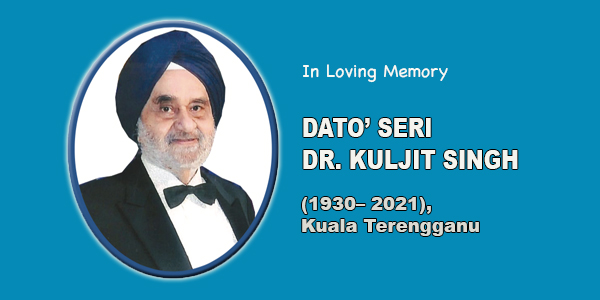
Dato’ Seri Dr. Kuljit Singh (1930– 2021), Kuala Terengganu

P A A T H D A B H O G

Dato’ Maha Jasa

DATO’ SERI DR. KULJIT SINGH

S.S.M.T., S.P.M.T., P.S.D., J.P.

MBBS, FAMM, FNHAM, FRCP, FCCP, FACA, FICA, DIP. CARDIOLOGY

husband of Late To’ Puan Seri Harjit Kaur

left for his heavenly abode on 4 September 2021.

Sahej Paath Da Bhog and Antim Ardaas will be held at Gurdwara Sahib Sentul Kuala Lumpur on 19 September 2021 from 10:00am to 12:15pm.

Due to the current MCO and prevailing SOPs, we have to comply with a restricted number of attendees.

We humbly request you to join us virtually via the link provided to pray for his departed soul.

Thank you for your kind understanding.

Link: https://youtu.be/NkV6TlxVPsE (or click here)

We are eternally grateful to our family and friends for sharing our grief. Thank you for the support and prayers.

In grief:

Son & Spouse: Dato’ Dr. Jagdeep Nanra & Datin Deirdre Nanra

Grandchildren: Dillon Nanra, Jordan Nanra, Lauryn Nanra

Leaving behind beloved siblings: Professor Ranjit Singh Nanra & Mdm Jagdish Kaur Matharu

All family and friends

A true gentleman, husband and a statesman

What a glorious journey! To quote your life’s tagline “Simple living high thinking”. You lived every moment of it. You led a principled, dedicated and exemplary life fulfilled with great experiences, accomplishments, charity and happiness. There are no words to fully describe the impact that you have made on the lives of your loved ones, the community and the medical profession, in which you were held in such high regard.

Your joy in music was evident in your love for your harmonica and piano. A passionate golfer, you have played the best golf courses. As an explorer, you have travelled the world with your beloved wife To’ Puan Seri Harjit Kaur.

The fond memories of being in your presence nestled with your wonderful sense of humour will remain etched in our hearts and minds forever.

You will be remembered as a loving husband, a nurturing father, a doting grandfather and a wonderful uncle and brother.  You were the anchor of our family and we take comfort in knowing that you have found your rightful place in heaven.

For enquiries, please contact:

Dato’ Dr. Jagdeep Nanra (012- 2071897) or Anita Nanra (012-2688008/016-2227808)

| Entry: 5 Sept 2021; Updated 15 Sept 2021 | Source: Family

ASIA SAMACHAR is an online newspaper for Sikhs / Punjabis in Southeast Asia and beyond.Facebook | WhatsApp +6017-335-1399 | Email: editor@asiasamachar.com | Twitter | Instagram | Obituary announcements, click here |

Singh: The compassionate brother who draws on suits, social media and spirituality

By Christopher Reynolds | The Canadian Press |

OTTAWA – Jagmeet Singh was barely out of his teens when he took his little brother in.

A biology student at the University of Western Ontario, Singh insisted on looking after Gurratan, then 15, following a nearly violent confrontation with their father that prompted a police call to their farmhouse in Windsor, Ont.

The change was a blessing for both, offering a stable environment for the younger sibling and a chance for the two to reconnect.

“I was getting a little bit frightened, quite frankly, and anxious being at home. And he kind of, at the perfect moment, took me off to London, Ont. I think he was very sensitive to the fact that he didn’t want me to feel those emotions again,” said Gurratan, now a lawmaker in the Ontario legislature.

The duo lived there for three years along with their German shepherd, Jugnu, with college friends popping in and out via the balcony across from a nearby mall to walk the dog unprompted while Singh worked three jobs, Gurratan said.

“He’s a really great cook now, but back then he wasn’t the best,“ his brother recalled. ”I remember one time I was really hungry … He passed me this plate of pasta, and it’s all these chopped-up veggie dogs. … “I was like, ‘What is this, man?’ But he was trying his best. He was trying to do what he’s always done: make the best out of a tough situation.”

The same might be said of the current election campaign.

Jagmeet Singh consistently enjoys the highest net favourability ratings of any federal leader and has a record to run on after nearly four years as leader of the federal NDP, but his prospects of returning New Democrats to the official Opposition status they achieved in 2011 — with most of that caucus based in Quebec — appear a long way off from the fourth-party spot they have now.

Having been reduced to 44 seats in the 2015 election that returned the Liberals to power under Justin Trudeau, the NDP managed to send just 24 MPs to the House of Commons under Singh’s first campaign at the helm in 2019.

That smaller caucus nonetheless wielded some influence in the minority Parliament, securing enhanced pandemic benefits and paid sick leave in exchange for supporting the throne speech. Days before Trudeau visited the Governor General, Singh wrote the prime minister a letter, which he published on social media, accusing him of breeding cynicism for telling Canadians that a minority government cannot work.

Nonetheless, he treads the campaign trail with a smile, inviting comparisons to the “happy warrior” persona of venerated former NDP leader Jack Layton. His gait is a confident stride, a slower version of the catwalk struts he’s trotted out at fashion shows and gala fundraisers in recent years.

At a coffee shop west of Ottawa’s downtown earlier this month, Singh, 42, displays the selective style for which he’s become known: a maroon polo made by British Columbia’s Reigning Champ, jeans from Montreal’s Naked and Famous Denim, and an artisanally crafted kirpan — a ceremonial Sikh dagger — cut from spalted maple by a knifemaker in Cobourg, Ont.

The GQ-esque esthetics — from the 2017 spread in said magazine to the Rolex watches and urban bicycles — might seem at odds with the working-class voters traditionally courted by the NDP. But he’s described his sharp fashion sense as a kind of armour against racial prejudice, a form of cladding that dates back to his time as a criminal defence lawyer in the mid-2000s when he was one of the few racialized, turbaned attorneys at the courthouse in Brampton, Ont.

Read the full story, ‘Singh: The compassionate brother who draws on suits, social media and spirituality (Toronto Star, 29 Aug 2021), here.

RELATED STORY:

Bardish Chagger has been up and running since 13 (Asia Samachar, 3 Sept 2021)

ASIA SAMACHAR is an online newspaper for Sikhs / Punjabis in Southeast Asia and beyond.Facebook | WhatsApp +6017-335-1399 | Email: editor@asiasamachar.com | Twitter | Instagram | Obituary announcements, click here |

Dr JS Sambhi: O&G veteran who went beyond call of duty

4

By Mohan Singh Rendhawa | Tribute | Malaysia |

A Tribute to Datuk J. S. Sambhi Patron of Gurdwara Sahib Ampang Ulu Kelang

Datuk Dr. Jagjit Singh Sambhi, Patron of Gurdwara Sahib Ampang located Jalan Ulu Kelang suddenly departed from this world on 18th August 2021. Dr Sambhi and his family right from the time of his late father Gurbakhsh Singh have been very strong supporters of this Gurdwara . The new langgar hall was built with a generous donation of RM250,000 from the Sambhi family and later another RM 30,000 was donated to add 6 air-conditioning units in the langgar hall to convert it into a multipurpose hall. It was officially opened by Dr Sambhi in the presence of his whole family on 20 March 2011.

The community of Gurdwara Sahib Ampang today, thanks to Dr. Sambhi and his family, have been using this new facility for Gurdwara functions. The Gurdwara also encourages newlyweds to hold their wedding lunch receptions soon after the official wedding ceremony in this hall, where vegetarian lunch is served in a much enhanced fashion with formal seating arrangements. Many families celebrate birthdays with a darbar sahib program followed by a birthday lunch or dinner at his hall. This contribution of the Sambhi family will be remembered for a very long time.

I have been visiting this Gurdwara Sahib ever since I arrived in Kuala Lumpur 50 years ago from Penang to join the Royal Malaysian Air Force as a cadet officer. I have met the founder President of this Gurdwara Sardar Khundan Singh, he was the president for many years. Now his granddaughter Bhanji Karenjit Kaur d/o of Gian Singh is following her grandfather’s footsteps to do sewa for this Gurdwara.

The langgar hall was an open air kind of place with wooden tables and a temporary roof. Picture below shows the langgar hall before its redeveloped in 2011.

Dr Sambhi leaves behind a big family, wife Margaret Sambhi, two sons Kasheminder and Dr. Robinder, daughter Genevieve and their spouses Claire, Mari, and Paul and four lovely grandchildren Steffen, Naomi, Isabella, and Alexander. The whole family is going to miss him dearly especially the grandchildren. Dr Sambhi was born in Penang on 19th June 1931. That makes him 90 years of age.

Dr Sambhi’s father, Gurbakhsh Singh, travelled from India to Penang in the 1920s in search of better prospects. Once he established himself on the island, he went back to India to get married and returned to Malaya with his new bride, Amarjit Kaur. A year after Sambhi was born in 1931, his father moved the family to Kuala Lumpur and became the first Sikh to start a provision shop business in Batu Road (now Jalan Tuanku Abdul Rahman). Dr Sambhi had his early education in Kuala Lumpur, at the Batu Road School and Victoria Institution where he first thought about becoming a teacher; he later took a teacher’s advice and chose medicine instead. He studied at University Malaya in Singapore.

After graduating in 1959, he worked as a junior doctor for a year at KL General Hospital (now Hospital Kuala Lumpur). He was then seconded by the Government to serve in Brunei for six months. From 1963 to 1966, he did his postgraduate studies in obstetrics and gynaecology (O&G) in Oxford. It was here in the maternity wards and delivery rooms of Oxford University Hospital in Britain that he met his beautiful wife Margaret Rowe. They married in 1967 in Penang his birthplace.

Dr. Sambhi’s had a simple philosophy in life was: “I want to encourage people to always do better and live a peaceful long life!” What I have admired personally over the years is his trademark white turban tied in his unique style. He is the second of eight siblings – five boys and three girls. He autobiography “Doctor on the Move: Life’s Journey” details the colourful life of this beautiful couple and their adventures.

I was surprised to know that he was born a premature baby. “I weighed just a little over 1kg at birth and was so tiny that my parents could hold me in one hand. I was put in a little box with hot water bottles to keep me warm. In those days, even the big hospitals did not have the modern facilities we have today for premature babies, hot water bottles were used for preemies as there were no incubators,” Dr Sambi recounted over lunch at the Selangor Golf Club one day. I was told by my parents that the doctor told them that I would only survive a few hours or a few days. The good doctor also told my parents that if I survived three months, I would survive until adulthood. My mother told me, when I was very tiny, I cried so much like I wanted to live and did not want to die,” added Dr Sambhi

He also shared with me that he wanted to study O&G, but he drew strong opposition from both his parents. They were not objecting to his medical profession but his chosen field of specialization. He told me that his father tried to get his other friends to indirectly persuade him not to do the specialization he had chosen. His mother said “ Billoo You will starve to death as a doctor if you study this. Look at me, I have had 8 children and I did not need a doctor to help me. The midwives did a wonderful job.” Billoo was his nickname at home and he is known by this nickname among his siblings and close family members. Lucky for him, he stood his ground and completed his specialization. He said “I find obstetrics to be more interesting. You see the miracle of birth in this field.” This passion spurred him to achieve so much in his lifetime.

Dr. Sambhi did not only focus on his primary job of being just a gynaecologist, he contributed to society in many other ways. But let us first explore how the Heart Foundation was set up. The idea for the formation of a Heart Foundation was first mooted by him in 1982. It was registered two years later by his right-hand man Datuk Gurbakhash Singh, who is a lawyer by profession, and he was also responsible for drafting The Heart Foundation of Malaysia charter. Thanks to the vision of these two people and other team members who shared the same vision, The Heart Foundation is now at the forefront of campaigning for good heart health. It also maintains a halfway house for families of heart patients who come from outstation to KL for treatment.

Later in the years, I read somewhere that during his career as a gynaecologist he delivered 6,995 babies in his maternity centre. Dr. Sambhi also had other associates working with him and together they recorded more than 17,000 deliveries. Yes, he kept records of the date, time, and type of delivery, and every baby’s weight, gender, and length! My 2 daughters would be in the list, as well.

The other big project by Dr Sambhi when he was president of the Kuala Lumpur Rotary Club (1981 to 1982) was to set up the Research Fund under the KL Rotary Charity Foundation. As founder and chairman of the fund, he was still actively involved in its work. In 2011, he was conferred the Malaysian Medical Association’s Outstanding Public and Healthcare Service Award in recognition of his contributions to healthcare and related services.

He believed in the adage, all work and no play makes Jack a dull boy. He played golf as often as he could – he made time for other things in life too, from being the chairman of the Philharmonic Society of Selangor to the president of the Malaysian branch of the Chaine des Rotisseurs, the prestigious international gastronomic society. Although Dr Sambhi enjoyed fine dining, at the right place and right time he still loved his traditional Punjabi food. For this, he relied heavily on the supply of his childhood traditional Punjabi dishes on his sister Jago, who knew his likes and dislikes.

In another first, Dr. Sambhi was sent by the Government to Sarawak, where he served from 1967 to 1970. During his service in Sarawak, he observed many local traditional practices of the Penan Community. Dr. Sambhi’s most unforgettable experiences were when working with the natives in interior Sarawak. He remembers operating in 1968 on an Iban woman to remove what turned out to be the largest tumour in Malaysia, weighing in at 34kg! The ovarian cyst had to be placed on a trolley to be moved away.

He was very impressed with his encounters with the Hakka women back then in Sarawak. He observed that during delivery of a baby they had the shortest labour in the world – between one and four hours only. They were predominantly pepper farmers and toiled in the fields and the ladies were physically very fit.

He was also fascinated with the traditional Penan birthing practice. He said “The Penan men assisted their wives when they gave birth. They would build an elevated wooden bed two feet from the ground. The bed had a circular hole in the middle for the mother-to-be to place her bottom and deliver her baby.” “When the baby crowned, gravity would push it through the hole. Under the hole, there would be a large pile of dried leaves to help cushion the baby’s arrival.

It is time to say farewell to our beloved Dr. J.S Sambhi. He will be remembered for a very long time by Gurdwara Sahib Ampang, Jalan Ulu Kelang.

The author, Lt. Col (Rtd) Mohan Singh Rendhawa, is a retired officer of the Royal Malaysian Air Force and lives in Kuala Lumpur

RELATED STORY:

Tribute: Nothing fake about Lady Joe (Asia Samachar, 14 March 2021)

ASIA SAMACHAR is an online newspaper for Sikhs / Punjabis in Southeast Asia and beyond.Facebook | WhatsApp +6017-335-1399 | Email: editor@asiasamachar.com | Twitter | Instagram | Obituary announcements, click here |

Clash of Sikh Traditions: Can we create a win-win scenario?

2

By Gurnam Singh | Opinion |

INTRODUCTION

Currently, a debate is raging amongst Sikh scholars belonging to various traditions about how to approach the understanding of Gurbani, specifically concerning the relevance of ‘reason’ or ‘tarak‘. On one side of the spectrum of opinion, we have ‘Derahvaad‘ associated with Udassi-Nirmala samparda perspective who emphasise the importance of devotion and revelation. For them, reason can be useful for practical tasks, but when it comes to the question of faith and metaphysical matters, beyond creating doubt, it has little value.

And on the other side, we have the so-called ‘Missionaries’, who identify with the Singh Sabha Movement that emerged during the latter part of the 19th Century to challenge, what they felt at the time, was the dilution of Sikhi. This was both from within, by the Udasis, Nirmala, and Seva Panthis, and from outside, the proselytising activities of Christian Missionaries and Hindu Reformists linked to the Brahmo and Arya Samaj. They argue that, as is evidenced in the first verse of Japji, Guru Nanak lays down a methodology based on reason and logic by unflinchingly questioning the four main religious practices of the time, namely, ritual cleansing, renunciation, ritual fasting, and knowledge accumulation, and then posing the questions, ‘how does one escape falsehood and imbibe truth in one’s life’.

In describing the two opposing positions, I need to acknowledge that for many, perhaps most Sikhs, there is no conflict and that the apparent division simply reflects the imprecise nature of belief more generally. Hence, it could be argued that the doctrinal divisions are confined to a relatively small number of scholars, writers, and kathavachiks (preachers), each of whom will have their specific agendas. That is probably true, but in an age of social media, whereas doctrinal discourses may have once been confined to a small number of professional philosophers and priests, there is no doubt that in an age of social media, these debates are taking place on a much broader canvas.

In this short article, I would like to do two things. First, to set out the basic differences between the two camps concerning specifically the method for interpreting Gurbani. And second, as my aim is not to declare a winner, through clarifying the different perspectives, explore the possibility of finding a harmonious way forward.

DERAVAAD OR SAMPARDA PERSPECTIVE

Deravaad is a term that refers to a tradition that emerged in the Panjab from before the Mogul period to describe the various religious institutions (Sampardas), associated with ‘Sufi Pirs’, ‘Naths Yogis’, and in the Sikh period, the ‘Udassis’ and later the ‘Nirmala Sants’. The word ‘Dera’ has Persian origins associated with a ‘camp’, ‘abode’, ‘monastery’, or ‘convent’. Deras accordingly emerged as a kind of cult based around a succession of spiritual leaders, and a place where he and his followers would meet to engage in all manner of ‘religious’ practices/rituals.

As noted above, Deras predate Sikhi and in some senses, it might be argued that the mission of Guru Nanak, realised through his teachings and actions, was to make a clean break from this tradition. This would be achieved by diminishing the reliance on ritualistic faith and focussing on a practical spirituality expressed through such things as ‘grist jeevan‘ or ‘social living’, ‘kirt karni‘ or earning one’s way in life. And regarding the concept of God or the divine creator, the emphasis was given to ‘Shabad Guru’, or formless supreme being, as opposed to worshipping deities or ‘buth pooja‘.

Despite the challenge presented by Guru Nanak, which eventually resulted in the establishment of the (Sikh/Khalsa) Panth and the (Guru) Granth, ‘Sikh’ Derahs have proliferated to this very day. There are complex internal and external socio-political reasons for this, but perhaps one of the more significant factors within the Sikh fold was the betrayal of Guru Nanak by his elder son, Sri Chand, who, in total contradiction of his father’s teachings established ascetic sect of Udasis. Oberoi (1994) notes that the Udasis considered engaging with society at large to be incompatible with personal salvation, which was to be achieved only through renouncing the world and espousing asceticism and a monastic traveler lifestyle. Along with the Nirmala’s, the Udasis established Derahs or Akharas, and to this day, along with performing various rituals associated with or adapted from Hinduism, also pay homage to the five Hindu deities: Shiva, Vishnu, Durga, Ganesha, and Surya.

Deravaads staunchly claim to be Sikhs; indeed, they argue that it is they who are upholding the traditions and that the ‘modern-day Sikhs’ are corrupting Sikhi. But in terms of the distinctiveness of their approach to Sikhi is based on the belief that that the only way to understand Gurbani is through a Vedic lens; some even argue that the primary Sikh Text, the Guru Granth Sahib, is the 5th Veda. Any attempt, they argue, to understand Gurbani must be through knowledge of and reference to the Vedantic texts or ‘dharamshastras‘, such as the Upanishads, the Bhagavad Gita, the Brahma Sutras, and the Manusimrti.

As well as becoming knowledgeable of the Vendatic texts, on a practical level, the Nirmala scholars argue that the starting point for understanding Gurbani is through the emptying of the mind and this can only be done through various acts of devotion. These may constitute a mild form of hath Yoga that can take the form of physical suffering, such as sitting in one posture for many hours, walking barefooted, going hungry, ritual/perpetual cleaning of the body, bathing in ‘holy’ waters, and celibacy.

Another important aspect of the Nirmala perspective is ritual recitations of scriptures and a literal acceptance of the text. Significantly, for them, the act of reciting and devotion must be apriori to understanding the text. That is because it is only through the emptying of one’s mind which is trapped in ego and submitting to the Guru that one can reach an elevated state of spiritual consciousness for the Gurus message to be heard and then understood. Only through this state, where the ego desire is controlled, can realisation begin in earnest. The role of intermediaries, ‘Brahmgianis’, ‘Sants’, ‘Babas’ etc., is critical for it is through them that one can be mentored towards the right path.

Philosophically, the Dera/Sampardaee perspective expressively rejects the undue emphasis on reason by focussing on the metaphysical aspects of Sikhi. For them, Sikhi, defined principally as a spiritual path with the expressed aim of connecting one’s Soul or Atma with the Universal Soul or Paratma, can only be understood through ‘sharda‘ or devotion and not cold heartless logic. Accordingly from their perspective, those who challenge these basic assertions are pejoratively referred to as ‘nastik‘ (atheists/unbelievers) or ‘Guru-nindaks‘ (blasphemers).

MISSIONARY OR SINGH SABHA PERSPECTIVE

The Singh Sabha in historic terms is a relatively modern movement that was established at Lahore, in pre-partition Panjab in 1879. It was primarily an intellectual movement, though because of the enmeshing of religion and politics in the region, it inspired political activism leading to the Gurdwara reform movement and the establishment of a distinctly Sikh political party, the Akali Party. Most critically, its leaders played a what Harjot Oberoi argues was the making of a distinct Sikh identity, whilst others argue they aimed to rediscover true and unique Sikh tradition that has been constantly under attack by Brahmanical forces from the times of Guru Nanak’s refusal of the jeneu/thread initiation ceremony that a ‘high caste’ Hindu like Nanak was expected to undergo.

The most important figure’s among the Singh Sabha scholars were Professor Gurmukh Singh, Giani Ditt Singh, and Bhai Kahn Singh Nabha. Singh Sabha’, literally means ‘Society of Singhs’ which immediately links it Panthic codes especially associated with the Tat Khalsa tradition. This was is in contrast to the Deravaads, who, tend to come to Sikhi through the teachings, beliefs, and practices, handed down respective Dera heads and specific writings consistent with these.

Through promoting literacy, but also heavily influenced by ideas emerging from the European Enlightenment, especially related to the forward march of reason and impact of scientific discovery, the is little doubt that the Singh Sabha movement was a product of modernity. And so, for example in their attempt to distance Sikhi from the polytheism of the Hindu’s and to challenge the Christian missionaries by playing them at their own game, one can see in some of the writings and translations of Gurbani in and the choice of words, such as ‘Lord’ and ‘God’, one can detect Abrahamic influences, whilst seeking to revive Sikh doctrine in its pristine purity.

In terms of debates about authentic textual sources, the Singh Sabha scholars tend to identify the Guru Granth Sahib as the primary only source of revelation for Sikhs. This is in contrast to the Sampardai Sikhs who give almost equal reverence to the other texts, most notably the ‘Dasam’ Granth’, who they claim was written by Guru Gobind Singh, Suraj Parkash written by Kavi Santok Singh, and the ‘Gurbilas Patshahi Chhevin‘ a biography of Guru Hargobind whose author is unknown.

THE CURRENT MOMENT

In the current moment, in practical purposes, though there is a global network of Singh Sabha Gurdwaras across the World and perhaps the crowning glory of the movement, the Sikh Rehit Maryada, retains great importance, there is no doubt that Sampardaee thinking, both amongst Sikh masses, but also the youth and within intellectual circles, is experiencing something of a resurgence. Key protagonists for the Sampardaee angle are factions associated with the Damdami Taksaal Samparda, Nanaksar Samparda, and various Nihang Samparda’s. In terms of key parcharaks who broadly represent the Samparda tradition, foremost are Baba Santa Singh, Baba Takur Singh, Bhai Pinderpal Singh, Baba Harnam Singh Dhuma, the Late Sant Singh Maskeen, and amongst the diaspora, groups like Basics of Sikhi, Giani Sukhjeevan Singh, Jyoti Saroop Foundation, S. Gurcharanjit Singh Lamba and Baba Hari Singh, Randhawewale.

On the other side, though significantly divided on specific matters, are the various Gurmat Missionary Colleges, Akhand Kirtani Jatha, Parmeshwar Duar linked to Bhai Ranjit Singh Dhadriawala, Nirvair Khalsa, Khalsa News, and various individual parcharaks, most notably, Professor Sarabjit Singh Dhunda, Bhai Panthpreet Singh, Professor Darshan Singh, Dr Harjinder Singh Dilgeer, Dr Karminder Singh Dhillon, Professor Gurtej Singh, and various social media outlets, such as Singh Naad TV and The Sikh Rennaisance Podcasts.

Though there have been some sporadic and serious violent incidents in Gurdwaras and around gurdwaras, much of the debate is peaceful and conducted through various electronic, and to a much lesser extent print media. One could despair at the vitriol and ruptures that can be are regularly witnessed through an almost constant stream of material through social media, but I want to suggest this would be a mistake.

However, it could be argued that given the essence of Sikhi is dialogue, what we are seeing amongst the various groups is a renewed interest in Sikhi on a global scale as never before seen before in our short history. Whilst sometimes challenging and being challenged, whatever one’s perspective, maybe troubling, that would only be the case if one lacks confidence in one’s perspective. If one is genuinely open to learning, then dialogue is perhaps the best method for developing oneself. Indeed, Guru Nanak in Asa Di Vaar talks about the importance of ‘Sikhi’ (methods of learning), ‘Sikhia’ (the practice of learning), ‘Gurvichar’ (the content of learning, namely reflecting on the divine formless universal teacher).

And so, the issue and challenge isn’t the fact that as Sikhs we have differing views about a whole lot of matters, ranging from the everyday practical challenges to deep ethical and philosophical challenges, but whether we can agree on a method of exchanging thoughts, ideas and learning. And in this regard, along with clear injunctions in Gurbani, we have the example set by Gurus to provide us with clear direction in that regard.

I am reminded of the concept of ‘dialectics’ or the ‘dialectical method’, which is associated with the Greek Philosopher, Socrates in ancient times and the European Enlightenment Philosopher, Hegel in the modern era. In essence, this represents a method for discovering the truth or at least progressing towards it through developing a point of view (thesis), critiquing it (anti-thesis), refining it (synthesis), and then continuing this process of refinement until one reaches an endpoint of the discover of pure knowledge. An important distinction to be made between dialogue and debate is that in dialogue both parties can potentially be victorious, why because the point is to build consensus, wherein in some senses teaches the other. However, in debate, often there can only be one winner and often arguments are made not based on reasoned evidence but emotion and trickery. wherein one side of the conversation teaches the other

One might argue, given we have Gurbani as the revealed truth, why do we need dialectics? The issue is, without dialogue how can one get to fully appreciate what the Gurus were seeking to communicate, not east given that Gurbani is written in poetic form, which means it is replete with metaphors, similes, and personification, different tenses etc. If we look at Gurbani, there are many examples, such as the Sikh Gosht, where the Guru is recalling precisely a form of dialectics. And in Raag Malaar (Guru Granth Sahib, p1254) Guru Nanak explicitly states that ‘The true seeker flourishes whilst the debater whithers away’. Just as a caveat later in the Shabad Guru Nanak reminds us to be aware of our limits, and the scale of the challenge for true understanding, since ‘the unknown cannot be known’ and nothing can be achieved without devotion for and blessing from the divine entity. Now given that Gurbani tells us that the divine being is part of our being, one might reflect that here one is directed towards self-reflection and meditation.

CONCLUSION

In this article, I have sought to practice what I am ‘preaching’, namely through honest dialogue, try to realise the possibility of reconciling different and seemingly opposing viewpoints. As a writer one always runs the danger of falling victim to one’s biases. And for a Sikh this would be a form of ego-centeredness, which, we know, though full of temporary satisfaction, is a path to suffering. To counteract this, for me, as a writer, the task is not just about providing a balanced argument. That is important, but arguably even more important is to expose oneself to self-critique and a willingness to change, adapt, refine and perhaps even abandon one position in the light of new insights.

Sikhi is a complete and complex philosophical system of thought that addresses many realms of human existence, both physical and metaphysical, or if you like the ‘sargun or seen realm and the ‘nirgun‘ or unseen realm. Though having its own unique spiritual, moral, ethical, and political beliefs, there is no doubt that Gurbani is replete with references to both Hindu/Vedic polytheism and Abrahamic/Katebic monotheism, but the question we have to ask is Sikhi different or simply a footnote to these ancient traditions? Failure to clearly articulate the originality of Sikhi has led to all kinds of attempts to variously position the message of Gurbani in terms of an evolution of the Sufi/Bhagti tradition, the Sanatan tradition, a hybrid between Islam and Hinduism, a movement towards secularism, a protestant movement, a rational and even a scientific philosophy!

Sikhi has clear historical roots and one cannot be surprised that the Guru utilised the prevailing discourse; how else could the Gurus have communicated their ideas? But significantly, over time, one can see distinct changes in the language, but the important thing is, whatever the origins, in some senses language, like the river water it is always free to flow and be reinterpreted. As the celebrated linguist, Noam Chomsky notes, “Language is a process of free creation; its laws and principles are fixed, but the manner in which the principles of generation are used is free and infinitely varied. Even the interpretation and use of words involve the process of free creation.”

And so, as well as untilising the wide range of linguistic resources that were available to them during their lives, and in evolving the unique Gurmukhi script, the Gurus were able to articulate and develop a unique system of practical spirituality for fulfilling our naturally ordained lives as human beings. In other words, how do we apply a belief system we call Sikhee, practically in our lives? And when the Gurus revealed the bani, they were doing so consciously knowing they were addressing the whole of humanity, not just in their present moment but for all times and places. This means ultimately, Sikhi cannot be anything but universal, a philosophy that is capable of adapting and evolving. This is precisely what Guru Nanak is getting at when in Raag Dhanasari (Guru Granth Sahib, p6) “Sahib mera neet nava, sada sada dataar” or “my true ever-present timeless teacher is constantly showering me with blessings (creative insights) as if each day there is something new.” With some humility, we can realise experience the greatest blessing we can receive from the Guru, which is the gift of the human mind and potential for critical thinking, creativity, consensus, and caring.

Gurnam Singh is an academic activist dedicated to human rights, liberty, equality, social and environmental justice. He is an Associate Professor of Sociology at University of Warwick, UK. He can be contacted at Gurnam.singh.1@warwick.ac.uk

* This is the opinion of the writer and does not necessarily represent the views of Asia Samachar.

RELATED STORY:

Miracles and Godmen (Asia Samachar, 31 July 2020)

Towards a more loving, sharing and caring world in 2021 (Asia Samachar, 22 Dec 2020)

ASIA SAMACHAR is an online newspaper for Sikhs / Punjabis in Southeast Asia and beyond.Facebook | WhatsApp +6017-335-1399 | Email: editor@asiasamachar.com | Twitter | Instagram | Obituary announcements, click here |

A brief Overview of Salok Mahalla 9

0

By Bhupinder ‘Bo’ Singh | Opinion |

The concluding composition in Guru Granth Sahib comprising of 57 stanzas, is Salok Mahalla 9 by Guru Tegh Bahadur Ji. It embodies the soul’s journey from “Janam akarath keen (ਜਨਮੁ ਅਕਾਰਥ ਕੀਨੁ)” which means that the life has been wasted, to achieving the climax of:

“Raam naam ur mai gahio (ਰਾਮ ਨਾਮੁ ਉਰ ਮੈ ਗਹਿਓ)”

Meaning: I have enshrined the Lord’s Naam within my heart.

The result was:

“Sankat mithai daras tuhaaro hoi (ਸੰਕਟ ਮਿਟੈ ਦਰਸੁ ਤੁਹਾਰੋ ਹੋਇ)”

Meaning: Eradicated all suffering and glorious vision of God was obtained.

Let us have an overview of this transformative journey through Guru Ji’s own words. The numbers in the parentheses are the stanza numbers of the saloks. Guru Ji starts with how we all are engaged in sensual pleasures, while the noose of death is ever tightening.

In the first stanza Guru Ji declares that the life was given to live in the remembrance, but it has been wasted in vain, without singing praises of God. Guru Ji wants us to adore our source (of life) just as fish adores (its life source) water (1). Guru Ji wants us to detach ourselves from vice, as that will lead us to be caught in the noose of Yama (2). Already the youth period is over and old age has overtaken the body, death is approaching (3). Despite this factual reality the realization on inevitability is not downing, and meditation has not taken hold (4). What are the reasons? Guru Ji answers that the mind is preoccupied with wealth, wife, and possessions, which will not accompany us (after death) (5).

Next, Guru Ji talks about the Redeemer- hope of the fallen as well as the dispeller of all fears (6). He abides within us, has given us human body and wealth (7), possessions, beautiful house, and other material comforts, still the mind does not remember Him (8). Guru Ji says through remembrance you could have attained salvation (9). But the span of remaining life is getting constantly dwindling (10). Remembrance is the destroyer of all fears and eradicates evil-mindedness (20).

Guru Ji reminds that the body is made of five elements, which upon death shall merge back into same source from where they originated (11). Guru Ji shares that the unique aspect of the human body is that God dwells within it, so He asks us to remember Him to cross the fearful worldly ocean (12). Describing the person who is one with God, Guru Ji describes the qualities of that person as:

  • Not affected by pleasure or pain (13)
  • Not affected by greed, attachment, or pride (13)
  • Not affected by praise or slander (14)
  • Treats gold and iron as same (14)
  • Is not affected by joys or sorrows (15)
  • Treats friends and foes alike (15)
  • Frightens none nor fears anyone (16)
  • Is free from vices and has adopted attitude of detachment in life (17)
  • Has freed self from grip of Mammon (Maya) and is detached from all entanglements (18)
  • Has given up his ego, realizing that the real doer is God (19)
  • Has renounced his possessiveness, greed, attachment, egotism, and he will himself swim across and help many others to swim across (22)

Such a person possessing these qualities has attained salvation while alive (19). Guru Ji shares that the path to salvation is built on Naam. The benefit of Naam is that it is destroyer of all fears and eradicates evil mindedness (20). The Naam is to be recited with tongue and the seeker should listen to the sounds with his own ears (21). Guru Ji says the whole world is just a dream sequence, not real, and only reality in it is God (23) and rest is Maya (perishable and illusion of reality) with an expiry date. By knowing that life is a dream and then realizing that nothing can be taken with you eradicate pride from within (41). Guru Ji describes the Maya as:

  • Everyone is busy chasing Maya day and night, hardly anyone remembers God (24).
  • Maya is like bubbles in water forming and dissipating continuously (25).
  • Mortals blinded by Maya don’t remember God even for a moment, consequently they get caught in the noose of death (26, 30, 31).
  • The precious human life should have been yoked to God (in remembrance) to achieve eternal bliss (27).
  • However, running wild in the chase of Maya, life becomes futile (28).
  • Remembrance of God should have transformed life, by transforming the seeker to an image of God (29).
  • In celebrations you will find many willing partners joining in, but in adversity you will find yourself without a friend. Guru Ji says meditate on One God alone, who helps in the end (32).
  • Despite wandering cluelessly through numerous life cycles, the fear of death did not depart. But meditation of God could have made you fearless (33).
  • Despite your rigorous efforts, the pride has not been dispelled, so seek the blessings of God to achieve it (34).
  • Without remembrance, all three stages of life – childhood, youth, and old age are wasted (35).
  • Entangled in greed the needed has not been done in life, now what use are the regrets (36).
  • Mind absorbed in Maya is like a carved statue on the wall which cannot be erased (37).
  • Mind absorbed in Maya had false hopes/expectations, but something else transpired. He plotted to cheat others but find self with noose around his neck (38).
  • Made all efforts of chasing pleasures and avoiding sorrows, but whatever is ordained by God has come to pass (39).
  • The entire mankind is beggar and only One giver, so meditate on Him to get all your wishes fulfilled (40).
  • Pride in body is false as that can perish in any given instant, instead sing praises of God thereby conquer the world (42). 

The mind steeply absorbed in God becomes liberated, becoming just like God (filled with virtues) with no difference (43). Guru Ji says consider those engaged in other pursuits besides remembrance of God as dogs and swine (44). But Guru Ji notices a positive trait of loyalty to their masters in dogs and asks us to develop similar loyalty with oneness of mind and heart (45). Guru Ji says rituals as doing pilgrimage, fasting or charity will not get you closer to the goal, instead they will fill you with pride. These rituals are futile, like the bath of the elephant (46). The prime of life has been dissipated in futile pursuits, with old age taking hold, complete with head trembling, gait staggering, poor eyesight, yet the elixir of life has not been tasted (47). Don’t hold hope in others, as none can help; instead cultivate God’s devotion (ardent love) which is everlasting (48). Guru Ji next discusses the impermanent nature of the world with these revelations:

  • The world is impermanent, like a wall of sand constantly eroding only to disappear (49).
  • Siting prominent historical figures Guru Ji shares impermanence nature of world where Rama passed away, even Ravana despite support of his huge family could not escape death (50).
  • Guru Ji advises us not to get alarmed by the impermanence nature of the world, by reminding that nothing is everlasting here (51).
  • Guru Ji adds that everything created is destined to die, it is just a matter of time – today or tomorrow, so setting aside other entanglements, just sing praises of God (52). 
  • With strength depleted, bondages imposed there is no sign of relief. Guru Ji says seek the refuge with God, and pray for help, as He helped the mythological elephant (53).
  • (The result is) Strength is revived, bondages are removed, all measures (for relief) become available. Nanak, everything is in Your hands, You are my succor (54).  
  • All friends, and companions have deserted, no one is remains to help. In such a predicament God alone is my support (55).
  • Naam remains, saints remain, and the Guru who is one with God remain forever. (Yet) hardly anyone in this world recites Guru’s Mantra (Naam) (56).
  • I have enshrined Naam in my heart, nothing is equal to it in this world. Its meditation eradicates all troubles and sufferings, and glorious vision of God is experienced (57).

We have taken a brief overview of 57 Saloks by Guru Tegh Bahadur Ji which form the epilogue of Guru Granth Sahib. There is a strong belief that these were written by Guru Tegh Bahadur Ji in Delhi before his martyrdom. The main themes that Guru Ji has shared with us are that life in this world is fragile and its sure culmination is in death. There is no mortal who can be a support in this world, so seek only true support of Naam of God. Guru says experience the merger with God while alive, ending the greatest fear of death and becoming free of cycles of rebirths.  

Bhupinder ‘Bo’ Singh, Houston. Born in Bhamo, Myanmar, he now lives in Houston, US, where he runs a manufacturing company formed with his son. A mechanical engineer by training, he has authored a number of books, including Connecting with the Master – A collection of essays on topics related to Sikhism (2006) and In Bully’s Eyes – An Illustrated Children’s book on Bullying(2019).
RELATED STORY:

New Year Wish: Seeking Grace (Asia Samachar, 12 May 2021)

ASIA SAMACHAR is an online newspaper for Sikhs / Punjabis in Southeast Asia and beyond.Facebook | WhatsApp +6017-335-1399 | Email: editor@asiasamachar.com | Twitter | Instagram | Obituary announcements, click here |

Bardish Chagger has been up and running since 13

0

By Asia Samachar | Canada |

Bardish Chagger is one of the dozen or so Sikh candidates running in Canada’s Sept 20 federal election.

She goes into the polls no more a rookie lawmaker she was in 2015. This time around, she has under her belt of being a two-term parliamentarian and federal minister.

She has been given a ticket by the Liberal Party led by Justin Trudeau who shot into prominence when his party won the elections in 2015. Prime Minister Trudeau called for the snap election in the midst of a Covid-19 pandemic just two years into a four-year mandate secured in 2019.

With some of the novelty wearing off, both Chagger and the Liberals are facing a tough battle.

“I have been involved in politics since I was 13 years old when I went with my father to install signs for Andrew Telegdi. As a young person, even before I could vote, I supported progressive policies such as same-sex marriage, advancing equality for women, and legalization of cannabis. Since that time, I have advanced policies such as a national manufacturing strategy, the removal of interest on Canada student loans and the women’s entrepreneurship strategy,” Chagger to The Record in a recent interview.

The 41-year-old was elected MP for the riding of Waterloo in 2015 and re-elected in 2019. She has served in Trudeau’s cabinet as minister of small business and tourism (2015-2018), government house leader (2016-2019), and minister of diversity and inclusion and youth (2019-2021).

In 2015 election, Chagger was one of the five Sikh women and five turbaned Sikhs among the 19 Indo-Canadians who emerged victorious. The Indo-Canadians representatives more than doubled their representation in the 338-member parliament.

Also in the running this time around is national defence minister Harjit Singh Sajjan, another easily recognisable Sikh politician in Canada. Dropping out of the show is Navdeep Singh Bains who was retained as a minister earlier on after the 2019 elections but had quit politics.

One obvious big name is Jagmeet Singh who has served as the leader of the New Democratic Party (NDP) since 2017. With no outright winners after the 2019 polls, Jagmeet and the NDP became the kingmakers.

Jagmeet consistently enjoys the highest net favourability ratings of any federal leader and has a record to run on after nearly four years as leader of the federal NDP, but his prospects of returning the NDP to the official Opposition status they achieved in 2011 — with most of that caucus based in Quebec — appear a long way off from the fourth-party spot they have now, according to a recent report in Toronto Star.

RELATED STORY:

Jagmeet, Harjit Sajjan and some Sikh candidates who won in Canadian elections (Asia Samachar, 22 Oct 2019)

Bardish makes history as Canada’s first woman House leader (Asia Samachar, 21 Aug 2016)

ASIA SAMACHAR is an online newspaper for Sikhs / Punjabis in Southeast Asia and beyond.Facebook | WhatsApp +6017-335-1399 | Email: editor@asiasamachar.com | Twitter | Instagram | Obituary announcements, click here |

CSGB new team elected unopposed

0

Left: Dilbagh Singh. Right: Baljit Singh welcoming Singapore PM Lee Hsien Loong the opening of the renovated Gurdwara Sahib Silat Road on 3 July 2021

By Asia Samachar | Singapore |

A new team has been elected unopposed to run the Central Sikh Gurdwara Board (CSGB), a statutory body that manages two gurdwaras and a Sikh centre.

Retired educationist Dilbag Singh is the new president, taking over from Baljit Singh who served two terms of two years each. The board’s election was held on Aug 7.

“The new Council comprises a few members who had previously served for several years and many new younger members.The older members bring to the Council the experience and new younger members will provide vigour and enthusiasm,” Dilbagh said in a note in the latest CSGB bulletin.

The CSGB manages and operates the daily running of two Singapore’s Gurdwaras – Central Sikh Temple (CST) at the junction of Towner Road/Serangoon Road and the Silat Road Sikh Temple (SRST) along Jalan Bukit Merah. The board, formalised through the enactment of the Central Sikh Gurdwara Board Act of the Singapore Parliament, is a gazetted statutory board recognised by the Government of Singapore.

Dilbagh Singh, 79, an educationist who retired as a school principal in 2004, is no stranger to CSGB having served in various capacities since 1985, including two terms as president in 2001 and 2004.

“Somehow, I was asked to do this round….call of duty,” he told Asia Samachar when contacted.

Outgoing president Baljit will continue to serve as a vice president and SRST chairperson. When contacted, he told Asia Samachar: “They gave me seva at Silat Road. I’m tasked to groom individuals to take over. It’s important. We want to groom and mentor them, so that they can pick up faster and run faster.”

In the CSGB bulletin, Dilbagh said the out-going team, working under several restrictions and lockdowns, had managed to set up religious services streaming for both gurdwaras, allowing the Sikhi Parchar and Gurmat Sangeet classes to continue on Zoom.

Moving forward, he noted that new religious services for the ladies, youth and elderly will be planned and introduced, while explanations of Gurbani in English will be phased in.

He also said the renovation and expansion of SRST headed by Balbir Singh Padri was completed on time and within budget.

CSGB LINE-UP FOR 2021-2023

CSGB President: Dilbagh Singh

CSGB Vice Presidents: Baljit Singh (SRST Chairperson), Gurdip Singh Usma, Karpal Singh

CSGB Secretary: Manmohan Singh Malla
CSGB Assistant Secretary: Rajeshpal Singh Sandhu (SC Secretary)

CSGB Treasurer: Jaspal Singh
CSGB Assistant Treasurer: Sukhbir Singh Rode

SRST Chairperson: Baljit Singh
CST Chairperson: Amritpal Singh Randhawa
SC Chairperson: Kuldeep Kaur

SRST Vice Chairperson: Talwinder Singh
CST Vice Chairperson: Jasmindar Singh Gholia
SC Vice Chairperson: Hardip Kaur Gill

SRST Secretary: Harjit Kaur
CST Secretary: Narinder Kaur
SC Secretary: Rajeshpal Singh Sandhu
SRST Assistant Secretary: Gurpreet Singh
CST Assistant Secretary: Amritpal Singh Sidhu
SC Assistant Secretary: Jagjit Singh Sandhu

SRST Treasurer: Gurpal Singh
CST Treasurer: Sukhbir Singh Nijer
SC Treasurer: Avtar Singh
SRT Assistant Treasurer: Harbhajan Singh Ghosal
CST Assistant Treasurer: Satvinder Singh

CST Committee Members: Bhupinder Singh Pabbian, Simranjit Singh (Youth Task Force)

RELATED STORY:

Singapore PM opens renovated Silat Road gurdwara (Asia Samachar, 3 July 2021)

ASIA SAMACHAR is an online newspaper for Sikhs / Punjabis in Southeast Asia and beyond.Facebook | WhatsApp +6017-335-1399 | Email: editor@asiasamachar.com | Twitter | Instagram | Obituary announcements, click here |
Power Sikh women in security industry

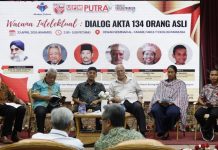
Power women in security: Dr. Manmeet Kaur (left) and Reshvin Kaur

By Asia Samachar | Malaysia  |

Two Sikh women were named in the inaugural Top Women in Security in Malaysia initiative established to recognize women who have advanced the Malaysian security industry. And one of them went on to become a regional champ!

Associate Professor Dr Manmeet Mahinderjit Singh and insurance company IT audit head Reshvin Kaur were selected late last year in the industry-wide recognition. Yesterday (31 Aug), she was awarded the Top 30 Women in Security for Asean Region 2021 award.

The listing, said to be a unique industry partnership arrangement, is part of a global campaign by the Women in Security & Resilience Alliance (WISECRA). It brings together Malaysian Women in Security (MYWiS) and Malaysia Chapters of premier, global security industry associations, ISACA Malaysia Chapter and ASIS International Malaysia Chapter.

Dr Manmeet is from University Sains Malaysia’s (USM) where she teaches information security and cybersecurity educator. Reshvin is IT audit head at Zurich Life Insurance Malaysia Bhd.

Dr Manmeet Kaur graduated from the University of Queensland, Brisbane, Australia with a PhD Degree specialising in data security. Her area of expertise is in Information and cyber security, Internet of things security, smart devices security and mobile security. She has extensively worked on research projects revolving mobile devices, smart cities applications and smart homes.

She also holds several grants involving APT-groups and privacy risk. She has designed a range of cybersecurity training courses and delivered trainings on emerging technology security, bid data security, mobile security and cybersecurity for managers, according to her profile.

On her part, Reshvin has close to 16 years of experience within internal and external audit focusing on Insurance, banking and manufacturing companies.

She started her audit career in IT advisory with KPMG Malaysia. She then joined ING Insurance Bhd and Danajamin Nasional Bhd before joining Zurich Insurance in 2013 as an IT audit manager.

Reshvin has been engaged mostly in IT related audit works, including IT controls such as IT security, business recovery processes, IT general controls and others. Knowledge and experiences from IT Audit were also applied for non-IT audits to support more in-depth review.

In her current position, she covers both general and takaful business as well as provide support to IT audits in Malaysia and globally. In 2020, Reshvin was also being admitted as one of the directors for ISACA Malaysia. She holds a CISA certification from ISACA.

The other women in Malaysia’s top 10 listing were Bond Holdings Sdn Bhd chief strategy officer Dr Carrine Teoh Chooi Shi, SEEK’s Asia businesses (JobStreet.com and JobsDB) cybersecurity head Shamini Suganantha Technohills Academy founder/CEO Manimegalai @ Manie Intellize Tech Services chief strategy officer Dr Kavitha Muthy, Standard Chartered Bank head information security risk officers Stephanie Liew, Standard Chartered Bank director for CRC COO TDR risk & control governance management Devika Rani Krishnan and Celcom Axiata Bhd information security GRC manager Raihan Ismail.

RELATED STORY:

Eye on risk (Asia Samachar, 27 July 2021)

Power counsel for wheels (Asia Samachar, 23 July 2021)

ASIA SAMACHAR is an online newspaper for Sikhs / Punjabis in Southeast Asia and beyond.Facebook | WhatsApp +6017-335-1399 | Email: editor@asiasamachar.com | Twitter | Instagram | Obituary announcements, click here |

Mata Kulwant Kaur (Kanto) (1935-2021), Bidor

MATA KULWANT KAUR (KANTO) BIDOR

13.08.1935 – 29.08.2021 (86 yrs old)

Village: Tanda, Punjab

“Thank you for the gift of love. Now you’re sharing it up above. You had many things to say, All in A caring Way.”

Waheguru Ji Ka Khalsa, Waheguru Ji Ki Fateh

With grief and sorrow, we regret to inform you the demise of our beloved Nani Ji Kulwant Kaur @ Kanto (Late) wife of our Nana Ji Santokh Singh (Sokhi). She passed away peacefully on 29-08-2021.

Children:

Late Prasan @ Parsini Kaur (Brunei)

Harjit Kaur – Bidor

Grandchildren:

Sharmeen Kaur,Jesvinder Kaur, Amandeep Kaur Semrenjit Kaur, Chamandeep Kaur, Amardeep Singh, Sharandeep Singh, Novedeep Singh

And 14 Great Grandchildren.

Path da Bhog: 4 Sept 2021 (Saturday), 10.00am – 12.00noon, at Gurdwara Sahib Bidor, Perak

Due to current restriction of Covid-19 pandemic, the Sejh Path da Bhog will be limited with strict SOP.

The family appreciates the kind understanding, support and prayers of all the family members, relatives, friends & Gurdwara Sahib Bidor Committee.

Contact:

Sharan – 0127271986

Novedeep – 0195891332

| Entry: 1 Sept 2021 | Source: Family

ASIA SAMACHAR is an online newspaper for Sikhs / Punjabis in Southeast Asia and beyond.Facebook | WhatsApp +6017-335-1399 | Email: editor@asiasamachar.com | Twitter | Instagram | Obituary announcements, click here |
Sri @ Manjit Kaur (1945-2021), Pontian

SRI @ MANJIT KAUR A/P NARAIN SINGH

05.11.1945 – 31.08.2021

Village: Himmat Pura

Wife of Jora Singh s/o late Kehar Singh

Children / Spouse

Surinder Singh / Rosnani
Gurmeet Singh / Kulvinder Kaur
Balwinder Kaur / Surinderdeep Singh

and five grandchildren.

Path da Bhog: 9.30am, 11 September 2021 (Saturday) at Gurdwara Sahib Pontian, Johor

Due to Covid-19 SOP and restrictions, the programme will be held among family members and close friends.

Contact:

Gurmeet Singh +6012-6729605

Surinderdeep Singh +6019-6912777

| Entry: 1 Sept 2021 | Source: Family

ASIA SAMACHAR is an online newspaper for Sikhs / Punjabis in Southeast Asia and beyond.Facebook | WhatsApp +6017-335-1399 | Email: editor@asiasamachar.com | Twitter | Instagram | Obituary announcements, click here |