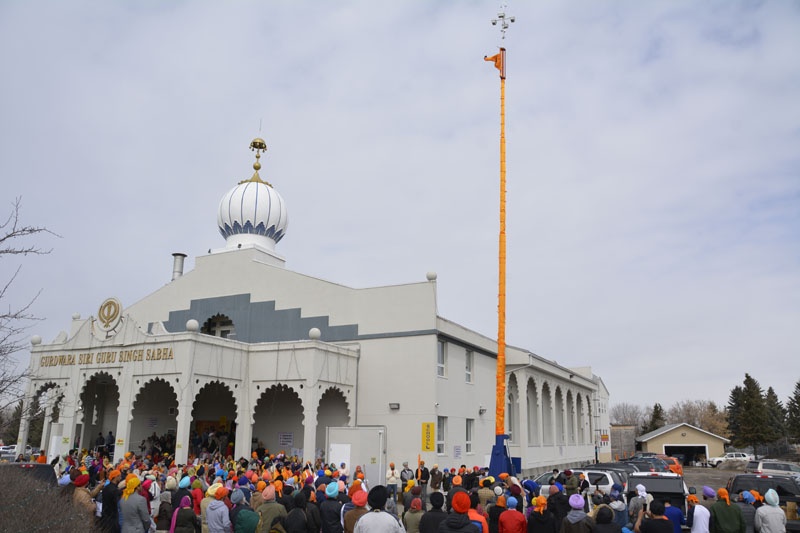
Edmonton gurdwara during a Vaisakhi event – Photo: Gurdwara website
By CBC News| CANADA |
Leaders at the Singh Sabha Gurdwara in the Mill Woods area of southeast Edmonton are speaking out about months of targeted harassment.
Since March, the gurdwara — where thousands of Sikh Edmontonians worship — has received daily multiple threatening phone calls. Voices on the other end hurled racial slurs and espoused anti-Sikh sentiment.
There has also been calls from local businesses expecting payments for estimates and services, as well as deliveries of meat products, that no one in the gurdwara ever ordered.
“This is where we grew up. This is a place that we were born into. We attended every Sunday or every day. And just seeing the people that we grew up with, being so affected by this, it honestly is heartbreaking,” said Gurpreet Kaur, a spokesperson for Sangat Youth, a group that amplifies Sikh voices and provides support and resources for the community.
Last May, a large delivery of meat pizzas and chicken wings showed up at the gurdwara. No one there had ordered it. In fact, meat isn’t allowed on the premises and there are even signs outside saying so.
Community leaders decided it was time to call the Edmonton police service’s Hate Crimes and Violent Extremism Unit.
Sikh Edmontonians are not the only ones who are increasingly the target of hate-motivated incidents in the Edmonton area. There have also been a string of attacks on Muslim women that drew a crowd of hundreds out last weekend demanding action to protect them.
Read the full story, entitled ‘Edmonton Sikh temple targeted with threatening phone calls, prank deliveries’ (CBC News, 1 July 2021), here.
ASIA SAMACHAR is an online newspaper for Sikhs / Punjabis in Southeast Asia and beyond.Facebook | WhatsApp +6017-335-1399 | Email: editor@asiasamachar.com | Twitter | Instagram | Obituary announcements, click here |
Sameet Kaur Sidhu has been promoted as the human resources (HR) director for global customer operations at Schneider Electric.
She began her new role in June 2021, according to her LindkedIn profile. She had previous stints at Cisco Systems, Alstom and Experian Asia Pacific.
The Malaysian-based HR specialist has regional and global exposure on projects and international relocation assignments within the UKI, EMEA, India and Asia Pacific region.
Sameet studied in Seremban and has a Bsc in Computer Science from University of Westminster.
ASIA SAMACHAR is an online newspaper for Sikhs / Punjabis in Southeast Asia and beyond.Facebook | WhatsApp +6017-335-1399 | Email: editor@asiasamachar.com | Twitter | Instagram | Obituary announcements, click here |
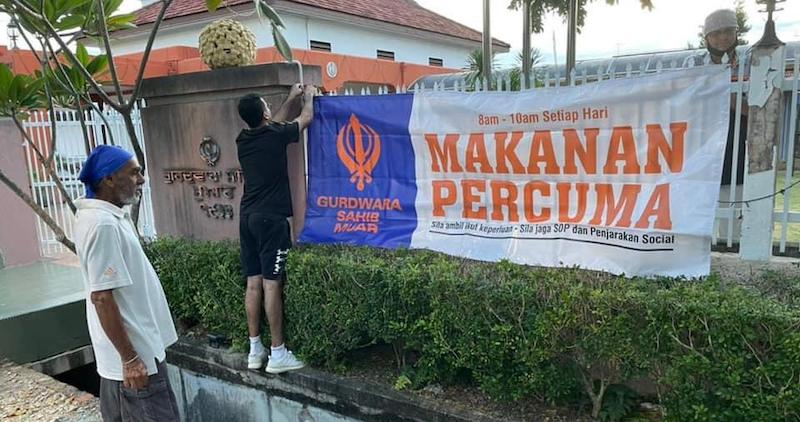
The 160 nasi goreng packs prepared early in the morning at the Muar gurdwara were snapped us within a short period of time.
A small number of volunteers gathered at 6am to start the cooking process. By 8am, as promised in their poster entitled ‘Makanan Percuma’ (Free Food), the packs were arranged just outside the gurdwara gate. It didn’t take long for them to be snapped up.
“There are people are going hungry, so we had to do something. We will do it again tomorrow. We hope to carry on until December,” Gurdwara Sahib Muar committee president Bhagwan Singh told Asia Samachar. “We may make mee goreng tomorrow, and maybe nasi lemak the next day.”
The move to make available free food was in response to the hardship caused by the various Covid-19 pandemic movement restrictions. In the process, many daily wage earners have lost sources of income.
During the first lockdown, called Movement Control Order (MCO) in March 2020, Bhagwan said the the MalaysianFoodbank had distributed food packs to a number of factories affected by the maiden lockdown. The Muar team had also distributed food to foreign workers in areas like Tangkah, Pagoh, Bukit Pasir and Parit Jawa.
“This time, there is not so much demand from factories,” he added.
ASIA SAMACHAR is an online newspaper for Sikhs / Punjabis in Southeast Asia and beyond.Facebook | WhatsApp +6017-335-1399 | Email: editor@asiasamachar.com | Twitter | Instagram | Obituary announcements, click here |
Anoopal Kaur, one of the youngest female liquidators in Malaysia, has been made a partner at accounting and business advisory firm Baker Tilly Malaysia.
Anoo, as she is fondly referred to by the Baker Tilly family, joined Ferrier Hodgson Malaysia 13 years ago after she graduated from university.
Baker Tilly (Malaysia) group managing partner Andrew Heng recalled the moment when Anoopal first joined Ferrier Hodgson Malaysia, fresh out of university, and excited to learn all she could about the world of insolvency and corporate restructuring.
“Throughout the many years that Anoo has been with us, I have watched her grow and mature in her knowledge of the industry (which is quite a tough one) and as a leader. In an industry that is predominantly male, Anoo really stood out as a rising star and earned the respect of her fellow colleagues and many others in the industry,” he shared in a LinkedIn message.
Now, that’s a solid word of confidence from one of her bosses.
Anoopal grew up in Raub, a small town in Pahang. Her father, Kirpal Singh Sardool Singh, previously operated an electric and electronic repair shop in town. He is now retired. Her mother Amarjit Kaur Shamir Singh is a homemaker.
“I came to Kuala Lumpur to pursue my higher education and have been here since,” she told Asia Samachar.
Just before she graduated, she attended a career fair, and applied for a job as an associate consultant with Ferrier Hodgson MH Sdn Bhd. It was then an Australian affiliated firm specialising in insolvency and recovery work. She joined in 2008 and has been with the firm since.
“When I first applied for the role, I didn’t really know much or understood insolvency work. It is a very niche industry and not much that I read online then, was something I could comprehend well. I graduated as an accountant, but preferred a more advisory based role, which the job offered. It was exciting and challenging both at the same time,” she said
Anoopal Kaur
So, what do insolvency practitioner like her do? An insolvency practitioner is a person appointed to act over a company, partnership or person when the business becomes insolvent or when a person goes bankrupt, or via a debenture over charged assets of a financial institution.
A liquidator is one of the appointment an insolvency practitioner can act as. A liquidator is appointed by the court over a company when it gets wound-up. As a liquidator, his primary role is to take over the business of a wound-up company, identify and dispose its assets and use the recovery as settlement to the creditors that were not settled when the business was still in operations.
An example would be, to be appointed over a development company that is wound-up leaving a housing project abandoned half way. The liquidator would likely access what is the best value for the abandoned project, if need be, revive the same and deliver the units to the purchasers of the project. Any unsold units, could be used as payments to the potential white knight that will be appointed to complete the project.
An insolvency practitioner can also assist with companies facing financial difficulties via restructuring exercises and some other mechanisms available in the companies act ie. judicial management or corporate voluntary arrangement.
Anoopal is one of the founding board members of the International Women’s Insolvency and Restructuring Network, the Malaysian Chapter. She is also a member of the Women in Business Committee with CPA Australia and Malaysian Institute of Accountants (MIA).
Baker Tilly ranks among the largest accounting and business advisory firms in Malaysia, with 50 partners and directors, 6 offices across Malaysia and an office in Phnom Penh, Cambodia, and a staff force of over 800 professionals, according to information at its website.
ASIA SAMACHAR is an online newspaper for Sikhs / Punjabis in Southeast Asia and beyond.Facebook | WhatsApp +6017-335-1399 | Email: editor@asiasamachar.com | Twitter | Instagram | Obituary announcements, click here |
Our premise in these series of videos has been that Guru Nanak’s Portrait of Sikhi was Painted Over an existing canvas – one that had existed for thousands of years prior to Guru Nanak.
What we mean by PAINTING OVER is that Guru Nanak RE-DEFINED all the spiritual concepts of that pre-existing canvas to suit the spirituality of Gurbani. So while all the concepts of the old canvas are MENTIONED in the SGGS, they have been given NEW Meanings.
And IF we intend to appreciate the Sikhi of Guru Nanak, we will need to understand the NEW meanings or REDEFINED meanings of the concepts – as contained within the Sri Guru Granth Sahib.
In today’s video, we will look at the concept of the Court of Judgement, or Dargah as it’s known in Punjabi.
Let’s begin with Dargah and what is advocated about it by the 4,000-year-old Canvas.
According to its beliefs, Dargah is the Court of Judgement. The Sanskrit equivalent of Dargah is Sanyumni. This is the word that appears in the texts that are based on the 4K year old Canvas – Sanyumni.
Dargah is presided by Dhrm Raj and the one who prosecutes the soul of the deceased person is Chitargupt.
Dargah is the place where judgement is pronounced on the departed soul. Good souls are sent to heaven to obtain salvation, some bad ones are ordered to serve their sentences in one of the 21 hells, and other bad ones are condemned to their journey of avagaun or reincarnation. The court of judgment – Dargah – sets the exact path and order of 8.4 million reincarnations for the departed soul. How many life forms and which comes first and which next.
This narrative is presented as a religious FACT, and religious TRUTH. And believed by millions. And accepted by millions more.
What is most chilling really is that this narrative of Dargah – as drawn from the texts of the old canvas – is the one that is presented by our clergy – our granthis and parcharaks in our gurdwaras AS Sikhi beliefs. As Gurmat beliefs. As beliefs supported by Gurbani.
The outcome is that – the narrative that is held within the psyche of a vast majority of Sikhs is NOT the narrative of Gurbani, but that of the 4K year old canvas. And this vast majority of Sikhs mistakenly think and accept and believe the narrative of the 4K Old canvas to be the narrative of Gurbani.
Nothing can be further than the truth.
So what is the narrative of Dargah within Gurbani? We can develop the basic principles by examining some verses that discourse the concept.
Before we do that, it will help if we looked at two primary principles of Sikhi, Gurmat and Gurbani. Principle one pertains to the PRIMACY of HUKM and principle two is that SIKHI is for the HERE and NOW and Gurbani therefore concerns itself with the LIFE THAT WE ARE LIVING in the HERE and NOW.
The primacy of Hukm in Sikhi is laid out in this verse of Guru Nanak on Page 1 of the SGGS:
ਹੁਕਮਿ ਰਜਾਈ ਚਲਣਾ ਨਾਨਕ ਲਿਖਿਆ ਨਾਲਿ ॥ ੧ ॥
Hukm Rajayee Chalnaa, Nanak, Likhiya Naal.
Hukm (with Sihari) means Within the confines of His Hukm. Rajayee – translates as Rzaa Walla; meaning the Creator. Chalnaa – Lit means to Walk, Flow. Abide in Sehej. Then we have the phrase Likhiya Naal. The word Lekha means an accounting. So Likhya Naal means – the Hukm is contained within, accounted for within.
The meaning of the verse is Nanak, The Way to Realize the Creator Within Is to Remain Within the Confines of, and Abide in Sehej (Chalna) Of His Hukm, As Contained Within Me.
So that’s the first primary principle of Sikh – the Primacy of the Hukm.
The principle of Sikhi being a spirituality of the Here and Now, of the PRESENT life is contained within this verse of Bhai Gurdas.
Varatmaan Vich Varatda Hovanhaar Soee Parvana. Karan Karta Jo Karey Serr Dhar Munn Krey Shukrana. Bhai Gurdas Vaar 18.
Meaning: The accepted Sikh is one who lives successfully in the PRESENT. Whatever the Creator does, he accepts with gratitude as His hukm.
When we put these two principles together, then we get a narrative that can be summarized as follows.
One, The Hukmi is the Creator. Second, the Creator is Within. Third, If the Creator is Within, then His Court is also Within.
We know in temporal life; a Court is only good when the Judge presides. And the Court is where the Judge is. If a judge decides to sit under a tree and conduct the business of his court – then that’s his court. If a King holds court in a cave – then that is where his court is. If a judge decides to set up court on the beach – then that’s where the court is.
The court is where the Judge is, where the King is.
Guru Nanak tells us the Creator is Within. So His Court has to be Within. And there can be no court higher than the Creator’s court.
Fourth, If the Court is Within, then the Judgement is Within.
And finally, all of the above happens in the HERE and the NOW.
In order for the above principles to settle into our psyche, lets return to the seminal verse of Guru Nanak from page one of the SGGS ਹੁਕਮਿ ਰਜਾਈ ਚਲਣਾ ਨਾਨਕ ਲਿਖਿਆ ਨਾਲਿ ॥ ੧ ॥ Hukm Rajayee Chalnaa, Nanak, Likhiya Naal.
Guru Nanak is giving us some very profound messages in this verse. Every word of this verse is revolutionary. Every word carries a concept of spirituality that did NOT exist in the pre-1469 period.
Guru Nanak is saying the Creator is Within ਨਾਲਿ Naal. Since the Creator is within and realization of the Creator is within; it follows that His Hukm for us is in operation within ਨਾਨਕ ਲਿਖਿਆ ਨਾਲਿ Nanak, Likhiya Naal. It cannot be that the Creator is within us but that His Hukm is not, or that His Hukm is Without.
Four points are thus discernable from the verses thus far and worth noting. First, the Creator is Within. Second, Realization of the Creator is Within. Third, His Hukm for us is therefore Within (The Creator cannot be Within us sans His Hukm, minus His Hukm). The fourth consequential point is that the accounting of our deeds is therefore Within too.
Pre-existing and pre-1468 notions of judgement IN THE AFTER LIFE by external “entities” such as Dharam-raj, Chitargupat, Lekha etc. are thus REJECTED. They are then REDEFINED in Gurbani as processes that occurs WITHIN and in the Here and Now.
But where is the direct evidence from within Gurbani that the Court is Within?
Ander Raja Takhat Hai Apey Krey Nioao. Gur Shabdi Dar Janeeaiy Ander Mehl Asrao.
Guru Amardas ji is saying. The King is Within ਅੰਦਰਿ ਰਾਜਾ Ander Raja. His Throne on which he sits is Within ਅੰਦਰਿ ਰਾਜਾ ਤਖਤੁ ਹੈ Ander Raja Takhat Hai the Justice, the law, the rules, the judgement is also Within ਅੰਦਰਿ ਰਾਜਾ ਤਖਤੁ ਹੈ ਆਪੇ ਕਰੇ ਨਿਆਉ Ander Raja Takhat Hai Apey Krey Nioao.
How do we get enlightened about this Court Within? How do we find the door, the access to this Court Within? The answer is in the next verse ਗੁਰ ਸਬਦੀ ਦਰੁ ਜਾਣੀਐ Gur Shabdi Dar Janeeaiy. Dar means door, it means passage way, it means access. Through the messages of the Shabd Guru.
Enlightenment about the Court within, within which the Creator Reigns, sits on the throne, and executes judgement within ਅੰਦਰਿ ਮਹਲੁ ਅਸਰਾਉ Ander Mehl Asrao is to be obtained from within the messages of the shabd ਗੁਰ ਸਬਦੀ ਦਰੁ ਜਾਣੀਐ ਅੰਦਰਿ ਮਹਲੁ ਅਸਰਾਉ Gur Shabdi Dar Janeeaiy Ander Mehl Asrao.
The phrase ਅੰਦਰਿ ਮਹਲੁ ਅਸਰਾਉ Ander Mehl Asrao means Within the Conscience. It is our CONSCIENCE that is the DARGAH. It is the Conscience that is the court.
Keep in mind that all of Gurbani’s concepts are grounded in the HERE and NOW. In our present life. ਵਰਤਮਾਨ ਵਿਚ ਵਰਤਦਾ ਹੋਵਣਹਾਰ ਸੋਈ ਪਰਵਾਣਾ॥ Varatmaan Vich Varatda Hovanhaar Soee Parvana.
Similarly, the concepts of Dargah and Judgement in Dargah are grounded in the HERE and NOW.
In that context then, the phrase ਅੰਦਰਿ ਮਹਲੁ ਅਸਰਾਉ Ander Mehl Asrao means Within the Conscience. It is our CONSCIENCE that is the DARGAH. It is the Conscience that makes judgements about our thoughts, speech, acts and deeds. These are instant judgements in the here and now.
The meaning of the verse then is this: The Creator is Within, His Throne on which he sits is Within. The Justice, the law, the rules, the judgement is also Within. Enlightenment about the Court within Our Conscience is obtained from within the messages of the shabd.
Khrey Parkh Khajaneiy Payien Khotia Nahi Thao. Sabh Sach Scho Sach Vartda Sda Sach Niao. Amrit Ka Rus Aiya Mun Vasiya Nao. SGGS Page 1092
What happens in the Court or Dargah that is our Conscience – is that judgement or evaluation takes place – in the HERE and NOW. The word ਪਰਖਿ means just that – evaluation and judgement.
What is the ਪਰਖਿ Parkh about? What is the judgement within our Conscience? Guru ji says – ਖਰੇ ਪਰਖਿ ਖਜਾਨੈ ਪਾਈਅਨਿ ਖੋਟਿਆ ਨਾਹੀ ਥਾਉ Khrey Parkh Khajaneiy Payien Khotia Nahi Thao – To accept the good and to reject the bad. To provide space and acceptance to upright thoughts, to worthy speech and to virtuous deeds – ਖਰੇ ਪਰਖਿ ਖਜਾਨੈ ਪਾਈਅਨਿ Khrey Parkh Khajaneiy Payien and to reject and toss out the fake ਖੋਟਿਆ ਨਾਹੀ ਥਾਉ Khotia Nahi Tha.
The voice of our Conscience Within is the Voice of the Creator Within.
ਅੰਦਰਿ ਰਾਜਾ ਤਖਤੁ ਹੈ ਆਪੇ ਕਰੇ ਨਿਆਉ
Ander Raja Takhat Hai Apey Krey Nioao.
He Himself is the Voice of our Conscience Within.
The voice of our Conscience Within is the Judgement of our thoughts, deeds and actions that takes place all the time in the HERE and NOW, in our PRESENT life. The Conscience is the Court. The Conscience is the Dargah WITHIN.
Then Patshah says in the next verse:
ਸਭੁ ਸਚੋ ਸਚੁ ਵਰਤਦਾ ਸਦਾ ਸਚੁ ਨਿਆਉ
Sabh Sach Scho Sach Vartda Sda Sach Niao.
This verse tells us of the character and quality of the ਪਰਖਿ Parakh or evaluation or judgement that takes place within our Conscience as the voice of the Creator within. The character is ਸਦਾ ਸਚੁ ਨਿਆਉ Sda Sach Niao. Niyao means Justice. Sda means permanent, without exceptions. Sach means eternal, of the eternal creator.
The judgement that is of the voice of the Conscience Within pertains to the Justice of the Eternal Creator. Why? Because the voice of our Conscience Within is the Voice of the Creator Within.
And what is the outcome of such realization? What is the outcome of the realization that The Creator is Within, that His Throne on which he sits is Within, that His court is within, that the Justice, the law, the rules, and the judgement is also Within?
The outcome is in the final verse ਅੰਮ੍ਰਿਤ ਕਾ ਰਸੁ ਆਇਆ ਮਨਿ ਵਸਿਆ ਨਾਉ ॥ Amrit Ka Rus Aiya Mun Vasiya Nao. Amrit comes from two words A + Mrit. Mrit means death and A negates it. It therefore means the absence of death, the absence of spiritual death. In other words, SPIRITUAL LIFE.
ਅੰਮ੍ਰਿਤ ਕਾ ਰਸੁ ਆਇਆ Amrit Ka Rus Aiya means the essence of Spiritual life comes into being. That is the outcome. And then pathsah says ਮਨਿ ਵਸਿਆ ਨਾਉ Mun Vasiya Nao. meaning Divine virtues comes to reside within our minds. ਮਨਿ ਵਸਿਆ ਨਾਉ Mun Vasiya Nao. means we inculcate divinity within our minds.
The translation of the verse is: The Judgement Within My Conscience Is I Inculcate the Good and I Discard the Bad. The Creator Reigns Supreme Within the Court of Justice of the Creator Within. The Essence of Spiritual Life Is Realized Upon the Realization of Divine Virtues Within.
Putting it all together then, the message of the verse is: The judgement within our Conscience is of essence.
The good and the bad, the truth and the falsity, the real and the unreal – I judge within my Conscience on the basis of ਗੁਰ ਸਬਦੀ ਦਰੁ ਜਾਣੀਐ Gur Shabdi Dar Janeeaiy.
I inculcate the good ਖਰੇ ਪਰਖਿ ਖਜਾਨੈ ਪਾਈਅਨਿ Khrey Parkh Khajaneiy Payien. I discard the bad ਖੋਟਿਆ ਨਾਹੀ ਥਾਉ Khotia Nahi Thao. The essence of Spiritual life is realized upon the realization of Divine virtues within.
What all the above means is that Guru Amardas ji is telling us that for Divinity to come into existance within our minds in the HERE and NOW– we need to appreciate that the Creator is Within, His Court or Dargah is within, and so is the Judgement which comes through the voice of the conscience which is the voice of the Creator within.
On the other hand, if we accept that the Dargah is an external entity in the After Life, and that the judgement is done by an entity out there –also in our afterlife – then the essence of it will NOT be DIVINITY, but fear, anxiety, worry and dread. These are not the building blocks of spirituality in the Here and Now.
The fourth Guru Ramdas ji has these set of very profound verses on page 591 of the SGGS.
Jis Kaiy Ghar Diban Har Hoveiy Tis Ki Muthi Vich Jagt Sabh Aiya. Tis Kao Talki Kiseiy Di Nahi Har Diban Sabh Aann Pairi Paya.
The first verse is ਜਿਸੁ ਕੈ ਘਰਿ ਦੀਬਾਨੁ ਹਰਿ ਹੋਵੈ Jis Kaiy Ghar Diban Har Hoveiy. Diban is Court. And ਘਰਿ Ghar with a sihari is Within – within the mind, within the conscience.
So in the first verse Guru Ramdas ji is saying The Court of the Omnipresent Creator is Within ਜਿਸੁ ਕੈ ਘਰਿ ਦੀਬਾਨੁ ਹਰਿ ਹੋਵੈ Jis Kaiy Ghar Diban Har Hoveiy.
Then Patshah says ਤਿਸ ਕੀ ਮੁਠੀ ਵਿਚਿ ਜਗਤੁ ਸਭੁ ਆਇਆ Tis Ki Muthi Vich Jagt Sabh Aiya. Realization of such puts the Entirety of our life into the Creator’s hand – into the Creator’s Hukm or will.
The second verse speaks of the outcome of such a realization ਤਿਸ ਕਉ ਤਲਕੀ ਕਿਸੈ ਦੀ ਨਾਹੀ ਹਰਿ ਦੀਬਾਨਿ ਸਭਿ ਆਣਿ ਪੈਰੀ ਪਾਇਆ Tis Kao Talki Kiseiy Di Nahi Har Diban Sabh Aann Pairi Paya. The phrase ਤਲਕੀ ਕਿਸੈ ਦੀ ਨਾਹੀ Tis Kao Talki Kiseiy Di Nahi means the subjugation of none, the fear of none, the dread of none.
So the outcome of Realization that the Court of the Omnipresent Creator is within is the REMOVAL of subjugation to any OTHER entity. Any entity other than the Creator within.
The message is crystal clear – A Sikh of the SGGS, a Sikh of Gurbani does not subject himself or herself to any COURT, any Diban, any Dargah that is under the jurisdiction of any entity OTHER than the Creator Within.
This single verse alone is sufficient to discard all the external entities such as the Dargah of the afterlife, Dhrm raj, Chitargupt etc. A Sikh is NOT subject to any such concocted entities.
Meaning: Why would any human being ਮਾਣਸਾ Mannsa Har Dibannho Koyi Kitheiy Jaya discard such a Court, such a Diban ਕਿਅਹੁ ਦੀਬਾਣਹੁ ਕੋਈ ਨਸਿ ਭਜਿ ਨਿਕਲੈ Kioh Dibannho Koee Nus Bhaj Nikleiy and what other court other than the Court of the Creator Within is there to go to ਹਰਿ ਦੀਬਾਣਹੁ ਕੋਈ ਕਿਥੈ ਜਾਇਆ Har Dibannho Koyi Kitheiy Jaya?
So Aisa Har Diban Vasiya Bhagtan Kaiy Hirdaiy Tin Rehndey Kuhndey Aann Sabh Bhagtan Agaiy Khalvaiya.
Meaning Such is the court of the Creator ਸੋ ਐਸਾ ਹਰਿ ਦੀਬਾਨੁ So Aisa Har Diban Tin Aann. Such is the court of the Creator that is located within the conscience ਵਸਿਆ ਭਗਤਾ ਕੈ ਹਿਰਦੈ Vasiya Bhagtan Kaiy Hirdaiy. The Court is within the Conscience. So much so that all other insignificant courts ਰਹਦੇ ਖੁਹਦੇ Rehndey Kuhndey vanish in such realization ਸਭਿ ਭਗਤਾ ਅਗੈ ਖਲਵਾਇਆ Sabh Bhagtan Agaiy Khalvaiya.
The message is crystal clear. Once Realization of the Court of the Creator Within comes, settles in, and becomes a reality of our Spirituality in the HERE and NOW – all other courts become insignificant, become inconsequential, become irrelevant. Guru ji uses the words ਰਹਦੇ ਖੁਹਦੇ ਦੀਬਾਨੁ Rehndey Kuhndey Diban in comparison to ਹਰਿ ਦੀਬਾਨੁ Har Diban. The idiom ਰਹਦੇ ਖੁਹਦੇ Rehndey Kuhndey means trivial, petty, frivolous and irrelevant remnants.
To a Sikh of Gurbani, the so called Dargah, or Court of judgement in the afterlife is as frivolous as it is irrelevant.
The meaning of the verse is: Why would any human being discard the Court within; What other court other than the Court of the Creator Within is there to go to. Such is the court of the Creator that is located within the conscience of Divine Seekers (Bhagats) that all other insignificant courts vanish in such realization.
In essence then pyareo, what Gurbani has done is to Liberate us from the entire pre 1468 Canvas. To free us from the debilitating and crippling fear of the clergy concocted concepts of the 4K year old canvas.
Life is difficult enough without having to believe that the entire universe is just waiting to consign us to an eternal hell. And that is exactly what the 4K year old Canvas and our clergy want us to believe. That we are given an infinitely miniscule span for our life and that what awaits us in the afterlife is a terrifying judgment in a petrifying court, at the hands of of a horrifying judge who is just waiting to confine us into 21 hells for eternity for some petty wrongdoings and have us to go through 8.4 million life forms of cats, rats, bats and cockroaches.
This is the fear from which Guru Nanak and Gurbani seek to liberate us from. There is no court of judgement, no Dargah, no kacheri, no saynyamni in the afterlife. The only court is the one within us. In the here and now.
The court of judgement is our conscience. Every thought, every word, every action of ours is judged right within us, in the very instant, and a judgement delivered by our conscience right there and there. We have to listen to our conscience. We have to silence the background noises in our mind that tell us to ignore our conscience. We have to refrain our attempts to silence our conscience. Instead, we have to empower our conscience. Gurbani is the source of this empowerment. The messages of Gurbani are the nourishment for our conscience. The voice of our conscience is the voice of the creator within us. Gurbani tells us to seat the Creator Within – on His Throne Within – In His Court Within – which is our Conscience.
Ander Raja Takhat Hai Apey Krey Nioao. Gur Shabdi Dar Janeeaiy Ander Mehl Asrao.
The King is Within ਅੰਦਰਿ ਰਾਜਾ Ander Raja His Throne on which he sits is Within ਅੰਦਰਿ ਰਾਜਾ ਤਖਤੁ ਹੈ Ander Raja Takhat Hai. The Justice, the law, the rules, the judgement is also Within ਅੰਦਰਿ ਰਾਜਾ ਤਖਤੁ ਹੈ ਆਪੇ ਕਰੇ ਨਿਆਉ Ander Raja Takhat Hai Apey Krey Nioao.
When You Stop Fearing the Dargah of the After Life, You Start to Listen to the Dargah Within in the Here and Now
When You Discard the concocted notion of Dargah in the Afterlife. You Acquire the Gurbani Notion of Dargah Within us in the Here and Now.
You start to listen to the Voice of your Conscience as the Voice of the Creator Within, When You Stop Chasing the Spirituality of Life After Death. You Start Living the Spirituality of Here and Now. And You Allow the Spirituality of HUKM to live within You
When You Discard the Gurbani Discarded Narratives of the 4K years Old Canvas, You start living the Truths of Gurbani.
The next video will examine the concepts of Dhrm Raj. It will attempt to provide the new, redefined, and Gurbani meanings as outlined within the 1429 pages of the SGGS.
SIKHI CONCEPTS SERIES BY DR KARMINDER SINGH DHILLON: COMPLETE LINKS TO VIDEOS & LECTURE NOTES
Sikh thinker, writer and parcharak Karminder Singh Dhillon, PhD (Boston), is a retired Malaysian civil servant. He is the joint-editor of The Sikh Bulletin and author of The Hijacking of Sikhi. He can be contacted at dhillon99@gmail.com.
* This is the opinion of the writer, organisation or publication and does not necessarily represent the views of Asia Samachar.
ASIA SAMACHAR is an online newspaper for Sikhs / Punjabis in Southeast Asia and beyond.Facebook | WhatsApp +6017-335-1399 | Email: editor@asiasamachar.com | Twitter | Instagram | Obituary announcements, click here |
Dr. Halbans Kaur beloved daughter of late Sdr Kaur Singh and Sdrni Bhan Kaur returned to the Abode of the Almighty Guruji on 29th June 2021.
“Gazing upon the Blessed Vision of the Guru, the pains of death and rebirth are taken away”. – Guru Granth Sahib
Deeply missed and longed by her husband, sons, daughters in law grandchildren, sisters, brothers and relatives.
| Entry: 1 July 2021 | Source: Family
ASIA SAMACHAR is an online newspaper for Sikhs / Punjabis in Southeast Asia and beyond.Facebook | WhatsApp +6017-335-1399 | Email: editor@asiasamachar.com | Twitter | Instagram | Obituary announcements, click here |
Gurbir Singh Grewal joins SEC as enforcement director
By Asia Samachar| UNITED STATES |
Gurbir Singh Grewal, one of New Jersey’s longest-serving attorneys general who made history as the first Sikh American to hold the position, has been tapped by the US Securities and Exchange Commission (SEC).
The 48-year old will lead the agency’s enforcement division that polices markets. This is definitely another first for the Sikh community.Grewal currently serves as Attorney General for the State of New Jersey, a role he has held since January 2018, when he was confirmed by the New Jersey State Senate after being nominated by Governor Phil Murphy.
“I’m honored and delighted to welcome Attorney General Grewal to the SEC,” said SEC Chair Gary Gensler in a statement. “He has had a distinguished career as New Jersey’s chief law enforcement officer and as a prosecutor at both the local and federal levels. He has the ideal combination of experience, values, and leadership ability to helm the Enforcement Division at this critical time. I look forward to working closely with him to protect investors and root out wrongdoing in our markets.”
The appointment puts in place a well-known public sector figure to police Wall Street misdeeds, reports Politico.com.
During his tenure in Trenton, Grewal made a name for himself by suing the Trump administration dozens of times, including frequent legal barrages against the federal Environmental Protection Agency, reports NorthJersey.com.
He also took to court firearms vendors who sold high-capacity ammunition magazines to New Jersey residents despite a state ban. And he enacted a cascade of police reforms meant to overhaul the way the Garden State’s 38,000 cops do their jobs, it added.
“The Enforcement Division has a critical role to play in finding and punishing violations of the law,” said Grewal in the same statement. “I’m excited to get to work with the talented team of public servants to uncover and prosecute misconduct and protect investors. I thank Governor Murphy for the opportunity to serve the people of New Jersey and all of the colleagues with whom I’ve had the pleasure to work during my career in the state.”
As New Jersey’s Attorney General, Grewal heads the Department of Law & Public Safety, which employs more than 3,700 uniformed officers, 750 lawyers, and thousands of additional public servants, including investigators, regulators, and administrative staff. Before becoming Attorney General, Grewal served as Bergen County Prosecutor, the chief law enforcement office of New Jersey’s most populous county.
His appointment at Bergen County made him the first Sikh county prosecutor in the state and the first of South Asian descent. What made the appointment more interesting was that Gurbir, a Democrat, was appointed by Gov. Chris Christie, a Republican.
Earlier in his career, he was an Assistant U.S. Attorney in the Criminal Division of the U.S. Attorney’s Office for the District of New Jersey, where he served as Chief of the Economic Crimes Unit from 2014 to 2016 and oversaw the investigation and prosecution of all major white collar and cybercrimes in the District of New Jersey.
He also previously served as an AUSA in the Criminal Division of the United States Attorney’s Office for the Eastern District of New York, where he was assigned to the Business and Securities Fraud Unit. Grewal worked in private practice from 1999-2004 and from 2008-2010.
Grewal graduated cum laude with a Bachelor of Science in Foreign Service from the Georgetown University School of Foreign Service in 1995. He obtained his law degree from the College of William & Mary, Marshall-Wythe School of Law in 1999.
ASIA SAMACHAR is an online newspaper for Sikhs / Punjabis in Southeast Asia and beyond.Facebook | WhatsApp +6017-335-1399 | Email: editor@asiasamachar.com | Twitter | Instagram | Obituary announcements, click here |
The coronavirus pandemic has wrecked havoc across the world. In Malaysia, there has been a spate of lockdowns, of different intensity, to contain the spread of Covid-19. The first lockdown, called movement control order (MCO), was instituted in mid-March 2020.
Life has not been the same ever since. The pandemic has impacted businesses, big and small. Workers have lost income, families devastated by the stalling economy.
In the gloom and doom scenario, various outfits have come forward to assist the people at large. Many gurdwaras in Malaysia have also stepped forward to assist people in their vicinity to cope with hardship.
Asia Samachar contacted the Malaysian Gurdwaras Council (MGC), the umbrella body for gurdwaras in the country, to reach out to their member gurdwaras to find out what they have done to help their local congregation. It’s not an exhaustive exercise, but enough to get a rough picture as to what is happening out there.
As reported earlier, we found that a good good number of Malaysian gurdwaras have ventured out to assist needy families. They provided much needed food and cash assistance even to the Panjabi foreign workers, many of whom were stranded without jobs and unable to move around. They also provided food ration to other migrant workers.
This is Part 3 for the individual gurdwara reports that have reached us. Gurdwaras featured in this installment are Kuantan, Mentakab, Ampang and Wadda Gurdwara Penang.
Part 1: Port Klang, Serendah, Shah Alam, Kota Kinabalu, Setia City Darbar and Petaling Jaya.
Part 2: Klang, Raub, Bentong, Sungai Petani, Labuan and Khalsa Land (KKB).
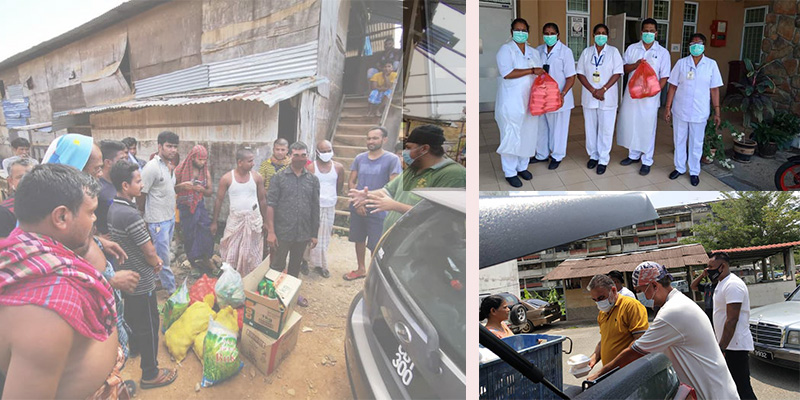
Kuantan gurdwara team delivering food supplies to one foreign workers’ kongsi during pandemic lockdown in 2020 – Photo: Supplied
KUANTAN
We distributed aid to some 30 Indian foreign workers during the MCO last year. While on the distribution rounds, we found two kongsi (workers’ quarters) of Bangladesh and Indonesian workers who had run out of food. We provided them with food ration as well. We distributed dry groceries and vegetables every 2 to 3 weeks. Dry groceries and vegetables. For this year, we have sent out notice to whoever is in need but no one has approached us yet.
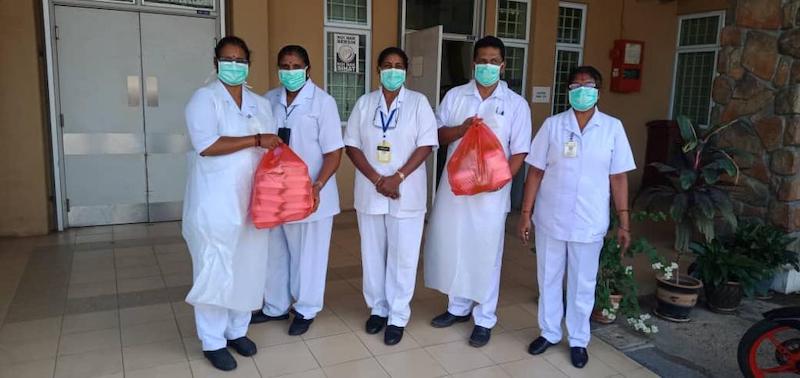
Mentakab gurdwara team also distributed meals to frontliners in the Temerloh district area
MENTAKAB
Mentakab Gurdwara Sahib team distributed 1,000 packs of vegetarian meals during MCO1 to residents of the Temerloh District. They included frontliners hard at work. Soon, we will once again start assisting our community affected by this pandemic. We will start soon with a RM500 one-off cash payment to needy households.
AMPANG
In 2020, the Gurdwara Sahib Ampang team distributed food packets worth RM6,000 to foreign workers (Desi brothers) in this area. We also distributed food ration to Niketan Darbar and Wadda Gurdwara Kampung Pandan for further distribution. The team also supplied vegetables and ration woth RM1,000 to Gurdwara Sahib Kampung Pandan Dalam which did the cooking and onward distribution. At the same time, we provided donations, between RM100 to RM200 each, to foreign workers to help them wtih their rentals and free medical treatment to those who needed it.
This year, we have supported two families with cash and food ration. With the assistance of the local parliamentarian, we have also distributed food package to 15 families in Ampang.
Buns and other items distributed by Wadda Gurdwara Sahib Penang during the Covid-19 pandemic lockdowns
WADDA GURDWARA PENANG
Persatuan Wadda Gurdwara Sahib (WGSP), Pulau Pinang, has been active in its outreach activities since MCO 1. The management committee would like to extend its heartfelt appreciation to everyone who have, and still are, contributing in so many ways towards the outreach sewa. Our contributors are from diverse backgrounds and races.
To date, WGSP has supported families with rations from Penang and the mainland (Sungai Petani, Kulim, Butterworth, Bukit Mertajam, Machang Bubok and nearby areas). The recipients are from all races, including migrant workers from India, Bangladesh, Pakistan, Vietnam, Indonesia and Rohingya. We have also reached out to Jawantankuasa Pemulihan Dadah Timur Laut and Community Aids Society Penang, Orang Asli settlement in Perak.
During Vasakhi, Hari Raya, Deepavali and Chinese New Year cleebrations, we reached out to families and also the homeless and rickshaw peddlers with cookies.
Breakfast and lunch meals for the homeless in Kompleks Masyarakat Penyayang, Lighthouse, Pitt Street, children homes and anyone in need of meals. Bread buns, paus, cakes, mineral water bottles, biscuits, masala chai packets, tea and coffee and juices bottles were also supplied to Penang and mainland (Butterworth, Bukit Mertajam, Machang Bubok and nearby areas).
We also managed daily supply for the homeless. Daily food: Lunch and dinner for senior citizens, stranded tourist and for the unwell, regardless of race.
We have also been providing psychosocial support such as counselling and keeping in touch with members of the Sikh congregation and members of the other communities. The MCO has impacted many who have shown stress, depression, anxiety and suicidal tendencies. Our outreach team consists of doctors, nurses and community development counsellors. As for chronic cases, they have been referred to various mental health organisations and Women Centre for Change for those going through domestic violence.
We have also created a friendship zone where those who are staying on their own can call us on WhatsApp via multiple chatting video call.
As for the senior citizens keeping in touch often with them breaks the social isolation faced by them and a little laughter helps cheer them up.
Distributions of care packs as such; face masks, antiseptic soaps and hand sanitisers to the needy families and individuals who cannot afford it. Initially, we made our own hand sanitizers. The distribution became much wider with sponsorship that came along.
During Sangrands and Gurpurabs, senior citizens could not make it to gurdwara due to lockdown or other reasons. Karah Parshad and Langgar was sent to their homes.
More individual gurdwara reports will be shared in days to come. You can submit your local gurdwara’s report via Whatsapp (+6017-3351399) or email asia.samachar@gmail.com
ASIA SAMACHAR is an online newspaper for Sikhs / Punjabis in Southeast Asia and beyond.Facebook | WhatsApp +6017-335-1399 | Email: editor@asiasamachar.com | Twitter | Instagram | Obituary announcements, click here |
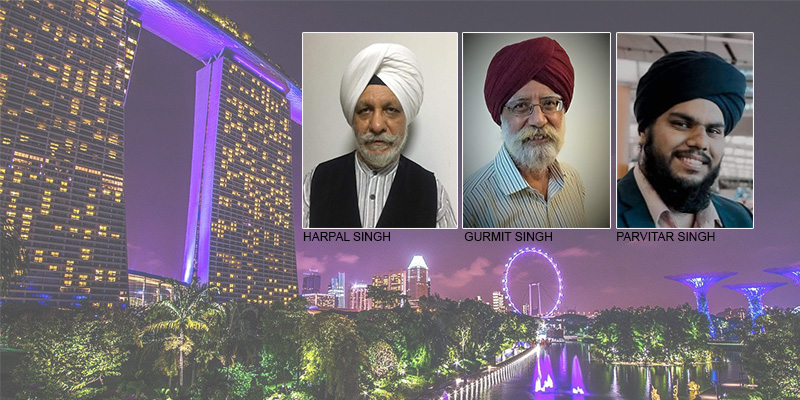
L-R: Harpal Singh, Gurmit Singh and Parvitar Singh
By Asia Samachar| SINGAPORE |
Parvitar Singh has been roped into the youth council of the Inter Religious Organization Singapore (IRO). The Sikh youth leader has been appointed vice chair of IRO Youth Singapore.
The 24-year old community activist is the founder of Fruits of Labour, a ground up movement which looks to empower migrant and blue collared workers.
IRO’s main council has two Sikh representatives for the 2020-2021 term. They are retired army officer Harpal Singh, a former IRO secretary who now serves as its treasurer. Also on board is Gurmit Singh Mehervan Singh, a retired teacher who has been serving the council since 1999.
The IRO was formed in 1949 by religious leaders from different faiths, with a timeless purpose to achieve harmony of faiths in Singapore. The outfit is represented by followers of major religions: Hinduism, Judaism, Zoroastrianism, Buddhism, Taoism, Jainism, Christianity, Islam, Sikhism and Baha’i.
ASIA SAMACHAR is an online newspaper for Sikhs / Punjabis in Southeast Asia and beyond.Facebook | WhatsApp +6017-335-1399 | Email: editor@asiasamachar.com | Twitter | Instagram | Obituary announcements, click here |
“There was a time when the British insisted that Sikhs joining the colonial British Army must be Amritdhari (fully initiated), practising Sikhs wearing all their articles of faith. During the two World Wars, some 1.5 million Amritdhari Sikhs fought for the freedom of the United Kingdom, Europe and humankind. 83,000 Sikhs gave their lives, whilst 110,000 were wounded. Many gallant Sikhs were awarded Victoria Crosses (or equivalent awards) for their bravery. Sikhs have been living in some Western countries like the United Kingdom, Canada and America as a significant visible community for well over half a century. Before that, during the British colonial period, they were encouraged to migrate to countries in East Africa and South East Asia as soldiers, policemen and skilled workers. In recent years Sikhs have migrated to Australia and even to South American countries. Yet, direct and indirect challenges to visible Sikh identity have increased, especially since 9/11; so that their sense of belonging in the Western countries they live in as hardworking and law abiding citizens, has been “put in jeopardy“. (Gurmukh Singh OBE, Challenges to Sikh Identity in the West, Sikh Missionary Society UK[i])
“Institutional racism” was first defined by Sir William Macpherson in the UK’s Lawrence report (1999) as: “The collective failure of an organization to provide an appropriate and professional service to people because of their colour, culture, or ethnic origin. It can be seen or detected in processes, attitudes and behaviour that amount to discrimination through prejudice, ignorance, thoughtlessness, and racist stereotyping which disadvantage minority ethnic people.”
Institutional racism in the government and agencies, legislative assemblies, the courts, the health and educational systems and other public and private sector bodies is directed against a people like the Sikhs because they are seen to be “different”. They are different not just because of their visible identity in case of Amritdhari (initiated) Sikhs and Sikhs who keep turbans and beards but also due to their association with a way of life based on creed, culture and customs.
The Jewish people are not visibly different from the white majority but there is institutional discrimination against them. This clear understanding for the basis of “them and us” discrimination because “they” are “different” is important, for “different” does not refer to difference in physical appearance only as some Sikhs who claim to represent Sikhs, believe. Those same Sikhs have also misled the policy makers and those who collect statistics about communities like the Office for National Statistics in the UK to count and monitor their treatment. Miri-Piri (politico-spiritual) Sikhi is much more than a “religion” in the traditional sense. It is a whole-life temporal-spiritual paradigm which gave birth to a distinct people, a qaum or a nation.
Sikhs are victims of institutional discrimination because of their qaumi ethos; their Sikh way of life, values, behaviour and characteristics, of which, varying degrees of religious observance is one aspect. Sikhs leading Panthic “morchas” are not always very “religious”. For example, the recent farmers protest against unjust and oppressive Indian farm laws is led by Sikhs fired mainly by liberating Sikh values. The Sikhs range from Amritdhari, Naam Abhiyasi (fully practising) GurSikhs to Sikhs who hardly observe Sikh Reht but have deep-rooted qaumi sentiments expressed along the line, “We are the proud Sikhs of Guru Nanak- Guru Gobind Singh”. For them the Gurus are their qaumi Miri-Piri heroes. These are Sikhs from all over India and not just Sikhs from what is left of Panjab. That is in response to those who misleadingly argue the “Panjabi qaum” case in the context of Sikh “ethnicity” as defined by the Lords in the Mandla case 1983.)
One important aspect of preserving the history and heritage of UK Sikhs is to keep a record of institutional racism against the community by keeping a digital library of old court cases, reports and images. This would be a historical record of the challenges faced by the community in settling down while trying to preserve own religio-cultural identity. Otherwise, “The Sikhs are a role model community and provide an exceptionally interesting example of successful integration whilst maintaining a very visible and distinctive religious identity.” (The Sikh Manifesto 2015-2020). In fact, it has been suggested that all Sikh diaspora countries should keep and maintain such a record for next generations.
There can be parallel projects like Sikh museums of early settlers where actual old photos, artefacts and documents are displayed for the benefit of next generations. To some extent such initiatives have been ongoing through Anglo-Sikh heritage and other projects undertaken by organisations and dedicated individuals.
Recent findings of the prolonged Daniel Morgan murder investigation into Scotland Yard remind UK Sikhs of their own experience in dealing with public servants and ministers. Civil servants work across departments and any form of institutional weaknesses and biases in the State system are unlikely to be isolated. The Sikh interest is in evidence which shows institutional bias against them because they are “different”.
As a lawyer noted, “The State and political powers prefer to deal with a uniform set of rules, values and ideas and tend to conspire against diverse cultures, religions and traditions.” (Sikh lawyer Sukhvinder Thandi[ii]). So, is there evidence that State political powers – ministers and civil servants – actually “conspire against diversity” represented by the distinct Sikh community? There is need to collate such evidence through a process like an inquiry e.g. British Sikh Inquiry into institutional racism in the UK.
Due to long-standing Anglo-Sikh relations, Sikhs expected full legal safeguards for their visible Sikh identity and culture including religious practice. It was precisely the distinctive Sikh identity and what it stood for, which was valued and promoted by colonial Britain. Yet, when Sikhs arrived in the UK after the 1947 partition, they were compelled by economic circumstances to discard their proud Sikh identity. That suggests a failure on the part of UK policy makers to accommodate diversity. The community is unlikely to recover from that early identity loss passed on as negative heritage to next generations. Numerous court battles had to be fought by the more resilient and determined Sikhs to secure even basic rights.
The evidence produced before panels and courts is there because some who stood up to prejudice and racism are still around. All that evidence should be collated and preserved. It takes a prolonged, determined and expensive public inquiry like the Daniel Morgan Independent Panel investigation into police handling of the murder case to expose any wrong doing by public servants. It is important to collate documented evidence of institutional racism, corruption and cronyism over the changing race relation period in the UK over the last 60 years when Sikhs started settling in significant numbers.
For example, in recent years, over half a million British Sikhs have been denied their legal right to be counted and monitored as a distinct ethnic group under the current system. Despite taking the matter to the courts, they have not been allocated own ethnicity (qaumi) tick box in the Census. Leaving aside ignorance about Sikhi Miri-Piri tradition, objections based on trade relations with Indian have been used by some. Unless there is a public investigation into the consultation and decision-making processes in the Office for National Statistics (ONS), British Sikhs will remain totally confused about this issue which seriously affects their rights as a distinct community. That is a wrong perpetrated against a whole community. That is a conspiracy against diversity referred to by Sikh lawyer Sukhvinder Thandi quoted above.
To save and remember qaumi heritage and history is to save qaumi existence and identity. In itself it is a process of self-identification in a multi-cultural society. To respect and to have pride in own identity and way of life while respecting that of others in a spirit of unity in diversity. That is the true spirit of democratic multi-culturalism. That is “Anekta meh ekta” principle preached by Guru Gobind Singh.
Evidence of institutional racism requires case histories including documentation relating to cases taken to the courts and tribunals. The process would be in the nature of an inquiry by the community. Anyone arriving in the UK in late 1950’s and early 1960’s was compelled to cut his hair and discard his turban. I have seen first generation Sikhs looking at own images in mirrors after discarding their proud Sikh identity and crying aloud in anguish. What would their parents and families think of them back home?
Sikhs became more organised and took matters to the courts to secure their basic religious rights. It was an uphill struggle and some rights were won in the courts but most grudgingly conceded by the public and private sectors. The obstructive challenges came from the policy makers, the senior civil servants and ministers. As is the Sikh experience in the case of Sikh ethnic (qaumi) tick box in the Census, such challenges continue. Regrettably, there are those within the community who claim to be “leaders” or “representatives” and oblige the establishment by making compromises from which the community cannot recover for many generations.
As questions are being raised in the West about the damage done by colonial attitudes and institutional racism, the Sikhs too need to take timely steps to record their own experience.
[ii]State Policy and Legislation Affecting Sikhs, SHRG, 2001.
Gurmukh Singh OBE, a retired UK senior civil servant, chairs the Advisory Board of The Sikh Missionary Society UK. Email: sewauk2005@yahoo.co.uk. Click here for more details on the author.
* This is the opinion of the writer, organisation or publication and does not necessarily represent the views of Asia Samachar.
ASIA SAMACHAR is an online newspaper for Sikhs / Punjabis in Southeast Asia and beyond.Facebook | WhatsApp +6017-335-1399 | Email: editor@asiasamachar.com | Twitter | Instagram | Obituary announcements, click here |