

























 By Karminder Singh | Sikhi Concepts | Part 4 of 12 |
The ongoing premise of these series of videos (and essays) is that Guru Nanak Redefined, in a Revolutionary way – all the spiritual concepts that existed for thousands of years before him.
The metaphorical depiction of that premise was that Guru Nanak’s Portrait of Sikhi was painted over an existing canvas – a canvas that had existed for 4,000 years prior to Guru Nanak.
The implications of the premise are twofold. First, that while all the concepts of the old canvas are MENTIONED in the Sri Guru Granth Sahib (SGGS), they have been given NEW meanings.
Two, IF we intend to appreciate the Sikhi of Guru Nanak, we will need to understand the NEW or REDEFINED meanings or what we call the Gurbani meanings – of the concepts – as contained within the Sri Guru Granth Sahib.
This short video looks at the concept of 8.4 MILLION life forms or 84 lakh (chaurasi lakh) joon. Let’s begin with examining the basics of the 4-thousand-year-old canvas pertaining to 8.4 million.
TO WATCH THE VIDEO, CLICK HERE
The primary argument is that the total count of life forms on earth are 8.4 million in number.
The stated belief is that upon judgement by Drhm Raj in the afterlife, the departed soul goes through these 8.4 million life forms. The new physical form the soul acquires in its next life is determined by an accounting of one’s deeds in the human life. The soul may take the form of a cat, rat, a snake, cow, swine, or the mighty croc – just to name a few.
The specific path for the reincarnation journey of the departed soul is also determined in the judgement. In other words, the judgement determines that the 8.4 million cycle will begin with a particular life form of life and end with another particular one. Once the 8.4 million cycle is completed – the soul comes back in human form.
And this whole cycle repeats. These details are contained within the ਸਵੇਤਾ ਸਵਰਤਰ ਉਪਨਿਸ਼ਦ Sweta Swartar Upnishad – an ancient Sanskrit text.
The chilling and scary details of this journey – never travelled by anyone ever – were contained within numerous concepts on the old canvas. All this about a journey that NO one has travelled, and no one has come back to file a report on. But presented as a religious FACT, and religious TRUTH. And believed as REAL by millions. And accepted by millions more.
What is most chilling really is that this narative of afterlife – drawn from the 4K year old canvas – is the one that is presented by our clergy – our granthis, ragis, parcharaks and our kirtanias in our gurdwaras as Sikhi beliefs.
Our granthis, ragis and kirtanias – sing shabds from the SGGS during the death ceremonies of our loved ones and their barsis – but present narratives derived from the Upanishads to our sangats. In short its Kirtan of Gurbani but discourse of the 4K year old discarded canvas.
The social media is inundated with individuals – dressed as Sikhs and claiming to be Sikhs – quoting Gurbani verses even, but pushing the narratives of the Upanishads in their misguided proclamations that Guru Nanak accepted the beliefs of the 4K old canvas.
The outcome is this. The narrative that is held within the psyche of a vast majority of Sikhs is NOT the narrative of Gurbani, but that of the 4K year old canvas. And this vast majority of Sikhs mistakenly think and accept and believe the narrative of the Upanishads pertaining to 8.4 mil to be the narrative of Gurbani. Nothing can be further from the truth.
So what is the narrative of 8.4 million life forms within Gurbani? We can develop the basic principles by examining some verses that discourse the concept.
The first thing that Gurbani does is to debunk the notion that the total number of life forms is 8.4 million. For one, no one has done the counting. And those people whose business it is to count life forms – namely the scientists, biologists and zoologists – they have gone way beyond this minuscule 8.4 million AND are still counting.
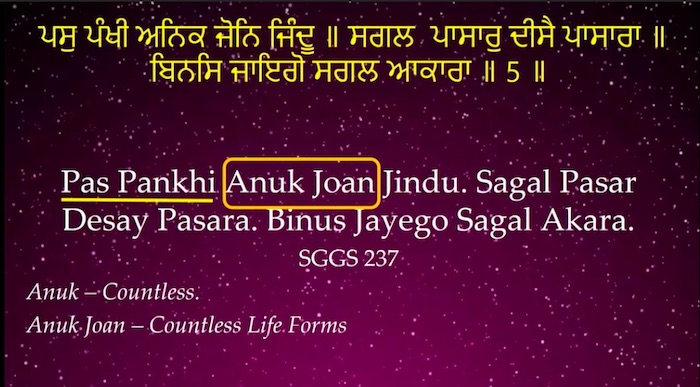 The verse in Gurbani on page 237 is illustrative:
ਪਸੁ ਪੰਖੀ ਅਨਿਕ ਜੋਨਿ ਜਿੰਦੂ ॥ ਸਗਲ ਪਾਸਾਰੁ ਦੀਸੈ ਪਾਸਾਰਾ ॥ ਬਿਨਸਿ ਜਾਇਗੋ ਸਗਲ ਆਕਾਰਾ ॥ 5 ॥
Pas Pankhi Anuk Joan Jindu. Sagal Pasaar Deesaiy Pasara. Bines Jayego Sagal Akara.
The word being used is ਅਨਿਕ Anuk – which means countless, beyond count, innumerable. ਅਨਿਕ ਜੋਨਿ Anuk Joan means countless life forms. The words ਪਸੁ ਪੰਖੀ Pas Pankhi tell us that the reference is to the animal kingdom.
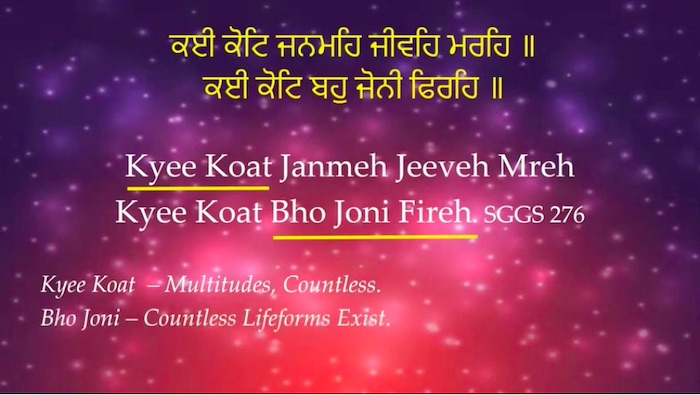 Here is another verse:
ਕਈ ਕੋਟਿ ਜਨਮਹਿ ਜੀਵਹਿ ਮਰਹਿ॥ ਕਈ ਕੋਟਿ ਬਹੁ ਜੋਨੀ ਫਿਰਹਿ ॥
Kyee Koat Janmeh Jeeveh Mreh. Kyee Koat Bho Joani Fireh.
ਕਈ ਕੋਟਿ Kyee Koat means – multitudes, countless. ਬਹੁ ਜੋਨੀ ਫਿਰਹਿ Bho Joani Fireh means countless lifeforms are in existance.
So it’s clear, Gurbani does NOT accept the 8.4 million limiting count as a fact. There is a reason for this. Which is that the Creator cannot be limited, cannot be boxed in with numbers and counts. 8.4 million may have sounded a near-infinite number 4K years ago, but as far as Gurbani is concerned it is a minuscule number. The Creator of Gurbani is beyond fathom. The Creation of the Creator is equally beyond fathom. It cannot be put into numbers. Certainly not into concocted numbers.
That is why when it comes to putting down the Gurbani belief as to how many life forms there are in Creation – Gurbani uses the words KOAT and ANEYK – meaning multitudes, uncountable, beyond fathom etc.
Consequently, when 84 Lakh is used in Gurbani – it refers to the pre-existing concept, it refers to the 4K year old belief. It refers to a belief of 8.4 million in the AFTER life. A belief that is NOT subscribed to by Gurbani, a belief that is CRITIQUED in Gurbani, a belief that goes contrary to the belief of ANEK and KOAT of Gurbani. It refers to the belief that NEEDED to be redefined, and IS Re-defined within Gurbani to fit the Canvas of Guru Nanak. The Canvas of Life. The Canvas of Here and Now.
So this, in essence, is the first primary difference. The old Canvas says total number of life forms is 8.4 million. Gurbani says no one has counted, the Creator cannot be limited to any fixed number, and Gurbani therefore rejects this fixed figure. There is a second critical difference and this relates to the issue of the deceased individual taking on 8.4 million life forms in its journey of after-life.
The FIRST thing Gurbani does within the REPAINTED Canvas is to undertake a revolutionary REDEFINING of the concept of Joons. Guru Nanak’s canvas redefines Life Forms.
Gurbani anchors the notion of life forms, the notion of Joons into the HERE and NOW. Gurbani plants it FIRMLY into the life that we have in the HERE and NOW. Gurbani GROUNDS the 8.4 million notion into our present life – and NOT something that exists in the AFTER LIFE. This is the second critical difference. This is the crux of the revolutionary and innovative re-defining.
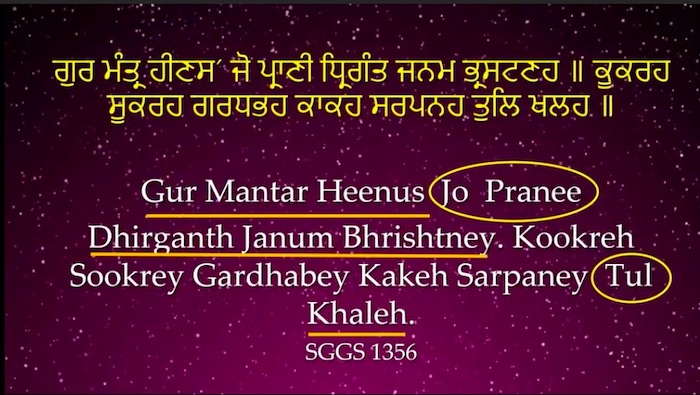 The following verse from page 1356 of the SGGS makes this clear.
ਗੁਰ ਮੰਤ੍ਰ ਹੀਣਸ´ ਜੋ ਪ੍ਰਾਣੀ ਧ੍ਰਿਗੰਤ ਜਨਮ ਭ੍ਰਸਟਣਹ ॥ ਕੂਕਰਹ ਸੂਕਰਹ ਗਰਧਭਹ ਕਾਕਹ ਸਰਪਨਹ ਤੁਲਿ ਖਲਹ ॥
Gur Mantar Heenus Jo Pranni Dhrigant Janum Bhresthneh. Kookreh Sookreh Gardhbey Kakeh Sarpney Tul Khaley.
The second verse contains mention of a number of animals – ਕੂਕਰਹ ਸੂਕਰਹ ਗਰਧਭਹ ਕਾਕਹ Kookreh Sookreh Gardhbey Kakeh and ਸਰਪਨਹ Sarpney. ਕੂਕਰਹ Kookreh is a dog, ਸੂਕਰਹ Sookreh is a pig, ਗਰਧਭਹ Gardhbey is a donkey, ਕਾਕਹ Kakeh is a crow, ਸਰਪਨਹ Sarpney is a snake.
All are animal life forms. If we look at the first verse, we see the REDEFINING in the clearest of terms.
Of key importance are the terms ਜੋ ਪ੍ਰਾਣੀ Jo Pranni which mean that human being. A certain kind of human being. A human being with a certain type of a mental state. A living person with a certain mental make-up. A human being with a certain kind of mind-set. What kind? Gurbani says: ਗੁਰ ਮੰਤ੍ਰ ਹੀਣਸ Gur Mantar Heenus meaning one who DISCARDS the Guru’s advice. One who Rejects the Guru’s messages.
ਮੰਤ੍ਰ Mantar comes from the Sanskrit word MANTRI – Advisor or what we call a minister these days.
ਗੁਰ ਮੰਤ੍ਰ ਹੀਣਸ´ ਜੋ ਪ੍ਰਾਣੀ Gur Mantar Heenus Jo Pranni means that person, that individual, that living human being who ignores the Guru’s spiritual advice. Then we have this phrase ਧ੍ਰਿਗੰਤ ਜਨਮ ਭ੍ਰਸਟਣਹ Dhrigant Janum Bhresthneh. Which means – is wasting one’s life, squandering his or her life. The we have the word ਖਲਹ Khleh which refers again to a human being, an ignorant human being. One who is not only squandering one’s life, but squandering it in complete ignorance – ਖਲਹ Khleh. The reference is clearly to our present life, life as being lived in the Here and Now.
Then there is this word ਤੁਲਿ Tul hich means akin to, just like, comparable with.
So the meaning of the verse is – Human beings ਜੋ ਪ੍ਰਾਣੀ Jo Pranni who discard or reject the Shabd Guru’s advice – waste their lives, squander their lives – their present lives, their lives in the HERE and NOW by living it akin to ਕੂਕਰਹ ਸੂਕਰਹ ਗਰਧਭਹ ਕਾਕਹ ਸਰਪਨਹ Kookreh Sookreh Gardhbey Kakeh and ਸਰਪਨਹ Sarpney. They live it AKIN to these animalistic mindsets in ignorance and in disregard of the Guru’s spiritual advice.
So ਕੂਕਰਹ ਸੂਕਰਹ ਗਰਧਭਹ ਕਾਕਹ Kookreh Sookreh Gardhbey Kakeh and ਸਰਪਨਹ Sarpney – dog, pig, donkey, crow, snake – are NOT life forms in the AFTER LIFE, but MENTAL STATES. They are STATES of the MIND lived by us in the HERE and the NOW.
Here is another verse of Guru Nanak from page 832 of the SGGS and on the same lines.
ਸੂਕਰ ਸੁਆਨ ਗਰਧਭ ਮੰਜਾਰਾ ॥ ਪਸੂ ਮਲੇਛ ਨੀਚ ਚੰਡਾਲਾ ॥ ਗੁਰ ਤੇ ਮੁਹੁ ਫੇਰੇ ਤਿਨੑ ਜੋਨਿ ਭਵਾਈਐ ॥ ਬੰਧਨਿ ਬਾਧਿਆ ਆਈਐ ਜਾਈਐ ॥
Sookar Suan Gardhab Manjara. Psu Mlech Neech Chandala. Gur Tay Moh Fayray Tin Joan Bhvayeay. Bandhan Bandhiya Aiyeah Jayeah.
The phrase ਗੁਰ ਤੇ ਮੁਹੁ ਫੇਰੇ ਤਿਨੑ Gur Tay Moh Fayray Tin refers to us human beings who turn our backs on the messages of the Shabd. What happens to human beings who do such?
We either fall back on or acquire mindsets of ਸੂਕਰ ਸੁਆਨ ਗਰਧਭ ਮੰਜਾਰਾ Sookar Suan Gardhab Manjara. We acquire animalistic mindsets. The greed of a dog ਸੁਆਨ Sookar, the arrogance of a donkey ਗਰਧਭ Gardhab, cowardice / timid-ness of a cat ਮੰਜਾਰਾ Manjara, And demonic mindsests. ਪਸੂ ਮਲੇਛ ਨੀਚ ਚੰਡਾਲਾ Psu Mlech Neech Chandala.
The mention of animals ਸੂਕਰ ਸੁਆਨ ਗਰਧਭ ਮੰਜਾਰਾ Sookar Suan Gardhab Manjara – are meant to reference the mindsets OF THE HUMAN BEING – Gurbani is meant for human beings, certainly not for those in the animal kingdom.
It needs to be made clear that Gurbani is not critiquing the traits and behaviour of animals. Animals are instinct based. There is nothing wrong with those instincts because they define the animals concerned. The critique is against human beings with a mind, intellect and capacity to know – BUT choose to define their humanity in terms of animalistic traits.
Here is another verse from page 1418 of the SGGS:
ਜਿਨਾ ਸਤਿਗੁਰੁ ਪੁਰਖੁ ਨ ਸੇਵਿਓ ਸਬਦਿ ਨ ਕੀਤੋ ਵੀਚਾਰੁ ॥ ਓਇ ਮਾਣਸ ਜੂਨਿ ਨ ਆਖੀਅਨਿ ਪਸੂ ਢੋਰ ਗਾਵਾਰ ॥
Jinna Satgur Purakh Na Sayveyo Shabd Na Keeto Vichar. Oye Manus Joon Na Akheyan Psu Dhor Gavaar.
Those human beings who have not realized the Creator within ਸਤਿਗੁਰੁ ਪੁਰਖੁ ਨ ਸੇਵਿਓ Satgur Purakh Na Sayveyo and have not contemplated on the messages of the Shabd ਸਬਦਿ ਨ ਕੀਤੋ ਵੀਚਾਰੁ Shabd Na Keeto Vichar.
The Guru says, I consider them NOT as living the human life form ਓਇ ਮਾਣਸ ਜੂਨਿ ਨ ਆਖੀਅਨਿ Oye Manus Joon Na Akheyan but living the life forms of animals in their unenlightened states ਪਸੂ ਢੋਰ ਗਾਵਾਰ Psu Dhor Gavaar.
ਢੋਰ ਗਾਵਾਰ Dhor Gavaar refers to an unenlightened state, and ਪਸੂ Psu refers to an animal, animalistic.
So the ਪਸੂ Psu of Gurbani is NOT the 8.4 mill life forms in the AFTER LIFE, it refers to MENTAL STATES, STATES of the MIND lived by us in the HERE and the Now. They are MINDSETS of us HUMAN BEINGS in the Here and NOW.
Here is another verse from page 167 of the SGGS.
ਅੰਨੁ ਖਾਣਾ ਕਪੜੁ ਪੈਨਣੁ ਦੀਆ ਰਸ ਅਨਿ ਭੋਗਾਣੀ ॥ ਜਿਨਿ ਦੀਏ ਸੁ ਚਿਤਿ ਨ ਆਵਈ ਪਸੂ ਹਉ ਕਰਿ ਜਾਣੀ ॥੩॥
Ann Khanna Kapurr Paiinnun Deeya Rus Ann Bhoganni. Jin Deyay So Chit Na Aavayi Psu Haon Kar Janni.
The first verse refers to the Creator blessing us with Life and the needs of Life ਅੰਨੁ ਖਾਣਾ ਕਪੜੁ ਪੈਨਣੁ ਦੀਆ ਰਸ ਅਨਿ ਭੋਗਾਣੀ Ann Khanna Kapurr Paiinnun Deeya Rus Ann Bhoganni.
The second verse talks of a state of being that is NOT in appreciation of the Creator as the Give of all these. ਜਿਨਿ ਦੀਏ ਸੁ ਚਿਤਿ ਨ ਆਵਈ Jin Deyay So Chit Na Aavayi.
The next part ਪਸੂ ਹਉ ਕਰਿ ਜਾਣੀ Psu Haon Kar Janni means I have reduced my life – my human life – ਕਰਿ ਜਾਣੀ Kar Janni to that of a ਪਸੂ Psu – an animal.
Again the reference of ਪਸੂ Psu is NOT the 8.4 mill life forms in the AFTER LIFE, it refers to one’s MENTAL STATE, to our STATE of the MIND lived by us in the HERE and the Now ਪਸੂ ਹਉ ਕਰਿ ਜਾਣੀ Psu Haon Kar Janni.
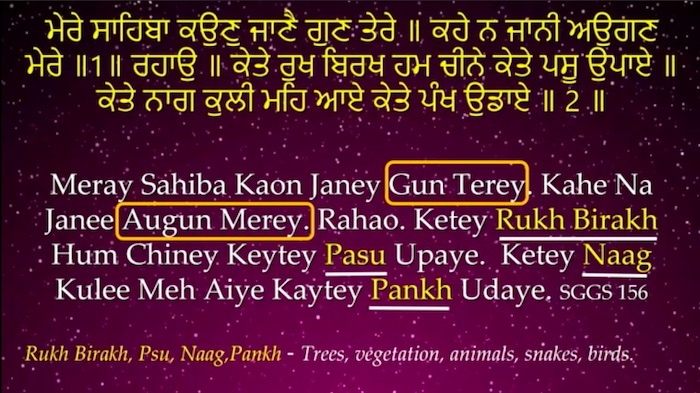 This verse of Guru Nanak on page 156 makes the notion of 8.4 as REDEFINED in Gurbani even clearer.
ਮੇਰੇ ਸਾਹਿਬਾ ਕਉਣੁ ਜਾਣੈ ਗੁਣ ਤੇਰੇ ॥ ਕਹੇ ਨ ਜਾਨੀ ਅਉਗਣ ਮੇਰੇ ॥1॥ ਰਹਾਉ ॥ ਕੇਤੇ ਰੁਖ ਬਿਰਖ ਹਮ ਚੀਨੇ ਕੇਤੇ ਪਸੂ ਉਪਾਏ ॥ ਕੇਤੇ ਨਾਗ ਕੁਲੀ ਮਹਿ ਆਏ ਕੇਤੇ ਪੰਖ ਉਡਾਏ ॥ 2 ॥
Mayray Sahiba Kaonn Janney Gun Tayray. Khay Na Janni Augunn Mayray. Rahao. Kaytay Rukh Birekh Hum Cheenay Kaytay Psu Upaye. Kaytay Naag Kulee Meh Aiyey Kaytay Pankh Udaye.
The first verse – ਮੇਰੇ ਸਾਹਿਬਾ ਕਉਣੁ ਜਾਣੈ ਗੁਣ ਤੇਰੇ Mayray Sahiba Kaonn Janney Gun Tayray is about the Creators Divine Virtues ਗੁਣ ਤੇਰੇ Gun Tayray. The second verse talks about my VICES, my human VICES. ਕਹੇ ਨ ਜਾਨੀ ਅਉਗਣ ਮੇਰੇ Khay Na Janni Augunn Mayray . The word AUGUN is VICES, My Vice filled mindsest.
Guru Nanak is saying BOTH – Divine Virtues and my VICES are equally innumerable. In the next two verses, Guru Nanak provides examples of our Vices.
ਕੇਤੇ ਰੁਖ ਬਿਰਖ ਹਮ ਚੀਨੇ ਕੇਤੇ ਪਸੂ ਉਪਾਏ ॥ ਕੇਤੇ ਨਾਗ ਕੁਲੀ ਮਹਿ ਆਏ ਕੇਤੇ ਪੰਖ ਉਡਾਏ
Kaytay Rukh Birekh Hum Cheenay Kaytay Psu Upaye. Kaytay Naag Kulee Meh Aiyey Kaytay Pankh Udaye.
All of these examples are life forms – ਰੁਖ ਬਿਰਖ, ਪਸੂ, ਨਾਗ, ਪੰਖ Rukh Birekh Psu Naag Pankh – Trees, vegetation, animals, snakes, birds.
It is clear that these examples of life forms refer to our MENTAL STATE, STATE of the MIND lived by us in the HERE and the Now. In other words, a human life filled with Vices. A human life being lived out with animalistic mindsets. A human life lived in animalistic traits.
 Here is yet another set of verses from page 802 of the SGGS.
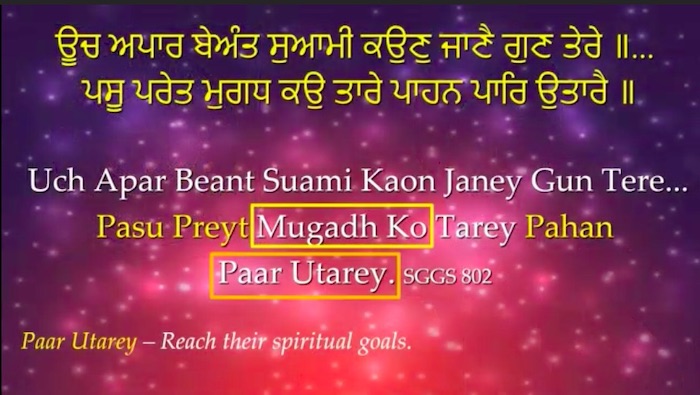
ਊਚ ਅਪਾਰ ਬੇਅੰਤ ਸੁਆਮੀ ਕਉਣੁ ਜਾਣੈ ਗੁਣ ਤੇਰੇ ॥
Uch Apar Bayant Suami Kaonn Janney Gunn Tayray … and ਪਸੂ ਪਰੇਤ ਮੁਗਧ ਕਉ ਤਾਰੇ ਪਾਹਨ ਪਾਰਿ ਉਤਾਰੈ ॥ Psu Prayt Mughad Ko Tarey Pahan Paar Utaray.
Of Such Immense Divinity are Your Virtues O Creator. ਊਚ ਅਪਾਰ ਬੇਅੰਤ ਸੁਆਮੀ ਕਉਣੁ ਜਾਣੈ ਗੁਣ ਤੇਰੇ Uch Apar Bayant Suami Kaonn Janney Gunn Tayray. Why so? How so? The next verse answers that.
ਪਸੂ Psu, Animals, ਪਰੇਤ Prayt Demons, ਪਾਹਨ Pahan Stones become Divine, reach their spiritual goals – ਪਾਰਿ ਉਤਾਰੈ Paar Utaray.
As said above, Gurbani is not for animals, demons, and stones. Animals, demons and stones do not have spiritual Goals. Human Beings alone do, so what is the message of Gurbani here?
It is about mindsets. For ਮੁਗਧ Mugadh persons. For humans with unenlightened mindsets ਮੁਗਧ Mugadh. For Humans with Animalistic mindsets ਪਸੂ Psu. For Humans with Demonic mindsets ਪਰੇਤ Prayt, Humans with hearts and mindsets as hard as stones, rocks and boulder ਪਾਹਨ Pahan. All of these can and do become divine through the acquisition ਜਾਣੈ of Divine Virtues ਜਾਣੈ ਗੁਣ ਤੇਰੇ Janney Gunn Tayray.
This verse of Guru Arjun on page 267 makes it crystal clear.
ਕਰਤੂਤਿ ਪਸੂ ਕੀ ਮਾਨਸ ਜਾਤਿ ॥
Kartoot Psu Kee Manus Jaat.
Meaning: The life form is Human ਮਾਨਸ ਜਾਤਿ Manus Jaat, but the character, deeds, and traits ਕਰਤੂਤਿ Kartoot are animalistic ਪਸੂ ਕੀ Psu Kee.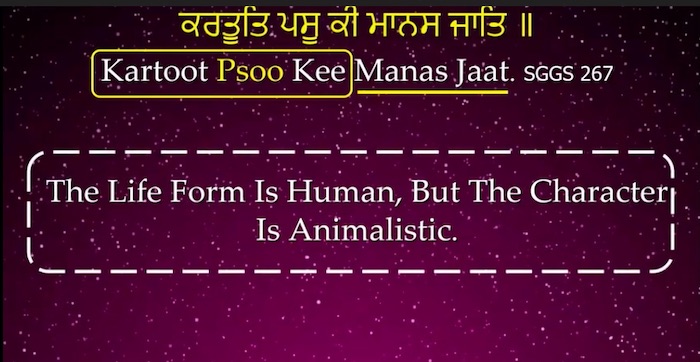
The reference of ਪਸੂ Psu is NOT the 8.4 mill life forms in the AFTER LIFE, it refers to our ਪਸੂਪੁਣਾ Psu-punna. To our STATE of the MIND, our animalistic character, our deeds as lived by us in the HERE and the Now.
Here is a verse that ties all that we have said above. It’s on page 190 of the SGGS.
ਗਉੜੀ ਮਹਲਾ ੫ ॥ ਅਨਿਕ ਰਸਾ ਖਾਏ ਜੈਸੇ ਢੋਰ ॥ ਮੋਹ ਕੀ ਜੇਵਰੀ ਬਾਧਿਓ ਚੋਰ ॥ ੧ ॥ ਮਿਰਤਕ ਦੇਹ ਸਾਧਸੰਗ ਬਿਹੂਨਾ ॥ ਆਵਤ ਜਾਤ ਜੋਨੀ ਦੁਖ ਖੀਨਾ ॥ ੧ ॥ ਰਹਾਉ ॥
Anuk Rsa Khayey Jaisay Dhor Gvaar. Moh Ki Jayvri Ba(n)dheyo Chor. Mirtak Deh Sadhsang Bihuna. Avat Jaat Joni Dukh Kheena. Rahao.
Meaning: Indulging and drowning in Temporal Life ਅਨਿਕ ਰਸਾ ਖਾਏ Anuk Rsa Khayey is akin to living an animalistic life, ਜੈਸੇ ਢੋਰ Jaisay Dhor, the word ਢੋਰ Dhor means an animal. Living such and without spiritual realization – ਸਾਧਸੰਗ ਬਿਹੂਨਾ Sadhsang Bihuna – is to have suffered death ਮਿਰਤਕ ਦੇਹ Mirtak Deh. The word ਮਿਰਤਕ Mirtak means death. The aftermath is the cycle of animalistic mindsets ਆਵਤ ਜਾਤ ਜੋਨੀ Avat Jaat Joni and suffering ਦੁਖ ਖੀਨਾ Dukh Kheena.
Its clear that the DEATH being referred to is SPIRITUAL DEATH – ਮਿਰਤਕ ਦੇਹ Mirtak Deh which is the concern of Gurbani. It is a DEATH that happens in the HERE and NOW, while we are ALIVE. It is also clear that the animalistic Life Forms ਜੈਸੇ ਢੋਰ Jaisay Dhor, being referred to are MINDSETS of ours WHILE STILL ALIVE. It is also clear that the CYCLE of life forms ਆਵਤ ਜਾਤ ਜੋਨੀ Avat Jaat Joni being referred to are cycles that happen to us in the HERE and NOW. And the suffering ਦੁਖ ਖੀਨਾ Dukh Kheena is the suffering in the HERE and NOW – not in some unknown realm of afterlife.
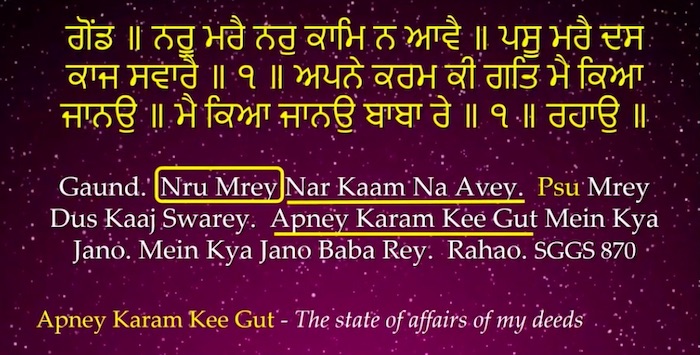 Bhagat Kabir, on page 870 of the SGGS tells us to bring to life the Humanity, bring to life the HUMANE-ness within us and ELIMINATE the animalistic mindsets, animalistic characters and deeds within us. The set of verses is as follows:
ਨਰੂ ਮਰੈ ਨਰੁ ਕਾਮਿ ਨ ਆਵੈ ॥ ਪਸੂ ਮਰੈ ਦਸ ਕਾਜ ਸਵਾਰੈ ॥ ੧ ॥ ਅਪਨੇ ਕਰਮ ਕੀ ਗਤਿ ਮੈ ਕਿਆ ਜਾਨਉ ॥ ਮੈ ਕਿਆ ਜਾਨਉ ਬਾਬਾ ਰੇ ॥ ੧ ॥ ਰਹਾਉ ॥
Nru Mreiy Nur Kaam Na Aveiy. Psu Mreiy Dus Kaj Swareiy. Apnay Karm Ki Gut Mein Kya Jano. Mein Kya Jano Baba Ray. Rahao.
The Rahao verse has the words ਅਪਨੇ ਕਰਮ ਕੀ ਗਤਿ Apnay Karm Ki Gut meaning this is the state of affairs ਕੀ ਗਤਿ Ki Gut of my deeds – ਅਪਨੇ ਕਰਮ Apnay Karm. The state of affairs is that when the HUMAN in Me Dies from Within me – ਨਰੂ ਮਰੈ Nru Mreiy the consequence is that I become of no worth to other beings – ਨਰੁ ਕਾਮਿ ਨ ਆਵੈ Nur Kaam Na Aveiy.
However, when the animal kingdom within me dies, ਪਸੂ ਮਰੈ Psu Mreiy then I become useful to humanity by ten fold ਦਸ ਕਾਜ ਸਵਾਰੈ Dus Kaj Swareiy.
Again, the reference of ਪਸੂ Psu is NOT the 8.4 mill life forms in the AFTER LIFE, it refers to our STATE of the MIND, our character, our deeds as lived by us in the HERE and the Now. That is why the Rahao verse is ਅਪਨੇ ਕਰਮ ਕੀ ਗਤਿ Apnay Karm Ki Gut meaning this is the state of affairs of my deeds.
Esentially then, what is happening in Gurbani is the REDEFINING of the 8.4 mill life forms concept from one that is PHYSICAL and EXTERNAL to one that is INTERNAL. To one that is a Mental Paradigm in the form of CHARACTER and MIND SETS.
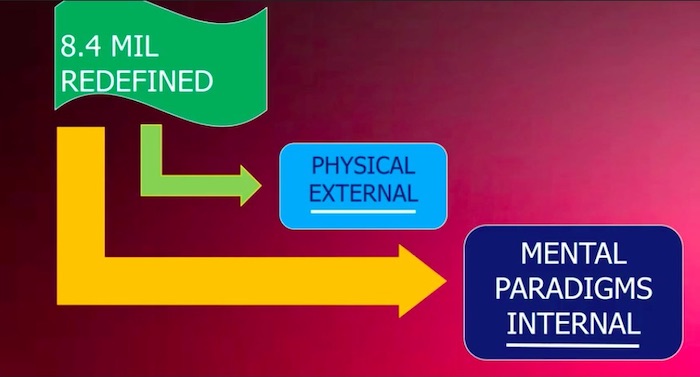 This is a revolutionary redefining. It is revolutionary because Gurbani anchors the notion of life forms, the notion of Joons into the HERE and NOW. Gurbani plants it FIRMLY into the life that we have in the HERE and NOW. Gurbani GROUNDS the notion of Joons and life forms into our present life – and not something that exists in the AFTER LIFE. In doing so, it throws out the concept of 8.4 mil that refers to life forms that the soul – any soul – goes through in the Afterlife or after death.
What is being said by all the verses that have been presented above is that there is a Zoo within us, inside of us. The Zoo is within us as Human Beings. As un-enlightened Human beings. The Zoo is inside us as we are alive. In our Here and Now.
One of France’s greatest mind of the 1800s Victor Hugo put this idea this way 300 years after Guru Nanak gave it to the spiritual world in 1469. This is what he said: All animals are found in men. And each of them exists in some men. Sometimes several at a time. Animals are found in men. Within men. Men who are kicking and alive.
Hugo also said something else. He said Nothing is more powerful than an idea whose time has come. Guru Nanak presented us with powerful, innovative, new, novel and original ideas pertaining to spirituality.
Guru Nanak presented us with a spirituality whose time had come. A spirituality for the 21st century – way back in the 15th Century.
The sad reality is that for a large majority of Sikhs, the time for Guru Nanak’s ideas has not come, and may never come. For a large majority of Sikhs, Guru Nanak has yet to be born into their lives. For a large majority of Sikhs, we are still living the spirituality of 4 K years ago. Perhaps that is why we have prevented the birth of Guru Nanak into our spiritual lives.
We can change this in our lives by acknowledging that the time for Guru Nanak’s Sikhi has come. We can change even if our clergy – our granthis, ragis, parharaks, kirtanias and our gurdwaras won’t allow us to change. Our clergy have a reason to NOT change, to NOT ALLOW us to change, and to NOT preach the truths of Gurbani. It is in their interest to keep us imprisoned within the discarded 4K year old belief system. They are heavily invested in the old canvas. Their livelihoods and fake positions as agents of their concocted God depend on that canvas being kept alive.
But we Sikhs – ordinary, everyday Sikhs wanting to inculcate the truths of Gurbani have no reason to Not want to change.
When You Start Living the Spirituality Whose Time has Come, You Stop Living the Spirituality Whose Time has Run Out.
The next video, part 5 of 12 will examine the concepts of Reincarnation or Ava Gaun as it is called in Gurbani.
SIKHI CONCEPTS SERIES BY DR KARMINDER SINGH DHILLON: COMPLETE LINKS TO VIDEOS & LECTURE NOTES
MASTER LINK: Complete links to videos and lecture notes
PART 1: GURU NANAK’S CANVAS: Video | Lecture Notes
PART 2: DEATH: Video | Lecture Notes
PART 3: AFTER LIFE: Video | Lecture Notes
PART 4: CHAURASI LAKH (8.4 MILLION): Video | Lecture Notes
PART 5: REINCARNATION: Video | Lecture Notes
PART 6: HEAVEN & HELL: Video | Lecture Notes
PART 7: SALVATION (MUKTI): Video | Lecture Notes
PART 8: COURT OF JUDGEMENT (DARGAH): Video | Lecture Notes
PART 9: DHRM RAJ: Video | Lecture Notes
PART 10: JUM DOOT & CHITR GUPT: Video | Lecture Notes
PART 11: ANCESTORS: Video | Lecture Notes
PART 12: APPLYING THE CANVAS: Video | Lecture Notes
Sikh thinker, writer and parcharak Karminder Singh Dhillon, PhD (Boston), is a retired Malaysian civil servant. He is the joint-editor of The Sikh Bulletin and author of The Hijacking of Sikhi. He can be contacted at dhillon99@gmail.com.
* This is the opinion of the writer, organisation or publication and does not necessarily represent the views of Asia Samachar.
RELATED STORY:
Hijacking Sikhi (Asia Samachar, 19 Dec 2020)
Karminder talks about what shaped his thinking, and his latest books on Sikhi (Asia Samachar, 20 Nov 2020)
ASIA SAMACHAR is an online newspaper for Sikhs / Punjabis in Southeast Asia and beyond. Facebook | WhatsApp +6017-335-1399 | Email: editor@asiasamachar.com | Twitter | Instagram | Obituary announcements, click here |




Interesting point by Rawel Singh: “I hope Karminder Singh would take part in the dialogue rather than target my person in different publications.”
Deepak has said it wonderfully in his comment below: But what comes out from you (Rawel Singh) is now a monologue.
Deepak also rightly said : You (Rawel Singh) have decided that Dr Karminder is doing his Gurbani interpretation in bad faith. Why? Because you accused him of ‘twisting’. Looks like you lack confidence in (your own) reasoning.
On the point of “different publications” I see Rawel Singh making personal attacks of “twisting Gurbani” against Dr Karminder Singh on the Gurmat Learning Zone, in Yahoo Groups, on his website and as revealed by Dr Karminder Singh in his reply Benarsi Conspiracies in numerous emails to numerous people.
So why is it OK for you Rawel Singh to bad mouth others on multiple platforms, but not OK for someone to reply to you in different publications (I assume you mean The Sikh Bulletin.)
Mohinder Sahni Ji. Please read my post. There is no reference to after-life. I asked Karminder Singh to take part in dialogue on issues instead of attacking my person.
S. Rawel Singh Jee The pankti ਜਬ ਲਗੁ ਦੁਨੀਆ ਰਹੀਐ ਨਾਨਕ ਕਿਛੁ ਸੁਣੀਐ ਕਿਛੁ ਕਹੀਐ ॥ M: 1, p 660
Let us exchange views while alive relates to divine traits and it has got nothing to do with after life. It translates ‘As long as we are in this world, O Nanak, we should listen, and speak of the Divine traits and articulate our views. (Listen attentively and respectfully with an aim to find the Truth). Gurbani encourages us to have dialogues on divine virtues, but not to expend energy on duality.
Unable to bear that Karminder Singh cannot refute my pointing out twisting Gurbani meanings to justify his agenda, Koomar Singh has resorted to using intemperate language against me. I cannot claim to be fully right so Karminder Singh should respond in the spirit of
ਜਬ ਲਗੁ ਦੁਨੀਆ ਰਹੀਐ ਨਾਨਕ ਕਿਛੁ ਸੁਣੀਐ ਕਿਛੁ ਕਹੀਐ ॥ M: 1, p 660
Let us exchange views while alive.
I hope Karminder Singh would take part in the dialogue rather than target my person in different publications. Please respond to specific points.
Agree with Deepak. Rawel Singh has lost the plot. Completely. Pointless having a discussion with him so fixated on himself.
Personal attacks, alleging that Dr Karminder Singh was “twisting Gurbani,” making ludicrous claims that Dr Karminder Singh was Christian believer, etc were the hallmark of Rawel Singh’s comments when this 12-part series was published for the first time.
So now Rawel Singh is getting unraveled in in dishing out Fareedkoti Vedic translations.
Plus, I see that he is going for Round 2 with his same old personal attacks.
Dr Karminder Singh has exposed Rawel Singh’s fixation with all things Benarsi, Vedic and Puranic here: https://asiasamachar.com/2021/04/26/37897/ and with more detail here: https://sikhbulletin.com/Bulletins/SikhBulletin2021Issue2.pdf
He has further begun exposing that Rawel Singh’s translations are plagiarized from the Fareedkoti Translation. Part 1 titled The Sri Guru Granth Sahib Translation by Rawel Singh: A Critical Review can be read here: https://sikhbulletin.com/Bulletins/SikhBulletin2021Issue2.pdf
I am eagerly waiting for Part 2 and subsequent parts.
Mohinder Sahni Ji: S. Rawel Ji Dr. Karminder Jee has rightly said while all the concepts of the old canvas are MENTIONED in the Sri Guru Granth Sahib (SGGS), they have been given NEW meanings. New meaning means it is totally rejected thus question of unequivocally fixed numbers or alternative interpretation does not arise.
RS. Firstly please do not drop Singh from my name. I am happy to be known as a practicing Sikh. Secondly simply making a statement does not change things. He never responds to any comments, so you may like show how Gurbani rejects these concepts. Serious study shows that what Gurbani actually does is to reject the symbolism and ritualism advocated by the Hindu clergy. For example, Japji paurri rejects bathing, meditation, gathering money or personal wisdom/Siaanap to attain satisfaction. He or you should please show such rejection for after-life, Dharam Rai, Chitr Gupt and Jam, which according to him stand rejected in Gurbani, and you seem to agree. Rejection means direct rejection as in Japji Paurri 1, not by inference.
S. Rawel Ji Dr. Karminder Jee has rightly said while all the concepts of the old canvas are MENTIONED in the Sri Guru Granth Sahib (SGGS), they have been given NEW meanings. New meaning means it is totally rejected thus question of unequivocally fixed numbers or alternative interpretation does not arise.
Deepak Ji writes:
Deepak: On Point No 1, you are no longer open to the possibility of changing your view on the issue at hand. Your mind is made up. Good for you, perhaps. But what comes out from you is now a monologue.
RS: I hold no personal views and rely only on Gurbani, However, my interpretation of Gurbani may be erroneous. Kindly point that out and we can discuss. As for the monologue, I have been requesting Karminder Singh to respond to my comments. He did it only once, but did not respond to the issues and chose only to criticize me sayng I am following Benares conspiracy.
DEEpak: On Point No 2, you have decided that Dr Karminder is doing his Gurbani interpretation in bad faith. Why? Because you accused him of ‘twisting’. Looks like you lack confidence in reasoning.
RS: Kindly point out any instance where it was not justified. However, I have never used the expression “bad faith”. I say he does it to suit his agenda/beliefs. Please face realities, do not rely on some article you read without mentioning the context.
Dear Mr Rawel Singh. As a fellow Gurmat buff, you are welcome to provide your interpretation and tell the world where/how you disagree with the interpretations of Dr Karminder Singh Dhillon, or anyone else for that matter. You can put forward your arguments. Instead, you accuse Dr Karminder of ‘twisting’ Gurbani meanings. That is loaded. That is a personal attack! And, sadly, it reveals the state of your mind. Looks like you’ve lost it – the ability to disagree without being disagreeable.
One of the traits of critical thinkers is being open-minded. It entails the following:”Critical thinkers are open and receptive to all ideas and arguments, even those with which they may disagree. Critical thinkers reserve judgment on a message until they have examined the claims, logic, reasoning, and evidence used. Critical thinkers are fair-minded and understand that a message is not inherently wrong or flawed if it differs from their own thoughts. Critical thinkers remain open to the possibility of changing their view on an issue when logic and evidence supports doing so.”
Another point is confidence in reasoning. “Critical thinkers have faith in the power of logic and sound reasoning. Critical thinkers understand that it is in everyone’s best interest to encourage and develop sound logic. More importantly, critical thinkers value the power of letting others draw their own conclusions.”
I picked up the above from an article. On Point No 1, you are no longer open to the possibility of changing your view on the issue at hand. Your mind is made up. Good for you, perhaps. But what comes out from you is now a monologue. On Point No 2, you have decided that Dr Karminder is doing his Gurbani interpretation in bad faith. Why? Because you accused him of ‘twisting’. Looks like you lack confidence in reasoning.
Deepak Ji. You said “But you may want to drop personal attacks. You wrote – ‘I call upon Karminder Singh to stop twisting Gurbani meanings to suit his agenda.’ ” As may be seen from my post, I have detailed how Karminder Singh twists Gurbani meanings by quoting Gurbani but giving meanings which have no bearing on the original. Asking him not to do so cannot be considered a personal attack
Mohinder Sahni Ji, you have written what you believe. When Gur Nanak has unequivocally said that this number cannot change. We should accept it as such. Or give an alternative interpretation for the words used by Guru Nanak if there is one. As for the second line, it says those who love God – they obey and unite with God – and are not subject to the 84 lakh Joona. This is the consistent Gurbani teaching. It does not reject the number.
Rawel Jee with regard to your translation of ਲਖ ਚਉਰਾਸੀਹ ਮੇਦਨੀ ਘਟੈ ਨ ਵਧੈ ਉਤਾਹਿ ॥ M: 1, p 936 if you read the second line ਸੇ ਜਨ ਉਬਰੇ ਜਿਨ ਹਰਿ ਭਾਇਆ ॥ it will clear what Gurbani is trying to say here is that inculcating the divine virtues, the 5 evils will be eliminated. If they are gone, you will no longer fluctuate between different personalities, you will no longer be a greedy snake one day and a lustful elephant the next, you will have effectively broken the cycle, no more reincarnations for you, and as a result, be living a Gurmukh lifestyle.
Further Guru Nanak is mentioning the Eastern concept (Mythology) that 8.4 millions of species neither increase or decrease in number without further explanation except that false comes and go and one comes and goes without mentioning entering into the cycle of 8.4 million species. This is not the concept of Guru Nanak. It is an idiom used in the granth sahib. Please refer to sukhmani sahib where there is a complete ashtpadi on “keyi kote”–meaning, countless ! No one can put a definite number to life on earth. Guru Nanak’s concept of His creation is ‘vurhi kalam’ (infinite)is being continously written.
Scientifically also there is no fixed number of species on this Earth. New species are coming up and some are disappearing at greater speed. In fact many species are disappearing every year because of changes in environment.
I have read, and re-read, Dr Karminder Dhillon’s articles in this series. I’m persuaded by his arguments. I must say they run counter to my present understanding. But they make sense. They force me to unlearn, relearn. It’s amazing how we have been living with false notions of our faith all these years. So much for our understanding of the Sikh faith.
Mr Rawel Singh. Good to see you sharing your views on this topic. But you may want to drop personal attacks. You wrote – ‘I call upon Karminder Singh to stop twisting Gurbani meanings to suit his agenda.’ Why the need for such a personal attack on a fellow writer? Make your point and stop there. It will better serve you.
The principle in study of Gurbani should be at accept what Gurbani says with a discerning mind. However Karminder Singh has made up his mind that Gurbani rejects everything mentioned in earlier Indian beliefs. He manipulates Gurbani meanings to prove this. Here are some examples from this article.
KS: The first thing that Gurbani does is to debunk the notion that the total number of life forms is 8.4 million.
RS: In this he repudiates Guru Nanak who says this number can neither be reduced nor increased.
ਲਖ ਚਉਰਾਸੀਹ ਮੇਦਨੀ ਘਟੈ ਨ ਵਧੈ ਉਤਾਹਿ ॥ M: 1, p 936
Lakẖ cẖa▫orāsīh meḏnī gẖatai na vaḏẖai uṯāhi.
There are (lakh = one hundred thousand, chauraaseeh = eighty four) 8.4 million life forms in (m-edni) the creation, which number can neither (ghattai) be reduced nor (vadhai) increase (utaah-i) upward.
He tries to prove this by saying
KS: The verse in Gurbani on page 237 is illustrative:
ਪਸੁ ਪੰਖੀ ਅਨਿਕ ਜੋਨਿ ਜਿੰਦੂ ॥ ਸਗਲ ਪਾਸਾਰੁ ਦੀਸੈ ਪਾਸਾਰਾ ॥ ਬਿਨਸਿ ਜਾਇਗੋ ਸਗਲ ਆਕਾਰਾ ॥ 5 ॥
Pas Pankhi Anuk Joan Jindu. Sagal Pasaar Deesaiy Pasara. Bines Jayego Sagal Akara.
The word being used is ਅਨਿਕ Anuk – which means countless, beyond count, innumerable. ਅਨਿਕ ਜੋਨਿ Anuk Joan means countless life forms. The meaning of these words is different.
ਪਸੁ ਪੰਖੀ Pas Pankhi tell us that the reference is to the animal kingdom.
RS: He ignores the real message of the verse that everything created perishes, but tries to prove what he wants to. Anik means ‘not one’, i.e. numerous. ਜਾਤਿ ਵਰਨ ਤੁਰਕ ਅਰੁ ਹਿੰਦੂ ॥ਪਸੁ ਪੰਖੀ ਅਨਿਕ ਜੋਨਿ ਜਿੰਦੂ ॥ਸਗਲ ਪਾਸਾਰੁ ਦੀਸੈ ਪਾਸਾਰਾ ॥ਬਿਨਸਿ ਜਾਇਗੋ ਸਗਲ ਆਕਾਰਾ ॥੫॥ M: 5, p 237
Jāṯ varan ṯurak ar hinḏū Pas pankẖī anik jon jinḏū Sagal pāsār ḏīsai pāsārā Binas jā▫igo sagal ākārā ||5||
।੫।
(Jaat varan) castes, (turk are hindu = Muslims and Hindus) religions.
(Pas, pankhi) animals and birds (anik jon jindu) numerous life forms of the creatures.
(Sagal) all (paasaar) expanse (deesai) that is seen
In short (sagal) all forms of (aakaara) physical existence (binas jaaego) shall (binas) perish. 5.
Next he quotes
KS: ਕਈ ਕੋਟਿ ਜਨਮਹਿ ਜੀਵਹਿ ਮਰਹਿ॥ ਕਈ ਕੋਟਿ ਬਹੁ ਜੋਨੀ ਫਿਰਹਿ ॥
Kyee Koat Janmeh Jeeveh Mreh. Kyee Koat Bho Joani Fireh.
ਕਈ ਕੋਟਿ Kyee Koat means – multitudes, countless. ਬਹੁ ਜੋਨੀ ਫਿਰਹਿ Bho Joani Fireh means countless lifeforms are in existance.
RS: ਕੋਟਿ means crore or One hundred Lakh, i.e. ten million. ਕੋਟਿ is used in Gurbani for large numbers and in no way rejects the number 84 lakhs.
The next is an example of Karminder Singh laboring to prove something Gurbani does not say. He sees reincarnation in the following lines which have a simple message that those who do not follow the guru act like animals.
KS: ਗੁਰ ਮੰਤ੍ਰ ਹੀਣਸ´ ਜੋ ਪ੍ਰਾਣੀ ਧ੍ਰਿਗੰਤ ਜਨਮ ਭ੍ਰਸਟਣਹ ॥ ਕੂਕਰਹ ਸੂਕਰਹ ਗਰਧਭਹ ਕਾਕਹ ਸਰਪਨਹ ਤੁਲਿ ਖਲਹ ॥
Gur Mantar Heenus Jo Pranni Dhrigant Janum Bhresthneh. Kookreh Sookreh Gardhbey Kakeh Sarpney Tul Khaley.
The second verse contains mention of a number of animals – ਕੂਕਰਹ ਸੂਕਰਹ ਗਰਧਭਹ ਕਾਕਹ Kookreh Sookreh Gardhbey Kakeh and ਸਰਪਨਹ Sarpney. ਕੂਕਰਹ Kookreh is a dog, ਸੂਕਰਹ Sookreh is a pig, ਗਰਧਭਹ Gardhbey is a donkey, ਕਾਕਹ Kakeh is a crow, ਸਰਪਨਹ Sarpney is a snake.
All are animal life forms. If we look at the first verse, we see the REDEFINING in the clearest of terms.
RS: All this verse is saying is that humans devoid of the guru’s guidance are foolish and act like these animals.
The next quote is about reincarnation but he manipulates to say it is not.
KS: ਸੂਕਰ ਸੁਆਨ ਗਰਧਭ ਮੰਜਾਰਾ ॥ ਪਸੂ ਮਲੇਛ ਨੀਚ ਚੰਡਾਲਾ ॥ ਗੁਰ ਤੇ ਮੁਹੁ ਫੇਰੇ ਤਿਨੑ ਜੋਨਿ ਭਵਾਈਐ ॥ ਬੰਧਨਿ ਬਾਧਿਆ ਆਈਐ ਜਾਈਐ ॥
Sookar Suan Gardhab Manjara. Psu Mlech Neech Chandala. Gur Tay Moh Fayray Tin Joan Bhvayeay. Bandhan Bandhiya Aiyeah Jayeah.
The phrase ਗੁਰ ਤੇ ਮੁਹੁ ਫੇਰੇ ਤਿਨੑ Gur Tay Moh Fayray Tin refers to us human beings who turn our backs on the messages of the Shabd. What happens to human beings who do such?
We either fall back on or acquire mindsets of ਸੂਕਰ ਸੁਆਨ ਗਰਧਭ ਮੰਜਾਰਾ Sookar Suan Gardhab Manjara. We acquire animalistic mindsets. The greed of a dog ਸੁਆਨ Sookar, the arrogance of a donkey ਗਰਧਭ Gardhab, cowardice / timid-ness of a cat ਮੰਜਾਰਾ Manjara, And demonic mindsests. ਪਸੂ ਮਲੇਛ ਨੀਚ ਚੰਡਾਲਾ Psu Mlech Neech Chandala.
The mention of animals ਸੂਕਰ ਸੁਆਨ ਗਰਧਭ ਮੰਜਾਰਾ Sookar Suan Gardhab Manjara – are meant to reference the mindsets OF THE HUMAN BEING – Gurbani is meant for human beings, certainly not for those in the animal kingdom.
RS: The lines say those who turn away from the guru, i.e. do not follow the guru and commit transgressions “ਗੁਰ ਤੇ ਮੁਹੁ ਫੇਰੇ ਤਿਨੑ ਜੋਨਿ ਭਵਾਈਐ ॥ ਬੰਧਨਿ ਬਾਧਿਆ ਆਈਐ ਜਾਈਐ “॥ meanaing they go through Jon/life forms of the animals mantioned. This happ3ns for being bound with the bondage to vices. Karminder Singh has ignored
ਤਿਨੑ ਜੋਨਿ ਭਵਾਈਐ ॥ ਬੰਧਨਿ ਬਾਧਿਆ ਆਈਐ ਜਾਈਐ because it does not suit his agenda.
KS: Here is another verse from page 167 of the SGGS.
ਅੰਨੁ ਖਾਣਾ ਕਪੜੁ ਪੈਨਣੁ ਦੀਆ ਰਸ ਅਨਿ ਭੋਗਾਣੀ ॥ ਜਿਨਿ ਦੀਏ ਸੁ ਚਿਤਿ ਨ ਆਵਈ ਪਸੂ ਹਉ ਕਰਿ ਜਾਣੀ ॥੩॥
Ann Khanna Kapurr Paiinnun Deeya Rus Ann Bhoganni. Jin Deyay So Chit Na Aavayi Psu Haon Kar Janni.
—ਪਸੂ ਹਉ ਕਰਿ ਜਾਣੀ Psu Haon Kar Janni means I have reduced my life – my human life – ਕਰਿ ਜਾਣੀ Kar Janni to that of a ਪਸੂ Psu – an animal.
Again the reference of ਪਸੂ Psu is NOT the 8.4 mill life forms in the AFTER LIFE, it refers to one’s MENTAL STATE, to our STATE of the MIND lived by us in the HERE and the Now ਪਸੂ ਹਉ ਕਰਿ ਜਾਣੀ Psu Haon Kar Janni.
RS: Gurbani is saying that ਪਸੂ Pasoo = animal, the unmindful human being does not acknowledge Divine benedictions and considers s/he has got them – with his/her capability.
KS: ਕੇਤੇ ਰੁਖ ਬਿਰਖ ਹਮ ਚੀਨੇ ਕੇਤੇ ਪਸੂ ਉਪਾਏ ॥ ਕੇਤੇ ਨਾਗ ਕੁਲੀ ਮਹਿ ਆਏ ਕੇਤੇ ਪੰਖ ਉਡਾਏ
Kaytay Rukh Birekh Hum Cheenay Kaytay Psu Upaye. Kaytay Naag Kulee Meh Aiyey Kaytay Pankh Udaye.
All of these examples are life forms – ਰੁਖ ਬਿਰਖ, ਪਸੂ, ਨਾਗ, ਪੰਖ Rukh Birekh Psu Naag Pankh – Trees, vegetation, animals, snakes, birds.
It is clear that these examples of life forms refer to our MENTAL STATE, STATE of the MIND lived by us in the HERE and the Now. In other words, a human life filled with Vices. A human life being lived out with animalistic mindsets. A human life lived in animalistic traits.
RS: Gurbani is clearly saying ਕੇਤੇ ਰੁਖ ਬਿਰਖ ਹਮ ਚੀਨੇ ਕੇਤੇ ਪਸੂ ਉਪਾਏ ॥ ਕੇਤੇ ਨਾਗ ਕੁਲੀ ਮਹਿ ਆਏ ਕੇਤੇ ਪੰਖ ਉਡਾਏ I Here the soul is saying I have been through these life forms, but Karminder Singh does not want to believe it and calls it mental state. Pasoo upaaey means created animal forms.
I call upon Karminder Singh to stop twisting Gurbani meanings to suit his agenda
Comments are closed.