















UA-56202873-1
Page 400

Of mantras and malas in Sikh prayer

2
The bead – Photo: Vector Xue / Pixabay
By Rishpal Singh Sidhu | OPINION |

This article explores the origins, use, and rationale of mantras and malas (prayer beads) in Sikhism. Gurmat as distinct from Gurmantra (gur-mat, mat, from Sanskrit mati, etymologically meaning tenets/beliefs/principles of our Gurus, is a term synonymous with mainstream Sikhism and the Sikh way of life) does not condone or endorse the use of malas in Sikh prayer although some Sikh sects claim counting mantras using malas. These sects often depict images of Guru Nanak with the mala in his hand. Many artists depictions of Guru Nanak show him wearing a mala around his neck, holding it in his hand, and even around his dastar. Photography was not invented until 1826 or 1827 and the first photographic technologies were produced around the 1830s and 1840s, well over a century after the death of Guru Gobind Singh in 1708. The Sikh Gurus did not permit paintings of themselves in their lifetimes as this is contrary to the philosophy of the Sikh faith.1

Originating from Sanskrit, the word mantra literally means instrument of thought (Proto-Indo-Aryan “mantram”, Proto-Indo-Iranian “mantram”, Proto-Indo-European “men-tro-m” from men “to think”). It has also been described  as a sacred message or text, charm, spell, counsel, a scared utterance, a numinous sound, a syllable, word or phoneme, or group of words, and is believed by its practitioners to have religious, magical, or spiritual powers. The notion of mantra can be traced both, to pre-Vedic and non-Aryan traditions and to earlier primitive cults of magic, animism, and totenism. These mantras were usually chosen from scriptural texts and used as a means of appeasing the Gods. “Similarly, certain mystic words from the Scriptures were chosen to be meditated upon to win relevance or liberation. Om is the highest mantra in the Hindu system.” 2 The erstwhile charismatic Indian guru Sri Sathya Baba  is believed to have said that “a pure thought from a pure heart is better than a mantra”, implying that pure intentions and genuine kindness mean more.

Mantra is not Nam. Rather, it is a way to reach the Nam. Different religions  and  sects have different mantras. Nam (also spelt Naam, from Sanskrit nāman)  literally means Holy Name and has multiple meanings including Supreme Reality/all-pervading Spirit sustaining the universe. It signifies Gurbani, the compositions of our Gurus, and also stands for the glory and praise of God.Beck(1995, p.114) observed that the Sikhs “stress meditation on the Word (Naam) or sound current in the form of prayer and song.”Coward (1988, p.133) concurs in noting that “for the Sikh, as for the Hindu, participation in the divine word has power to transform and unify one’s consciousness.”5

Mantras in Sikhism are fundamentally different from the secret mantras used in other religions in that they are not taught in secret sessions. Rather, they are openly pronounced and used by Sikhs, either individually or in open assemblies with other Sikhs. A mantar or mantra is also shabad (word or hymn) from the Sri Guru Granth Sahib (SGGS) to concentrate the mind on God. Through constant and consistent repetition of the mantra and listening to one’s own voice, the mind wanders less frequently with extraneous thoughts and is able to rise above material things to ‘tune in’ with the voice of God.

“In Sikhism, the gurmantra is neither variable  nor confidential. It is not whispered into the ear of the disciple, but openly pronounced. The word Vahiguru has been the gurmantra for the Sikhs from the very beginning. Vahiguru is the name by which the Supreme Being is known in the Sikh tradition.”Notwithstanding its variant spellings of Waheguru, Vaheguru, Vahiguru and Vahguru, it is the main mantra, gurmantra or gurmantar in Sikhism. Its meaning is derived from an amalgamation of two words, namely Vah from Persian, meaning exclamation of wonder and admiration for the Divine, and Guru from Sanskrit, meaning spiritual parent or preceptor. Taken together, the word Vahiguru expresses wonder of the Divine and almighty God  and the Creator in Sikhism. The Mool Mantar, the first composition of Guru Nanak is the second most widely known Sikh mantra. Modern scholars affirm that the name Vahiguru is owed originally to the Gurus, most likely to the founder of the Sikh faith, Guru Nanak himself.7  Other scholars believe that the Waheguru mantra was given by God to the order of the Khalsa to reform the recreant into the purified. Guru Gobind Singh used Vahiguru in his supplication Ik Onkar Sri  Vahiguru ji ki Fateh as well as the traditional Ik Onkar Satigur Prasadi at the beginning of some of his compositions, and also in the Sikh salutation Vahiguru ji ka Khalsa Vahiguru ji  ki Fateh.

Interestingly, in the SGGS “the term Vahiguru does not figure in the compositions  of the Gurus, though it occurs therein, both as Vahiguru and Vahguru in the hymns of Bhatt Gayand, the bard contemporary  with Guru Arjan, and also in the Varaan of Bhai Gurdas.8 According to Bhai Gurdas, the word Vaahiguroo is the gurmantra or the mantra given by the Guru, and it eliminates ego.

ਵਾਹਿਗੁਰੂ ਗੁਰਮੰਤ੍ਰ ਹੈ ਜਪਿ ਹਉਮੈ ਖੋਈ।

Vaahiguroo Guramantr Hai Japi Haumai Khoee |

His Guru-manta is Vahiguru, whose recitation erases egotism.

ਵਾਰਾਂ ਭਾਈ ਗੁਰਦਾਸ : ਵਾਰ ੧੩ ਪਉੜੀ ਪੰ.

The gurmantar to be practiced is referred to as Naam, the Divine Name, and constant remembrance of Naam brings manifold benefits. The SGGS is replete with references on the importance and benefits of remembering, reciting, chanting, and remaining focused on Naam. The gurmantar acts as a remedy for all ills.

The Sanskrit word ‘japa’ is derived from the root ‘jap’, meaning to utter in a low voice, repeat internally, mutter. The mechanical recitation of sacred sounds in Hinduism is known as japa. It also means the meditative repetition of a mantra or divine name. It is a practice commonly found in Hinduism, Jainism, Sikhism, Buddhism, and Shintoism. Naam Japna (meditation or contemplation on the Naam)  is one of three cardinal principles of Sikhism. The mantra or name is often spoken lightly enough for the practitioner to hear it, or it may be spoken within the practitioner’s mind. It can also be chanted in congregational prayer.

Prayer beads, also known as rosaries or malas, are believed to have originated around the 8th century in India. The word ‘bead’ originates from the Anglo-Saxon words ‘bidden’ and ‘bede’, which mean ‘to prayer’ and ‘prayer’. The word Japamala or mala (Sanskrit: mālā, meaning ‘garland’) is a string of prayer beads commonly used in a number of religious practices to help recite prayers and to meditate. “The practice of counting beads during prayer or petition is well known to Westerners primarily through the Roman Catholic Church, which recognizes the bestowal of the rosary from the Blessed Virgin Mary to St. Dominic in 12th century  Spain.” 9

“There is a certain amount of  ambivalence among Sikhs regarding the use of mala…and often malas are reputed to have protective powers, an idea which Sikhism does not accept….Many Sikhs would assert, with Guru Amar Das, ‘right deeds are the only effective mala, tells its beads with sincerity, for it keeps your soul company eternally’ (SGGS, Ang. 1134. It is also called a simarani).” 10

The Nanakpanthi Sikhs are a sect of Sikhism and are followers of the teachings of Guru Nanak. Many Sindhi Hindus in both, India, and Pakistan, consider themselves as Nanakpanthis, with practices and beliefs that overlap with Sahajdhari and Udasi Sikhs. The beliefs of  this “community transcends the boundaries of Sikhism and Hinduism, and was also a reference to the early Sikh community.”11 The Nanakpanthis meditate using mala. The Namdhari Sikhs is another sect of Sikhs that place equal importance on both, the SGGS and the Dasam Granth. They are distinguished by their homespun white turbans wrapped around their heads (sidhi pagri). “They are called Kuka which means “crier, shouter”, for their ecstatic religious practices during devotional singing. They also meditate using the rosary.”12  Kalsi (2005) notes their use of a wooden rosary (mala) during nam-simran (meditating on God’s name) sessions.13  It is believed that a certain Baba Nand Singh Ji of Nanaksar Kaleran Wale (1870 -1943) advised his disciples to “complete 180 malas (rosary mala of 108 beads) of Mool Mantra (from Ekonkar to Nanak Hosi Bhi Such) in a month; do six malas daily. Complete 80 Malas daily of Gur Mantar ‘Waheguru’; 20 Malas of Waheguru if the Nam is recited four times on each bead.”14 Mainstream Sikhism does not recognize followers of the 3HO (Healthy, Happy, Holy Organization)  Sikh Dharma International as being true Sikhs owing to their focus and allegiance on the teachings of  the late Siri Singh Sahib Yogi Bhajan. This group allegedly  use  tantric necklaces made of a variety of 416  gemstone beads, and recite an Ardas over each necklace to have God, Guru and Siri Singh Sahib Ji bestow further blessings.15

Some Sikh worshippers are known to use the mala for chanting a mantra such as Waheguru as a form of meditation, while others use it when reciting shabads from the SGGS. Mantra japa is a practice of repetitively uttering the same mantra for a number of times and using the finger to count each bead in the mala in repeating the chosen mantra. The main purpose of the beads is to help recite the mantras as one meditates. Various rationales have been put forward by the users of these malas, including the fact that it is a form of mental exercise that helps the mind to focus, stops it from wandering, brings stillness to thoughts, keeps track of time, and is also an indirect measurement of time. With every mala bead that is touched, one repeats the mantra until all 108 beads are done, very much like a Catholic rosary. This is believed to channel intentions, goals, and aspirations. Some users of the mantra have posited that it helps to focus on the vibration, meaning, and sound of what is being recited while counting the beads in the mala. Still other users have claimed to feeling the energy and power of the mala beads worn on their bodies. These malas are sometimes used as part of the users’ attire and worn around the wrists, and sometimes also worn around turbans. In truth, the depiction of images of some of our Sikh gurus in the marketplace are products of an artist’s imagination and have contributed  to the mistaken belief that our Sikh Gurus did indeed use such malas, and, more importantly, that it is an acceptable practice.

The material used in the malas is sometimes associated with a particular deity. Tulsi beads are sacred to the Hindu God Vishnu. The mala used by some Sikh worshippers is often made of wool and has 108 knots.  Smaller malas of 29 knots are also used.16  The Hindus and Muslims tend to count the beads on their malas while uttering the name of God, be it Ram, Hari, or Allah. In Sikhism, there is no need  to  count the number of times God’s name is remembered. God’s name and presence is remembered within one’s heart at all times. The traditional malas of some Sikhs sects are made of iron beads (lohe ke mala). The Nanakpanthis tend to use sphatik (white crystal stone/quartz) beads, whereas the Kuka Sikhs tend to use oon ki mala, black and white beads made of wool.17

The significance of the number of 108 beads in a mala is open to interpretation, and there has been much spiritual and scientific relevance given to this number. There are 54 letters in the Sanskrit alphabet with each having a masculine and feminine, Shiva and Shakti.  There is also a “guru bead”, around which the other 108 beads turn like the planets around the sun. This number also connects the sun, moon, and earth. The average distance of the sun, and the moon to earth is 108 times their respective diameters. It has also been suggested that there are 108 paths to God. In yoga, the number 108 refers to spiritual completion, and is also considered a sacred number in Hinduism, Buddhism, and yogic tradition. Hindu deities have 108 names, and it has been said that the human soul or Atma goes through 108 stages in the journey of life and reincarnation.  Sikhism decries such beliefs, but accepts that all living beings have a soul and, rather, teaches that the goal is to escape from the cycle of death and rebirth, and that this freedom from rebirth only comes from God’s grace and not through devotional meditation, mantra, or prayer.

Denouement

Waheguru is the main mantra, gurmantra or gurmantar in Sikhism, and it is an expression of the wonder of the Divine and almighty God, and the Creator in Sikhism. The Mool Mantar is the second most widely known Sikh mantra. Guru Gobind Singh used Waheguru in his supplication Ik Onkar Sri  Vahiguru ji ki Fateh as well as the traditional Ik Onkar Satigur Prasadi at the beginning of some of his compositions, and also in the Sikh salutation Vahiguru ji ka Khalsa Vahiguru ji Fateh.

Although the term Waheguru does not appear in the compositions  of the Gurus in the SGGS, according to Bhai Gurdas Varaan XIII.2 the word Waheguru is the gurmantra or the mantra given by the Guru, and it eliminates ego. The use of the mala in reciting the mantras in Sikhism is probably an inherited practice historically aligned with various Indic religions and culture. There is clear evidence that mainstream Sikhism does not support or endorse such practice.

References

  1. Sidhu, R. S. Idolatry in Sikhism. The Sikh Bulletin, April-June 2019, p. 32
  2. Singh, H. Editor-in-Chief. The encyclopaedia of Sikhism. 2d ed. Vol. 2. Punjabi University, Patiala, 2001, p. 149.
  3. Dogra, R.C. & Dogra, U. The Sikh world: An encyclopaedic survey of Sikh religion and culture. New Delhi, UBS Publishers, 2003, p.304
  4. Beck, G.L. Sonic theology; Hinduism and sacred sound. Delhi, Motilal Banarsidas Publishers, 1995, p.114.
  5. Coward, H. Sacred word, and sacred text: Scripture in world religions. Mary Knoll, New York, Olbis Books, 1988, p. 133.
  6. Singh, H. Editor-in-Chief. The encyclopaedia of Sikhism. 2d ed. Vol. 2. Punjabi University, Patiala, 2001, p. 149.
  7. Singh, H. Editor-in-Chief. The encyclopaedia of Sikhism. Vol. 4. Punjabi University, Patiala, 1998, p. 398
  8. Ibid, p. 397
  9. Beck, G.L. Sonic theology; Hinduism and sacred sound. Delhi, Motilal Banarsidas Publishers, 1995, p.134.
  10. Cole, W. & Sambhi, P.S. A popular dictionary of Sikhism. Taylor & Francis e-library, 2005.
  11. Dhillon, B.S. The Doctrine of Guru-Panth: Origin and its characteristic features, Guru Nanak Dev University. (PDF). globalsikhstudies.net. Retrieved 2015-12-30.
  12. Haar, K & Kalsi, S.S. Sikhism. Infobase Publishing, 2009, pp. 10-11.

13.Kalsi, S.S. Sikhism. Philadelphia, Chelsea House Publishers, 2005, p.11.

  1. https://www.babanandsinghsahib.org/philosophy-and-maryada/dargahi-ticket.htm
  2. https://www.sikhdharma.org/the-story-of-tantric-necklaces/
  3. Cole, W. & Sambhi, P.S. A popular dictionary of Sikhism. Taylor & Francis e-library, 2005.
  4. Dogra, R.C. & Dogra, U. The Sikh world: An encyclopaedic survey of Sikh religion and culture. New Delhi, UBS Publishers, 2003, p.279.

Rishpal Singh Sidhu has been involved in library and information services management in Singapore, New Zealand, and Australia over the past four decades. He has a passion for research, writing, and teaching. He is the compiler and editor of the book, Singapore’s early Sikh pioneers: Origins, settlement, contributions and Institutions, published by the Central Sikh Gurdwara Board in Singapore in 2017. He is presently based in Sydney, Australia.

RELATED STORY:

Mantra & freedom from suffering (Asia Samachar, 16 Aug 2017)

ASIA SAMACHAR is an online newspaper for Sikhs / Punjabis in Southeast Asia and beyond. Facebook | WhatsApp +6017-335-1399 | Email: editor@asiasamachar.com | Twitter | Instagram | Obituary announcements, click here |

MGC: Gurdwaras should reach out to the poor and needy Sikhs

To All Gurdwaras Presidents and Parbandhak Committees.

HELP to the needy during PKP Total Lockdown 3.0.

The PKP Total Lockdown 3.0 has now been extended by the Government to 28/6/2021. It has been in force since 1/6/2021.

2. This Total Lockdown has resulted in businesses closing, employees losing jobs or not allowed to work ,Universities and schools closing etc. This Executive action has resulted in economy shrinking ,businesses closing and hundreds of thousands losing their sources of income. Many people are facing hardship and pain. Many are also going hungry and some are really in desperate condition.

3. In view of the above the MGC appeals to all Gurdwara Parbandhak Committees to help the needy and the poor by providing them with dry rations and financial aid where possible. The Gurdwaras should reach out to the poor and needy Sikhs in their areas and provide them the necessary assistance. This is the time to use the Gurdwaras Golokh to assist the needy.

4. The promised RM 15,000/- aid to each Gurdwara will be given out as soon as the circumstances permit and the Full Lockdown is lifted. Dhanwad Ji.

From: Jagir Singh, MGC (13/6/2021)

(This is a note from Malaysian Gurdwaras Council president Jagir Singh. It was confirmed by the sender)


RELATED STORY:

‘Tuhan’ for Muslim God, ‘tuhan’ for other faiths? MGC response to Malaysia’s Malay language outfit (Asia Samachar, 22 April 2021)


ASIA SAMACHAR is an online newspaper for Sikhs / Punjabis in Southeast Asia and beyond. Facebook | WhatsApp +6017-335-1399 | Email: editor@asiasamachar.com | Twitter | Instagram | Obituary announcements, click here |
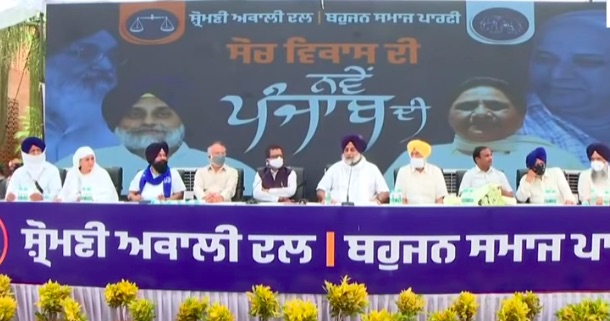
SAD joins BSP for 2022 Punjab state polls

0
SAD-BSP press conference to announce tie-up for 2022 polls – Videograb
By Harjeshwar Pal Singh | OPINION |

The coalition between Shiromani Akali Dal (SAD) and Bahujan Samaj Party (BSP) announced on 12 June heralds the start of the grueling match for ascendency between the various forces for the crown of Punjab Politics in March 2022.

The alliance between Akali Dal and BSP after a lapse of 25 years unveils a new chapter in the political history of the state. SAD is a predominantly state level rural Jatt Sikh party. It has endeavoured since 1996 to become a Punjabi party and a champion of Hindu-Sikh unity through its alliance with the radical Hindu nationalist BJP. However last year it had to severe links with its junior partner in the state over the farmer laws .

It has embraced BSP, a Dalit party which has steadily lost ground nationally as well as in Punjab.

BACKGROUND: On Saturday (12 June 2021), SAD and BSP, which had jointly contested the 1996 Lok Sabha elections, announced an alliance for the 2022 Assembly elections in Punjab. The tie-up was announced at a press conference attended by SAD president Sukhbir Singh Badal and BSP General Secretary Satish Chandra Mishra. SAD patron Parkash Singh Badal later spoke to BSP chief Mayawati who has served four separate terms as Chief Minister of Uttar Pradesh.

BSP focuses on a platform of social change for Bahujans, more commonly known as Other Backward Castes, Scheduled Castes and Scheduled Tribes as well as converted minorities from these castes. The alliance eyes the large presence of Dalits in Punjab. Punjab’s Dalit population, making up close to 32%, is mainly concentrated in Jalandhar, Hoshiarpur, Nawanshahr and Kapurthala districts. The border state has the highest percentage of Scheduled Castes population in the country. 

In 2017 state polls, BSP lost in all the 111 seats it contested.Since 1997, ​Akali Dal had joined forces with the Bharatiya Janta Party to contest the state polls, with BJP getting 23 seats.

This is how the senior Badal described the tie-up: “The alliance is a tribute to the composite vision of Guru Nanak Dev, Guru Ravidas and Bhagvan Balmiki and great saints and seers. That makes today the happiest day of my long political career as it marks the triumph of the concept of ‘Sarb Saanjhivalta’, ‘Sanman te Smajik Insaf’ (fraternity, equality and dignity) based on the ideal of ‘Sarbat da Bhala’ (welfare of all).”

Akali’s have a vote bank of about 25% and BSP 2-3%. Akalis are strong in Western Malwa, Rural Majha and rural Doaba while BSP is largely confined to the Doaba belt of the state.

The alliance has announced 20 seats for BSP in the state assembly elections for 2022. Akalis have left 9 seats in Doaba, 6 in Malwa and 5 in Majha to BSP. A preliminary glance at these seats reveals the following facts.

* BSP has been given the toughest seats for the alliance on which both parties have little chance of winning.

* Except 2-3 seats like Nawanshahr, Kartarpur and Phagwara, BSP will struggle.

* Many of the strongest BSP seats like Garhshankar, Banga, Balachaur, Phillaur, Adampur, Nakodar, Chabbewal, Sham Churasi, etc have been denied to it.

* Akalis by sacrificing 7-8 seats in Doaba stand a good chance in rest of rural Doaba and should be a formidable force in 16-17 seats .

* Akalis have also sacrificed some Hindu and urban seats like Pathankot, Bhoa, Sujanpur, Amritsar Central and Amritsar North in Majha ensuring that these seats will have direct Congress vs BJP contests.

* Akalis would be a force in 18-19 of Majha seats.

* Tacit Akali and BJP understanding seem to be in play as Akalis have given the toughest urban seats to BSP in urban Majha and Doaba where they have little chance.

* Aam Aadmi Party (AAP) should benefit by Akalis leaving seats like Payal, Chamkaur Sahib, Bassi Pathana and Mehal Kalan to BSP.

* Overall it seems Akalis by this move will hope to win 8-10 seats in both Doaba and Majha each.

* They also look good in Western and Southern Malwa.

* However as of today they look weak in Central and Eastern Malwa along with cities except in some pockets.

* Overall Akali Dal seems to be in the 35-40 range, as of today.

* Congress remains the most formidable opponent in all these 20 seats and it should hope to win a majority of these.

* AAP again looks down and out in Majha and Doaba.

Harjeshwar Pal Singh is an assistant professor at Sri Guru Gobind Singh College, Chandigarh, where he teaches history. He is an avid political commentator.


RELATED STORY:

Misogynistic treatment of women in farmers protest Asia Samachar, 5 April 2021)

Akali Dal revolt (Asia Samachar, 5 Jan 2020)


ASIA SAMACHAR is an online newspaper for Sikhs / Punjabis in Southeast Asia and beyond. Facebook | WhatsApp +6017-335-1399 | Email: editor@asiasamachar.com | Twitter | Instagram | Obituary announcements, click here |

Narmeet Singh (1990-2021), Buntong, Ipoh

SASKAAR / CREMATION: 2.00pm, 13 June 2021 (Sunday) at Sikh Crematorium Jalan Wadda Gurdwara, Ipoh. Hearse leaves No 53, Laluan Sungai Pari 13, Teluk Kurin Kampung Baru Buntong, 30100, Ipoh, Perak, at 1.30pm | Malaysia

NARMEET SINGH S/O UTUMBER SINGH

Passed away peacefully on 12 June 2021

Saskaar / Cremation: 2.00pm, 13 June 2021 (Sunday) at Sikh Crematorium Jalan Wadda Gurdwara, Ipoh

Hearse leaves No 53, Laluan Sungai Pari 13, Teluk Kurin Kg Baru Buntong 30100 Ipoh, Perak, at 1.30pm, 13 June 2021 (Sunday).

Contact:

Utumber Singh – 012 5323965

Sukhvinder Singh – 012 5376730

Balvinder Singh – 014 3075487

(Due to FMCO SOP, the funeral is limited only to 10 people consisting of family members only. We understand if you’re unable to attend due to the restrictions and we thank everyone for their assistance and prayers.)


| Entry: 12 June 2021 | Source: Family

ASIA SAMACHAR is an online newspaper for Sikhs / Punjabis in Southeast Asia and beyond. Facebook | WhatsApp +6017-335-1399 | Email: editor@asiasamachar.com | Twitter | Instagram | Obituary announcements, click here |

What To Watch: Pakistan drama Raqeeb Se captures an unconventional love story

    0
    Pakistan TV drama Raqeeb Se
    By Movie Walla | MOVIE |

    Pakistan drama Raqeeb Se depicts an unconventional love story that may be worthy of your attention.

    The story is unique. Sakina (Hadiqa Kiani) leaves her village and her abusive husband and turns up at the house of her ex-flame Maqsood Sahib (Noman Ejaz) many miles away. In tow is her grown up daughter Ameera (Iqra Aziz).

    Here’s the complication. The love story was 20 years old. Maqsood is now married to Hajra (Sania Saeed) and they have a daughter Insha (Faryal Mehmood). But right from the start, Hajra embraces Sakina.

    In fact, Hajra knows every minute detail of the love story between her husband and Sakina. She had read all their love letters! She knows them by heart.

    Raqeeb Se means, in Urdu, literally means ‘Like my rival in love’.

    So, how is this love triangle going to play out? One thing you can be sure, it is not your usual run of the mill storyline. Credit goes to writer-director duo Bee Gul and Kashif Nisar for a remarkable job.

    “A drama such as Raqeeb Se comes along maybe every 20 years,” Sania Saeed tells Dawn in an interview. “While shooting it, we used to joke that it may not end up getting us high ratings, but that there would be a certain audience that will love watching it. And it’s true. Raqeeb Se has gotten a lot of critical acclaim but not extremely high TRPs [television rating points].

    She added: “One of the earliest criticisms leveled against Raqeeb Se was that characters such as these cannot exist in real life. It was just that the audience couldn’t predict what these characters were going to do, or where they were headed. What these critics didn’t realise is that the story was special, especially because the characters were so different from general stereotypes.”

    The drama also marked singer Hadiqa Kiani’s debut in acting. She also composed the drama’s original soundtrack, another beautiful element in this television drama series which ended at Hum TV last month, is available on the Youtube.

    Click here for the first episode.


    RELATED STORY:

    What to Watch: Love, Death and Robots will leave you mind-boggled (Asia Samachar, 8 Jan 2021)


    ASIA SAMACHAR is an online newspaper for Sikhs / Punjabis in Southeast Asia and beyond. Facebook | WhatsApp +6017-335-1399 | Email: editor@asiasamachar.com | Twitter | Instagram | Obituary announcements, click here |

    Fake news: Immigration raid at Puchong gurdwara

    By Asia Samachar | MALAYSIA |

    A message circulating on the social media alleging that the authorities had raided the Puchong gurdwara is false.

    “The allegations are fake. The authorities did come to the gurdwara but it was to ensure adherence to the on-going MCO,” a gurdwara official told Asia Samachar.

    The joint check by immigration, police and health officials in Puchong also included visits to mosques, temples and other public places.

    In May, a nationwide movement control order, known as MCO 3.0, was re-imposed in Malaysia amid a third wave of Covid-19 cases. It has been extended for another two weeks from Jun 15 to Jun 28.

    Under the present lockdown, as per the national unity ministry guideline, non-Muslim houses of worship are allowed to operate with smaller congregations while adhering to strict standard operating procedures. The number of worshippers must not exceed 50 people for houses of worship that can accommodate more than 1,000 worshippers while only 20 people will be allowed into those with a capacity of fewer than 1,000 worshippers.

    However, Gurdwara Sahib Puchong had decided to cease all congregational prayers and programmes as it was ‘difficult to ensure proper adherence’ to the required SOP.

    “We are taking advantage of the lull to do housekeeping. We are painting the gurdwara,” the official said.

    Puchong gurdwara in 2018 – Photo: Asia Samachar


    ASIA SAMACHAR is an online newspaper for Sikhs / Punjabis in Southeast Asia and beyond. Facebook | WhatsApp +6017-335-1399 | Email: editor@asiasamachar.com | Twitter | Instagram | Obituary announcements, click here |

    Book Review: Revisiting life and times of Guru Tegh Bahadur

    1
    | Guru Tegh Bahadur (1621-1675) – The True Story (Second Edition)
    | Revised and Updated with Gurbani of Guru Tegh Bahadur (131 pages)
    | Author: Gurmukh Singh OBE

    | For digital edition, click link here.


    By Dya Singh | BOOK REVIEW | 

    Muslim chroniclers in the Indian subcontinent as far north as Afghanistan and west into Persia of the 18th and 19th centuries referred to Sikhs as ‘Ahli Kitab’, the ‘followers of the Book’. Book meaning Guru Granth Sahib. So, though we Sikhs pride ourselves for having ‘scriptures’ (Guru Granth Sahib) which were written and compiled by our Gurus (Masters) themselves, we have sadly been found lacking in writing down our true history.

    A large volume of folklore/fables and stories of magical happenings have crept into what is supposed to be our true ‘history’, especially the history of our Gurus (Gur-itihas).

    We hear from our parcharaks (lay-preachers), of miracles being performed by our Gurus which appear to be in direct conflict to the true spirit of Sikhi (Sikhism). (Nanak 5, Guru Arjan Sahib and Nanak 9, Guru Tegh Bahadur both refused to save themselves from torture and death with the use of occult powers.)

    Sardar Gurmukh Singh, author of Guru Tegh Bahadur – The True Story, points out that ‘sometimes, these preachers cannot escape from the Brahminic thought-trap and invariably end up interpreting Sikhi in Vedic or Snatan Dharma terminology life-style’.

    However, Sikhi and Gurbani does bring together reason and faith in Divine Law (Hukam, Raza) which is beyond human comprehension. We do have experiences in life which are (or seem like) miracles (kautaks). They do occur as natural phenomenon in Divine Will. Otherwise, miracle making – if there is such a thing – is rejected by Sikhi. After all, Guru Nanak did ridicule yogis’ supposed to have occult powers. Sikhs also though, do believe in the power of Ardaas (prayer in total-surrender mode). There are references in Guru Granth Sahib to Ardaas. For example, Nanak 5, Guru Arjan prayed for the well-being of his son Hargobind, and the Ardaas was answered.

    Nevertheless, that should not stop us from delving into ‘the Truth’ because the truth sometimes proves stranger than fiction, and simply, at the end, Truth must prevail. Older youth, especially western-orientated and educated, are more discerning, and a time comes when they need the ‘truth’. After all, a time comes when even Christian children have to be gleaned off Father Christmas, too. Yet the ‘magic’ of life should remain. After all, miracles (kautak) do happen, whatever one’s belief is.

    SEE ALSO: The story of Guru Tegh Bahadur reads like a novel

    So far as the current position of Sikhs in India is concerned, Sardar Gurmukh Singh’s “Guru Tegh Bahadur – The True Story” about Nanak 9, Guru Tegh Bahadur, is a work of painstaking research to bring out the unique martyrdom of the Guru, otherwise misinterpreted by both the NCERT (National Council for Education, Research & Training) of India historians and those with an open Hindutva agenda, to treat Sikhism as a sect of Hinduism (an ongoing subject of concern to all Sikhs).

    This research clearly proves that Guru Tegh Bahadur, as all other Gurus, rejected Brahminic practices which were in place over centuries, namely meaningless rituals, and especially the caste system which was established and drummed into the DNA of the residents of the Indian sub-continent, to ensure a privileged position for the upper castes at the cost of subjugation of the lower castes.

    If ‘India’ could fully comprehend and understand the deep impact and significance of the martyrdom of Guru Tegh Bahadur, who is also commonly referred to as ‘Hind dhi Chadar’ (The protective blanket of Hindustan), then not only would the value of Sikhs (and Sikhism) be recognized by Indians generally, but they would probably change the name of their capital Delhi to Tegh Bahadur City!


    12 FACTS RELATING TO GURU TEGH BAHADUR, SOME CONTRARY TO TRADITIONAL BELIEF:
     Guru Hargobind was the architect of the strategy to be followed by his successors.
     Guru Tegh Bahadur was the most travelled Guru after Guru Nanak.
     The suggestion that Guru Tegh Bahadur was meditating at Bakala for 20 (some say 26 or more) years cannot be possibly true for two reasons. Firstly, he could not have covered extensive areas of Northern India up to Assam doing parchar (preaching) while meditating at Bakala for over 20 years; and, secondly; it is against the miri-piri (temporal-spiritual) life philosophy of Sikhi based on an active life of a householder.
     He remained constantly in touch with the Guru Family at Kiratpur.
     Tegh Bahadur was named as the next Guru when referred to as Baba at Bakala by Guru Har Krishan before his demise.
     Guruship was passed on to Tegh Bahadur at an open well-attended ceremony at Bakala before the arrival of Makhan Shah Lubhana.
     Makhan Shah came to Bakala to serve the Guru for a prolonged period.
     Guru Gobind Singh was born on 18 December 1661.
     Guru Tegh Bahadur was arrested or detained three times.
     Contemporary evidence from Assamese Buranji (chronicle) suggests that the first arrest which eventually led to the Guru’s martyrdom, was following complaints from the Brahmins and Ulema of northern and eastern Indian sub-continunet against the Guru’s preaching tours.
     Aurangzeb was at Delhi when he ordered the execution of Guru Tegh Bahadur.
     Delhi Sikhs played a daring and well-planned part following Guru Tegh Bahadur’s execution.
    Source: Guru Tegh Bahadur (1621-1675) – The True Story (Second Edition)


    This research also debunks certain myths and discrepancies surrounding the Guru starting from Nanak 6, Guru Hargobind, the father of Tegh Bahadur right up to Nanak 10, his son, Guru Gobind Singh. In fact, this work further helps to establish Guru Tegh Bahadur as the ‘bridge’ between Guru Nanak with Guru Gobind Singh, and beyond. The author lists 12 such ‘debunks’. I shall address a few startling ones further down.

    There are those, even amongst us, who consider themselves followers of Guru Nanak alone, with Guru Granth Sahib to support their ‘way of life’. They are squeamish about the mention of the apparent grandeur and martial temperament of Nanak 6, Guru Hargobind for example, and especially his grandson, Nanak 10, Guru Gobind Singh. They prefer the ‘piri’ (religious) aspect of Sikhi and shy away from the ‘miri’ (the temporal). This book establishes Guru Tegh Bahadur as the bridge, the ultimate reflection of ‘Miri-Piri’. He straddles the twin pillars of Miri-Piri like a giant!

    MEDITATION & SWORD

    Tegh Bahadur was born Tyag Mal. He proved his prowess as a warrior in his early teens and was renamed Tegh Bahadur (Champion Swordsman). Yet he is reputed to have chosen a simple life and carried out extensive preaching tours in the northern part of the Indian subcontinent, first as Baba Tegh Bahadur, and later as Guru Tegh Bahadur. This research debunks the myth that he sought refuge in hermit-like meditation for over 20 years (some say over 26 years), though there is no doubt that he was a recluse at heart as reflected by his profound inspired verses incorporated into the Guru Granth Sahib. A Sikh has no time to shut oneself away for years meditating! A Sikh’s life is one of daily action. Meditation is a 24-hour a day affair in the din of life as a householder, not in prolonged isolation.

    Though a proven warrior, when the time came, he did not resort to the sword, simply because the time was not right for drawing the sword. He left that to his son, Guru Gobind Singh. Instead, he shook the very foundations of the oppressive Moghul empire with his martyrdom. He is the true reflection of a dynamic form of ‘passive resistance’ – a saintly warrior who lays down his sword and gives his head for a just cause. It is not the life-negating brand of ‘ahimsa’ which Indians generally understand – non-violence at all costs. It is a brand of active, ever-ascending (Chardhi Kala) ‘ahimsa’ incorporated into ‘dharam-yudh’ (spiritual war for a just cause).

    Another significant reason why he is the ‘bridge’, is the fact that after his grandfather, Nanak 5, Guru Arjan Sahib, who penned the largest portion of inspired verses in, and also edited, the Aad Granth, it is Guru Tegh Bahadur’s moving inspired verses which are incorporated into the Aad Granth by Guru Gobind Singh to complete it as the eternal Master and scripture, the Guru Granth Sahib. The other Gurus after Nanak 5, Guru Arjan Sahib Ji, did not contribute towards the Guru Granth Sahib.

    THE BRIDGE

    From a personal perspective, one more major ‘bridging’ aspect of Guru Tegh Bahadur highlighted by the author, is his contribution towards Gurmatt Sangeet (Sikh spiritual music and hymn singing) or simply kirten. Besides inclusion of four of his hymns in Raag Jaijaiwanti, as the 31st. ‘section’ in Guru Granth Sahib, he also introduced greater emphasis on congregational kirtan throughout his ‘perchaar’ journeys. From a two-person kirten started by Guru Nanak (presumably without rhythm), gurmatt sangeet progressed towards greater inclusion of other string and beat instruments. During Guru Tegh Bahadur’s time, there were kirtenias (hymn singers), persangh dhadhis (balladeers) and ragis (those who adhered to the raags, musical and rhythm strains where prescribed). There were kirtan ‘jathas’ (groups), accompaniment of multiple instruments and congregational hymn singing as he travelled in a ‘vaheer’ (caravan-like mobility) with many ‘sewadhars’, spiritual singers/musicians and security spreading this method of kirtan in north India.

    This paved the way to further widening the scope of kirtan by Guru Gobind Singh opening the doors to kirten becoming a global phenomenon today and a mainstay of any Sikh religious service (smagam) anywhere on the globe. Even some of his own inspired verses have a strong rhythmic influence (eg. Jaap Sahib)!

    The other aspect of great importance in this research points to, is the greater need for accuracy of dates, and hints at the importance of the Sikh Quom adopting the Nanakshahi calender to decrease further confusion in our ranks and thrust us forward as a global life-philosophy into the 21st century and beyond.

    12 MISCONCEPTIONS

    As stated earlier, the author lists 12 startling facts and misconceptions which might not be common knowledge amongst Sikhs generally. I wish to highlight a few more which were revelation even to me.

    New ‘Assamese Buranji’ evidence uncovered by the author, as a contemporary source, brings out the complicity of the Brahmin in the destiny and end fate of Guru Tegh Bahadur. The Assamese chroniclers became aware of the covert complaints by the Brahmins to the Moghul emperor about the influence the Guru was having on the masses on his extensive preaching tours in the northern parts of the Indian subcontinent – about religious and universal freedoms. This was disconcerting not only to the Islamic clergy. It threatened their’s and the emperor’s dominating influence on the masses) but also the Brahmin ideology. It threatened their comfortable position as the highest privileged class in the caste system. This was around the time after 1656 when the emperor changes from Shah Jahan to the cruel Aurungzeb. The seeds of Guru Tegh Bahadur’s destiny were already being sown almost 20 years before his martyrdom.

    The second interesting revelation here is the daring and obvious planning of Delhi Sikhs who knew what was to happen to the Guru’s human garb after beheading. It will appear that the plan of the emperor was to quarter the body of the Guru and hang the parts as a display at various prominent points in the city, and one can assume, the severed head at the centre as a reminder of the fate of anyone who opposed or defied the emperor! Reminds one of the true story of the end of the Scottish rebel William Wallace as depicted in the epic movie ‘Braveheart’.

    Delhi Sikhs were determined not to allow the remains of the Guru to be desecrated in any manner! Hence the plan, and its successful execution, with cremation of the body in the house of Lakhi Shah Vanjara and the dismembered head taken to Anandpur Sahib by Bhai Jaita, helped by Bhai Uday for dignified cremation.

    BABA RAM RAI

    It will also appear from this research that though, as lay Sikhs, we have always been brought up to believe that Baba Ram Rai was disgraced and banished by his father Nanak 7, Guru Har Rai, because he changed a word in Gurbani. He had substituted the word ‘Musselman’ to ‘be-iman’ when confronted by the emperor who was a Muslim. In fact, Baba Ram Rai kept on serving the Guru till his demise and was never far away from being called into service of the Guru. The mistake was unforgiveable but that did not mean he was henceforth shunned by the House of the Guru, or the Sikhs. The true Sikh way is never to humiliate one who has strayed, but the price of the erring has to be paid, so that it is never repeated again, even by someone else. Baba Ram Rai does play an important role within the Guru’s household and amongst the Sikhs as a respected Elder, during the lives of Nanak 8, Guru Har Krishan and Guru Tegh Bahadur.

    In conclusion, to fully grasp the full spiritual and temporal depth of Sikh life philosophy, the author proves that one needs to be fully aware of the contribution of Nanak 9, Guru Tegh Bahadur, from his mild, reflective but firm temperament yet early bravery as a warrior, through his vast preaching tours; a life of service and action; a family man; his profound God-inspired verses encapsulated in the Guru Granth Sahib; his indifference and rancour-free (nirvair) nature towards the centuries-strong in-bred wily nature of the Brahmin; his fearlessness (nirbhau) towards the cruelty of the emperor and the Muslim clergy; and his unwavering faith in the Creator-Being culminating in his martyrdom for the right of the ordinary human to practice his/her religion or chosen ‘way of life’ without fear. No other God-inspired, divine soul has come close to the contribution of Guru Tegh Bahadur towards all of humanity. The fact that he is called Hind-dhi-Chadar, is merely a by-product of his profound, unmatchable greatness.

    As time goes by, and with the inspiration from this research dissertation on Guru Tegh Bahadur, we can hope that more and more research is carried out, on the ‘untruths’ or ‘half-truths’ in Gur-itihas (history of our Gurus), and also of the formative years of the post-Guru period, to give us a clearer picture of true Sikh life-philosophy. If nothing else, this book will inspire Sikhs to question certain practices that have crept into ‘living’ Sikhi which appear to align it backwards towards Brahminic or even Hindu rites, rituals and practices.

    Time has come for Sikhism to grow from an ‘Indian’ (traditions and beliefs based) religion into a global life philosophy propagating universal truths, based on the twin pillars of Miri-Piri (temporal and spiritual) and the tripartite doctrine of Naam japna (constant remembrance of the Creator-Being), kirt karni (working for one’s livelihood) and wand shekena (sharing with others, sewa) espoused by the Grand-Master, Guru Nanak Sahib, practised by all the Gurus, and enshrined in the last and eternal Master and scriptures, Guru Granth Sahib.

    There is a tendency especially in ‘western-orientation’ to separate ‘religion’ from ‘politics’ or even the social aspects of life. Sikhi is an all-engulfing theo-political life-philosophy. So, besides focusing on the Guru Granth Sahib and Gurbani, it is important to read well-researched Sikh history of the lives of the Gurus and great Gursikhs (the Khalsa), as an essential aid to the interpretation of Gurbani into ‘lived’ Sikhi. It will help one to better understand Sikhi, and further enhance one’s understanding of the inspired verses within the Guru Granth Sahib.

    This book reads like an epic worthy of some of the greatest stories of man ever told. The author has also given some research-based views about all the other nine Gurus in an early chapter.

    To Sikh youth especially, besides the non-Sikh casual reader and even research scholar, I like to say that this book will help you better understand the true lives of our prime role models, the Gurus especially Guru Tegh Bahadur and enhance your understanding of the ‘spirit’ that is truly lived Sikhism and far from being just an Indian-based ‘religion’.

    Note: The digital book is available for publication by Gurdwaras and organisations


    Malaysian-born Dya Singh, who now resides in Australia, is an accomplished musician and a roving Sikh preacher. The Dya Singh World Music Group performs full scale concerts on ‘music for the soul’ based on North Indian classical and semi-classical styles of music with hymns from mainly the Sikh, Hindu and Sufi ‘faiths’. He is also the author of SIKH-ING: Success and Happiness. He can be contacted at dyasingh@khalsa.com

    * This is the opinion of the writer and does not necessarily represent the views of Asia Samachar.

    RELATED STORY:

    The story of Guru Tegh Bahadur reads like a novel (Asia Samachar, 1 Aug 2020)


    ASIA SAMACHAR is an online newspaper for Sikhs / Punjabis in Southeast Asia and beyond. Facebook | WhatsApp +6017-335-1399 | Email: editor@asiasamachar.com | Twitter | Instagram | Obituary announcements, click here |

    Hockey ace Kirandeep Kaur scores big time in SPM

    Kirandeep Kaur
    By Asia Samachar | MALAYSIA |

    Budding national women hockey ace Kirandeep Kaur emerged with flying results for her SPM results. She hit home with 9As.

    “She’s elated. We thank Waheguru [God]. She worked hard, studying and training for national team at the same time. A good part of her training was done via online monitoring,” her father Gurdip Singh told Asia Samachar.

    SPM is an O-level equivalent major national examination usually taken by year 11 students.

    Kirandeep’s motto: Work hard in everything you do.

    Kirandeep also shared the SPM joy with two cousins, who are also from the same class and school. Youth hockey players Harsuraj Singh and Harroshan Singh also scored all As in thei same examination.

    They play for the WPKL state team in under 12, 14 and 16 tournaments and in the Malaysian Junior Hockey League.

    On her part, Kirandeep is currently training for the 2021 Women’s Hockey Junior Asia Cup. The eighth edition of the Women’s Hockey Junior Asia Cup, to be held in Japan, has been pushed to August due to the Covid-19 pandemic.

    The budding national hockey player scored her first international goal when she was just 14 when she donned the national colours for the Hockey Series Open at Singapore’s Seng Kang Stadium in 2018. Coach K. Dharmaraj fielded her in every match in her maiden tournament with the senior side.

    Well done, Kirandeep!

    Kirandeep Kaur
    RELATED STORY:

    Field Hockey: A lot more to come from young Kirandeep Kaur (Asia Samachar, 19 April 2019)


    ASIA SAMACHAR is an online newspaper for Sikhs / Punjabis in Southeast Asia and beyond. Facebook | WhatsApp +6017-335-1399 | Email: editor@asiasamachar.com | Twitter | Instagram | Obituary announcements, click here |

    EastEnders star Gurlaine Kaur Garcha shaken after racist abuse which ‘came from nowhere’

    0
    Eastenders star Gurlaine Kaur Garcha (Photo: BBC)
    By Asia Samachar | BRITAIN |

    British soap opera EastEnders star Gurlaine Kaur Garcha was left shocked and speechless when she came face to face with verbal racial abuse.

    The actress – who plays Ash Panesar in the BBC soap – shared her horror and fears after the incident earlier this week.

    Her outpouring shows how deep is the cut from verbal racial abuse. And this is coming from someone who is highly trained in Tae Kwon Do, boxing and kick boxing and was European Champion for Tae Kwon Do.

    After bottling up it initially, she decided that she could not let is pass. She poured her heart out in an Instagram posting.

    “It came from nowhere, I wasn’t expecting it, and even though I know racism exists and I could always be victim to it, it was still deeply deeply shocking. In a completely unprovoked attack, I was told by a woman to go back home, to return to wherever I’ve come from, and to stay there.

    “The initial shock was that someone was so comfortable to say this to me in public, not once but several times. It made me feel angry, sad, and embarrassed. It upset me, and as a result of being upset I felt weak. I was ashamed that I wasn’t able to just brush it off and continue with my day as normal.

    “Instead what followed were tears of sadness and frustration. How can someone be allowed to say something so racially driven and then walk away? Why do I then have to deal with all the feelings that come with it? Why do I have to tell myself to stay calm and not to retaliate? And why do I have to be the one left crying?

    “It seems so unfair that I am judged by the colour of skin. My thoughts and feelings of fear weren’t just about that moment, but about a future where my children, nieces and nephews will have to face the same discrimination and hate. My heart sinks that deep down I know this won’t be the last time I experience something like this.

    “Initially I wasn’t going to say anything, but waking up this morning and feeling burdened with the same sadness from the day before, I realised that by speaking out it may help someone who has experienced the same, and make them realise they’re not alone.

    “When will racism end?

    “I am proud to be British. I am proud that my grandparents were born in Punjab. I am proud that my parents were born in Kenya. And I am proud to be Sikh. I celebrate all these things. I wish others did too.”


    RELATED STORY:

    Racism: The apples don’t fall far from the tree (Asia Samachar, 16 April 2021)


    ASIA SAMACHAR is an online newspaper for Sikhs / Punjabis in Southeast Asia and beyond. Facebook | WhatsApp +6017-335-1399 | Email: editor@asiasamachar.com | Twitter | Instagram | Obituary announcements, click here |

    Going beyond ritualistic religion

    1
    By Gurnam Singh | OPINION |

    It is difficult to imagine a world devoid of religion. The Communists tried to erase religion by force, but ended up creating a violent dystopian world where religion was driven underground. Following the collapse of Communism, religion reasserted itself with a vengeance, demonstrating its popular appeal. Religion and religions have survived pogroms and, though allegiance to formal faith has gone down significantly, belief in spirituality and even a metaphysical deity is still strong. In short God is alive and well.

    I love many of the cultural aspects of religion. I cannot imagine a world without the beautiful buildings, moving scriptures, the sublime poetry and stories of immense wisdom, associated with all religious traditions. However, I must accept that ultimately religion is made by human beings, and that, in spite of the good charitable work that is done by most faith groups, religion is a source of much conflict. And so the the question one must ask is, what is the purpose of religion and why is it seemingly so important to so many people?

    One perspective is that, in a seemingly meaningless world, or a world of constant change, religion operates to give some meaning to life and, through faith group membership, it affirms our sense of identity and being. Religion, and by association God, serves as this one permanent feature of existence that is not subject to time and space. The act of worship, performance of rituals, worshiping of divine idols or other objects and symbols, all manifests this affirmation to remain attached to something bigger than ourselves, something that is all powerful and all knowing.

    God has a fantastic appeal to us because he has the ability to transcend material existence; he is a supernatural force that can function in a metaphysical realm, where anything is possible. But most critically, what distinguishes us from God is that, unlike us mere mortals, he is not affected by worldly forces, including the human desires associated with ego. He is in short, the ultimate reality!

    It makes perfect sense, therefore for God to live in an unchanging place, which is referred to as Heaven (or any number of variations amongst different faith groups). This is a paradise which we can achieve but with one condition, only after death! Suffer today and you will be rewarded with a place in paradise. What a perfect ideology for people to accept their lot in this world! No wonder the ruling classes patronise religion so much!!

    The German philosopher Karl Marx has argued that this dependence on God and religion represents a state of inverted consciousness. For Marx, religion has a powerful appeal because of ‘its logic in popular form, its spiritual point, its enthusiasm, its moral sanction, its solemn complement, and its universal basis of consolation and justification’. In short, religion ‘provides’ the answers to the question that is almost impossible to answer, that is, what is the meaning of life and what happens when we die?

    But Marx characterises this as a ‘fantastic’ realization. That is because of what philosophers refer to as a state of imminence, human essence is something that can never be realised. It’s like being on a long journey where you do not know where or when it will end. Along the way somebody comes up to you and tells you precisely what the purpose is and where it will end. And because religion serves to provide these ‘answers’, in the absence of an alternative, one can see why it would be attractive.

    So, you may be thinking, what is wrong with religion, why do we need to move beyond it? Well, in some sense, religion is not the problem. What we really need to focus on is human suffering which makes people vulnerable to ‘fantastic’ explanations and the illusory function of religion.

    As Marx famously noted, “Religious suffering is, at one and the same time, the expression of real suffering and a protest against real suffering. Religion is the sigh of the oppressed creature, the heart of a heartless world, and the soul of soulless conditions. It is the opium of the people.”

    It is only by moving beyond religion and separating out religion, especially in its institutionalised form, and spirituality that we can begin to focus on reality and the actual state of mind and body, rather than illusion. But, because religion is a response to human suffering, it is only by addressing the suffering that we can ultimately move beyond religion. When we no longer feel the pain of poverty, oppression and injustice, then perhaps we will no longer have a need for the painkiller of religious rituals and dogma. And perhaps then religion is no longer perceived as a drug or escape but a utopian project to work towards building a better world, or perhaps even heaven on Earth.

    [Gurnam Singh is an academic activist dedicated to human rights, liberty, equality, social and environmental justice. He is an Associate Professor of Sociology at University of Warwick, UK. He can be contacted at Gurnam.singh.1@warwick.ac.uk]

    * This is the opinion of the writer and does not necessarily represent the views of Asia Samachar.


    RELATED STORY:

    Towards a more loving, sharing and caring world in 2021 (Asia Samachar, 22 Dec 2020)


    ASIA SAMACHAR is an online newspaper for Sikhs / Punjabis in Southeast Asia and beyond. Facebook | WhatsApp +6017-335-1399 | Email: editor@asiasamachar.com | Twitter | Instagram | Obituary announcements, click here |