















UA-56202873-1
Page 405

Lesson from coronavirus: Begone big weddings

0
By Manjit Kaur (UK) | OPINION |

I have been reflecting on the COVID 19 pandemic for many months, and what this means for me personally and humanity. But now that there is talk about life after Corona virus, I thought this was a good time to share my thoughts. As the COVID 19 vaccine roll-out is taking effect, there is talk about returning back to normal.

In the UK, we have had our fair share of tragedies and suffering, though I have been lucky to avoid the virus and am soon to have my second vaccination. I know that some people from ethnic minority communities, because of a mixture of superstition, mistrust and misinformation, have been reluctant to get the vaccine. This is tragic because we know the only way out of the pandemic is mass vaccination and, as well as unnecessarily suffering for themselves, these individuals will cause others to suffer.

I can only thank the scientists and health professionals for saving so many lives. And if there is a God, then I have doubt it is these professionals and the not so-called ‘holy people’ who have his ‘bakshish’ or blessing.

All the talk now if of how life will be after the lockdown? Will we return back to life as before or has virus changed our lives be forever in a new normal? I guess we can approach these questions from lots of different angles, but for me, especially concerning some of our unpleasant community attitudes, I would be very disappointed if things go back to as they were before the Pandemic.

BEGONE BIG WEDDINGS

Take for example the typical Panjab wedding, where before the lockdown people would spend in excess of £50,000 catering for 500 to 600 guests or more. But during the lockdown, most weddings were cancelled and those that were allowed were restricted to 15 to 30 people, which meant concentring on those relatives that really matter. We saw the same happening with birth and death ceremonies in Gurdwaras where restrictions were in place.

I know some people love the big gatherings, and certainly the gurdwaras and catering businesses have taken a big hit, but for me, there is something magical about having much more intimate weddings. There is a saying that ‘small is beautiful’ and I do believe having a wedding where the guests are not strangers or hangers-on, but people who you love and care for and you know they will be there for you when you truly need them. In our big lavish weddings, we sometimes forget the purpose, which is two people who are about to become one on a journey together.

Whether it is an arranged or love marriage, every marriage has ups and downs, but nowadays it could be argued that the pressure on most couples is greater than ever. Though not the only factor, perhaps because of unrealistic expectations or the pressure to please others rather than put you and your partners needs first, we have seen a big increase in divorces rates, both in India and across the world. When we focus too much on servicing the needs of relatives, we neglect our immediate family, each other and our children.

When we marry in front of Guru Granth Sahib ji, we take a vow to not only work together as a couple but to think as one, and to grow and learn together. We all know the lines from Gurbani that “they are not husband and wife if they simply sit together; only when two souls become one are they truly husband and wife.” And for most couples, coming together is also about bringing new lives into this world. And when you decide to do this, to have a child, it is very important that the child connects, first with the parents, and then with the wider family.

Children who develop healthy attachments will develop confidence and self-esteem. And a child who is comfortable at home with their parents and siblings is much more likely to feel comfortable with others from different communities.  But I would add this cannot happen at a distance through online communication, but only through close contact with others. Indeed, lack of human contact is one of the causes of fear, mistrust and hate towards others. Children are not born with racist attitudes but pick them up from their surroundings. One of the downsides of social media is that such attitudes can be easily spread and be picked up. It is so important that we teach our children to value all human beings as equals. As Guru Gobind Singh said, “Recognise the human race as one.”

THE SIMPLE THINGS THAT MATTER

Coming back to the COVID 19 experience, though it has been painful, I feel it has also allowed humanity to pause, reflect and think what is really important in life? And what I have discovered is that it’s not the material things that matter, but those things that either cannot be bought, such as a simple smile or loving embrace, or those things that are free, like a walk in the park, or helping others. But perhaps the most precious thing is our physical and mental health, which if we are honest, we do tend to neglect.

So I believe what COVID 19 has taught us of the dangers of selfish and self-harming behaviour, of the importance of caring for ourselves and others. In this regard, I have been very proud of those Sikhs throughout the world who have been providing langar and medical care to the needy. Some of the scenes in Delhi of people dying in the streets and in rikshaws gaping for oxygen were truly horrific, but I was so humbled by my Sikh brothers and sisters who, in Delhi and across the world, did what they could to help those in need. I am reminded of the words of Sikh historian Rattan Singh Bhangu, who in his composition Prachin Panth Prakash, said, “The mouth of a poor person is the treasury of the Guru”.

Another lesson that COVID 19 has taught us is the importance of respecting and loving the environment as if it were a living thing. Indeed, in Japji Sahib, Guru Nanak says this very thing: “The air we breathe is Guru, the water we drink is our father and the land from where all our food is obtained is our mother.”  And so I think, after the lockdown, we need to be much kinder to nature and that means reducing our wasteful consumption and working towards regenerating not destroying the natural world. It means having fewer desires, spending less and consuming less. As Guru Nanak warns in Japji Sahib “Bhukia bhukh na utaree, jay bhana puria paar” or “Our hunger to consume is never complete, even if we establish mountains of material goods.”

Yes, we all need clothes, food, shelter, money and transportation, but in the post COVID world we need to downsize. I for one, have sold my car and I am looking to move into a smaller house. I ask myself, do we really need to spend so much money on lavish weddings? I would say no, so the question is, why do we consume so much? And the answer is because we lack inner self-worth, which is also the cause of unhappiness.  We over consume to make ourselves feel happy, but like a drug, we simply end up covering our unhappiness. On the outside, we might appear to be happy, but this is just a mask; underneath we may feel lonely and unhappy about our lives.

FEAR LOSING HONOUR

One of the biggest downfalls we all have, and this is something that I see a lot in our Panjabi community, is the habit of covering things up, of not dealing with the real issues at hand, of being afraid of what people might think, of a fear of loss of honour or ‘beizti’. In the new post-COVID 19 normal, as a community we must lift the lit on this collective self-denial.  We could start with the issue of mental health, which is a massive silent killer. We also need to look at family violence and abuse, both physical and sexual, which has increased significantly during to the lockdown.

Perhaps the greatest challenge we have faced during the lockdown is that of our loss of freedom. The restrictions have meant we were not able to travel, to meet people, to socialise with family and friends. In some cases, this resulted in tragic circumstances where loved ones could not even attend funerals of their close relatives and friends. It’s been a really sad time where we have felt like being imprisoned. But as we come out of the lockdown, I have also been thinking about what does it mean to be free? And for me, this boils down to three key things: not be overly influenced by others when making decisions, but to follow your instincts;  having the awareness and critical consciousness to not believe everything you are told; not to feel compelled to always please others and neglect yourself, especially in terms of extended family pressures that are put on us.

This last point is particularly important as I have come to realise that the more you go out of your way to please others, the more you are disrespected. It’s as if we are trying to please others so they will like us! I believe the people who truly care for you do so unconditionally. And when you get people treating you in this way, then you can give back the same unconditional respect.  Again, I feel this unconditional love was there to be seen across the world where Sikhs and others were doing ‘nishkaam seva’ or selfless service, by feeding, sheltering and caring for the needs of others irrespective of their race, caste, religion or status.

Over the past year or so under the COVID 19 lockdown, another thing that has changed my life is that, along with my sister, I have begun to provide constant care for my 87-year-old mother who is no longer able to live independently. This has meant that for part of the week I have been staying at her house, which is some 30 miles away from my home. For many people, the prospect of providing round the clock care for their elderly parents is a burden and sadly some do get neglected and worse. For sure, it is not easy to care for a frail elder, but when I think about the unconditional love and care she has given me for so many years, then actually, looking after her is not a duty but an expression of my love. When I take care my mum, I try to enter her world, to understand what she must be going through. Not long ago, she was an independent woman who was looking after so many other people, so I realise how she must be feeling.  I do sometimes get upset and tearful, but I am so happy that my partner, Gurnam,  has been very supportive and has given my mum, his mother-in-law, his complete unconditional love.

COPING WITH MY ANXIETY

If I am completely honest, the past 12 months has been very difficult for me, and my anxiety levels have been getting worse, especially regarding my mums wellbeing as she has become increasingly vulnerable. Thankfully, she is fully vaccinated, but, given her age, I have been worried about her catching the virus. However, I have realised that anxiety is an important emotion that requires management and action.

To cope with the anxiety I have developed two key strategies: to reflect on the reasons for my anxiety and to act appropriately; to find ways of calming my mind. In this regard, I have found doing mool mantar to be very powerful. Also, I have found regular exercise, walks and taking time out to read and talk with my partner is also be very helpful. The way not to deal with anxiety is to go in on yourself, which can only result in harm. Anxiety, I have realised is a natural emotion which prepares you to meet your challenges and to take new steps to move forward. The problem is that some people become trapped in anxiety, which then can lead inaction, which is not good.

All the signs are that the various vaccines that have been developed are managing to drive down COVID 19, though I suspect, for years to come, we will be under some kind of restrictions, such as, annual vaccine boosts, wearing masks in enclosed spaces, and vaccine passports for travel. We must not forget that in many poor countries the battle against the virus is still raging on and sadly millions more will die and suffer before we can say humanity has moved on. But if we don’t learn the bigger lessons, if we don’t continue to keep caring for each other, for the planet and simply return to the old ways, perhaps as a human race we need to accept nature will do its work and this means humanity has no future. But the good news is, the future is in our hands and for sure we can have a new beginning.

Manjit Kaur, a UK-based therapist and counsellor, is a presenter of the 1 Show on Akaal Channel. She can be contacted via email at manjitkaur1show@gmail.com


RELATED STORY:

Dealing with loss, separation during Covid-19 crisis (Asia Samachar, 13 May 2020)


ASIA SAMACHAR is an online newspaper for Sikhs / Punjabis in Southeast Asia and beyond. Facebook | WhatsApp +6017-335-1399 | Email: editor@asiasamachar.com | Twitter | Instagram | Obituary announcements, click here |

Meet British Army’s newly promoted major

Major Dal Singh Virdee
By Asia Samachar | BRITAIN |

“Reflecting this morning as I walk into work as a Major. Never limit yourself. As a young #Sikh boy from West London I thought this was the highest I could ever dream of achieving. You can unlock your potential in the British Army,” he writes in his social media account a few days ago. He is also the chairperson at the Defence Sikh Network.


RELATED STORY:

“Army is in your blood”, says young Sikh American who joins US army (Asia Samachar, 21 May 2021)


ASIA SAMACHAR is an online newspaper for Sikhs / Punjabis in Southeast Asia and beyond. Facebook | WhatsApp +6017-335-1399 | Email: editor@asiasamachar.com | Twitter | Instagram | Obituary announcements, click here |

Flashback 1917: Ipoh Sikh couple attempts extraordinary kidnapping, buries girl in tunnel. What happens next?

By Asia Samachar | MALAYSIA |

This 1917 court case jumps up to attention for it sheer intriguing details. A Sikh couple attempts to kidnap their niece who lives nearby in order to help themselves to the jewellery in her possession.

After drugging her, they hid her in a tunnel dug in their house. It seems they had a plan, but it’s not not clear if the plan was simply to keep the girl hidden for a short while, or to kill her eventually.

The details were fleshed out at an Assize hearing presided by Justice Farrer-Manby. The evidence against the accused made up a narrative of some interest, reported Malaya Tribune in a report entitled ‘Extraordinary Kidnapping Affair. Smart Police Work’ its edition of 26 June 1917.

“It appears that the girl was living with her brother and her uncle in Silibin Road. On the morning of April 9 both of the latter had occasion to leave the house but when returned they found the girl missing. Her jewellery had also disappeared. A hue-and-cry ensued,” it reported.

Several of the neighbours, who had seen the girl in the morning in the company of her uncle and his wife, but had thought nothing of it at the time, informed her brother, who at once communicated with the police. Naturally, the couple were asked what they knew of the whereabouts of the girl but they stoutly denied all knowledge of her, the report added.

The newspaper report went on: “Inspector A Neave, who was put on to the case, set about trying to solve the riddle and he did so with commendable smartness. He arrested both accused on suspicion late that night and then raided the house. Under a charpoy, carefully covered over with boards and a layer of sand, the Police found a tunnel, several feet deep. In this tunnel the girl was found sleeping off the effects of a drug, whilst her jewellery lay on the ground close by.”

When carried up out of the tunnel and awakened the girl could remember nothing, except that her uncle had given her something to drink and she had fallen asleep.

Both accused denied that they had kidnapped the girl or seen her on the day in question, and protested that they could not understand how she came to be sleeping in a tunnel in their house.

But the judge did not buy their story. In the end, the judge convicted both accused, sentencing them to 15 months’ imprisonment each.


RELATED STORY:

Pardon me, we’re bluntly flouting Covid-19 rules (Asia Samachar, 21 Jan Sept 2021)


ASIA SAMACHAR is an online newspaper for Sikhs / Punjabis in Southeast Asia and beyond. Facebook | WhatsApp +6017-335-1399 | Email: editor@asiasamachar.com | Twitter | Instagram | Obituary announcements, click here |

“Army is in your blood”, says young Sikh American who joins US army

Gurjiwan Singh Chahal – Photo: West Point Center for Oral History
By West Point Center for Oral History | UNITED STATES |

Gurjiwan Singh Chahal was born in Canada, but grew up primarily in Sterling Heights, Michigan, with his older sister. His family hailed from India, and his grandfather had served in the British Army during World War I.

Gurjiwan’s father had immigrated to Canada in the 1980s during the anti-Sikh riots (or Sikh massacre). When the family settled in Michigan, Gurjiwan developed an interest in both soccer and the Army.

After receiving an acceptance letter from West Point, he was still unsure if he would attend the Academy until he received an accommodation to keep his long hair and beard and wear a turban in accordance with his Sikh faith.

After initially picking Mechanical Engineering, he transitioned to majoring in Social Sciences, calling it his best decision.

GURJIWAN SPEAKS AT LENGTH ON HIS FAMILY AND HIMSELF. HE SPEAKS VERY WELL! CLICK HERE

“I love the army. I love reading about it, watching movies, playing Legos making tanks and stuff…That’s the first moment I realise this is what I want to do when I grew up. Beyond that, I love soccer.”

“I face, honestly, little to no problem. I saw shocked. Beard and turban has always been the low hanging fruit for bullies, low hanging fruit for people to pick on. I faced a little bit in high school, middle school. I never really allowed it to bother me. I never really let it get to me. And, honestly, I had a good support group of friends, family and teachers that who were very intolerant of people who picked on others for their faith.

“When I came here…I can’t say that I faced any discrimination because of my beard or turban. And that’s something, while some may consider to be the bare minimum, it makes me proud that I’m part of an academy where so many people – 4,000 people from all walks of life – walk in. Instead of looking at me and saying some sort of negative comment or epithets, they’re curious. They comes up and say: ‘Hey, tell me about your faith.”

“That’s what makes West Point stand out from other places that I’ve been, schools I’ve been to. It’s the fact that whether it be cadet faculty or staff that work here, people are curious, and its genuine curiosity, from my experience. It’s something I’m appreciative of, really appreciative of.” – Gurjiwan Singh Chahal (born 1999) in the in interview

Throughout his Cadet career, he has participated in Crew and Sandhurst, completed Air Assault training, and helped with high school outreach through the LEADS program (Leadership, Ethics, and Diversity in STEM). In this interview, he describes some of the tenets of his Sikh faith. After graduating, Gurjiwan will branch Infantry.

(“Army Is In Your Blood”: Fighting For An Accommodation To Serve His Country While Practicing His Faith, West Point Center for Oral History May 2021) See here for the original entry.

Gurjiwan Singh Chahal – Photo: West Point Center for Oral History
RELATED STORY:

Rising Sikh star in Malaysian army (Asia Samachar, 20 April 2021)


ASIA SAMACHAR is an online newspaper for Sikhs / Punjabis in Southeast Asia and beyond. Facebook | WhatsApp +6017-335-1399 | Email: editor@asiasamachar.com | Twitter | Instagram | Obituary announcements, click here |

End-of-life dreams and visions: Hallucinations or reality?

1
Pexels – Photo: Lisa / Pixabay

Issues of life and death are never straight forward. They are filled with powerful emotions and all types of beliefs.

The recent article on death by Dr Karminder Singh Dhillon received a response from a reader (see below) raising some issues. The response is from an educated and a genuine Sikh seeker. He writes (names & years changed to conceal identity):

My personal encounter with dying people. Doctors and neurologists would say that it is hallucination:

1. In 1972 my father B Singh died of cancer. Three days before he died, he talked to unseen presence. My Pua Ji asked him what he was talking about. He said he was talking to a number of people whose names he mentioned. They were people who have died, including his parents. Guruji vi ethey aa (Guru Ji is also here), he said.

2. In 1982, my brother C in law died shortly after a road accident. He was hospitalised for internal injuries. His liver and spleen had been removed. His whole body was turning red. He was struggling in pain. The doctor had closed the curtain and asked everyone to stay outside. C shouted and called everyone back. “I m going to die! Come quick! They are here already! They are taking me along,” he said. He died 30 minutes later.

3. 1n 1996, my sister D Kaur died of cancer. A week before, she had a conversation with the unseen. When asked she said she was talking with her late brother and mother.

4. In 1988, my father in law died of liver chirrosis. A day before he died, he was talking to an unseen presence. My mother-in-law who caring for him became frightened. The next day, in the presence of the family, he asked everyone to make way for the “visitors” who are coming to take him away. Several hours later, he died.

Hallucinations or reality!?

We had shared the above letter with Dr Karminder Singh for a response. He responded with some thoughts. See below.


By Karminder Singh Dhillon | OPINION | 

End-of-life dreams and visions are accepted by the medical community as part of the dying experience. Hospice doctors and palliative nurses have conducted numerous studies on this matter and the general consensus is that people dream of loved ones who are already deceased and have visions of them. The hospice community considers these dreams and visions as comforting.

The question that needs answering is if these dreams and vision are a portrayal of objective reality pertaining to what really happens to us during death?

We know that dreams are not reality. That is why they are called dreams. Dreams can be an expression of our self-created realities. Dreams can be manifestations of long held beliefs. Dreams can be expressions of thoughts embedded deep within our sub-conscious mind. Dreams can reflect what is held within our psyches.

The general belief is that we have dreams during certain phases of sleep when the conscious mind is not in a position to supress the sub-conscious mind. Beliefs, thoughts, fears, anxieties, worries, etc that are held deep within our subconscious mind come into expression during this phase of sleep as dreams.

For example, while preparing for an important exam I was deeply aware that I had not done sufficient preparation. My conscious mind kept assuring me that I will do just fine by telling me: you have passed tougher exams before, other people can do it, it’s not a big deal, you are intelligent, etc, etc. But my subconscious mind held my fears and anxieties. These fears manifested themselves during deep sleep when my conscious mind could not supress my subconscious mind. My dreams in the days leading to the exam were that I had gone to the wrong location, I had overslept, I arrived at the exam hall when everyone was going home, I found myself in the exam hall without the proper attire, etc.


BEING HUMAN AND HAVING THOUGHTS

An Urdu saying expresses the link between being human and having thoughts. Insan Jisey Kehtay Hai Voh Khayalon Ka Mujashima Hota Hai. The entity that we call human is but a conglomeration of thoughts. The Punjabi version is Jaisee Dhristee, Vaisi Shrishtee. We see the world through our thoughts.

The Gurbani version is Jo Bhramandey Soi Pindey. The Universe that we see out there is the outcome of the perception of our bodily senses.

Thoughts become our beliefs. Beliefs become our doctrines. Doctrines become our dogmas. Dogmas become our psyches. Our beliefs become our universe. And we become our beliefs. Jo Bhramandey Soi Pindey.


MARY’S END-OF-LIFE DREAMS

When Mary was a child, her grandparents passed. She was told they were in heaven and smiling down on her. When her pet dog died, she was told he was “with her grandparents.” When other elders in her family passed on, the narrative was repeated. The narrative became her beliefs. And eventually embedded itself deep within her psyche.

When it was Mary’s turn to die, she was surrounded by friends, relatives and hospice workers. She passed in an out of consciousness. When someone sat beside her and talked to her she spoke of her dreams she was having – of the good times she had with her grandparents and others. She spoke of dreams of her pet. At times she spoke of them coming to talk to her.


END OF LIFE DREAMS OF OUR LOCAL GRANTHI

Thirty-five years ago my mother took me to visit our local granthi who lay dying of old age at University Hospital Petaling Jaya. He was a close family friend and a middle man for my elder brother’s marriage. He was asleep when we reached his bedside. His hair scattered. My mother asked the nurses for some hair oil, rubbed it into his hair and used her own kangha to comb his hair and tie a tiny little joora. I held up his head to make it easy for my mother.

He woke up. Or perhaps he didn’t. Maybe he was half awake. But we heard him speak. “She came.” He mentioned a name.  Then after a pause. “She brought food.” Another pause. “I told her I am not hungry.” And then “She wants to take me home.” Then “She said Baba ji was waiting.” He went silent. We sat for a few more minutes, held his hand, wished him the best and started to leave. He looked at us. I am sure I saw a smile on him.

On the way home in the car, my mother told me he was talking of his deceased wife.


END-OF-LIFE DREAMS IN THE OLD CANVAS

Texts related to the 4,000 year-old canvas have a story of a Brahmin clergy helping a Bania caste (businessman) man interpret dreams the latter was having on his death bed. The dream was recurring and it involved a crow sitting at the edge of his bed, getting closer in each dream, preparing to peck at the flesh of the Bania. The Brahmin told the Bania that some time ago he had loaned money to a Brahmin who was unable to pay it back. The Bania had then collected “his pound of flesh” from the Brahmin in a most merciless way, causing the Brahmin’s misery and eventual death. The crow was the deceased Brahmin who had come back to collect “his pound of flesh.” One can rest assured the crow never left the Bania’s dreams.


WHAT IS THE ROLE OF GURBANI IN ALL THIS?

Gurbani provides us with a conglomeration of profound messages.  These messages have embedded themselves within my mind to become my beliefs. These beliefs have become my doctrines.  In summary, the messages of Gurbani have become my universe. Gurbani’ messages have become my Khyalon Ka Mujashima. They have become my Shrishtee. Gurbani has become my psyche.

Gurbani has instilled in me that death is the RETURN to our origins. Pavney Meh Pavan Smaya. Gurbani tells me that my physical elements will RETURN to their original elements. Matee Matee Hoyi Eyk. Gurbani tells me that my Jyot will RETURN to the Complete Jyot. Jyoti Meh Jyot Rul Jaya. The RETURN to elements means I will become NOTHING. The RETURN to the Complete Jyot means I become EVERYTHING. That is because the Complete Jyot is EVERYTHING. Jeh tay Upjeyo Nanaka, Leen Tahey Meh Maan.

This is my resultant psyche.  It’s the psyche that the messages of Gurbani created for me related to death.


WHEN ITS MY TURN TO DIE

IF my death will come in a way that allows me the luxury of end-of-life-dreams.  And IF it will allow me the luxury of others to bear witness to my narratives. And IF there is still some amount of coherency left in my accounts. And IF someone is willing to make sense of them. My narratives will probably be to the effect of “I am RETURNING.”  Or “I dreamt I was descending into NOTHINGNESS.”  Or “ I dreamt I am becoming a part of EVERYTHING.” Or “I am becoming COMPLETELY NOTHING and COMPLETELY EVERYTHING.” Words to these effect.

I know I will not have “visions” of my beloved parents, elder brother and elder sister coming to take me. Because the psyche that Gurbani created for me tells me they have all RETURNED to NOTHINGNESS and RETURNED to EVERYTHING.

You see, pyareo, Gurbani liberates. It frees us from the fears and anxieties relating to death that have been imposed upon us by our clergy, culture, society as well as our own beliefs. As a result, we are also liberated in our process of dying. As human beings gifted with an intellect we of course have the choice of wanting to construct our psyches that will determine our dying experiences to be that of Mary, of the local granthi, the bania, or any other of our own volition.

As Sikhs of the messages of Gurbani we are blessed with making these messages part of our psyche.  The greatest blessing is to live life as a Sikh of Gurbani’s messages. It’s an equally great blessing to experience dying as a Sikh of Gurbani’s messages.

Sikh thinker, writer and parcharak Karminder Singh Dhillon, PhD (Boston), is a retired Malaysian civil servant. He is the joint-editor of The Sikh Bulletin and author of The Hijacking of SikhiHe can be contacted at dhillon99@gmail.com. 

* This is the opinion of the writer, organisation or publication and does not necessarily represent the views of Asia Samachar.


RELATED STORY:

Death (Asia Samachar, 13 May 2021)

Hijacking Sikhi (Asia Samachar, 19 Dec 2020)

ASIA SAMACHAR is an online newspaper for Sikhs / Punjabis in Southeast Asia and beyond. Facebook | WhatsApp +6017-335-1399 | Email: editor@asiasamachar.com | Twitter | Instagram | Obituary announcements, click here |

How well do you know your father?

0
By Dr. B.S. Bains OPINION |

Your father nurtures and plays a vital role all the way in a child’s development. He goes through all the thicks and thins of their life. He goes about fulfilling every wish and dreams of a child. He sacrifices his comfort to provide every comfort. For a father, his children are his priority. Deep down in his heart there will always be a place, a soft corner. The last he would wish to see is tears in their eyes.

Fathers can be hard, but at the corners of their rocky heart lies the sandy borders. It is there he would break down when it comes to his children.

The know-all stage begins in a child and they begin to slowly segregate from their father. This point can be heartbreaking.

Most of us, if asked about the close liking of our father, they may fail badly as the likings of the father might have changed with age and time. His daily routine, what he must really be doing in his room. Where does he keep his things, pillow, blankets, dressing area, bathing habits, perfumes, clothing, under clothes, socks and shoes. These areas are left unattended and children could be totally unaware.

He might have become slow in his life, forgetful, repeat issues again and again and he might not be able to even groom himself. Most of the time we become intolerant to our fathers.

How much do we know this man who could not tolerate a prick on our skin and feelings… How much do we know him today? Let’s ponder, did we? When he was even alive to those who have lost them?

Let’s know your father better while he is with us…

1. Make frequent visits to where he works.
2. Buy him lunch or dinner at his work.
3. Get him a shirt or somethings for his use once every 4 months.
4. Sit with him and keep your mobile phones away and speak to him. Exchange ideas.
5. Stay in his room when he is away out of station. Carefully observe every corner of his room, where he keeps his perfumes dressing area, his bed and his favourite things.
6. Arrange his cloths for him.
7. Clean his room and change his bedding sheets for his fresh sleep.
8. Bring ambiance to his room.
9. If you are earning, even if he is rich, surprise him with some money in an envelop. It can be any amount. Make him feel that you care.
10. Polish his shoes for him.

Most of the time we children only get surprises when we get to his room after they are no more with us. Your father just needs your care and indulgence. Know him better.

Dr Balwant Singh Bains is a Malaysia-based kirtan enthusiast and a practicing physiotherapist with a chain of physiotherapy clinics.


RELATED STORY:

Sikh heritage and art drained over years in Punjab and Delhi (Asia Samachar, 25 April 2021)


ASIA SAMACHAR is an online newspaper for Sikhs / Punjabis in Southeast Asia and beyond. Facebook | WhatsApp +6017-335-1399 | Email: editor@asiasamachar.com | Twitter | Instagram | Obituary announcements, click here |

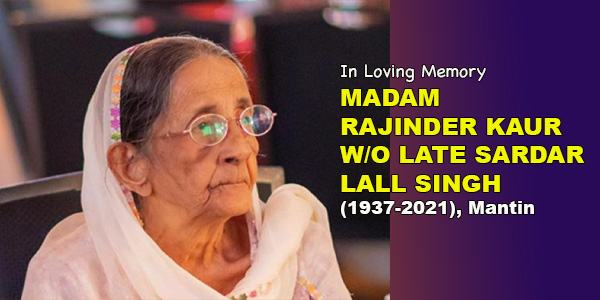
Rajinder Kaur (1937-2021), Mantin

SASKAAR / CREMATION: 1.00 pm, 22 May 2021 (Saturday) at Sikh Crematorium Mantin, Jalan Besar. Cortege leaves from 249, Jalan Pinggiran Bayu 2/20, Taman Desa Pinggiran Bayu, 71700, Mantin, Negeri Sembilan at 12.30 pm | Malaysia

MADAM RAJINDER KAUR W/O LATE SARDAR LALL SINGH (MANTIN)

15.01.1937 – 21.5.2021

The family of Rajinder Kaur is deeply saddened to inform that she passed away peacefully in the early morning of 21 May 2021.

Saskaar / Cremation: 1.00 pm, 22 May 2021 (Saturday) at Sikh Crematorium Mantin, Jalan Besar

Cortege leaves from 249, Jalan Pinggiran Bayu 2/20, Taman Desa Pinggiran Bayu, 71700, Mantin, Negeri Sembilan at 12.30 pm.

Deeply missed by Children / Spouse:

  • Jasvir Singh Dhaliwal (Melbourne)
  • Jasbeer Kaur / Late Baljit Singh (Punjab)
  • Darsheve Kaur / Banda Singh (Klang)
  • Baljit Kaur / Daljeet Singh (Rawang)
  • Dahave Kaur / Manjinder Singh Gill (Alam Damai)
  • Dasber Kaur / Manmohan Singh (Melbourne)
  • Late Perminderjit Singh

and all grandchildren, great-grandchildren & relatives near and dear.

Contacts:

Nateesha Kaur Gill 017-3697091

Sonia Kaur 012-6194227

Due to MCO restrictions in place, we understand if you are unable to attend. We thank everyone for their prayers and assistance.

| Entry: 21 May 2021 | Source: Family

ASIA SAMACHAR is an online newspaper for Sikhs / Punjabis in Southeast Asia and beyond. Facebook | WhatsApp +6017-335-1399 | Email: editor@asiasamachar.com | Twitter | Instagram | Obituary announcements, click here |

Sikh weddings throw caution to the wind

By Asia Samachar | MALAYSIA |

It seems some group functions in the state of Perak, including Sikh weddings, threw caution into the wind when it came to ensuring Covid-19 precautionary measures were at play.

Some of them have allegedly ignored advice to hold smaller functions and went on full scale with their wedding. As a result, some were believed to have contributed to the spread of the novel coronavirus.

“Many cases are coming up as a result of uncontrolled wedding receptions,” Khalsa Diwan Malaysia (KDM) president Santokh Singh Randhawa told Asia Samachar in a telephone conversation. “As a result, there are a number of people affected, and at times try to cover-up.” KDM is a Ipoh-based national Sikhs organisation.

This is not the first time that Santokh have raised this issues. In fact, he had twice (see here and here) written to Asia Samachar, trying to call on the community members to take seriously the Covid-19 prevention measures.

Since his second letter which was published in January 2021, Santokh said it was unfortunate that a number of weddings went on without observing strict SOP regulations, resulting in a quite a number of attendees either affected or forced to observer quarantine.

“The assumption is that ‘I will get away from it, Covid-19 will affect others, not me’,” he said.

He said that it was generally observed that members have been relaxed and not following the SOP rules strictly. Instead of cutting down the ceremonies to bear minimum, they tend to go through the full regilia of cultural and traditional ceremonies, too.

“We appeal to fellow Sikhs to please take serious note of this pandemic outbreak as it is becoming more serious. Maybe the gurdwara parbandhaks [management committee] and community leaders could help advice fellow Sikhs to follow SOP strictly and overcome this calamity,” he added.

So, under current circumstances, how can families still proceed with an Anand Karaj, as the Sikh wedding is called?

Santokh suggests: “Strictly, just the lavan ceremony. Both the families gather at gurdwara, have the lavan ceremony and Path Da Phog, and end it there. No friends and relatives will object. In fact, it will safe a lot of unnecessary expenditure.”

Path da bhog is usually referred to the end reading of the Sri Guru Granth Sahib to signify the completion of its entire reading. It is usually held at the end of a gurdwara programme, and then followed by an ardas (prayer).

The Malaysian authorities are mulling imposing another lockdown measures following a spike in number of Covid-19 cases and deaths. Malaysia’s National Covid-19 Immunisation Programme, launched on Feb 24, still seems slow in its rollout.


RELATED STORY:

Pardon me, we’re bluntly flouting Covid-19 rules (Asia Samachar, 21 Jan 2021)


ASIA SAMACHAR is an online newspaper for Sikhs / Punjabis in Southeast Asia and beyond. Facebook | WhatsApp +6017-335-1399 | Email: editor@asiasamachar.com | Twitter | Instagram | Obituary announcements, click here |
Sikhs getting Covid-19 vaccine jab

Photos: Tampa Bay Gurdwara
By Asia Samachar | UNITED STATES |

In mid-April, more than 150 doses of the Covid-19 vaccination were administered in a session supported by a gurdwara in the United States. In a social media posting, Tampa Gurdwara thanked the Cory Lake Isles (CLI) Beach Club for generously opening the event to all members. Here are some photos they shared.


RELATED STORY:

Singapore Sikhs hold dialogue on Covid-19 vaccination (Asia Samachar, 24 April 2021)


ASIA SAMACHAR is an online newspaper for Sikhs / Punjabis in Southeast Asia and beyond. Facebook | WhatsApp +6017-335-1399 | Email: editor@asiasamachar.com | Twitter | Instagram | Obituary announcements, click here |

Hey! My lockdown paintings are on display

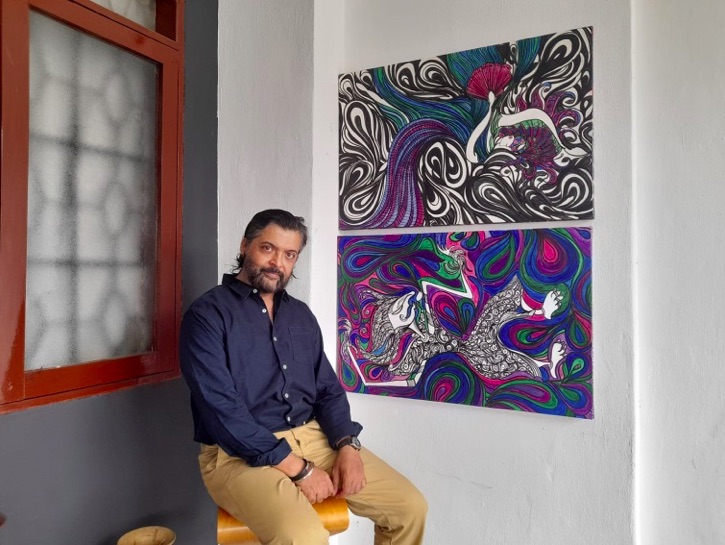
Vishal J Singh and his artworks on display at Zhan Art Space, Petaling Jaya, for an exhibition called “Duality” – Photo: Supplied
By Asia Samachar | INTERVIEW | Malaysia |

Vishal J Singh is no stranger to readers of Asia Samachar. We have been treated to many of his ideas as how gurdwaras can be designed. Click here to view them.

The aspiring architect is equally adept at painting. Two of his recent paintings are on display at the Zhan Art Space in The School at Jaya One, in Petaling Jaya, Selangor for an exhibition called “Duality”. Called “The Illusion of the Real”, they will be on display until 23 May 2021.

We caught up with Vishal, a project architect with at a Kuala Lumpur-based architectural firm, to find out more about his work.

How and when did you first start painting / making art?

Well, it started in primary school and then of course continued till secondary school. I was active in the art club and I enjoyed doing art as I found it very satisfying and therapeutic even. I had taken my interest in art to architecture school but the focus there was more on technical drawings, although we were encouraged to do sketches, diagrams, and perspectives and such for our assignments.

Once university ended and worked started the focus then was more on architectural design and conceptual presentations and technical works, so the other aspects of art based on abstract or whimsical notions were brushed aside for the longest time.

Then, last year, during the first MCO, I took part in the Ramadan Sketch Challenge 2020. I was completely free at the time because all work was suspended, so I thought why not indulge in sketching and doodling again. The challenge continued for 30 days (during the month when Muslims fast) and it allowed me to rediscover my love for drawing, painting, colouring and such.

Even after the sketch challenge was over, I had a friend in Hong Kong who kept encouraging me to do one every week. I decided it was a worthwhile venture to take and so I continued, resulting in more than 60 pieces.

The biggest surprise, however, was when another friend had asked me to send my art portfolio consisting of my sketches to a local art gallery. And thanks to those sketches, in early January this year I received a formal invite to have two new pieces displayed for an exhibition.

Needless to say I was thrilled, and I presented two pieces called “The Illusion of the Real” that are currently being displayed till May 23rd 2021 at Zhan Art Space in The School at Jaya One, in Petaling Jaya, Selangor for an exhibition called “Duality”.

What motivates you to paint?

A sense of commitment that if I need to prepare something by a specific deadline, I’ll do everything I can to meet that deadline to the best of my capabilities. Plus, I do look forward to the process of actually thinking and creating art rather than just finishing it for the sake of finishing it. A good deal of my work can be found here.

Vishal J Singh and his artworks on display at Zhan Art Space, Petaling Jaya, for an exhibition called “Duality” – Photo: Supplied

What inspired you to start painting?

The Ramadan Sketch Challenge in 2020 organized by KL Skecthnation. It did start from there last year.

What is the story behind these particular paintings and what inspired these painting?

These paintings are two separate pieces that are meant to be read as a singular piece called “The Illusion of the Real”. It talks about how the idea of shadow puppet and a dancer perform for the public under the assumed notion that they act on their free will, but the reality is they are both controlled by the unseen. In essence, between the shadows and the light, they are both directed and controlled without being realized.

This metaphor extends to the life of people as well, who very often believe that they have the choice or free will to do whatever they like, but more often than not, they too are being directed by invisible forces, such as personal responsibilities, commitments, consequences of their decisions and so forth, hence the title “ The Illusion of the Real”.

What do you do for work other than make art?

I’m a currently working for local architectural firm in KL as a project architect and occasionally write articles calling for the adoption of contemporary ideas and concepts in the design of Gurdwaras for Asia Samachar.


RELATED STORY:

Into the Future: Gurdwara that walks (Asia Samachar, 19 Jan 2021)


ASIA SAMACHAR is an online newspaper for Sikhs / Punjabis in Southeast Asia and beyond. Facebook | WhatsApp +6017-335-1399 | Email: editor@asiasamachar.com | Twitter | Instagram | Obituary announcements, click here |