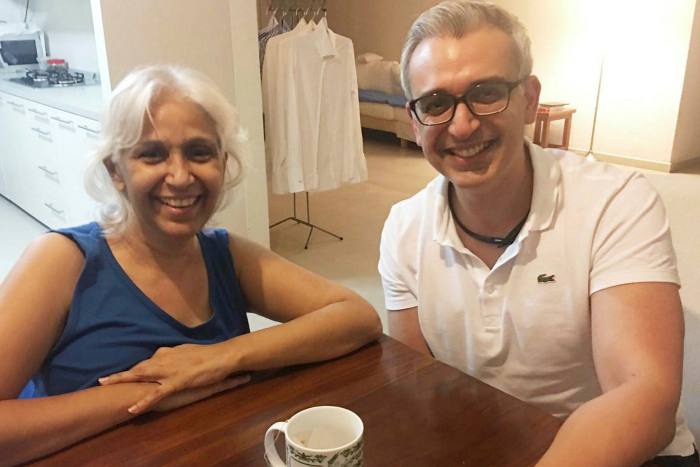
A visionary leader with an unshakable commitment to equality and cultural justice, Dr. Satwinder Bains is the 2021 recipient of UFV’s Faculty Service Excellence Award.
“As a woman of colour, not only is she smashing glass ceilings of patriarchy within academia, but also in conservative cultural spaces,” says Anita Lal, co-founder and director of the Poetic Justice Foundation, and one of Bains’ many nomination references.
“With each win she brings down barriers for future generations of women.”
And as her robutst CV attests, Bains is no stranger to putting in the hard work it takes to make a difference.
An early association with Abbotsford Community Services led to connections at UFV, inspiring Bains to join the university more than a decade ago. Today, she is as an associate professor in the department of Social Cultural and Media Studies. In addition to teaching, she made an immediate impact by spearheading a $2.25M donation drive crucial to establishing the BC Regional Innovation Chair in Canada-India Partnership Development — and with it UFV’s South Asian Studies Institute, which she has guided as director since 2006. That same year saw the establishment of UFV India, powered by the efforts of DJ Sandhu, with Bains working closely alongside. She served as director of UFV India from 2013-2017 before ascending to principal through 2019, making frequent trips to the campus in Chandigarh, located down a winding drive from her picturesque hometown of Shimla.
By teaching at UFV and guiding research through SASI, Bains continuously gifts those same motivations to a new generation of learners.
“It’s those seeds that you lay on the way,” she explains.
“A single person can’t do everything. I see the university as a very important part of the community. I’m simply a sum of all its parts.”
Read the full story, ‘Faculty Service Excellence 2021: Satwinder Bains’ impact is mighty at UFV and beyond’ (UFV Today, 21 May 2021), here.
ASIA SAMACHAR is an online newspaper for Sikhs / Punjabis in Southeast Asia and beyond.Facebook | WhatsApp +6017-335-1399 | Email: editor@asiasamachar.com | Twitter | Instagram | Obituary announcements, click here |
Sokhbir Kaur and Pav Gill. Kaur’s efforts to contact the FT set in motion a chain of events that exposed the German company as a house of cards – Photo: Handout / FT
By Dan McCrum, Stefania Palma and Olaf Storbeck | Financial Times |
Pav Gill thanks his mother for many things. Sokhbir Kaur raised him alone in Singapore’s subsidised housing, pushed him through the city’s best schools — and, when the time came, forced him to become the whistleblower who would bring Wirecard’s global fraud crashing down.
“It wasn’t me, to be clear. I was just trying to look for another job, and she was busy trying to find ways to expose the company from my sofa in the living room,” the lawyer said from Bangkok, where he is building a new life.
In October 2018 Gill had just been forced out of Wirecard, after senior executives stonewalled an internal investigation into fraud allegations. His mother’s efforts to contact the Financial Times set in motion a chain of events that exposed the German company as a house of cards, forced reform of the country’s humiliated institutions and shattered the reputation of audit firm EY.
When she arranged a first meeting with the FT at Changi Airport, however, Gill remembers simply thinking: “Oh my god, what have you done now?”
Gill agreed to reveal his identity ahead of a Sky documentary centred on the Wirecard whistleblowers, but he still struggles with the label. “I don’t like the term whistleblower, honestly. I think it has some stigma, or negative connotations attached to it. It implies you are going against the company which is feeding you, it involves a breach of trust.”
Back in 2018, the reluctant Gill decided that for the fraud to be properly exposed, he had to be involved. In a series of encounters in out-of-the way coffee shops and Singapore hotel lobbies, he explained to the FT what had happened to him. Kaur, an experienced banker and a first-generation Sikh immigrant with a strong moral code, came along for support — and to insist he be protected.
A magic circle specialist in financial services, Gill was hired in September 2017 as Wirecard’s first in-house lawyer responsible for the Asia-Pacific region, reporting directly to Munich.
Read the full story, ‘Wirecard’s reluctant whistleblower tells his story: ‘They tried to destroy me’’, (FT, 20 May 2021), here.
ASIA SAMACHAR is an online newspaper for Sikhs / Punjabis in Southeast Asia and beyond.Facebook | WhatsApp +6017-335-1399 | Email: editor@asiasamachar.com | Twitter | Instagram | Obituary announcements, click here |
Today, I was officially sworn in with my mother by my side! It is my greatest privilege and honor to serve as the first Sikh on the Three Bridges Volunteer Fire Company.
Wearing a turban is a part of my Sikh uniform and we stand out with our appearance for a reason. When someone is in need or needs assistance of any kind, they can rely on a Sikh to always render aid. With our turban, people can easily see us and count on us to assist and serve them in any capacity. The turban has long been used to identify me as a Sikh, but in the end, it has given me much more; an Identity.
I’ve always said that there is family that we’re born with and then there is family that we choose. I am so proud to call these incredible men and women in my department my family. The camaraderie we share and the respect that we have for each other is truly commendable.
I was always taught while growing up to always serve and help others in need. Prior to joining the department I’ve always had an emergency bag in my car to help those who were pulled over on the side of the road whether their battery died or if they needed assistance of any kind. I knew I had a calling. Someone I know who was already on the department told me they were in need of Fire Police Officers.
This is now one of the roles I currently hold. I also am the engineer of our tanker and I specialize in motor vehicle extrication utilizing the spreaders and cutters, also known as the “jaws of life.” These are used to pull people out of cars who have been crushed in motor vehicle accidents.
I hold multiple certifications in other aspects of emergency services as well, such as elevator rescue, traffic incident management systems, all hazards disaster response, vehicle extrication, pump operations, heavy lifting/moving, just to name a few.
Being a part of this incredible fire department, I reflect back on what I have learned and I wanted to share my story to inspire and motivate others to serve their community.
This journey and calling to become a firefighter/fire police officer has been a very personal one for me and I’ve now been with the department for a little over two years. I wanted to share with you why I am so passionate to do this.
When I was four years old, I lost my Dad in a tragic car accident. The loss of a father early in life is immeasurable but my mother truly has filled his role perfectly. I often think about his accident and those who came to his aid and how they gave him every opportunity towards survival. Whenever I’m responding to an emergency, I always give it my all to ensure that everyone can make it back home safely to their loved ones.
This isn’t something I signed up for, it was a calling. This is purely volunteer, whether we’re dispatched at 3pm or a 3am, we’re there. We not only serve Three Bridges, but also our neighboring cities as mutual aid.
My first intention of joining was to serve others and slightly after joining I realized how personal this opportunity was for me. This further ignited my desire and drive to dedicate myself to this profession. This isn’t just about being the first Sikh on my department, it’s about the message we send to the community which is that it doesn’t matter who you are, where you come from, who you believe in, or what you believe.
When you put on the badge, uniform, or gear, we’re all the same and a part of a larger family of firefighters and first responders. We all unite to accomplish a mission and respond to the call of duty in the direst situations. In my perspective I find it as human beings we have an obligation to serve others and help the helpless. I encourage people from all backgrounds to join your nearest agency and give back to your community and to our country.
Thank you Three Bridges Volunteer Fire Company for this privileged opportunity and I look forward to serve my community alongside my brothers and sisters. God bless.
The article is adapted from Khuswant Pall’s Facebook entry published on 20 May 2021.
ASIA SAMACHAR is an online newspaper for Sikhs / Punjabis in Southeast Asia and beyond.Facebook | WhatsApp +6017-335-1399 | Email: editor@asiasamachar.com | Twitter | Instagram | Obituary announcements, click here |
By His Will we come, and by His Will we go. O Nanak, when it pleases Him, then He absorbs us into Himself. ||6|| (SGGS, 294)
PRITAM KAUR A/P TAUKER SINGH
Village: Chupki Ambala
The family of Pritam Kaur is deeply saddened to inform that she passed away peacefully in the evening of 26 May 2021.
Path Da Bhog: 12 June 2021 (Saturday) at Gurdwara Sahib Shaheed Ganj Sahib, Kamunting, Perak
Contact:
Harmerjeet Kaur 018 – 386 5994
Dr Inderjeet Singh 017 – 520 2010
Ninderpal Singh 012 – 555 4061
(Please observe the MCO guidelines. We understand if you’re unable to attend due to the restrictions and we thank everyone for their assistance and prayers.)
| Entry: 26 May 2021: Updated. | Source: Family
ASIA SAMACHAR is an online newspaper for Sikhs / Punjabis in Southeast Asia and beyond.Facebook | WhatsApp +6017-335-1399 | Email: editor@asiasamachar.com | Twitter | Instagram | Obituary announcements, click here |
Joginder Singh Vedanti – Photo: Asia Samachar (Background photo of Akal Takht by Somyajit Seth)
By The Sikh Bulletin| OPINION |
There perhaps is no throne of a higher stature that the religious world can think of. The Sikh world calls it the Akaal Takhat – literally the Throne of the Eternal One. There perhaps is no travesty of a higher order in that a treacherous slave of the corrupt and decrepit political system of the Badal led Akali state government occupied this position for seven years till his removal in 2008. These were seven years in which Joginder Singh Vedanti steadily and surely poured poison into the roots of the Sikhi tree.
His most scandalous contribution lay perhaps in his co‐authorship with one Dr Amarjit Singh of Shaheed Sikh Missionary College, Amritsar, of the blasphemous and twice banned Gurbilas Patshahi 6. The Gurbilas was, by all accounts, a filthy book about the “life” of Guru Hargobind Ji – so filthy that the author chose to remain anonymous – perhaps out of fear of reprisals by Sikhs. One example of the wide spread blasphemy that fills the pages of this obnoxious book is a story of Guru Hargobind “eloping with a married Muslim girl named Kaulan, giving her refuge from her abusive husband by marrying her. And then refusing to pay for horses that the Guru had purchased from Kaulan’s father on account that he was now the Maulvi’s son‐in‐law.”
Another fictitious story that blackened the pages of Gurbilas pertains to Vishnu and his consort coming disguised as lay Sikhs to help in the construction of Darbar Sahib. Upon completion, both had revealed their true identities to Guru Arjun, who in “recognition of their services agreed to rename the place Hari Mandar” meaning Vishnu’s Temple.
The Sikh panth, in 1920 decided that Gurbilas should not be preached in Sikh Gurdwaras. It remained banned for almost 8 decades. But in 1998, the occupant of the seat of the highest authority in Sikhism ‐ Vedanti – of all persons – decided to re‐publish the book under his name and his co‐author. He got 13 other sycophants in the likes of Sant Singh Maskeen, Darbar Sahib head granthi Jaswant Singh Parwana, and then SGPC chief Tohra to pen glowing tributes over his decision to re‐publish the Gurbilas. And he got the Dhram Parchar Committee of SGPC ‐of all institutions – to be its publisher and distributor.
The treachery of the political slave sanctioned with the power that comes with the throne he sat on would go on beyond just his legitimizing of blasphemy. He moved expeditiously to ex‐communicate Gyani Gurbaksh Singh Kala Afgana in 2003. Kala Afgana’s crime was that he diligently and systematically exposed the folly of Gurbilas Patshahi 6; managing to establish that virtually every narrative in the book was a fabrication. More importantly Kala Afgana exposed the agenda behind its republication. It did not matter to Vedanti that the SGPC banned Gurbilas a second time in 2000. Kala Afgana had to pay for having the temerity to expose the occupant of the highest throne.
Excommunicating Kala Afgana did not satisfy Vedanti’s ire for getting exposed. Those who questioned his excommunication of Kala Afgana – Joginder Singh Editor of The Spokesman and Prof Inder Singh Ghagga – suffered the same fate. The founder and editor in chief of The Sikh Bulletin came within the cross hairs of Vedanti for promoting the writings of Kala Afgana.
He did more than just excommunicate Sikh intellectuals. He came to the defence of criminals and crooks. In 2002 he declared that Sadh Dhanwant Singh – who pleaded guilty to rape charges and earned a sentence of 10 years in jail – was guilty of no crime. Dhanwant Singh admitted in court that he paid Rs 70,000 to Vedanti to absolve him of his rape charges. He came to the defence of another crook Atma Singh Lubanna who collected money in the name of supporting Sikh widows and absconded with huge amounts of it.
In 2006, Vedanti presided over the “akhand path” of the Bachittar Natak granth at Dyalpura Bhai Ka during the Parkash Purab celebrations of Sri Guru Granth Sahib – the mockery of which act was overtaken only by Vedanti’s call to “beat with wet shoes” all those who opposed such a move.
The Sikhs stand as the only community in the world where a scholar of the Vedas – Vedanti – manages to sit on the highest throne of Sikhism. Imagine the Pope being a scholar of the Dhampad, or the Mufti of the Muslim lands being a scholar of the Puranas and Simritis instead of Islamic theology.
The political slave was removed from his throne in 2008 by the same political forces that he served. On May 15 he died of a heart attack. It is no surprise that the most glowing of tributes came from those whose agendas he so diligently served.
The government of India mourned his loss. Indian Prime Minister Modi wrote: “Vedanti was scholarly and humble. His life was a manifestation of selfless human service. He worked to create a compassionate and harmonious society. Pained by his demise. The Badals mourned his loss as well. Sukhbir Singh Badal wrote: “Vedanti’s passing away is a great loss to the Sikh Panth.” SGPC chief Jagir Kaur called him a great leader of the Panth.
In death and in his 7 years as our Clergy‐in‐Chief, Vedanti has taught us a valuable lesson. When a political slave ascends a Godly throne, it is the throne that suffers a relegation. The Sikh Bulletin wishes his family and his loved ones strength and courage to bear with their loss.
The article, entitled ‘When Slaves Ascend a Godly Throne’, first appeared in The Sikh Bulletin in its April‐June 2021 issue. Click here for the full issue.
ASIA SAMACHAR is an online newspaper for Sikhs / Punjabis in Southeast Asia and beyond.Facebook | WhatsApp +6017-335-1399 | Email: editor@asiasamachar.com | Twitter | Instagram | Obituary announcements, click here |
Amit Singh – Photo: Finding What’s Next exhibition
By Asia Samachar| SINGAPORE |
What happens to an autistic youth once they turn 18 years-old? It’s a major change as they are longer within the sanctuary of special education schools. It also presents a different set of challenges for the parents or caregivers.
A Singapore exhibition entitled ‘Finding What’s Next’ attempts to present the search for a future through the stories of 12 individuals and their families. One of them is 24-year-old Amit Singh.
The exhibition, running until 4 July, brings together a series of photographs, videos and personal effects gathered by three parent-advocates with autistic children.
In its storyline, the exhibition storyline tells us that the autistic youth have limited options once they cross the age point. They include costly day-activity centres or staying at home. The stark social isolation and lack of a national support system is likened to a cliff, where caregivers of autistic adults are often left on their own to find a better outcome, it argues.
Through a series of photographs, videos and personal effects, Finding What’s Next presents the search for a future through the stories of 12 individuals and their families, gathered by three parent-advocates with autistic children.
The exhibition involved interviews with fellow parents and sheds light on the daily lives and societal challenges that autistic adults face.
Produced by Lim Hwee Hwee and Sun Meilan, the project is hoped to be a bridge to encourage greater understanding of and empathy with autistic individuals and their caregivers.
By showing what is frequently hidden, Lee hopes to galvanise fellow parents to be courageous with their efforts in connecting with the community and inspire more people to care and take action. Click here for the website.
This is the entry on Amit:
No talking to strangers,” Amit, 24, would mutter to himself. An unfortunate misunderstanding years ago with a member of the public scarred this affable young man and left him wary of strangers.
Amit was labelled as a “public nuisance” and lost his hard-earned independence of travelling on his own. His mum, Mdm Nawandirijit Kaur, 55, had to leave her job to chaperone him so he would avoid further trouble during that period.
Amit Singh – Photo: Finding What’s Next exhibition
Amit bounced back from this incident with his cheerful personality and positivity. Upon graduation from Eden School, a special education school, five years ago, he found a job as an urban farmer at Edible Garden City, an organisation which champions the grow-your-own-food movement in Singapore. He would proudly introduce himself as “Amit urban farmer!”
Today, he not only contributes towards his family’s living expenses but also helps out around the house. His daily routine of housework, having chicken rice for lunch at the same coffee shop and evening prayers with his father keeps him secure and focused. Amit’s future aspiration is to spend more hours at work.
ASIA SAMACHAR is an online newspaper for Sikhs / Punjabis in Southeast Asia and beyond.Facebook | WhatsApp +6017-335-1399 | Email: editor@asiasamachar.com | Twitter | Instagram | Obituary announcements, click here |
A reception pupil has been left traumatised after his hair was cut with scissors while at school, his parents say.
The five-year-old, who had never had his hair cut prior to the incident due to his religion, has been left “deeply hurt”, his mum and dad have shared.
The “assault” was said to have taken place at the Alexandra McLeod Primary School in Abbey Wood, South East London on Friday (May 21).
The Sikh Federation UK has said it was “totally unacceptable & devastating” for the child’s “sacred unshorn hair” to be cut by “another pupil.”
The school in Fuchsia Street said it was aware of the incident, that it had occurred when “most of the staff had left”, and that the matter will be investigated.
Speaking on social media, the parent of the pupil said: “I am just posting this because we as parents are deeply hurt by this incident which happened today with my son in Alexandra McLeod School Abbey Wood.
“My son is only 5 years old, a Sikh boy and I never cut his hairs but someone in school today cut his hairs with scissors and my boy is really upset and saying ‘I am not going to school now’. I don’t understand from where a reception student can get scissors and it’s shameful.
“It’s bullying which should not be accepted. We are really scared to send him to school. Don’t know what to do to secure him in future.”
Read the full story, ‘Anger after 5-year-old Sikh boy had his ‘sacred hair cut’ with scissors in ‘assault’ in south east London school’, here (MyLondon, 24 May 2021).
ASIA SAMACHAR is an online newspaper for Sikhs / Punjabis in Southeast Asia and beyond.Facebook | WhatsApp +6017-335-1399 | Email: editor@asiasamachar.com | Twitter | Instagram | Obituary announcements, click here |
SASKAAR / CREMATION: 19 May 2021 (Wed) at Jalan Loke Yew Crematorium, Kuala Lumpur in the presence of immediate family members. PATH DA BHOG will be held privately | Malaysia
The pain passes, but the beauty remains. – Pierre Auguste Renoir
MADAM AMAR KAUR D/O PERTAP SINGH
Amar Kaur, formerly of Jerantut, Kuantan and Taiping, has been reunited with her beloved husband and son in Heaven. She leaves behind her daughter, son-in-law, granddaughter, siblings, brothers and sisters-in- law, nieces and nephews.
By the grace of Waheguru, the Saskar was on Wednesday, 19 May 2021 at Jalan Loke Yew Crematorium, Kuala Lumpur and went smoothly in the presence of immediate family members.
The family would like to express their gratitude for all the kind thoughts, prayers, messages and support during this difficult period. Special thanks to Gurdwara Sahib Petaling Jaya (GSPJ) and Shamshan Bhoomi Hall (Loke Yew Crematorium) for their support and assistance throughout.
In light of the current MCO situation we are in, the Path da Bhog will be held privately. We truly appreciate your thoughts and prayers for us and we want you to be safe. God bless.
Her gentle and kind spirit lives on in her loved ones. She will be very deeply missed.
Husband: Late Master Sohan Singh Jassal (Jerantut)
Children / Spouses:
Late Bhajan Singh Jassal
Gurit Kaur (Rita) / Manmohan Singh Hullon
Grandchild: Balveen Kaur Hullon
“Thank you for showing me just how deep love really goes. Your legacy of kindness will live on, Nani. Rest now, and give Nanaji my love when you’re reunited with him in heaven. I love you.” – Balveen
Contact:
Gurit Kaur 012-2982021
Manmohan Singh 012-3061157
| Entry: 25 May 2021 | Source: Family
ASIA SAMACHAR is an online newspaper for Sikhs / Punjabis in Southeast Asia and beyond.Facebook | WhatsApp +6017-335-1399 | Email: editor@asiasamachar.com | Twitter | Instagram | Obituary announcements, click here |
(Dedicated to the 400th Birth Anniversary of Sri Guru Tegh Bahadur Ji)
The human mind is the most unique, powerful, and complex creation of Nature. It gives us the capability to discern things, know ourselves and the world. It helps us to adapt to our circumstances or change these to ensure our survival and wellbeing. The human mind possesses matchless creativity and extensive capacity to create its own reality. Sadly, the remarkable mind has been hijacked to the make-belief circle and the illusive world.
Guru Tegh Bahadur, the ninth Sikh Guru, is credited with 57 Salokas and 59 other compositions (Shabads), written in 15 Raagas (measures). His hymns are enshrined in Sri Guru Granth Sahib [1-4]. These hymns cover a diverse range of topics [5-8]. A dozen Shabds and over three dozen verses directly address the problems of the human mind and its effect on human destiny [7]. In his compositions, the Guru enunciates on the origin and the description of the animalistic habits of the human mind. He emphasizes that the mind’s fickleness is the primary cause of unhappiness and failure in achieving our prescribed life goals.
The Guru urges that we can restrain and channelize our mental energies. A person can do so by diverting his/her mind from its animalistic tendencies and turning it to its innate longing for spiritual enlightenment. He emphasizes that with the continual longing for the Divine Grace (of Ek Onkaar) and by cultivating a compassionate and contented attitude, one can achieve the goal of harnessing one’s mind.
MIND: THE CONTRASTING VIEWS
In response to the evolutionary challenges of our world, Western thinkers and philosophers are engaged in investigating the external world such as stars, galaxies and the universe. They are looking for ways to maneuver the natural environment to the human advantage or gain control over it.
In stark contrast, Eastern faiths, especially Sikhi, begins with a premise that the human mind is central to understand and manoeuvre the natural world and human evolution. Sikhi points out that outside images are the reflection of the human mind. Gurbani repeatedly emphasized that human life is an opportunity to harness the mind to achieve life goals.
In the current terminology, the mann (mind) is described as the menome. Menome is a complete set of memes. British biologist Richard Dawkins proposed the term “meme” to describe a unit of intellectual or cultural information perceived by human beings and survives long enough to be recognized as such [9-11]. Memes, as the coded units, can pass from menome to menome or from one human mind to another, impacting our thinking process. Mimetic information passes from one person to another, from one society to another, and from one generation to the next. This aspect of the memes makes it the instrument of future human evolution.
To understand the instinctive mind, we need to explore the prenatal human biography. We must look into the ancient period for sequences, from the lives of our animal and human ancestors, with whom we share the genetic connections [9-11]. Christian theology interprets prenatal human history as the principle of original sin. It postulates that humans are born with a sinful mind. The Oriental religions invoke the law of karma to define the development of the animalistic human mind. Modern science views the human mind as the total of animal and human evolution completed to date [9-11]. Whichever way one may interpret the mind, it is for sure that prenatal human biography has affected the human mind. It has occurred throughout the history of the animalistic world. Humans have passed through numerous life forms during the preceding life cycles, ranging from unicellular organisms to primitive humanoids. The Sikh theology supports this evolutionary principle when it says,
Pas pankẖī birakẖ asthāvar baho biḏẖ jon bẖarmi▫o aṯ bẖārī.
I wandered a great deal in innumerable incarnations of species, including mountains, trees, birds, and beasts. (M. 5. SGGS, p. 1388)
The existent animalistic tendencies in human beings are described in Gurbani as:
ਕਰਤੂਤਿ ਪਸੂ ਕੀ ਮਾਨਸ ਜਾਤਿ ॥
Karṯūṯ pasū kī mānas jāṯ.
Although human beings belong to the homo-sapien class, yet their traits are those of sub-human animals. (M. 5, SGGS, p. 267)
INHERITED SUB-HUMAN EXPERIENCES
The prenatal history of the evolutionary experiences reveals that the doctrine of survival was the sole experience practiced for many life cycles. As imprinted on human minds, it guided our primitive human ancestors in selecting the best behavioural strategies for their physical survival in the periods of evolutionary history. They learnt to expend most of their time searching and fighting for food to satiate their hunger. They developed physical skills and mental anger to fight in self-defence when in danger or under attack. They wooed members of the opposite sex for procreation. In other words, their needs were of the sub-human type, and their acquired skills were animalistic at best compared to today’s needs. Gurbani describes this occurrence as:
People don’t understand that their intellect and understanding are perverted. They are filled with greed and corruption. They wandered as lost and confused through millions of incarnations. They were ruined through these experiences during such wandering. (M. 3, SGGS, p. 27)
These imprints of the sub-human psyche are still present in us. These are the lessons from our sub-human history. But these are of a little advantage in the ever-developing new world. Instead, these imprints impede our spiritual progress. Furthermore, their expression in our present life becomes the cause of many sufferings as the human mind is nothing more than a menome of memes and genes. The meme-centered culture exhibits a substrate of pain and anguish.
MEME-FOCUSSED VISION OF MIND
The memes are artifacts of the interaction of today’s culture that build up the imprints of self-centred genes. The memes are self-centred as they are the ideas or experiences of others. The memes are adept in replicating and co-evolving with massive apathy to their effect on their host humans. They infect the mind so that the actual purpose of life is forgotten. It is horribly discomforting, disturbing, and degenerating. Guru Tegh Bahadur describes it in this way.
Bẖūli▫o man mā▫i▫ā urjẖā▫i▫o. Jo jo karam kī▫o lālacẖ lag ṯih ṯih āp banḏẖā▫i▫o.
My mind is deluded due to its entanglement in the material world. Engaged in greed, whatever actions I do they only serve to bind me down. (M. 9, SGGS, p. 702)
In reality, the cultural meme spread their copies through cultural messages. They rob one’s mind of its meaning as a master. They take charge to make one’s life very unpleasant and disgusting. A meme-focused vision of mind and culture is a powerful control mechanism. It imposes an imperceptible controlling structure on our language, scientific thinking, philosophical systems, political behaviour, religion, and even history. Thereby they all become tools of our confinement into never-ending misery. Perhaps, this is what compelled Guru Tegh Bahadur to describe the meme created by our popular cultures and mythology related to psychological bondage.
Sagal janam bẖaram hī bẖaram kẖo▫i▫o nah asthir maṯ pā▫ī. Bikẖi▫āskaṯ rahi▫o nis bāsur nah cẖẖūtī aḏẖmā▫ī.
Deluded by doubt, I have wasted my whole life. I have not obtained a stable intellect. I remain under the influence of corrupting sins, night and day, and I have not renounced wickedness. (M. 9, SGGS, p. 632)
The cultural memes constitute the omnipresent environment that we live in today.
FICKLENESS OF MIND
Though the human mind is the highest expression of Nature in the mortal world, it is inherently fickle. This characteristic of mind is the source of all the misery a person faces in his/her life. Several factors contribute to the mind’s fickleness. The wavering nature of mind and its cause has been pointed out by Guru Tegh Bahadur as;
Sāḏẖo ih man gahi▫o na jā▫ī. Cẖancẖal ṯarisnā sang basaṯ hai yā ṯe thir na rahā▫ī.
O, Wise Ones! This mind cannot be restrained. Fickle desires dwell with it, and so it doesn’t remain steady. (M. 9, SGGS, p. 219)
Gurbani defines fickleness of mind [8-9] as “continuously running after transient things, entangled in illusions, craftiness, and evil passions. It remains ever unsatisfied and begs for more and more worldly gains.” Guru Tegh Bahadur indicates this reality in his verses as;
Marig ṯarisnā ji▫o jẖūṯẖo ih jag ḏekẖ ṯās uṯẖ ḏẖāvai.
Like the deer’s delusion (mirage), this world is unreal (false), and yet, beholding it, one’s mind chase after it. (M. 9, SGGS, p. 219)
The fickleness of mind pushes away success in our daily life and is the biggest hindrance [11-12] on the path of spiritual realization. Until the causes of the fickleness of the mind are not removed, one does not experience peace. Guru Tegh Bahadur pointed out that one must restrain or channelize the mental energies [5-6].
HARNESSING THE MIND
Spiritual success is the removal of the fickleness of the mind. It comes with a continuous and consistent focus in a specific direction. We draw the grace for the mind’s change and transformation through the self-effort of concentration and meditation. To tame the fickle mind, Guru Tegh Bahadur urges us to focus on the love of God.
Man re sācẖā gaho bicẖārā. Rām nām bin mithi▫ā māno sagro ih sansārā.
O, Mind! Embrace true contemplation. Except the love of God, know that this whole world is false. (M. 9, SGGS, p. 703)
In his verses, Guru Tegh Bahadur articulates that the human mind is based on two factors. The first factor is the evolutionary past of our species, which is dominated by five inborn urges of lust, anger, avarice, attachment, and narcissism. The second factor is realizing one’s finite existence and aspiration to transcend one’s finitude by relating oneself to the transcendent Infinite Wisdom (God). Often the urge to God-realization lies submerged in mind, and we live an ego-centred life. The ego-centred life is built on a false view of a world called ‘maya.’ Transitory things allure a human being towards maya. It deprives a person of his/her mind’s potentiality to rise to the vision of Infinite Wisdom. Guru Tegh Bahadur proclaims that by seeking the help of the Infinite Wisdom (Ek Onkaar), one could achieve the goal of diverting the mind from animalistic tendencies (e.g. instability of mind, discontent, greed, fear, selfishness, deceit, fanaticism, prejudice, caste, colour and creed divisions, and indifference to spiritual advancements) and redirect it towards attaining spiritual enlightenment. He emphasizes that contemplation on the Infinite Wisdom helps control the mind and achieve everlasting quietude.
Mā▫ī mai ḏẖan pā▫i▫o har nām. Man mero ḏẖāvan ṯe cẖẖūti▫o kar baiṯẖo bisrām.
O, Mother! I have gained the wealth of the Lord’s Name (love of God). My mind has stopped wandering, and now, it has come to rest. (M. 9, SGGS, p. 1186)
TRANSFORMATION OF MIND
Guru Tegh Bahadur emphasized the real damage our memes and their storehouse (mind) cause to our life goals. Under the control of genes, memes, genetic instructions, and mimetic lessons, the human mind provides generic wisdom. It applies only to physical and environmental situations. It prompts us to act in ways that have been generally useful in the past for similar situations. For instance, human beings might be genetically equipped to avoid a snake or other dangerous animal but incapable of avoiding unscrupulous salespersons, clerics, saints, and many materialistic role models, who may be more poisonous for our consciousness and spiritual goals. Thus, such wisdom is mismatched to our needs for enlightenment.
The Guru insists on the transformation of our mind. A human being must demolish the barriers of the self-centred ego that separates him/her from Infinite Wisdom. For a person, contemplation of God must not be an extrinsic act of ritualistic exhibition but a psychological act of communion, of imbibing the virtues of humility and internal cleansing. Guru Tegh Bahadur proclaims:
Ŧirath baraṯ ar ḏān kar man mai ḏẖarai gumān. Nānak nihfal jāṯ ṯih ji▫o kuncẖar isnān.
If someone goes on pilgrimages to sacred shrines, observes ritualistic fasts, and makes donations to charities but takes pride in such actions, Nanak says: the person’s such efforts are futile. Such a person is like an elephant, who takes a bath and then rolls in the dust. (M. 9, SGGS, p. 1428)
Ŧirath karai baraṯ fun rākẖai nah manū▫ā bas jā ko. Nihfal ḏẖaram ṯāhi ṯum mānhu sācẖ kahaṯ mai yā ka▫o.
By bathing at sacred shrines and adhering to fasts, even if one has no control over one’s mind, then such a religion is of no use to the person. (M. 9, SGGS, p. 831)
Cognizing the power of human will, the Guru proclaims that it is within one’s ability to control one’s lower passions and form a bond with Infinite Wisdom (God).
Par ninḏā usṯaṯ nah jā kai kancẖan loh samāno. Harakẖ sog ṯe rahai aṯīṯā jogī ṯāhi bakẖāno.
A person, who is indifferent to slander or praise, looks upon gold and iron alike and is free from pleasure and pain; he/she alone is called a true Yogi (a markedly reflective or mystical person). (M. 9, SGGS, p. 685)
CONCLUSIONS
Due to the continuing cultural imprisonment, the human mind keeps wandering and never learns to calm down and be still. The fickleness of mind has become so strong in present times that it has rendered us helpless. Guru Teg Bahadur again warned us about this helplessness. Guru Tegh Bahadur enunciates that a human being ought to seek the grace of the “Infinite Wisdom” for saving himself/herself from the grips of the animalistic mind. Guru Tegh Bahadur’s writings alert us about many human tendencies (e.g. seeking divine guidance, divine grace, spiritual wisdom and mindfulness of divinity) that should be nourished to weaken the animalistic tendencies. He outlined the endeavour of naam simran (contemplation) to train the mind so that it could be diverted towards spirituality to experience divinity. He states that through naam simran, one can obtain the quietude of mind and achieve bliss.
Guru Tegh Bahadur’s paradigm allows us to manipulate complex patterns of replicating memes into spirituality. This paradigm takes control of human behaviour away from the materialistic cultures and hands them over to the inner faculties of human consciousness, leading to pure bliss. There is no pain in that quiescent state. Guru Tegh Bahadur illustrates this paradigm in his hymns as:
Sāḏẖo man kā mān ṯi▫āga▫o. Kām kroḏẖ sangaṯ ḏurjan kī ṯā ṯe ahinis bẖāga▫o. ||1|| rahā▫o. Sukẖ ḏukẖ ḏono sam kar jānai a▫or mān apmānā. Harakẖ sog ṯe rahai aṯīṯā ṯin jag ṯaṯ pacẖẖānā. ||1|| Usṯaṯ ninḏā ḏo▫ū ṯi▫āgai kẖojai paḏ nirbānā. Jan Nānak ih kẖel kaṯẖan hai kinhūʼn gurmukẖ jānā. ||2||
O Holy Saints! Forsake narcissism. Make it your daily routine to shirk sexual desire, anger and the company of evil people. ||1||Pause|| One who treats pain and pleasure, honour and dishonour in the same way and remains aloof to joy and sorrow, realizes the true essence in the world. ||1|| Renouncing praise and slander; he/she seeks salvation. Nanak says, it is such a difficult task that only a few spiritually enlightened persons (Gurmukhs) understand it! (M. 9, SGGS, p. 219)
The state of the person, who has attained salvation is also described by Guru Tegh Bahadur in his hymns, as:
Mā▫ī mai ḏẖan pā▫i▫o har nām. Man mero ḏẖāvan ṯe cẖẖūti▫o kar baiṯẖo bisrām. ||1|| rahā▫o. Mā▫i▫ā mamṯā ṯan ṯe bẖāgī upji▫o nirmal gi▫ān. Lobẖ moh eh paras na sākai gahī bẖagaṯ bẖagvān. ||1|| Janam janam kā sansā cẖūkā raṯan nām jab pā▫i▫ā. Ŧarisnā sakal bināsī man ṯe nij sukẖ māhi samā▫i▫ā. ||2|| Jā ka▫o hoṯ ḏa▫i▫āl kirpā niḏẖ so gobinḏ gun gāvai. Kaho Nānak ih biḏẖ kī sampai ko▫ū gurmukẖ pāvai. ||3||
O mother, I have received the blessings of the Creator. Now, my mind has lost its fickleness and obtained peace. ||1||Pause|| Worldly desires have left me, and immaculate spiritual wisdom has welled up within. Greed and attachment don’t entice me now; I am blessed with the devotional worship of the Divine. ||1|| The cynicism of countless lifetimes is eradicated with the grace of the Divine (naam). My mind is bereft of all its desires, and peace is prevailing within. ||2|| The person, to whom the Merciful ONE blesses, sings the Glorious Praises of the Divine. Nanak says that this state is obtained only by a Gurmukh (spiritually enlightened person). ||3| (M.9, SGGS, p. 1186)
References
Sri Guru Granth Sahib, 1983 (Reprint), S.G. P. C., Amritsar. pp 1-1430.
Sant Singh Khalsa, English translation of Sri Guru Granth Sahib. http://www.srigranth.org/servlet/gurbani.gurbani?S=y
Sahib Singh, Sri Guru Granth Darpan, http://www.gurugranthdarpan.net/darpan.html
5. D. P. Singh, Teachings of Sri Guru Tegh Bahadur Ji: A Perspective, Studies in Sikhism and Comparative Religion, XLIV(2) (July-December 2020) 48-70.
6. Devinder Pal Singh, Holistic Vision of Sri Guru Tegh Bahadur Ji, The Sikh Review, 69(5), (2021) 12-22.
Pritpal Singh, Guru Tegh Bahadur on the Human Mind, 16th Jan.2014, https://sikhunity.wordpress.com/2014/01/16/guru-tegh-bahadur-on-the-human-mind/
8. Hardev Singh Virk, A Critical Analysis of Bani of Guru Tegh Bahadur, The Sikh Review, 69(5), (2021), 41-45.
9. Harbans Lal, Habits of Mind: An Evolutionary Perspectives, From Both Sides of Ocean, 44 (March-April 1998), 10-12.
10. Harbans lal, The Habit of Mind: Restlessness. From Both sides of the Ocean, 45 (May-June 1998), 16-18.
11. Harbans Lal, Harness the Mind to Win the World, Understanding Sikhism, 6(1), (January-June 2004), 23-27, 16.
12. H. S. Virk, Concept of Mind, Body, and Soul in the Sikh Scripture (SGGS), Jan 2018, https://www.researchgate.net/publication/322499263_Concept_of_Mind_Body_and_Soul_in_the_Sikh_Scripture_SGGS/references#fullTextFileContent
Dr. Devinder Pal Singh, M.Sc. Ph.D., Director, Centre for Understanding Sikhism lives in Mississauga, Ontario, Canada. Website: c4usikhism.com, https://philpeople.org/profiles/devinder-pal-singh
ASIA SAMACHAR is an online newspaper for Sikhs / Punjabis in Southeast Asia and beyond.Facebook | WhatsApp +6017-335-1399 | Email: editor@asiasamachar.com | Twitter | Instagram | Obituary announcements, click here |
I have been reflecting on the COVID 19 pandemic for many months, and what this means for me personally and humanity. But now that there is talk about life after Corona virus, I thought this was a good time to share my thoughts. As the COVID 19 vaccine roll-out is taking effect, there is talk about returning back to normal.
In the UK, we have had our fair share of tragedies and suffering, though I have been lucky to avoid the virus and am soon to have my second vaccination. I know that some people from ethnic minority communities, because of a mixture of superstition, mistrust and misinformation, have been reluctant to get the vaccine. This is tragic because we know the only way out of the pandemic is mass vaccination and, as well as unnecessarily suffering for themselves, these individuals will cause others to suffer.
I can only thank the scientists and health professionals for saving so many lives. And if there is a God, then I have doubt it is these professionals and the not so-called ‘holy people’ who have his ‘bakshish’ or blessing.
All the talk now if of how life will be after the lockdown? Will we return back to life as before or has virus changed our lives be forever in a new normal? I guess we can approach these questions from lots of different angles, but for me, especially concerning some of our unpleasant community attitudes, I would be very disappointed if things go back to as they were before the Pandemic.
BEGONE BIG WEDDINGS
Take for example the typical Panjab wedding, where before the lockdown people would spend in excess of £50,000 catering for 500 to 600 guests or more. But during the lockdown, most weddings were cancelled and those that were allowed were restricted to 15 to 30 people, which meant concentring on those relatives that really matter. We saw the same happening with birth and death ceremonies in Gurdwaras where restrictions were in place.
I know some people love the big gatherings, and certainly the gurdwaras and catering businesses have taken a big hit, but for me, there is something magical about having much more intimate weddings. There is a saying that ‘small is beautiful’ and I do believe having a wedding where the guests are not strangers or hangers-on, but people who you love and care for and you know they will be there for you when you truly need them. In our big lavish weddings, we sometimes forget the purpose, which is two people who are about to become one on a journey together.
Whether it is an arranged or love marriage, every marriage has ups and downs, but nowadays it could be argued that the pressure on most couples is greater than ever. Though not the only factor, perhaps because of unrealistic expectations or the pressure to please others rather than put you and your partners needs first, we have seen a big increase in divorces rates, both in India and across the world. When we focus too much on servicing the needs of relatives, we neglect our immediate family, each other and our children.
When we marry in front of Guru Granth Sahib ji, we take a vow to not only work together as a couple but to think as one, and to grow and learn together. We all know the lines from Gurbani that “they are not husband and wife if they simply sit together; only when two souls become one are they truly husband and wife.” And for most couples, coming together is also about bringing new lives into this world. And when you decide to do this, to have a child, it is very important that the child connects, first with the parents, and then with the wider family.
Children who develop healthy attachments will develop confidence and self-esteem. And a child who is comfortable at home with their parents and siblings is much more likely to feel comfortable with others from different communities. But I would add this cannot happen at a distance through online communication, but only through close contact with others. Indeed, lack of human contact is one of the causes of fear, mistrust and hate towards others. Children are not born with racist attitudes but pick them up from their surroundings. One of the downsides of social media is that such attitudes can be easily spread and be picked up. It is so important that we teach our children to value all human beings as equals. As Guru Gobind Singh said, “Recognise the human race as one.”
THE SIMPLE THINGS THAT MATTER
Coming back to the COVID 19 experience, though it has been painful, I feel it has also allowed humanity to pause, reflect and think what is really important in life? And what I have discovered is that it’s not the material things that matter, but those things that either cannot be bought, such as a simple smile or loving embrace, or those things that are free, like a walk in the park, or helping others. But perhaps the most precious thing is our physical and mental health, which if we are honest, we do tend to neglect.
So I believe what COVID 19 has taught us of the dangers of selfish and self-harming behaviour, of the importance of caring for ourselves and others. In this regard, I have been very proud of those Sikhs throughout the world who have been providing langar and medical care to the needy. Some of the scenes in Delhi of people dying in the streets and in rikshaws gaping for oxygen were truly horrific, but I was so humbled by my Sikh brothers and sisters who, in Delhi and across the world, did what they could to help those in need. I am reminded of the words of Sikh historian Rattan Singh Bhangu, who in his composition Prachin Panth Prakash, said, “The mouth of a poor person is the treasury of the Guru”.
Another lesson that COVID 19 has taught us is the importance of respecting and loving the environment as if it were a living thing. Indeed, in Japji Sahib, Guru Nanak says this very thing: “The air we breathe is Guru, the water we drink is our father and the land from where all our food is obtained is our mother.” And so I think, after the lockdown, we need to be much kinder to nature and that means reducing our wasteful consumption and working towards regenerating not destroying the natural world. It means having fewer desires, spending less and consuming less. As Guru Nanak warns in Japji Sahib “Bhukia bhukh na utaree, jay bhana puria paar” or “Our hunger to consume is never complete, even if we establish mountains of material goods.”
Yes, we all need clothes, food, shelter, money and transportation, but in the post COVID world we need to downsize. I for one, have sold my car and I am looking to move into a smaller house. I ask myself, do we really need to spend so much money on lavish weddings? I would say no, so the question is, why do we consume so much? And the answer is because we lack inner self-worth, which is also the cause of unhappiness. We over consume to make ourselves feel happy, but like a drug, we simply end up covering our unhappiness. On the outside, we might appear to be happy, but this is just a mask; underneath we may feel lonely and unhappy about our lives.
FEAR LOSING HONOUR
One of the biggest downfalls we all have, and this is something that I see a lot in our Panjabi community, is the habit of covering things up, of not dealing with the real issues at hand, of being afraid of what people might think, of a fear of loss of honour or ‘beizti’. In the new post-COVID 19 normal, as a community we must lift the lit on this collective self-denial. We could start with the issue of mental health, which is a massive silent killer. We also need to look at family violence and abuse, both physical and sexual, which has increased significantly during to the lockdown.
Perhaps the greatest challenge we have faced during the lockdown is that of our loss of freedom. The restrictions have meant we were not able to travel, to meet people, to socialise with family and friends. In some cases, this resulted in tragic circumstances where loved ones could not even attend funerals of their close relatives and friends. It’s been a really sad time where we have felt like being imprisoned. But as we come out of the lockdown, I have also been thinking about what does it mean to be free? And for me, this boils down to three key things: not be overly influenced by others when making decisions, but to follow your instincts; having the awareness and critical consciousness to not believe everything you are told; not to feel compelled to always please others and neglect yourself, especially in terms of extended family pressures that are put on us.
This last point is particularly important as I have come to realise that the more you go out of your way to please others, the more you are disrespected. It’s as if we are trying to please others so they will like us! I believe the people who truly care for you do so unconditionally. And when you get people treating you in this way, then you can give back the same unconditional respect. Again, I feel this unconditional love was there to be seen across the world where Sikhs and others were doing ‘nishkaam seva’ or selfless service, by feeding, sheltering and caring for the needs of others irrespective of their race, caste, religion or status.
Over the past year or so under the COVID 19 lockdown, another thing that has changed my life is that, along with my sister, I have begun to provide constant care for my 87-year-old mother who is no longer able to live independently. This has meant that for part of the week I have been staying at her house, which is some 30 miles away from my home. For many people, the prospect of providing round the clock care for their elderly parents is a burden and sadly some do get neglected and worse. For sure, it is not easy to care for a frail elder, but when I think about the unconditional love and care she has given me for so many years, then actually, looking after her is not a duty but an expression of my love. When I take care my mum, I try to enter her world, to understand what she must be going through. Not long ago, she was an independent woman who was looking after so many other people, so I realise how she must be feeling. I do sometimes get upset and tearful, but I am so happy that my partner, Gurnam, has been very supportive and has given my mum, his mother-in-law, his complete unconditional love.
COPING WITH MY ANXIETY
If I am completely honest, the past 12 months has been very difficult for me, and my anxiety levels have been getting worse, especially regarding my mums wellbeing as she has become increasingly vulnerable. Thankfully, she is fully vaccinated, but, given her age, I have been worried about her catching the virus. However, I have realised that anxiety is an important emotion that requires management and action.
To cope with the anxiety I have developed two key strategies: to reflect on the reasons for my anxiety and to act appropriately; to find ways of calming my mind. In this regard, I have found doing mool mantar to be very powerful. Also, I have found regular exercise, walks and taking time out to read and talk with my partner is also be very helpful. The way not to deal with anxiety is to go in on yourself, which can only result in harm. Anxiety, I have realised is a natural emotion which prepares you to meet your challenges and to take new steps to move forward. The problem is that some people become trapped in anxiety, which then can lead inaction, which is not good.
All the signs are that the various vaccines that have been developed are managing to drive down COVID 19, though I suspect, for years to come, we will be under some kind of restrictions, such as, annual vaccine boosts, wearing masks in enclosed spaces, and vaccine passports for travel. We must not forget that in many poor countries the battle against the virus is still raging on and sadly millions more will die and suffer before we can say humanity has moved on. But if we don’t learn the bigger lessons, if we don’t continue to keep caring for each other, for the planet and simply return to the old ways, perhaps as a human race we need to accept nature will do its work and this means humanity has no future. But the good news is, the future is in our hands and for sure we can have a new beginning.
Manjit Kaur, a UK-based therapist and counsellor, is a presenter of the 1 Show on Akaal Channel. She can be contacted via email at manjitkaur1show@gmail.com
ASIA SAMACHAR is an online newspaper for Sikhs / Punjabis in Southeast Asia and beyond.Facebook | WhatsApp +6017-335-1399 | Email: editor@asiasamachar.com | Twitter | Instagram | Obituary announcements, click here |