Can women be part of the Amrit Sanchar jatha? This issue came up at the recent meeting of a Malaysian Sikh organisation that has been running Sikh camps in the Southeast Asia region for more than five decades.
The Sikh initiation ceremony is the Khandey-da-Pahul or commonly called the amrit sanchar. As part of the process, sweetened water is prepared by a team of five Sikhs, who are themselves initiated, while reading a number of prescribed Sikh verses. The ceremony was introduced by the Guru Gobind Singh, the tenth Guru, in 1699.
As with many things in those days, women were probably not involved when preparing the Khandey-da-Pahul. But what about today? Is it allowed in the Sikh Reht Maryada (Sikh code of conduct)? And what does the Guru Granth Sahib (GGS) – the go-to guide for everything Sikhi – has to say about this topic?
Sikh Naujawan Sabha Malaysia (SNSM) members came face to face with the question at its annual general meeting (AGM) held in Kuala Lumpur on 19 Sept. See here.
The Kuala Lumpur-based organisation allows women to take part in the initiation ceremony. For some years now, women has been roped in to be part of the Amrit Sanchar jatha, or the group that prepares the Khandey-da-Pahul (amrit). In many places, it is still a no-go area for women. The SNSM jatha, with the presence of women members, had prepared the Khandey-da-Pahul on a number of occasions in Malaysia and in neighbouring Indonesia and Thailand.
PUSHBACKS
But they had been some pushbacks. At least two gurdwaras in the past had objected to women participation. At one gurdwara, the objection came from some of the ablakhis (persons coming for initiation, i.e. those who came to partake amrit). In the second incident, it involved an opening ceremony of a new gurdwara.
“In the first incident, we reluctantly agreed to carry on. After the ceremony, we explained to those who had just taken amrit that there was nothing wrong with the participation of women,” Jaswant Singh, the out-going coordinator of the SNSM Amrit Sanchar Jatha, told Asia Samachar.
“In the second incident, we were told a few days before the event that they didn’t want women in the Panj Pyare jatha. We tried talking to them, but to no avail. We then decided to decline the invitation.”
Due to the incidents, Jaswant and Hardev Singh Mahinder Singh, another key member of the SNSM Amrit Sanchar Jatha, decided to move a motion before the organisation’s general house to make a firm decision on the matter.
Here is the motion entitled ‘Proposal to stop discrimination in whatsoever manner against woman’:
“We being in Amrit Sanchar Jatha found that some Gurdwaras Committees or Sikh organisations believe that women should not be allowed to participate in the Amrit Sanchar Jatha and actively take part in the ceremony of Amrit Sanchar.
“We now propose and move this house that Sabha supports the active participation of women in Amrit Sanchar Jatha of SNSM whether it is opening of new Gurdwara, keeping of foundation stone or when Amrit Batha is prepared. All kinds of discrimination against women must be stopped. Equal status should be given to women as advocated by Sri Guru Granth Sahib.”
After a debate, the general house had passed with an overwhelming majority the motion to allow women participation in the Amrit Sanchar jatha. Only a handful members had opposed the motion.
Jaswant Singh (left) and the SNSM Amrit Sanchar Jatha at a recent SNSM Annual Gurmat Parchar Samelan at Khalsa Land, Kuala Kubu Bharu. The two women members were Kavithajit Kaur (left) and Jaswinder Kaur – Photo: SNSM Facebook
SRM ON WOMEN PARTICIPATION
So, what is the SRM position? Jaswant, a lawyer by profession, said the Sikh code of conduct clearly states that women were allowed to take part in the Khandey-da-Pahul ceremony. “Both Guru Granth Sahib and the Sikh Reht Maryada are clear on this issue,” he said. “It can even be five ladies preparing the amrit batha.”
The Sikh initiation mentioned in Article 24 (b) of the SRM. It states: “At the place where ambrosial baptism is to be administered, the holy Guru Granth Sahib should be installed and ceremonially opened. Also present should be six committed baptized Sikhs, one of whom should sit in attendance of the Guru Granth Sahib and the other five should be there to administer the ambrosial baptism. These six may even include Sikh women. All of them must have taken bath and washed their hair.”
One of the members at the AGM had asked SNSM to seek Akal Takht clarification if women were explicitly allowed to join the five who prepare the Khandey-da-Pahul, or merely to join the Amrit Sanchar jatha to take on other roles, including as the granthi or the pehrey-dar (watch persons). The call was rejected by the majority.
Gursharan Kaur with the SNSM Amrit Sanchar Jatha – Photo: SNSM Facebook
COORDINATOR, NOT JATHEDAR
Jaswant, who took on the lead role of the SNSM Amrit Sanchar Jatha in 2018, said they have introduced a number of changes. To begin with, he does not badge himself as the jathedar (literally, leader of the group) but coordinator. They have about 15 members.
“When there is an event, around eight members would come forward. They would chose among them one person to take on the role of the Maukhey Dah Jathedar (ceremony chief). That person will lead the way and take decisions. Once the ceremony is over, he steps down form his role,” he said. This allows more members to take on leadership roles.
Moving forward, Jaswant said it was up to the newly elected SNSM jathedar and his team to observe and implement the overwhelming ‘yes’ for women participation in Amrit Sanchar. “We are prepared to serve, as always,” he said.
ASIA SAMACHAR is an online newspaper for Sikhs / Punjabis in Southeast Asia and beyond.Facebook | WhatsApp +6017-335-1399 | Email: editor@asiasamachar.com | Twitter | Instagram | Obituary announcements, click here |
Global Sikh Council condemns the new agricultural laws passed by the Indian Government that will seriously disadvantage small farmers.
Global Sikh Council fully supports the stand of farmer against these laws
Requests the SGPC, Akal Takhat and all other organisations to support the farmers
Global Sikh Council (GSC) condemns the laws passed by the Indian Parliament that will damage the financial standing of small farmers, while giving larger conglomerates the opportunity to rig the market to their advantage. Farmers even now are not getting a fair price for their farm produce.
Before this new legislation, the farmers could take the produce to fixed Mandis (markets) and sell at the price fixed by the government. New legislation such as The Farmer Produce Trade and Commerce (Promotion and Facilitation) Act, 2020 will mean that anyone can send any produce anywhere with no government fixed price. This will result in richer traders dictating the market price without any protection for small farmers.
The small and marginal farmers of Punjab will be the worst hit because 70% of their crop used to be sold with Minimum Support Price (MSP). With this abolition of MSP, the government of India has sounded a death knell for the already struggling farming community of Punjab.
GSC requests the Indian Government to repeal this ill-considered discriminatory legislation that seriously disadvantages small producers at the expense of richer traders. We also request all major institutions and organisations, such as SGPC, Akali Dal, Akal Takhat, to protest against this discriminatory legislation which could result in smallholders being driven into destitution.
Global Sikh Council (GSC) press release, dated 22 Sept 202), signed by its president Kanwaljit Kaur (Lady Singh) and Kanwaljit Kaur Harjeet Singh Grewal (chair of the council’s Sikh sport committee which has organised football games for Sikh young men who wear turbans, in full Sikhi saroop. They have also planned football for girls as well).
ASIA SAMACHAR is an online newspaper for Sikhs / Punjabis in Southeast Asia and beyond.Facebook | WhatsApp +6017-335-1399 | Email: editor@asiasamachar.com | Twitter | Instagram | Obituary announcements, click here |
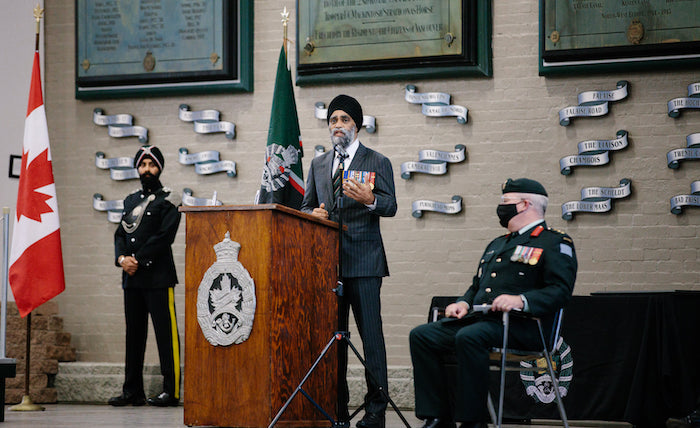
Harjit Singh Sajjan (centre) at The British Columbia Regiment change of command ceremony. The master of ceremony is standing at the left – Photo: BCF Facebook
By Asia Samachar Team | CANADA |
A Sikh soldier spotted. The change of command at the British Columbia Regiment Duke of Connaught’s Own on Sunday (20 Sept) saw a prominent presence of two Sikhs. Canadian national defence minister Harjit Singh Sajjan was the guest of honour to witness Lt-Col Paul Lindsay handing over command to Lt-Col Vincent Virk. Handling the task as the master of ceremony was another Sikh. They are both captured in this photo, courtesy of British Columbia Regiment Facebook page.
ASIA SAMACHAR is an online newspaper for Sikhs / Punjabis in Southeast Asia and beyond.Facebook | WhatsApp +6017-335-1399 | Email: editor@asiasamachar.com | Twitter | Instagram | Obituary announcements, click here |
Gurdwara Sahib North Shore opening on 9 March 2019 – Photo: Chris Darby Facebook page
By Gurmukh Singh | OPINION |
Covid-19 restrictions have resulted in a huge drop in Sangat attendance at gurdwara and consequential loss of donations (ਚੜ੍ਹਾਵਾ). This trend may not be reversible and there is need to assess the impact on costs associated with gurdwaras and religious personnel.
Live-streaming of religious programmes, Kirtan and discourses, through webinars and WhatsApp, in addition to daily TV religious programmes, is becoming popular.
These services make physical attendance at Gurdwaras optional, mostly for rites of passage i.e. ceremonies that mark important events in a person’s life, and major festivals, subject to Covid-19 restrictions of course. Admittedly, virtual Sangat is not the same as the spiritual experience of physically participating in worship, Kirtan and katha, in gurdwara Sangat environment.
Regarding Covid-19 related Sangat trend away from Gurdwaras, Satwant Singh Calais, a Sikh community and youth camps activist in Australia, mentioned webinars by those like Sikh Research Institute.(SikhRI), Dya Singh of Australia and Veer Manpreet Singh reaching over 100,000 people on many occasions. He writes, “Gurdwaras may no longer be the focal point for religious experiences and Sikhi education for next generation Sikhs. Covid has now given people time to reassess their reason to go to the Gurdwaras.”
There is almost a revolution going on in the religious sector which requires an assessment of longer-term impact at local and national and global levels.
There are small Sangats in remote diaspora places where Gurdwaras are run entirely by the Sangat. At the opposite end we have Takhts, historical and large city gurdwaras which need large sums to defray costs of religious staff and buildings. In some towns we have more Gurdwaras than we need due to community and ideological divides. Many in the name of castes and braadris are even against Gurmat. Local Gurdwaras can pool resources, reduce staff costs and use spare buildings for educational, youth and community activities.
The discipline of a new regime is being imposed by Covid-19 on the whole of the religious sector. Thousands depend for their livelihood on religious activities. There is a vast range of religious personnel from the regular granthi who perform gurdwara services, local and travelling raagis (traditional Gurbani singers) and kathakaars (exegetes) to sants and those who wear religious garbs and have become dependent on donations. The Sikhi lesson of kirat karni (earning ones living) is being taught by the pandemic leading to a leaner religious sector. Gurdwaras are looking at ways to review and rationalise their running costs.
Thousands of religious personnel including travelling raagis and parcharaks are struggling to make ends meet. There are likely to be hundreds of jathas who have families in India and who are unable to move around. They are in gurdwaras without much income from Sangat donations as Kirtan bhet. Innovative gurdwaras have already started live-streaming kirtan and katha but that does not help the kirtan-bhet situation.
The suggestion is that gurdwara committees should actively engage in fundraising for gurdwara upkeep and paying the granthis and jathas. The live streaming is a channel to request the faithful for their daswandh. Some gurdwaras have income from rented properties including shops and sale of books and religious artefacts.
To quote Satwant Singh Calais of Australia, ”We have seen that Covid- 19 has denied many raagi jathas and kathakaars to be able to earn funds and repay their cost of getting out to countries like Australia, UK and America. Sidney Sangat have raised funds for jathas to enable them to support their families. Most travel abroad without any employment agreement and depend on Sangat donations (Kirtan bheta). They get accommodation in cramped quarters [in view of Covid social distancing] and eat in the gurdwara langar. There is need for standard award structures for jathas.”
From his own experience in recent years, Dya Singh of Australia writes, “The next generation Sangats are moving on to iPhones. Bilingual Gurbani Kirtan, katha and discussions are all on WhatsApp groups, email groups, webinar, zoom meetings and so on. Even live gurdwara programs are being on-lined. Sunday programs are on air. It is amazing how much Sikhi interaction is going on worldwide.”
The pandemic has also highlighted the mental health issues of senior citizens. Gurdwaras can do much through volunteer sewadars from relevant professions and some are doing just that.
In the context of these discussions, the last word is about those who choose to train as religious personnel, mainly granthis, kirtanias and kathakars (those who serve in gurdwaras, recite, sing and interpret Gurbani). They should have genuine spiritual commitment and aptitude, a deep sense of calling, to serve the Sangat in these missionary roles. It is preferable that members of the Sangat should themselves do Sahaj or Akhand Paatth (slow/intermittent or continuous reading of Sri Guru Granth Sahib).
Gurdwara managements should also develop standard job descriptions and responsibilities of religious personnel. They should be conversant with modern communications technology for disseminating gurdwaras services to remote Sangats. Accordingly, they should be paid well so that they do not have to worry about their families or work security.
Covid-19 pandemic is a major challenge for the religious sector but also offers opportunities for overdue reforms.
Gurmukh Singh OBE, a retired UK senior civil servant, chairs the Advisory Board of The Sikh Missionary Society UK. Email: sewauk2005@yahoo.co.uk. Click here for more details on the author.
* This is the opinion of the writer, organisation or publication and does not necessarily represent the views of Asia Samachar.
ASIA SAMACHAR is an online newspaper for Sikhs / Punjabis in Southeast Asia and beyond.Facebook | WhatsApp +6017-335-1399 | Email: editor@asiasamachar.com | Twitter | Instagram | Obituary announcements, click here |
Chardikala Ride 3.0 at Gurdwara Sahib Johor Bahru – Photo: Supplied
By Asia Samachar Team | MALAYSIA |
A group of Sikh bikers visited eight gurdwaras on the southern side of Peninsular Malaysia – from Mantin to Johor Bahru – in their latest ride over the weekend (19-20 Sept).
Dubbed Chardikala Ride 3.0, they visited gurdwaras in Segamat, Kluang, Batu Pahat, Machap, Pontian, Johor Bahru, Port Dickson and Mantin.
They raised some funds for the gurdwaras, including to equip the new classrooms at the Muar gurdwara. They also organised a programme at Segamat, joining the local Sangat (congregation).
“Every where we went, we mingled with the local Sangat. It was a pleasure to meet them and they received us with warmth and open hearts,” Ravinder Singh, one of the bikers, told Asia Samachar.
The next ride, Chardikala Ride 4.0, will cover the east coast of the peninsular.
ASIA SAMACHAR is an online newspaper for Sikhs / Punjabis in Southeast Asia and beyond.Facebook | WhatsApp +6017-335-1399 | Email: editor@asiasamachar.com | Twitter | Instagram | Obituary announcements, click here |
Gurdwara Darbar Sahib Kartarpur just days before the Guru Nanak 550th anniversary celebration – Photo: Ramesh Singh Arora
By Nirmal Singh | OPINION |
September 22, 1539 is the day that Guru Nanak, then 70 and living at Kartarpur, a town he had founded in 1522, passed into Sachkhand – the domain of the True Lord. He had days before installed Bhai Lehna, renamed Guru Angad, as his successor Guru of Sikhs in a ceremony at Kartarpur. In years preceding, Guru Nanak had set up a Dharamsal at Kartarpur where the nascent community of believers, the Sangat, met for daily Kirtan – singing of praises of the Creator Lord – and partake of food at Langar, free kitchen, that the Guru had institutionalized.(1)
This Gurpurb is being celebrated at the Gurdwara Darbar Sahib at Kartarpur on 22 Sep. this year for the first time since the opening of the Kartarpur Corridor on November 9, 2019. Due to the Corvid-19 pandemic precautionary measures, Kartarpur Corridor continues to be closed and international travel is severely curtailed. This would impact the arrival of pilgrims from India and other countries on this occasion.
SYMBOLISMS OF KARTARPUR
Guru Nanak is remembered as Hinduan da Guru te Musalmanan da Pir – Guru of the Hindus and Pir of the Muslims. The tradition tells us that after his passing the body of Guru was claimed both by Hindus and Muslims. However when the sheet covering Nanak’s body was removed, they found instead a heap of flowers – which they divided and set up mausoleums in his memory, separated by a wall, that have lasted till today.
Bhai Gurdas, a few decades after passing of Guru Nanak, had written that:
Jaarati Kari Mulataan Dee Firi Karataari Puray No Aaiaa |Charhhay Savaaee Dihi Dihee Kalijugi Naanak Naamu Dhiaaiaa |Vinu Naavai Horu Manganaa Siri Dukhaan Day Dukh Sabaaiaa |Maariaa Sikaa Jagati Vichi Naanak Niramal Panthhu Chalaaiaa | Daapiaa Lahinaa Jeenvaday Guriaaee Siri Chhatr Firaaiaa |Jotee Joti Milaai Kai Satigur Naanaki Roopu Vataaiaa|
After journey of Multan, Baba Nanak again turned towards Kartarpur. His impact increased by leaps and bounds and he made people of kaliyug remember Nam. Desire of anything except the Nam of the Lord, is invitation to multiplying sufferings. In the world, he established the authority (of his doctrines) and started a way of life, devoid of any impurity, nirmal panth. During his life time he waved the canopy of Guru seat on the head of Lahina, Guru Angad, and merged his own light into him – Var 1, pauri 45.
The ‘sangat’ in time became the prototype for building of the Sikh faith community as it grew and spread. The continuity and leadership was provided by the Guru and the first such transition also took place at Kartarpur. In the process, Kartarpur also became the final resting place of Guru Nanak. So Kartarpur had too many firsts happen, in those few fateful years, on its sacred soil.
HOW AS GURU NANAK CREMATED? by Harjinder Singh Dilgeer. Click here.
Nonetheless Kartarpur, in spite of its historic role, has stayed relatively peripheral to development of Sikhs and Sikhi, possibly due to certain disconnects and discontinuities it experienced in its history. We propose to talk about those underlying institutional issues at another time.
KARTARPUR AS WE KNOW NOW
For now, we want to briefly review the developments since the heady feelings that had been generated by the inauguration of the Kartarpur Corridor, a little over nine months earlier. The expectations were high, both in terms of the volume of usage of the visa-less transit facility and the likely peace dividend of the tremendous goodwill plus a sense of pervasive optimism that the event had given rise to.
The Question of Footfall
The footfall has been much below the expected levels from the beginning. Even if there are no systemic impediments, the flow may improve only marginally because corridor offers restricted day visit to Kartarpur Darbar Sahib from Dera Baba Nanak ICP at total cost that may be unaffordable for average families.
Sikhs tried to concentrate on enlarging the yatri pool by facilitating their documentation needs, offer free travel from Amritsar, facilities for free stay at Dera Baba Nanak during transit and help out with sewa and liturgical services at Darbar Sahib Kartarpur but the improvement was insignificant.
Lockdown due to the Pandemic forced closure of the facility and the subject is gone off our horizon.
Need for Special Institutional Structure
Considering the various factors, when the circumstances become more congenial, we will need a broad structure answering to the following requirements to make this project start delivering:
Shiromani Gurdwara Parbandhak Committee (SGPC) and Pakistan Shiromani Gurdwara Parbandhak Committee (PSGPC) to take care of liturgical, sewa and devotee needs and services required and coordinate operational issues with concerned government agencies on their side of border.
Akal Takht Secretariat to be equipped to process coordination of extra resources needed for the current or new projects, channeling global resourcing, rule setting and providing dispute resolution support.
Akal Takht to consider setting up a joint Advisory Committee to help develop coordinated approach for Sikh related procedural changes, agreement review points to be pursued with respective Governments by SGPC/PSGPC
Peace and Interfaith harmony Sikh initiatives, engagement and advisories to be by a joint Committee under Akal Takht aegis.
The principles guiding the above are:
All operations are managed and coordinated with government agencies by the Gurdwara Management Committee concerned, while
all the policy, reviews, dispute resolution, new initiatives, resource mobilization and advisories would be by and under the aegis of Akal Takht.
Peace Expectations
We have to realize that using the opening provided by the corridor to set the neighbors on a path to Indo-Pak amity and regional prosperity can only be accomplished by the political leaders of the two countries. Sikhs share that hope because of the force of their persuasion and theology and also because they realize that it is only abiding Indo-Pak peace and harmony that will help the Sikh longing of connecting with Kartarpur to be fulfilled in practice.
Thus the Sikhs agree with and endorse the calls for peace and harmony and would no doubt get engaged in supporting peace initiatives and to help avoid any acts that may impede the maintenance of peace. On their own, however, Sikhs are not in a position to initiate the peace process. The role of Sikhs can and should be a part of the initiatives by leaders of their countries.
Umbilical Cord Reality
The Indo-Pak Peace and Harmony should not be read only as control over cross border acts of terror and related planting of spies and saboteurs or other acts of hostility but it should include security of the minorities and their heritage in both the countries. That is the real umbilical cord that will ultimately sustain Kartarpur spirit and model.
Reminisce what?
This day therefore assumes, more vividly, the need for Sikhs to rediscover their old and tried role of helping the suffering lokaaee to resist the wrongs that happen all the time in their midst and proactively make ourselves and others realize that absent goodwill for one and all our endeavor may not yield much.
Not easy! True, but that to me is the message of Kartarpur that Guru Nanak bequeathed the humanity!!
[Nirmal Singh has written six books on Sikhs and Sikhi and several of his articles have been published in journals like Sikh Review, Journal of Sikh Studies and Comparative Religion and Abstracts of Sikh Sudies (IOSS) as well as in the US mainstream news media. Resident in Orlando, he spends considerable time in Delhi]
ASIA SAMACHAR is an online newspaper for Sikhs / Punjabis in Southeast Asia and beyond.Facebook | WhatsApp +6017-335-1399 | Email: editor@asiasamachar.com | Twitter | Instagram | Obituary announcements, click here |
Jasmeet Kaur with her charcoal work – Photo: Personal LinkedIn
By Asia Samachar Team | INDIA |
An amazing charcoal sketch. Mumbai-based creative specialist Jasmeet Kaur shared on LinkedIn what she said was her first attempt at charcoal painting. Judging from the likes and comments, it was a home run! “Advertising is addictive, even thoug it saps every drop of your blood!,” says the MBA in Advertising holder.
ASIA SAMACHAR is an online newspaper for Sikhs / Punjabis in Southeast Asia and beyond.Facebook | WhatsApp +6017-335-1399 | Email: editor@asiasamachar.com | Twitter | Instagram | Obituary announcements, click here |
Handover: Dr Jasbir Singh handing over the symbolic Sri Sahib to Harjinder Singh who takes over the jathedari (chieftainship) of SNSM – Photo: Main photo courtesy of SNSM Malaysia Facebook page
By Jespal Singh Brar | LETTER TO THE EDITOR |
My congratulations to the Malaysian Sikhs regarding the harmonious election for the post of Jathedar, Sikh Naujawan Sabha Malaysia.
Congratulations Veer Harjinder Singh Ji for being blessed with Guruji’s Kirpa to take the helm of SNSM. I also want to thank Dr Jasbir Singh Ji, the former Jathedar for his leadership. Thank you for your sewa Veer Jasbir Singh Ji in a very challenging environment as Malaysian Sikhs are going through an unprecedented time, where there is mass polarization among friends and family due to concerns about what is Gurbani and if Dasam Granth is Dasmesh Pitajis written words.
My sincere request to Malaysian Sikhs to please give Veer Harjinder Singh Ji a chance to manage the leadership of SNSM. There should not be any lobbying behind the scenes. Perception might seem like a reality if one group is seen to be lobbying or in close association. It will only make it more challenging for the unity of Malaysian Sikhs.
My humble request to Sardar Harjinder Singh Ji is being open to listening to everyone but should not let anyone influence him. As it is the Malaysian sangat is divided and the position of the Jathedar can be the unifier that the Sikhs in Malaysia need.
Sitting across on the other side of the globe I feel concerned regarding the situation of Sikhs in Malaysia, due to the deterioration in civility as well as camaraderie. Unity of Sikhs in Malaysia was one aspect that differentiated Malaysian Sikhs from those in the west, it was a sense of our maturity to manage differences. It was common to see Sikhs fighting in Gurdwaras in the west but this had never happened in Malaysia until a recent incident. This was an aberration and even those who opposed the speaker in that situation were surprised it happened in Malaysia. Emotions need to be checked. It was actually a wakeup call that we should be able to agree to disagree without resorting to violence and shaming.
Please have mercy on the younger generations and keep things that divide us from becoming such a huge block. The pulse of the younger generation is appealing, to please give them a space to learn Sikhi and have the camaraderie of previous generations. Third parties who want to see the schism within the Sikhs, will work harder to play the game of whispers and malicious gossip to divide Sikhs. Please overlook each other’s faults and work together for unity. “Bhulan Ander Sab Ko, Abhul Gur Kartar”.
May the Sikhs of Malaysia provide all assistance to Jathedar Harjinder Singh Ji with the support that he deserves and needs so that he is very successful, which in turn will make the Sikhs of Malaysia successful as well. God bless Jathedar Harjinder Singh Ji and the Sikhs of Malaysia.
(Malaysian-born Jespal Singh Brar now lives in California, US)
A SAMACHAR is an online newspaper for Sikhs / Punjabis in Southeast Asia and beyond.Facebook | WhatsApp +6017-335-1399 | Email: editor@asiasamachar.com | Twitter | Instagram | Obituary announcements, click here |
Punjab MPs: (L-R) S Hukam Singh, Sardar Kapur Singh and Sardar Tarlochan Singh with his wife wife Uttamjit Kaur at Rashpatri Bhavan
By Hardev Singh Virk | OPINION |
INTRODUCTION
Indian Parliament is a mammoth organisation to run the Indian democracy. The Lok Sabha at present consists of 545 members. Of these, 530 members are directly elected from the States and 13 from Union Territories, while two are nominated by the President to represent the Anglo-Indian community. There are total 20 Members in Parliament (MPs) from Punjab, 13 in Lok Sabha and 7 in Rajya Sabha. So representation of Punjab in Indian Parliament (Lok Sabha) is just 2.5 percent. It is unfortunate that there is no Punjab Forum of Members of Parliament to fight for common causes; hence they fight among themselves in Parliament as directed by their political parties. That is one reason that Punjab and Sikh issues remain unresolved.
Punjab has been ruled by two political parties, Congress and Akali Dal. Other parties act as splinter groups to join either of these two. Akali Dal has been represented by stalwarts like Hukam Singh, Kapur Singh, Rajinder Kaur and Gurcharan Singh Tohra in the Indian Parliament. Some of their light weights included Kikar Singh, a driver of Sant Fateh Singh; Dhanna Singh Gulshan, a Dhadi by profession; and Giani Bhupinder Singh, Jathedar of Akal Takhat. The parliament record shows that some of these worthies never opened their mouth in Parliament. The track record of speeches delivered in Indian Parliament is available. This article gives critical analysis of speeches delivered by three Parliamentarians who fought for the Sikh Causes in the Indian Parliament.
S. Hukam Singh addresses Sikh-Kenyans in Nairobi, 1964. Photo: Amarjit Singh Chandan Collection via SikhChic
A CRITIQUE OF S. HUKAM SINGH‘S LAST SPEECH IN THE CONSTITUENT ASSEMBLY OF INDIA
Hukam Singh (1895-1983) was elected to the Constituent Assembly of India on 30 April 1948 as a member of the Shiromani Akali Dal. He actively participated in the Constituent Assembly’s debates, and only a year after his entry was nominated to the panel of its chairmen. He continued to be on the panel till his unanimous election as Deputy Speaker on 20 March 1956, this even though he was a member of the Opposition.
He was one of the two Sikh Members, the other being Bhupinder Singh Mann, who did not sign the Indian Constitution in protest against providing no guarantees to the Sikhs, as promised by the leaders of Indian National Congress, for joining India. Hukam Singh was a qualified lawyer and had a brief stint as a Judge of Kapurthala High Court, hence he was a prominent member of the constituent assembly. His speech in the assembly is remarkable and full of pithy comments on the basic structure, articles and schedules of the Indian Constitution. A gist of his comments on the Constitution in his famous speech is given as under:
We have produced the bulkiest Constitution in the world. The Constitutions of other countries are much simpler. I am not happy at all over this achievement.
Indian Constitution is neither indigenous nor a complete copy of any other single type. It is neither federal nor unitary.
We have created a hybrid by mixing American, English, Australian, Canadian and Irish constitutions, which we have been pleased to name the Indian Constitution.
Hukam Singh quoted BR Ambedkar, the main architect of Indian Constitution: “Democracy in India is only a top-dressing on Indian Soil, which is essentially undemocratic.”
He warned about Emergency provisions: “The mere Proclamation of Emergency ought not to have been allowed to abrogate civil liberties“. Hukam Singh stood vindicated when Emergency was imposed by PM, Indra Gandhi, in June 1975.
He was in favour of providing social and economic security to Indian citizens: “Unless material insecurity is eliminated, personal freedoms are paper safeguards and worth nothing“.
“I believe rights are no rights unless enforceable“.
He spoke about the apprehensions of Sikhs which proved to be true: “The Sikhs grew apprehensive that the Congress, in their anxiety to win freedom, otherwise very commendable, might hand over their home-land to the Muslims and they might be subjugated forever”.
He referred to the wrath of the Sikhs in their boycott: “The Sikhs got indignant and the Panthic Prathinidhi Board boycotted the Constituent Assembly by their resolution dated 5th July 1946 when the Muslim League had accepted it“.
He reminded the Constituent Assembly about the promises made by the Working Committee of the Congress to the Sikhs: “Congress will give them all possible support in removing their legitimate grievances and in securing adequate safeguards for the protection of their just interests“.
In view of the promises made by the Congress in para supra, the Sikhs made common cause with the Congress and stood firmly by it. Then again on 6th January 1947, the Congress made it clear that the right of the Sikhs in the Punjab should not be jeopardised, keeping in view the Cabinet Mission Plan.
He referred to the predicament of the Sikh masses: “It is only the Sikh Community that earnestly desired, repeatedly requested and constantly cried for safeguards but have been denied any consideration. They fail to understand why they have met this treatment“.
He was a visionary who predicted the future state of affairs in India: “The majority can oppress, it can even suppress the minority; but it cannot infuse contentment or satisfaction by these methods“.
He ridiculed that despite India being a Secular state, special provisions were being made: “It was said that it was a blot to acknowledge any religious minority; but the Anglo-Indians have been given safeguards in the Constitution”.
He highlighted the Sikh problems diligently: “The whole economy of the Sikh community depended upon agriculture and army service. Lands have been left in Pakistan and their proportion in the army since the partition has been greatly reduced and is being reduced every day”.
He referred to the discrimination being made on the basis of language: “They (Sikhs) wanted a Punjabi speaking province. That has been denied. It was not a communal demand, but a territorial one”.
He referred to the stubborn attitude of Punjabi Hindus and their communal attitude towards their mother tongue Punjabi: “Majority community in the province went so far as to disown their mother tongue. That language is in danger on account of aggressive communalism of the majority“.
He spoke boldly about the reasons for rejection of Indian Constitution by the Sikhs: “The Sikhs feel utterly disappointed and frustrated. They feel that they have been discriminated against. Let it not be misunderstood that the Sikh community has agreed to this Constitution. I wish to record an emphatic protest here. My community cannot subscribe its assent to this historic document“.
He pointed to the weakness of basic structure of Indian Constitution: “In our Constitution, each article tends to sap the local autonomy and makes the provinces irresponsible”.
Hukam Singh was forthright in pointing out the serious flaws of our Constitution: “The right to work is not guaranteed. There is no assurance for old age maintenance or provision during sickness or loss of capacity. Even free primary education has not been provided for. The minorities and particularly the Sikhs have been ignored and completely neglected“. Several Amendments have been made subsequently in Indian Constitution, in view of his criticism, to rectify the situation.
He was highly critical of the Status provided to the President of Indian Republic which agitates against the spirit of Parliamentary Democracy: “President has been enthroned as the Great Moghul to rule from Delhi with enough splendour and grandeur”.
We must appreciate the futuristic vision of Hukam Singh who predicted that Indian State can catapult itself to a fascist state: “This shall consequently facilitate the development of administration into a fascist State for which there is enough provision in our Constitution“. It is going to happen during our lifetime, if the present trends of Indian polity are true indicators of future of Indian democracy.
A CRITIQUE OF SARDAR KAPUR SINGH‘S SPEECH IN PARLIAMENT “BETRAYAL OF THE SIKHS”
Kapur Singh (ICS) (1909-1986) was a renowned scholar of Sikhism. This speech was delivered by him on 6th September, 1966 in Lok Sabha. He remained Member of Parliament of 3rd Lok Sabha (1962-67). He became popular among the Sikhs due to his Anandpur Sahib Resolution of 1973 which is a magna carta of Sikhs demands and aspirations.
Kapur Singh was a vociferous orator in Indian Parliament and he participated in almost all debates concerning Punjab and Sikh issues. Out of his many speeches, we may refer to just two: (i) Causes of Sikh Unrest, and (ii) Betrayal of the Sikhs. The modus operandi in both these speeches is same, as there is a common thread of blame game running between the two, though they were delivered on different occasions for different purposes.
Kapur Singh was speaking on the Bill to provide for the reorganisation of the existing State of Punjab on linguistic basis. He started his speech with his remark: “Madam Chairman, as it is, I have no option but to oppose this Bill. Like the curate’s egg, though it might be good in parts, it is a rotten egg”.
He opposed it on the following grounds: “This act is conceived in sin, because it constitutes the latest act of betrayal of solemn promises given to the Sikh people by the revered leaders of the Congress national movement”. He quotes a Slok from Mahabharat to bring home the point: “He who has one thing in mind but represents another thing to others, what sin he is not capable if committing? For, he is a thief and robber of his own self.”
His criticism is based on eight points. First, he reminded the Members of Lok Sabha that Congress leaders like Mahatma Gandhi, Pandit Moti Lal Nehru, and Jawaharlal Nehru went to meet Baba Kharak Singh, the undisputed leader of the Sikhs, in 1929 and gave him a solemn assurance that after India achieves political freedom, no Constitution shall be framed by the majority community unless it is freely acceptable to the Sikhs”.
“The second link is that in the year 1932, at the time of the Second Round Table Conference, the British Government, through Sardar Bahadur Shivdev Singh, then a member of the Indian Secretary of States’ Council, made an informal proposal to the Sikhs that if they disassociate finally with the Congress movement, they would be given a decisive political weightage in the Punjab, such as would lead to their emerging as a third independent element in India after the British transfer power to the inhabitants of this sub-continent”. Kapur Singh squarely blames Master Tara Singh for his naivety: “Master Tara Singh, to my personal knowledge, promptly rejected this tempting offer, I was then a student at the University of Cambridge and was closely associated with these developments”.
Source: Punjabi Library
The third link refers to the All India Congress Working Committee meeting held at Calcutta in the month of July, 1946, which reaffirmed the assurances already given to the Sikhs, and in his Press Conference held on the 6th July, there, Pandit Jawaharlal Nehru spelt out the concrete content of these solemn undertaking in the following flowery words: “The brave Sikhs of the Punjab are entitled to special consideration. I see nothing wrong in an area and a set-up in the North wherein the Sikhs can also experience the glow of freedom.” In these words, an autonomous State to the Sikhs within India, was promised.
Fourthly, Kapur Singh claims that at the time of the Cabinet Mission’s visit to Delhi in early 1946, a message was communicated to the Sikhs through the late Sardar Baldev Singh that if the Sikhs are determined not to part company with Hindu India, the British Parliament in their solicitude for the Sikh people, will ensure that no Constitution shall be framed such as does not have the concurrence of the Sikhs. But Sardar Baldev Singh, in consultation with the Congress leaders, summarily rejected this offer.
Fifthly, in April, 1947, Mr. Jinnah, in consultation with certain most powerful leaders of the British Cabinet in London, offered to the Sikhs, first through Master Tara Singh and then through the Maharaja of Patiala, a sovereign Sikh State. Master Tara Singh summarily rejected this attractive offer and the Maharaja of Patiala declined to accept it in consultation with Sardar Patel and Pandit Jawaharlal Nehru.
Sixthly, on the 9th December 1946, when the first meeting of the Constituent Assembly was held under the Chairmanship of Babu Rajendra Prasad, Pandit Jawaharlal Nehru moved the first and the fundamental resolution in which it was said: “Adequate safeguards would be provided for minorities… It was a declaration, a pledge and an undertaking before the world, a contract with millions of Indians, and, therefore, in the nature of an oath which we must keep.”
Seventhly, Kapur Singh blames Sardar Baldev Singh for committing the blunder of revealing the offer made to him by the British Cabinet to Pandit Jawaharlal Nehru during a meeting held in London on 17th May, 1946, to find a final solution to the Indian communal problem: “When the Congress and the Muslim League failed to strike any mutual understanding and Pandit Jawaharlal Nehru decided to return to India, the British Cabinet leaders conveyed to Sardar Baldev Singh that if he stayed behind, arrangements might be made “So as to enable the Sikhs to have political feet of their own on which they may walk into the current of World History.”
Eighthly, and lastly, in the month of July 1947, the Hindu and Sikh members of the Punjab Legislative Assembly met at Delhi to pass a unanimous resolution favouring partition of the country, in which resolution occur the following words: “In the divided Indian Punjab, special constitutional measures are imperative to meet just aspirations and rights of the Sikhs.”
When in 1954, Master Tara Singh reminded Pandit Nehru, the then Prime Minister of India, of the solemn undertaking previously given to the Sikhs on behalf of the majority community by passing resolutions for providing safeguards to the Sikhs in free India, Pandit Jawaharlal Nehru coolly replied, “the circumstances have now changed.”
Kapur Singh blames Hindus of Punjab in an equal measure: “The Hindus of Punjab aided and abetted by the Central leadership of India are playing a sordid drama by refusing to form a Punjabi speaking State in which the Sikhs might acquire political effectiveness and second by falsely declaring that Punjabi was not their mother tongue”.
He reminds the Members of the Lok Sabha that Sikhs have no faith in Indian constitution: “the Sikhs do not accept this Constitution Act; the Sikhs reject this Constitution Act.” Nevertheless, the Sikhs are aware that, under the existing constitutional arrangements, they cannot send more than a couple of their own representatives to the Parliament and even they may not always be heard freely.
Kapur Singh ridiculed the TERMS given to the Shah commission for reorganising Punjab on linguistic basis: “All these three guidelines given to the Commission by the Government of India are found to be, when they are properly examined by people who understand the realities of politics, heavily loaded against the Punjab State, and have the effect of reducing Sikhs to even more political ineffectiveness than at present”.
The ramifications of this reorganisation act of Punjab on the linguistic basis are being felt till today after more than fifty years of its enactment by the Indian Parliament. The injustices done to Punjab by sharing its water resources and power resources; merging Punjabi speaking areas in adjoining states of Haryana and Himachal; and robbing Punjab of its Capital by creating a Union Territory of Chandigarh, were vociferously referred to in the speech of Sirdar Kapur Singh.
Tarlochan Singh with PM Indira Gandhi and President Giani Zail SIngh – Photo: Tarlochan Singh website
A CRITIQUE OF SPEECH DELIVERED BY SIRDAR TARLOCHAN SINGH
I had the privilege to review the book “Role of A Parliamentarian (Tarlochan Singh’s Speeches, Mentions & Questions in Rajya Sabha)” published by Punjabi University, Patiala in 2016. Sirdar Tarlochan Singh was elected to the Indian Parliament from the state of Haryana, with the support of BJP and INLD, as an independent member of Rajya Sabha for a term of 6 years from August 1, 2004 to July 31, 2010. In the history of Indian Parliament, he is one of the rare Parliamentarians who has shown the temerity to publish the record of his speeches delivered in the Upper House of Parliament.
The Calling Attention Motion of Sirdar Tarlochan Singh was admitted in 2009 in the Rajya Sabha to discuss the 1984 riots. This was for the first time after 25 years of the traumatic events that the discussion took place in the Parliament. The purpose of this critique is to highlight the impact of his speech delivered on 14th December, 2009 during call attention motion on killing of Sikhs in 1984.
Some of the highlights of his speech are as follows:
Sikhs were the sword arm of India. About 35000 Sikhs were massacred fighting Ahmed Shah Abdali in what is known as “Vadda Ghallughara” in Sikh History.
Sikh leaders joined India in preference to offer of a Sikh state by MA Jinnah in Pakistan.
Despite assurances by the Indian leaders, no special rights were included in the Indian Constitution for the Sikhs as promised to them by Gandhi and Nehru.
The Sikhs made sacrifices for the freedom of India; about 90% Sikhs were imprisoned in the jail in Andaman & Nicobar; out of the total proportion of the people who were hanged in India about 80% were Sikhs.
He compares the massacre of Sikhs in Delhi in November 1984 for 3 days with the massacre carried out by Nadir Shah for three days in Delhi during March 1739. On 1st to 3rd November, 1984, 2973 Sikhs were murdered in Delhi alone. The number of murders amounted to 5000 in the whole of India.
Tarlochan Singh decried that Delhi massacre of Sikhs is not a riot as propagated by Govt. of India. “Riot takes place when there is fight between two groups. Our was not a riot? Ours was what happened in case of Jews by Hitler in 1942-43, i.e. genocide, massacre, holocaust”.
Justice has been denied to the Sikhs. In all, 39 inquiries were conducted by the Home Department and the police, out of these in 36, accused were exonerated.
The CBI has asked permission from the government for prosecution of Sajjan Kumar, but the government is not giving permission so that the trial should start. I am surprised you have made an accused of Sikh massacre in Delhi, a Minister of your government.
Tarlochan Singh is at his rhetoric best in his speech delivered on 14th December 2009 during a call attention motion on killing of Sikhs in 1984. Anyone who reads his entire speech will become sentimental as it touches the emotional chords of the Sikhs. He reminds the Parliament: “Why didn’t the earth shake when Mahatma Gandhi was murdered, how many Marathas were murdered in the country, because the murderer was a Marathi? When Rajiv Gandhi was killed, how many Tamils were killed? Why were only the Sikhs victimized, why the tree had to fall only on the Sikhs?“. He is highly critical of the role played by the Indian judiciary and CBI in dealing with the Sikh massacre.
He concludes his speech with the remarks: “I am thankful to Chairman and Deputy Chairman for allowing the discussion for the first time after 25 years in this House. We were not allowed to discuss this issue earlier and even a motion of this was dissuaded in the Parliament”.
Tarlochan Singh is known for his oratory and political acumen. His training as a public relation man in early stages of his career stood him in good stead in developing long lasting relationships with political leaders of all hues. He believes that most of the problems faced by the Sikhs in Indian state can be fruitfully addressed through a meaningful participation and logical presentation in the democratic forums of the country. He has indomitable courage and passion to fight for the Sikh causes. I always find him pragmatic in politics and optimist in life.
Scholar and scientist Hardev Singh Virk retired from Amritsar-based Guru Nanak Dev University in 2002 after serving as Founder Head Physics Department and Dean Academics. Ex-Professor of Eminence, Punjabi University, Patiala. He is the present Visiting Professor at SGGS World University, Fatehgarh Sahib (Punjab), India.
ASIA SAMACHAR is an online newspaper for Sikhs / Punjabis in Southeast Asia and beyond.Facebook | WhatsApp +6017-335-1399 | Email: editor@asiasamachar.com | Twitter | Instagram | Obituary announcements, click here |
ASIA SAMACHAR is an online newspaper for Sikhs / Punjabis in Southeast Asia and beyond.Facebook | WhatsApp +6017-335-1399 | Email: editor@asiasamachar.com | Twitter | Instagram | Obituary announcements, click here |



















 By Asia Samachar Team | MALAYSIA |
 SIKH REHT MARYADA: English version, Punjabi version