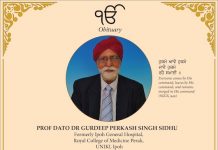
In remembrance of our late father, Sardar Sarjit Singh Sidhu and Family wish you to join us for a Jodh Mela programme on the
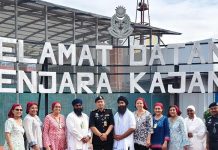
12th September 2020 (Saturday) at Gurdwara Sahib Chagkat, Batu Gajah, Perak
The programme will commence with Kirtan Darbar at 10am followed by Sahej Path Da Bhog at 11.15am
Guru Ka Langgar will be served.
Please accept this as a personal invitation from the family. In lieu of the RMCO, kindly observe the S.O.P. in place.
Contact: Sarjit (017 – 669 7775)
| Entry: 6 Sept 2020 | Source: Family
ASIA SAMACHAR is an online newspaper for Sikhs / Punjabis in Southeast Asia and beyond.Facebook | WhatsApp +6017-335-1399 | Email: editor@asiasamachar.com | Twitter | Instagram | Obituary announcements, click here |
Do Sikhs discriminate black Sikhs? Is there anti-blackness within the community? And what role can Sikhs play as the world is trying to wrap around Black Lives Matter (#BLM)?
Two black Sikh women have come together to take these issues head on. Meet Brianna Sukhmani Kaur and Gurpreet Kaur, co-founders of a grassroots organisation Black Sikh Initiative (BSI).
They have big plans. They intend to empower black Sikh activists, as well as their white and brown allies, to fight against racism, colorism, and casteism within and outside of the Sikh community.
In an email response to Asia Samachar, Gurpreet (Jasmine Morris) said they found that even though Sikhs had started to speak out against discrimination in their different countries of residence, most had not taken action to address the discrimination within their own community.
So, they intend to bring about changes. For one, the movement founded in July 2020 envisions to make Sikh spaces truly welcoming and inclusive for Sikhs of all colors as well as people in general.
They are starting small. For now, they have a presence on the social media. In an entry last month, they had a ‘call to action’ on what books are stacked in your home library. The note asked readers to examine if the books in your library or your children’s library are all written by people from the same cultural background as yourself.
“If so, consider purchasing a book from an author who comes from a different culture then you. By better understanding each other’s perspectives, we can better know how to interact and treat one another,” they urged.
This is just one recent example how they are trying to inject change in the community – one step at a time, one person at a time.
Gurpreet is a writer and activist who is keen to share her perspective as someone not born into the Sikh tradition. She plans on pursuing a “Master of Divinity” after she graduates to pursue a role in ministry. Co-founder Brianna “Sukhmani” Kaur is an activist and health care professional who served in the United States Army as a human resources specialist.
BSI founders were inspired to take action after watching the series of events surrounding the death of George Floyd. The sadness, the anger, and the irritation they felt had turned into motivation to stand up against injustice and discrimination in all its forms and manifestations.
At the time, the two were not in contact with each other. But by fate, the two activists would reconnect on Facebook via Messenger. They then began discussing different issues that they have encountered trying to combat discrimination by other Sikhs in their own experience. And even how in the past they had discussed their experiences on panels, blogs, and websites, only to realise that these same Sikh organisations and personalities were exploiting their stories for likes, comments, and shares.
“To be Black and Sikh means to understand all elements of being a minority. We are a minority within a minority, but that’s what makes us unique and resilient. I am hoping to carve a place for myself in a society that doesn’t recognize my struggles as a Black Sikh woman,” Brianna says in a recent entry.
RELATED STORY:
(Asia Samachar, 23 June 2020)
ASIA SAMACHAR is an online newspaper for Sikhs / Punjabis in Southeast Asia and beyond.Facebook | WhatsApp +6017-335-1399 | Email: editor@asiasamachar.com | Twitter | Instagram | Obituary announcements, click here |
The Malaysian Gurdwaras Council (MGC) has raised its concern over media reports that a Delhi historical gurdwara plans install another granth at part with the Guru Granth Sahib (GGS) for a katha (sermon) session.
In a letter to the Akal Takht acting jathedar Giani Harpreet Singh, MGC said Punjabi newspaper Rozana Spokesman had on 31 Aug reported that the Delhi Committee of Gurdwaras, in defiance of Sikh Reht Maryada (SRM) and Sikh Sidanth, will install the Bachhitar Natak Granth at par with GGS at Gurdwara Bangla Sahib and allow katha from it.
In the latter dated 4 Sept, MGC said stated ‘forcefully’ that the act would be blasphemous of GGS which ‘is the only Guru of the Sikhs on whom was bestowed GurtaGaddi by Sri Guru Gobind Singh Ji in 1708 and declared “Sabh Sikhan Koh Hukam Hai Guru Manio Granth”.’
It noted the Panth approved SRM had clearly states that no book should be installed like and at par with the GGS. It added that it also meant that no chandoa or chaur service was to be done for any other Granth (Book) except only for the GGS.
It said the Amritsar-based Shiromani Gurdwara Parbhandhak Committee (SGPC), after consulting the Singh Sahiban of Darbar Sahib and Jathedar of Sri Akal Takht, had stated in Resolution No. 366723 / 4-8-73: Charithropakhyan which is found in the Dasam Granth (DG) is not “Dasmesh” Bani, This is the translation of the Ancient Hindu Mythological stories.
It added that Charithro Pakhyan is more that 1/3 of the DG, having more than 560 pages. It contains pornography and degrading stories relating to women to signify that they cannot be trusted. They are portrayed as cheating on husbands and having sexual relations with own family members etc. Its intention appears to be to morally corrupt all the readers so that the high character that the Sikhs now have, will be lowered and they will become unreliable and dishonourable.
It further added that the SRM had stated that in the congregation Kirtan only of Gurbani and for its elaboration, of the compositions of Bhai Gurdas and Bhai Nand Lal, may be performed. Further, it said in SRM is stated: The exposition can only be of the Ten Guru’s Bani or Bhai Gurdas’s and Bhai Nand Lal’s writings or any generally accepted Panthic Book or books of history (which are in agreement of Guru’s Tenets).
The MGC letter, signed by its president Jagir Singh, added: “From above Sikh Reht Maryada (SRM) provisions katha in congregation (Gurdwaras) can only be done of the 10 Guru’s Bani, Bhai Gurdas and Bhai Nand Lal writings or of generally accepted historical books which are in agreement with Guru’s Tenets, that is with “GURMAT”. Clearly, therefore the Bachhitar Natak/Dasam Granth cannot be installed in a Gurdwara and its katha done in a congregation as not GURMAT compliant and not sanctioned by SRM.
“In fact, when the Prime Minister of India Narendra Modi stated at the laying of the foundation stone of Ram mandir that Sri Guru Gobind Singh Ji had written the Gobind Ramayan, many Sikhs then suspected that there will be an attempt to install the Dasam Granth in Gurdwaras. The event at Bangla Sahib Gurdwara is the result of it and it will not be the last. Therefore the Sikhs world over have to wake-up to it.
“The Malaysian Gurdwaras Council, therefore appeals to the Singh Sahib Jathedar Akal Takht Giani Harpreet Singh Ji to issue Adesh against the Delhi Gurdwara Bangla Sahib to stop the katha from DG with immediate effect. This is because the Katha is not in accordance with the Sikh Tenets, Sikh Reht Maryada and the SGPC Resolution Number 366723 of 4/8/1973.
“Any delay on the part of Singh Sahib as Jathedar of Akal Takht in addressing this will result in the Sikh community being divided world over. The Sikh community must gather around the Sri Guru Granth Sahib Ji and accept it as the only Guru of the Sikhs which contains GURBANI (SHABAD GURU).”
ASIA SAMACHAR is an online newspaper for Sikhs / Punjabis in Southeast Asia and beyond.Facebook | WhatsApp +6017-335-1399 | Email: editor@asiasamachar.com | Twitter | Instagram | Obituary announcements, click here |
THEN: Khem Singh Bedi (2nd from right) played a key role in excommunicating Gurmukh Singh (left). NOW: Akal Takht acting jathedar Giani Harpreet Singh (left) and Harnam Singh Dhumma (2nd from left) are key players in moves against Ranjit Singh Dhadrianwala – Asia Samachar Gaphic
By Gurnam Singh | OPINION |
The partial excommunication of the progressive young Sikh preacher Bhai Ranjit Singh by Sikh Jathedars (clerics controlling the key seats of institutional power) on August 25 has raised the real possibility of a major rupture in the Sikh Panth. Though excommunication of Sikh public figures — from preachers, politicians, to former Jathedars — by the Akaal Takht does occasionally happen, the case of Bhai Ranjit Singh is unique for 3 key reasons.
First, he is a very popular Sikh preacher with a huge following spanning the whole world and on the social media. Second, he is a staunch advocate of the official Akaal Takht Sikh Rehit Maryada (SRM) and implores congregations to take amrit and join the Khalsa Panth. And third, there is widespread feeling that the Jathedars, and the Shiromani Gurdwara Parbandhak Committee (SGPC) who employs them, are actually being controlled by a political elite heavily influenced by Parkash Singh Badal and his allies in the Bharatiya Janata Party (BJP).
Though there are instances of individuals being banished during the Guru period — such as Guru Nanak shunning his son Sri Chand, Guru Arjan shunning his brother Prithi Chand and also Dhir Mal and Ram Rai being disowned by his father Guru Harrai Ji — by and large excommunication was very rare during the Guru period, whose strategy was always to avoid conflict but to engage in dialogue or ’samvaad’ as a way to win hearts and minds. Accordingly, it can be assumed that the concept of excommunication or ‘kharj‘ or ‘shake deyna‘ is one that is a product, not of Sikh philosophy as enshrined in the Guru Granth Sahib, but of the various power struggles that emerge within institutionalized Sikhism in the post Guru period.
All institutions, small and large, secular or religious, are prone to differing viewpoints and schools of thought. On the whole successful institutions are those that are able to tolerate a degree of flexibility and/or have well developed mechanisms for dispute resolution and arbitration. However, very occasionally fundamental differences can emerge resulting in divergences up to and including complete schisms. When this happens, more often than not, such conflicts are accompanied by some form of excommunication of the weaker faction by the more powerful incumbents. It can also lead to the emergence of new institutions, sects and religions, often led by the excommunicated person/s.
Alleged doctrinal differences can also function to obscure other motives, namely, a toxic concoction of personal enmity and/or desire for power, money and influence. After all, give or take the odd truly enlightened soul, even religious preachers are human and therefore vulnerable to the allure of the ego. Given the blatant interference of the major political parties in Sikh Panthic affairs, it would be reasonable to assume that the current fallout between Bhai Ranjit Singh Dhadriawala and the SGPC-appointed Akaal Takht Acting Jathedar Giani Harpreet Singh is not simply a matter of theological differences, but political patronage.
It is worth noting here that almost all of the groups aligned to the Sant Smajh (Society of Saints), led by Damdami Taksal (Mehta) head Baba Harnam Singh Dhumma, who have been pushing for Bhai Ranjit Singh to be excommunicated, explicitly reject the official Akaal Takht ‘Sikh Rehit Maryada’ or ‘Sikh Code of Conduct’. Hence, it is difficult to understand what yard stick is been used to claim Bhai Ranjit Singh is engaged in ‘anti-Panthic’ preaching! Indeed, a further irony is that Bhai Ranjit Singh has consistently declared his total allegiance to the very same Sikh Rehit Maryada.
Harnam Singh Dhumma (seated on the ground) with Parkash Singh Badal (seated on chair), with Sukhbir Singh Badal looking on – Photo: SikhSiyasat
It can be inferred from these contradictions that Bhai Ranjit Singh and his troubles are part of a much greater political game. It is even alleged that this could be linked to attempts by the Rashtriya Swayamsevak Sangh (RSS), a right-wing Hindu nationalist movement with close links to the ruling BJP to incorporate the Sikh Panth into the Hindutva project. There is strong circumstantial evidence that the Sant Smajh, both through the patronage of the Alkali Dal Party headed by Parksah Singh Badal as well as direct contacts through the Nirmala Sampardas, has in recent decades been building close ties to the BJP and RSS.
DIFFERENT STROKES
Putting aside the politics of the situation, as Bhai Ranjit Singh has openly acknowledged, over the past few years his own spiritual awakening has led him to reject what he terms the ‘pujari’ system, which he claims is characterized by reverence to so called ‘Sants/Brahmgianis’ (holy men) and pointless ritualistic practices. In its place, he now emphasizes the importance of logic, reason and practical spirituality. Interestingly, when Bhai Ranjit Singh was pushing the doctrine propagated by the Sant Smajh, he was hailed as a shining light of the Panth. As Ranjit Singh recounts, he was the ‘number 1 Baba’ and all the stages were open to him to preach a version of Sikhi based on centered on ritualism, mythology, miracles, and worship/pooja or men, objects and places.
But ever since he adopted a radically different approach based on practical and social spirituality and a repudiation of what he calls a ‘pujari God’, he has been cast as a Panth dokhi (enemy of the Panth) and Gurunindak (blasphemer). The result has been that, through threats and actual violence, for the past three years or so, across the world he was prevented from performing in Gurdwaras other that his base at Parmeshwar Diwar, near Patiala in Panjab.
For some years now his preaching was increasingly focused on contemporary challenges facing the people, such as relationships problems, health, drugs, oppression of women and girls, corruption at all levels, fake Godmen, environmental concerns, scientific knowledge and human development. It’s worth noting that wherever he would perform Kirtan and Katha, huge numbers of people, especially young people would turn-up to listen. Being undaunted by the restrictions being applied to him, he improvised by establishing his own online TV channel through which he had built up an impressive global audience and following.
Though until very recently there was no official ban on him, just prior to the Covid-19 lockdown, following widely publicized protests led by Bhai Amrik Singh Ajnala, head of a faction of the Sikh seminary, Damdami Taksal, at a scheduled three-day diwan (religious discourse) at Gidrani village near Lehragaga in Sangrur district between 8-10 Feb 2020, Bhai Ranjit Singh took the decision to temporarily halt all public diwans. The context of the protests and justification provided by Amrik Singh Ajnala was a pending order by the Akaal Takht for Bhai Ranjit Singh to meet up with a panel of Sikh intellectuals to clarify allegations that he was preaching against official Sikh theology and traditions.
In his defence, Bhai Ranjit Singh’s has consistently argued that he has never spoken against Gurmat and that he was being subject to a vendetta for confronting the anti-gurmat practices and writings of the Sant Samajh and for focussing his preaching on practical Sikhi and logical reasoning and not myth. He has consistently claimed that his approach has been very successful in attracting youth towards Sikhi and that the real motive by what he refers to as ‘sampardai lana’ (traditional Sikh seminaries led and transmitted from one spiritual head or sant to another) is that they are worried about losing congregations.
FRESH TAKE
Looking at the border development of religious doctrines amongst most of the major world faiths, it becomes clear that Ranjit Singh’s interpretation of the nature of God and the divine is not actually that unique. It is unclear whether he has arrived at his position through self-realization, or through study of comparative religion. However, it is safe to suggest he has moved towards what is termed a panantheistic world view.
This is essentially a belief that God and the world are inseparable, namely that the ‘Kadar‘ or creator and the ‘Kudrat‘ or creation are one. It follows that to know God is to know and come to understand nature and the laws that govern this, namely the laws of nature. A key aspect of this approach is the rejection of a personal God that is separate from the self. In others words, to know God is to know oneself and in this regard, Bhai Ranjit Singh often quotes the lines, “Man thoo joath saroop hei, apna mool pehchaan” or “O mind you are the embodied light of the divine, recognize this and you will know your true origin”.
And so, from this perspective, Bhai Ranjit Singh has sought to reinterpret Sikh religious tradition, such as performing pilgrimages, ritual bathing, etc. In the process he has deemed them to have no relevance to Sikhism. In his weekly sermons he especially focusses on those Shabads in the Guru Granth Sahib that explicitly challenge the prevailing ritualistic practices of the Hindu pandits and Muslim mullahs.
Though there is clearly widespread popular appeal for Bhai Ranjit Singh’s self-proclaimed logical, scientific approach to Sikhi, for some he gone too far! His detractors, mostly those belonging to the Nirmala Samparai tradition, argue that in adopting an ultra-rationalist position, Ranjit Singh has ignored the critical importance of devotion (sharda) in Sikh teaching. They also argue that by undermining Sikh traditions and reverence towards buildings and places of worship, he is actually dismantling Sikhism as we know it and is turning it into more of a new age lifestyle, self and personal development tool. Their demand is that either Bhai Ranjit Singh appears before the Jathedars at the Akal Takht and repents for his sins or that he is excommunicated from Sikhism, and If he so desires, develop his own sect outside of the Panth.
In this regard, one can certainly see parallels with the formation of existing sects – most notably the Radhaswami, Nirankari, Darshan Dasi and Namdharis – that have come out of the Sikhs tradition, whether that is through formal excommunication or Panthic edicts. However, there is one significant difference. Though they base their teachings on gurbani, they have rejected the authority of the Guru Granth Sahib ji in preference for a living human Guruship. Contrast this against Bhai Ranjit Singh Dhadriawala rejection that title of Sant, defense of the Akaal Takht’s SRM and total acceptance of the supremacy of the Guru Granth Sahib as eternal and living Guru of the Sikhs.
PUSH OR PULL
Ever since the origins of the institutionalized religions, there have emerged conflicting viewpoints, between those who defend tradition and orthodox confessional faith and those who take a more progressive rational position. In this regard, Sikhs are no different from other major world faiths each of which has undergone many small and large schisms, most notably, Shia/Sunni in Islam, Catholic and Protestant in Christianity, Orthodox/Secular in Judaism, Vaishnavism, Shaivism and Shaktism in Hinduism.
IMAGE Life of Martin Luther and the Heroes of the Reformation (c. 1874) by H. Bruel c/o Wikimedia Commons
Whilst each faith group and factions within have their own unique issues, the general pattern resulting in divisions is between ultra-orthodox elements arguing for blind ritualistic dogmatic literal devotion to text and progressive elements arguing for a rational, critical interpretive orientation. Because of the historic control of religious shrines, ultra-orthodox religious cliques have tended to exercise more power, control on congregations, and hence financial and political clout. And their control has become self-serving, meaning that those seeking to challenge their hegemony have been accused of blasphemy resulting in excommunicated, ostracization, and even death!
During their own lives, though they had to endure considerable tests, both from within their own families and their wider political and priestly classes, the Gurus were able to protect development and protect the revolutionary teachings. There is no doubt that Guru Arjan’s reasons for compiling the Adi Granth in such a way that it would be impossible to tamper with it, were to avoid corruption of the message of Nanak. Similarly, Guru Gobind Singh, the 10th and last Guru, to prevent any future corruption and dilution of the Guru’s teachings vested all spiritual authority for the Sikhs in eternal Guru of the Sikhs, Guru Granth Sahib ji.
Sikh reform movements in the late 19th Century, most notably the Khalsa Diwan societies and the Singh Sabha Movement, and ironically, the SGPC and Akali Dal in the early 20th century, made great sacrifices to regain control of the Panth from the Sanantanist and Nirmala holy men, who were in charge of the main historic Sikh holy shrines and were involved in all manner of anti-gurmat practices. Their aim was simple to restore Sikhism to its essence based on the teachings of the Guru Granth Sahib and the Tat Gurmat tradition and belief system of the Khalsa. What has sometimes been termed the Sikh reformation or Sikh renaissance didn’t last long and, though some Nirmala’s sects, such as the Namdharis, went their separate ways, others, such as the Damdami Taksaal, Nanaksari and various Nihang groups, most notably the Budda Dal, managed to retain a powerful influence, especially in the five seats of power headed by the Akaal Takht.
Based on Sikh tradition, excommunication should be an absolute last resort and should happen in an unbiased basis where the alleged perpetrator has unequivocally been found guilty of preaching against Sikh ideals. If a boycott which has been placed barring the speaker is not respected, and all other efforts at rectification fail, the offending party may be called to appear at the Akal Takhat in Amritsar, India, before Panj Pyare, a court of five Amritdaris, for penance. If the perpetrator fails to appear, they may be excommunicated. Reinstatement is always an option.
Bhai Ranjit Singh’s refusal to appear before the Akal Takht or even the panel of scholars has drawn criticism from his opponents as well as those who were otherwise sympathetic to his point of view. They argue that by refusing to engage in dialogue, he is in effect justifying the argument that he is scared of defending the. Indefensible and that his offer to do a live TV debate is simply a divisionary tactic. They go further by arguing his somewhat arrogant approach towards the Akaal Takht Jathedar betrays both the weakness of his case but also that Bhai Ranjit Singh is engulfed in ego and self-importance.
BLAST FROM THE PAST
As it seems highly likely, unless there is a massive change of heart on either side, Bhai Ranjit Singh will sooner or later become excommunicated from the Panth. But he and his supporters should not despair. History may just be on their side. He should take strength from the excommunication of no other than Prof. Gurmukh Singh’s ex-communication.
Sikh Reformers: Bhai Gurmukh Singh (1849-1898) and Giani Dit Singh 1850-1901)
Though very different personalities, not unlike the current situation facing Bhai Ranjit Singh, the mistreatment of Prof. Gurmukh Singh during the back end of the 19th Century was a prime example of the abuse of illicit power by a bunch of self-serving religious leaders. Back then the Jathedars were led by Baba Khem Singh Bedi, who claimed direct lineage to Guru Nanak had was a staunch defender of Sanantan beliefs. With the political support of Rajah Bikram Singh of Faridkote, who too was a keen defender of the Nirmala Saints and has commissioned an exegesis of the Guru Granth Sahib popularly known as the Faridkot Teeka, Khem Singh was able to wield significant power.
At the time of his ex-communication, Prof. Gurmukh Singh, who was one of originators of the Singh Sabha Movement, was promoting actively pursuing his goal to found the first ever Khalsa College in Amritsar. For his efforts, rather than being praised, the Jathedars decided to not only excommunicate Prof. Gurmukh Singh, but also ordered the Sikh community not provide any financial support for his project to establish the Khalsa College. His crime was that he fought against the prevailing caste discrimination and arranged baptism for low castes. The edict to excommunicate Prof. Gurmukh Singh, which was passed in March 18, 1887, said that he had showed disrespect to Guru Granth Sahib Ji, and that no one should associate with him or help him. Sounds familiar!!
During this same period, another giant in Sikh history and a close friend of Prof. Gurmukh Singh’s, Giani Ditt Singh — historian par excellence, scholar, journalist, poet and author of over 70 books on Sikhism — was harassed by the Nirmala Jathedars led by Baba Khem Singh. Following Prof. Gurmukh Singh’s excommunication, Giani Ditt Singh responded by publishing excerpts from his book Svapan Natak, a thinly veiled satire ridiculing the so-called leaders, in the Khalsa Akhbar. This resulted in a lawsuit which, although eventually dismissed, cost the Khalsa Akhbar dearly in time and money resulting in the paper closing soon after in 1889.
It is worth recalling some of accusations leveled against Prof. Gurmukh Singh were mostly related to his rejection of the Nirmala ritualistic practices, including the practicing of untouchability and caste discrimination within the Gurdwaras and in the administration of ‘Khande di Pahul’ or the Khalsa initiation. Coupled with doctrinal differences there was personal enmity from Baba Khem Singh Bedi who was directly challenged by Prof Gurmukh Singh. To any reasonably informed student of Sikh theology it is clear the excommunication of Prof. Gurmukh Singh was a case of blatant abuse of illicit spiritual and temporal authority.
It is clear that something similar is taking place with Bhai Ranjit Singh and those who control the SGPC and Akaal Takht. However, other might argue that whereas Prof Gurmukh Singh was given no opportunity to engage in dialogue and defend his case, Bhai Ranjit Singh was and arguably still has a chance to defend himself. Though he argues the decision has already been taken, arguably, he has more to gain than to lose by appearing before the Akaal Takht appointed panel of experts.
Whatever his reasoning, refusal to not appear before the Akaal Talkht will no doubt fuel a narrative that Bhai Ranjit Singh has turned his back on the Panth. And so in this regard, for the historical record, if nothing else, it is important that he does appear to defend himself. Things have considerably changed from 1887 when Prof. Gurmukh Singh was excommunicated by the then Jathedars. Unlike then, when things were largely done in secrecy, today we have extensive media, which means every move and utterance is open to scrutiny. At the moment Bhai Ranjit Singhs is asking for a public televised debate whereas the Jathedars want a closed hearing. However, there is no reason why a compromise cannot be found whereby, following a private session, an open televised Q&A is held. In this way, we could resurrect the tradition of ‘samvaad’ or respectful dialogue, and perhaps justice, with a degree of impartiality and due process, can be seen to be done and out of this bad situation something good can come out.
[Gurnam Singh is an academic activist dedicated to human rights, liberty, equality, social and environmental justice. He is an Associate Professor of Sociology at University of Warwick, UK. He can be contacted at Gurnam.singh.1@warwick.ac.uk]
* This is the opinion of the writer and does not necessarily represent the views of Asia Samachar.
ASIA SAMACHAR is an online newspaper for Sikhs / Punjabis in Southeast Asia and beyond.Facebook | WhatsApp +6017-335-1399 | Email: editor@asiasamachar.com | Twitter | Instagram | Obituary announcements, click here |
GLOBAL PLATFORM: Lady Kanwaljit Kaur (right) elected as the new president of Global Sikhs Council (GSC) at its AGM in Kuala Lumpur, Malaysia, on 26 April 2017. She replaces Gulbarg Singh (centre). Also in the picture is MGC president Jagir Singh – PHOTO / ASIA SAMACHAR
By Asia Samachar Team | BRITAIN |
The Global Sikh Council (GSC) has appealed to the Akal Takht acting jathedar Giani Harpreet Singh to ‘act with urgency to rectify’ its ‘unsatisfactory position’ on independent preacher Ranjit Singh Dhadrianwale.
It expressed ‘grave concern’ with the 24 Aug decision and described as ‘incredulous’ the call that Sikhs should refrain from hearing or sharing Gurbani, parchaar and kirtan videos of Ranjit.
“The decision has caused widespread unease in the Sikh community. The decision based on a report by a five-member committee, appears to lack impartiality,” GSC president Kanwaljit Kaur (Lady Singh) said in a statement dated 1 September sent to Asia Samachar.
On Monday (24 Aug), Harpreet announced decisions taken against Ranjit and another popular Sikh preacher Harinder Singh who heads the UK-based Nirvair Khalsa Jatha (NKJ).
Leading a team of panj pyarey, Harpreet said they had received a report from the sub-committee formed earlier to investigate allegations against Ranjit for allegedly distorting religious and historical facts. Ranjit was found guilty and had been asked to come to the Akal Takht to seek forgiveness, or may face further actions.
GSC has asked Akal Takht to let the Sikh community know what Ranjit has said that was contrary to the teachings of the Guru Granth Sahib.
“The GSC views this decision as dividing the Sikh community further, as it has turned a blind eye to Sampardaik Parchaaraks whose interpretations clearly do not accord with the teachings of the Guru Granth Sahib,” she said. (Corrected).
She said the GSC was of the view that the issue should have been sorted by examining what Ranjit said on the benchmark of principles contained within the Guru Granth Sahib.
ASIA SAMACHAR is an online newspaper for Sikhs / Punjabis in Southeast Asia and beyond.Facebook | WhatsApp +6017-335-1399 | Email: editor@asiasamachar.com | Twitter | Instagram | Obituary announcements, click here |
Climate and rights activist Zay Linn Mon stands outside the former Punjab school in Yangon where his brother was told to remove his turban. (Photos by Lorcan Lovett)
By Lorcan Lovett | MYANMAR |
Between a Hindu temple and a Salvation Army church sits a four-storey-high school in downtown Yangon. Its foundation stone bears the name of Dr Randhir Singh, the Sikh who founded it on 24 February 1934.
The school was established at a time when anti-Indian sentiment was already brewing in Yangon, then known as Rangoon, the nation’s capital. But within three decades, covering the Second World War to the Burmese military coup in 1962 that established military rule, many Punjab students were forced to leave the country.
Fast forward to 2018: one Sikh boy sat among the Buddhist students, a sole representative of the school’s original faith. A new head teacher, who was apparently unfamiliar with the Sikh religion, gave the student an ultimatum: either the turban goes or you do. The young boy was eventually allowed to wear his turban, but the teacher was never held accountable for the discriminatory behaviour.
That episode in the classroom may be indicative of a once-flourishing community, eventually beaten down to obscurity. But most Sikhs at a nearby temple, or gurdwara, would disagree. Their modest numbers are growing, worshippers tell New Naratif. The new generation is unafraid to grapple with a biased system. They are winning small victories for equality here and there, such as the freedom to express their religion in certain spaces, while also obtaining smaller bureaucratic reforms.
The Sikh student’s brother, Zay Linn Mon, 23, is one of those rare people in Myanmar who openly calls for justice for the country’s persecuted Rohingya Muslims.
A climate and rights activist, he, as well as his mother, explained to the brother’s headmaster that the turban is not a taqiyah (a Muslim prayer cap), and that Sikhism and Islam are two different religions, the latter of which is vilified by Buddhist extremists.
“I feel guilty saying that,” said Zay Linn Mon. “It’s not the teachings of the Sikh people to throw another community under the bus.”
But for him, the problem runs deeper than pitched battles for wearing a turban. Whether it is in a government identification photo or a school, it all boils down to Islamophobia, he says.
“Some authorities mistake us with Muslims, others know who we are, but [think that] if Sikhs are given favourable treatment, Muslims will also ask for the same,” he says. “And that’s something the authorities definitely do not want.”
Read the full story, ‘The turban stays on: how Myanmar’s young Sikhs are confronting discrimination’ (New Naratif, 8 June 2020), here. New Naratif is a movement for democracy, freedom of information, and freedom of expression in Southeast Asia. We aim to make Southeast Asians proud of our region, our shared culture, and our shared history
ASIA SAMACHAR is an online newspaper for Sikhs / Punjabis in Southeast Asia and beyond.Facebook | WhatsApp +6017-335-1399 | Email: editor@asiasamachar.com | Twitter | Instagram | Obituary announcements, click here |
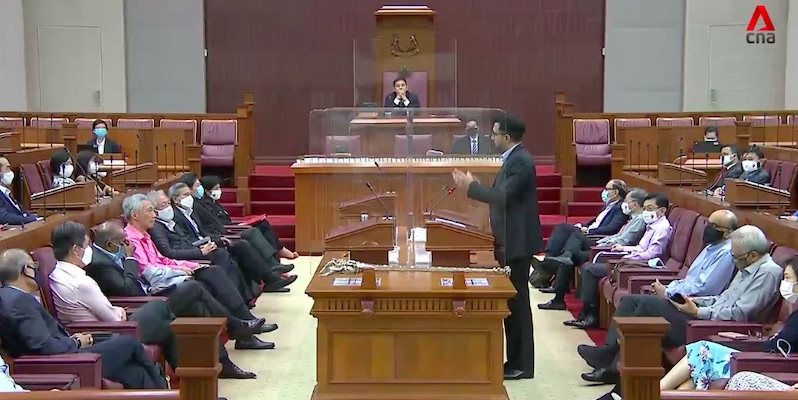
Singapore parliament in session post-2020 elections. Pritam Singh speaking, with PM Lee seated across the isle – Photo: Videograb / CNA
By Sarabjeet Singh | OPINION |
Given the COVID-19 situation, Prime Minister Lee Hsien Loong did not deliver a National Day Rally (NDR) speech this year. It is the first time that the Singapore annual NDR was not held since the first speech in 1966 by founding Prime Minister Lee Kuan Yew.
Apart from this fact, there are other reasons this was a widely anticipated speech. Typically, the NDR is the platform for the Prime Minister to lay out key issues that the Government is prioritising in the short and long term. Since PM Lee would be speaking in parliament in lieu of the NDR, there was significant interest, within and beyond Singapore, on what he would cover in his speech. Therefore, it came as no surprise that PM’s speech would be telecast live from parliament. What did come as a surprise, to me at least and what I think, is the impact that was made by this live telecast.
Since the watershed General Elections of 2020, there has been a lot of chatter about how parliament in Singapore will be different. This is because of the increase in Opposition representation in parliament and the appointment of a Leader of the Opposition – a first for Singapore. During this live telecast, we finally got a taste of how this different parliament in Singapore will look and feel like. It was a blast!
Indulge me as I share some thoughts after watching PM’s speech in parliament and the exchange that followed with Leader of the Opposition Pritam Singh.
Right off the bat this was the best reality TV ever. I am not trivialising the issues discussed. Far from that. Watching the speech and the impassioned exchange that followed showed all of us truly what it takes to lead, govern and care deeply for Singapore. There may be differences on approaches and ideas to take Singapore forward but fundamentally the objective is the same – to do what is in the best interest of Singaporeans.
Imagine if every Singaporean watching this exchange unfold in parliament were to internalise what was demonstrated on how we can go about this. Debate fiercely, be objective and substantiate arguments with facts, and respect one another. PM Lee and Leader of the Opposition Pritam Singh modelled the way on how we can exchange ideas, views and opinions on issues that impact all of our lives. This one reason alone compelled me to share my thoughts on this live telecast. Immediately, I thought of how youth in our community would benefit tremendously from watching the exchange on how to engage respectfully and constructively with others who may have very different perspectives or views on issues. If youth today are seeking out role models, they need to look no further than the confidence these two leaders showed as they engaged each other. On a related note, it was amazing to see both PM Lee and Pritam Singh speak directly and not refer to any prepared speeches (just notes they each took down as issues were raised) during the exchange. #mindblown
I think Parliament in Singapore just got more dynamic with a significant opposition presence. This is necessary. I think an opposition can offer alternatives on policies and decisions. With greater resources and information, we can expect the opposition to deliver when it comes to this. The more pertinent question on my mind though is why limit this just to the opposition? Every citizen and Singaporean can contribute by being more informed.
This is why I think it is long due for all parliamentary proceedings in Singapore to be telecast live. I learned so much more, gained insights on different perspectives and appreciated even more deeply the issues raised in parliament during this particular live telecast. Showing live telecasts will not turn parliament into “theatre” (one of the reasons given for not having live telecasts) but increase our knowledge of the stakes, deepen our understanding and sense of ownership over decisions.
I would should also acknowledge at this juncture that indeed parliamentary proceedings can often also be dry to the layman on many if not most days. The information shared can include details and jargon which many may not understand, me included, and we would not follow up to know more about. But this also and precisely brings to bear two important points.
First and foremost, it is about the choice we should be given and have as citizens. Whether we want to find out more based on what we hear or see in a live telecast of parliament can and should be a choice we are able to make on our own. Second, and as I pointed out earlier, if parliamentary exchanges are already inaccessible in terms of the content and substance of what is discussed (issues being complex and, in some instances, very technical), then shouldn’t every effort be made to reduce any other barriers to information and gaining understanding on what is raised? As I see it, the logic is simple. Live telecasts will be one way to reduce barriers, foster greater interest in issues raised in parliament, and garner more ideas and contributions from Singaporeans. This is what the government has been trying to do anyway with the increased frequency of public consultations especially over the past few years.
Even if live telecasts may just become “theatre” for some, surely the benefits outweigh such costs? On second thought, scratch that. Some of the most valuable lessons we can learn come from watching theatre. The emotions and convictions of both PM Lee and Pritam Singh were palpable during this live telecast as they each shared what they believe can best serve Singaporeans. They both showed me how much one can love our country.
PM Lee Spoke of an expectation of sincerity when voters go to the polls. He is not alone in having such expectations. It is one I believe most Singaporeans have of each other too and one which fundamentally rests on trust. We trust that as we vote in our representatives in parliament, we do so in an informed way, with an appreciation and understanding of what is at stake. This is key. Sincerity cannot be expected in a vacuum. In the absence of information, that would be blind loyalty or placing faith. We need information in order to do what is expected of us.
Sarabjeet Singh, an active social worker, is also the president of Young Sikh Association (Singapore), YSA. The views are his own.
ASIA SAMACHAR is an online newspaper for Sikhs / Punjabis in Southeast Asia and beyond.Facebook | WhatsApp +6017-335-1399 | Email: editor@asiasamachar.com | Twitter | Instagram | Obituary announcements, click here |
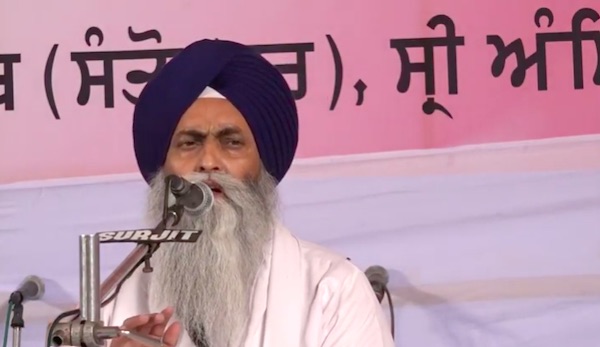
Jagtar Singh – Photo: Videograb from IBS Records / Sikh TV
By Asia Samachar Team | INDIA |
Listening to live kirtan from Harmandir Sahib is pretty common these days for Sikhs the world over. Thanks to technology, they are able to pursue their day while listening to the soothing Sikh hymns from Amritsar.
But things are not well with the kirtan singers called ragis.
The kirtanis at the Darbar Sahib seem to have had enough of the antics of Darbar Sahib head granthi Giani Jagtar Singh. As head granthis, he takes charge of the 70-odd ragi employed under the Shiromani Gurdwara Parbandhak Committee (SGPC).
In the last few days, they have gone public with Jagtar’s rude and rowdy treatment.
Silent all these years, they rose in unison at a recent press conference. They have also dispatched a memorandum to Akal Takht acting Jathedar Giani Harpreet Singh.
When admonishing them, they alleged that Jagtar have asked the ragi group to become rickshaw operators, in an apparent slur against them.
“He hurls all kinds of abuses publicly at us,” said one ragi at a press conference. “He makes us wait for two hours outside his office.”
They also said that Jagtar had never held any meetings with to resolve any possible outstanding issues. “He would issue fatwas and paste them in the office,” said one ragi.
At press time, neither Jagtar nor Harpreet have responded on the issue.
Here’s a link to a report in Punjabi on the topic from Khalas TV.
ASIA SAMACHAR is an online newspaper for Sikhs / Punjabis in Southeast Asia and beyond.Facebook | WhatsApp +6017-335-1399 | Email: editor@asiasamachar.com | Twitter | Instagram | Obituary announcements, click here |
How can Sikhs make a difference for Black Lives Matters?
A Sikh Youth Australia (SYA) webinar this Saturday (5 Sept 2020) featuring a hip-hop singer, a rapper, an artist and a scholar will touch on#BLM, a subject that is still raging around the world. The topic will kickstart the SYAx series.
The panelists are L-Fresh the Lion (Australian born hip hop artist who’s music speaks of purpose), Simran Jeet Singh (US-based scholar and activist), Kameron Smalls (US-based artist and advocate) and Rhyan Clapham aka Dobby (Ausralia-based rapper and drummer who identifies as a Filipino and Aboriginal musician).
ASIA SAMACHAR is an online newspaper for Sikhs / Punjabis in Southeast Asia and beyond.Facebook | WhatsApp +6017-335-1399 | Email: editor@asiasamachar.com | Twitter | Instagram | Obituary announcements, click here |
Funny how this word comes out from my mouth gleefully as I introduce myself in a crowd, but immediately leaves a bitter taste on my tongue.
“Forget it, they don’t need to know what comes with it.” The bitterness stays and reels in the roots of emotions of knowing that migration is key to finally having it erased from my tongue.
You see, my family is now in different parts of the world in the name of education, progress and better lives. My people, we run so that we can finally be seen. We run to provide for our children. We run away from “Oye, you pendatangokay! Jangan lupa!” at home to find ourselves being the pendatang in another’s land. We run for better lives.
Ha. Better lives, what does that even mean? As though a nation with four seasons will help shed our attachments to our identities. As though nations with more efficient waste management systems will suddenly help us with fulfilling our responsibilities as citizens. [AHEM Australia, Europe, Canada and other “developed countries” who send their trash to our shores in the name of adding economic value when really most of the trash can’t even be RECYCLED]. As though a nation with more white folk will suddenly transform us into informed people.
My relationship with my birth country is almost like tango minus the sexiness. It is often rough, swift and loud. There are days when I roll my eyes at the sight of all things patriotic and cannot find myself to work for this nation. I scoff at “Sayangi Malaysiaku” (Love Your Malaysia]. How to sayang (love) when I cannot tahan (witstand), you tell me lah?!
What can’t I tahan? The tidak apa attitude. Plastik beg untuk bungkus makanan? Takpe lah. Cut queue orang lain? Bolehlah. Dengar orang cakap benda racist? Eh jangan masuk campur lah apa kaitan dengan kita? Ada kaitan! Dengan generasi yang akan datang nanti. Malaysia’s love for long winded conferences about the social landscape with a RM100,000 buffet lunch. Takpe lah, duit taxpayer jer nanti budget next year berlambak lagi. Malaysia makes me want to run away and never come back. But question is, why?
Working as a key player of the education system, I can see myself in KLIA, pushing all the people in my way, running towards Departures and boarding a flight to anywhere but here. I can’t help myself to feel a sharp tug at my heartstrings when I see my work colleague sharing a racist meme on Facebook or overhearing racial remarks made about the majority by minorities, thinking that it’s justified. Malaysia shackles me on most.
But then, there are days, when the mind is asleep and courage takes its place. Days when no matter how bad it is, it’s worth to stay a little bit longer, just to fix something broken. It could just be, reminding your kids that you too have red blood despite the difference in skin colour.
I’m not sure where I will end up one day. But I do know this, there is no Malaysia without integrity. It’s a love-hate relationship, that’s obvious but I’d like for it to be resolved once and for all.
The bitter taste reminds me of the distorted lens I have towards my birthplace, my Manglish, my identity. One hand, I am a Sikh, and feel strong for my motherland, Punjab and on the other hand, I belong to the gula merah soyabean coloured rivers and durian headquarters. You must be wondering – why don’t you feel like you belong?
I feel un-Malaysian when I am asked, “orang Bangla ah?”. I feel un-Malaysian when I am told by my respected elders who clearly want the best for me to “Work hard and get out from here for a better life.” I feel un-Malaysian when I’m asked after a terrible experience, “What was his/her race of the perpetrator?”. I feel un-Malaysian when they tell me, “Oh sorry, you’re not accepted but you can try other Indian focused scholarships/investment schemes/insert-another-race-based-social-policy here. I feel un-Malaysian when after my best friend leaves my home after a great laugh session, and I’m told, “Don’t get too close. You know how their people are.”
All the things that I’ve been told, weigh me down and although I’ve risen from some, I’ve been weighed by some words too. Fact is, a Malaysia that speaks of all its children without the colour of their skin is Utopia; an imagined community. A Malaysia that breathes clean, cool air with its forests and indigenous peoples, is one of the mind. A Malaysia that looks at me, and says, “Ini tanah air you” is a dream.
This Malaysia Day, the bitter taste has travelled and lingers in the pit of my belly now. It lingers but lathered in sweet gula merah like syrup, the colour blind friendships, the heartiest encounters, the glorious food pathways have all hugged me and whispered, “You’re mine.”
Malaysian-born Phavanjit Kaur writes to make sense of the world. This article was first published here.
ASIA SAMACHAR is an online newspaper for Sikhs / Punjabis in Southeast Asia and beyond.Facebook | WhatsApp +6017-335-1399 | Email: editor@asiasamachar.com | Twitter | Instagram | Obituary announcements, click here |