Gurleen Kaur Mander, student and voting rights advocate.
By Chloe Veltman | UNITED STATES |
Many parents, teachers and other caregivers take it upon themselves to teach children about the importance of voting. Gurleen Kaur Mander tells a different story.
Mander is from a small town near Fresno. When she’s not studying for her undergraduate degree, the 21-year-old student said she enjoys playing soccer and watching TV.
She’s also a big fan of politics.
Mander is majoring in political science. She served as a poll worker in her teens. As a volunteer for the League of Women Voters, she does a lot of voter registration and education on campus (and more recently, because of COVID-19 restrictions, in the virtual space).
“I explain to friends what the electoral college system is, what voting is and how the polling system works, because it can be a bit confusing if you’re not really familiar with the system and the structure of voting,” Mander said.
And in her household, she’s the one who’s been schooling her parents about the power of the vote.
“They were just like, ‘Oh, we don’t want to vote,’ ” Mander said. “But I would be like, ‘No, you should vote. You are a citizen of the United States. Your taxpayer money goes into the system. We should have a say in how things work.’ ”
When her parents came to the U.S. from India as refugees in the early 1990s, they found jobs as farmworkers. Mander said her mom and dad came of age during the previous decade when India was in a state of political turmoil.
Read the full story, ‘A Daughter of Refugees Restores Her Parents’ Faith in Voting’ (KQED, 28 Aug 2020), here.
ASIA SAMACHAR is an online newspaper for Sikhs / Punjabis in Southeast Asia and beyond.Facebook | WhatsApp +6017-335-1399 | Email: editor@asiasamachar.com | Twitter | Instagram | Obituary announcements, click here |
The modern-day seeker has been uneasy with the various English translations of the Guru Granth Sahib currently available. They have always yearned for a better set of work that would allow them to reach the essence of the Sikh Gurus’ teachings.
Now, a team has launched the initial portion of their work after labouring for three years. They promise to make the ‘Sabad-Wisdom’ accessible to seekers, scholars and techies.
Sikh Research Institute (SikhRi) yesterday (31 Aug 2020) announced the first official release of the Guru Granth Sahib Project (TGGSP) website to coincide with the First Prakash Purab (Illumination day) of then known Adi Granth in 1604.
The project, described as a ‘curative-collaborative effort’, currently consist 31 members.
In a statement, SikhRi said its research and development phase has completed eight different banis (compositions) with the technology, UX paradigm and user persona developed in the last few months.
Talking about the project, SikhRI co-founder and project lead Harinder Singh said: “We are disrupting the Sikh theological space which is currently caught between binaries created by men.”
He added that the process intentionally integrated a diverse array of schools of thought, acknowledges their strengths and biases, and builds on the collective knowledge transfer to expand them for current times.
The Guru Granth translations available today has been widely debated, partly driven by the different schools of thoughts at work.
The most widely available English translation of the Sikh scripture, produced by Dr Sant Singh Khalsa, is said to be aligned with the yogic teachings of Harbhajan Singh, popularly known as Yogi Bhajan, of the 3HO. Dr Sant’s work became the default English translation as it was widely available online.
The first complete English translations of the Guru Granth emerged in the 1960s. Dr Manmohan Singh’s 8-volume English and Punjabi translation was published by the Shiromani Gurdwara Parbandhak Committee (SGPC) in 1962 while Dr Gopal Singh’s four volume set was published in 1978.
Unlike the wider collaboration at TGGSP, Dr Manmohan’s work was, in his own words, a ‘single-handed effort and attempt with no extraneous financial or scholarly help from any quarter’ while staying as a refugee after fleeing Lyallpur following the 1947 partition.
One of the most recent addition to Guru Granth translation was Dr Harjinder Singh Dilgeer’s 7-volume English and Punjabi translation published by the Sikh University Press in 2016.
Dr. Ishmeet Kaur Chaudhry, an assistant professor of English literature and the TGGSP English reviewer, said Guru Granth translations currently available in Panjabi and English limit the profound depth, cultural opulence and poetic genius so eloquently revealed in the Sikh scripture.
“In awe and reverence, we have attempted to converse and draft the verbiage that we hope is capturing the letter, message and spirit of the original language of the Guru Granth Sahib,” she said.
In the same statement, Prof. Mohanbir Singh Sawhney, an IT marketing expert who is part of the team, said he took on the challenge of intermixing content, technology and marketing.
“If we get this right, and I believe we will, this will become the most important initiative to scale Sikh teachings for global audiences,” he said.
Harinder added that the project was the first effort in history to include the female perspective in developing an understanding of the ‘Sikh canonical text enthroned to the Guru-Perfection’.
Project content lead Dr. Jaswant Singh noted that the effort was another SikhRI milestone on a 20 year journey to complete the research on each word of Guru Granth Sahib: etymology, grammar, and meaning.
“The team of subject matter experts carves a literal translation and an interpretive transcreation. Then, a commentary is composed. All is done in contemporary English and Panjabi while incorporating musical, poetical, and historical dimensions,” he said.
At part of the launch, the TGGSP website is now making available the complete work to date on Asa ki Var which consist of about 300,000 words (equivalent of 629 pages). More portions of the Guru Granth will be released in the coming weeks.
To access The Guru Granth Sahib Project, click here.
ASIA SAMACHAR is an online newspaper for Sikhs / Punjabis in Southeast Asia and beyond.Facebook | WhatsApp +6017-335-1399 | Email: editor@asiasamachar.com | Twitter | Instagram | Obituary announcements, click here |
A Queensland hospital has appointed Thai-born Dr Simi Sachdev as its acting executive director of medical services.
The North West Hospital and Health Service announced the appointment in an entry at its Facebook page.
Born in Bangkok, Thailand to Indian parents, the entry says Simi speaks three languages: Punjabi, Hindi and English.
After studying at a boarding school in India, Simi completed a Bachelor of Medicine and Surgery at the University of Delhi.
On the completion of her studies, she returned to her family in Bangkok and worked for the World Health Organisation in family planning for several years.
She then moved to Australia and has been travelling and working in locum positions in Australian hospitals for over 25 years.
Although she has grown accustomed to Australian food, the entry said Simi loves to cook and eat traditional Thai and Indian food, with her favourite being Som Tam, a green papaya (paw paw) salad.
She also likes to grow Thai herbs in her garden, such as makrut and galangal, as the smells take her back to her homeland.
ASIA SAMACHAR is an online newspaper for Sikhs / Punjabis in Southeast Asia and beyond.Facebook | WhatsApp +6017-335-1399 | Email: editor@asiasamachar.com | Twitter | Instagram | Obituary announcements, click here |
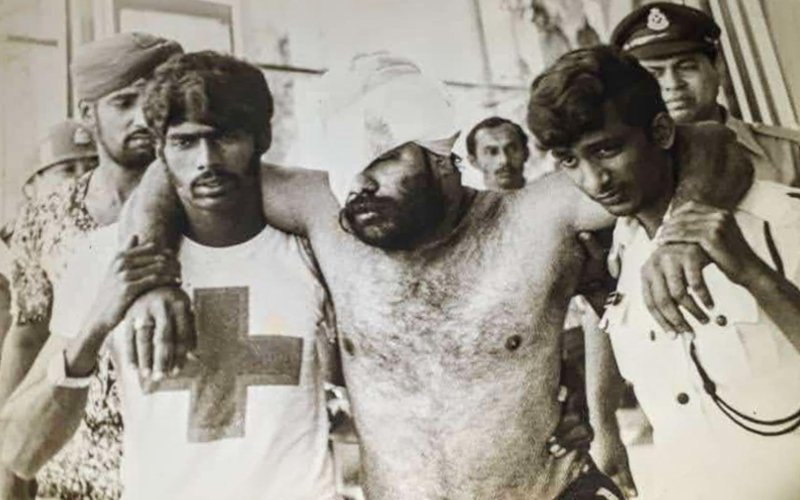
A heavily bandaged Sukdave Singh, then 29, being led to an ambulance after he was shot under his right eye by JRA when he went to investigate intruders in the AIA building. (Sukdave Singh pic).
By Frankie D’Cruz | MALAYSIA |
KUALA LUMPUR: Fearless security guard Sukdave Singh, a central figure in the Japanese Red Army (JRA) siege at the American International Assurance (AIA) building here in 1975, turned 74 yesterday.
The day passed like any other in past decades with no visitors, and birthday greetings only from family members.
It was the same every August 4, the day 45 years ago when he became a national hero after being shot in the right eye while investigating a “robbery” that turned out to be a hostage crisis.
JRA fanatics stormed the ninth floor of the building and took 53 people hostage from the US and Swedish embassies, the AIA agency office and a Japanese firm, C Itoh.
Today, Sukdave, who may not be known to younger Malaysians, is like a hostage left behind and long forgotten.
He is helpless, depressed – spirit crushed.
Looking desolate, he told FMT at his Taman Sri Ampang home that life wasn’t easy for him over the years with the nightmares and scars, both physical and mental.
Sukdave Singh – Photo: Denne Singh / FMT
He was 29 when he lost sight in his right eye after a shot fired by a terrorist went under the eye and out at the back.
Both his legs are weak and he had to stop riding his motorcycle after falling off several times.
Sukdave needs cataract surgery in his left eye but has been putting it off to look after ailing Kuldip, 64.
His two-room terrace home is infested with white ants and he doesn’t have the money to call pest control.
Since his wife sleeps on a bed downstairs, he struggles to climb the narrow, steep staircase to retire for the night.
Sukdave said he remained idle at home after stopping work as a watchman two years ago and missed cooking at the Gurdwara Sahib Ampang, Ulu Klang, where he did community service for over three decades.
He said his two sons and two daughters had their own family obligations looking after his seven grandchildren.
Sukdave, who began work with AIA on June 6, 1966 with a basic pay of $100, received $2,000 from the company that also covered his medical costs until his retirement which was extended until in 2003.
This is an abridged version of ‘Heartbreak of Malaysian hero in 1975 Japanese Red Army hostage crisis’ (Free Malaysia Today, 31 Aug 2020). Read the full story here.
ASIA SAMACHAR is an online newspaper for Sikhs / Punjabis in Southeast Asia and beyond.Facebook | WhatsApp +6017-335-1399 | Email: editor@asiasamachar.com | Twitter | Instagram | Obituary announcements, click here |
Kulwant Singh Dhillon and Mohinder Kaur Dhillon at the their Tasmania residence – Photo: Supplied / SBS Punjabi
By Preetinder Grewal | AUSTRALIA |
Kulwant Singh Dhillon and his wife Mohinder Kaur Dhillon migrated to Australia from Malaysia in 1969.
The Indian-Malaysian couple, both retired schoolteachers say they are ‘blessed to be living’ in the Tasmanian city of Launceston.
“We have such a lovely experience to share with everyone. Throughout our years here, we have been nurtured with love and support from the locals and have built fantastic relationships with people living in this area,” said Mr Dhillon.
“It was the local social fabric based on love, acceptance and positive guidance, that helped us thrive in our chosen part of the world.”
She came to Tasmania for training at Launceston Teachers College in 1963.
In 1964, she returned to her home city of Ipoh in Malaysia, where she started her career in teaching at a local school.
She met Mr Dhillon, who had recently returned from England after completing his studies on a scholarship-based program, at the school. They got married in 1965.
Mrs Dhillon said it was the ‘political unrest’ in Malaysia in 1969 which led to the decision to move out of the country.
“We first had an approval for Canada where we were supposed to work in Winnipeg, as per the visa arrangements. But once I shared this news with my foster parents Charles and Molly [in Tasmania], they convinced us to make a move to Australia.”
Mrs Dhillon said that Australia’s visa approval at that time, was a rather difficult task due to the White Australia policy.
“It wouldn’t have been easy without my foster parents’ visa sponsorship. I am very thankful for all they have done for me and my family,” she said.
Read the full story, ‘Tasmania’s ‘first Sikh couple’ reflects on 50 years of ‘love and support’ in Australia’ (SBS Punjabi, 27 Aug 2020), here.
ASIA SAMACHAR is an online newspaper for Sikhs / Punjabis in Southeast Asia and beyond.Facebook | WhatsApp +6017-335-1399 | Email: editor@asiasamachar.com | Twitter | Instagram | Obituary announcements, click here |
Alexi Singh Grewal is an American Sikh Olympic gold medalist and former professional road racing cyclist. At the 1984 Summer Olympics in Los Angeles, Grewal became the first American Sikh man to win an Olympic gold medal in road cycling.
It is interesting to note that the media at that time, did not highlight the fact that a Sikh of Indian origin, Alexi Singh Grewal won Gold medal in road cycling. He defeated the Canadian, Steve Bauer and covered the distance of 190.2 km to win the medal. A crowd of approximately 300,000 cheered the Indian-Sikh. He raced to a lead of 24 seconds , also the final lap was very exciting as Both Baur and Grewal were close to take lead over the other.
For Sikhs, like for many minorities, it is something significant to see one of their own competing at the highest of levels. It’s a source of inspiration and validation, allowing us to claim our space in our diasporic communities and also understanding that athletics can be an acceptable vocation for Sikh.
Alexi Singh Grewal is the first American sikh to take Gold in a road cycling event, and provided Sikhs with a high-profile introduction to Americans and the global cycling stage who had previously never heard of Sikhism.
In 2004 he was inducted into the United States Bicycling Hall of Fame. – Source: Sikh Cycling Network Facebook page
ASIA SAMACHAR is an online newspaper for Sikhs / Punjabis in Southeast Asia and beyond.Facebook | WhatsApp +6017-335-1399 | Email: editor@asiasamachar.com | Twitter | Instagram | Obituary announcements, click here |
ASIA SAMACHAR is an online newspaper for Sikhs / Punjabis in Southeast Asia and beyond.Facebook | WhatsApp +6017-335-1399 | Email: editor@asiasamachar.com | Twitter | Instagram | Obituary announcements, click here |
Almost every Sikh interested in the Ranjit Singh Dhadrianwale issue seem to have an opinion as to who is right and who is wrong. Some are supportive of the independent Sikh preacher seen as a beacon of reformist Sikh understanding. Others fault him for his defiant stance against Akal Takht.
If only everything in life was black and white. As in life, there is much grey matter in the Dhadrianwale issue.
On Monday (24 Aug), Akal Takht acting jathedar Giani Harpreet Singh announced decisions against Ranjit and another popular Sikh preacher Harinder Singh who heads the UK-based Nirvair Khalsa Jatha (NKJ).
He said the panj pyarey team he led had received a report from the sub-committee formed earlier to investigate allegations against Dhadrianwale for allegedly distorting religious and historical facts. Ranjit was found guilty and had been asked to come to the Akal Takht to seek forgiveness, or risks further actions. Harpreet has also asked Sikhs not to listen or share his videos which are widely followed online.
The issue has dominated each and every media channel that has an interest in Sikh matters. And leaders of all shades have put forward their views.
Asia Samachar has also picked up the issue. Our conclusion: There is blame on both sides, and there is a golden opportunity to set the future tone.
In this instance, Akal Takht has not been the shining example of conflict resolution. Right from the jathedar down, they seem to have made numerous missteps. Take the simple matter of setting-up the committee to look into the allegations? Its composition was far from independent. It seemed more an effort designed to fail on purpose or to further inflame the issue. Going further back, the folks at Akal Takht had not been sympathetic on the attacks, some physical and life threatening, mounted on Dhadrianwale and his people. Their silenced had been deafening. All this led to deep suspicion of bias at the Akal Takht, an institution that carries considerable sway on Sikhs globally, though diminishing.
On his part, Dhadrianwale is at fault for engaging head-on the taksals and other influential powers-that-be in the Sikh community. It seems he cannot let go an opportunity to hit out at fellow parcharaks (preachers) who may hold different views. Perhaps he should ignore the attacks. Let them be. If you have a Sikhi message of your own, stick to it and run with it. The confrontational approach has derailed him, and his wider mission. Mind the inflated ego that comes with fame. It can lead to his downfall.
How to move forward? Akal Takht must find a more conciliatory next step, and Dhadrianwale must reciprocate accordingly.
The Akal Takht jathedars cannot press on with red lines in the sand. While the institution established by Guru Hargobind Sahib has considerable sway on the wider Sikh world, some have questioned the credibility and integrity of the individuals wielding powers bestowed by the august institution. We have seen abuse in the past. The excommunication sword, hanging high once again, has been abused for political and other purposes. There is no reason for Akal Takht to draw that card.
So, let us hope sanity prevails all around. If Dhadrianwale is displaying reckless youth exuberance, let us hope that the Akal Takht will shine as a beacon of conflict resolution.
PS: As always, we welcome views. You can comment at our website or on our social media platforms (Facebook, Twitter & Instagram). You can also email (editor@asiasamachar.com) or Whatsapp (+607-3351399).
ASIA SAMACHAR is an online newspaper for Sikhs / Punjabis in Southeast Asia and beyond.Facebook | WhatsApp +6017-335-1399 | Email: editor@asiasamachar.com | Twitter | Instagram | Obituary announcements, click here |
FLASHBACK: President Barack Obama and Prime Minister Singh of India walk along the Cross Hall of the White House towards the East Room for the arrival ceremony. November 24, 2009. (Official White House Photo by Chuck Kennedy)
By Nirmal Singh | OPINION |
Several of us, especially the US residents, would be getting releases from Civil Rights Advocacy organizations like SALDEF, of the following kind:
“This weekend SALDEF will present the third part of the series Demystifying U.S. History and Activating Sikh Action for Black Justice Movements. Part III of the series Fighting for Civil Rights / From Liberation Movements to the Movement for Black Lives with Dr. Ashley Howard will talk about the role of “white leagues” in maintaining white supremacy; why was the Black Panther Party formed, and how it served the people; and what role internationalism played in the Black Power movement to connect South Asian and Black struggles.”
While the immediate objective of this series by SALDEF is possibly to mobilize the Sikh vote to influence outcome of the US election in a certain direction, I am bringing it up for very different reasons.
To me it seems that the Sikh story and US story could have some parallels because the historical period nearly overlaps and in many ways the Sikh Gurus envisioned even more just, equitable, empathetic and humane social values with as much, if not more, zeal for the society to be guided by theistic ethical and moral values.
The struggle, by migrant Pilgrims against the tyrannies they had experienced, took political form, and “the Pilgrims’ story became a central theme in the history and culture of the United States.” After a violent struggle against the indigenous people, the migrants established control over the land mass and set up their envisioned state structure that became a beacon for others to emulate for over a century now.
The Indian society which had its own institutionalized weaknesses like caste system and chronic disunity that kept its people compartmentalized and had debilitating influence on social cohesion leading to political control by migrant invaders – seen by locals as oppressive and discriminatory.
One more parallel that I see is of ‘paap ki janj lai kabuloon dhaaya‘ – the minority migrant bosses were not paragons of virtue – they had their flaws – in India for loot and rapine and in the US for their disenfranchised ‘slave’ labor.
The US Black movement was for their own ‘freedom’ from ‘slavery’ under the new white ruling elite followed by civil rights and justice for a still beleaguered minority community. The leading characteristics of societal balance continued to be defined by this struggle till very recently albeit with increasing numbers and influence of the Black minority.
FLASHBACK: President Barack Obama and Secretary of State Hillary Clinton talk with Prime Minister Singh of India in the Cross Hall of the White House. November 24, 2009. (Official White House Photo by Pete Souza)
In India, the parallel was offset both in time and the character of beleaguered segment – it was the majority community in distress under centuries of Muslim invader’s rule. To the Hindus aid, an emerging minority, the Sikhs, picked up the cudgels and eventually succeeded to weaken hold of oppressive Muslim regime sufficiently to set up their rule over a vital part of India till another, but perhaps seemingly less threatening invader, the British, got the upper hand and subdued both the ruling Muslims and Sikhs to establish their rule.
This change gave the Hindu majority a breather. All the three communities reorganized to cope with the changing administrative and political environment. Sikhs did not have the numbers but made up somehow to build and retain their influence in the decision processes and new political formations seeking freedom from foreign rule.
British left in 1947. India was divided into a Muslim dominated Pakistan and Hindu dominated India. According to Akhtar Sandhu, a Gujrat University, Pakistan, Professor, Sikhs not only got nothing in 1947 but also lost the position of being an influencing group. This is not only Akhtar who says this – I have faced similar questions from lay Pakistanis after my presentation ‘tussi khatya kee hai? Shaheedian dena thheek hai par mila kya?’
Sikhs got nothing and joined India but things kept getting worse. The loss of political influence became too irksome but reactionary Sikh stances made it worse. The result was the attack by the Indian Army on Golden Temple complex in 1984 to eliminate holed up Sikh militants, followed by revenge killing by two Sikh security guards of PM Indira Gandhi which caused the pogrom to mercilessly kill Sikhs in Delhi and several other places in Nov 1984. The Sikhs had touched their lowest point of influence in history perhaps comparable to 1606 martyrdom of Guru Arjun.
The Sikh and US story comes together in time and space once again when Manmohan Singh, by accident or otherwise was picked by Congress to be the PM of India for a decade during 2004- 14 and Barack Obama was elected the first Black President of US for two terms – 2008 to 2016.
This was no small achievement by a Sikh and should have given a boost to flagging Sikh morale but the Sikh response was – ‘he was not even a Sikh’ or words like that effect. Sikhs were wary of Congress to which Manmohan Singh belonged and Dr Singh’s own obsessive sense of propriety made him stay aloof from the Sikhs as a community.
On the other hand, the Obama candidacy was celebrated by even the Republican Party top Black leaders who openly supported Obama and he got almost 100% of Black vote. Sikh dispersal that had started post 1984 continued and in spite of a bump, their influence has continued to recede.
The successors of Obama and Manmohan Singh draw upon narrow majoritarian nationalism as their lead policy which has tended to marginalize minorities. The Black response in the US has lately turned into a very sophisticated paradigm of journey from slavery to not ‘freedom’ from slavery but to ‘informed influencers of state policies’ and perchance again a shot at Presidency! Sikhs on the other hand are revisiting their past and ruminating over the failures of their leaders even as their down slide continues unabated in India.
Sikh narrative was rooted in high ideals and had egalitarian and equitable political objectives. Sikhs saw glory and high recognition but now seem to be mystified by an array of problems. The prototype put together by minds like Obama and other thinkers and communicators demystifies the militant streaks in Black narrative and sharpens focus on connecting with similar justice and liberty aspirations of other groups.
Sikhs had almost similarly burnished their endeavors a century or more back when their radical acts were recognized as patriotic sacrifices and their lead in successful espousal of non violent protests made the entire nation look to them as exemplars – cementing their place as part of the group to decide the country’s future. Sikhs thus made it to become ‘influencers’ in pre independence India and retained that status till 1947 even though they lost the baton in the last lap and have not since been able to get their hand to it.
Let us therefore try to stop escaping to the past, pull ourselves up and reshape our present to regain some of the luster that we lost in 1947 and after in the rough and tumble of the Indian polity. It is not impossible. We have the wherewithal and we have the need!
[Nirmal Singh has written six books on Sikhs and Sikhi and several of his articles have been published in journals like Sikh Review, Journal of Sikh Studies and Comparative Religion and Abstracts of Sikh Sudies (IOSS) as well as in the US mainstream news media. Resident in Orlando, he spends considerable time in Delhi]
ASIA SAMACHAR is an online newspaper for Sikhs / Punjabis in Southeast Asia and beyond.Facebook | WhatsApp +6017-335-1399 | Email: editor@asiasamachar.com | Twitter | Instagram | Obituary announcements, click here |
A good run for a Pakistani living in as a permanent resident (PR) in Singapore came to a crashing stop when his pas misdeeds caught up with him
The 51-year old businessman was found to have falsely made the claim that he had an arts degree from the University of Punjab when submitting the PR application in 1997.
As it turns out, he never had any such degree. And this may cost him the PR status, which is now under review.
On Thursday (27 Aug), Mohammad Sohail failed in his appeal to the High Court against a three-week jail sentence handed down by a district court in December last year.
In dismissing the appeal, Chief Justice Sundaresh Menon said that based on sentencing guidelines for such cases, the starting point was a custodial term of two to four weeks, reports the Straits Times.
The chief justice noted that the district judge, in imposing three weeks’ jail, had taken into account that Sohail had shown remorse by readily owning up to his wrongdoing.
Sohail first arrived in Singapore in 1995 on an employment pass and married a Singaporean woman the following year. Some time between September and October 1997, he applied for permanent residency and falsely stated that he held a Bachelor of Arts from the University of Punjab, the report added.
ASIA SAMACHAR is an online newspaper for Sikhs / Punjabis in Southeast Asia and beyond.Facebook | WhatsApp +6017-335-1399 | Email: editor@asiasamachar.com | Twitter | Instagram | Obituary announcements, click here |