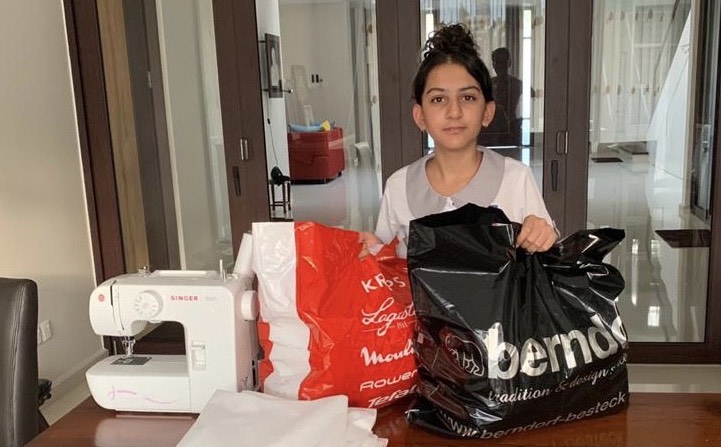
She is just 12 years old but she can sew! Student Preisha Kaur Jammu jumped at the chance of helping the medical frontliners in their battle with the novel coronavirus.
Her school teacher Ann Yeoh, who knew Preisha can sew, invited her to be part of a team to sew personal protection equipments (PPEs). In less than a fortnight, she had put sewn 25 sets.
“I’m aware from the news how bad the [Covid-19] situation is and how important it is for healthcare workers to be adequately protected. I felt I needed to do something to help,” she told Asia Samachar via a short video clip.
Dr Kiren Kaur Sidhu, an obstetrics and gynaecology at a Kuala Lumpur private hospital, said that her daughter loves sewing. “She has her own sewing machine and she loves sewing,” she said.
Those taking part in the PPE making project were given the different parts of the PPE and asked to sew them together.
“I know its not a big contribution but this is my contribution,” said Preisha. “I was very happy when I heard that the hospital where my Massi (aunt) works at will be receiving the PPS that were part of the project that she had participated in.”
ASIA SAMACHAR is an online newspaper for Sikhs / Punjabis in Southeast Asia and beyond.Facebook | WhatsApp +6017-335-1399 | Email: editor@asiasamachar.com | Twitter | Instagram | Obituary announcements, click here |
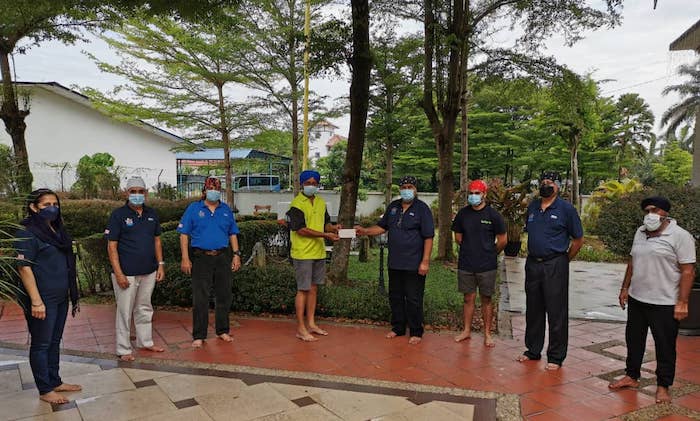
Many gurdwaras in Malaysia and Singapore saw their regular income stream disrupted by measures deployed to break the spread of Covid-19, forcing them to resort to their savings to keep things going.
For smaller gurdwaras with little reserves, they have had to call upon local well-wishers to fill the gap.
Asia Samachar spoke to a number of gurdwara management committee members in both the neigbouring countries to take stock of the situation as countries globally respond to the novel coronavirus pandemic.
“Our funding has been affected. There has been no income from golak, mehta thek, karah parshad and other donations from the Sangat,” said Kota Kinabalu gurdwara secretary Amarjit Kaur. “We had to use our existing reserve funds to manage the gurdwara.”
Sri Guru Singh Sabha (SGSS) Singapore treasurer Gurmukh said that Covid-19 has also impacted the finances of the gurdwara.
“Various programmes booked by member’s had to be cancelled. That had greatly affected our finances as that is the main source of revenue for the gurdwara. Weekly Sangat donations were surely affected,” he said.
The situation is pretty similar for other gurdwaras.
However, dozens of gurdwaras in both countries have continued to provide Langgar, or free meals, to the needy. These have been largely funded by direct donations.
Malaysian Gurdwaras Council (MGC) president Jagir Singh said he had spoken to more than a dozen gurdwara committee presidents who confirmed that the gurdwara income from individual offerings have more or less dried up.
“There was some collection when someone came to matha tekh. This matha tekh money amounted to less than 5 percent of the average gurdwara charava (collection) earlier on a monthly basis,” he said.
Malaysia rolled out a movement control order (MCO) on 18 March that required all places of religious worship, including gurdwaras, to cease all prayer gatherings. Singapore implemented its set of preventive measures called a “circuit breaker” since 7 April which also placed restrictions on gurdwara programmes.
Malaysia will allow selected places of worship to operate under strict conditions 10 June onwards.
In neigbouring Singapore, gurdwaras will be allowed to operate under strict conditions starting Tuesday (2 June). Gurdwaras will be open from 8am to 6pm and only up to five households will be allowed in for private worship and to ‘mehta tekh’ (pay respects to Guru Granth Sahib).
Here are the responses by some gurdwaras contacted by Asia Samachar.
Dr Kalwinder Singh, representing the Kuching gurdwara, at an event in September 2019 – Photo: GS Kuching Facebook
Dr Kalwinder Singh,
PRESIDENT, GURDWARA SAHIB KUCHING
Funding has definitely been affected by the MCO and CMCO as the gurdwara closed and no functions were held.
For us, our car park which generates income was also closed. Luckily it has reopened with the opening of businesses. We also get income from rental (though we expect it to be reduced) and fixed deposit intetest. So, we will be able to manage for the near future.
Even when gurdwaras reopen, incomes will still be low as Sangat attendance will be restricted and programmes reduced. This I suppose will go on for a while. Having said that, expenditure is also reduced but not by much as fixed expenditures like utilities and salaries still need to be paid.
We have not done any request or canvassing for donation for our gurdwara. However, individual members of sangat have donated or have been encouraged to donate to worthy causes here and also in Kuala Lumpur to those who are helping those more affected during these trying times. I think they need it more than us at this time.
MCO has brought up new ideas and norms which we will need to incorparate in the future. For example, langgar hall sitting, distancing, serving of langgar and cleanliness.
We will have to relook at them when the time comes to restart.
In Kuching, the MCO will delay gurdwara expansion plans. We will hold on and only start at a later date once the situation is safe.
Our Punjabi school on Saturdays has not been running. We’re not sure when it will restart.
Gurmukh Singh
TREASURER, SGSS SINGAPORE
COVID-19 certainly has impacted the finances of the gurdwara. Various programmes booked by member’s had to be cancelled. That had greatly affected our finances as that is the main source of revenue for the gurdwara. Weekly Sangat donations were surely affected.
We has also just completed the Darbar Sahib renovations and donations were still coming in. That had stopped, too, whilst some outstanding works will resume after Covid-19.
We still have to pay for our expenses: salaries, utilities charges and food for the staff. This has caused some strain our finances as we have to draw on our “reserves”.
Whilst we have tried our best to keep the Sangat connected to the gurdwara, we feel the moral of the staff, especially the granthi, has been affected. A gurdwaras without Sadh Sangat is really baron. There really is no certainty that things be as normal as pre-covid.
To keep the Sangat connected with gurdwara, we broadcast daily live streaming prayers. We are improving the equipment to be able to provide better coverage to Sangat. This has incurred some substantial cost. We feel its money well spent to reach out to Sangat, especially the elderly, which make up a huge percentage of our Sangat.
At the same time, we have ramped up housekeeping and maintaining cleaniness of the premises.
Sourjan Singh
PRESIDENT, GURDWARA SAHIB KUANTAN
The gurdwara income stream has completely stopped since MCO started. We had to depend on our saving and the goodwill of the Sangat. Some have come forward to support with donations when needed.
The main concern now is how can we keep the Sangat safe when we reopen.
Gurcharan Singh
PRESIDENT, GURDWARA SAHIB SUNGAI PETANI
The gurdwara was affected funding wise but many sewadars came forward to help out.
We had broadcast messages to all Sangat members to help out the needy families here. The gurdwara has been providing food ration to the underprivileged and families effected by the pandemic. Some members have contributed daswand via golak while others bank in directly into the gurdwara account.
Our major challenge was the three deaths within two weeks in this area. It was tough for everyone. With Waheguru ji’s blessing, volunteers came forward to assist.
Amrick Singh
PRESIDENT, GURDWARA SAHIB SUBANG
Due to the MCO, Gurdwara Sahib Subang has not conducted any Sanggati programmes. Due to the its absence, the golak has been seriously impacted. We had to postpone payments of the friendly loans until sufficient funds are available. We have paid salaries of the sevadars (gurdwara staff) in full but the cash flow is drying up. Hence, we have appealed for donations to ensure we are able to meet our financial obligations.
We carried out the daily obligatory ceremonies. The gurdwara was not under lock down, so members of the Sanggat were allowed to visit for matha tek and such. Only parshad was available. No tea or langgar.
The gurdwara has also been conducting e-satsangs on Fridays (7 – 8pm) and Sundays (9.30 to 10.30am). The e-istrisatsang will commence weekly on Wednesdays from 2 to 3pm. Such e-prayers will be continued upon request.
Ranjit Singh
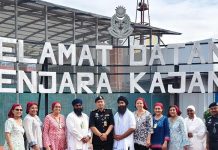
PRESIDENT, GURDWARA SAHIB KAJANG
We are fine with cashflow mainly due to fixed monthly rental of RM3,500 coming in which is sufficent to cover all expenses of the gurdwara.
We continued to request donations for purchase of groceries and we have helped a number of Punjabi families with providing them groceries through our energetic PECK team.
The only impact is on our collection for the building fund which has reduced a lot. We were lucky are the bank has deferred the RM20,000 monthly installments due to the MCO. However, we continue to accumulate the interest.
Amarjit Kaur
SECRETARY, KINABALY SINGH SABHA ASSOCIATION
The MCO measures have definitely affected our funding. No income from golak, mehta thek, karah parshad and other donations from the Sangat. We need to pay the Granthi and other monthly expenses. We are using existing reserve fund to manage the gurdwara.
The cancellation of the various programmes, including Vaisakhi, has affected the Sangat bonding and interaction.
In the future, we have to be prepared for such eventualities. We need to look into other income streams for the gurdwara.
The Kota Kinabalu Gurdwara Sahib did its Corporate Social Responsibility (CSR) by making donations to the Society for the Blind, Red Crescent, Volunteer Police, Luyang Police Station, Jabatan Bekalan Air Sabah and other needy families and organisations.
Sabah Sikh Club (SSC) also did their CSR by making donations to Sabah Society for the Blind and Red Crescent Society who assisted to donate to 50 needy families.
ASIA SAMACHAR is an online newspaper for Sikhs / Punjabis in Southeast Asia and beyond.Facebook | WhatsApp +6017-335-1399 | Email: editor@asiasamachar.com | Twitter | Instagram | Obituary announcements, click here |
5th Bn, 11th Sikh Regt, – Photo: Australian War Memorial
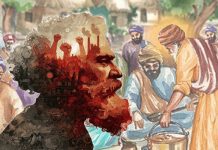
Some of the 66 members of the 5th Bn, 11th Sikh Regt, who were freed by US forces from a PoW camp. They had been captured after the fall of Singapore and refused to join Subhas Chandra Bose and the INA. They were moved to New Guinea as slave labour with other PoWs. The Sikh soldiers are playing bridge at the New Guinea Details Depot, awaiting repatriation to India. Port Moresby, New Guinea. 31st May 1944. – Photo: Australian War Memorial
ASIA SAMACHAR is an online newspaper for Sikhs / Punjabis in Southeast Asia and beyond.Facebook | WhatsApp +6017-335-1399 | Email: editor@asiasamachar.com | Twitter | Instagram | Obituary announcements, click here |
READER’S PICK | ‘Living as a minority in Pakistan: Nankana Sahib Vlog’ captures some beautiful scenes at Nankana Sahib, the birth place of Guru Nanak. Lahore-based blogger Miss Chatter uploaded this vlog in July 2018. It is definitely worth a peek. The blogger is a management consultant. Click here.
ASIA SAMACHAR is an online newspaper for Sikhs / Punjabis in Southeast Asia and beyond.Facebook | WhatsApp +6017-335-1399 | Email: editor@asiasamachar.com | Twitter | Instagram | Obituary announcements, click here |
How safe are we with this virus lingering around and what about going to the gurdwara? A flood of questions come to the mind.
The first quarter of this year has witnessed a steep slowdown in global economics, the superpowers included. Many dimensions of our day-to-day lives have also changed, for one – restricted movements as they call in Malaysia, or circuit break in Singapore – something we likely never anticipated in a highly connected and fast moving world. The onset of Covid-19 has surely made 2020 memorable in many ways!
In Malaysia, the gurdwaras have been inaccessible for some months now, after the Movement Control Order (MCO) came into force on 18 March. Even if we could eventually visit the gurdwara as some are set to reopen on 10 June, will it be the same?
Asia Samachar spoke to ProfDr Balwant Singh Gendeh – a professor and senior consultant surgeon with 36 years of experience in the field of ear, nose and throat (ENT) to better understand the novel coronavirus and that within is within our means to prevent the further spread of the virus. Here are excepts of the interview.
What is COVID-19? What should we look out for?
The origin source of Covid-19 is said to originate from animals to humans in the initial phase and subsequently, from humans to humans – implying that mutation is likely.
The Covid-19 viral particles affects the upper airways and the lungs with shorter incubation period, and the symptoms are multifactorial. It generally depends on the viral load. There are several phases, so to speak, though it varies by individuals. Let’s just say one has nasally inhaled the virus, the first 72 hours are usually vital. Should the virus replicate further, it goes down to the throat where it multiplies faster – then comes the fever and sore throat. The fever gets higher and accompanied by early respiratory indicators if the virus spreads to the airways. Should the situation worsen further, serious respiratory problems and lung infection (pneumonia) may kick in – which possibly require non-invasive ventilation. If the need for intubation arises, then it is an indication of progression of the disease.
Covid-19 viral particles may also enter the swallowing tract which gives rise to gastrointestinal symptoms. Patients may have diarrhea. Its presence in the GI tract may explain why viral samples can be detected via fecal samples. Again, symptoms and criticality varies by individual type – of course there are other factors to consider such as underlying medical condition. Usually, the elderly are more susceptible to risk, but it discount others of contracting the virus or experiencing more intense symptoms.
Other method of spread can be via the eyes which like the nose and mouth is exposed to the external environment. This is why the World Health Organization (WHO) and the Malaysian Ministry of Health (MOH) stress on the need for good hand hygiene and avoid touching ones face (e.g. mouth, eyes and nose) to reduce the risk of transmission.
The daily cases trajectory is a situational update of sorts – is it reducing or increasing?
Regardless, any improvement is not a pass for letting our guard down. The situation is fluid and any resurgence warrants attention. In Malaysia, the Movement Control Order (MCO) was enforced with the intention to flatten the curve and prevent our health services from being overwhelmed. The MCO is vital to control spread of the virus, and as we transcend into its several phases – the need is for us all to be equally responsible in playing our part. The easiest way out is, stay home if there is no essential need to go out. Evaluate any risk of contracting the virus – for example, when considering any form of travelling in confined environments.
Is it okay to metha theek at a Gurdwara Sahib in Malaysia during this period of time?
Any decision must abide by regulatory requirements and the necessary approved government standard operating procedures (SOPs). A more conservative approach in implementing the approved government SOPs is, however, advisable, and it should start from the entrance gate itself. Any person with a temperature above 37.4 degrees Celsius shouldn’t be permitted into the gurdwara premise. The sangat (congregation) should be granted entry in batches with a stipulated 30 minutes duration, not exceeding 20 preferably at any one time. A mask should be worn and hands sanitised at the point of entry, observing a distance of 1 metre at all times. Hands should be washed as regularly as possible. Age is another point of consideration – where those belonging to the riskier age groups should refrain from stepping out over concerns of higher vulnerability levels.
Some Covid-19 cases are asymptomatic. What does that mean? What precautions should be taken in a gurdwara?
This means that some individuals with Covid-19 may not necessarily display any symptoms and so, could be infecting otherwise unknowingly. Studies have shown that patients affected by Covid-19 my show no symptoms up to 12 to 14 days, but during this period they are at risk of spreading it to others. The need to manage any exposure to potentially asymptomatic individuals is necessary anywhere, and in a gurdwara, going back to what I said earlier – temperature taking, mask, sanitizers, hand washing, social distancing as well as time spent in a location are all important precautionary measures.
Dr Balwant Singh Gendeh – Photo: Supplied
In a place like a gurdwara, what are the most susceptible exposure areas to Covid-19?
Specific to the Gurdwara Sahib – locations where people gather, confined spaces, surfaces touched, restrooms and food are areas warrant attention.
Where feasible, congregations should be carried out virtually. This includes Punjabi schools lessons, where such classes take place in a gurdwara. In terms of hand-bound activities such as preparation and serving of food e.g. Degh and Langgar, including chaur sewa – these required unparalleled levels of hand hygiene, preferably by using hand gloves; a fresh pair each time and thereafter carefully discarded.
On the other hand, lifts may accommodate 4 people – while for smaller ones, best to keep the number at 2. For restrooms, regardless on the number of available cubicles, it should be limited to 1 or 2 persons at any given time. More frequent cleaning of these areas is also advised.
What about the serving of Langgar or Degh for that matter?
Any activity using the hand is an exposure point. To mitigate an impending risk, the use of mask and gloves at every point of preparing and serving Langgar as well as Degh would to some extent contribute in reducing the risk of transmission. A feasible solution is packed langgar, this also minimises risk on sewadars (usually a reference to volunteers or paid workers). Packed food will also prevent congregation as the act of sitting down and eating in the gurdwara may predispose to socialisation. If eating is allowed in the Langgar hall then social distancing must be followed with marked areas to sit. The same social distances should be maintained for the sit in prayers/sangat, too.
As for the serving of Degh, it should avoid the use of bare hands. In fact, any activity using the bare hand in the gurdwara should be reevaluated, with the underlying reason being to uphold the wellbeing of every person in the gurdwara – of the Sangat, Sewadars and Parbandaks, alike.
What are the key non-negligible precautions one should take – especially in a Gurdwara Sahib that’s also applicable elsewhere?
Covid-19 is an invisible threat and if I was to outline the general precautions – here they are: (1) temperature screening (2) social distancing, (3) use of mask and (4) hand hygiene.
Specific to our Gurdwara Sahibs, in addition to these four, stricter practices at the entry point of the Gurdwara Sahib, coupled with any activity using the bare hand should be carefully carried out. Placing a stronger emphasis on the wellbeing of respective granthis and dedicated sewadars is also worth a thought.
Any personal sharing as a frontliner (observation, new learning) which you wish to impart?
We all have to role to play, at every level of the society. Even at a community level, it is important to be adequately informed and aware of what Covid-19 really is, appreciate its risk points as well as diligently deploy prevention measures. The pursuit of everything should be aligned with government initiatives and policies. And most importantly, front liners (e.g. medical practitioners, enforcement officers) are sacrificing themselves to keep us all safe.
In summing up, it is time we fought fear with facts and the calling to be socially responsible at a community level is a SEWA in itself. As members of the Sikh community, undertaking coordinated, concerted and cooperative actions in the face of Covid-19 is not only our responsibility, also an investment for a brighter future. As some gurdwaras will reopen soon, let’s stand together and ensure every action taken weights people, their safety, health and wellbeing.
Note: This article merely expresses individual viewpoints in good faith as means to raise awareness, based on personal understanding of COVID-19 and the applicable mitigations – which may differ from others. Reader discretion and evaluation is advised.
ASIA SAMACHAR is an online newspaper for Sikhs / Punjabis in Southeast Asia and beyond.Facebook | WhatsApp +6017-335-1399 | Email: editor@asiasamachar.com | Twitter | Instagram | Obituary announcements, click here |
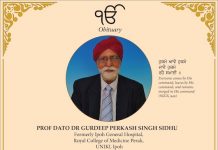
MESSAGE FROM FAMILY: Due to Conditional Movement Control Order (CMCO), we have been advised to keep the Path da Bhog as a small affair. Hence, this announcement is meant to inform relatives and friends of her demise. We appreciate the love and support that we have received during our bereavement.
Contact: Akbal 012-4310176 & Ranjit 012-5063878
| Entry: 30 May 2020 | Source: Family
ASIA SAMACHAR is an online newspaper for Sikhs / Punjabis in Southeast Asia and beyond.Facebook | WhatsApp +6017-335-1399 | Email: editor@asiasamachar.com | Twitter | Instagram | Obituary announcements, click here |
Corporal Pardeep Kaur – Photo: UK MOD Facebook page
By Asia Samachar Team | BRITAIN |
British Sikh armed forces men and women shared the message of their faith with fellow soldiers. The Defence Sikh Network (DSN) held its first ever Chabeel event in commemoration of the martyrdom of Guru Arjan Sahib.
The event at the HQ Montgomery House, Aldershot, was focused internally and followed all government guidance on social distancing.
Despite access to the building also being restricted, it had a great turnout with over 100 people attending, including General Eastman GOC SJC(UK) who is leading the military response to COVID-19, according to an entry at DSN Facebook page.
DSN intends to make it an annual event, run by Sikhs across the Ministry of Defence (MOD) in their own area of work.
Chabeel Day commemorates the martyrdom of the 5th Sikh Guru in 1606. Instead of mourning, Sikhs honour the Guru by serving others Chabeel, a cold, sweet drink.
Today, staff at Standing Joint Command, Aldershot, have been treated to Chabeel by two members of the Defence Sikh Network.
“It’s a great honour to be here serving Chabeel to not only my Army colleagues but to my Royal Navy and Royal Air Force colleagues as well. It feels good to be helping our community,” said Corporal Pardeep Kaur in an update shared at the MOD Facebook page.
ASIA SAMACHAR is an online newspaper for Sikhs / Punjabis in Southeast Asia and beyond.Facebook | WhatsApp +6017-335-1399 | Email: editor@asiasamachar.com | Twitter | Instagram | Obituary announcements, click here |
A bridegroom was among three men slapped with a RM1,000 compound fine each for flouting the conditional movement control order (CMCO) for organising a wedding ceremony in a Selangor district last Sunday.
Serdang district police chief Ismadi Borhan said police had completed investigations into the case and recorded statements from all parties involved in the wedding, reports Malaysian news agency Bernama.
In a statement, the police officer said the investigation paper was referred to the Selangor public prosecutor’s office on Wednesday and police received the order to compound the offence for the temple chairman, bridegroom and priest on Saturday.
On Sunday, a video, shared widely on social media, showed the temple in Serdang flooded with 100 individuals. They were believed to be there for a wedding ceremony even though the government had prohibited gatherings, including at temples, following the implementation of CMCO to curb the spread of the Covid-19 pandemic, according to the report.
ASIA SAMACHAR is an online newspaper for Sikhs / Punjabis in Southeast Asia and beyond.Facebook | WhatsApp +6017-335-1399 | Email: editor@asiasamachar.com | Twitter | Instagram | Obituary announcements, click here |
Malaysian Veterans Association president Awtar Singh handing cheque to Gurdwara Sahib Pulapol representative
By Asia Samachar Team | MALAYSIA |
They have served the nation, but they don’t intend to fade away. The Sikh veterans from the Malaysian armed forces stepped forward to chip in their support for the on-going efforts to assist those impacted by the novel coronavirus pandemic.
The newly registered Persatuan Veteran Sikh (PVS) donated close to RM10,000 to Gurdwara Sahib Pulapol, a gurdwara based in the Kuala Lumpur police training ground.
The gurdwara has been actively preparing meals for residents affected by a number of total lockdowns under the nation’s movement control order (MCO), including Selayang and Selangor Mansion.
“This was our little contribution back to society. It went towards preparing Langgar distributed to the needy during the MCO,” PVS president Awtar Singh Jagir Singh told Asia Samachar.
Though they began their activies in 2003, the association was duly registered with the authorities in 2019. Aside from ex-servicemen, members from the police and prison department can joins as associate members.
Among others, he said among its annual events are their prayers, family trips overseas and family day.
“We also assist with seva (service) wherever required,” he added
ASIA SAMACHAR is an online newspaper for Sikhs / Punjabis in Southeast Asia and beyond.Facebook | WhatsApp +6017-335-1399 | Email: editor@asiasamachar.com | Twitter | Instagram | Obituary announcements, click here |
Brelveenraj Kaur Rajwant Singh has always been a curious admirer of the wonders of space, but little did she know that she would one day represent the country as the National Point of Contact (NPoC) to the United Nations-backed Space Generation Advisory Council (SGAC)!
The 25-year-old, who was born in Kuantan, is one of the 13 young volunteers appointed to the council in May, which is in support of the United Nations Programme on Space Applications.
SGAC is a global non-governmental, non-profit organisation headquartered in Vienna, Austria, with over 15, 000 members representing more than 150 countries across the globe.
Brel – as she’s known by friends and family – will be part of the prestigious global network of university students and young space professionals represented to the United Nations, space agencies, industry, and academia.
As Malaysia’s NPoC, she will be communicating with other NPoCs across Asia Pacific on future space activities in our region, which include events, national newsletters, national scholarships, policy discussions and contributions to national space policy activities.
She will also be in touch with local space agencies and space enthusiasts and work closely with them with regards to the space activities in Malaysia.
Brelveenraj Kaur with the replica of the International Space Station, placed in the Al Sharjah’s Academy for Astronomy, Space Science and Technology Centre (SASST) in UAE – Photo: @brel_kaur/Twitter
Naturally, Brel is thrilled by the appointment, telling us that she came across the programme while attending the Young Professionals in Space Conference (YPinSpace) in Dubai last year. There, she met dozens of SGAC representatives from across the world and was inspired by their achievements.
“I wanted to take the challenge of a new responsibility – as long as I can inspire more people to join space-based events for the betterment of Malaysia’s space exploration in the future,” she said.
See full story, Malaysian Girl Among 13 Selected Globally To Represent Country In UN-Backed Space Programme (The Rakyat Post, 29 May 2020), here.
ASIA SAMACHAR is an online newspaper for Sikhs / Punjabis in Southeast Asia and beyond.Facebook | WhatsApp +6017-335-1399 | Email: editor@asiasamachar.com | Twitter | Instagram | Obituary announcements, click here |