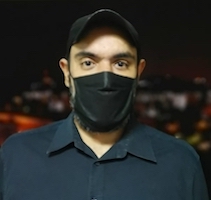
A Hoshiarpur firm – Surgeine Safety Products – has manufactured a new protective mask specifically designed for men with beards.
The ‘K-180’ is an N-95 mask that would cover a major part of the face – from the nose to the lower part of chin and left and right parts of the face.
The company recently got approval from the Government of India for mass-level production of N-95 masks to meet the demand during coronavirus outbreak, reports The Indian Express.
“The beard is a fashion all over the world but people in Punjab also keep beards for religious reasons. I am also a Sikh. I was receiving feedback, mostly from Sikhs, that there should be a mask for people with beards. So we have come up with this mask,” Surgeine Safety Products owner Gurbhagat Singh told the newspaper.
In the wake of the Covid-19 threat, doctors spotting beards, including Sikhs who maintain their bodily hair as per their religious belief, have come under pressure in some jurisdictions around the globe when it came to the safety of patients and themselves.
In the report late last month, Gurbhagat was quoted as saying: “The mask will cover a large portion of the face. It will come with tight elastic to properly seal a bearded face”
“All masks come with instructions that a beard can affect the fitting of the mask and it may not allow proper sealing of the face. So particles can infiltrate inside. We would like to get feedback from the market before marking it as a mask for bearded people. There are different styles of beards. The success of the mask will also depend upon the style of beard.”
ASIA SAMACHAR is an online newspaper for Sikhs / Punjabis in Southeast Asia and beyond.Facebook | WhatsApp +6017-335-1399 | Email: editor@asiasamachar.com | Twitter | Instagram | Obituary announcements, click here |
The following comment on social media provides a seemingly valid argument pertaining to portraits of our Gurus. My response follows.
An artist is able to express what philosophies cannot. An Artist has an aesthetic experience in which he/she surrenders to “it” with no other intention than the beauty of that experience in itself. Given, our Gurus were human beings and expressed likewise doesn’t mean they’re belittled or have become icons of murti pooja (idol worship), but rather part and parcel of our everyday lives. And just as photos of our loved ones are displayed in our homes so too are the portraits of our Gurus.
My Response.
The argument is defective when it comes to a philosophy (Gurmat) that strives to draw a line between the message and the messenger. In Sikhi, the philosophy is paramount; the philosopher reduces himself to nothing. The message is supreme, the messenger desires a status of non-entity. The value and belief is everything; the messenger reduces his position to nothing-ness. This notion is found all over the philosophy of Gurbani and within the messages of the Shabd.
ਹਉ ਆਪਹੁ ਬੋਲਿ ਨ ਜਾਣਦਾ ਮੈ ਕਹਿਆ ਸਭੁ ਹੁਕਮਾਉ ਜੀਉ ॥
Haon Apho Bol Na Jannda Mein Kaheya Sabh Hukmao Jio. SGGS 763.
ਮੈ ਨਾਹੀ ਕਛੁ ਹਉ ਨਹੀ ਕਿਛੁ ਆਹਿ ਨ ਮੋਰਾ ॥
Mein Nahi(n) Kach Hao(n) Nhi Kich Ahe Na Mora. SGGS 858.
ਸਭਿ ਗੁਣ ਤੇਰੇ ਮੈ ਨਾਹੀ ਕੋਇ ॥
Sabh Gunn Teyrey Mein Nahi(n) Koey. SGGS 4
ਮੈ ਨਾਹੀ ਕਛੁ ਆਹਿ ਨ ਮੋਰਾ ॥
Mei(n) Nahi(n) Kach Ahe Na Mora. SGGS 337
ਤੂੰ ਕਰਤਾ ਕਰਣਾ ਮੈ ਨਾਹੀ ਜਾ ਹਉ ਕਰੀ ਨ ਹੋਈ ॥
Tu Karta Karnna Mein Nahi(n) Ha Hao(n) Kree Na Hoyi. GGS 469
ਜਬ ਹਮ ਹੋਤੇ ਤਬ ਤੂ ਨਾਹੀ ਅਬ ਤੂਹੀ ਮੈ ਨਾਹੀ ॥
Jub Hum Hotey Tan Tu Nahi(n) Ab Tuh(n) Mein Nahi(n). SGGS 657
ਮੈ ਨਾਹੀ ਪ੍ਰਭ ਸਭੁ ਕਿਛੁ ਤੇਰਾ ॥
Mein Nahi(n) Prabh Sabh Kich Tera. SGGS 827
From the above sampling of verses, one gets the clear message that Gurmat is a philosophy that strives hard to obliterate the status, position and standing of the messenger. Mein Nahin – I am not, I am nothing, the messenger is of no significance.
None of the 35 writers of Gurbani left even the faintest of clues as to their full names, that of their parents, their spouses, their families, their place of birth, etc. None of our Gurus indulged in having their portraits created. Surely amongst their followers, there would have existed many a good artist as there were poets, musicians and skilled persons in other arts to record details of their physical likeness. It is not that they could not. But that they were disallowed.
It is the tragedy of Sikhs that instead of linking with the messages, we have strived to link with the physical identity of the messengers – the identities they sought so hard to obliterate. They sought to obliterate their own personal human identities so that we could learn to do the same to ours and not indulge in the egoistic inflation of our own.
In our own desire for self-indulgence and self-grandiose, we have sought to transfer the same to our Gurus. In our own egoistical desire for portraits, pictures, paintings and drawings of our own selves, we have sought to create the same for our Gurus. To the extent that we have accepted artists’ impressions that are as fake as the one artist who created a self-portrait and passed it off as Guru Nanak’s. All of us Sikhs, including our premier institutions such as SGPC [Shiromani Parbhandak Gurdwara Committee], were fooled into giving this fake portrait a place in our homes, gurdwaras and psyche.
Guru Nanak as painted by artist Sobha Singh or a Self Potrait of Sobha Singh passed off as Guru Nanak?
The statement that “an artist is able to express what philosophies cannot” needs to be examined to expose the falsity of the premise. In the case of our Gurus, our artists have expressed what our philosophy did not want to express. The portraits of Guru Nanak are shown ordained with rosaries, offerings and ornamentations that have been critiqued in their messages. The portraits of Guru Nanak tell the lie of a non-existent companion Bhai Bala. The wide acceptability of these portraits help establish the lie of the Janm Sakhis under the name of Bhai Bala. The eventual outcome is a philosophy that exists within the message of the Gurus side by side a contradictory philosophy that the artists have created for us in their portraits.
The statement that “an artist has an aesthetic experience in which he/she surrenders to “it” with no other intention than the beauty of that experience in itself,” holds the biggest lie when it comes to Sikhi. What aesthetic experience can an artist have – if he has not read or understood the crux of the messages of the Guru that he paints? What kind of surrender can one talk about in the act of an artist painting the image of an individual who expressly forbade such in the first instant? The only intention that remains is either a monetary reward from the sale of such fakery or a purposive one to corrupt the philosophy of Gurmat.
The mythical entity in the person of Bala was made into a “historical reality” – thanks to the “aesthetic” experience of the artist. The acceptance of the non-existant Bala led to the acceptance of another heretical and blasphemous text called Bhai Baley Wali Janm Sakhi.
To say that our Gurus have not been “belittled or become icons of murti pooja given that our Gurus were human beings,” is an expression of ignorance of what our Gurus said, preached and wrote out for us – as human beings. A study of Gurbani in relation to morti pooja will point out the fallacy of such a view.
The statement that “and just as photos of our loved ones are displayed in our homes so too are the portraits of our Gurus,” is defective because it is the case of comparing apples with bananas. We want our photos to be displayed, and we understand that our loved ones wanted them to be. We go to great lengths to create our own photos to leave behind, so that they can be displayed. Such is the essence of our fallible human-ness; one that is centred on our innate ego.
On the other hand, our Guru have told us amply – both through their messages and their own conduct – that they wanted no such thing. And if our Gurus did go to great lengths to do anything – it was to ensure their pictures, paintings, and sculptures were never made.
An artist is able to express what philosophies cannot? This is one case of an artist expressing what Sikh philosophy DID NOT want expressed. While Gurbani tells us that God is Within us, this artist has been able to imitate a portrait of another prophet depicting our Guru “praying to a God sitting high up in the heavens”!
Here is another case of an artist who has relied on a propaganda poster of Napoleon Bonaparte to express something Sikh philosophy never needs. Napoleon’s portrait is an attempt by a 5 feet tall general to give himself a false stature of height and power. The picture of him on a horse with its fore limbs up gives him just that. He had an artist paint the background showing dark clouds – to show he was leading France away from dark times. He had his finger pointed upwards to show he was leading France into the future.
Do we need such a “philosophy “to be associated with Guru Gobind Singh? Be we have, thanks to the “aesthetic experience” of a plagiarist artist.
Finally, if painted portraits of our Gurus are fine, then what do we say of stone, metal or wooden statues of them. Going one step further, what about human beings who claim to be embodiments of our Gurus?
This article first appeared at Sikh Vichar Forum website. The author, Karminder Singh, PhD (Boston), is a co-editor of The Sikh Bulletin. He can be contacted at dhillon99@gmail.com.
ASIA SAMACHAR is an online newspaper for Sikhs / Punjabis in Southeast Asia and beyond.Facebook | WhatsApp +6017-335-1399 | Email: editor@asiasamachar.com | Twitter | Instagram | Obituary announcements, click here |
Maa … Meri Maa Pyari Maa Mumma … Oh Maa … (Film: Dasvidaniya)
By Dr Charanjit Kaur | OPINION |
Ma, Mama, Mak, Mom, Mummy, Ammi, Amma, Mi, Eomma, and Ibu are names for the women in various societies that turn the lifetime social status of a woman into a mother. Children’s presence is a key predictor for women who are called as a mother. Undeniably, the relationship of the child with the mother is incomparable. The sacred relationship begins from the womb of bonding between child and mother (and parents/guardians).
A mother pregnant with the child for nine months is said to have a unique or maternal instinct to understand the feelings and needs of children more than any other individual. This is further exacerbated by the ongoing emotions of childbirth. In cases where the child is unrelated, such as adoption, a maternal bond may also develop. Mothers who give birth and mothers who adopt both should be considered as ‘biological mothers’ based on changes that occur in their bodies when they become parents (both undergoing similar neuro-endocrinological transformations even in the absence of birth or lactation).
Our society defines roles in general terms. For each of us there are certain roles that society expects us to fulfill. Women are expected to take care of their infants, elderly relatives, sick or disabled children/individuals. Women are expected to take on the role of supporting, caring for, and responding to others. That’s the main reason we value women in our society with the ability to have kids (and families).
Punjabi women are entrusted with this task which has been socialised since young. Most infants are cared for by women, often by mothers. Women are supposed to display affection, to interact in a good and inspiring language, to be sensitive to the feelings and needs of children, to affirm their feelings and, most of all, motherhood is a place for children to comfort. In short, the expectations of this society indirectly make women a ‘superhero’ (multi-tasking) for their children. No wonder, a genuinely dedicated and committed mother can do something beyond her ability and strength.
It should be remembered, however, that each woman has a different experience in growing up and raising children. Not all birth-giving women are able to immediately cultivate her offspring. Women living in nuclear families may not have strong moral support while those living with extended families may experience stress due to unreasonable expectations or surplus advice. There are also specific obstacles faced by single parents who have lost their husbands or divorced or unmarried moms in raising their children. There is, in short, no absolute manual that any woman or mother should follow in this respect. Therefore, we should respect and honour the contribution of women to this ‘maternal struggle’.
In today’s realities, there are two different narratives of coexisting motherhood: (i) liberated from conventional roles to have careers, enjoy egalitarian relationships with partners who share in homemaking and child care, and raise outstanding children (‘have it all’) and, (ii) might not be possible to get work and fewer chances for highest level of professional life. I assume that our grandmothers, mothers, aunts and sisters belong to the two groups listed above because of their education, socialisation and life opportunities.
But what happens when a mother doesn’t have a relationship with her child? We easily label her as a woman with mental ailment, attachment disorders, postpartum depression (widely known now), abnormal, less feminine, greedy, career-oriented, lack of compassion, and so on. This mark is more harmful if the woman is unable to give birth. Interestingly, it wasn’t the outsider who mocked her but the surrounding families around her – the worse, it comes from the same gender. This is the quality of society we have today that considered a married woman with children(s) as a standard metric for a ‘complete woman’. Although educated and employed, most mothers cannot make decisions about their child – whether they want to be a mother, how many children they want, delayed or content without any offspring at all. Married women who do not want children or had miscarriages or gifted with special the child are worse off, therefore.
Surprisingly, our religious bodies do not seem to be serious to address these dilemma faced by women. Motherhood is certainly a tough journey for many of us and some parents do faced challenges: emotionally, economically, socio-psychologically and spiritually. Many paid ragi jatha are repeating old stories and are not assisting the Sikh to manage their families in accordance with Sikhi way of life. Many of us are proud of the ‘our’ patriarchy culture and hesitant to adopt a Sikh culture that professes gender equality. No wonder women in our culture became the victim and blamed for any unfortunate incident happened in their married life. Ironic.
From woman, man is born; within woman, man is conceived; to woman he is engaged and married. Woman becomes his friend; through woman, the future generations come. When his woman dies, he seeks another woman; to woman he is bound. So why call her bad? From her, kings are born. From woman, woman is born; without woman, there would be no one at all. (Guru Granth Sahib, 473; English translation from srigranth.org)
For the Sikhs, every day is a blessing and lets us appreciate our parents and other individuals regardless their gender who have played a significant role as a ‘mother’ by nurturing us.
The author’s area of specialisation is cultural anthropology with a special focus on the Sikh minority community in Malaysia which touches on themes such as religious-cultural conflicts, gender identity and social behavior.
ASIA SAMACHAR is an online newspaper for Sikhs / Punjabis in Southeast Asia and beyond.Facebook | WhatsApp +6017-335-1399 | Email: editor@asiasamachar.com | Twitter | Instagram | Obituary announcements, click here |
The novel coronavirus has thrown the world of Punjabi Mums and their families topsy-turvy. The ensuing circuit breaker in Singapore makes this year an unforgettable year, including Mother’s Day celebration tomorrow (10 May).
The first major impact came with the panic buying. Many a Singaporean rushed to NTUC and Sheng Siong. The famous Mustafa was announced closed with immediate effect.
Atta, dhaal, ghee, achaar, dahi and all other essential Punjabi ingredients came close to extinction. Smaller Indian grocers tripled their prices. Panic became real and there was a sense of urgency in the air. Mums began calling their immediate helplines – sisters and sahelis – to find out who had stockpiled capati flour.
On Facebook, one Punjabi Mum commented bluntly: “We are not like them, we will die eating Maggi!”
She got a reply from another mum: “The temples [gurdwaras] also close but their storeroom filled with dhaals. They should distribute to us.”
While some started hammering their husband’s phones to go for island-wide “QBB” hunt, other Mums pressured their kids to go to online marts and discussion forums!
Fortunately, for some, they knew Punjabis returning from India in special flights. They instructed them not to fill their luggage with Punjabi suits, go for kitchen ration.
“Buy as much ‘Basmati’ as possible. Your son’s wedding 100% postponed, so no use bringing back your kurteh. There is nowhere to wear and go!” read one correspondence, via WhatsApp, leaked at an active Sikh gentleman’s kutth (kutu in Malay) group chat.
To alleviate the Punjabi meals predicament, some families met the market demand by selling home cooked capatis and dhaal makhani. Not sure how these overnight home entrepreneurs obtained extra stocks, but well, social media witnessed many happy home taken pictures of staple Punjabi food with customised chicken nuggets, potato wedges and other instant fry options.
Punjabi Mummy Ji’s were managing the kitchen problem well until the next bomb was dropped right on them: Circuit breaker extended to June 1st and immediate lock-down of all beauty parlors and hair salons. It was made clear that home visits were a big NO, so all the helpers and female students from India trained in ‘threading’ and what not, had to stay put at home.
Some women poured their distress online. One Instagram entry reads: “My eyebrows will join into one big straight line and white hair will grow like ‘hantu‘!” (Hantu is ghost in Malay).
No solution in sight, yet. Expect to see long lines and many smiling home beauticians moonlighting on Sundays!
Now, what to do with Mother’s Day Celebrations? The date has multiplied in popularity over the years, with heartfelt effort put in by children to reward their Mums with excellent restaurant dinners, parties, gifts, shopping escapades, massage and spas, or even local staycations and quick Batam getaways.
After the last lohri gig, some ladies-wings were planning to make Mother’s Day 2020 a memorable one.
One Mrs Singh told her fellow committee members: “My Mother’s Day party lengha was bought in February but don’t know why this stupid virus come and attack us!”
So with macro level celebrations down and out, the onus and pressure now bounces back entirely on the micro. Families have to overcome the depressing claws of Covid-19, but many still remain clueless how.
I asked around to find out what contingency plans they have come up with. Some families are trying their best to convince their Mummy Ji’s into performing Tik Tok giddha videos. Last minute attempts to buy gifts is problematic too; it’s never easy finding that perfect gift for these special occasions.
Well, it seems Covid-19 and the entailing Circuit Breaker is a reset button for many of us who have drifted far away from simpler things in life.
This Mother’s Day 2020, let us spend quality time with our Mummy Ji’s and exchange engaging conversations. The fancy restaurants can’t play host, but the comfort of your homes can. Recall back what ‘comfort food’ your Mummy Ji just enjoys eating most at home, and let that be the main course. The same with gifts. Since “essential” has been the essential term this season, grab what Mum needs most and she will be the happiest person among all of us in 2020!
Jatinder (Jat) Singh is a freelancer in the events and training industry in Singapore with a passion for writing
* This is the opinion of the writer, organisation or publication and does not necessarily represent the views of Asia Samachar.
ASIA SAMACHAR is an online newspaper for Sikhs / Punjabis in Southeast Asia and beyond.Facebook | WhatsApp +6017-335-1399 | Email: editor@asiasamachar.com | Twitter | Instagram | Obituary announcements, click here |
Dr Veerinderjeet Singh (left) and Ranjit Singh – Photo: Supplied
By Asia Samachar Team | MALAYSIA |
Tax specialist Dr Veerinderjeet Singh and audit expert Ranjit Singh are now part of business expansion specialist and professional services provider Tricor Services (Malaysia) Sdn Bhd.
Dr Veerinderjeet has been named its non-executive chairman while Ranjit as the regional managing director of Tricor Axcelasia, a new strategic business advisory entity in Tricor.
The appointments follow the recent acquisition of the Malaysian operations of the Singapore-listed Axcelasia Inc, of which Dr Veerinderjeet and Ranjit were among the founder members.
Axcelasia is an integrated professional services firm delivering governance, risk and c compliance (GRC) solutions, corporate, business and tax services.
In a statement, Hong Kong-based Tricor said Dr Veerinderjeet will act as an advisor in areas of complex tax advisory, support business development, mentor executives and serve as an ambassador for the Tricor name and brand.
For Tricor, it said the transaction represented the launch of a new regional GRC business focused on helping clients manage their increasingly complex regulatory and compliance responsibilities while operating in the emerging and maturing economies of the Asia Pacific region.
ASIA SAMACHAR is an online newspaper for Sikhs / Punjabis in Southeast Asia and beyond.Facebook | WhatsApp +6017-335-1399 | Email: editor@asiasamachar.com | Twitter | Instagram | Obituary announcements, click here |
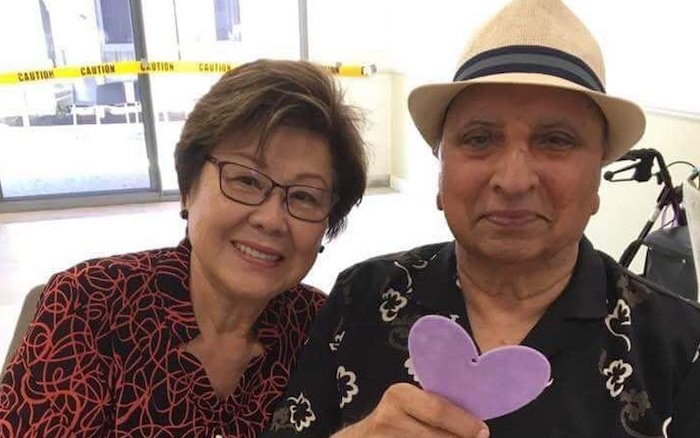
Harjit Singh Bhullar and his wife Doris Chua – Photo: Via Harjit Singh Hullon
By Asia Samachar Team | MALAYSIA |
Former Malaysian radio sports commentator Harjit Singh Bhullar has passed away in Perth, Australia. He was in his 80s.
His passing away had kicked off a small social media storm for his namesake and veteran Radio and Television Malaysia (RTM) newsreader Harjit Singh Hullon, probably the most recognised Sikh face in Malaysia.
“I’m alive and kicking,” Hullon told Asia Samachar when contacted. “It is sad to hear about the passing on of Bhullar. I had worked with him in 60s.”
There was a third Harjit on the editorial and production floors of the RTM, this one from the radio side. Harjit Singh, as he was simply known, joined RTM in 1979 as a news reporter for the radio section and retired in 2014 as head of the English new division for television.
“I worked with Bhullar as well as his wife Doris who was a deejay with the English service of RTM,” Harjit told Asia Samachar. “He started off as a radio sports commentators and later became a TV producer. He left for Perth sometime in the 1990s after his retirement.”
Harjit Singh Hullon and hiw wife Sabinder Kaur after the award ceremony at Istana Alam Shah on 11 Dec 2016 – PHOTO SUPPLIED
ASIA SAMACHAR is an online newspaper for Sikhs / Punjabis in Southeast Asia and beyond.Facebook | WhatsApp +6017-335-1399 | Email: editor@asiasamachar.com | Twitter | Instagram | Obituary announcements, click here |
There is a trend amongst modern Sikh scholars to question the very founding principles of Sikhi in the name of research. Some regard this as necessary to establish their scholarly credentials. They do not seem to realise that even academic quest for knowledge should have the humility to accept own limitations.
Heated public exchanges between Sikh scholars take place as a result, creating further doubts and divisions. Recently, Sardar Tarlochan Singh, ex-MP and Indian Minorities Commissioner, has warned that such public controversy was dangerous and created rift among the Sikhs and also created doubts about our history.
Another commentator wrote: If a scholar manipulates history and tries to stretch the truth in order to arrive at a disturbing conclusion against the treasured and sacred traditions/fundamental doctrine of a religion, then it cannot be accepted under the rubric of academic freedom.
Yet, Guru Nanak Sahib did adopt a questioning and critical approach regarding exploitation by the priestly class, the rituals and hypocrisy (pakhand) in the name of religion and practices like the caste system and treatment of women which created human inequality. Practices which did not respect human rights and dignity. However, he also pointed the right way to the followers of different religious paths. As a result, he was able to win over the leading figures of different religions of his time. His methodology did not sow seeds of division or doubt but, by clarifying the underlying truths and universal human values, it was seen and accepted in his time to unite diversity.
However, the path of Guru Nanak Sahib was distinct, for he and his Sikhs are neither Hindu nor Musalmaan. Bani of saintly people (bhagats) from diverse backgrounds was included selectively – sometimes with qualification by the Guru – because these were the reformer saints who had revolted against their own orthodox religions as practised. They shared the same universal ideals as the Guru Jot-Jugat.
This is in response to those who treat Sikhi as just another offshoot of Hinduism or those who say that it is a syncretic movement which bridges the gap between Hinduism and Islam. Sikhi emerged over the tutorial period of the Ten Gurus as the Tisra Panth, the Third Path after the Abrahamic and Eastern faiths. Sikhi of Guru Nanak derives its egalitarian ideology and institutions from the unique description of the One Timeless Being in the founding formula of Sikhi, known as the Mool Mantar.
The latest conflict in Sikh studies is between science-based and faith-based approaches to religion. The purely scientific approach challenges the traditional interpretation of Sikhi as we know it and as defined through the definition of a Sikh in the Sikh Reht Maryada, that is, total belief in One Immortal Being; Ten Gurus and their teachings, and Sri Guru Granth Sahib; and, Amrit initiation bequeathed by Guru Gobind Singh Ji.
Renowned Sikh thinker, Dr I J Singh points to the correct approach when he writes, “In fact, science and religion are complementary – two sides of the same cloin. Science explores order in existence; religion must find meaning in it. One would be pointless without the other. Unfortunately, between the scientists lack of concern with the meaning of their work and the priests ignorance or fear of science, both destroy what they aim to love and understand – human heart, mind, body and soul.”
He points out that scientific theory changes with new discoveries while religious insights, “though made at a point in time and space, are made for all time, or else they would have no value…. It is tempting to take what is written for all eternity and apply it literally to what science reveals to us at a given point in time.”
Regarding the ongoing distortion of Sikh ideology and history, in a recent article in the Sikh Review, Dr Hardev Singh Virk quoted S Puran Singh as follows: It is to be regretted that Sikh and Hindu scholars are interpreting Guru Nanak in the futile terms and dissecting texts to find the Guru’s meaning to be same as of the Vedas and Upanishads. This indicates enslavement to the power of Brahmanical traditions.” Indeed, it does.
Our aim should be to bring faith and reason together with due regard to Sikh ideology, institutions and identity developed as a distinct way of life, based on the teachings of the Ten Nanaks now enshrined in Sri Guru Granth Sahib.
Gurmukh Singh OBE, a retired UK senior civil servant, chairs the Advisory Board of The Sikh Missionary Society UK. Email: sewauk2005@yahoo.co.uk. Click here for more details on the author.
* This is the opinion of the writer, organisation or publication and does not necessarily represent the views of Asia Samachar.
ASIA SAMACHAR is an online newspaper for Sikhs / Punjabis in Southeast Asia and beyond.Facebook | WhatsApp +6017-335-1399 | Email: editor@asiasamachar.com | Twitter | Instagram | Obituary announcements, click here |
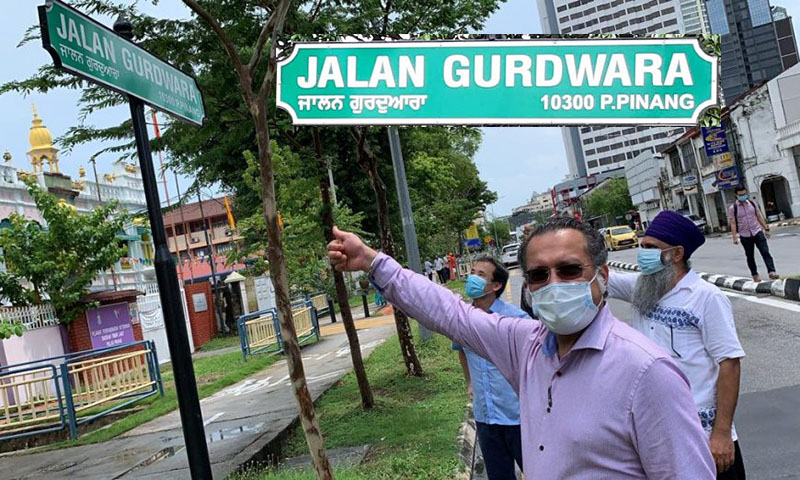
Jagdeep Singh Deo inspecting the new road signage with the Gurmukhi script, accompanied by Wadda Gurdwara Sahib Penang president Daljit Singh and MBPP mayor Yew Tung Seang. – Photo: Jagdeep Singh Deo office / Buletin Mutiara
By Asia Samachar Team | MALAYSIA |
Malaysia received what is probably its first road signage in Gurmukhi, one of the scripts for the Punjabi language.
If you head to Penang, you will find Jalan Gurdwara also listed the Gurmukhi script, something that is no doubt endearing to the Sikh community. Jalan is road in Malay.
Penang state executive member Jagdeep Singh Deo told Buletin Mutiara that the state government approved the request made by the Sikh community on Jan 15.
“We have approved their request to put Gurmukhi script on the Gurdwara Road signage and it is the first dual language road sign in Penang that contains such script. And I believe, it is also the first in the country,” he was quoted in the Penang state portal.
When contacted, local historian and author of Sikhs In Malaysia Series Malkiat Singh Lopo said he believes that it is probably the first such signage in Malaysia.
“I remember seeing Gurmukhi signage at railway stations when I was young. We also have the danger warning signs at the power stations,” he told Asia Samachar.
Gurmukhi is also the script used for the Sikh scripture called the Sri Guru Granth Sahib. Punjabi is also written in Urdu and Devanagari.
Jasdeep, who is the state local government, housing, town and country planning committee chairman, added: “Of course, the Malay language is still a priority and it is still there on every road sign in the state.”
He added that Penang has about 180 dual language road signs which include Malay, Jawi, Chinese and Tamil scripts. They are installed by the Penang Island City Council (MBPP).
Malaysia has a few Jalan Gurdwara, usually named for a road near a gurdwara (Sikh place of worship). The others are in Ipoh, Perak and Bentong, Pahang.
Penang’s Jalan Gurdwara, formerly Brick Kiln Road, is where you will find Wadda Gurdwara Sahib Penang (WGSP).
Describing it as a ‘historical moment’, WGSP committee president Daljit Singh said told the magazine: “On behalf of the Sikh community and Penang Wadda Gurdwara Sahib, I would like to express my utmost gratitude and appreciation to the state government and the city council for approving our request to insert Gurmukhi script into the Gurdwara Road signage. It means a lot to us.”
ASIA SAMACHAR is an online newspaper for Sikhs / Punjabis in Southeast Asia and beyond.Facebook | WhatsApp +6017-335-1399 | Email: editor@asiasamachar.com | Twitter | Instagram | Obituary announcements, click here |
Every week, the Singapore Sikh community prepares and delivers 12,000 hot vegetarian meals to vulnerable groups in Singapore as part of its Langgar (Free Kitchen) Outreach Programme (LOP).
The LOP, which has been running out of the seven Sikh Gurdwaras in Singapore for several years now, stepped up its efforts in March this year to feed more individuals and families made vulnerable by the pandemic.
Despite the gurdwaras being closed to the public during this period, a small group of volunteers and staff gather daily to cook and distribute packed meals for breakfast, lunch and dinner – all while observing strict safe distancing measures.
Langgar is the cornerstone of the Sikh faith and outreach as can be seen all around the world, noted a former Sikh lawmaker.
“Whenever there is a pandemic, natural or man-made disaster, the Sikh community is always among the first to respond through langgar by feeding others,” said former Member of Parliament Mr Inderjit Singh in a statement.
“I am glad that through this important way we are able to play a role in helping the society in Singapore during this challenging time.”
Inderjit is also the Chairman of the Coordinating Council of Sikh Institutions (CCSI).
They join fellow Sikhs around the world – from Wolverhampton to New York to New Delhi – who are serving free meals to the needy in this trying times.
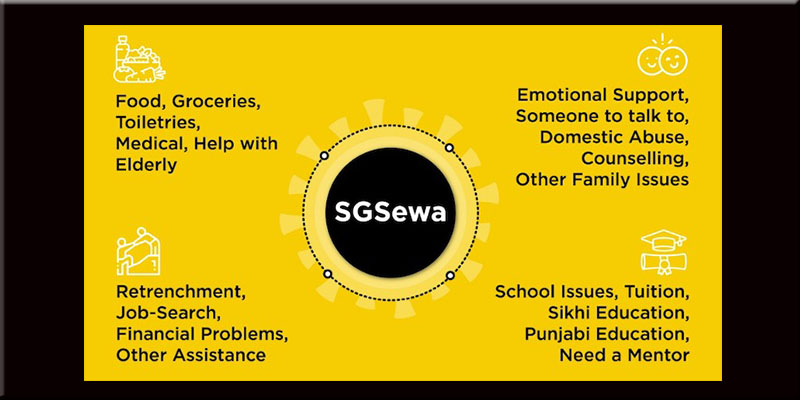
In addition, on April 29, the community launched #SGSewa – a task force supported by the CCSI.
Made up of a group of volunteers, the ground-up initiative aims to provide assistance to vulnerable individuals in the community and beyond in the following areas – counselling and emotional support for abuse or mental health issues; provision of food, groceries and financial assistance; helping people who have been retrenched with job search; supporting families whose children face may be facing disruption to their education; as well as providing legal and medical assistance.
The task force will also assist in directing these individuals to established government or community support schemes, the statement added.
In the first three days of #SGSewa’s launch alone, the task force received hundreds of queries on its hotline from people facing diverse challenges, including retrenchments and lost incomes, domestic abuse, and medical issues.
More than a hundred callers were foreign students who had been evicted by their landlords.
These students, mostly Indian nationals, have requested assistance on a range of issues. The #SGSewa taskforce has been working closely with the Indian High Commission to refer students who seek repatriation as well as accommodation and other issues, according to the statement.
On its own, the taskforce has also teamed up with local doctors in the community to provide free medical assistance to some of these foreign students as well distributed 150 dry-ration packages to them, as they are financially-strapped.
“The #SGSewa taskforce has made a key decision of not turning away anyone who needs help. Our volunteers have been working tirelessly around the clock answering calls on the hotline and linking callers with other organisations such as the Indian High Commission.
“We are also sourcing temporary accommodation for those who need it and even speaking to some of their family members overseas,” said Inderjit, who also heads the taskforce.
Going forward, the taskforce expects to team up with other professionals and community organisations to support more vulnerable groups including providing support to migrant workers in dormitories.
ASIA SAMACHAR is an online newspaper for Sikhs / Punjabis in Southeast Asia and beyond.Facebook | WhatsApp +6017-335-1399 | Email: editor@asiasamachar.com | Twitter | Instagram | Obituary announcements, click here |
Pioneers of Kuching Traffic Police. Gurbachan Singh Akhara (2nd from left) and Arjan Singh Cheema (5th from left) in an undated photograph taken in front of Central Police Station, Kuching in Sarawak. – Photo: Gurdwara Sahib Kuching Facebook page
By Asia Samachar Team | MALAYSIA |
Pioneers of Kuching Traffic Police. Gurbachan Singh Akhara (2nd from left) and Arjan Singh Cheema (5th from left) in an undated photograph taken in front of Central Police Station, Kuching in Sarawak.
The Central Police Station was built to replace the old police station formerly located on the site of the General Post Office. It opened in 1931 and has retained its original function and façade to the present day, according to an entry at the Saraweak Tourism website. It stands out prominently among the building lining the Padang Merdeka thanks to its blue and white colour scheme, common to all police stations in Malaysia.
ASIA SAMACHAR is an online newspaper for Sikhs / Punjabis in Southeast Asia and beyond.Facebook | WhatsApp +6017-335-1399 | Email: editor@asiasamachar.com | Twitter | Instagram | Obituary announcements, click here |























 By Asia Samachar Team | INDIA |