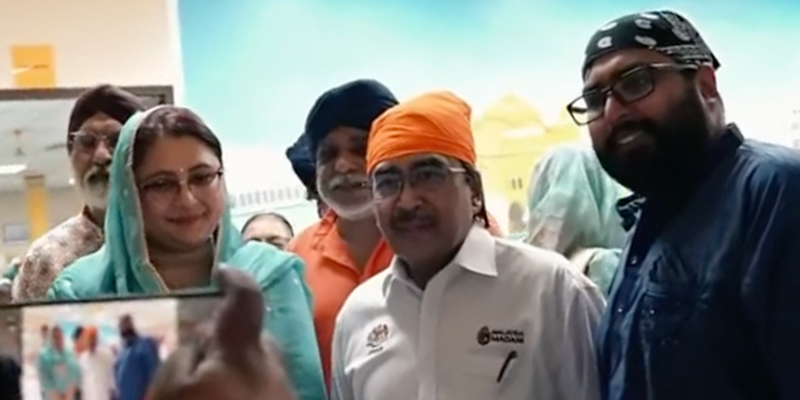
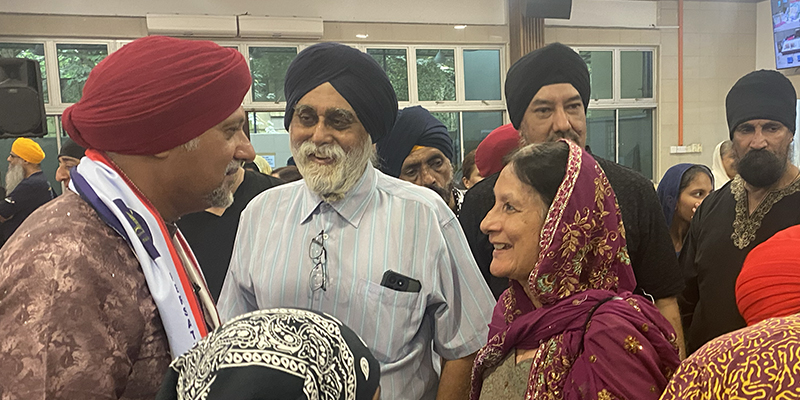
Johari Abdul Ghani visiting Tatt Khalsa for Vaiskahi on 14 April 2026 – Photo: Videograb from JAG Facebook
By Asia Samachar | Malaysia |
Minister of Investment, Trade and Industry Johari Abdul Ghani visited Gurdwara Sahib Tatt Khalsa today in conjunction with the Vaisakhi celebrations.
On Sunday, he was at Wadda Gurdwara Sahib Kampung Pandan, where he observed ongoing gatka (Sikh martial arts) practice and was briefed on the gurdwara’s renovation plans.
“I was honoured to receive an invitation from my Sikh friends to join them in celebrating Vaisakhi. For the Sikh community, this celebration reflects the principles of courage and justice that lie at the heart of their faith,” he shared on social media.
Johari, a senior leader from United Malays National Organisation and a member of the federal unity government, is the Member of Parliament for Titiwangsa, a constituency that encompasses both gurdwaras.
Join the conversation on this story on Asia Samachar’s Facebook and Instagram pages.
ASIA SAMACHAR is an online newspaper for Sikhs / Punjabis in Southeast Asia and beyond. You can leave your comments at our website, Facebook, Twitter, and Instagram. We will delete comments we deem offensive or potentially libelous. You can reach us via WhatsApp +6017-335-1399 or email: asia.samachar@gmail.com. For obituary announcements, click here
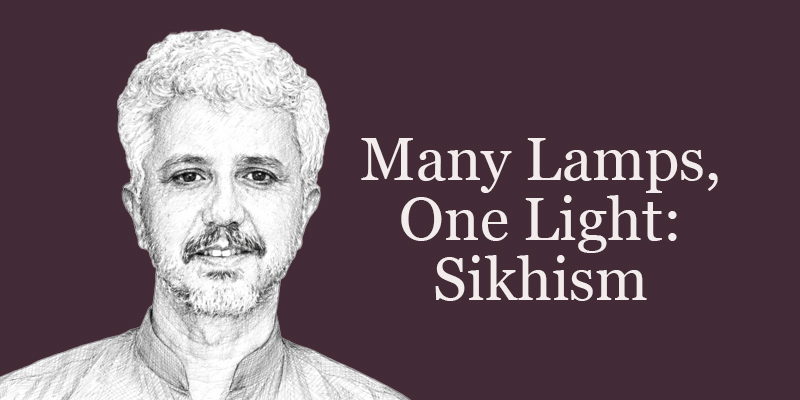
Sikhism is one of the youngest major religions in the world. Its core philosophy teaches that there is One God, that all human beings are equal, and that we should lead honest lives dedicated to the service of others.
In Malaysia, the Sikh community is often recognized by their distinctive turbans, their disciplined nature, and a profound sense of service. Whether as teachers, police officers, neighbors, or friends, Sikhs have quietly and consistently contributed to the building of our nation.
Brief History
Sikhism began in the 15th century in the Punjab region of South Asia. It was founded by Guru Nanak, who lived during an era where society was deeply fractured by religion, caste, and social status.
The Message of Guru Nanak: He travelled widely, meeting people from different backgrounds, teaching that there is only One God and that all people are equal, regardless of religion, race, or social standing. He rejected empty rituals and emphasised living a truthful and honest life.
The Lineage: After him, nine more Gurus continued his teachings.
The Khalsa: The tenth Guru, Guru Gobind Singh, established the Khalsa—a community committed to courage, discipline, and equality.
The Eternal Guide: He also declared that the holy scripture, the Guru Granth Sahib, would be the eternal guide for Sikhs.
Core Beliefs
Sikhism is built on a few clear and powerful ideas:
There is One God who is for all people.
All human beings are equal.
Live an honest life and earn through hard work.
Share with others, especially those in need.
Remember God in daily life.
Reject injustice and stand up for what is right.
Practices & Rituals
Sikhs live their faith through action:
Prayer: They pray and remember God daily.
Worship: They gather at the Gurdwara (place of worship).
Scripture: They read from the Guru Granth Sahib.
Seva: They practise seva, which means selfless service.
The Langar: One of the most beautiful practices is the langar, a free kitchen in every gurdwara where anyone can come and eat, regardless of race, religion, or status.
Sikhs also follow important life practices such as naming ceremonies, marriage rites, and funeral prayers, all guided by their teachings.
Festivals & Celebrations
The most important Sikh festival is Vaisakhi.
Vaisakhi marks the founding of the Khalsa by Guru Gobind Singh in 1699. It is a day of courage, commitment, and identity. Sikhs gather at gurdwaras, pray, share meals, and celebrate together.
Gurpurabs: Other important occasions include birth anniversaries of the Gurus, especially Guru Nanak’s birthday.
In Malaysia, these celebrations are often open and welcoming, where people from all backgrounds are invited.
Values We Can Learn
There is much we can learn from the Sikh community to strengthen our nation:
Stand for justice, even when it is difficult.
Treat everyone as equal.
Be disciplined in life.
Work hard and earn honestly.
Serve others without expecting anything in return.
Be brave, but also humble.
Cultural Expressions
Sikh culture is rich and distinctive:
The Turban: Represents dignity, responsibility, and identity.
Traditional Attire: Reflects modesty and discipline.
Music (Kirtan): An important part of worship.
Food: Plays a central role, especially in langar.
The Sikh identity is not just about belief, but about living those beliefs openly and consistently.
Misunderstandings & Clarifications
Understanding these points helps us respect one another better:
Distinct Faith: Sikhism is a distinct religion with its own teachings; it is not a branch of another faith.
The Turban: It is a symbol of honour, equality, and commitment.
Hair: Sikhs do not cut their hair as part of their discipline and identity.
Dos and Don’ts When Visiting or Meeting Sikhs
Meeting a Sikh:
A common greeting is “Sat Sri Akal,” which means “Truth is eternal.”
A simple smile and handshake are also acceptable.
Do not touch a Sikh’s turban.
Visiting a Gurdwara:
Remove your shoes before entering and cover your head as a sign of respect.
Dress modestly and maintain cleanliness.
Remain calm and respectful; you may bow or stand quietly when the Guru Granth Sahib is present.
Sit respectfully and avoid pointing your feet towards the Guru Granth Sahib.
Do not bring alcohol or cigarettes into the gurdwara.
During Langar:
Sit together with others regardless of background.
Accept the food served and avoid wasting it.
Ik Onkar: Remember that the central expression of Sikhism is Ik Onkar –“There is One God” – reflecting unity and oneness.
Sikhism in Malaysia
Sikhs arrived in Malaya during the British period, serving with distinction in the police and military. They were known for their reliability and courage.
Today: Malaysian Sikhs serve in law, education, business, and public service.
Contribution: They have contributed significantly to nation-building, maintaining law, order, and public trust through their strong traditions of service.
Interesting Facts
Guru Nanak worked as an accountant before beginning his mission.
He travelled thousands of kilometres to spread his message.
His close companion was Bhai Mardana, a Muslim Sufi musician who played the rabab while Guru Nanak sang.
Sikhism rejects caste and social hierarchy.
The langar system feeds millions of people around the world daily.
Voices from the Tradition (Guru Granth Sahib)
“Earn by honest work and share with others.” (Ang 1245)
“Truth is high, but higher still is truthful living.” (Ang 62)
“No one is my enemy, no one is a stranger.” (Ang 1299)
“By egotism all are corrupted; through humility, one is saved.” (Ang 466)
“Make good deeds your body, and faith your support.” (Ang 4)
“Let self-control be your furnace, and patience your goldsmith.” (Ang 8)
10 Beautiful Things We Can Say About Them
They stand up for what is right.
They treat everyone as equal.
They are highly disciplined.
They value honest labor.
They feed the hungry through langar.
They protect the weak.
They serve the community quietly.
They are proud of their identity.
They are incredibly welcoming.
They remind us that humanity is one.
Moving Forward Together
We hope that this brief look at Sikhism helps Malaysians to better know, understand, and appreciate one another. When we take the time to learn from each other’s traditions and values, we move closer as a people. And when we move closer, we become stronger as one nation.
Peace, anas
* Note – Beginning this Vaisakhi, we launch Many Lamps, One Light — a project dedicated to sharing the beauty of our different religious traditions. By learning about one another, we hope Malaysians will grow in understanding, appreciation, and unity as one people.
(THE ARTICLE IS REPRODUCED HERE WITH PERMISSION. CLICK HERE FOR THE ORIGINAL ENTRY)
Join the conversation on this story on Asia Samachar’s Facebook and Instagram pages.
ASIA SAMACHAR is an online newspaper for Sikhs / Punjabis in Southeast Asia and beyond. You can leave your comments at our website, Facebook, Twitter, and Instagram. We will delete comments we deem offensive or potentially libelous. You can reach us via WhatsApp +6017-335-1399 or email: asia.samachar@gmail.com. For obituary announcements, click here
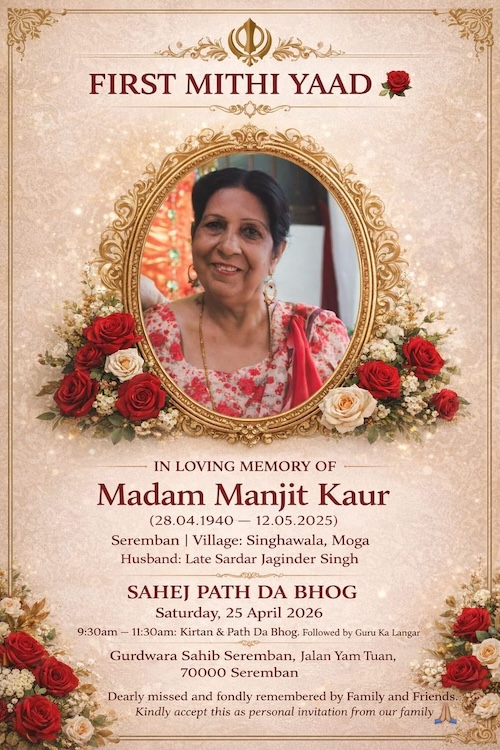
Seremban | Village: Singhawala, Moga Husband: Late Sardar Jaginder Singh
SAHEJ PATH DA BHOG
Saturday, 25 April 2026 9:30am – 11:30am: Kirtan & Path Da Bhog. Followed by Guru Ka Langar Gurdwara Sahib Seremban, Jalan Yam Tuan, 70000 Seremban
Dearly missed and fondly remembered by Family and Friends
Kindly accept this as personal invitation from our family.
Link to posting at Facebook and Instagram
| Entry: 10 April 2026 | Source: Family
ASIA SAMACHAR is an online newspaper for Sikhs / Punjabis in Southeast Asia and beyond. You can leave your comments at our website, Facebook, Twitter, and Instagram. We will delete comments we deem offensive or potentially libelous. You can reach us via WhatsApp +6017-335-1399 or email: asia.samachar@gmail.com. For obituary announcements, click here
Gurdwara Sahib Guru Nanak Shah Alam will kick off its five-day Grand Vaisakhi Semagam on Wednesday (April 15), with the raising of the Nishaan Sahib (Khalsa flag) taking place on Saturday. Check out the line-up of programmes planned throughout the celebration. #vaiskahi2026
Join the conversation on this story on Asia Samachar’s Facebook and Instagram pages.
ASIA SAMACHAR is an online newspaper for Sikhs / Punjabis in Southeast Asia and beyond. You can leave your comments at our website, Facebook, Twitter, and Instagram. We will delete comments we deem offensive or potentially libelous. You can reach us via WhatsApp +6017-335-1399 or email: asia.samachar@gmail.com. For obituary announcements, click here
The 1st of Baisakh Nanakshahi Sammat 558, which coincides with 14th of April 2026 marks two pivotal events of Sikhi – Vaisakhi of 1469 and of 1699.
By Karminder Singh | Opinion |
Vaisakhi 1469 and 1699: defining moments in Sikh history
Happy Vaisakhi 1469, Happy Vaisakhi 1699.
The 1st of Baisakh Nanakshahi Sammat 558, which coincides with 14th of April 2026 marks two pivotal events of Sikhi – Vaisakhi of 1469 and of 1699. Vaisakhi 2026 is thus the 557th anniversary of Guru Nanak’s birth in 1469; and the 327th anniversary of the celebration in 1699, of the culmination of a 230-year journey.
Vaisakhi 1699 was the celebration of spiritual completeness.
The journey of spiritual completeness began with Guru Nanak in 1469, and was contributed to by nine successive Gurus. This journey, which was celebrated in 1699, culminated in 1708 with the installation of the Sri Guru Granth Sahib cementing the Shabd as our Guru and guide towards spiritual enlightenment. Spiritual completeness is defined within the Shabd as being linked completely with the messages of the complete Guru within; and being linked completely with humanity without.
The highlight of Vaisakhi 1469 was the advent of Guru Nanak. The highlight of Vaisakhi 1699 was the celebration of being linked within and without. Guru Gobind Singh called out 5 Sikhs that he had selected based on their links with Guru Nanak’s Sikhi. He made sure they were each from different regions and different castes. He united them in the one-ness of humanity, erased their differences in caste and origin, gave them one identity as Khalsa. When it was all over, he had united them with him and him with them.
The Sikh world is, lamentably, removed from the essence of both events. Vaisakhi 1469 has gotten erased from the Sikh psyche as the birthdate of Guru Nanak. The Sikh world celebrates the birthdate of their founder on a fraudulent date seven months after Vaisakhi. And Vesakhi 1699 has become mired in unbelievable tales of the Guru beheading his own Sikhs before brining them back to life.
ASIA SAMACHAR is an online newspaper for Sikhs / Punjabis in Southeast Asia and beyond. You can leave your comments at our website, Facebook, Twitter, and Instagram. We will delete comments we deem offensive or potentially libelous. You can reach us via WhatsApp +6017-335-1399 or email: asia.samachar@gmail.com. For obituary announcements, click here
ASIA SAMACHAR is an online newspaper for Sikhs / Punjabis in Southeast Asia and beyond. You can leave your comments at our website, Facebook, Twitter, and Instagram. We will delete comments we deem offensive or potentially libelous. You can reach us via WhatsApp +6017-335-1399 or email: asia.samachar@gmail.com. For obituary announcements, click here
Gobind Singh Deo (left) mingling with Sikhs at the Sentul Vaisakhi 2026 event – Photo: Asia Samachar
By Asia Samachar | Malaysia |
Digital Minister Gobind Singh Deo and his younger brother, Bukit Gelugor MP Ramkarpal Singh, joined hundreds of Sikhs and guests at a Vaisakhi gathering at Gurdwara Sahib Sentul today (April 12).
In his address, Gobind described Vaisakhi as “a reminder of our resilience—of who we are, what we have achieved, and what we can continue to achieve moving forward.”
“Our faith teaches us Sarbat Da Bhalla—to seek the well-being of all. In a world that often feels divided, our community serves as a bridge that fosters peace and understanding,” he said, adding that seva (service) for all Malaysians remains integral to Sikh identity.
Speaking directly to “young Singhs and Kaurs” who recently sat for their SPM examinations, he encouraged them to view this milestone as only one chapter in their journey.
“As you move on to universities or careers, carry the identity of our community with you. Make us proud not just through your intellect, but through your character, integrity and kindness.
“The country needs your brilliance—whether as doctors, artists, engineers, lawyers or cybersecurity experts. Do it with the intention of making Malaysia a better place,” he said.
Gobind also reminded youths to honour the sacrifices of earlier generations. “Your success is the fruit of their prayers and hard work. As you rise, stay grounded. A true Sikh is one who rises by lifting others.”
Gobind is chairman of the Democratic Action Party (DAP), a key component of the Pakatan Harapan (PH) alliance led by Prime Minister Anwar Ibrahim.
The event was organised by Gurdwara Sahib Sentul in collaboration with the Malaysia Punjabi Diaspora Association. (Edited)
Join the conversation on this story on Asia Samachar’s Facebook and Instagram pages.
ASIA SAMACHAR is an online newspaper for Sikhs / Punjabis in Southeast Asia and beyond. You can leave your comments at our website, Facebook, Twitter, and Instagram. We will delete comments we deem offensive or potentially libelous. You can reach us via WhatsApp +6017-335-1399 or email: asia.samachar@gmail.com. For obituary announcements, click here
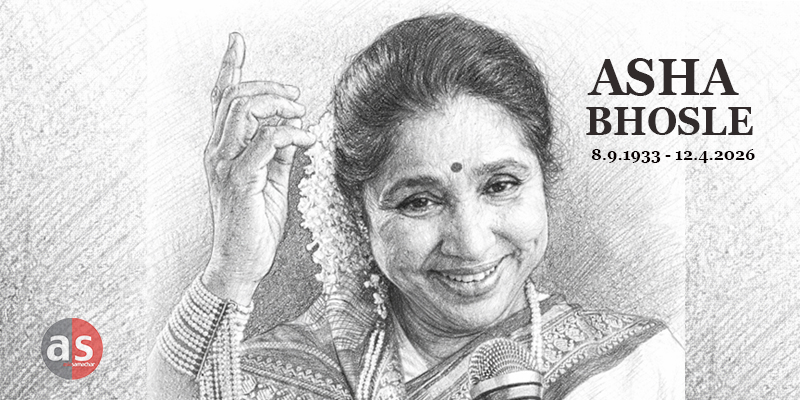
Asha Bhosle, one of India’s most celebrated playback singers whose voice defined generations of Bollywood music, has died at the age of 92.
Her family confirmed that she passed away in Mumbai on Sunday after being hospitalised. Reports said she had been suffering from health complications, including a chest infection and extreme exhaustion, while another account noted she had earlier experienced a heart attack.
Bhosle’s death marks the end of an extraordinary musical career spanning more than seven decades, during which she recorded over 12,000 songs in multiple Indian languages. Her versatility — from romantic ballads and ghazals to upbeat cabaret numbers — made her one of Bollywood’s most enduring and adaptable voices.
Born on September 8, 1933, into the illustrious Mangeshkar family, she began singing at a young age alongside her sister, Lata Mangeshkar. Despite constant comparisons, Bhosle carved her own path, known for her bold, expressive style that contrasted with her sister’s classical precision.
Her collaborations with legendary composers, particularly R. D. Burman, produced some of Bollywood’s most iconic songs, reshaping the sound of Indian cinema.
Tributes poured in following news of her passing. Indian Prime Minister Narendra Modi described her as “one of the most iconic and versatile voices India has ever known,” while musicians and actors hailed her lasting influence on global music.
Beyond music, Bhosle also ventured into international collaborations and business, including her “Asha’s” restaurant chain.
Even in death, her legacy endures — a voice that continues to echo across generations and borders.
Join the conversation on this story on Asia Samachar’s Facebook and Instagram pages.
ASIA SAMACHAR is an online newspaper for Sikhs / Punjabis in Southeast Asia and beyond. You can leave your comments at our website, Facebook, Twitter, and Instagram. We will delete comments we deem offensive or potentially libelous. You can reach us via WhatsApp +6017-335-1399 or email: asia.samachar@gmail.com. For obituary announcements, click here
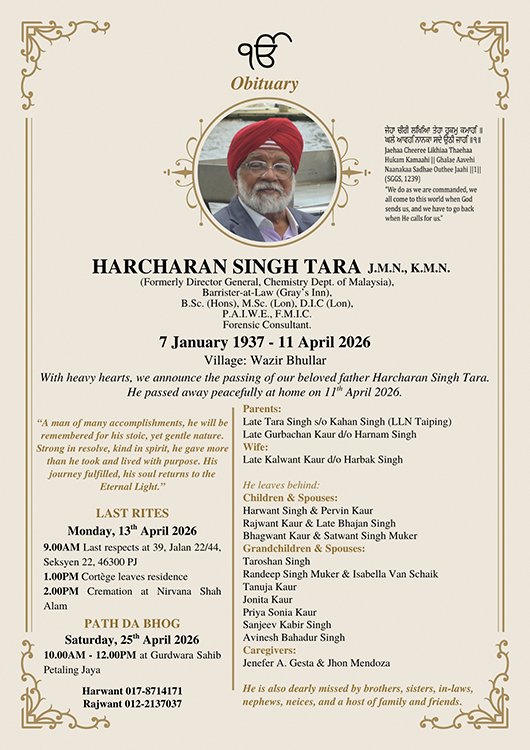
With heavy hearts, we announce the passing of our beloved father Harcharan Singh Tara. He passed away peacefully at home on 11th April 2026.
“A man of many accomplishments, he will be remembered for his stoic, yet gentle nature. Strong in resolve, kind in spirit, he gave more than he took and lived with purpose. His journey fulfilled, his soul returns to the Eternal Light.”
Parents: Late Tara Singh s/o Kahan Singh (LLN Taiping) & Late Gurbachan Kaur do Harnam Singh
Wife: Late Kalwant Kaur d/o Harbak Singh
He leaves behind:
Children & Spouses: Harwant Singh & Pervin Kaur Rajwant Kaur & Late Bhajan Singh Bhagwant Kaur & Satwant Singh Muker
He is also dearly missed by brothers, sisters, in-laws, nephews, neices, and a host of family and friends.
LAST RITES Monday, 13th April 2026 9.00 AM: Last respects at 39, Jalan 22/44, Seksyen 22, 46300 Petaling Jaya 1.00 PM: Cortège leaves residence 2.00 PM: Cremation at Nirvana Shah Alam
PATH DA BHOG Saturday, 25th April 2026 10.00 AM – 12.00 PM at Gurdwara Sahib Petaling Jaya
ASIA SAMACHAR is an online newspaper for Sikhs / Punjabis in Southeast Asia and beyond. You can leave your comments at our website, Facebook, Twitter, and Instagram. We will delete comments we deem offensive or potentially libelous. You can reach us via WhatsApp +6017-335-1399 or email: asia.samachar@gmail.com. For obituary announcements, click here
(To get noticed, WhatsApp your events to Asia Samachar +6017-3351399 and tag us on your social media)
Join the conversation on this story on Asia Samachar’s Facebook and Instagram pages.
ASIA SAMACHAR is an online newspaper for Sikhs / Punjabis in Southeast Asia and beyond. You can leave your comments at our website, Facebook, Twitter, and Instagram. We will delete comments we deem offensive or potentially libelous. You can reach us via WhatsApp +6017-335-1399 or email: asia.samachar@gmail.com. For obituary announcements, click here