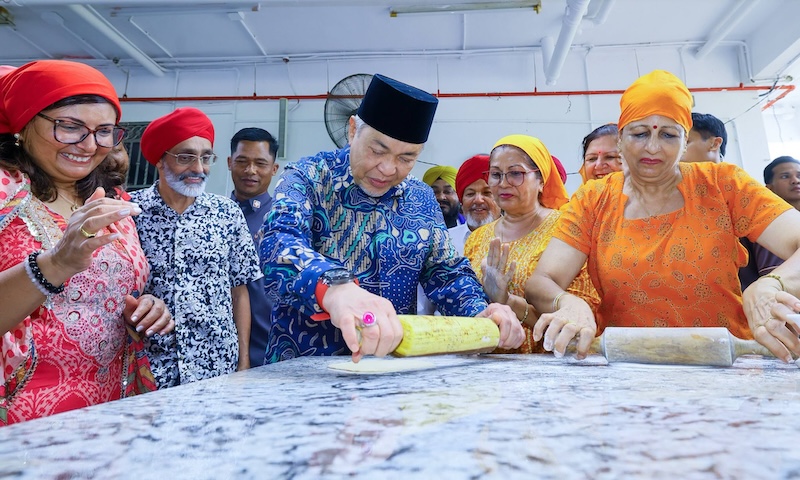
Malaysia’s DPM Ahmad Zahid Hamidi trying his hands at making chapati during a Vaisakhi celebration at Gurdwara Sahib Guru Nanak Shah Alam on 18 April 2026 – Photo: Zahid Facebook
By Asia Samachar | Malaysia |
Malaysia’s diversity remains its greatest strength, Deputy Prime Minister Ahmad Zahid Hamidi said as he joined the Sikh community for a Vaisakhi celebration at Gurdwara Sahib Guru Nanak Shah Alam.
Framing unity as a product of mutual respect and understanding, Zahid said the country’s multicultural fabric continues to underpin its stability and progress.
“My presence is not merely to fulfil an invitation, but as a mark of respect for a community that has long contributed to the nation’s development,” he said in his address yesterday (April 18).
He highlighted the Sikh community’s enduring contributions to Malaysia, describing it as rich in values of courage, discipline and service. He also pointed to its strong culture of charity and volunteerism, which he said transcends racial and religious boundaries and strengthens national unity.
Zahid added that such shared values form the foundation of a harmonious society, noting that Malaysia’s diversity should be embraced as a unifying force rather than a dividing line.
“With a spirit of togetherness and mutual respect, we can continue to build a Malaysia that is peaceful, harmonious and prosperous,” he said.
The DPM also extended Vaisakhi greetings to Sikhs nationwide, expressing hope that the festival would bring joy and further deepen bonds across communities.
Gurdwara Sahib Guru Nanak Shah Alam’s present committee is led by Patminderjit Singh. Also present was former Asean secretary general Ajeet Singh who was the patron of the gurdewara’s building committee more than a decade ago.
Join the conversation on this story on Asia Samachar’s Facebook and Instagram pages.
ASIA SAMACHAR is an online newspaper for Sikhs / Punjabis in Southeast Asia and beyond. You can leave your comments at our website, Facebook, Twitter, and Instagram. We will delete comments we deem offensive or potentially libelous. You can reach us via WhatsApp +6017-335-1399 or email: asia.samachar@gmail.com. For obituary announcements, click here
ASIA SAMACHAR is an online newspaper for Sikhs / Punjabis in Southeast Asia and beyond. You can leave your comments at our website, Facebook, Twitter, and Instagram. We will delete comments we deem offensive or potentially libelous. You can reach us via WhatsApp +6017-335-1399 or email: asia.samachar@gmail.com. For obituary announcements, click here
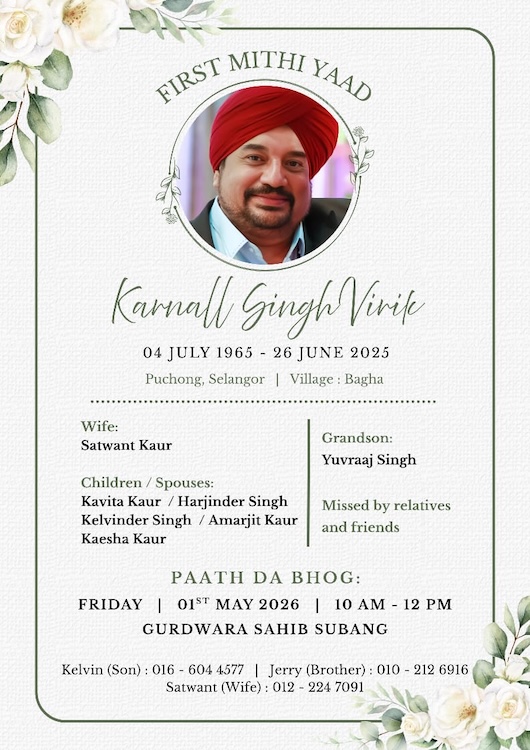
PAATH DA BHOG: Friday | 1st May 2026 | 10 AM – 12 PM Gurdwara Sahib Subang
It’s been almost a year since you left to your heavenly home but you’re always remembered by your dearest ones.
With the blessings of Waheguru, we humbly invite you and your family to join us for the First Mitthi Yaad of our beloved Late Sardar Karnall Singh Virik
The program will include Kirtan, Katha & Paath da Bhog. Langgar will be served.
Your presence will be a great comfort to the family.
ASIA SAMACHAR is an online newspaper for Sikhs / Punjabis in Southeast Asia and beyond. You can leave your comments at our website, Facebook, Twitter, and Instagram. We will delete comments we deem offensive or potentially libelous. You can reach us via WhatsApp +6017-335-1399 or email: asia.samachar@gmail.com. For obituary announcements, click here
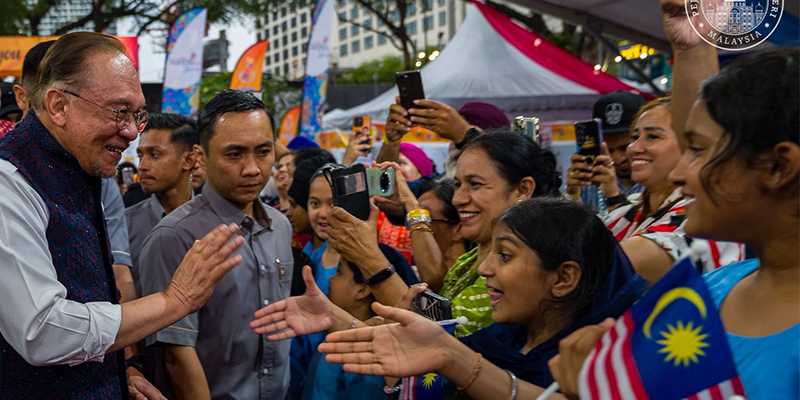
Prime Minister Anwar Ibrahim greeted at a Vaisakhi celebration in Kuala Lumpur on April 18, 2026 – Photo: Anwar Facebook
By Asia Samachar | Malaysia |
Prime Minister Anwar Ibrahim delivered a speech that wove together policy, personal reflection and emotion, paying a heartfelt tribute to Malaysia’s Sikh community as a steadfast pillar in both the nation’s journey and his own life.
Speaking at a Vaisakhi celebration in Kuala Lumpur yesterday (April 18), Anwar moved beyond formalities to recount moments from his years of political struggle, including imprisonment and hospital stays, where Sikh families stood quietly but steadfastly by him.
“For me personally, the Sikh family was part of my family, part of my struggle,” he said, recalling how visitors would bring food to him during treatment at Kuala Lumpur Hospital. “It is the sense of dedication and devotion of the gurdwara and the Sikh community.”
The Malaysian Prime Minister also honoured the late Karpal Singh, describing him as a symbol of justice and principle, while acknowledging the continued contributions of his family, including Digital Minister Gobind Singh Deo. In a lighter moment, Anwar joked about Gobind’s dual role as both Cabinet colleague and trusted adviser, underscoring the close personal ties forged over decades.
Beyond personal reflections, Anwar framed the Sikh community’s role within a broader national narrative. He highlighted their longstanding contributions to Malaysia, particularly in advancing values of service, justice and social cohesion.
“When we celebrate Vaisakhi, we not only honour a cherished tradition, but also the spirit of service, togetherness and justice,” he said, adding that Malaysia’s diversity remains the “very foundation” of its unity.
He also expressed admiration for the teachings of Guru Nanak, noting that Sikhism’s emphasis on compassion and service continues to enrich Malaysia’s multicultural fabric.
In a tangible show of support, Anwar announced a government allocation of RM500,000 to support this year’s Vaisakhi celebrations, despite ongoing economic pressures.
“Even though we are going through an economic crisis, this is a gesture of appreciation,” he said.
The event, held in conjunction with Visit Malaysia 2026, served as both a cultural celebration and a reminder of the enduring bonds that cut across race, religion and history.
“We are from different cultures, races and religions,” Anwar said. “But this is a prime example of how we struggle together, share our inspiration, and show affection — because we are Malaysians.”
Join the conversation on this story on Asia Samachar’s Facebook and Instagram pages.
ASIA SAMACHAR is an online newspaper for Sikhs / Punjabis in Southeast Asia and beyond. You can leave your comments at our website, Facebook, Twitter, and Instagram. We will delete comments we deem offensive or potentially libelous. You can reach us via WhatsApp +6017-335-1399 or email: asia.samachar@gmail.com. For obituary announcements, click here
The recent and deeply troubling episode involving the un-ceremonial prevention of Bhai Manpreet Singh Kanpuri doing kirtan during the Annual Akhand Kirtani Jatha’s (AKJ’s) Vaisakhi programme in Amritsar raises urgent and uncomfortable questions for both the Jatha and the Panth.
The manner in which he was physically confronted – and played out in full public view across social media – was deeply distressing. Equally disconcerting was the visible distress of his son, who instinctively sought to shield his father from being forcibly removed from the stage by some individuals who were adamant he would not be allowed to perform kirtan. What kind of impression will this have left on him and many other Sikh you who look up to Manpreet Singh.
Compounding this was the conduct of a particular female ‘Gursikh’ whose angry outburst and threatening gestures towards Manpreet Singh represented a complete breakdown of Gurdwara decorum. That such behaviour was subsequently honoured with a ‘siropao’ by some members of Amritsar AKJ is difficult to comprehend and risks setting a dangerous precedent. Indeed, at a time when we should be joining hands, sadly, like many other Panthic groups, both political and dharmic, there is a real fear that this could lead to further fragmentation of the AKJ, where unity was already strained.
COMMERCIALISATION
Taken together, these events do not simply reflect a lapse in judgement or the egotistical behaviour of a few individuals, but point to deeper structural and ethical tensions within our Panth. That is, beyond this immediate unsavoury episode, which the AKJ will need to resolve, a far more significant and pressing concern, namely, the growing commercialisation of our institutions, most notably Gurdwaras.
Gurbani repeatedly reminds us that ego, power, and attachment to maya can entrap even those who appear outwardly pious. No institution or jatha is immune from these pressures. It is precisely for this reason that responses to such events must be measured, principled, and rooted in collective wisdom.
The arbitrary exclusion or banning of individuals is neither just nor sustainable. Such actions risk deepening divisions while ignoring the complexity of the underlying issues within the Panth. It is to the credit of the current Akaal Takht Jathedar, Giani Kuldeep Singh Gargaj, that over the past two years, not only have we seen a move away from the trend to excommunicate and ban Sikhs parcharaks, but to bring those previously banned back into the fold under the aegis of the Panthic Maryada.
In order to avoid the kinds of fallout seen at the AKJ function in Amritsar recently, what is required is thoughtful and inclusive dialogue, one that seeks to balance two essential imperatives: the fair and dignified support of Gursikh kirtanis who choose to dedicate their lives to serving Sikhi and the need to resist the steady drift towards the commodification of Sikh religious life.
If one’s love for Gurbani is genuine, then the act of receiving financial support for performing kirtan should not, in itself, diminish the spiritual integrity of that seva. Those grounded in ethical discipline will not compromise their principles merely for monetary gain. Indeed, the very notion that Gurbani can be “sold” is, in essence, absurd. Intention, as much as action, must remain central when making such serious judgements.
At the same time, accountability cannot be ignored. In all professions, individuals are held to clear ethical standards; a doctor, for example, may be disciplined or even struck off for serious misconduct. The same principle must apply within religious spheres.
Nevertheless, we cannot overlook a growing and genuine concern: the increasing commercialisation of Sikh practices. Payments for Akhand Paaths, kirtan programmes, and religious services have become normalised, while so called Babas continue to exploit and defraud vulnerable individuals for financial gain.
What often begins with sincere intention can, over time, become corrupted by ego and materialism. This is not unique to any one group; it is a broader human frailty that has, regrettably, affected individuals across different religious roles, including sants, babas, and gianis.
It is also worth asking whether inconsistent or inadequate financial support structures may themselves contribute to this problem. When individuals who dedicate their lives to the Panth are not supported in a fair and dignified manner, there is a risk that religious service becomes increasingly transactional.
REFLECTIONS
This brings us to a number of critical questions that require collective reflection.
First, how should Sikhi understand the relationship between seva, modern day commercial imperatives? Is there, in fact, a contradiction between the two? To what extent does receiving financial compensation undermine the principle of nishkam seva? And how should we interpret the concept of ‘kirat’ and ‘nishkam seva’, for those whose full-time work may be devoted in service of the Panth?
Second, what responsibilities do our institutions carry? Gurdwaras must consider how they can ethically support granthis, raggis, and staff without reducing the sangat to consumers and religious practice to a service economy. Financial arrangements and investments must be transparent, fair, and aligned with Sikh values, not dictated by market logic and the profit motive.
Third, how can we avoid the corrupting influences of commercialisation, which Gurbani reminds us of? When profit motives begin to shape religious spaces, there is a real danger that kirtan, parchaar, and even education become commodified. Increasingly, we see Gurdwaras competing to attract larger congregations by inviting high profile kirtanis and speakers, often at significant cost. This raises uncomfortable questions about whether we are inadvertently creating a culture of celebrity religiosity.
Fourth, and perhaps most crucially, there is the issue of accountability and governance. Who has the authority to decide who may or may not perform kirtan? As Sikh institutions grow into complex, multi-million-pound organisations, they require professional management and full-time commitment. Yet how do we balance this need for professionalism with the foundational Sikh principles of humility, equality, and the rejection of a priestly hierarchy?
The modern Panth stands at a crossroads. On one hand lies the practical necessity of supporting those who dedicate their lives to religious service. On the other lies the imperative to protect Sikhi from the encroaching forces of commercialisation and institutionalisation.
These are not easy questions, nor do they admit simple answers. The financial realities of the contemporary world cannot be ignored. Yet neither can we compromise the spiritual integrity of Gurbani and the principles upon which Sikhi is founded.
If the Panth fails to engage with these challenges collectively and with an open mind, we risk further division, fragmenting into smaller groups. As we navigate this evolving landscape, one principle must remain non-negotiable: the selfless core of the Panth must not be eroded by the transactional pressures of the modern world.
Join the conversation on this story on Asia Samachar’s Facebook and Instagram pages.
Gurnam Singh is an academic activist dedicated to human rights, liberty, equality, social and environmental justice. He is a Professor of Sociology at University of Warwick, UK. He can be contacted at Gurnam.singh.1@warwick.ac.uk
* This is the opinion of the writer and does not necessarily represent the views of Asia Samachar.
ASIA SAMACHAR is an online newspaper for Sikhs / Punjabis in Southeast Asia and beyond. You can leave your comments at our website, Facebook, Twitter, and Instagram. We will delete comments we deem offensive or potentially libelous. You can reach us via WhatsApp +6017-335-1399 or email: asia.samachar@gmail.com. For obituary announcements, click here
ASIA SAMACHAR is an online newspaper for Sikhs / Punjabis in Southeast Asia and beyond. You can leave your comments at our website, Facebook, Twitter, and Instagram. We will delete comments we deem offensive or potentially libelous. You can reach us via WhatsApp +6017-335-1399 or email: asia.samachar@gmail.com. For obituary announcements, click here
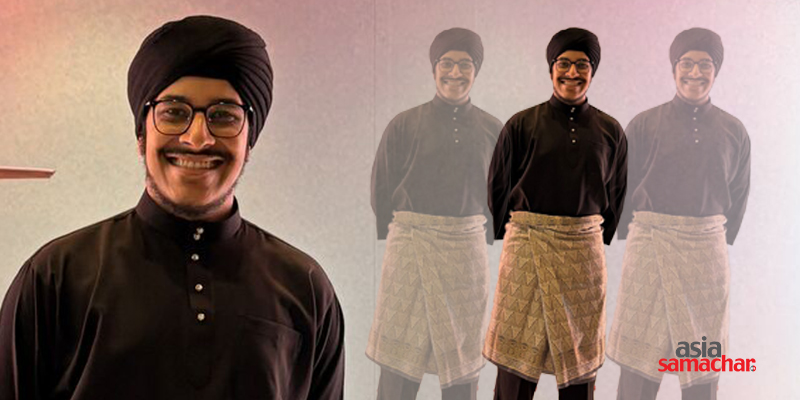
Psychology graduate Manvirdeep Singh in baju Melayu – Photo: Personal LinkedIn / Asia Samachar
By Asia Samachar | Malaysia |
How does a young Sikh man look in a Baju Melayu? Psychology graduate Manvirdeep Singh, currently an apprentice at a Malaysian bank, offers a compelling glimpse.
“I’ve always thought being Malaysian is a privilege because of the cultural blend here. I don’t think you can go to any other country and see a Chinese wearing a Baju Melayu, or a Malay wearing samfu, or a Punjabi man pairing a turban with both. That’s what makes us unique — and it’s something worth celebrating,” he shared on LinkedIn.
The Baju Melayu is a traditional Malay attire worn by men across Malaysia, Brunei, Singapore, and parts of Indonesia, southern Philippines, and southern Thailand. Originating from the court of the Malacca Sultanate, it remains the national dress of Malaysia and Brunei, commonly worn at official functions and festive occasions.
Manvirdeep certainly stands out — in the best way.
Join the conversation on this story on Asia Samachar’s Facebook and Instagram pages.
ASIA SAMACHAR is an online newspaper for Sikhs / Punjabis in Southeast Asia and beyond. You can leave your comments at our website, Facebook, Twitter, and Instagram. We will delete comments we deem offensive or potentially libelous. You can reach us via WhatsApp +6017-335-1399 or email: asia.samachar@gmail.com. For obituary announcements, click here
At a time when the international order, established after the Second World War, is under significant strain, questions regarding the role and responsibility of political leadership have gained renewed urgency. In particular, the rise of powerful authoritarian leaders, such as Donald Trump and Vladamir Putin, coupled with the significant increases in inequality, conflict and refugee flows, has triggered important debates about the ability of international leaders and institutions to respond appropriately to the challenges facing humanity.
Against this backdrop, this article examines political leadership through a comparative lens that brings Sikh political ethics into a wider debate about leadership in Western political philosophy. By contrasting the leadership style of Maharaja Ranjit Singh with Donald Trump, the article explores competing conceptions of power, legitimacy, and moral responsibility. Drawing on Sikh concepts such as miri–piri, seva, and sarbat da bhala, the article argues that durable political authority is best understood as a form of ethical stewardship rather than control and domination. In doing so, it seeks to demonstrate the relevance of Sikh thought to modern debates on governance, leadership, and global political order.
Leadership, Power and Authority.
Western political philosophy has long wrestled with the tension between moral authority and coercive power. In The Republic, Plato’s ideal ruler is the philosopher king, not because he can command obedience, but because he understands ‘the good’ and governs with reason and knowledge rather than emotion. Leadership grounded purely in desire or ambition, Plato warns, deteriorates into tyranny.
Writing a very different kind of political handbook, the Roman emperor and Stoic philosopher Marcus Aurelius approached leadership from the inside. In the Meditations, composed while ruling his vast and fragile empire, he repeatedly reminds himself that since power is temporary, reputation brittle, ego is a poor basis for making judgments. For Aurelius, an effective ruler governs by self discipline, and by mastery over impulse before. From such a perspective, leadership becomes a form of ethical labour, rather than the wielding of power alone.
In contrast, Machiavelli, a figure who reportedly is idolised by Donald Trump, disrupts this moral standpoint. In The Prince, being an effective leader, he argues, in not predicated on moral virtue, but on clarity and determination to achieve your goals. Indeed, for Machiavelli, this may require deception, fear, or calculated cruelty, and for this reason, rulers cannot be overly restricted by ethical concerns. Yet even Machiavelli’s pragmatism is often misread as being morally blind. His concern was not the kind of spectacle or bravado that is the hallmark of authoritarian leaders like Donald Trump, but resilience. Machiavelli was firmly of the opinion that a leader who relies too heavily on fear invites resistance, decay and ultimately failure.
In the modern era, philosophers such as Hannah Arendt have returned to this question with renewed urgency following her work on totalitarianism, Stalin and Hitler. Arendt, distinguished sharply between power and violence: power, she asserts, arises from collective consent and shared purpose, while violence compensates for its absence. Where power must constantly be asserted, especially through violence and threats, she argued, it is already betraying its inherent weakness.
Contrasting Leadership Approaches
Sikhi is often and mistakenly seen purely as a ‘religious’ ideology only concerned with spiritual matters. This couldn’t be further from the truth! A cursory scan Sikh of scriptural and historical literature uncovers critical insights into the nature of human functioning, ethics, power, conflict and politics.
Sikh political thought begins from the premise that power must be balanced with responsibility and ethics. The doctrine of miri–piri, articulated by the 6 Guru of the Sikhs, Guru Hargobind, asserts that temporal authority (miri) is legitimate only when guided by moral responsibility (piri). Political authority from this perspective is not self validating; it must be measured by approval from the Sangat or general body of people over whom it is exercised. In this regard, one can see this as a middle ground approach between the ethical imperative of Marcus Aurelius and the pragmatism of Machiavelli.
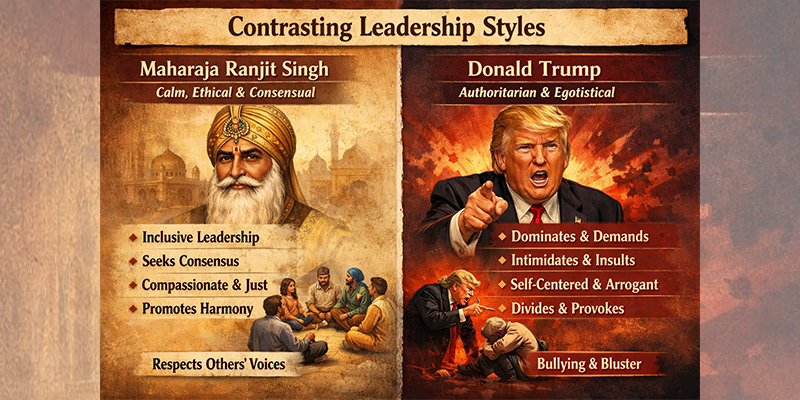
Maharaja Ranjit Singh’s authority reflected this balance. Though an autocrat by constitutional standards, he governed through consultation, religious plurality, and embedded power in institutions. His presence was restrained and his court was administrative rather than theatrical. Donald Trump’s leadership style, by contrast, has been widely characterised as chaotic, performative and personality driven. Trump seeks to project power through visibility, rhetoric, and confrontation rather than consensus. For authoritarian leaders like him, institutions matter insofar as they serve the leader’s capacity to negotiate and prevail.
As for Trump, one can only speculate, but, his grave blunder to decide to attack Iran, that he may be subject to the 22nd Amendment of the US constitution. This gives Congress the power to remove a sitting president if is he is deemed unable to discharge the powers and duties of the office.
Power, Governance and Moral Responsibility
However they may have gained the leadership position, the moral duty of all rulers and ultimate justification for the power is invested in them is to serve the people and maintain social harmony. From Aurangzeb in Mughal India, to Hitler in Nazi Germany and Stalin in communist Russia, no leader in human history, however brutal their policies may have been, would claim to be motivated by cruelty. Indeed, rulers throughout history that have exercised brutality; tend to justify this as moral necessity and the need to maintain order. As for theocratic leaders, such as the Ayatollah’s of Iran, the justification is often to serve some higher purpose. Tyranny rarely presents itself as cruelty, but as duty!
In Sikh thought, tyrannical rule is not justified on any grounds, and certainly not as the will or mission of God. Legitimacy flows not from victory or mandate, but from ethical conduct in office. Ranjit Singh governed a religiously plural population by institutionalising fairness. Muslims retained their own legal practices; Hindu and Sikh sites received protection; and revenue systems were stabilised to reduce arbitrary extraction. His rule was not neutral, but it was broadly recognised as just, hence its durability.
Largely due to his legacy as the enlightened founder of a unified, tolerant Sikh Empire between 1799 and 1839, in a BBC World Histories Magazine poll in 2020, Maharaja Ranjit Singh was voted the “Greatest Leader” of all time. Riven by conflict and political instability, Ranjit Singh was credited with transforming a region into a prosperous and stable unified state through consensus and inclusivity.
Transactional leadership approaches, such as those characterised by Donald Trump often frame policy programmes as a series of deals, evaluated by immediate gain and loss. For authoritarian leaders, past alliances, norms, treaties and constitutional conventions are treated as obstacles to success, which is often defined in terms of winners and losers.
Diplomacy and Haumai (Ego)
Sikh ethics repeatedly warn against haumai or unbridled ego that can confuse personal will with collective good. Leaders shaped by haumai may succeed tactically in the short term, but destabilise the moral order necessary for lasting authority.
Ranjit Singh demonstrated an acute awareness of the limits of authoritarian rule. Facing the expansion of the British Empire, he resisted both submission and reckless confrontation. Indeed, one of the features of Ranjit Singh’s rule, which only ended after his death, were the numerous treaties, which were used not as a sign of weakness, but as tools for preserving autonomy and peace. Diplomacy was strategic, not emotional. As Khushwant Singh, in his book on the Maharaja notes, “Ranjit Singh was extremely angry with the English, but he had never let anger be his counseller.”
In contrast, Donald Trump’s approach to diplomacy has consistently foregrounded leverage and pressure. Long standing alliances are destabilised and chaos is used as a negotiating tactic. While such methods may yield short‑term concessions, they tend to undermine trust, which is a political asset that is difficult to restore once eroded.
Service Versus Extraction
At the heart of Sikh ethical leadership is the duty to serve rather than engage in self aggrandisement. Applied to leadership, it transforms power from possession into responsibility, with the ruler becoming a benevolent steward rather than a ‘brand’ that demands sycophantic support.
Ranjit Singh’s administration reflected this ethic. Under his rule, infrastructure, cultural life, and military reform were pursued not to enhance his image, but to stabilise the state. Expansion was followed by consolidation; institutions were strengthened to function beyond the ruler’s presence. The daily Sikh prayer concludes with the slogan ‘sarbat da bhala…’ which literally means, welfare of all humanity. This is not some sentimental universalism or some spiritual escapism. Caring for the whole population is the best way to build cohesion. History tells us that societies endure when prosperity and security are broadly shared.
Ranjit Singh’s legacy rests not on conquest alone, but on the relative stability and confidence his rule brought to Punjab. Though his empire declined after his death, the memory that endures is one of order rather than fear.
By contrast, the transactional leadership associated with Donnad Trump and authoritarian leaders more generally, often externalises costs: disruption is reframed as innovation, and institutional strain treated as collateral damage. Such approaches may benefit individual leaders, but they weaken the systems they leave behind. Its successes may appear vivid, such as enforcing a deal through co-erosion or simple dishonesty, these are often fragile prone to breaking down. And when this occurs, the blame for failure tends to be directed elsewhere.
The comparison between the strength that Ranjit Singh derived through his firm but fair approach and that of Donnald Trump, is not simply a question virtue versus vice, but about different perceptions of strength. One understands power as something to be accumulated through restraint, justice, and service. The other, like the school bully, treats power as something demonstrated through generating fear, pressure and visibility.
Final Thoughts
At a time when strong political leadership is increasingly identified with authoritarianism resulting in growing conflict, humanity needs to unite. Maharaja Ranjit Singh offers an example of an alternative approach grounded in the miri–piri concept underpinned by sarbat da bhalla.
The language may differ – miri piri in nineteenth century Punjab, constitutional norms in the modern West – but the underlying test remains the same: does authority serve the common good, or simply the moment to satisfy their ego? And in this regard, the example of Maharaja Ranjit Singh lends considerable weight to the argument that strength shaped by restraint and benevolence does not need any cheer leaders; It endures because people recognise leaders who display these characteristics as their own.
Join the conversation on this story on Asia Samachar’s Facebook and Instagram pages.
Gurnam Singh is an academic activist dedicated to human rights, liberty, equality, social and environmental justice. He is a Professor of Sociology at University of Warwick, UK. He can be contacted at Gurnam.singh.1@warwick.ac.uk
* This is the opinion of the writer and does not necessarily represent the views of Asia Samachar.
ASIA SAMACHAR is an online newspaper for Sikhs / Punjabis in Southeast Asia and beyond. You can leave your comments at our website, Facebook, Twitter, and Instagram. We will delete comments we deem offensive or potentially libelous. You can reach us via WhatsApp +6017-335-1399 or email: asia.samachar@gmail.com. For obituary announcements, click here
along with Dad, Siblings, Mum in-law, a host of Relatives and Friends
KIRTAN DARBAR & PATH DA BHOG Saturday, 2nd May 2026 From 9.30am to 11.30am, followed by Guru Ka Langgar Gurdwara Sahib Johor Bahru
Our family warmly invites you to join us for the prayers and to pay tribute to the memory of late Sardarni Manjit Kaur, honoring the remarkable person she was.
For further details, contact: Hardip Singh 012 – 799 3161 or Phavinjit Kaur 012 – 791 3161
ASIA SAMACHAR is an online newspaper for Sikhs / Punjabis in Southeast Asia and beyond. You can leave your comments at our website, Facebook, Twitter, and Instagram. We will delete comments we deem offensive or potentially libelous. You can reach us via WhatsApp +6017-335-1399 or email: asia.samachar@gmail.com. For obituary announcements, click here
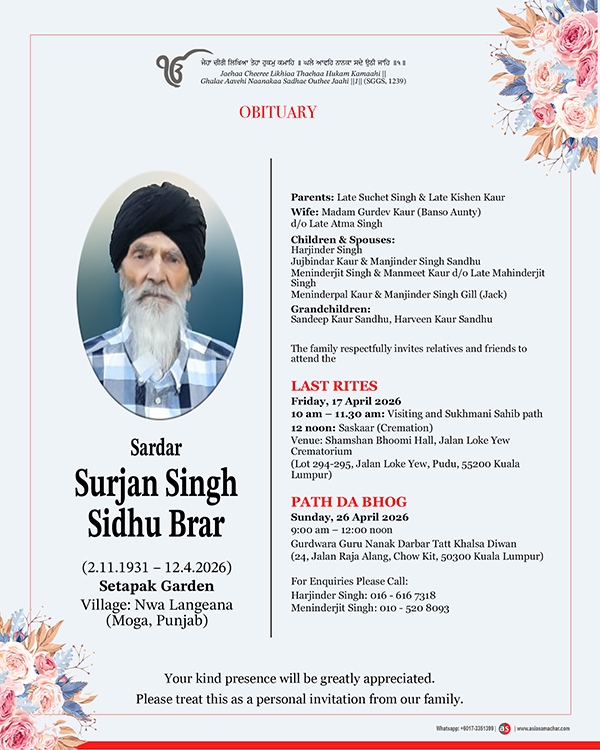
The family respectfully invites relatives and friends to attend the
LAST RITES Friday, 17 April 2026 10 am – 11.30 am: Visiting and Sukhmani Sahib path 12 noon: Saskaar (Cremation) Venue: Shamshan Bhoomi Hall, Jalan Loke Yew Crematorium (Lot 294-295, Jalan Loke Yew, Pudu, 55200 Kuala Lumpur)
PATH DA BHOG Sunday, 26 April 2026 Time: 9:00 am – 12:00 noon Gurdwara Guru Nanak Darbar Tatt Khalsa Diwan (24, Jalan Raja Alang, Chow Kit, 50300 Kuala Lumpur)
Your presence and prayers will be deeply appreciated.
ASIA SAMACHAR is an online newspaper for Sikhs / Punjabis in Southeast Asia and beyond. You can leave your comments at our website, Facebook, Twitter, and Instagram. We will delete comments we deem offensive or potentially libelous. You can reach us via WhatsApp +6017-335-1399 or email: asia.samachar@gmail.com. For obituary announcements, click here