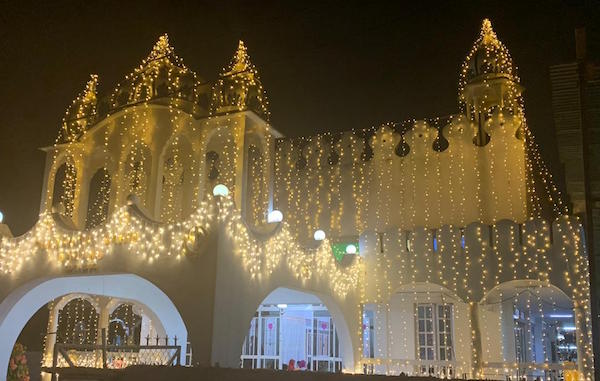
The Gurdwara Janam Asthan Nankana float – Photo Suki Singh
By Asia Samachar Team | SINGAPORE |
A float of Gurdwara Janam Asthan traveled to all the gurdwaras and some major tourist attractions in Singapore.
This was one of the highlights as the Singapore Sikh community commemorated the 550th birth of Guru Nanak.
The actual Gurdwara Janam Asthan is in Nankana Sahib, the birthplace of Guru Nanak. Once in unified Punjab, it is today in the Pakistan side of Punjab.
Singapore Sikhs have certainly taken up the 550th celebration with gusto. The float – which also passed through Chinatown, Little India and Orchard Road – was just one of the many events that had been drawn up.
In fact, collectively, Sikhs in Singapore had set out 19 events and initiatives for the commemoration, including community service by Punjabi school students and a very successful call-upon-you-to-perform-service programme called Sewa Pledge.
“In Singapore, our aim was not to just celebrate this important milestone among the Sikhs only but also involve Singaporeans of all races and religions,” former parliamentarian Inderjit Singh told a gathering at one of the gurdwaras yesterday (12 Nov 2019).
“Guru Nanak’s taught us may things and among the most important ones is the universality of mankind – everyone is equal and hence our logo for these celebrations – One Humanity. So in most of our events, we had many Singaporeans of all walks of life and of all backgrounds who joined us.”
Inderjit, who led a team to coordinate the year-long commemoration, also chairs the Coordinating Council of Sikh Institutions (Singapore).
The grand finale at Central Sikh Temple was also attended by Singapore Deputy Prime Minister Heng Swee Keat who said that he was impressed with the key role the Sikh community has played in promoting racial and religious harmony.
In particular, he noted the Young Sikh Association’s (YSA) unorthodox approach to an Instagram influencer’s controversial remarks in September.
They invited Sheena Phua to the Central Sikh Temple after she posted controversial remarks about two men wearing turbans being “huge obstructions”, introducing her to Sikh religion and culture, reports the Straits Times.
“Through this, you turned a potentially divisive incident into an opportunity to deepen mutual understanding and respect. Your thoughtful actions are commendable,” he was quoted by the newspaper.
YSA team and guests with DPM – Photo: YSA Facebook page
YEAR-LONG PLANNING
Inderjit said the team started planning the celebrations since early 2018, with a soft launch at NaamRas 2018, a major kirtan-katha programme held on alternative years towards the year-end.
The events included Japji Sahib workshop, heritage exhibition and harmony walk. The Central Sikh Gurdwara Board (CSGB) launched the Visiting Professorship in Sikh Studies at National University of Singapore (NUS).
In December, the community will see the launch of a permanent Sikh exhibition at Asian Civilisation Museum, a first for the community where an exhibition will be permanently displayed at the museum.
“This is a huge milestone for the Sikhs,” Inderjit told Asia Samachar.
The Sewa Pledge is another exciting item in the list, taking into consideration how Guru Nanak has placed seva (selfless service) as one of the key underpinning concepts of his teachings.
The idea was to mobilise the community to pledge and do 550,000 service hours, which includes the community as well as national level, outside the Sikh community.
At the planning stage, he said some had voiced concern whether a small community of around 12,000 Sikhs could ever make the 550,000 hours of service, to be achieved by end-2019.
“Well today I am excited to announce that by Guru’s ji Grace, we have already crossed our goal and as this evening, the Sikh community has already contributed 555,000 of service hours and I am sure we will make it to 600,000 hours by the end of the year,” Inderjit said in his speech.
ASIA SAMACHAR is an online newspaper for Sikhs / Punjabis in Southeast Asia and beyond.Facebook | WhatsApp +6017-335-1399 | Email: editor@asiasamachar.com | Twitter | Instagram | Obituary announcements, click here |
ASIA SAMACHAR is an online newspaper for Sikhs / Punjabis in Southeast Asia and beyond.Facebook | WhatsApp +6017-335-1399 | Email: editor@asiasamachar.com | Twitter | Instagram | Obituary announcements, click here |
The Singapore trio at Nankana Sahib – Photo: Facebook of Overland by Jeep Singapore-Pakistan-Singapore
By Asia Samachar Team | SINGAPORE |
They have reached Pakistan. This morning, the Singapore trio on an overland Jeep trip from reached Nankana Sahib after travelling 22 days on their epic six-nation venture.
They left Singapore on Oct 20, passed through Malaysia, Thailand, Myanmar and India before finally reaching Pakistan.
Gurcharan Singh, Amarjit Singh and Salljit Singh join thousands of Sikhs and people of other faiths in commemorating the 550th birth of Guru Nanak, the founder of the Sikh faith. Nankana is the birth place of Guru Nanak.
To catch glimpses of check out their Facebook here. They are expected to return to Singapore on Dec 9.
Across the causeway, five Malaysian Sikh riders had returned on Saturday (9 Nov 2019) after riding from Malaysia to Pakistan, and back, also in conjunction with the 550th commemoration. They are also raising funds for National Cancer Society Malaysia (NCSM). See here.
Note: Some corrections were made to an earlier version of this story
Nankana Sahib all lighted up to commemorate Guru Nanak’s 550th birth – Photo: Facebook of Overland by Jeep Singapore-Pakistan-Singapore
ASIA SAMACHAR is an online newspaper for Sikhs / Punjabis in Southeast Asia and beyond.Facebook | WhatsApp +6017-335-1399 | Email: editor@asiasamachar.com | Twitter | Instagram | Obituary announcements, click here |
Santana Mc riders completed a 6-nation charity ride – Photo: Asia Samachar
By Asia Samachar Team | MALAYSIA |
The Sikh bikers in a five-nation cancer charity ride has safely returned after clocking some 16,800km.
The five of the riders had travelled all through: Malaysia, Thailand, Myanmar, India and Pakistan.
“We got wonderful response everywhere, including in Pakistan,” Rajvin Singh told Asia Samachar.
They made it to Pakistan before the height of the celebration now going on for the 550th birth anniversary of Guru Nanak.
The highlight is today’s launch of the Kartarpur Corridor on the Indian and Pakistani sides of Punjab, by Indian Prime Minister Narendra Modi and Pakistan PM Imran Khan, respectively. This corridor is a historic pathway between two key gurdwaras in the life of Guru Nanak, today divided by an international border drawn upon India’s independence in 1947.
The bikers, led by the Santana Bikerz Mc, were flagged off by Malaysia’s Minister of Communications and Multimedia Gobind Singh Deo on Sept 25. They are raising funds for National Cancer Society Malaysia (NCSM).
ASIA SAMACHAR is an online newspaper for Sikhs / Punjabis in Southeast Asia and beyond.Facebook | WhatsApp +6017-335-1399 | Email: editor@asiasamachar.com | Twitter | Instagram | Obituary announcements, click here |
On this day, 30 years ago, we saw the fall of the Berlin Wall that had created a deep physical and emotional barrier between East and West Germany, and indeed the world. Today, on the 550th birth anniversary of Baba Guru Nanak, we are seeing the fall of another wall. This is the wall created in 1947 and the partition of Panjab.
But today, with the blessings of Baba Nanak and his message of peace, justice, spirituality and universalism, we are once again seeing history being made with the destruction of the border at Kartarpur. Let’s hope this is the beginning of the unification of Panjab! When hearts and minds of people become one, then nothing can stop man made walls from tumbling down.
Today is also the birth anniversary of the great Panjabi poet Allama Iqbal. It is fitting that as we remember Guru Nanak’s 550th anniversary and the opening up of the Kartarpur Corridor we recall Iqbal’s love and appreciation of Nanak’s teaching. Like Nanak, for Iqbal, exploitation and deceit in the name of the God was a perversion of faith; that to be a good human was to fight social justice and equality. This could not be clear from Iqbal’s poem “Bang-e-Dara” which pays profound homage to Nanak.
Iqbal’s poem hinges mainly upon four themes – Gautama Buddha (563 BC-483 BC) and his teachings, essence of truth and monotheism, spirit of social justice and equality, and Guru Nanak (1469-1539). Out of eight couplets in the poem, the top six are dedicated to the first three themes; while the last two couplets are dedicated to Guru Nanak. “India was now illuminated after a long time with the birth of Guru Nanak in Punjab; monotheistic commandments would be rejuvenated in Punjab,” said Iqbal.
Freedom for Iqbal is predicated on the eradication of exploitation and oppression. And it is the foremost duty of faith to help the masses to end exploitation. With such a vision, Guru Nanak, the mard-e-kamil (the perfect man) for Iqbal, started his mission and awakened the slumbering souls of India.
Let’s hope that today, not only are we seeing the opening of a border post but the unification of hearts and minds and ultimately peoples, nations and the whole of humanity.
[Gurnam Singh is an academic activist dedicated to human rights, liberty, equality, social and environmental justice. He is a Visiting Fellow in Race and Education at University of Arts London and a Visiting Professor of Social Work at University of Chester as well as a presenter at UK-based Akaal channel]
* This is the opinion of the writer and does not necessarily represent the views of Asia Samachar.
ASIA SAMACHAR is an online newspaper for Sikhs / Punjabis in Southeast Asia and beyond.Facebook | WhatsApp +6017-335-1399 | Email: editor@asiasamachar.com | Twitter | Instagram | Obituary announcements, click here |
Thai Minister for Cultural and Religious Affairs Ithiphol Khunpluem with Nagar Kirtan Bangkok organising team – Photo: Supplied
By Asia Samachar Team | THAILAND |
Some 5,000 people and representatives from all the five major faiths are expected at the Nagar Kirtan Bangkok tomorrow (10 Nov) in conjunction with the 500th birth anniversary of Guru Nanak.
The procession, where Sikh religious hymns will be sung along the way, will start at 7am at the Thai Sikh Gate and end up at Gurdwara Sri Guru Singh Sabha, Bangkok.
The procession will be joined by representatives from the various faiths: Buddhism, Christian, Islam, Hindu and Sikhi.
“Guru Nanak taught us to walk together, and to move together,” organising team member Darshan Singh Sachdev told a press conference yesterday.
Thai Minister for Cultural and Religious Affairs Ithiphol Khunpluem is scheduled to open the event.
More than 60 Indian-based organisations are expected to support the procession, said another volunteer involved in the event.
ASIA SAMACHAR is an online newspaper for Sikhs / Punjabis in Southeast Asia and beyond.Facebook | WhatsApp +6017-335-1399 | Email: editor@asiasamachar.com | Twitter | Instagram | Obituary announcements, click here |
Rawang gurdwara commemorating Guru Nanak’s 550th birth – Photo: Supplied
By Asia Samachar Team | MALAYSIA |
#GuruNanak550Malaysia | RAWANG: Tree planting, essay writing competition and turban day. These are just some of the events planned by Gurdwara Sahib Rawang (GSR) for commemorate 550th birth of Guru Nanak.
As Guru Nanak Dev Ji was a nature lover, GSR said it was preparing 55 specially selected shrubs, jungle and fruit saplings for purchase at a minimal cost for the Sanggat (Nov 7-10, 2019).
The species available are Panex, Bucida, Cordyline , Gajus , Mata Pelanduk, Miracle Berry 7. Buah Melaka, Mertajam, Kelat Paya, Asam Gelugor and Tenggek Burung.
ASIA SAMACHAR is an online newspaper for Sikhs / Punjabis in Southeast Asia and beyond.Facebook | WhatsApp +6017-335-1399 | Email: editor@asiasamachar.com | Twitter | Instagram | Obituary announcements, click here |
Path da bhog: 17 November (Sunday) 9.30am-11.30am, at Gudwara Sahib Tatt Khalsa followed by Guru Ka Langgar
Contact:
Kamey (019-2280046)
Akash ( 019-2286631)
Message from the family: Dearly missed by Family and friends.
| Entry: 8 Nov 2019; updated: 11 Nov 2019 | Source: Family
[ASIA SAMACHAR is an online newspaper for Sikhs / Punjabis in Asia. How to reach us: Facebook message or WhatsApp +6017-335-1399. Our email: editor@asiasamachar.com. For obituary announcements, click here]
Guru Nanak (alias Baba Nanak ) founder of Sikhism was born on 14th April 1469 AD, on the outskirts of Lahore, in a village called Talwandi, now known as Nanakana Sahib in the Pakistani Punjab. He was a contemporary of various European polymaths during the Renaissance period.
Renaissance was the rebirth of the modern age (1400-1700) and its teachings were felt in literature, philosophy, art, music, politics, science, religion and other aspect of intellectual inquiry. In South East Asia teachings of Guru Nanak and of the other nine Gurus subsequently had the same impact. Renaissance commenced at the time of religious turmoil. It was also the period that gave birth to Sikhism in the sub-continent.
The West had its Renaissance based on humanism but in the subcontinent, Guru Nanak taught on the basis of truth and love.
The advent of Guru Nanak brought light to the modern world from the dark night of medieval ignorance, religious intolerance, inequality and corruption.
Guru Nanak narrates the gruesome period as follows:
‘Kal kaathe Raajae Kaasaaee dharam pankh kar Oddariaa’
The world is like a drawn knife
In the dark age
The Kings are butchers
In the gloom of falsehood
The moon of truth is never seen.
(Page 149 AG)
Martin Luther (1483) is well known for his role in the advancement of civil rights using nonviolent civil disobedience based on his Christian beliefs and was a seminal figure in bringing Reformation.
He taught that salvation and consequently eternal life are not earned by good deeds but are received only as the free gift of God’s grace contrary to Church stand that faith and good deeds were needed for salvation.
Luther challenged papal authority and perceived corruption in selling indulgencies particularly with respect to instances of solid indulgencies. His 95 thesis led to the Reformation, fractionalising the Catholic Church.
On the other side, Nanak gave a pure and special message for the whole mankind that by communion with the WORD (Shabad) shall be attained the vision unattainable – the personal realisation of god and salvation irrespective of gender.
Nanak gave his message in simple language in the Mul Mantar, the Prologue to the Sikh scripture.
There is but One Reality- Manifest and Unmanifested One
The Eternal all-pervading Divine Spirit,
The Creator, the Supreme Being,
Omnipresent, Omniscient, Omnipotent
Without fear, without enmity,
Immortal reality, Unborn Self Existent.
By His Grace made known to men
Guru Nanak’s Reformation in terms of religion was absolute:
He preached that salvation was to be achieved while living thus giving rise to a new social order; other civilizations anticipated salvation after death.
Muiaa jit ghar jaieeaai tit jeevadhiaa m ar maar
To reach your true home after death, you must conquer death while you are still alive
( P21.AG)
This gave rise to the essence of Sikh mysticism, and it is today the 4th largest monotheistic faith in the world.
For the first time in South East Asia, Guru Nanak brought reformation of the polytheistic society by introducing monotheistic Indian religion in line with Semitic faiths to its indigenous people in the form of Sikhism. The people of sub-continent were polytheistic in their outlook and beliefs, other than those impacted by external Islamic influence in the 11th century. The worship of gods, animals, idols was an integral part of that society. Superstition and idol worship were rampant and caste systems the norm of the society resulting in most advanced ‘apartheid’ practiced in any culture and the corresponding divisions in the society:
Ghar naraain sabhaa naal.
‘In your home, is the Lord God, along with all your other gods.
You wash your stone gods and worship them.’
(Page 1204 AG)
RELIGIOUS FREEDOM
Nanak preached that everyone had the right to practice and chose his/her religion or beliefs:
Young Nanak refused to be initiated into Hindu faith and rejected the baptismal ceremony of wearing the sacred thread- janeu as being futile, superstitious and spiritually meaningless.
His rebellious behavior is indicated in the following verse in the Sikh scripture:
Dhiaa kapaeh satokh soot jat ganndee sat vat
When making the sacred thread, the janeu,
See that the following rules you pursue:
Out of the cotton of compassion Spin the thread of tranquility;
Let continence be the knot
And virtue the twist thereon.
O pundit, if such a sacred thread there be.
Around our neck, we shall wear it willingly,
A thread so made will not break,
It will not get dirty, or burned or lost.
O Nanak, thou shall see,
Those who wear this shall be blessed.
(Asa M1 p 471 AG)
The ninth Guru (9th Nanak – GuruTegh Bahadur) also advocated to the Mughal Emperor Aurangzeb that every individual had the right of freedom to practice his /her religion and that the Hindus should be allowed to wear their sacred thread. He was beheaded at Sis Ganj Gurdwara in Old Delhi in 1675 for advocating freedom of religious practice for the Kashmiri Pundits.
Nanak’s reformation of religion loudly echoed freedom to practice and choose one’s religion and this fundamental human right is now enshrined in the United Nations Charter of Human Rights.
In the 15th century Nicholas Bacon (1510) after graduating from Corpus Christi College Cambridge joined the Gary’s Inn and subsequently became Lord Keeper of the Great Seal. He gave modern science its first-born son, in the days when Elizabethan England flourished at its peak. That son Francis Bacon (1561) after graduating from Trinity College Cambridge became Lord Chancellor, the highest law officer in England He was already recognised as a philosopher. He was endowed with the wisdom of universal thought and laid the foundation of modern science.
The great Renaissance of learning began with Roger Bacon in the 14th century. The torch of genius was then taken up by Leonardo da Vinci who was a polymath artist, made observational drawings of anatomy and nature. Da Vinci’s contributions during this period include machines designed to saw marbles and lift monoliths and discoveries in acoustics, botany, geology, anatomy and mechanics.
Nanak taught in his Prologue to the Sikh Scripture Adi Granth – ‘Nanak’s code’, the Mul Mantar -that God was the Uncaused First Cause of everything. He is therefore the cause of big bang, the black holes, the dark matter and inertia which keep the rockets far flung into the deep skies and the cause of expanding and contracting universe.
Kaee baar pasrio paasaar
So many times, He has expanded his universe.
(P276 AG)
SPACE INNOVATIONS
Renaissance was thrown into the sky by Galileo (1564) and Copernicus (1473). Galileo had believed Copernicus theory that planets orbit the sun. For his views Galileo was placed under house arrest by the Inquisition – Holy Office of Rome.
Galileo defied directives delivered to him by the Church not to hold or defend the idea that the earth moves and the sun stands still at the centre. His book “Two New Sciences” was to be the genesis of modern physics.
Nanak gave the distance to the moon as stated in his Janam Sakhi ( Biography).He stated it was 52000 Yojan or 236363 miles which is about the same as NASA distance to the moon of 225742 miles. The difference is due to the fact that this distance keeps changing because the orbits of the earth and moon are eclliptical. The distance of moon from us at its farthest point is about 52000 miles.
Nanak stated that there were universes after universes, galaxies after galaxies and even further more spheres after spheres which our Hubble telescope has not been able to observed yet.
Thithae khand mandal varpand
There are planets, solar systems and galaxies
If one speaks of them there is no limit no end,
Thitae loh loh akaar
Jiv jiv hukan thevai tiv kaar.
There are worlds upon worlds of His creation
As He commands, so they exist. (Guru Nanak Japji stanza 37)
Kae kot akaas brahmand
Many millions are the fields of creation and the galaxies
Many millions are the etheric skies and the solar systems
(P 276 (12) AG)
Nanak described the endless twinkling stars as the suns like our sun around which the planets rotate and were not flat. The earth was round, and there were earths and still more and more earths which were propped by their own force which the scientist call gravity.
Dharti hor praiee hor hor
So many worlds beyond this world and many more beyond.
What power holds them and support their weight (p3 Adi Granth)
There is life on other planets of earth which is similar to ours.
So many worlds and lands for working out our karma.
So many lessons to be learned.( Guru Nanak Japji Stanza 35)
When Guru Nanak was challenged in Baghdad about life on other planets, he took Dastgir Pir’s son to endless universes by soul travel and even brought sacrament as proof from one of the nether worlds where Nanak was also worshipped.
TRAVELS
Whilst Columbus(1451) was voyaging the seas, Vasco da Gamma (1469) voyaged to the East and died in Kochi, India ((1524 ),Guru Nanak walked the land like Jesus, only difference is Nanak walked much further distances, in fact he walked enough to circle the earth three times covering some 45000 miles. While Columbus and Vasco da Gamma did their explorations for trade and for the empire, Guru Nanak did this to preach the glory of God’s Name. He visited every religious centre in the world – Mecca of the Muslims, the Benares of the Hindus, Jerusalem of the Jews, Buddhist centres in Tibet and the Sadhus in Himalayas.
STATESMAN
Prince Niccoll Machiavelli (1469 ) an Italian statesman, and political writer showed an acute understanding of human nature, with such genius which was regarded as the work of the devil.
Guru Nanak was a wise statesman and forged peace. At Eminabad,he was herded with dozens of innocent people and imprisoned by Babur, the First Mughal Emperor. All the inmates were asked to grind corn. But Nanak’s grinding wheel moved by itself. On learning this, Babur summoned Nanak for an audience before him. Nanak advised Babur to act righteously with justice. All the prisoners were released.
SCIENCE
The research of William Gilbert (1544) found science of magnetism. Vesalius (1514) gave a new confidence to the role of dissection, observation, and mechanistic view of anatomy and called out the slumbering genius before reformation days, and then came Francis Bacon to call the training school of Europe.
Sikh scriptures had disclosed that there were 72000 nerve channels in the body and this must have added value to the medical field.
Dhas Bairaagan Mohi Bas Keenhaee PanhahuKaa Mitt Naavo
Satar dhoe pare Amritsar Beekh ko Maar Kadaaeve sins.
I have brought the ten sensory organs under my control and erased all the venial sins.
I have filled the seventy two thousand nerve channels with Ambrosial Nectar , and drained out the poison.
(P 693 Adi Granth )
Isaac Newton (1643), an alumni and Professor of Mathematics and Physics at Cambridge University, worked on gravitational forces as well as centripetal forces and laws of Motion.
However, Nanak taught that to control forces of the material world we must begin with mind control.
‘Conquer the mind and you conquer the world’ (Guru Nanak – Japji Stanza 27)
Scientists’ have shown that electricity is one substance into which all other substance resolve themselves, everything ending at last in protons, electrons, neutrons, Fermions, bosons, quarks and leptons.
By gaining complete control over the mind we can then direct it towards prana- breath or vital energy/ vital force in the body. By controlling prana, we can compel it to manipulate lower
substances which we have to deal with and visible in its manifestation such as electricity. Gaining that we may play with nature’s forces as we desire – secret of all science and miracles!
It was a time of general awakening from dark night of medieval ignorance. Guru Nanak and Kabir, Savonarola and Luther, John Knox and Wesley, came into the general stir not so much, as to inculcate science but to awaken the stupefied spirit.
MUSIC
The music of the 15th century Burgundian school defined the beginning of renaissance in music and the polyphony of the Netherlands, formed the core of the first true international style in European music. At the end of 16th century Italy became a centre of musical innovation.
The 1430 pages of main Sikh scriptures the Adi Granth, compiled in 1604 by Guru Arjan, the 5th Sikh Guru, is divided according to 60 Indian classical raags or musicals. Each hymn is sung according to its emotive nature corresponding to the specific time of the day. The devotional singing of these mystic hymns forms the Sikh mode of worship.
It is said that the mode of these musicals/ raags evoke therapeutic and mental solace to its listeners.
POETRY
William Shakespeare ((1564) England’s national poet and writer had profound influence on language, literature, and culture in the 15th century
The poetry in the Holy Adi Granth used by Nanak and other Gurus as well as other saints like Kabir was a medium of communication. Their mystic poetry is expressed by use of metaphors such as bride and bridegroom to express relationship between soul and the creator as well metaphor rooted in images of life and nature which take one to mystic heights. It clearly had huge impact on the Punjabi language, literature and above all its spiritual culture.
The language of the poems and the music they evoke identifies Nanak as the greatest mystic poet of all time.
FAMILY LIFE
Guru Nanak was a married man with two sons. He showed that a loving family made a strong family and a great nation and was necessary for one’s spiritual development. He condemned the Sadhus who became recluse and left home and retired into the forests or Himalayas and refusing to make any contribution to the society.
Guru Nanak emphasised that every individual and family must praise the glory of God’s Name; and must earn honest day’s bread for an honest day’s living and donate ten percent of their income or dasvand for charitable purposes – Naam Jaapo, kirit karro , vand chakko.
EQUALITY
Guru Nanak ensured that individuals or groups of individuals are not treated differently or less favourably, on the basis of their specific protected characteristic, including areas of race, gender, disability, religion or belief, age and in diversity is reflected the same light of got. It is the same light of God in everyone that makes us equal.
On the social front Nanak challenged the Indian caste system that is akin to ‘apartheid’. It is the corner stone of Hindu civilisation. He promoted education for all men, women and children by introducing Gurumukhi script that became accessible to all and sundry- it is the script of the Holy Adi Granth and the vehicle of written communication for the most glorious Punjabi language in the Indian Union. However, Nanak’s schooling itself was short-lived at Patti Sahib school as he was too clever to be taught by anyone. He was removed from the school and assigned the task of grazing his father’s cattle in the farm where he would meditate in the scorching heat of the sun. The trees would move to provide him shade at the site of Kiara Sahib and dangerous snakes(cobra) would spread their hood over the young boy’s head to protect him from the heat. This site is venerated as gurdwara Malji Sahib.
The four doors of the Golden temple were designed and built in 1589 to embrace equality irrespective of caste, creed, religion, colour, race or gender.
WOMEN’S LIBERATION
Nanak endorsed women’s rights and became a pioneer in championing the cause of women’s equal rights in society. He encouraged and allowed women to worship together with men in the Sikh temples which broke barriers of inequality.
Women were cursed in all the religious scriptures as being unclean at menstruation or child birth and incompatible or incompetent with the roles played by men. Nanak removed this myth and condemned such conduct in the Sikh scripture, and the first scripture ever to do that in human history:
Of a woman are we conceived,
Of a woman are we born
To a woman we are betrothed and married,
It is a woman who is friend and partner for life,
It is a woman who keeps the race going,
Another companion is sought when the life partner dies,
Through woman are established social ties
Why should we consider woman cursed and condemned?
When from woman are born kings and prophets
From woman alone is born a woman
Without woman there can be no human birth
Without woman, O Nanak, only the True One exists.
( Asa Di Var Page 471 AG)
The world celebrates Women’s Day each year. Guru Nanak remains an unsung hero who had championed the women’s liberation.
SPIRITUAL CONTRIBUTION
Nanak’s biggest spiritual contribution to mankind was the teaching of Science of the Word (Naam) which unlike other science disciplines is a perfect science which forms the subject matter of 1430 pages of the Adi Granth compiled and composed by the Sikh prophets- Nanaks
Nanak ke ghar kewal naam.
In the House of Nanak dwell on the Word (Shabad) only.
(P1136 AG )
Guru Nanak’s teachings reveal a personal experience of the Divine, the Almighty – the Creator. It takes one beyond the realms of time and space and all its attendant evils. It destroys all sorrow and suffering and brings salvation before dying.
Guru Nanak reached height of spiritual exaltation unparallel in any age. A glimpse of Nanak’s mystic teachings will be an eye opener for all those who genuinely wish to enquire the meaningful purpose of individual life and aspirations for God realisation with a wish to return to their true home – “Sach Khand,” the Kingdom of God.
Muiaa jit ghar jaieeaai tit jeevadhiaa m ar maar
To reach your true home after death, you must conquer death while you are still alive
– P21.AG
Nanaak jeevtiae mar raheeai aisaa jog kamaaa ee ai
Remain dead while yet alive, practice such a yoga.
(p730 AG)
PEACE AND RECONCILIATION
Guru Nanak introduced an agenda of peace, reconciliation and community cohesion to make an inclusive society and a just world possible. He believed that integrity, respect and trust between different communities would lead to dignity for all people.
The impact of Islam in North Western India in the 11th century had been through military conquest and sword. This naturally slated reactions in the polytheistic and sensitive Indian mind mainly Hindus, that resulted in impassable barriers of hatred and prejudice, between world culture currents. Their mutual contacts have therefore left irritating and unfortunate monuments of bigotry, and misunderstanding, spiritual and physical, that still mark the Indian scene. The new born Sikhism was to be the common meeting ground between these two world culture streams. A prominent Muslim Sufi divine Mian Mir was therefore honoured to lay the foundation of the Golden Temple jointly with Nanak VI, which in the embrace of the waters of Immortality, thus was intended to be a profound symbol of future confluence of world culture into a universal culture for the mankind.
The Golden Temple and its complex is the home of Sikh civilisation and a living example of humanity, equality, inclusiveness, tolerance, mutual respect, peace, serenity and love.
Nanak was LOVE and his message was love, compassion, kindness, forgiveness, equality and mercy. He attracted followers from all streams – the Muslims, Hindus, and the Buddhists.
But at his death at Kartarpur Sahib in Pakistan – the Medina of the Sikhs – it created a precarious situation. The Muslims demanded their rights to bury him and the Hindus insisted on cremation. It was mutually agreed that both sides would lay flowers on his body covered in white sheet and those flowers that remained fresh the next morning would take the body. To everyone’s surprise both flowers blossomed evermore with freshness but the body beneath had ascended to high heavens where Nanak had his home – the Sach Khand.
Each side received half the sheet which they disposed of at the site of death as a token of last rites.
Violence was thus averted. Peace and reconciliation have been maintained to this day where a temple and a tomb were erected at the site of death. The Sikhs, Muslims and Hindus pay their homage side by side the temple and the tomb in a spirit of community cohesion, and reconciliation with absolute peace and love for each other.
Guru Nanak’s contribution to the modern world in every aspect of human life was true renaissance of the people in the subcontinent. It was reformation of a new nation consolidated by the creation of Khalsa Order in 1699 by the tenth Guru. It is reflected in his followers, the Sikhs, which means in Pali Language Winners of life and in Sanskrit students of life.
Justice Anup Singh Choudry (Retd)
Justice (Retd) Anup Singh Choudry is a Sikh writer and a retired High Court Judge who served in Uganda
ASIA SAMACHAR is an online newspaper for Sikhs / Punjabis in Southeast Asia and beyond.Facebook | WhatsApp +6017-335-1399 | Email: editor@asiasamachar.com | Twitter | Instagram | Obituary announcements, click here |
The Indian government is offering scholarships under the Scholarship Programme for Diaspora Children (SPDC) 2019-20.
In a press release, the Indian high commission in Kuala Lumpur said the selection will be based exclusively on merit and See the full release below for details.
PRESS RELEASE: Scholarship Programme for Diaspora Children (SPDC) 2019-20
The Government of India has announced Scholarship Programme for Diaspora Children (SPDC) for Persons of Indian Origin (PIOs), Non-Resident Indians (NRIs) and Children of Indian Workers in Malaysia, for pursuing undergraduate courses in India during the 2019-20 academic intake. The courses under the SPDC do not include medical and related courses.
Eligibility Criteria:
2. The SPDC is open to applicants in the age group of 17 to 21 years as on 1st October 2019. Applicants born on or after 1st October 1997 and before 1st October 2001 are eligible to apply.
3. PIO applicants need to submit a valid OCI card as proof of their Indian origin, in the absence of which, an affidavit from the applicant attested by the Head of Indian Mission, verifying the Indian origin status of the applicant must be submitted.
4. NRI applicants should have pursued at least 3 years of education abroad (in any one of the 66 countries covered under SPDC, which includes Malaysia) during the last 6 years, and should have passed the qualifying examination abroad inclusive of 11th & 12th standard or equivalent (not beyond). NRI applicants must submit a certificate, which is to be attested by the High Commissioner of India certifying that the parent(s) of the candidate is/are working in a foreign country for last two years.
5. Applicants who are Children of Indian Workers in ECR countries and studying abroad should have pursued at least 3 years of education in an ECR country during the last 6 years, and should have passed the qualifying examination abroad inclusive of 11th & 12th standard or equivalent (not beyond). Applicants who are Children of Indian Workers in ECR countries but studying in India should have passed the Higher Secondary i.e. Senior Secondary (10+2) or equivalent examination from a system of education recognised by the Association of Indian Universities (AIU). These applicants must submit a certificate to be attested by the High Commissioner of India certifying that their parent(s) is/are working in an ECR country since last two years. A copy of the parent(s) work permit for the ECR country must be submitted, attested by the Indian High Commission.
6. Candidates securing admission in undergraduate courses in any of the following are eligible to apply for SPDC:-
A. Central Universities of India offering Under Graduate Courses;
B. ‘A’ Grade Institutions accredited by National Assessment and Accreditation Council (NAAC) and recognized by UGC;
C. National Institutes of Technology (NITs), Schools of Planning and Architecture and Indian Institutes of Information Technology (IIITs) through DASA Scheme.
Academic Qualifications:
7. Applicants must have passed the 12th standard or equivalent qualification from a system of education recognised by the AIU, with the requisite subjects for the course that they are applying for. The applicants must have scored a minimum of 60% aggregate marks or equivalent grades in all the subjects in the qualifying examination. The marks obtained in an improvement / compartment examination i.e. marks obtained by re-sitting for an examination would not be considered.
8. Candidates who passed the qualifying examination and secured admission in an undergraduate course in the designated Institution in India and fulfil other eligibility criteria can apply for the SPDC. Such candidates will be shortlisted on the basis of marks/score obtained at the 12th standard level along with submission of proof of Admission Letter issued by the Institution, duly stamped and signed by the Authorized Signatory of that Institution and other required documents submitted only on the SPDC portal <spdcindia.gov.in>.
Income Criteria:
9. The total monthly income of the parent(s) of the PIO / NRI candidates should not exceed an amount equivalent to US$5,000. The applicants’ parents will provide a self-attested salary certificate from the employer and latest annual income tax return, attested by the Indian Mission.
10. Candidates availing any scholarship / financial assistance / any other assistance under any scheme sponsored and/or funded by any State Government or the Central Government of India shall not be eligible for assistance under the SPDC. The applicants’ parents/guardians are required to sign a declaration about this in a prescribed format.
Application and Selection Process:
11. Selection will be based exclusively on merit. Applications have to be submitted online at the SPDC portal <spdcindia.gov.in> along with the required documents (scanned copies) by the last date which is 30th November 2019. The list of selected candidates will be posted on the SPDC portal <spdcindia.gov.in>. Candidates will have to give their consent about acceptance of scholarship by e-mail to the MEA within 7 days of publication of the shortlisted candidates. Thereafter, candidates shall submit an undertaking duly stamped and signed by the respective Institution (within 15 days of display of the merit list) that as per the requirements of the SPDC Guidelines the Institute shall submit required documentation online from time to time. The students shall then be sent an ‘Offer Letter’ containing details of the scholarship amount admissible to them.
Financial Assistance:
12. In the First Year, the scholarship provides partial financial assistance of 75% of the Institutional Economic Cost (IEC) subject to a maximum of US$ 3,600 to US$ 4,000 per annum, whichever is less, depending upon the tuition fee structure of the Institution. IEC includes Tuition fee, Hostel fee and other institutional charges. (Food charges are excluded). For the Second and Subsequent Years, the amount of scholarship would depend on the marks scored by the candidate. For more details, check the complete SPDC Guidelines 2019-20.
Kuala Lumpur
4 November 2019.
ASIA SAMACHAR is an online newspaper for Sikhs / Punjabis in Southeast Asia and beyond.Facebook | WhatsApp +6017-335-1399 | Email: editor@asiasamachar.com | Twitter | Instagram | Obituary announcements, click here |