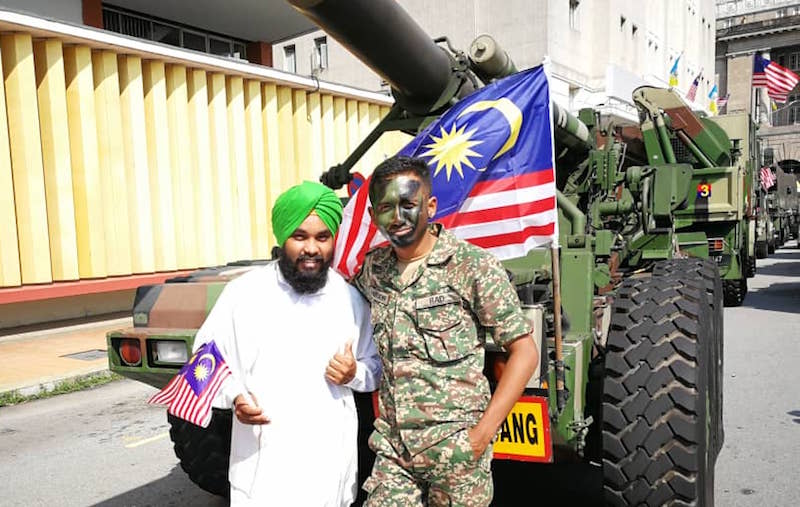
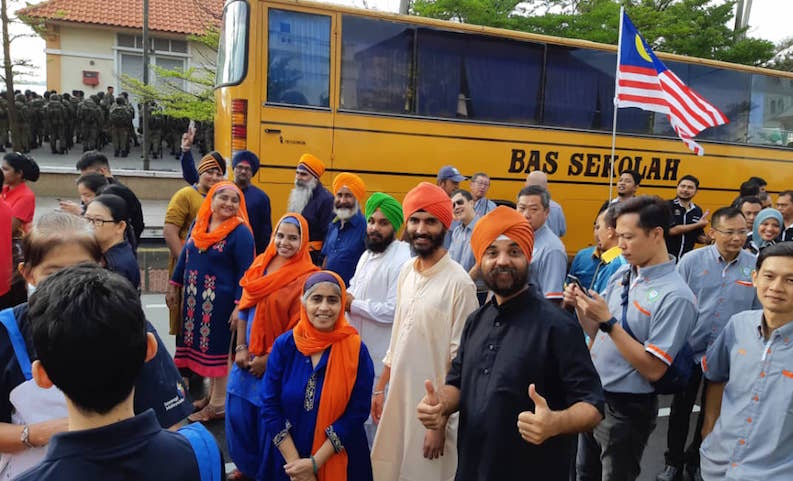
Merdeka Day 2018 parade in Penang – Photo: Supplied
Wadda Gurdwara Sahib Penang (WGSP), one of the first few gurdwaras to throw its support for the #MerdekaDayShiningTurban campaign, added colour to the Penang state parade.
The Penang Regitrar of Societies (ROS) invited Persatuaan Wadda Gurdwara Sahib Penang to join them in this year’s parade, a first for the gurdwara.
And, as part of the Merdeka Day Shining Turban campaign, they got all their members to wear the turban.
#MerdekaDayShiningTurban is campaign launched by Asian Sikh media portal Asia Samachar to get Sikhs to don the turban as Malaysia celebrate the independence day on 31 Aug.
Merdeka Day 2018 parade in Penang – Photo: Supplied
[ASIA SAMACHAR is an online newspaper for Sikhs / Punjabis in Asia. How to reach us: Facebook message or WhatsApp +6017-335-1399. Our email: editor@asiasamachar.com. For obituary announcements, click here]
Dear respected saad sangat jio, please be informed that there will be a special darshan sewa of puratan SGGS saroops at PULAPOL Gurdwara from 1 to 2.30 pm and 4pm to 6 pm Saturday 1st September 2018. SGGS saroops of different sizes and languages such as Hindi , Sindhi and Urdu will be displayed for the sangat to do darshan. Please come and be part of this once in a lifetime event ji . Looking forward to seeing you.
[The above message was received from the organising team]
[ASIA SAMACHAR is an online newspaper for Sikhs / Punjabis in Asia. How to reach us: Facebook message or WhatsApp +6017-335-1399. Our email: editor@asiasamachar.com. For obituary announcements, click here]
By Surinder Kaur Sohan Singh |SIKHI STUDY | OPINION
In the Sri Guru Granth Sahib (SGGS) the word Simran is mentioned many times and we are advised by the clergy to do simran or meditate everyday for a few minutes at least in a day.
Is few minutes a day sufficient? Is that all that is required?
In many places in the SGGS it is written that we should remember God twenty four hours a day, with every breath. Is it possible for us to do that?
ਮਨ ਬਚ ਕ੍ਰਮ ਪ੍ਰਭੁ ਏਕੁ ਧਿਆਏ ॥
Man Bach Karam Prabh Eiek Dhhiaaeeai.
One who meditates on the One GOD through thoughts, words and deeds.
ਸਰਬ ਫਲਾ ਸੋਈ ਜਨੁ ਪਾਏ ॥੬॥
Sarab Falaa Sooee Jan Paaeae.
That humble being receives the fruits of all rewards.
How can we meditate through thoughts, words and deeds not for one or two hours but all the time?
Guruji’s main message in Gurbani is for us to to be AWARE all the time. Guruji does not say to be aware for a short while.
AWARE of what? Aware of what we are DOING at the following three levels:
– thinking
– speaking
– performing actions.
Meditation in Sikhi, therefore, means to be aware of all the activities of the body and the mind twenty four hours of the day on the 3 levels of thinking, speaking and performing actions.
How do we go about being aware all the time?
To be aware our eyes must be open and we must be fully conscious.
Meditation is a 4 step process.
Step 1 is to be a witness to the activities of the BODY. Example: Breathing, walking, moving different parts of the body, talking, eating, drinking, etc.
Step 2 is to be a witness to the thoughts in the mind. Do not evaluate or judge the quality of the thoughts. Just be AWARE of them. Soon a miracle will start happening. As you start witnessing the thoughts, the frequency of thoughts will start decreasing slowly.
The relationship between awareness and frequency of thoughts is as follows:
0% AWARENESS = 100% thoughts. (Mind is fully occupied with thoughts)
100% AWARENESS = 0 % thoughts (Thoughts disappear with full Awareness)
Therefore, the higher the AWARENESS, the lower the number of thoughts. The mind starts to become peaceful when thoughts decrease.
Step 3 is to witness the feelings. Feelings of anger, jealousy, hatred will lose its power with observation over time. Feelings of love, gratitude, compassion on the other hand will start increasing with awareness.
This is the meditation that Guruji wants us to do regularly. This type of meditation cannot be done just for 1 or 2 hours. It has to be a continuous process to be AWARE at all times how we are creating our karma every second of the day through the activities of the body and the mind . This kind of meditation increases awareness and eventually leads to transformation of the mind.
When all the 3 steps are complete, the fourth step will happen on its own. No further effort is required.
Meditation is the way (Step 1, 2 and 3)
The fourth step is Enlightenment. Enlightenment is the reward.
Therefore, meditation is not a passive process of closing our eyes and repeating a word for a short period of time. Meditation is an active process that involves total alertness, awareness and mindfulness. It cannot be done mechanically for a short period of time. Meditation is not separate from our life. Our life becomes a meditation if we are fully aware of what we are doing.
This type of meditation can be done continuously as we go about doing our normal duties. We do not need to find a quiet corner to do this kind of meditation.
Surinder Kaur Sohan Singh is a Malaysia-based Gurbani enthusiast. This is an edited version of her regular articles shared within a circle of fellow Sikhi seekers. The articles appear on Mondays and Thursdays.
* This is the opinion of the writer, organisation or publication and does not necessarily represent the views of Asia Samachar.
ASIA SAMACHAR is an online newspaper for Sikhs / Punjabis in Southeast Asia and beyond.Facebook | WhatsApp +6017-335-1399 | Email: editor@asiasamachar.com | Twitter | Instagram | Obituary announcements, click here |
The concept of Sikh ethnicity can only be captured if we learn how advent of Guru Nanak gave rise to the principles of Sikhism in the 15th century. This is aptly explained by Bhai Gurdas in Vaar 1 Pauri 45:
‘Nanak endorsed his seal of Naam and a new way of life emerged.
This new way of life was a third way of life distinct from the Semitic way of life practiced by Jews, Muslims and Christians and distinct from the polytheistic eastern religions like Hindus.
Each path before Nanak believed in salvation after death. Nanak’s third path introduced the concept of salvation before death and therefore one should die while living. Such an individual is called ‘Jivan Mukhat’ in Sikhism.
‘To reach your true home after death, you must consider death while still alive’ (page 21 Adi Guru Granth).
‘Nanak Ke Ghar Keval Naam’ – Guru Arjan
‘In the house of Nanak, subscribe to the word(shabad) only’.
This made Sikhs a fiercely monotheistic and mystic faith on this planet.
Sikhism became a religion for the love of God and humanity, and gave every individual the opportunity for their spiritual development irrespective of colour, creed or ethnicity and to experience direct union with the unseen.
The nirmal panth, the new way of life or civilisation, as a new world order, had spanned 239 years of inculcation from Guru Nanak to the time of Guru Gobind Singh, at which point it became Khalsa Panth, the modus operandi of nirmal panth.
From this new way of life emerged the Sikh ethnicity peculiar to them.
In the age of Kalyug, the age of vice, falsehood, inequality, slavery, greed, and injustice, the Khalsa panth precisely reversed these ills and pursued their political ambitions as demonstrated by the establishment of Khalsa Raj or Sikh empire.
No one has to be born into Sikh ethnicity. It is open to any race, creed or other ethnic group or background, whether you are Chinese, black, white, or Asian. Tara Chand Malhotra was initiated into Sikhi from Hinduism and became leader of the Sikhs as Master Tara Singh. He was succeeded by a Muslim Fateh Mohammed, who became Fateh Singh. The first five initiates into Khalsa Order came from different castes and creeds. Four of them were from India and one was from Pakistan.
The Sikh Ardas, or prayer of supplication is very inclusive. It does not discriminate between the Sikhs and those not born into Sikhi and seeks the good of all mankind.
The apex court in the UK was quite explicit in their reasons in ruling that Sikhs were an ethnic group which was in accordance with concepts of Nirmal Panth. The Ruling stated that to constitute an “ethnic group it had to regard itself, and be regarded by others as a distinct community by virtue of certain characteristics, two of which were essential.
‘Firstly, it had to have a long-shared history, of which the group was conscious as distinguishing it from other groups, and the memory of which it kept alive’.
‘Secondly, it had to have a cultural tradition of its own, including family and social customs and manners, often but not necessarily associated with religious observance.’
The principles of Sikh ethnicity as derived from Nirmal Panth are unique compared with other socio/cultural groups whether it is spiritual, political, social, cultural ,economic or historic.
The law of the land is incontrovertible that Sikhs are an ‘ethnic group’. It can only be altered by an Act of Parliament. To omit a separate section or tick box for the Sikhs in the ethnicity column in the national census is inconsistent with the law. It undermines the legality and accuracy of the national census and discriminates against the Sikhs in the application of Equality Act 2010; notwithstanding that the majority of the Sikh community supports such provision for the purposes of implementation of the law.
Sikh ethnicity and Sikh religion are mutually inclusive. The ethnicity tick box does not currently cater for the Sikhs because a tick box for ‘Indian’, ‘Pakistani’ and ‘other’ cannot reflect the Sikh ethnicity as endorsed by law and by its historical basis derived from Nirmal Panth.
It is therefore proposed that there be a separate section for the Sikhs so that under that section the following boxes can be ticked: British Sikhs, Indian Sikhs, White Sikhs, Sikhs of other background.
Such a proposal cannot prejudice anyone because it helps monitor Sikh statistics in the future.
The writer is a retired High Court Judge in Uganda and Director of Gurbani Centre UK, a Sikh charity
[ASIA SAMACHAR is an online newspaper for Sikhs / Punjabis in Asia. How to reach us: Facebook message or WhatsApp +6017-335-1399. Our email: editor@asiasamachar.com. For obituary announcements, click here]
Aswin Phlaphongphanich was always the quietest kid in the class. The patka on his head set him apart from others, he rarely spoke and was frequently picked on. The classmate who sat next to him for the yearbook picture didn’t even know his name.
Born in Thailand into a Sikh family from India, the 40-year-old entrepreneur describes himself as a “minority on minority on minority” and looks back on his childhood as a time of introversion and unhappiness.
“I was the only odd one out, the only different kid in school. If you asked my classmates or teachers, they might not know me,” he says.
The founder and CEO of SawasdeeShop Group, a provider of telecom-related services, says his introversion is now a thing of the distant past, partially thanks to the circumstances that induced him to become an entrepreneur.
“People may face racism in their childhood but as they grow older they have two choices: they can go totally in or come totally out,” Mr Aswin tells Asia Focus.
When he established his first business at age 21, the role and responsibility as a leader helped expedite the transformation, making him more outspoken and confident.
“I had to hire and lead people who were in their late 30s or 40s. They were coming from such smart and intellectual backgrounds, so I had no choice but to change,” he recalls.
“If I didn’t portray the leadership role, I could never gain respect from them and I wouldn’t be able to grow and lead the team.”
Confident leadership, he says, is especially crucial for startup businesses because the founders only have a finite period to prove themselves.
Mr Aswin repeated that belief to himself over and over, and eventually started to use his identity and uniqueness to his advantage, seeing it as something of value, rather than embarrassment.
“It’s up to you whether you want to use it in your favour or not. If I’m unique and shouting out that I’m a brand and use it to make my identity, people will remember. It’s your decision to capitalise on it or become an introvert,” he says.
BUSINESS IN THE BLOOD
Mr Aswin has faced many setbacks and disappointments since the beginning of his business journey, but he never gets discouraged. He never gives himself the choice to give up. The same perseverance also drove his grandfather, who came to Thailand over a century ago to start a textile business.
“My grandfather was only 14 when he came to Thailand, or Siam at that time. He imported textiles from different parts of the world and walked around, village by village and house by house to sell, literally knocking door to door,” he says.
As the business grew, it opened up the opportunity for Mr Aswin’s father to receive a better education and experience life abroad. Receiving a full scholarship from the Thai government to study in Germany, his father later started a business with German counterparts in Thailand and became very successful.
However, the Asian financial crisis hit the family particularly hard, bringing the business close to insolvency. Mr Aswin, returning home in 1999 as a fresh graduate from the United States, felt compelled to do what he could to help out.
“I came back in that post-crisis period when banking and businesses were collapsing. I had no other options but to start something of my own, differentiate myself and do something completely different,” he recalls.
Mr Aswin chose to turn crisis into an opportunity to pursue a business he was passionate about, in the field of technology, without having the pressure of succession as his father was preoccupied with his own predicament.
“If it wasn’t so, I might have just joined the family business and taken it forward like a lot of other successors.
“But my forte is not in traditional industries. My mind is more on the technology side. Technology is where the exponential growth is, but the chance of being disrupted and revolutionised is also very high.”
When he began his business career at 21, the dot-com boom was peaking in the United States, and Mr Aswin looked for something that would work in Thailand.
“In 2000, I saw that the next big thing would be digital marketing. I knew that it would be the hot thing to sell or to have,” he says.
Armed with a unique educational background in both engineering and e-commerce and marketing degree, Mr Aswin decided to build an e-commerce platform.
However, being directly related to the owner of a bankrupted family, it was almost impossible for him to obtain loans to set up his business.
After a bumpy start, Mr Aswin finally launched SawasdeeShop as one of the first e-commerce platforms in the country in 2000. But it’s one thing to be an early mover and another thing to be too early, he discovered.
“Thai people only owned personal computers at the time and they still didn’t want to use credit cards. This was 19 years ago. In the US, [e-commerce] had already started booming. It was too early for the Thai market,” he says.
Mr Aswin had no choice but to shift his focus to something more relevant. That led him to apply his engineering training and instincts to telecommunications.
The most important thing for any business, he affirms, is to understand what the consumer wants. “Even if we may not have expertise in the industry, we still try to do it in a way that consumers will like.”
In addition, Mr Aswin emphasises having a multicultural workplace, as it promotes diversity of thoughts and ideas.
“It doesn’t matter where you come from. It’s about accepting you the way you are and if you can add to the team’s value,” he says, added that his companies employ a wide range of nationalities from Cambodian to Russian to Indian and Thai.
“If I don’t hire a Cambodian, I would never know how a Khmer thinks. If I think from a Thai-Indian perspective of what they think, it’s generally wrong and mismatched.”
[ASIA SAMACHAR is an online newspaper for Sikhs / Punjabis in Asia. How to reach us: Facebook message or WhatsApp +6017-335-1399. Our email: editor@asiasamachar.com. For obituary announcements, click here]
A dominating political ideology that essentially at its core, simply believes and states that all men (and women, of course) are equal in the eyes of the law, drawing parallels with our faith, Sikhi, clearly stating that everyone is equal in the eyes of a Higher Power. In democracy, everyone has a voice and everyone’s opinion matters, and to quote the 16th president of the United States, the much admired President Abraham Lincoln, a government of democracy is a “Government of the people, by the people, for the people, shall not perish from the Earth.”
Reminiscing what Lincoln said, on 9 May 2018, a surprising political miracle of sorts happened in my tanahair (homeland) of Malaysia, where against huge odds, the spirit of democracy prevailed and a new government was elected to rule the country. The unexpected victory for the Opposition at the time caught everyone by surprise and renewed the Malaysian peoples’ faith in democracy that we the people, through resolve and determination, really can mobilise to make things better as nation if we feel that change is necessary for the betterment of society, and the means of the change we wanted was through the democratic process of casting votes and electing officials we believe in.
This renewed faith in democracy led my train of thought to the notion of politics, and just as sure as the oxygen we breathe, wherever we go and wherever the affairs of the people are discussed, the issue of politics will be present. In our community, too, it is inescapable that matters relating to our people, our society and culture will be tinged by political influence, either subtle or otherwise.
And so I wondered, instead of reluctantly admitting that politics plays a relatively substantial role in our community and affairs pertaining to how our Gurdwaras are managed, why don’t we fully embrace the rigours of societal politics in our lives and design spaces that would allow politics to be addressed openly, with class, dignity and integrity, in a parliamentary kind of setting within our Gurdwara complexes?
The principal point of democracy is already very much a part of who we are as a people, where Sikhi clearly espouses that all of mankind, regardless of caste, creed and colour are equal in the eyes of God and other such values of democracy such as transparency, openness and inclusivity are architecturally incorporated into the design of the Gurdwara complex through the usage of clear glass to highlight transparency, open plazas and corridors to allow for public congregations, and open areas from all sides as symbolic gesture of equality by providing unhindered access in all directions.
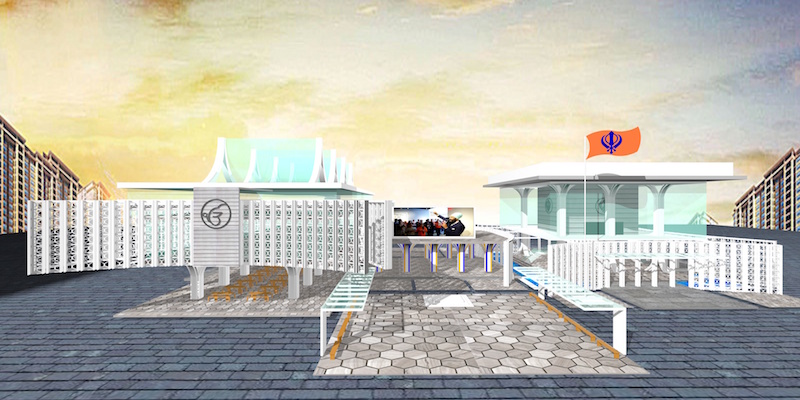
Therefore a space designed to openly discuss and debate matters pertaining to mutual affairs relevant to our society such as education, finance, culture and so forth in a setting where everyones’ voice is heard and considered seems like a natural architectural extension of sorts to incorporate, and that idea led to the proposed design of this conceptual Gurdwara as shown above.
This Gurdwara, where the Darbar Sahib (upstairs) and the Langgar Hall (downstairs) located on the left proposes an incorporation of a Parliamentary Hall on the right within a full height glass enclosure, inside of which political matters are openly discussed in a dignified and respectful manner. The two separate buildings are connected by a series of open corridors that are connected to a plaza in front of the entire Gurdwara complex.
The open plaza in the middle of the complex faces a giant digital screen showcasing the parliamentary procedures of discussions and debates happening in the hall for everyone to see so that everyone can have clear visual access to see what’s going inside the hall. It also has a Speakers’ Corner where people are encouraged to share opinions and ideas with the Sanggat.
The Darbar Sahib is elevated above the ground floor where the Langgar Hall is located. The walls of the Darbar Sahib are surrounded with a series of curved geometric frames that provide a semi-public cover and the Langgar Hall itself is totally open to encourage active social participation with the Sanggat and members of the general public.
The Parliamentary Hall is located within a huge glass wall on all 4 sides, again to consistently symbolise its transparency as a message that all should have access to the democratic process and be part of its structure to contribute to society as positively as possible. Clear entrances marked by graceful semi-public screens mark all 4 sides of the entry points to also reinforce the message of openness from all sides to access the hall.
The Parliamentary Hall and the Darbar Sahib project a sense of uniformity in design where the front of the complex and the back of the complex seems almost visually indistinguishable, and this was done to create an identity where the entire Gurdwara itself projects a cohesive and unified appearance. Establishing a design where the entire complex seems cohesive from all the major viewpoints and individual perspectives promotes a sense of equality and access for everyone to appreciate and this concept of equality strongly shaped the visual language of the proposed Gurdwara design.
Beyond mere aesthetics though, the incorporation of the Parliamentary Hall to address evident politically influenced matters that affect certain issues in our society still remains the main guiding principle in this proposal. Perhaps if we can openly share our opinions and concerns in an architectural setting that promotes discussion and debate in an ideally dignified and democratic manner, then we can contribute more to benefit our community as whole, without fear or favour, and feel a sense of belonging and acknowledgment while we contribute as valuable members of the Sanggat. In this way, we address the issues closest to our hearts as an individual through the beauty of Sikhi and address the issues closest to our community through the inclusiveness of democracy.
Waheguru Bless. And for all my Malaysians brothers and sisters, Happy Merdeka the 61st on 31 August, 2018!
Vishal J.Singh, an aspiring architect, holds a Bachelor of Architecture Degree from Infrastructure University Kuala Lumpur and enjoys engaging in architecture and its theories as his first love.
* This is the opinion of the writer, organisation or publication and does not necessarily represent the views of Asia Samachar.
[Fastest way to reach Asia Samachar: Facebook message or WhatsApp +6017-335-1399. Our email: editor@asiasamachar.com. For obituary announcements, click here]
Saskaar / Cremation: 12.00pm, 29 August 2018 (Wednesday), at Kampung Tunku crematorium. Cortege leaves residence at 11.00 am
Akhand Path: 7-9 September 2018 at Gurdwara Sahib Petaling Tin. Akand Path commences at 8am
Path Da Bhog: 9 September 2018, 9am-12pm, at Gurdwara Sahib Petaling Tin
Message: Will be deeply missed by all family members
Contact:
Binde 019-2247584
Vicky 016-3766635
| Entry: 28 August 2018 | Source: Family
[ASIA SAMACHAR is an online newspaper for Sikhs / Punjabis in Asia. How to reach us: Facebook message or WhatsApp +6017-335-1399. Our email: editor@asiasamachar.com. For obituary announcements, click here]
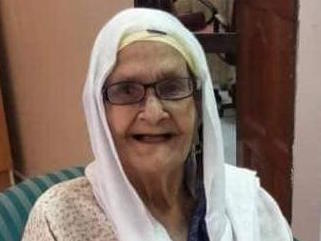
On 17 August 2018, we lost our dear grandmother Mata Nasib Kaur d/o Ishar Singh (fondly called Behji) after a short illness. Mata Nasib Kaur Ji was born in the village of Rakoli, in the Ropar district of Punjab, in 1931 or thereabouts, to Ishar Singh, a police hawaldar and his wife Kako Kaur. She married Sardar Sewa Singh Ji who hailed from a neighbouring village, Fatehgarh.
As we the family got together to perform the Antam Sanskar and bid our farewell, we had the opportunity to share our unique little anecdotes, cherished tales of our dear Behji. Sharing these stories greatly helped us to cope with losing our pillar of strength. Piecing together our various treasured moments with Behji, we marvelled at the collective personification that emerged . Behji was:
The Braveheart – who was first to respond to calls for assistance and courageously led the rescue mission of a neighbour’s child who had fallen into a well.
The Midwife – who safely delivered a baby when a pregnant neighbour could not reach a hospital in time and the ambulance was late to arrive.
The ProlificReader – while she never attended a formal school, she was a reasonably proficient, self-taught Gurmukhi reader and writer- taking years to accomplish her goal, a testimony to her diligence and persistence. Behji had a keen love for reading. Her particular favourites were Sakhis Of Sikh Gurus and biographies of eminent Sikhs. She was truly fascinated with the book ‘Safal Jiwan Sant Sohan Singh Ji’ which she read over and over again. Her latest book which was still at her bedside, is a biography of Bhagat Puran Singh Ji Pingalwara.
The Quizmaster and Language Teacher – during family gatherings, the Rehras Sahib session would inevitably end with the grandchildren having to answer in Punjabi, the challenging quiz questions on important dates and events of Sikh Gurus history. Of course, we the grandchildren will especially enjoy the customary ‘lecture’ to our parents for not using the Punjabi language in their daily dealings with the children.
The Sounding Board – the ever present, trusted and willing listener and reference point to whom most of the family members young and old always turned towards to seek advice, share ups and downs, bounce ideas or otherwise simply provide some historical context to an issue.
The Conversationalist – Behji was very interested in current affairs and had a good memory. It was therefore not unusual for family conversations with her, to cover a range of diverse topics including Malaysian politics (she voted in the May 9th 2018 elections too), Trump news, British Royal family developments etc. She enthusiastically joined the family in watching the recent FIFA World Cup Final even at a late hour.
Pictures from Behji’s Garden (20.8.2018) – Photo: Provided
The Gardener – the vision that will forever be etched in most of our minds and cherished eternally, is the image of Behji, kneeling and tending to the flora of our home gardens. Behji had an extraordinary passion for gardening. An often-recited amusing family anecdote is that, in the 6 months during the summer/autumn of 2003, that she spent in Cranfield, England with one branch of the family, there was no necessity to buy tomatoes, as Behji had a thriving tomato patch at home!
Similarly, as a result of her green fingers, we in our different homes and on various occasions have had the opportunity to savour home grown karela and bhindi (ladies finger) sabzi, pudina chutney, rambutans, papayas, mangoes and jack-fruit, all fruits of her magical gardening skills. Behji has also left a little legacy in one corner of the Kelana Jaya SS4C public park which now flourishes with hedges, flowering plants and fruit trees, collectively offering park visitors (humans, birds and squirrels) peace, solace and comfort. The flowers especially are collected by visitors for their prayer altars at home. Sadly, the gardener is now no more and may the garden continue to grow and flourish!
Behji had a very clear philosophical approach to life which embodied that all things are impermanent. She accepted that death comes in the normal course of life and her readiness simply amazed us. Being an accomplished tailor (exemplified by our childhood pyjamas and patchwork pillowcases), Behji had personally sewn and carefully packed ready for the inevitable day, a new Punjabi suit, Kachhera, Kafan, including Theli for ashes. There were clear instructions on matters such as her last bath ritual, no-wailing rule, and her preference for a wood funeral pyre .
In her own way, Behji has lived a worthy and meaningful life. She was a tremendous influence and played a strong supportive role in all our lives. Metaphorically speaking the phrase, ‘the maalee is no more, may the baag continue to flourish’, holds great significance and applies to us in that, she would want us to continue to strive forward and flourish, living up to the values, principles and teachings she has so lovingly passed down.
Nasib Kaur (1931-2018), Cheras
Essentially over the last years Behji spent much time regularly reading Gurbani and never missed her daily prayers. While we will miss her presence, we draw inspiration and comfort from the ‘hukum’ from Sri Guru Granth Sahib Ji that was read after her Antam Sanskar (SGGS, Ang: 623, Sorat’h, Fifth Mehl).
ਗੁਰਿ ਪੂਰੈ ਚਰਨੀ ਲਾਇਆ ॥ ਹਰਿ ਸੰਗਿ ਸਹਾਈ ਪਾਇਆ ॥
The Perfect Guru has attached me to His feet. I have obtained the Lord as my companion, my support, my best friend.
ਜਹ ਜਾਈਐ ਤਹਾ ਸੁਹੇਲੇ ॥ ਕਰਿ ਕਿਰਪਾ ਪ੍ਰਭਿ ਮੇਲੇ ॥੧॥
Wherever I go, I am happy there. By His Kind Mercy, God united me with Himself. ||1||
Note: We wish to express our sincere appreciation to all relatives and friends for their kind presence and support during our recent bereavement. You are cordially invited to the Sahej Paath da Bhog of Behji (Mata Nasib Kaur Ji) on 31 Aug 2018, at Gurdwara Sahib Mainduab between 9.30 am – 12.00 pm. SEE HERE.
A tribute to Mata Nasib Kaur Ji by her grandchildren
[ASIA SAMACHAR is an online newspaper for Sikhs / Punjabis in Asia. How to reach us: Facebook message or WhatsApp +6017-335-1399. Our email: editor@asiasamachar.com. For obituary announcements, click here]
By Surinder Kaur Sohan Singh |SIKHI STUDY | OPINION
Saach kaho suna laeho sabhai
Jin Prem Keeo tin hee Prabh paaeeiou.
The line above is from one of the Nitnem Banis. In this line, Guruji calls upon all of us and says:
“Please listen, all yee people, to this eternal truth: Only the one who really understands the PURE DIVINE LOVE of GOD and manifests it in his life will realise GOD in his life.”
The truth is that PURE UNCONDITIONAL LOVE is the ONLY positive force in the world. This love is the cause of all good things happening in our world and the lack of it is the cause of all negative things happening in this world.
But in Gurbani we are made AWARE of the fact that LOVE does also exists in its negative form in humanity. This happens when love deteriorates and becomes what is called MOH or ATTACHMENT.
While pure unconditional love is a virtue, attachment or moh on the other hand is a vice. It is called a vice because moh often leads to possessiveness, jealousy, hatred and a struggle for power in many relationships. Guruji cautions us against this negative form of love.
In our worldly relationships, husband-wife, parents-children, friends etc, we normally depict this kind of selfish love that deteriorates very quickly into possessiveness.
Example: Parents often hold children in bondage demanding obedience and respect in return for bringing them up. The same thing happens between couples. The dominant partner will try to control the other party.
In the PURE DIVINE LOVE that radiates from GOD there is no possessiveness at all. This PURE LOVE gives the other person the total freedom to grow and become a complete being.
Every human being needs and desires this freedom. PURE LOVE not only allows for this freedom but also strengthens the freedom. Anything that destroys freedom is not love. LOVE and freedom are two wings of the same bird. Pure unconditional love gives one the freedom, and liberates him. Once a person is totally free, he feels grateful to the person who has given him his freedom.
Possessiveness, on the other hand, denies this freedom. This becomes the cause of conflict in many relationships. All growth needs love but the kind that is pure and unconditional . If love comes with conditions then growth cannot be total.
Pure unconditional love is the virtue of God.
Attachments or moh on the other being a vice and having arisen out of ego leads to other negative traits like selfishness, greed, anger, hatred etc.
To attain liberation we have to learn how to transform our moh that holds us in bondage to the pure unconditional love of God that is liberating to the spirit.
Surinder Kaur Sohan Singh is a Malaysia-based Gurbani enthusiast. This is an edited version of her regular articles shared within a circle of fellow Sikhi seekers. The articles appear on Mondays and Thursdays.
* This is the opinion of the writer, organisation or publication and does not necessarily represent the views of Asia Samachar.
[ASIA SAMACHAR is an online newspaper for Sikhs / Punjabis in Asia. How to reach us: Facebook message or WhatsApp +6017-335-1399. Our email: editor@asiasamachar.com. For obituary announcements, click here]
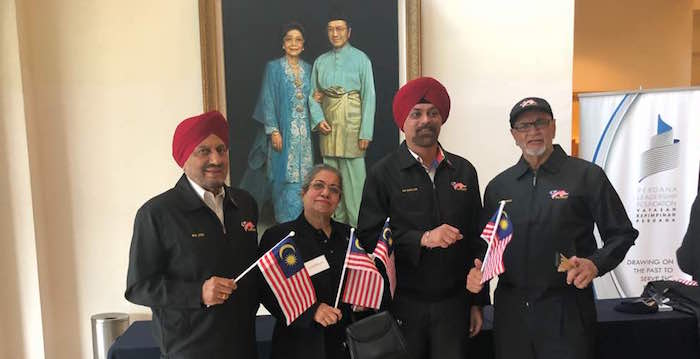
VETERANS AT LUNCH WITH DR MAHATHIR: MAFSCA president Major (Rtd) Baldev Singh, auditor Major (Rtd) Harbans Kaur, secretary Major Swaran Singh Dhillon and former deputy president Major (Rtd) Bhagwant Singh Virik
Sikh veterans are throwing their support for the Merdeka Day campaign to get Sikhs to don the turban on 31 Aug when Malaysia celebrates its independence day.
The Malaysian Armed Forces Sikh Veterans Association (MAFSVA), a two-year old organisation, has thrown its support for the Merdeka Day Shining Turban campaign.
“Our members have served the nation on the frontline and have sacrificed much for the nation. They are honoured to be part of this campaign,” MAFSVA president Major (Rtd) Baldev Singh tells Asia Samachar.
MAFSVA has also been invited to the planned national day parade. Its members were also recently invited to a lunch with Prime Minister Dr Mahathir Mohamad.
The association, which held its inaugural meeting meeting in Kuala Lumpur on 31 July 2016, was set up, among others, to liase with and make representation to the Jabatan Hal Ehwal Veteran (JHEV), the department for veteran affairs set-up in 2000 under the Defence Ministry, ‘on all matters related to retired Armed Forces personnel’.
The #MerdekaDayShiningTurban calls on Malaysian Sikhs to don the turban on 31 Aug 2018 as Malaysia celebrates its 61st independence day.
Tech Line Group of Companies and Kyocera Documents Malaysia are the campaign partners.
The campaign has also received wide support from Malaysian-based host of Sikh organisations and gurdwaras (Sikh place of worship). They include Gurdwara Sahib Taiping, Wadda Gurdwara Sahib Penang, Gurdwara Sahib Putra Heights, Gurdwara Sahib Kuantan, Gurdwara Sahib Seremban, Gurdwara Sahib Rasa, Gurdwara Sahib Kuala Pilah and the Malaysian Sikh Education Aid Fund (MSEAF).
Let us join the #MerdekaDayShiningTurban campaign. Let’s rock the country with the shining turban!
HOW TO JOIN CAMPAIGN:
If you run a gurdwara or society, let us know via Whatsapp (+6017-3351399)
If you plan to join, great if you run the hashtag and photo on your Facebook, Twitter, Snapchat, etc. #MerdekaDayShiningTurban
Tell your family & friend. Grow the party.
On Merdeka Day, just wear a turban wherever you are!
Send a photo to Asia Samachar (Whatsapp +6017-3351399 or Facebook messenger or email editor@asiasamachar.com)
[ASIA SAMACHAR is an online newspaper for Sikhs / Punjabis in Asia. How to reach us: Facebook message or WhatsApp +6017-335-1399. Our email: editor@asiasamachar.com. For obituary announcements, click here]