








UA-56202873-1
Page 656

UK Sikh community raise concerns with Theresa May to take up with Narendra Modi next week

STATEMENT | Sikh Federation (UK) | 
Theresa May
London – 10 April 2018: The Sikh Federation (UK) with the support of over 200 UK Gurdwaras and Sikh organisations has written to the Prime Minister, Theresa May to raise a number of serious concerns with Narendra Modi when the two meet on 18 April.
 
Theresa May has been urged to take up the issue of growing ‘Hindu radicalisation’ and intimidation, harassment, forced conversions and violence against religious and ethnic minorities, including Hindu Dalits.   
 
A number of Commonwealth countries have been lobbied and are expected to tackle the significant threat of right wing Hindu groups for India to become an exclusive Hindu State by 2021 run by upper class Hindus.  
 
Theresa May has also been asked to tell Narendra Modi in no uncertain terms that the Indian authorities should stop interfering in internal matters for the UK and British Sikhs who have increasing support from politicians across the political spectrum.  
 
The letter also refers to the appalling treatment and attempts to undermine the Canadian Prime Minister, Justin Trudeau during his recent visit to India for having Sikh Ministers in his Cabinet and being a close friend of the Sikh community.  
 
Bhai Amrik Singh, the Chair of the Sikh Federation (UK) said: 
 
“To hide their own failings the Indian authorities are going out of their way to target law-abiding Sikhs in the Diaspora for their long tradition of activism and opposition to human rights abuses.”  
 
“We are confident this will badly backfire on the Indian government as politicians and governments across the globe rightly view Sikhs as vibrant, hard working, loyal and responsible citizens that contribute massively to the economies of the countries in which they live.”
 
“We expect the recent outrageous treatment in India of the Canadian Prime Minister, Justin Trudeau for his support of Sikhs to be a major informal talking point during next week’s Commonwealth Heads of Government Meeting (CHOGM).”
 
“Many governments have had enough of these underhand tactics by India of targeting the Sikh minority that has developed an excellent reputation abroad, using trade to blackmail governments and repeatedly making use of Indian sensitivities about its colonial past.”   
 
ENDS
Gurjeet Singh
National Press Secretary
Sikh Federation (UK)
The full text of the letter sent to Theresa May is below:
Prime Minister’s Office
10 Downing Street, Westminster,
London, SW1A 2AA
LETTER                                                                      
10th April 2018
 
Dear Rt. Hon. Theresa May
 
Concerns of the UK Sikh community, to raise at the meeting next week with Narendra Modi during CHOGM
 
When Narendra Modi first came to the UK as Indian Prime Minister in November 2015 the Sikh community following a long tradition of opposing all oppressive regimes and leaders with a dubious human rights record raised a number of serious concerns with the UK Government, MPs and the mainstream media. At Annex A we provide details of some of those concerns with an update.
 
However, to deflect attention away from these concerns and growing ‘Hindu radicalisation’ it was widely reported in the Indian media, following briefings by Indian officials and to our disappointment that a ‘dossier’ on ‘Sikh radicalisation’ of British Sikhs was on the agenda when David Cameron and Narendra Modi met..  This so-called dossier inappropriately maligned certain Gurdwaras, individuals, Sikh TV channels and Sikh organisations in the UK.
 
Although the UK Government has denied the existence of the ‘dossier’ the high profile arrest of one of those named, Paramjit Singh from Birmingham when he visited Portugal with his family within a matter of weeks of Modi’s visit and a failed attempt to extradite him to India led to significant suspicion on the tactics being deployed by the Indian authorities.  
 
Also the Centre for Research and Evidence on Security Threats (CREST) funded by the UK Government in response commissioned a project ‘Investigating Sikh Radicalisation in Britain’. This was published in November 2017 and in effect concluded the term ‘Sikh radicalisation’ was totally inappropriate and should not be confused with ‘Sikh activism’ that should be viewed positively.  The report concluded ‘there is no threat to the British state or to the wider British public from Sikh activism as there is no conflict with ‘the West’ or with Britain’.  
 
Prior to Narendra Modi’s attendance at next week’s Commonwealth Heads of Government Meeting (CHOGM) Indian officials appear to have again briefed Indian media to suggest Narendra Modi will again raise the issue of ‘Sikh radicalisation’ when he meets you on 18 April. We hope you will tell him in no uncertain terms that many of the issues reported in the media are internal matters for the UK and British Sikhs who are supported on these issues by UK politicians from across the political spectrum.  
 
Politicians and governments across the globe rightly view Sikhs as vibrant, law abiding, hard working, loyal and responsible citizens that contribute massively to the economies of the countries in which they live and see through such underhand tactics targeting a minority.  It is time for such actions to be publicly called out.
 
Following Narendra Modi’s last visit we were subsequently assured some of these concerns were taken up though diplomatic channels as the UK Government, unlike the Indian regime do not see the benefit of ‘megaphone’ diplomacy, especially given the British colonial past and continued Indian sensitivities. However, following the recent appalling treatment and attempts to undermine the Canadian Prime Minister, Justin Trudeau for having Sikh Ministers in his Cabinet and being a friend of the Sikh community during his visit to India and the abduction and torture of British citizen, Jagtar Singh Johal, many believe it is now right for Narendra Modi and the Indian regime to be publicly challenged during and after CHOGM.
 
Narendra Modi should be prepared to respond to some difficult questions about the extreme Hindutva agenda regarding the killing and treatment of religious minorities and Dalits in India and the growth of Hindu radicalisation across the globe.  The direction in which Narendra Modi is taking India needs to be checked as a matter of urgency.
 
We would welcome a meeting with leading Sikh organisations after CHOGM to discuss our concerns.  This letter has the support of over 200 UK Gurdwaras and Sikh organisations and is being copied to the leader of the Opposition, the Foreign Secretary, Home Secretary, their counterparts and other leading politicians.  
 
Supporters of this letter:
 
·       Federation of Sikh Organisations, including the Sikh Federation (UK)
 
·       Khalsa Human Rights
 
·       Various Sikh youth groups and organisations
 
·       The Sikh Network
 
·       Over 200 UK Gurdwaras
 
Annex A – Update of serious concerns that should be raised with Narendra Modi and the Indian Government
 
Narendra Modi and the ruling party have clear Hindutva objectives and are encouraging Hindu radicalisation across the globe
Narendra Modi trained with the ultranationalist right wing Hindu group, the Rashtriya Swayamsevak Sangh (RSS).  The RSS is a Hindu nationalist paramilitary group that has been involved in extreme violence, including acts of terrorism and been banned several times in India.  This includes when RSS member Nathuram Godse assassinated Mahatma Gandhi in 1948.  The most recent ban was in 1992 after the demolition of the Babri Masjid.
 
There have been numerous examples of forced conversions since Modi came to power in May 2014..  In January 2015 President Obama while speaking in Delhi criticised the Modi led BJP government by making a plea for freedom of religion to be upheld in India.  In a veiled threat President Obama warned without freedom of religion India could break up.  In 2015 we pointed out that the BJP government led by Modi presented a significant threat to religious and ethnic minorities in India with the declaration by right wing Hindu groups that they will ensure India becomes an exclusive Hindu State by 2021.  
 
Oppression of religious and ethnic minorities in India
In 2016 the United States Commission on International Religious Freedom, the US government’s religious-freedom research agency delegation was prevented from visiting India to assess religious freedom conditions.  However, they have reported right wing Hindu groups, the RSS, Shiv Sena, Sangh Parivar, and Vishva Hindu Parishad (VHP) and their sympathisers continue to perpetrate numerous incidents of intimidation, harassment, and violence against religious minority communities and Hindu Dalits. These groups have been allowed by the Modi led government to convert Muslims and Christians to Hinduism by force and have been attacking and interfering in the Sikh faith to try and secure its assimilation.
Members of the ruling party that have ties to Hindu nationalist groups implicated in religious freedom violations, use religiously divisive language to inflame tensions.  These issues, combined with longstanding problems of police and judicial bias and inadequacies, have created a pervasive climate of impunity in which religious minorities feel increasingly insecure and have no recourse.
Narendra Modi blamed for Gujarat 2002 massacre of at least 2,000 Muslims 
Narendra Modi is described as a man either responsible for mass-genocide or the saviour of India’s Hindus – depending on your point of view.  Britain imposed a 10-year diplomatic boycott of Narendra Modi after he was accused of failing to stop the sectarian murder of at least 2,000 Muslims in Gujarat in 2002. An internal British report at the time described the violence as pre-planned with the support of the state government.
It led to a de facto travel ban imposed on Modi by the UK, the US and some European nations, as well as the boycott by all but junior officials. In 2005, Modi was refused a US visa as someone held responsible for a serious violation of religious freedom.
Modi, who was the chief minister of Gujarat at the time and was severely criticised for not doing enough to stop Hindu mobs who went on a spree of raping, burning and murdering. He is on record as saying he felt the same pain over the bloodshed as a passenger in a car that has just run over a puppy. In August 2012, Maya Kodnani, a former aide to Modi and State Minister, was handed 28 years in jail for her part in the murder of 97 people.
Three of those killed in Gujarat in 2002 were British Muslims visiting India on holiday. Their car was stopped by a mob at a road block when they were returning to Gujarat after a visit to Jaipur.  The three men and their driver were all set ablaze with petrol and burnt to death.
 
Human Rights Watch have accused the Gujarat authorities of harassing rights activists rather than pursuing justice for the victims.  Sikhs champion human rights and cannot turn a blind eye to the actions of someone termed ‘the Butcher of Gujarat’ for the injustices of 2002 even though many governments have done this since Modi became the Indian PM.
 
There were also specific Sikh issues raised in November2015 where the Indian government has failed to adequately respond. Instead additional concerns have arisen
Returning rare and priceless items stolen by the Indian Army in June 1984 from the Sikh Reference Library
 
These included rare and priceless manuscripts of Guru Granth Sahib Ji, Hukamnamas carrying signatures of the Sikh Gurus, documents related to the Sikh Raj and Sikh contribution during the independence movement and books on Sikhi and our history. There has been no progress whatsoever on this issue since November 2015 despite close political links between the Akalis and BJP and the matter being taken up again in writing by the Shiromani Gurdwara Parbandhak Committee (or SGPC) in 2016 and 2017.
Release of Sikh political prisoners
When Modi came to the UK in November 2015 there were 84 known Sikhs political prisoners languishing in India’s prisons some had been in prison for over 25 years. One of the first steps for resolving political conflicts is the release of all political prisoners and a general amnesty for those that have cases pending. Some Sikh prisoners, including several senior citizens, have been released, but only after legal action suggesting the present Indian government has no interest in resolving the political conflict with Sikhs. The Indian authorities have instead been making additional arrests of younger Sikhs, including British citizen, Jagtar Singh Johal. Over 60 Sikhs have been arrested in the last 12 months with the number of Sikh political prisoners at around 150.
 
Abduction and torture of British citizen Jagtar Singh Johal who has been held for 160 days without charge or access to medical care
 
By the time you meet Narendra Modi, Jagtar Singh Johal, a 31-year old British national from Dumbarton would have been detained in India without charge for over 160 days.  Jagtar’s access to medical and legal services has been severely restricted and there have been allegations of torture made against the Indian police. Constituents have written and raised serious concerns with around 250 MPs regarding Jagtar.  
 
Jagtar travelled to India to marry his fiancée in October 2017. On 4 November, while out shopping, he was seized by plain-clothes officers, hooded and abducted. Following a brief court hearing he was held incommunicado by Indian police for nine days in an undisclosed location and he was denied all access to lawyers, British consular staff and family members.
 
On 10 November Jagtar was secretly presented in court while his lawyer and British consular staff were outrageously left outside the courtroom waiting to be called.  They were informed after he had been presented before the court and had left the courtroom.  Subsequently witnesses reported that Jagtar had great difficulty standing or walking and had to be assisted by the police officers escorting him in and out of the courtroom supporting Jagtar’s claim of third degree torture. 
 
When he first briefly met his lawyer in the courtroom on 14 November Jagtar made allegations of third degree torture between 5 to 9 November.  This included leg separation and electric shocks to his ears, nipples and genitals.  He has told lawyers that police also forced him to sign blank pieces of paper, believed to be for the purpose of forging confessions from him. 
 
After considerable lobbying British consular staff were eventually able to meet Jagtar on 16 November, some 12 days after his abduction, torture and interrogation.  However, two senior police officers remained in the small interrogation room to prevent a private conversation.  The experienced consular officer present assessed and concluded that Jagtar was prevented from fully opening up about his mistreatment and to show signs of torture, but was declared ‘vulnerable’.  To date the Indian authorities have unacceptably prevented Jagtar having private access to British consular staff.
 
For a large part of his detention Jagtar has been in police as opposed to judicial custody.  In police custody apart from third degree torture he has been abused and mistreated.   Sleep deprivation techniques, constant verbal abuse, solitary confinement, use of hand-cuffs 24-hours a day and misinformation about his family and the British authorities have been used to mentally exploit and demoralise Jagtar.
 
UK Parliamentarians have been told Jagtar’s treatment is ‘unconstitutional’ and Britain has warned of ‘extreme action’ against the Indian authorities.  He has been repeatedly denied an independent medical examination..  His case is extremely serious, but has become farcical and trial by media.  He has been brought to court over 30 times and has been taken in and out of judicial and police custody.
 
Justice for the Sikh Genocide of November 1984
 
The Union Home Minister Rajnath Singh in late December 2014 referred to what happen to the Sikhs in November 1984 as ‘Genocide’ and that ‘justice would be meted out to the victims only when the perpetrators of the crime are punished’ and ‘that until these persons are punished, victims will not get relief’.  Sikhs in the Diaspora have had some successes in the US, Canada and with officials at the United Nations to have the 1984 Sikh Genocide recognised and the campaign continues, although the Indian authorities oppose others calling it a genocide. 
 
Earlier this year Congress leader, Jagdish Tytler revealed in an interview that he accompanied Rajiv Gandhi when the latter drove through the streets of Delhi on 1 November 1984 monitoring/supervising the killing of innocent Sikhs. This came as a huge shock in India and led to a video subsequently being released showing Jagdish Tytler confessing to killing of over 100 Sikhs in November 1984.. The Narendra Modi led BJP Government need to be challenged to see if they are serious about ‘meting out justice’ or if this is simply lip-service to secure votes.
Prosecution of police officers involved in human rights violations in Punjab
To resolve the political conflict with the Sikhs international admission of the truth around widespread human rights violations by India is essential.   For over 30 years UN rapporteurs and independent experts as well as Amnesty International have been denied access to Punjab to investigate widespread allegations of torture, disappearances, false encounters and extra-judicial executions.  If India wishes to be taken seriously on the international stage it must allow the truth to emerge by removing such restrictions, allowing independent investigations followed by prosecutions.
Compensation for Sikh farmers in Gujarat forced to leave and prosecution of those responsible for violent attacks against them 
In 2010, the Narendra Modi-led Gujarat government had over 20,000 acres of land belonging to Sikh farmers in Gujarat confiscated. These Sikh farmers migrated there about five decades ago. They were being uprooted under a law enacted by the Gujarat government that stopped Sikhs from owning land in the state. The Sikh farmers won their case in the Gujarat High Court but the state government challenged the order in the Supreme Court.  In the run-up to the Lok Sabha polls, Narendra Modi had assured that no Sikh farmer in Gujarat would ever be evicted. However, since the May 2014 elections attacks by land mafia and goons have increased and charges have brought against Sikh farmers for defending themselves.  These attacks have forced many to flee the land they had successfully made their home.  No progress has been made since November 2015 on compensating Sikh farmers forced to leave Gujarat.
UN-led inquiry into the 1984 Sikh Genocide orchestrated by the Congress Party
Backing for a UN-led inquiry into the atrocities committed by the Congress Party in June 1984, the killings and disappearances in the months that followed and the systematic and deliberate killing of innocent Sikhs in November 1984.   The UN inquiry should also look into the use by the police of criminals, goons, gangsters and smugglers to impersonate Sikh ‘militants’, widely known as Black Cats.   The BJP Government has to date demonstrated in the last four years it is not serious on establishing the truth and providing justice for the 1984 Sikh Genocide.
Application of self-determination to the Sikhs and the demand to re-establish a Sikh homeland, Khalistan
Acceptance by India of the general principle that self-determination is a basic human right founded in international law and it applies to the Sikhs. Withdrawal of India’s ‘reservation’ at the UN Human Rights Council that self-determination does not apply to the people of India. Internal self-determination by Sikhs since 1947 has been violently rejected and crushed with state terror so remedy via external self-determination is possible.  The persecution of Sikhs in 1984 and in the years that followed and the lack of justice to date is the basis on which the Sikhs continue to raise the legitimate demand for an independent Sikh homeland, Khalistan.


[ASIA SAMACHAR is an online newspaper for Sikhs in Southeast Asia and surrounding countries. We have a Facebook page, do give it a LIKE. Follow us on Twitter. Visit our website: www.asiasamachar.com] 18503


RELATED STORY:

Is Sikh extremism really active in Canada? (Asia Samachar, 2 April 2018)

Understanding Sikh activism in Britain (Asia Samachar, 16 Nov 2017)

Making sense of the overdrive to discredit Sikhs during Trudeau visit to India (Asia Samachar, 3 March 2018)

Two Indian magazines and how they treat Sikh related stories (Asia Samachar, 11 Feb 2018)


[Fastest way to reach Asia Samachar: Facebook message or WhatsApp +6017-335-1399. Our email: editor@asiasamachar.com. For obituary announcements, click here]
Akal Takht excommunicates Nanak Shah Fakir movie maker

0
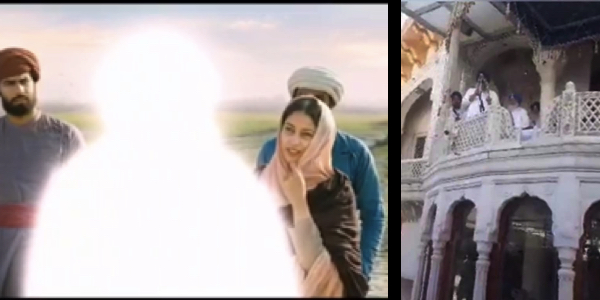
LEFT: A clip taken the Nanak Shah Fakir movie trailer; RIGHT: Akal Takht Jathedar Giani Gurbachan Singh making the pronouncement upon Harinder Singh Sikka

The Akal Takht has ‘excommunicated’ Harinder Singh Sikka, the man behind the controversial film ‘Nanak Shah Fakir’, set to be released tomorrow in a number of countries, including Malaysia.

In an announcement to the public today (12 April), Akal Takht jathedar Gurbachan Singh made known the decision after a closed-door meeting.

He said that Harinder had ignored repeated appeals to him not to release the movie, which was first supposed to be released in 2015, but held back after ferocious complaints from some segments of the Sikh community.

In view of his actions, the jathedars has called on Sikhs not to have any relationships with Harinder.

In another development, Shiromani Gurdwara Parbhandak Committee (SGPC) chief secretary Roop Singh had apologised to the Sikhs through social media for granting permission to the film. He said it was a blunder on his part to issue such a letter, reports Tribune News Service.
.
Referring to the letter issued under his signature on March 19, directing the gurdwaras to prominently display the posters of the film so that the devotees would be aware of the film based on Guru Nanak, Singh, in his message, submitted that the letter was withdrawn on March 29.

He clarified that he had issued the letter only on the basis of an earlier letter issued by his predecessor after a sub-committee had recommended it.

To substantiate his claim, the report said that Roop also posted the letter dated May 13, 2016, which reads, “It is in continuation to the letter number 31424 and now after the film is seen by the appointed committee of Shiromani Gurdwara Parbhandak Committee, we have no objection in granting you the permission for the release of the film ‘Nanak Shah Fakir’.”

On January 22, 2015, Akal Takht Jathedar Gurbachan had issued a congratulatory letter addressed to the film-maker Harinder terming it as a “praiseworthy” step and that it was ‘a fine example of promotion of Sikh faith’, the report added.

However, following the protest, the Akal Takht Jathedar thought the screening of the film could create unrest and vitiate peace.


RELATED STORY:

Why the film Nanak Shah Fakir would be a disaster for Sikhs (Asia Samachar, 12 April 2018)

Nanak Shah Faqir: An Epic of Sorts  – PART ONE (Asia Samachar, 4 June 2015)

Artee and Sikhi (Asia Samachar, 10 Mar 2015)


[ASIA SAMACHAR is an online newspaper for Sikhs / Punjabis in Asia. How to reach us: Facebook message or WhatsApp +6017-335-1399. Our email: editor@asiasamachar.com. For obituary announcements, click here]
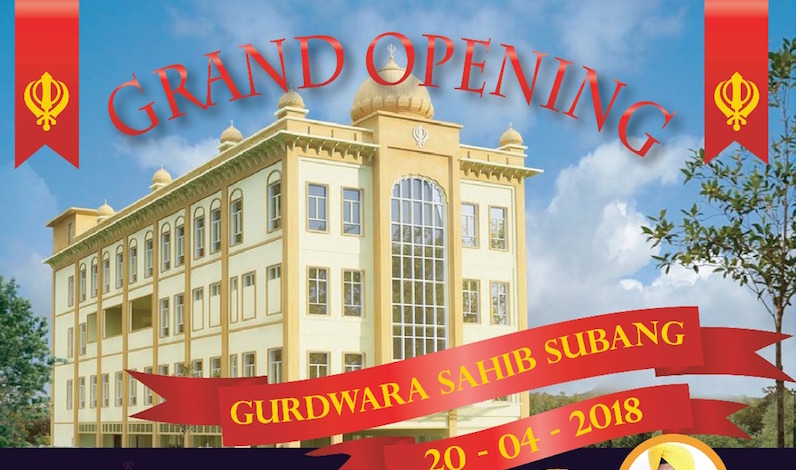
Subang gurdwara opening on 20 April, daily kirtan diwans from 14 April dropped

Gurdwara Sahib Subang opening will take place with an akhand path that kick starts on 20 April (Friday) and ends on 22 April (Sunday).
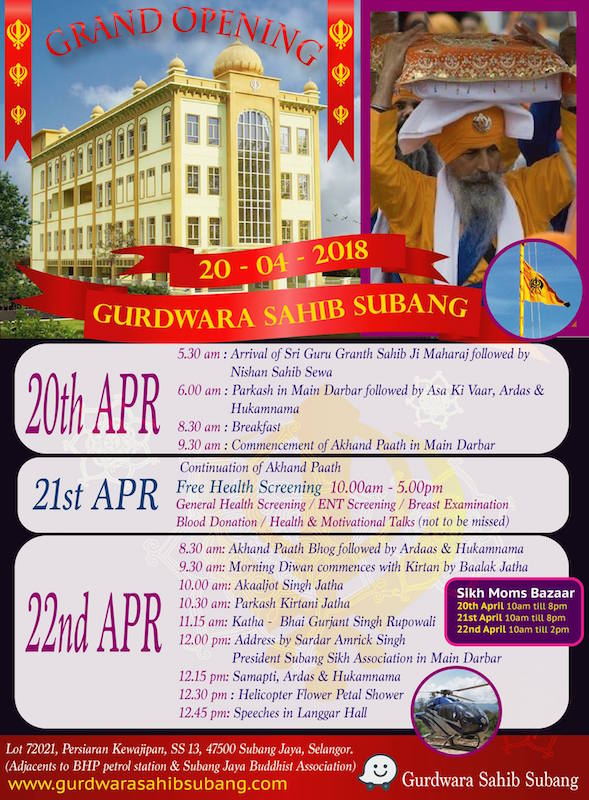
A daily evening kirtan programme, initially planned for to start on Saturday (14 April), has beeb cancelled.

“We have a few more things to complete. Hence, we will not be able to run the evening programmes.

“The opening will happen as originally planned on the 20 April,” a gurdwara committee official told Asia Samachar. “We welcome the Sangat to take part in this momentous event.”


[ASIA SAMACHAR is an online newspaper for Sikhs in Southeast Asia and surrounding countries. We have a Facebook page, do give it a LIKE. Follow us on Twitter. Visit our website: www.asiasamachar.com] 18631

RELATED STORY:

62 golfers signed up for Subang gurdwara charity game. They need more players (Asia Samachar, 9 Nov 2017)

Wheelchair-bound Keshvinder Kaur eagerly awaits completion of Subang gurdwara (Asia Samachar, 20 Aug 2016)


[Fastest way to reach Asia Samachar: Facebook message or WhatsApp +6017-335-1399. Our email: editor@asiasamachar.com. For obituary announcements, click here]

American Sikh Congressional Caucus (ASCC) Introduces House Resolution 189 Recognizing The Sikh Festival Vaisakhi In The House of Congress

STATEMENT | UNITED SIKHS | US:

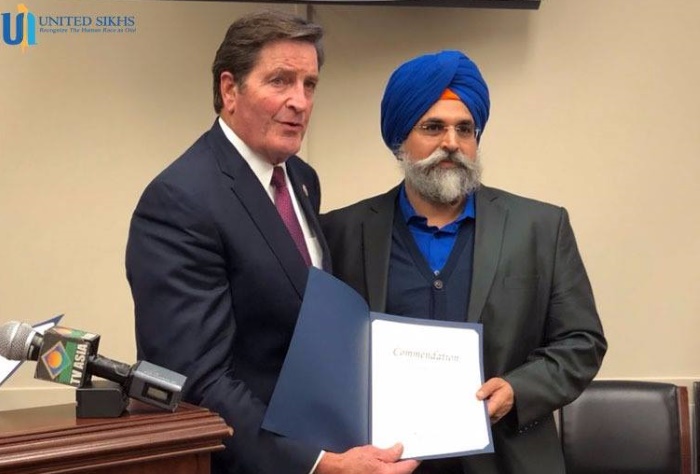
NEW YORKApril 11, 2018 — Today, the American Sikh Caucus Committee in tandem with the American Sikh Congressional Caucus (ASCC), is introducing the House resolution 189 in the House of the Congress in Washington D.C. The reception, which takes place in the Rayburn House Building Room 2203 from 5pm – 6 pm, will not only celebrate Vaisakhi but also recognize individuals and organizations for their outstanding work.

United Sikhs, a UN based humanitarian and Civil Rights Organization, will be recognized for its commendable global work in the field of humanitarian aid and civil rights work. Hardayal Singh, founding member of United Sikhs, will be recognized on behalf of the organization.

The House Resolution 189, which “recognizes the historic, cultural, and religious significance of the festival of Vaisakhi.” The H. Res.189 resolution, introduced by ASCC Co-Chairs Rep. Garamendi, Rep. Meehan, and Vice Co-Chairs, Rep. Judy Chu, Rep. Valadao, states that the United State House of Representatives recognizes the significance of the festival and communities that celebrate it both stateside and worldwide.

“United Sikhs is honored to be recognized for its accomplishments in advancing the Sikh community, but there is much more work that needs to be done, especially with H.Res. 189,” said Singh. “It’s imperative that community members encourage their congressman to sign the resolution. Sikhs are an integral part of the American fabric and our philosophy is on the lines of Universal Declaration of Human Rights that recognizes the ideal of humans enjoying freedom from fear, and can be achieved only if everyone may enjoy economic, social, cultural, civil and political rights. We invite our fellow Americans to learn more about their Sikh neighbors by visiting their local Gurdwaras and partnering with their community-based projects.”

Vaisakhi marks the birth of the Khalsa, the Sikh way of living and is one of the most important dates in Sikh history and a consistent reminder to the sacrifices needed in standing up for human rights, justice and charter of freedom for all. It also celebrates the beginning of the spring harvest season. It was originally celebrated in the Punjab region of South Asia for centuries but has since been adopted in communities throughout Indiathe United States and other parts of the world.

“America’s founding ideals of freedom of worship, equality and justice are reflected in the Sikh American community’s celebration of Vaisakhi,” said Director of the Friends of the Sikh Caucus, Harpreet S Sandhu. “Our organizations and their work reflect the values given by Vaisakhi. We thank them for their continued efforts, as we look to make further strides in being accepted by the mainstream population and that day is not far.”

United Sikhs is a UN-affiliated, international non-profit, non-governmental, humanitarian relief, human development and advocacy organization, aimed at empowering those in need, especially disadvantaged and minority communities across the world.

The organization was originally founded in New York in 1999 to assist in the socio-economic development of immigrant communities in the Queens borough of New York. Today the organization has chapters in North AmericaAsia and Europe aiming to pursue projects that help facilitate the economic empowerment of underprivileged and minority communities.

About UNITED SIKHS

UNITED SIKHS is a U.N. affiliated, international non-profit, non-governmental, humanitarian relief, human development and advocacy organization, aimed at empowering those in need, especially disadvantaged and minority communities across the world. UNITED SIKHS is registered: as a non-profit tax exempt organization pursuant to Section 501(c)(3) of the Internal Revenue Code in the USA; as a Registered Charity in England and Wales under the Charities Act 1993, Charity Number 111 2055; registered in Australia as a not for profit NGO (ABN 24 317 847 103); and is a registered NGO in Belgium; as a non-profit organization in Canada; under the Societies Registration Act 1860 in Panjab and as a tax exempt organization under section 80G of the Income Tax Act 1961; under the French Association Law 1901; under the Societies Registration Act 1860 in Khyber Pakhtoonkhwa, Pakistan; as a registered society under the Registrar of Societies in Malaysia (registered as UNITED SIKHS Malaysia Humanitarian Aid Organisation- Regn No: PPM-015-14-06042015); and an NGO pending registration in the Rep of Ireland.

For more information about UNITED SIKHS, visit www.unitedsikhs.org.


* This is the opinion of the writer, organisation or publication and does not necessarily represent the views of Asia Samachar.


[ASIA SAMACHAR is an online newspaper for Sikhs in Southeast Asia and surrounding countries. We have a Facebook page, do give it a LIKE. Follow us on Twitter. Visit our website: www.asiasamachar.com] 18692


RELATED STORY:

United Sikhs offer legal representation to Aussie Sikhs affected by school turban discrimination (Asia Samachar, 5 Feb 2017)


[Fastest way to reach Asia Samachar: Facebook message or WhatsApp +6017-335-1399. Our email: editor@asiasamachar.com. For obituary announcements, click here]

Why the film Nanak Shah Fakir would be a disaster for Sikhs

4
Screen capture from a preview of the movie Nanak Shah Fakir
By Turbaned Man | OPINION

“Why don’t you paint the 10 masters?” I asked the young Sikh artist. A master at Panjabi landscape and Sikh portrait painting, he was saying no to commissioned work that required painting the Gurus. Two fresh immigrants nostalgic about mango trees and people we left behind, we met in his small studio in the suburbs of Vancouver.

In Sikhi Guru refers to one of the ten Sikh teachers that lived between 15th and 18th century, before Guru Granth Sahib, a compilation of Sikh scriptures was declared the last Supreme Spiritual Authority and Head of the Sikh religion in 1708 AD by the tenth teacher of Sikhs, Guru Gobind Singh.

“My manifestation of Guru is so limited and the Guru is so complete. I would end up painting my limited vision of the Guru, limiting those who see it. When the Guru himself has said, if thou seek me, you will find it in the Shabad (words of Guru Granth Sahib), would that not be against the will of the Guru?” said the young painter.

I realized there are two types of people — those who live within the faith, and those who observe it from outside. I was the latter, observing the faith as an outsider. The Artist was relishing the nectar of the faith — as Gurbani refers “Goonge Kee Mathiayi ”(the sweet tasted by the mute) — a living body of his master’s teachings.

On the first look, a movie like Nanak Shah Fakir appears like another exploration of the founder of the Sikh faith. As one digs deeper into religion and its history, one starts to wonder such a film’s impact on the Sikh community.

People, cultures and beliefs

I have broken bread with people of many faiths and nationalities traveling around the world. And I have come to realize that there is no absolute one universal exposition of the truth. People have their own beliefs, practices and their own interpretations of divinity. And they do so for good reasons. As free men and women, every community should be able to celebrate and relish their own ways of life.

You cannot walk bare-shoulder in the Vatican or when traveling to Qatar or Iran. You cannot drink in Doha, and you cannot eat beef while on the ghats of Benaras. Christianity celebrates Michelangelo’s paintings of the Christ. Muslims consider it blasphemous to paint Prophet Mohammad. In the progressive corners of the earth, people learn to respect each others’ beliefs while celebrating and minding their own. In other parts of the globe yet, groups try to define faith for other cultures and that is where the trouble starts.

Free Men and Slaves

If history is any indication, the people who became slaves, lost their own ways of life — often in the name of progress. Generations of Native Canadians and Indigenous Australians were removed away from their own cultures into residential schools. This happened all under the guise of “cultural civilization”, a term often used for cultural assimilation. The African slaves brought into Americas lost their language, identity symbols, and culture of their own origins.

Cultures that evolve with time by the people who live in them survive; others that change under forced persuasion often don’t live long. Free folk have their own way of life that they wear on their sleeves when co-existing with other cultures. The slaves rarely enjoy that privilege.

Limitation of visual media

The limitation of the film as a medium is that it curtails that personal exploration of an idea and limits it to the vision of the film-maker. This may not be as important when making a film on a fiction book, but it gets hairy pretty quickly when exploring faith.

As a kid, listening to Sakhis or stories of Sikh Gurus, I would imagine the era and characters of Gurus. As a Sikh child starts exploring Guru’s written word — Gurbani, it adds to his understanding and personal connection with the Guru. Sikhi is a religion which advocates Sikh’s personal connection to his Guru, without the intermediation of the priest.

Visual medium is such a rich sensory medium that it is hard to break away from visual messaging once exposed to it. It severely handicaps the essence of a complex relationship, that require introspection over time. Just like one cannot extract the taste of slowly cooked saag (mustard greens), by fast processing it in a pressure cooker.

For example, Ramanand’ Hindu epic Ramayan was a highly successful broadcast in 90’s across Indian television. Since then, almost every character of Lord Ram in theatre plays or Ram Leela appears to be a copy of the actors of the two-decades old TV show.

I have observed that Sikh kids who grow up exploring Gurbani (hymns of Gurbani), grow a unique worldview as a consequence of that personal exploration. A Sikh kid grows up not hating Muslims despite reading about stories of constant conflict with Muslim rulers. Neither does she hates Hindus despite listening to stories of deceit by Hindu Kings of the Hills and of Gangu Brahmin. Because via personal exploration of Sikh history, Sikhs would also come across Pir Budhu Shah and Moti Ram Mehra — a counter-narratives to the characters above. One realizes that a Sikh is to only look at other’s personal conduct and not their faith, race or origin.

Now, counter that with a cinematographic story-telling. When it comes to the matter of faith, cinematographic story-telling very rarely does not have a point of view or in extreme cases, a propaganda. More divisive an idea is, more is the money to be made for the filmmaker. Even if the film-maker started with all the right intentions, he or she is often facilitated by those that benefit from challenging the belief systems of a community or creating conflict within it.

Case in point — in 80’s and 90’s era Punjab, a strong Sikh separatist movement was being fought together by men and women from different stratas of society. 79% of Sikhs in Panjab lived in rural areas. Majority of these rural Sikhs wore turbans. The films that were pushed into Punjab in this era however, emphasized casteism (every other Panjabi film in 90’s had Jatt — a vanity name for land owners), mostly showed protagonist without turbans, normalized booze and drug abuse and displayed cat-calling women as protagonist’s way to find affection of opposite sex. To someone who was comparing the media to the ground truth, this display of Panjab appeared alien at that time. Two decades later, Panjab is the largest consumer of alcohal in India, casteism in Sikh community is a huge issue, female foeticide and gang-violence has increased at an alarming rate.

Sikhi and Theatre

It is often incorrectly assumed that a visual representation of Sikh Gurus helps younger generation easily connect with the Sikhi. If history is any witness, it can be observed that as Sobha Singh’s paintings of Guru Nanak Sahib became widespread, calendars of the Guru became far more common in Sikh households, over the scriptures of Gurbani.

Sikhi is a way of life that worships the word of the Guru, or Gurbani as the source of light navigating this vast ocean of life. A Sikh (literally meaning student) without reading Gurbani — the poems of love for humanity, separation songs for the creator and the multiple reminders to find the source of light within oneself, a consistent reminder to raise one’s moral standing — cannot understand Sikh faith. It is Gurbani through which a Sikh’s heart is in an everlasting spring, elevated from fears of death or others (nirbhau) and without consistent enmity with anyone (nirvair).

When copies of paintings of Sikh Gurus became common in Sikh households, bowing heads to the paintings became a common occurrence. Such a practise is repeatedly debunked by Sikh Gurus in Guru Granth Sahib.

ਜੋ ਪਾਥਰ ਕਉ ਕਹਤੇ ਦੇਵ ॥ ਤਾ ਕੀ ਬਿਰਥਾ ਹੋਵੈ ਸੇਵ ॥

Those who call a stone their god, their service is useless.

ਜੋ ਪਾਥਰ ਕੀ ਪਾਂਈ ਪਾਇ ॥ ਤਿਸ ਕੀ ਘਾਲ ਅਜਾਂਈ ਜਾਇ ॥੧॥

Those who fall at the feet of a stone god, their work is wasted in vain. ||1||

ਠਾਕੁਰੁ ਹਮਰਾ ਸਦ ਬੋਲੰਤਾ ॥ ਸਰਬ ਜੀਆ ਕਉ ਪ੍ਰਭੁ ਦਾਨੁ ਦੇਤਾ ॥੧॥ ਰਹਾਉ ॥

My Lord and Master speaks forever. God gives His gifts to all living beings. ||1||Pause||

ਅੰਤਰਿ ਦੇਉ ਨ ਜਾਨੈ ਅੰਧੁ ॥ ਭ੍ਰਮ ਕਾ ਮੋਹਿਆ ਪਾਵੈ ਫੰਧੁ ॥

The Divine Lord is within the self, but the spiritually blind one does not know this. Deluded by doubt, he is caught in the noose.

ਨ ਪਾਥਰੁ ਬੋਲੈ ਨਾ ਕਿਛੁ ਦੇਇ ॥ ਫੋਕਟ ਕਰਮ ਨਿਹਫਲ ਹੈ ਸੇਵ ॥੨॥

The stone does not speak; it does not give anything to anyone. Such religious rituals are useless; such service is fruitless. ||2|| (Sri Guru Granth Sahib, 1160)

On 20th February 1934, Shiromani Gurdwara Parbhandak Committee’s (SGPC) Religion Advisory committee made a recommendation to bar representation of Sikh Gurus, Sikh Martyrs and Gursikhs of the past to cast as characters in theatre. SGPC made it a declaration on August 7, 1940, by passing a rule that Sikh Gurus, their families, and Guru Granth Sahib cannot be brought to the stage.

When the producer of the film Nanak Shah Fakir got permission from the controversial current SGPC, behind closed doors, a few weeks ago after being denied last year, which time and time again has proved to be under the control of Punjab’s political family, Sikh protests against this decisions were to be expected.

It is for independent Sikh organizations like Sarbat Khalsa to reconsider and make amendments to such rules if the community sees the need. Any external agency, who is making a for-profit venture for the Sikh community, while challenging its beliefs, value systems, and rules, is trying to force an agenda on to the Sikh community. And the community has every right to protest and oppose such nefarious plans.

Free Speech and the right to protest

It is often insincerely propagated that a community’s right to protest is somehow suppression of free speech. It is a fool’s errand to think so. In fact, protesting is an excellent expression of free speech. When two opposing ideas come across each other, it is far better for ideas to clash in peace — to test their strengths and come to a consensus. Wherever in the world, free speech is suppressed with an iron hand, it is commonly observed that violence starts to take root.

How to protest in the 21st century

One of the ways in which the world protests are economic boycotts. It is an effective and non-violent way of getting one’s message to commercial producers.

In 1955, when Rosa Parks was denied a seat in the segregated bus in Alabama, she sparked Montgomery Bus Boycott, losing the company 65% of its income. The small act of defiance and the boycott led to the beginning of American Civil Rights movement, ending segregation.

A divestment boycott — which is the use of a concerted economic boycott to pressure a government, industry, or company towards a change in policy — led to the downfall of South Africa’s apartheid government.

There needs to be a concerted effort with clear outcomes, instead of signing online petitions to voice community’s opposition to this unholy precedence.

There seems to be a race going on in Bollywood and Indian media industry to redefine Sikh history — Ranjit Singh’s serial on Life Ok is a prime example, as well are four films on Battle of Saragarhi.

Film Nanak Shah Fakir will act as another salvo in the same direction. It will also be used as a precedent by filmmakers in Bollywood, to portray any Sikh character in a light that the director wants to convey.

Almost every Panjabi character in Bollywood has been cast in Indian nationalistic hegemony often in Islamophobic undertones, the damage from casting of founders of Sikh faith in similar light would be disastrous for the future generation of Sikh children who will be exposed to hacked-job storytelling.

TLDR: The film Nanak Shah Fakir is a misrepresentation of Guru Nanak and Sikh community’s belief system and is against the guidelines set by its representing bodies on the representation of Sikh historical characters. A forceful economic, divestment and social boycott is required to ensure such plans do not succeed.


The author is a techie, language aficionado. Owns 50 turbans. Tweets at @TurbanedMan

* This is the opinion of the writer, organisation or publication and does not necessarily represent the views of Asia Samachar.

[ASIA SAMACHAR is an online newspaper for Sikhs in Southeast Asia and surrounding countries. We have a Facebook page, do give it a LIKE. Follow us on Twitter. Visit our website: www.asiasamachar.com] 18692


RELATED STORY:

Nanak Shah Faqir: An Epic of Sorts  – PART ONE (Asia Samachar, 4 June 2015)

Artee and Sikhi (Asia Samachar, 10 Mar 2015)


[Fastest way to reach Asia Samachar: Facebook message or WhatsApp +6017-335-1399 or email: editor@asiasamachar.com. Please state your real name and contact number. You may use a pseudonym if necessary. For obituary announcements, click here]

Guru Tegh Bahadur Ji: The True Story

0
By Gurmukh Singh OBE | OPINION |

In Guru Tegh Bahadur, the Sikhs have a most remarkable story to tell the world torn apart by religious conflict. It is the story of a great saint-martyr who gave his life for the religious freedom of all. He was witness to the end, to the founding belief of Guru Nanak’s egalitarian ideology: that all have the fundamental human right to own chosen religious path to seek the Ultimate Reality described by numerous Names. His was a protest through his supreme sacrifice, against zealous proselytization and bigotry.

It was in that sense that in the history of great martyrdoms for worthy causes, Guru Tegh Bahadur’s martyrdom was described as unique by Nanak X, Guru Gobind Singh. The universal objective of Guru Nanak’s mission was to secure the human rights of all. Religious freedom is one of those rights.

The clash between Baabay ke and Babar ke started with the egalitarian ideology of Guru Nanak. There was an immediate confrontation between Guru Nanak and Babar but the inevitable was delayed till the martyrdom of Guru Arjan. The martyrdom of Guru Tegh Bahadur followed the Sikh-Mughal conflict during the Guruship of Guru Hargobind and the extensive preaching tours of Tegh Bahadur before and after Guruship.

Guru Gobind Singh’ “Tilak janju Rakha Prabh tanka” should be read in the sense that it was a consequence of the egalitarian Sikh ideology. Even the highly biased NCERT historian (see below) realised this when he wrote a distorted account of Guru Tegh Bahadur’s lifestyle and about the reason for the shaheedi.

The main reason for this publication is that earlier publications about the life and martyrdom of Guru Tegh Bahadur either do scant justice to the Guru’s active life or have been written more like fiction in the traditional saakhi (story-telling) style. One example is an otherwise informative biography of Guru Tegh Bahadur by Dr Trilochan Singh (see Bibliography) which is written more like a historical novel. That is the style of most traditional Sikh writers and poets. It is almost impossible to separate fact from flight of poetic imagination!

Many writers have not taken too much trouble to cross-check even some important events and dates and just carried on with the traditional accounts written on the basis of oral tradition of story telling, or hearsay, or even guesswork when evidence was not available. Nevertheless, what the great Sikh poets and scholars believed to be true at different times of Sikh history, is an important aspect of historiographical evidence. This is a point missed by many Indian historians relying e.g. on Persian sources.

One serious consequence is distortion of Sikh history in educational textbooks approved by the National Council of Educational Research and Training (NCERT) of India. My attention was drawn to this re-writing of Sikh history by Dr M S Rahi, a Chandigrah based lawyer, in August 1998. As requested, I sent a formal Affidavit in the form of an ‘opinion’ to the High Court of India dated 9 May 1998 (Annex II).

Guru Tegh Bahadur -The True Story by Gurmukh-Singh OBE

That evidence related to just one passage about Guru Tegh Bahadur from the publication Medieval India – A History Textbook for Class XI. To quote a few lines:

“The Sikhs were the last to come into military conflict with Aurangzeb. As we have seen, there was conflict with the Sikh Gurus during the reigns of Jahangir and Shah Jahan. But the reasons for the conflict were political and personal rather than religious. The Guru had started living in style, with an armed following, and assumed the title of sachchah padshah (“the true sovereign”). However, there was no conflict between the Guru and Aurungzeb till 1675 when Guru Tegh Bahadur was arrested with five of his followers, brought to Delhi and executed. The causes of this are not clear. According to some Persian accounts, the Guru had joined hands with a Pathan, Hafiz Adam, and created disturbances in Punjab. According to Sikh tradition, the execution was due to intrigues against the Guru by some members of his family who disputed his succession and who had been joined by others. But we are also told that Aurungzeb was annoyed because the Guru had converted a few Muslims to Sikhism and raised a protest against religious persecution in Kashmir by the local governor {5}. It is difficult to sift the truth of these allegations…….”

(see full text of this passage at Annex)

Such distortion of Sikh history in text books requires not an emotional but research-based response. That has been my main objective as I have collated evidence about the life and unique martyrdom of Guru Tegh Bahadur. The project was undertaken at the request of colleagues at the Sikh Missionary Society UK in January 2016. This proved to be a much more challenging task than anticipated. Fortunately, due to more recent research by late Prof Piara Singh Padam, we have the evidence of Bhat Vahis which has been made available for cross-checking, albeit, with caution, of dates and events.

I am convinced that here we have, at least, the start of a serious study of Guru Tegh Bahadur’s life and martyrdom – otherwise much distorted by parcharaks (traditional preachers) and Indian NCERT historians alike. There are pointers to further research to show the Guru Jote-Jugat (Spritual Light & method) continuity during this critical period. The same twin-track approach emerged as the Sikhi miri-piri tradition symbolized by Akal Takht Sahib.

So, the main reason for this publication is to produce a factual account for the research student and the mature lay reader. While some dates may not be necessarily correct, the chronological order of events is based on reasonably authentic records available to date.

This is my labour of love for the Great Guru who laid the foundation for the final chapter in Guru Nanak’s mission, the revelation of the Khalsa Akal Purakh ki Fauj (Khalsa, the Army of the Timeless Being).

Courtesy of Panjab Times. See original here. The book is available from The Sikh Missionary Society UK

Gurmukh Singh OBE, a retired UK senior civil servant, chairs the Advisory Board of The Sikh Missionary Society UK. Email: sewauk2005@yahoo.co.uk

* This is the opinion of the writer, organisation or publication and does not necessarily represent the views of Asia Samachar.

FROM THE SAME AUTHOR:

Same-Sex & Other Relationships: A Sikh View (Asia Samachar, 10 Feb 2018)


ASIA SAMACHAR is an online newspaper for Sikhs / Punjabis in Southeast Asia and beyond. Facebook | WhatsApp +6017-335-1399 | Email: editor@asiasamachar.com | Twitter | Instagram | Obituary announcements, click here |

Mulligans & Gilligans

By I.J. Singh | OPINION

Years ago, I toyed a little with golf.  I was young enough to think the walk was too slow for my reckless energy.  So, my affair with golf didn’t last.

But golf’s style and language continue to fascinate me – now in the winter of my life they have a special resonance and romance.

Just days ago, after years away from golf I tried a round.  My thoughts went to the mulligan, gilligan, eagle, birdie and similar labels that give special meaning, not just to the game, but to life itself?  Par, remember, is the expected number of strokes it should take a competent golfer to complete a hole. Rarely does a round run on par. Why? Because our needs and wants are endless – way more than we deserve in golf or in life.  Isn’t that a universal human issue?  And to err is human, as it is to overestimate our skills and expectations.

In golf, a mulligan is a second chance at a stroke, usually after the first attempt went awry through bad luck, oversight or lack of skill. Its best-known meaning is in golf, whereby a player is informally allowed to replay a stroke, even though this is against the formal rules of golf.  I don’t know of any other sport that offers such second chances.

Parenthetically, I should add that there are many theories about the origin of the term.  One legend says that the mulligan is named after David Mulligan who played largely in New York and Montreal a hundred years ago in the 1920’s.  Heaven knows why and how his name signified a correction shot?  He might have insisted on the prerogative after hitting an embarrassingly bad shot because he had overslept and was rushing to make tee-time, or he might have been shaky after a difficult drive in traffic.  Apparently, his friends and admirers decided to name “the correction shot” after him.   An alternative story suggests that the Mulligan was named for a locker room attendant at a golf club in New Jersey.  Players enjoyed awarding themselves a Mulligan after a poorly executed drive, and sports writers picked up the practice. Mulligans save time by not having to look for a lost ball after an errant play.

A Mulligan’s philosophic opposite is the Gilligan which is a redo of a super-magical shot that is miraculously unbelievable and is then retried at the request (challenge) of the opponent. I am not aware of the origin of the term.

Every life deserves a mulligan.  Mulligans for everyone and every time seems to be the cry.  Isn’t this how a cat gets its proverbial nine lives?

All these magical illusions in golf turn my attention to the classic Indian philosophic and mythologic take on birth and death.  It is infinitely parsed and minutely analyzed, as opposed to the Judaic-Christian-Islamic position that speaks of a Day of Reckoning when the dead will be resurrected from their earthly graves and lifted up to the heavens bodily to face a final judgment. Mine is a very terse summary statement on a complex process but pursuing that is not my mandate today.

In the Indian mythologic take, life can run down a gamut of 8.4 million incarnations.  Which one form you or I inherit after death depends on how we have lived the form we are leaving and how it has been judged by the Creator and/or his minions.  This hypothetical model is best and most elaborately seen in Hindu philosophy but it also seems to be entirely accepted by Sikhi.  My personal take on this model is to take it as metaphoric and not literally true and I have written a detailed essay or two on it. My take is to look at life as something that addresses the art and purpose of living here on earth, and not get too obsessed with the unknown of a life after death.

But it seems that the Indian model of life after death — cycling between the myriad of possible life forms – is saying that after every term of life you receive a judgment that asks you to live again and see if you can improve your score, and continue the process until you get the ball in the hole.  Every game is designed on a score of par, but any hole (the goal) is rarely attained with that score.  The Indian philosophic position of birth and its cyclical reality is then be simply seen as a matter of serial mulligans until you get it right?

All religions promise the opportunity for errors (sins!) and their forgiveness.  Hence all religions are models of living where second chances abound – much like the cat with nine lives. We recognize that to err is human, and some are more human than others.  This is perhaps the one common thread where all religions have the same general view even if they vehemently disagree on serial birth, who deserves a second chance and who must rot in hell forever.  I am making no exceptions here of any major or minor religions, including Judaism, Christianity, Islam, Hinduism, Sikhi, Bahai, Buddhism, Jainism … ad infinitum, and ad absurdum.

Similarly in golf, a round at par is always hoped for but is never or rarely expected.  Gilligans, on the other hand, raise suspicions of a rigged game.  Such unexpected good luck can’t be real and one may then repeat the stroke (or birth) to see if it is true.  Hence the call for a second chance.  Does life then become a game of multiple mulligans or gilligans?

Never realized that there may be unexpected philosophic depth behind the mulligans and gilligans in golf – in chasing a ball on open ground with well-placed holes.

It seems to me that where mulligans demand forgiveness, gilligans stand for humility, even if it is somewhat forced. What a life of mulligans and gilligans!

I.J. Singh is a New York based writer and speaker on Sikhism in the Diaspora, and a Professor of Anatomy. Email: ijsingh99@gmail.com

* This is the opinion of the writer, organisation or publication and does not necessarily represent the views of Asia Samachar.


[ASIA SAMACHAR is an online newspaper for Sikhs in Southeast Asia and surrounding countries. We have a Facebook page, do give it a LIKE. Follow us on Twitter. Visit our website: www.asiasamachar.com] 18683

FROM THE SAME AUTHOR:

Khalistan: One Sikh’s View (Asia Samachar, 16 March 2018)

Unholy Triad (Asia Samachar, 3 Feb 2018)

And the twain shall meet (Asia Samachar, 17 Jan 2018)

FREE SPEECH, CRITICISM & CENSORSHIP: A Tribute to The First Amendment (Asia Samachar, 11 Dec 2017)


[The fastest way to reach Asia Samachar is by sending us a Facebook message. For obituary announcements, click here]

Remind ourselves that we are blessed

0

By Jagdesh Singh | Opinion

“We have been blessed. We still are being blessed.”, I reminded my better half. But it was more of a reminder to myself.

Our eldest daughter put up a brave front as she told us she wasn’t sad for not being selected into the Malaysian national football team to compete in a tournament in Indonesia. Both the parents were disappointed and it was apparent to her. She would miss out this time around. She had just got back from Hong Kong donning the yellow Tiger jersey.

The reminder for me and my wife came after a tumultuous few days where we seemed desperate for her to continue with her good fortunes to play for pride and country. We knew we were desperate because we were exhibiting the ugly worse sides of our selves.

We all know what these ugly reflections of ourselves look like. These are borne from being competitive.

Competitiveness comes from comparing ourselves with others and not looking at ourselves from within. Questions like “Why aren’t you as tough as the other?” Or “Why don’t you want it as bad as the other?” come out without abandon. They come when, in the big scheme of things, these questions themselves don’t really matter.

These questions are never ever asked when it was at the beginning of the journey. When our daughters were beginners, they jumped right into football because for the fun of learning. When they got better and more serious, it was still for the fun of bettering themselves. And we, the parents, just enjoyed going with the flow.

But at some point, a threshold is passed, and like a ghostly stranger in the night of a horror movie scene, the competitiveness crept in and snuggled comfortably along side our egos. Familiar bedfellows.

And it rears it’s ugly demonic head when you lose to the competition. When she didn’t make it, we were disappointed and sad, slightly enraged, even shocked.

The reminder of us being blessed was us taking a step back and taking stock of what had happened. We had lost sight of the big picture. We had completely taken for granted the more important things in life, like our daughters being healthy, caring, intelligent, strong willed girls. We had forgotten that time is always on their side, and that life was still an opened book for them to chart out other adventures and experiences for themselves. We had lost ourselves from being grateful for all that we’ve got thus far.

And to be brutally honest to ourselves, we had minimal or no control over their life journeys thus far. I’m utterly convinced that our daughters were guided and are still being guided by higher powers that be. Call it fate. Call it karma. Call it whatever you want, what we’ve experienced so far has been magical. This is true for any parent and their children. To see your child grow beyond their potential in any facets of life is magical. From being a kind hearted human, to being an intelligent student, to being a spiritual wise person, to being another parent, to see your child grow is magical.

And this is why we are blessed. And continue to be so. We just need to remind ourselves often enough.

Jagdesh Singh, a Kuala Lumpur-based executive with a US multinational company, is a father of three girls who are as opinionated as their mother

* This is the opinion of the writer, organisation or publication and does not necessarily represent the views of Asia Samachar.


[ASIA SAMACHAR is an online newspaper for Sikhs in Southeast Asia and surrounding countries. We have a Facebook page, do give it a LIKE. Follow us on Twitter. Visit our website: www.asiasamachar.com] 18676


RELATED STORY:

Choose harmony (Asia Samachar, 7 March 2018)

Forcing dreams (Asia Samachar, 23 Jan 2018)

The next one will be a boy! (Asia Samachar, 9 Nov 2017)

Footballing sisters try out for Barcelona, again (Asia Samachar, 28 Aug 2017)


[Fastest way to reach Asia Samachar: Facebook message or WhatsApp +6017-335-1399. Our email: editor@asiasamachar.com. For obituary announcements, click here]

Down syndrome in the Asian community

0
Gian Singh with Down Syndrome pictured with father Dr Jatinder Singh from Leeds UK. – Photo: Baby Brain Memoirs

By Harps Kaur | Baby Brain Memoirs

Another one of my biggest fears is how Saajan will be accepted in the wider Asian community – will he be able to go to the Gurdwara as openly and freely without glances and stares? Would he even grasp the concept of our religion? Will I be able to keep his hair like Arjun? Speaking to Sarbjit and seeing Gian develop through Instagram as he’s further on his journey, gives me a lot of hope for our future!

My wish is to educate the Asian community especially on what Down Syndrome and other additional needs actually are – there’s quite a black and white perception of special needs within the Asian community due to a lack of knowledge. I pray we are able to move forward as a community and we are able to educate each other through sharing knowledge and information and by being more open.

Below, Sarbjit shares her story of an unexpected diagnosis, the stigma attached to learning difficulties within our community and how the diagnosis was received.

7 years ago, our family began a new journey. It has been an emotional, joyous, demanding and rewarding one so far. My husband and I had already been blessed with two children who were 10 & 12 years older than their baby brother Gian.

Gian’s birth added a new dimension to our lives. We had to learn about the world of parenting a child with Down Syndrome.

Prior to Gian’s birth I had no complications, scan’s were normal and I didn’t take any screening tests for our baby. Our belief is that a child is a gift and we would not have wanted any tests even though I was over 35.

Gian’s dad held him just after his birth and kept saying to the midwife “his back seems weak, he feels really fragile”.

I kept replying “it’s because his tiny and only weighs 4lb and we were expecting a big baby”. He will get stronger after he starts feeding”.

No one in the room had said that Gian may have low muscle tone or may have a genetic disorder. We were both very happy and may be they didn’t want to say anything until the Dr saw me in the morning. I would have liked a little more reassurance from the midwife that we will check this out for you in a while. The Drs/consultants went all quiet and the joyous moment for us dampened slightly by their moods. Not knowing why…

I had the feeling when I finally got a moment alone that Gian may have Down Syndrome.

I asked the sisters on the transitional ward if they knew that my baby might have Down Syndrome and they said yes we had an idea as soon as Gian came over to the ward. They gave me the right response. The staff were exceptionally helpful and supportive.

The Dr’s came to see me in the morning and they didn’t hand me anything to read (which was great) just spoke to me about the characteristics that may suggest that Gian has DS. They decided to send Gian’s blood tests to confirm whether Gian had Down Syndrome. The results arrived 4 days later.

In that time Gian had very low blood platelet levels and jaundice too. We were not allowed to leave the hospital until his platelet levels increased. He didn’t have any other health issues at the time. Gian had to keep having blood taken from the heel and I was then told the sample provided wasn’t sufficient and we need yet another sample. It was a little distressing and sometimes the Dr’s (junior) didn’t seem confident and would also make a mess.

Gian wasn’t feeding well and I had to express and we fed Gian through a little plastic open beaker. It was fantastic to see him sipping away but his sucking was weak and the milk would dribble out from the sides of his mouth.

However, the hospital electrical pumps were a life saver and tempted for me to invest in one too. There was no advice given at the time from staff on different bottles or nipples that might help Gian’s feeding at home.

On Day 5. We were taken into the Sisters office with two Dr’s that had been seeing Gian over the last 4 days. It was confirmed that Gian had DS. The staff looked a little sad as my husband was very upset. But I was so positive and ready for the beautiful journey I was about to take. We were given a letter from Sister to open at home. It was the poem about going to Italy and ending up in Holland. We met the paediatrician on Day 6 and she was very informative and told us how things will be over the next few months. But she said Gian is your son first. Go home and enjoy your baby.

My experience in hospital was very positive.

How we both told our close family and friends:

We sent one text message. Same time. The same message.

Yes we got some sorry’s and questions to whether we took any test before ours son was born.

I am fortunate that I was able to tell my in-laws, parents, brothers and sisters in a clear and calm way and communicate how I was feeling and how I would like them all to be involved in Gains’ journey too. I wanted them all to see and feel my passion for Gian to grow and develop in his own unique stages in life.

When I came home on day 7 is when it had hit me that my little baby boy I have bought home has a DS. I looked in to the mirror as I placed him into his cot and said “Why me?”. I didn’t cry but I did everything I could to support my little boy and get all the things that he would need to help with his feeding. Gian had no complex issues with his health.

Within the Asian community there are families with children that have learning disabilities and they have not supported each other. There are negative attitude towards children with a learning disability. There is a lack of awareness and understanding with regards to learning disabilities within the Asian community and it is the child that may fall behind because of the lack of early intensive interaction and intervention.

Within the Sikh community we have had to deal with misconceptions and negative attitudes in relation to Gains’ disability. However this has not deterred us from seeing the potential in our child and also tackle and dispel some of the attitudes in the community.

Gian is very welcomed at the Gurdwara and is missed by the Sikh community if he does not turn up on Sunday. He has integrated well and learned the routine and enjoys attending his place of worship.

Gians hopes for his future that he is content, health and to be reach his full potential and to be accepted in the wider society for who is and not what society wants him to be.

Gian is the best thing that has happened for our family.

Love Sarbjit & Gian xx

[Courtesy of Baby Brain Memoirs, a blog run by Harps Kaur. The London-based mother of two shares real life experiences, including the highs and lows of motherhood and her journey through PND and pregnancy post PND. Go here for the original story and more photos and accounts]


RELATED STORY:

Simranjit Singh to steer Guardant Health International (Asia Samachar, 21 March 2018)

Mental health stigma (Asia Samachar, 17 Aug 2017)


ASIA SAMACHAR is an online newspaper for Sikhs / Punjabis in Southeast Asia and beyond. Facebook | WhatsApp +6017-335-1399 | Email: editor@asiasamachar.com | Twitter | Instagram | Obituary announcements, click here 

Music industry applauds Harjit

2

Veteran news reader Harjit Singh Hullon received a special award to recognise his more than four decades of contributing to the Malaysian airwaves.


Harjit, 65, was honoured with a special award at the Anugerah MeleTOP ERA 2018 on Sunday, an event ceremony for the Malaysian music industry.

Introduced as ‘wira di medan berita’ (a media warrior) and ‘wajah kesayangan Malaysia’ (a much loved Malaysian face), Harjit was given a standing ovation.

“I never thought I would have served 45 years at a single station, RTM,” he spoke in flawless Malay, who made it known that he was still passionate about his area of expertise.

The former newscaster, probably the most recognised Sikh face in Malaysia, had joined Radio Television Malaysia (RMT) as a radio deejay in 1972. He then moved to television the next year where he started reading news.


[ASIA SAMACHAR is an online newspaper for Sikhs in Southeast Asia and surrounding countries. We have a Facebook page, do give it a LIKE. Follow us on Twitter. Visit our website: www.asiasamachar.com] 18631

RELATED STORY:

Selangor award for RTM newscaster Harjit Singh Hullon (Asia Samachar, 11 Dec 2016)


[Fastest way to reach Asia Samachar: Facebook message or WhatsApp +6017-335-1399. Our email: editor@asiasamachar.com. For obituary announcements, click here]