Prayer: 10am-12pm, 22 April 2018 (Sunday), at Wadda Gurdwara Kampung Pandan, Kuala Lumpur
Contact:
Grace Kimneo 017-256 2468
Maninder Kaur 014-229 9817
| Entry: 9 April 2018 | Source: Family
[ASIA SAMACHAR is an online newspaper for Sikhs in Southeast Asia and surrounding countries. We have a Facebook page, do give it a LIKE. Follow us on Twitter. Visit our website: www.asiasamachar.com] 18652
[The fastest way to reach Asia Samachar is by sending us a Facebook message or Whatsapp message to +6017-3351399. For obituary announcements, click here]
He had a difficult start to his educational life and professional career. He faced many hurdles in then-tumultuous Singapore. However, the late Dr Mehervan Singh doggedly overcame each one of them to emerge a stalwart in the Singapore accountancy sector as well as in the inter- religious circles nationally and internationally, and the Sikh community.
Born in Patiala in Punjab, Mehervan moved to Singapore with his father, Mr Nand Singh, the first priest of the Silat Road Temple. Mehervan was just 10 years old then. He studied in Radin Mas Primary School before gaining entry into Raffles Institution where he emerged as the top student in his class. He was awarded a scholarship by the Indian government but it was withdrawn as he could not prove that he was a British subject, being born in the princely state of Patiala.1 It was for the same reason he was denied a job at the Government Clerical Services. Naturally disappointed but undeterred, he eventually secured employment as a clerk at the British Air Ministry in Singapore.
He then went to work with the Inland Revenue Department in 1948, after excelling in Accountancy in the Higher London Chamber of Commerce Examination.2 There, he decided he wanted to be an accountant and persevered for six years through a correspondence course to pass the Association of Chartered Certified Accountants examination. He became the first Sikh accountant in Singapore and started his firm, Mehervan Singh & Co. It eventually grew from its humble beginnings to a highly successful venture. It also became a household name in the Sikh community, with many Sikh institutions, companies and individuals using its services.
INTER-RELIGIOUS
Apart from his professional affiliation to the Sikh community, Mehervan was socially and religiously connected to it as well. He cared for it and was always keen on being involved in community-based projects. He was particularly interested in educational development and wanted to create greater awareness of Sikhism among non-Sikhs.
He strongly believed that with awareness came appreciation and with that, greater camaraderie and brotherhood.
His extensive involvement in community service eventually resulted in him becoming a founding member of the Inter-Religious Organisation (IRO) – it was formed in 1949. He was also its Honorary Secretary from 1963 to 1983.
“It was my privilege to be acquainted with Dr Mehervan Singh when I became a member of the IRO. When working with him, I found him to be an extremely open-minded individual. His thoughts and inter- faith activities were an inspiration to me and many others.
For his sel ess inter-faith and social work, he was given the Public Service Star at the National Day Awards ceremony in 1966. With regard to his role as the roving Ambassador of the Sikh faith and his inter-faith work, Mehervan will be missed by not only the Sikh community but also by non-Sikhs.
Mr Noor Marican
Advocate and Solicitor Marican & Associates
According to his son, Mr Gurmit Singh: “He was very passionate about the IRO. I think that was the one and only passion he had so he really immersed himself in it.”3
For the IRO, in general, and Mehervan, personally, it was imperative that the different religious groups in Singapore came together to promote greater awareness and understanding of one another so as to avoid any recurrence of racial conflicts in Singapore. When the IRO first started out, it did not have all the major religions as part of its landscape. Mehervan succeeded in bringing on board the Bahais and the Taoists. He felt that, for the IRO to be successful, it must involve all the religious groups in Singapore.
Mehervan Singh
RACE RIOTS
The racial riots in 1964 tested Mehervan’s resolve as well as the significance of the IRO. As he was in the IRO, he was issued a permit to go out during the curfew to mediate between the groups. His family worried for him as there were cases of murder and bashing. However, Mehervan knew that he could not succumb to fear as it would mean the failure of the IRO. Eventually, peace was restored and it was a major achievement for the IRO and him.
Gurmit attested to the fact that his father never saw any issue as an obstacle. “It is very difficult to say when he had a challenge. The interesting thing about him was that he breathed and lived his religion – Sikhism. He would always say it is not a challenge, it is always chardi kala’.4 He always strived forward. So if anybody were to ask what some of the challenges are, he would say there are none. There was no such thing as it cannot be done. You simply strive to do it.”5
The race riots further convinced Mehervan of the importance of harmony among all the diverse religious groups in Singapore. He used speaking opportunities at various events to further push the good work of the IRO. He also attended numerous conferences worldwide that focused on issues of religious tolerance and ways to bridge the gap between different faiths.
One such conference was the four-yearly World Conference on Religion and Peace (WCRP), which he attended in 1970, 1974, 1979, 1984, 1989 and 1994. The WCRP led to the Asian Conference on Religion and Peace, which held its first assembly in Singapore in 1976. Mehervan was appointed its Secretary-General, re-appointed in 1981 and then again from 1986 to 1991.(6)
Apart from the IRO, Mehervan was also active in a number of charitable and voluntary organisations. They included the Singapore Anti-Tuberculosis Association, the Leprosy Relief Organisation, the Aftercare Association, the Ramakrishna Mission, the Singapore Indian Educational Trust, the Singapore Anti-Narcotics Association and the National Kidney Foundation.7 His selfless service was recognised by the Singapore government when he was awarded the Bintang Bakti Masyarakat (Public Service Star)8 in 1966.
Mehervan’s resolve and whole-hearted commitment to the Sikh community’s cause earned him the title of ‘Roving Ambassador of the Sikh Faith’. (9) He took every opportunity to represent the Sikhs and speak about Sikhism. He had an audience with a number of world political and religious leaders, including Dr Michael Ramsay, Archbishop of Canterbury, Pope Paul VI, United States’ President Jimmy Carter, Cardinal Cooke at St Paul’s Cathedral and Pope John Paul II at the Vatican. He also had a meeting with Pakistan’s President, General Zia Ul Haq, in 1979 to discuss the maintenance of Nankana Sahib, the birthplace of the first Sikh Guru, Sri Guru Nanak Dev Ji.
TIRELESS WRITER
On top of his work and travels, Mehervan found time to write books on the Sikh faith and his trips. A tireless writer, he even wrote a book after suffering a heart attack and while convalescing in hospital. His books included Religious and Cultural Heritage of Singapore, Whither Singapore Sikhs? and Daedal Decades: Autobiographical Essays.
He recorded his memories and thoughts as he wanted young Sikhs and young Singaporeans to know their history. He strongly believed that they must have a stake in the country and never take things for granted, especially since they now enjoy peace and did not live through the tumult and troubles faced by the previous generations.
Mehervan was also known to be a revolutionary in the Sikh community and was ahead of his time. He was not afraid to be unorthodox, particularly on his views on the engagement of the youth. For instance, he wanted to introduce joint youth camps for Sikh boys and girls so that they could meet and learn about their faith and community. While such an idea was initially shunned, such camps have now become regular events in the Sikh community. In fact, they cater not just to the youth but also to anyone keen to have a better understanding of Sikhism.
Mehervan also stressed on the importance of providing more direct opportunities for other faiths to better appreciate the Sikh community. He allayed fears that progressive thinking would lead to forsaking one’s beliefs. Such forward thinking resulted in the opening up of the gurdwaras (Sikh temples) and the langar (communal meal) halls to people of other faiths. In doing so, it enabled people of all faiths to meet and interact, thereby encouraging a greater understanding of the Sikh community and its beliefs and practices.
Mehervan passed away on 2 January 1999. According to Gurmit, his father’s open-minded nature shone through in every stage of his life. He gave serious consideration to ideas that may not conform to the norms when he saw the ultimate good that could be derived by the country and the Sikh community. It was this openness that resulted in Mehervan overcoming all challenges with his chardi kala attitude to become synonymous with inter-religious harmony and the progress of the Sikh community in Singapore.
3 Interview with Mr Gurmit Singh, August 15, 2015.
4 Chardi Kala is a concept in Sikhism that refers to a mental state of optimism and joy. Sikhs are ideally expected to be in this positive state of mind as a sign of their contentment with the will of God, even during the times of adversity. See http://searchsikhism.com.
8 The Bintang Bakti Masyarakat was instituted in 1963. It is awarded to any person who has rendered valuable public service to the people of Singapore; or who has distinguished himself or herself in the field of arts and letters, sports, the sciences, business, the professions and the labour movement. See http://www.pmo.gov.sg/nationaldayawards.
9 This was started by the late Justice Choor Singh – Interview with Mr Gurmit Singh, op. cit.
[This article is courtesy of SINGAPORE AT 50: 50 SIKHS AND THEIR CONTRIBUTIONS, a book published in 2015 by the Young Sikh Association, Singapore (YSA) in conjunction with Singapore’s 50th birthday. Some parts of the article above have been adapted from other external sources]
ASIA SAMACHAR is an online newspaper for Sikhs / Punjabis in Southeast Asia and beyond.Facebook | WhatsApp +6017-335-1399 | Email: editor@asiasamachar.com | Twitter | Instagram | Obituary announcements, click here |
HAPPY HOUR: Baljit Singh Sidhu (5th from left), out-going president Gagandeep Singh (6th from left) and the rest of the newly elected SSU Kelab Aman exco for 2018/2020 – Photo: SSU Kelab Aman Facebook page
Baljit Singh Sidhu and his team made a clean sweep for the SSU Kelab Aman leadership for the next two years.
“The members spoke loud and clear. Never before has a team been elected en-bloc. We will work with every club member,” he told Asia Samachar in a short telephone call after the elections were announced today (8 March 2018).
The club out-going deputy president led a side that will make up the management committee for 2018/2020.
The the alternate team was led by out-going secretary Dawinder Singh Randhawa.
Pritam Singh won unopposed today the second most important position in Workers’ Party, Singapore’s largest opposition political party.
The 42-year old second-term parliamentarian went into the WP’s biennial central executive council (CEC) elections as the party’s assistant secretary-general. Party chairman Sylvia Lim was also re-elected unopposed.
Pritam succeeds Low Thia Khiang, who had successfully defended the position in 2016 when challenged by MP for Aljunied GRC Chen Show Mao.
Pritam first entered parliament after a spectacular victory in the 2011 general elections. He was part of a five-person WP’s team that took on People’s Action Party (PAP) team led by Foreign Minister George Yeo for the Aljunied Group Representation Constituency (GRC). WP’s victory in that contest marked the first occasion in Singapore’s history when an opposition party had won an election in a GRC.
GRC is unique to the Singapore political landscape. Political parties are required to field a team of between three to six candidates, with at least one of them coming from a minority race.
WP repeated the same success in Aljunied in 2015, with Pritam again being part of the team.
Pritam was then appointed as the chairman of the Aljunied-Hougang Town Council, the only town council cornered by an opposition party after the 2015 polls.
Pritam is a locum solicitor at Donaldson & Burkinshaw LLP, according to a profile at the WP website. A locum solicitor is one who is engaged on a freelance or temporary basis.
He graduated from the National University of Singapore (NUS) with a Bachelor of Arts degree and later read a Master of Arts degree from King’s College in London, which he attended as a Chevening scholar. He also has a Diploma in Islamic Studies (by correspondence) from the International Islamic University Malaysia (IIUM).
He also holds a Juris Doctor (cum laude) degree from the Singapore Management University.
[ASIA SAMACHAR is an online newspaper for Sikhs in Southeast Asia and surrounding countries. We have a Facebook page, do give it a LIKE. Follow us on Twitter. Visit our website: www.asiasamachar.com] 18635
[Fastest way to reach Asia Samachar: Facebook message or WhatsApp +6017-335-1399. Our email: editor@asiasamachar.com. For obituary announcements, click here]
CHOSE THE LEADER: Dawinder (left); Gagandeep with Baljit (right) – Photo: Asia Samachar
Malaysia’s oldest Sikh club SSU Kelab Aman will see another keen battle for leadership when members gather tomorrow for its annual general meeting.
Outgoing deputy president Baljit Singh Sidhu and outgoing secretary Dawinder Singh Randhawa are leading their teams to vie for the various positions at the club.
“I won’t be contesting as I want to concentrate on my family. I have a young family,” outgoing president Gagandeep Singh told Asia Samachar.
Two years ago, Gagandeep, 39, then out-going vice president, took on treasurer Amarjit Singh Deo for the presidency.
In 2016, the house had returned a somewhat balanced teams, with almost equal representations from both sides. Baljit, a criminal litigation lawyer who co-founded Messrs. Shukor Baljit & Partners, ran with Amarjit’s team.
In separate interviews with Asia Samachar prior to that elections, both Gagan and Amarjit had said they wanted to bring about change to the club, located a mere few kilometers from the Petronas Twin Towers, at one point the tallest twin towers in the world.
TWO teams vying for SSU Kelab Aman leadership – Photo: Asia Samachar
Dawinder is no stranger to SSU Kelab Aman. At 18, he represented the club’s football team while his great grandfather, Karam Singh Randhawa, was a SSU secretary in 1938.
“I want to bring back the family like atmosphere that our club enjoyed a few years ago. Unfortunately, too much divisive politics has ruined this atmosphere,” said Dawinder in mission statement prepared for the contest.
In a five-page letter to members, Baljit had addressed a number of issues raised in some discussions on social media platforms.
“The Club continues to thrive in terms of membership and activities. The Club is abuzz wth activities and members continue to patron the Club, a tremendous change form previous years,” he said.
Both sides have fielded women for the secretary position: Harjit Kaur from Team Baljit and Harmel Kaur from Team Dawindar.
[ASIA SAMACHAR is an online newspaper for Sikhs in Southeast Asia and surrounding countries. We have a Facebook page, do give it a LIKE. Follow us on Twitter. Visit our website: www.asiasamachar.com] 18614
[Fastest way to reach Asia Samachar: Facebook message or WhatsApp +6017-335-1399. Our email: editor@asiasamachar.com. For obituary announcements, click here]
Asheesh Kaur with U14 Selangor State team – Photo: Asia Samachar
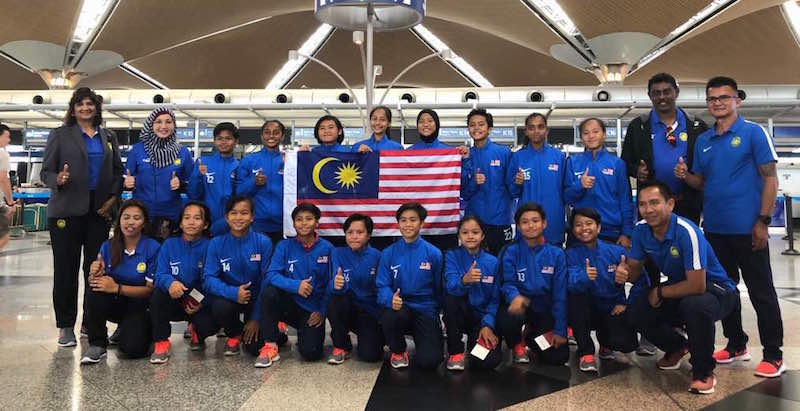
Young footballer Asheesh Kaur, 13, is creating waves. She was recently selected to join the Malaysian under-15 girls team for an international tourney in Hong Kong. There, she was proud to don the national jersey!
The journey began at the Football Association of Malaysia (FAM) carnival at Wisma FAM in November 2017 when she played defender for the Selangor state team. Selangor defeated the other state teams and finished second after losing to GDT Singapore by one nil.
Asheesh, who started playing football at 9, has always been athletic. At school, she was the netball team captain and a runner as well. In 2017, she bagged the school’s Sports Girl award.
In 2016, Asheeh, she proved herself at Astro’s Kem Bola when she was selected to join 31 others for a 10-day training at FCB Escola in Barcelona, Spain.
At the national level, Steffi Sarge Kaur is the first Sikh woman to don the national jersey. The Malaysian women’s international footballer and futsal player was part of the football team at the 2007 Southeast Asian Games and the national futsal team which won the bronze medal at the 2013 Southeast Asian Games.
Asia Samachar spoke to the young footballer. Excerpts:
AS: How did it feel to be selected to play for the national team?
AK: It was a mixed feeling. I was very happy but nervous at the same time.
AS: How did you prepare for this tournament?
AK: I only had two weeks before traveling to Sabah to train under the national coach and with the rest of the team. I had to ensure I was fit for the hectic training at the Malaysian Sports School Sabah. Luckily I am part of the athletics team in my current school. The training I received helped. I also trained daily with a national football development program coach. His coaching was tough. He made me run barefooted for 30 minutes straight everyday before I could even touch the ball. I also received invaluable guidance from my former state sport’s school coach. He helped me train with a former Malaysian team player.
AS: How was the training in Sabah?
AK: I was afraid in the beginning because I heard they train hard but luckily I could keep up. The coach slowly eased me into their training. I had to wait and watch before I could play. I guess that’s normal because I needed to learn their style.
AS: How long were you away for?
AK: I spent seven days in Sabah Sports School and five days in Hong Kong.
Asheesh Kaur with U14 Selangor State team – Photo: Asia Samachar
AS: How did you handle being away?
AK: Again, I had mixed feelings. I felt uneasy especially at night because this is my first time being away, completely on my own. However I was fine when I was training. I wasn’t homesick when I was playing football. Only when I had nothing to do, I felt very homesick but once in Hong Kong, I got used to it by the next day. I think I just needed time to adjust.
AS: Tell us about Hong Kong?
AK: We played against three other teams; Bangladesh, Hong Kong and Iran. We did poorly in our first match against Bangladesh. The team got acclimatised and played better against Hong Kong and Iran. It was a good learning experience.
AS: What’s next?
AK: I’m going to keep on training. It started two days after returning from Hong Kong. I am hoping to be selected again to represent our national team. I want to be ready when that happens.
[ASIA SAMACHAR is an online newspaper for Sikhs in Southeast Asia and surrounding countries. We have a Facebook page, do give it a LIKE. Follow us on Twitter. Visit our website: www.asiasamachar.com] 18594
[Fastest way to reach Asia Samachar: Facebook message or WhatsApp +6017-335-1399. Our email: editor@asiasamachar.com. For obituary announcements, click here]
Kelab Aman hash family day retreat at Kuala Tahan – Photo: Supplied
By Balvinder Singh | Kuala Lumpur
Kelab Aman Hash held its 2018 Family Day retreat at the Xcape Resort in Kuala Tahan, the entry point to Taman Negara, Malaysia’s renowned National Park, on -11 March, 2018.
The idea of a hash run amidst the lush greenery of the world’s oldest deciduous tropical rainforest, estimated to be more than 130 million years old, was too alluring for the organising committee led by Sarbjit Singh aka Video.
Selangor Sikh Union Kelab Aman (SSU) hash section holds its runs on the first, third and fifth (where applicable) Fridays of each month, usually in and around the Klang Valley.
The three-day and two-night event was attended by 94 members and their respective families, both young and old.
They were treated to a flurry of indoor and outdoor activities, from the actual hash run, river cruise along the Tembeling river, a visit to an Orang Asli village and fun games and entertainment for all age groups.
The event was capped-off with a trek up the 1,096-foot high Bukit Terisek on Sunday morning. Those who took part were gifted with a panoramic view from the top over the interior of Taman Negara.
Kelab Aman hash family day retreat at Kuala Tahan – Photo: Supplied
[ASIA SAMACHAR is an online newspaper for Sikhs in Southeast Asia and surrounding countries. We have a Facebook page, do give it a LIKE. Follow us on Twitter. Visit our website: www.asiasamachar.com] 18588
[Fastest way to reach Asia Samachar: Facebook message or WhatsApp +6017-335-1399. Our email: editor@asiasamachar.com. For obituary announcements, click here]
We may have many Sikh non-governmental organisations in country, but I belief that none has the stature of the Sikh Naujawan Sabha Malaysia (SNSM) as a single most significant.
It will not be exaggerating to say that almost every Sikh household in Malaysia would have at some point participated in an activity organised by the SNSM. As a matter of fact, many of us grew up associating with the SNSM as a sole-pillar which brought us together, only to become stronger.
Over the years, the SNSM has organised many impactful and meaningful events, signature being the Gurmat Parchar Samelan, Hola Mahalla Games and Vasakhi Semagam.
While the Samelan has grown to include international participation, Hola Mohalla games provides a platform for young Sikhs to gather and demonstrate unity by competing against each other in the spirit of brotherhood.
The Vasakhi semagam, previously fondly known as “Cheras Programme”, has propelled Sikhi into remarkable heights. This event has indeed been significant in fortifying the foothold of Sikhi in Malaysia, taking us closer towards the teachings of our Gurus. Collectively, the Kirtan sessions nurture our soul while the parcharks (preachers) mould our thinking; in many cases leaving a significant impact in our lives.
It is therefore vital that these parcharaks and kirtanis are carefully identified and selected with strict due diligence process in place, regardless of any sponsor’s interest. After all, it is an unwavering responsibility to serve the wider sanggat, which goes beyond fueling personal interests. The ultimate objective must be to nurture Sikhi, the right way, premised on fundamentals outlined by Panth approved Sikh Rehat Maryada (SRM).
This year, it was initially a shocker when a seemingly controversial individual from the UK, based on the person’s YouTube videos demonstrating blasphemous ideology, was entrusted to address the sanggat at the Vasakhi Semagam, but congratulations to the SNSM leadership who rose to the occasion and later retracted that same invitation.
It is important that our key organisations such as the SNSM demonstrate leadership is ensuring that our religious school of thought as ordained by our Gurus is not in any way disrupted by controversial individuals. In this instance, our leaders at the SNSM had realised their responsibility as individuals vested with the power to ensure that the Sanggat remains united at all times.
It must be a fundamental rule that Semagams, especially those organised by SNSM, to only feature individuals who subscribe to teachings as ordained by Sri Guru Granth Sahib Ji and conform to the established principles of the Sikh Rehat Maryada (SRM) are allowed to do parchar. Nothing more, nothing less!
We cannot and must not at any cost allow our own individual belief to risk disuniting the larger sanggat. While we have witnessed ugly scenes unfolding in our backyard previously, we should never pave the way for more destruction?
It is hoped that the SNSM leadership is more careful when extending invitation to parcharaks and kirtanis in the future. A thorough due diligence must be conducted.
Well done, SNSM!
Darshan Singh Dhillon
* This is the opinion of the writer, organisation or publication and does not necessarily represent the views of Asia Samachar.
[ASIA SAMACHAR is an online newspaper for Sikhs in Southeast Asia and surrounding countries. We have a Facebook page, do give it a LIKE. Follow us on Twitter. Visit our website: www.asiasamachar.com] 18559
[Fastest way to reach Asia Samachar: Facebook message or WhatsApp +6017-335-1399. Our email: editor@asiasamachar.com. For obituary announcements, click here]
IN THE RUNNING: (L-R) Jaspal Singh (MIC), Gobind Singh Deo (DAP), Baljit Singh (Gerakan) and Sangeet Kaur Deo (DAP).
Lawyers Baljit Singh and Sangeet Kaur Deo and former senator Jaspal Singh are among six Malaysian politicians hailing from the Sikh community who may be chosen by their respective parties to run in the next general elections.
The other three – brothers Gobind Singh Deo, Jagdeep Singh Deo and Ramkarpal Singh Deo – are incumbents.
Sangeet and the trio are children of the late Karpal Singh, the legendary lawmaker and lawyer from the Democratic Action Party (DAP).
Another three from the Sikh community with an outside chance are former senator Daljit Singh from the Malaysian Indian Congress (MIC), lawyer Naran Singh from People’s Progressive Party (PPP) and former Perak assemblyman Keshvinder Singh.
Malaysians will go to the polls soon to elect a new Federal Government as well as a majority of the state governments following Prime Minister Mohd Najib Razak’s announcement today (6 April 2018) that the Federal parliament will be dissolved tomorrow. Najib leads the Barisan Nasional (BN) coalition.
Baljit and Sangeet would be entering the Parliament for the first time should they win the race.
The 52-year old Baljit is said to be Gerakan’s choice for the Jelutong parliamentary seat, a Penang seat one time held by Karpal who was famously known as the Tiger of Jelutong.
The Gerakan legal and human rights bureau head, who is also BN coordinator for Jelutong, speaks fluent Hokkien.
Baljit Singh in one of his campaign – Photo: Personal Facebook page
Sangeet, who is the Selangor DAP women’s wing deputy chief, is reportedly being considered to contest in Puchong, the parliamentary seat currently held by her older brother Gobind.
Jaspal, an entrepreneur turn politician, is no stranger to the Parliament having served two-terms at the the upper legislative chamber known as Dewan Negara between 2011-2017.
The MIC vice president is eyeing the Kedah state seat of Bukit Selambau, one of the two state seats in the Merbok parliamentary seat. BN won Merbok in the 2013.
In 2015, Jaspal was elected as VP in MIC after having served as the party treasurer.
In that same party election, Daljit, who had earlier served as a senator between 2008 and 20111, won a seat in the party’s central working committee (CWC).
He then became a director at the Malaysian Tourism Promotion Board and the Indian affairs advisor to Minister of Tourism and Culture.
Daljit has been tasked to work at one of the Selangor constituencies.
Criminal lawyer Naran Singh is in the running for the Perak state seat of Buntong won by the DAP in the last election.
Keshvinder, another potential candidate, first emerged on the political scene when he successfully ran under the DAP banner for the Malim Nawar state seat in 2008.
The then opposition coalition of Pakatan Rakyat managed to wrest the state from BN. In 2009, Perak went back to BN control when three state assemblymen became BN-friendly independents. In 2010, Keshvinder also joined their ranks as BN-friendly lawmakers.
Keshvinder Singh and Hee Yit Foong, who was part of the original three, were appointed coordinators for the Non-Islamic Affairs and Caring Society committees.
[ASIA SAMACHAR is an online newspaper for Sikhs in Southeast Asia and surrounding countries. We have a Facebook page, do give it a LIKE. Follow us on Twitter. Visit our website: www.asiasamachar.com] 18573
[Fastest way to reach Asia Samachar: Facebook message or WhatsApp +6017-335-1399. Our email: editor@asiasamachar.com. For obituary announcements, click here]
Celebration goes on: The small Sikh community in Kota Bharu, Kelantan, celebrate Vasakhi at their local gurdwara – Photo: Suwaran Singh Dhillon
They may be in number, but they are connected with the wider Sikh community in Malaysia and the world over in their passion to celebration Vasakhi, one of the most significant events on the Sikh calendar.
Meet the Sikhs in Kota Bharu, a city in the Malaysian state of Kelantan about 440km from Kuala Lumpur.
They held a rumah terbuka (open house) today at the local gurdwara. Rumah terbuka is a unique Malaysian tradition where groups or individuals hold open functions to celebrate events like the Aidilfitri (or Eid), Chinese New Year and Diwali.
“Pre Vasakhi Celebration today. Small number of Sanggat but they are keeping the tradition going !!! I was obsessed to listen Sikh Members talking in Kelantan Dialect (Kecek Kelate) among them,” Suwaran Sikh Dhillon, a retired Malaysian defence personel, updated in his Facebook entry.
Kelantan has gurdwaras in Kota Bharu, Tumpat and Kuala Krai, a reflection of the bigger number of Sikh population it once had. They were mainly in the armed forces and the civil service.
Today, they are mostly professionals like medical doctors, dentists and police officers. You have retirees, businessmen, teachers and students and lecturers mostly from Universiti Sains Malaysia Health Campus (medicine and dentistry). There also foreign workers from Punjab.
Gurdwara Sahib Kota Bharu welcomes visitors to their Vasakhi open house – Photo: Suwaran Singh Dhillon
[ASIA SAMACHAR is an online newspaper for Sikhs / Punjabis in Asia. How to reach us: Facebook message or WhatsApp +6017-335-1399. Our email: editor@asiasamachar.com. For obituary announcements, click here]






















 He had a difficult start to his educational life and professional career. He faced many hurdles in then-tumultuous Singapore. However, the late Dr Mehervan Singh doggedly overcame each one of them to emerge a stalwart in the Singapore accountancy sector as well as in the inter- religious circles nationally and internationally, and the Sikh community.







 We may have many Sikh non-governmental organisations in country, but I belief that none has the stature of the Sikh Naujawan Sabha Malaysia (SNSM) as a single most significant.