AKHAND PATH: 9-11 February 2018, atGurdwara Sahib Changkat Batu Gajah Perak. PATH DA BHOG: 12pm, 11 February (Sunday) |Malaysia
SAMA SINGH S/O BHAGAT SINGH
Born: 10/06/1928
Departed: 30/01/2018
Wife: Jeet Kour
Children / Spouses:
Hari Singh / Gurcharan Kaur
Bachan Kaur / Joginder Singh
Bibi Kaur / Kartal Singh
Joginder Singh / Horchan Kaur
Silinder Singh / Kaldeep Kaur
Satpal Kaur / Harjinder Singh
Manjit Kaur / Abtar Singh
Charanjeet Kaur / Peram Singh
Jagjeet Kaur / Autar Singh
Grandchildren, great-grandchildren, a host of relatives and friends
Saskaar/cremation:
Cortege leaves from residence at No 116, Persiaran Anggerik Satu, Desa Changkat , 31000 Batu Gajah, Perak at 1p.m on 31/1/2018 (Wednesday) to Sikh Crematorium Batu Gajah
Akhand Path at Gurdwara Sahib Changkat Batu Gajah Perak from 9/2/2018 – 11/2/2018
Path da Bhog at 12pm, 11 February at Gurdwara Sahib Changkat, Batu Gajah
Contact:
Manjit Kaur 0124184073
Silinder Singh 0165346194
Deeply will be missed by family members , relatives and friends.
| Entry: 30 Jan 2018 | Source: Family
[ASIA SAMACHAR is an online newspaper for Sikhs in Southeast Asia and surrounding countries. We have a Facebook page, do give it a LIKE. Follow us on Twitter. Visit our website: www.asiasamachar.com] 17538
[The fastest way to reach Asia Samachar is by sending us a Facebook message or Whatsapp message to +6017-3351399. For obituary announcements, click here]
SASKAAR: 11.45am, 1 February 2018 (Thursday), at DBKL Crematorium, Cheras, Kuala Lumpur|Malaysia
Iser Singh (1952-2018), Kaleke Ampang
ISER SINGH S/O LATE NAJAR SINGH (KALEKE AMPANG)
Birth: 1952
Deceased: 29 Jan 2018
Age: 66
He will be dearly missed, lovingly remembered and forever cherished by all his loved one.
Wife: Bee Be Kaur d/o Late Hamir Singh (Shapa, Sungai Besi)
Children / Spouses:
1. Paramjit Kaur / Jagjit Singh
2. Paramjit Singh
3. Charanjit Singh / Hardeep Kaur
4. Sharonjit Kaur
5. Jaswinderjit Singh
Leaving behind grandchildren, brothers, sisters and relatives.
Cortege timing: Cortege leaves residence No. 28, Jalan 2/1C, Ampang Tasek, 68000 Selangor at 11am, 1 February 2018 (Thursday)
Saskaar / Cremation: 11.45am, 1 February 2018 (Thursday), at DBKL Crematorium, Cheras, Kuala Lumpur
Path Da Bhog: 9am-12pm, 10 February 2018 (Saturday) a Gurdwara Sahib Lembah Jaya Ampang, Selangor, followed by Guru Ka Langgar
Contact:
Jaswin 016-2502267
Charan 014-3621136
| Entry: 30 Jan 2018 | Source: Family
[ASIA SAMACHAR is an online newspaper for Sikhs in Southeast Asia and surrounding countries. We have a Facebook page, do give it a LIKE. Follow us on Twitter. Visit our website: www.asiasamachar.com] 17523
[The fastest way to reach Asia Samachar is by sending us a Facebook message or Whatsapp message to +6017-3351399. For obituary announcements, click here]
Prof Kernial S. Sandhu, 1929–92 – Photo Courtesy of ISEAS – Yusof Ishak Institute, Singapore
Upon finishing his Doctor of Philosophy at the University of British Columbia, the late Professor Kernial Singh Sandhu, a rising academic from Southeast Asia, was appointed Director of the Institute of Southeast Asian Studies (ISEAS) in 1972. The institute was set up in 1968 by Dr Goh Keng Swee, then-Singapore’s Minister for Defence, to become the leading hub for interdisciplinary research for the region. [1]
Many found the move wasteful of crucial monetary resources. [2] Singapore had then just acquired independence and was a third world country that needed all the resources it had. Furthermore, Southeast Asia was a poor region and the western world was at its peak. All in all, there appeared to be little reason to study the region extensively.
Given this, Kernial had two key challenges. The first was for ISEAS to produce highly prized and relevant literature on the region. Secondly, and more importantly, he had to spark interest and help others realise the underlying potential of Southeast Asia. In his 20 years at the institute, Kernial transformed it.
An interview with Dr Sharon Siddique, then-Deputy Director of ISEAS, offered an integral insight into the world of the institute under Kernial’s leadership. First and foremost, Kernial ensured that ISEAS operated with a regional mindset and not just a national one. [3] He implemented a regional culture through nurturing and retaining Southeast Asian talent at the institute. He fully appreciated the concerns of many regional scholars who faced financial constraints in completing their research and extended ISEAS’ funds to help them complete their work.
Putting financial support aside, Kernial was also a man who had time for everyone. He saw equal importance in the work of prominent senior scholars and newly-graduated researchers. “He gave everyone the benefit of doubt for producing good pieces of work. He would continuously allow extension of deadlines. I was amazed by his patience and honestly,” Sharon noted [4].
Kernial’s effort to make ISEAS a regional body with an international appeal was highly successful. By 1992, it had researchers from all over the world, with 40 per cent of them coming from Southeast Asia. [5] Also, by 1992, ISEAS had published over 640 titles and was the region’s largest publisher of scholarly material on the Asia Pacific region. [6] It is clear, this was a man who believed in anyone who walked through his door and it was a quality that is still remembered and deeply appreciated by researchers and ISEAS alike.
Kernial was also behind the movement to develop a world-class library at ISEAS. He believed in equipping the library with excellent updated material and filling it with relevant material. He worked very closely with the librarian to make sure that researchers could get whatever they needed from the library itself. By 1992, the library stood in its own glory and was known to be a regional information centre, hosting more than 300,000 materials. It had increased its usership by 5,330 people in the same year, whereby usership was not exclusive to just researchers of the institute. [7]
EXPANDING ISEAS
Under Kernial’s guidance, ISEAS grew tremendously. However, he had even greater ambitions for the institute and the region. He foresaw a great potential in Southeast Asia and understood the role ISEAS had to play in helping everyone realise the same. To do this, the institute needed to expand much more rapidly in size and reputability.
He used his high stature with the government and international scholars to help acquire funds and academic freedom that would further hone ISEAS’ legitimacy as a reputed source of information on Southeast Asia. Kernial succeeded in acquiring funding from renowned organisations like Volkswagen and Ford Foundation. [8] In fact, by the late 1980s, Konrad Adenauer Foundation was one of ISEAS’ main financial supporters, contributing more than S$400,000 in 1989-90, second only to America’s Ford Foundation. [9] In addition, Australia contributed S$917,633 towards 21 ISEAS research fellowships. [10]
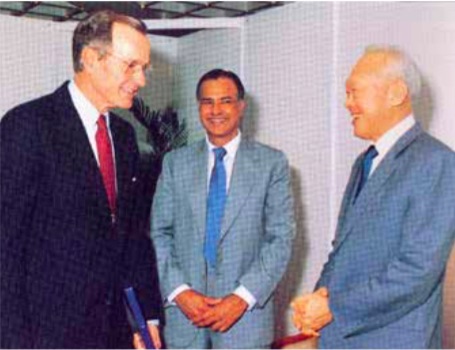
Kernial also saw the value of dialogue in plugging the institute into issues that mattered to the government and the public. Numerous conferences, seminars, public lectures and workshops were conducted throughout the year. He invited former congressmen, ministers and even ex-presidents like Mr George W Bush to deliver public lectures on various topics. [11]
Kernial also sought to make ISEAS a “public education tool” through journals. [12] Some of these journals included The ASEAN Economic Bulletin and Contemporary South East Asia and Trends. [13] These journals comprised materials contributed by scholars at the institute as well as ministers, policy-makers and senior research fellows from all over the world. The willingness of so many big names to contribute to the journals published by ISEAS again demonstrated the institute’s growing reputability and its positive reputation amongst an international crowd. These publications were distributed in 73 countries, 53 per cent of them in Asia. [14]
Prof Kernial S. Sandhu (middle) with Singapore PM Lee Kuan Yew and George Bush – Photo-Courtesy of ISEAS Yusof Ishak Institute, Singapore
“Professor Sandhu was one of the brightest minds of his time. He had an astute understanding of regional and global affairs. A wonderful intellectual, he was much- sought after by local and international institutions for his views on geo-political issues confronting Singapore and the region at that time. Above all, he was generous with funding, advice and time – he was always willing to help fellow colleagues and young academics who wanted to understand his thoughts and perspectives. Professor Sandhu spent much of his life at ISEAS and transformed it into one of the most, if not the most, respected institutions in Southeast Asia. When I took over as Director of ISEAS in 2002, some 10 years after Professor Sandhu, I inherited an organisation that owed so much of its progress to him. His unfortunate demise in 1992 shocked all of us who knew him. He left a huge void in the academic arena.“
MR K KESAVAPANY
Adjunct Professor, Lee Kuan Yew School of Public Policy, National University of Singapore, and Former Director, ISEAS
ASEAN FTA
Despite having so much on his plate, Kernial also continued with his own research and authored seven books centred mainly on migration of Indians to Southeast Asia and the rise of Melaka in the 18th century. [15] According to Sharon, Kernial’s books are still highly regarded and known as classics till today. In particular, his book, Management of Success: The Moulding of Modern Singapore even caught the attention of Singapore’s first Prime Minister, Mr Lee Kuan Yew. A joint effort by Kernial and Professor Paul Wheatley, Sharon explained that no one has been able to beat the 1,134-page reference material till today, some 26 years later. [16]
The professor’s most prominent contribution to Singapore and Southeast Asia, however, lies in building economic cooperation which eventually led to the establishment of the Association of Southeast Asian Nations (ASEAN) Free Trade Agreement in 1992. [17] He led the way by organising annual ASEAN roundtables and invited officials and ministers from ASEAN to discuss economic potential of and possible challenges to ASEAN cooperation. By 1992, a new chapter was opened by the region with the free trade agreement.
HEART ATTACK
Not surprisingly, towards the end of his tenure at ISEAS in 1992, Kernial showed no signs of slowing down. He was preparing the launch of another compilation called the ASEAN Reader [18] when he suddenly passed away of a heart attack on 2 December 1992.
Suggestions were made to put the book launch on hold. Instead, Sharon explained that the book launch was used as a platform to celebrate the legendary professor’s magnificent career. She stated: “It is, to-date, one of the most moving book launches I have ever been to.” [19]
Guests flew down from all parts of the world for the launch and memorial service for Kernial. Among the guests were former Senior Minister, Mr S Rajaratnam, Distinguished Senior Fellow at ISEAS, [20] and Justice Punch Coomaraswamy, Chairman of the ISEAS Board of Trustees. His Excellency Dato’ Ajit Singh, ASEAN Secretary General-designate, delivered a moving speech where he said: “It is a tragedy that the one man to whom we owe it all is not with us today. This would have been one of Kernial’s proudest moments for I know how much it meant to him.” [21]
An active member in public service, Kernial was awarded the Pingat Pentadbiran Awam (Public Administration Medal) (Gold) [22] in 1985. [23]
Sharon also revealed that Kernial was one of the most respected members of the Sikh community, taking part in many Sikh committees to lend support to members of the community. However, she added that he was, first and foremost, a devoted husband, stating: “In fact, on the evening of the 2 December 1992, he left office early as he was taking his wife to see the Christmas lights in Orchard Road.” [24]
Kernial was a man who dedicated his life to service, believed in breaking scholarly boundaries and lived for the unification of ASEAN countries for economic success. He was also one of the most respected academics of his time. His legacy lives on.
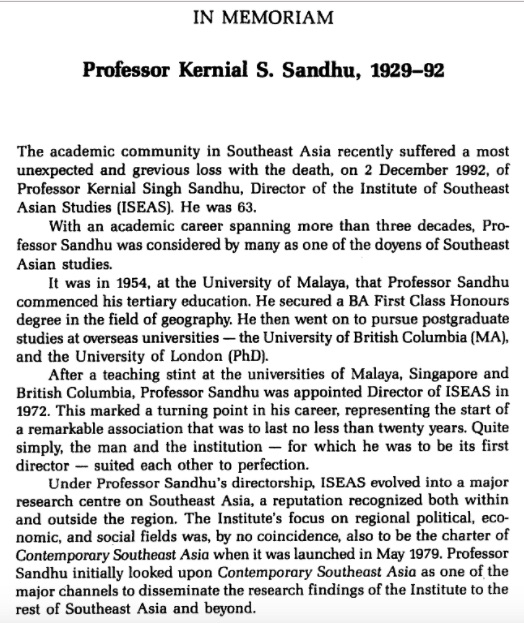
IN MEMORIAM: Professor Kernial S. Sandhu, 1929–92 by Derek da Cunha, Contemporary Southeast Asia, Vol. 14, No. 4 (March 1993), Published by: ISEAS – Yusof Ishak Institute
Endnotes
1 A Chen, What other Singapore think tanks do, The Straits Times, February 19, 1991, Factiva. 2 K James, Research Institute Worth Backing, The Straits Times, November 19, 1989, Factiva. 3 Ibid. 4 Interview with Dr Sharon Siddique, May 6, 2015. 5 ISEAS Annual Report (1992-1993), 1993, 1-73. 6 Ibid. 7 Ibid. 8 Ibid. 9 Dr Seet awarded fellowship to do research at Iseas, The Straits Times, September 28, 1991, Factiva.
10 Australian government gives fellowship grant, The Business Times, July 3, 1991, Factiva. 11 Bush to give Singapore Lecture in January, The Business Times, December 17, 1991, Factiva. 12 P Daniel, Returned émigré pays tribute to human spirit, The Straits Times, November 14, 1989, Factiva. 13 ISEAS Annual Report, op cit. 14 Ibid. 15 K James, The Business Times, December 4, 1992, Factiva. 16 James, The Straits Times, op cit. 17 P Imada, In AFTA, the way ahead, Singapore: ASEAN Economic Research Unit, Institute of Southeast Asian Studies, 1992. 18 Iseas book in memory of Sandhu, The Straits Times, December 11, 1992, Factiva. 19 Interview with Dr Sharon Siddique, op cit.
20 Daniel, op cit. 21 Iseas book in memory of Sandhu, op cit.
22 The Pingat Pentadbiran Awam was instituted in 1963. There are three grades of the medal, namely, gold, silver and bronze. The medal may be awarded to any of the following persons for outstanding efficiency, competence and industry – any person who is or has been a public officer; any person who is or has been an officer employed by any stat- utory authority (other than a Town Council); any person who is or has been in the service of any organisation, association or body rendering services in the field of education; or any person who is or has been employed in any company which is wholly-owned by the government and which is carrying on business mainly as an agent or instrumentality of the government.
23 K James, The Business Times, op cit.
24 Interview with Dr Sharon Siddique, op cit.
[This article is courtesy of SINGAPORE AT 50: 50 SIKHS AND THEIR CONTRIBUTIONS, a book published in 2015 by the Young Sikh Association, Singapore (YSA) in conjunction with Singapore’s 50th birthday]
[ASIA SAMACHAR is an online newspaper for Sikhs in Southeast Asia and surrounding countries. We have a Facebook page, do give it a LIKE. Follow us on Twitter. Visit our website: www.asiasamachar.com] 17469
RELATED STORIES:
[The fastest way to reach Asia Samachar is by sending us a Facebook message. For obituary announcements, click here]
Mother Indira Gandhi with two of her older children. The family is embroiled in a nasty conversion case. – Photo/AsiaSamachar/Facebook
Malaysia’s apex court has ruled that the consent of both parents is needed to change a child’s religion.
In a landmark ruling today (29 Jan 2018), Federal Court of Malaysia ruled against the unilateral conversion of Hindu mother M. Indira Gandhi’s children by her Muslim ex-husband, thus ending her nearly decade-long ordeal.
The unanimous decision of the five judges would certainly be welcome by the substantial non-Muslim population in Malaysia, though some elements will certainly call for the elevation of the status of the Syariah courts.
The three appeals before the Federal Court were concerned with the registration of conversion of children in a non-Muslim marriage to Islam under the Perak Enactment.
“We hold that the High Court is seised with jurisdiction to exercise its supervisory power to decide on the complaints made by the Appellant against the administrative act of the Registrar of Muallafs in issuing the certificates of conversion of the Appellant’s children to Islam,” said Justice Zainun Ali who read out the 99-page judgment.
“We find that the Registrar of Muallaf had no jurisdiction to issue the certificates of conversion in respect of the conversion of the children to Islam due to noncompliance of sections 96 and 106(b) of the Perak Enactment. In giving effect to the statutory provisions of the Perak Enactment the Court is not required to inquire into principles of Syariah law or to resolve doctrinal legal issues arising out of the matter.
“We also find that the certificates of conversion were issued without the consent of the Appellant thus contravening Article 12(4) of the Federal Constitution and sections 5 and 11 of the GIA. The certificates of conversion are void and must be set aside,” according to a press summary released for the case.
He said the decision enables the comprehensive regime of judicial review based on standard concepts of justiciability.
A five-man panel, led by Court of Appeal president Justice Zulkefli Ahmad Makinudin, were unanimous in their decision. The panel included Chief Judge of Sabah and Sarawak Justice Richard Malanjum, Justices Zainun, Abu Samah Nordin and Ramly Ali.
The issue dates back to 2009. On April 2, 2009, Indira’s ex-husband had covertly converted their three children to Islam without her knowledge and without her consent. He then appeared before the Shariah court just a few days later to obtain custody rights for them. Indira was a kindergarten teacher.
In late 2015, Malaysia’s Court of Appeal released a ruling on the conversion case that has gripped the attention of the nation.
In a 2-1 majority ruling, the court held that the validity of conversion of three children by their Muslim father could only be determined by the Shariah Court.
The three questions posed to the Federal Court in this appeal were:
QUESTION 1: Whether the High Court has the exclusive jurisdiction pursuant to section 23, 24 and 25 and the Schedule of the Courts of Judicature Act 1964 (read together with Order 53 of the Rules of Court 2012) and/or its inherent jurisdiction to review the actions of the Registrar of Muallafs or his delegate acting as public authorities in exercising statutory powers vested by the Administration of the Religion of Islam (Perak) Enactment.
QUESTION 2: Whether a child of a marriage registered under the Law Reform (Marriage & Divorce) Act 1976 (‘a civil marriage’) who has not attained the age of eighteen years must comply with both sections 96(1) and 106(b) of the administration of the Religion of Islam (Perak) Enactment 2004 (or similar provisions in State law throughout the country) before the Registrar of Muallafs or his delegate may register the conversion to Islam of that child.
QUESTION 3: Whether the mother and the father (if both are still surviving) of a child of a civil marriage must consent before a Certificate of Conversion to Islam can be issued in respect of that child?
[ASIA SAMACHAR is an online newspaper for Sikhs in Southeast Asia and surrounding countries. We have a Facebook page, do give it a LIKE. Follow us on Twitter. Visit our website: www.asiasamachar.com] 17518
APPEAL: Senator Devamany letter to PNB chief Abdul Wahid Omar – Photo / Asia Samachar
D Singh, a retired public school principal, visited a branch of a local bank to invest in a Government-initiated investment scheme targeted for Malaysians of Indian origins.
To his surprise, the bank staff told him that he did not make the cut for the Amanah Saham 1Malaysia investment scheme, managed by the Malaysian investment giant Permodalan Nasional Berhad (PNB).
“The bank staff told that the scheme is for Indians only. I was surprised as all my life, I have been registered as an Indian,” the retired principal told Asia Samachar. “The staff herself was an Indian.”
Singh plans to visit again another day the Malayan Banking Bhd (Maybank) branch in Kuala Lumpur.
It seems he is not the first to get the cold shoulder when attempting to make avail of the investment scheme. It has even prompted a senator from the Malaysian Indian Congress (MIC) to issue a letter to PNB chairman Abdul Wahid Omar to highlight the matter.
“We have received feedback that Malaysian citizens listed under Punjabi, Singh and Kaur in their Identity Card and Birth Certificates have not been allowed to purchase the investment units as they have not been categorised as Indians. This has raised some unhappiness and confusion as they are of indian origin and have the right to purchase the AS1M,” writes SK Devamany.
The confusion is probably caused by the option taken up when registering race. Some opt for Indians, while others may have ticked Punjabi, thus placing them in the ‘Other’ category.
When presenting Federal Government Budget for 2018, Prime Minister Najib Razak had announced that PNB would allocate of an extra 1.5 billion units under AS1M to enable Malaysian Indians to top up their investment in the unit trust fund, up to 30,000 units per investor.
The scheme is meant to benefit the Indian community, especially those in the so-called B40 category, which refers to the poorer segent of th society.
The scheme was open from today (29 Jan 2018).
Earlier, the government had also introduced interest free loans to allow members of the Indian community to purchase up to 5,000 AS1M shares.
[ASIA SAMACHAR is an online newspaper for Sikhs in Southeast Asia and surrounding countries. We have a Facebook page, do give it a LIKE. Follow us on Twitter. Visit our website: www.asiasamachar.com] 17180
[Fastest way to reach Asia Samachar: Facebook message or WhatsApp +6017-335-1399. Our email: editor@asiasamachar.com. For obituary announcements, click here]
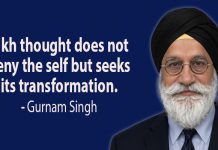
We inherited the name Singh from our parents by being born in a Sikh Household. Most of us just brush it aside as it’s just a name. I am afraid most of us are not aware of the significance of the name itself. If only we all are truly aware of the sacrifices and true valor displayed by our Singhs and Sikh forefathers that gave is this beautiful inheritance.
Singhs and Kaurs alike championed human rights. Faught bravely to uphold justice and freedom. Guru Govind Singh Ji Maharaj and our martyr Sikhs sacrificed almost everything for us to retain this beautiful name.
The Singhs served in the British Army during both the world wars and was lauded by the world to be the bravest men and most disciplined men with outmost level of morality. The 36the Sikh regiment whereby 21 Sikh soldiers went against 10,000 Afghan forces defending the Indian border. True display of courage and strength. The freedom fighter Bhagat Singh laying down his life for the liberation of India. The Khalsa Aid for serving humanity in any corner of the world.
Our Guruji’s gave us this beautiful legacy to carry on. The Singhs are known to be warriors of the people. Thousands of people around the world are fed through the Gurdwaras around the world.
Yes we inherited the name Singh but remind yourself the importance and history of the name. Uphold the reputation of the name. It didn’t come easy. The least we can do is not put a strain on the name. Before doing anything wrong, remember that We are SINGH and it took so much to establish that. Serve all, help all and respect all
My apologies if I have made any mistakes.
A Humble Singh,
Malaysia.
[ASIA SAMACHAR is an online newspaper for Sikhs in Southeast Asia and surrounding countries. We have a Facebook page, do give it a LIKE. Follow us on Twitter. Visit our website: www.asiasamachar.com] 17509
From time to time, schools authorities in some odd Malaysian schools will raise the issue of Sikhs students bearing their uncut hair or wearing of the kara (bangle).
Every year, Sikh organisations would encounter such issues from a few schools around the nation. This year itself, at least two such incidents in Selangor came to the attention of the Sikhs organisations.
Usually, the matter is resolved when the parents highlight to the school authorities of the circulars from the Ministry of Education underlining the right of Sikh students to bear their unshorn hair and the wearing of kara.
We share the circular here for the ease of parents who may need it.
In 2015, the Ministry of Education (MOE) issued a circular dated 4 June 2015, addressed to all ministry divisions and state directors, dealing with the Sikhs students uncut hair and facial hair, including the beard and moustache.
The circular is known as: Surat Pekeliling Ikhtisas Kementerian Pendidikan Malaysia Bilangan 9 Tahun 2015 – Panduan Berkenaan Rambut dan Pemakaian Steel Bangle (KARA) Oleh Murid-Murid Keturunan Sikh (05/06/2015). It can be found here.
Many a time, they had faced an uphill battle to convince school heads that their religion forbids them from shaving hair from any part of their body. Earlier MOE circulars on the matter were vague in some areas, especially when it came to allowing Sikh students to maintain their moustache.
[ASIA SAMACHAR is an online newspaper for Sikhs in Southeast Asia and surrounding countries. We have a Facebook page, do give it a LIKE. Follow us on Twitter. Visit our website: www.asiasamachar.com] 17504
[The fastest way to reach Asia Samachar is by sending us a Facebook message or Whatsapp message to +6017-3351399. For obituary announcements, click here]
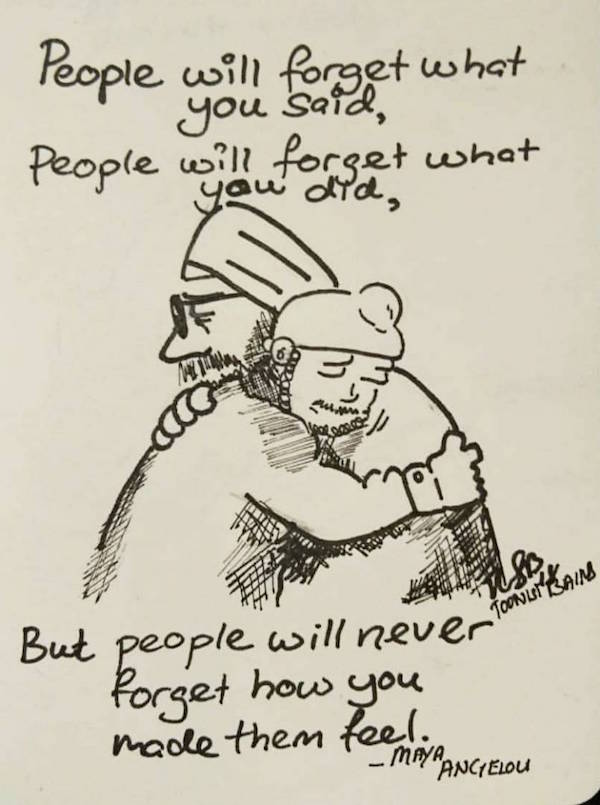
People will never forget how you made them feel – ToonistBains
ASIA SAMACHAR is an online newspaper for Sikhs in Southeast Asia and surrounding countries. We have a Facebook page, do give it a LIKE. Follow us on Twitter. Visit our website: www.asiasamachar.com] 17500
[Fastest way to reach Asia Samachar: Facebook message or WhatsApp +6017-335-1399. Our email: editor@asiasamachar.com. For obituary announcements, click here]
PATH DA BHOG / DEEWAN: 9am onwards on 4 February 2018 (Sunday) at Gurdwara Sahib Sentul, Kuala Lumpur | Malaysia
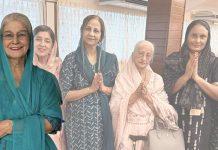
Giani Inderjit Kaur (1930-2017), Sentul
GIANI INDERJIT KAUR
Wife of Giani Indar Singh Gill
She served as Punjabi Teacher and headmistress at Guru Nanak Punjabi School for a period of more than 40 years. Helped the greatest number of students to score distinctions at PMR and SPM level. Won several awards for this and remained dedicated to helping families and individuals to connect with language and Gurbani even after retirement.
Born: 5 March 1930
Departed: 6 Feb 2017
Path da bhog & Deewan: 9am onwards on 4 February 2018 (Sunday) at Gurdwara Sahib Sentul, Kuala Lumpur
Children/Spouses:
Sdr Jasbir Singh/ Sdrni Pretham Kaur
Sdr Hargopal Singh/ Sdrni Daljit Kaur
Sdr Harwindar Singh/ Sdrni Jaswinder Kaur
Sdrni Tejindarpal Kaur/ Sdr Jaspal Singh Bhetti
Request kind attendance to join us in remembering Mata Ji and connect to Gurbani messages.
Contact:
Harwindar 012–2682417
Jasbir 019-6629566
| Entry: 28 Jan 2018 | Source: Family
[ASIA SAMACHAR is an online newspaper for Sikhs in Southeast Asia and surrounding countries. We have a Facebook page, do give it a LIKE. Follow us on Twitter. Visit our website: www.asiasamachar.com] 17492
[The fastest way to reach Asia Samachar is by sending us a Facebook message or Whatsapp message to +6017-3351399. For obituary announcements, click here]
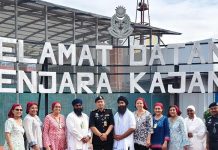
During Nirvair Khalsa Jatha UK’s Indonesia Gurmat Parchaar Tour 2018, under the NKJ Outreach Programme an initiative was taken to meet and support those children who had been neglected by their parents and taken in by Yayasan Rumah Piatu Foundation, established in 1975 in Jakarta.
The Foundation takes in children from all ages – both girls and boys – where they are taught key life skills and educated to allow them to become talented individuals when they become adults. Educating a young girl and boy, provides the groundwork for an educated mother and father, which will lead to an educated family preventing children being neglected in the future.
Members of NKJ Outreach Programme today spent an afternoon with the children in the Foundation discussing their aspirations and aims – we were taken aback by their ambitions and enthusiasm. They were given a grand lunch this afternoon and provided with educational books, stationary and essentials a child would have when going to school such as lunch boxes and water bottles.
We thank the Yayasan Rumah Piatu Foundation for allowing NKJ Outreach Programme to donate their time and resources to such driven, motivated and aspirational children. They are doing an amazing job taking in neglected children and giving them grounds to develop wise and educated personalities.
















 SAMA SINGH S/O BHAGAT SINGH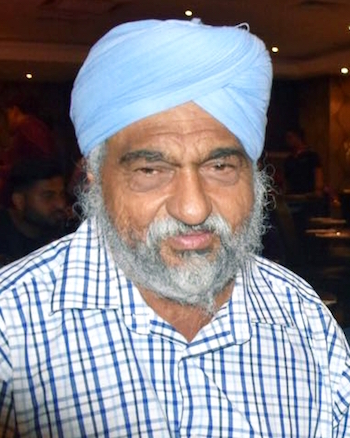
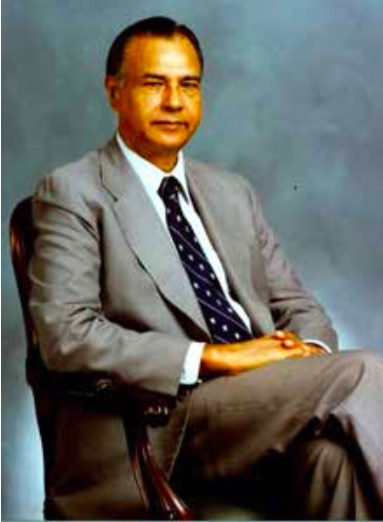


 We inherited the name Singh from our parents by being born in a Sikh Household. Most of us just brush it aside as it’s just a name. I am afraid most of us are not aware of the significance of the name itself. If only we all are truly aware of the sacrifices and true valor displayed by our Singhs and Sikh forefathers that gave is this beautiful inheritance.
 From time to time, schools authorities in some odd Malaysian schools will raise the issue of Sikhs students bearing their uncut hair or wearing of the kara (bangle).