The Punjabi mother forked out some Rs 3.70 lakh (S$7,600 or RM22,500) to land her kid a job in Singapore. That didn’t happen. And now they are chasing after the money which seems to be alluding them.
This is yet another potential immigration scam reported in the Punjab media.
In the latest report, it was reported that three persons running an immigration agency have been booked for allegedly duping two persons duping between Rs 1.72 lakh and Rs 3.70 lakh.
The victims said the agency ‘Vagaband Immigration Consultants’ was not registered and the accused had been “duping” gullible youth by promising them the moon, reports Tribune News Service (TNS).
In the first case, Gurdevpreet Singh, a resident of Patti (Tarn Taran), alleged that Padmini Khanna and her father Raman Khanna took Rs 1.72 lakh from him and promised to send him to Austria on a study visa.
The second complaint was filed by one Vishal Kumar and his mother Sunita Rani. Sunita said Padmini and Resham had taken Rs 3.70 lakh from her to send her son to Singapore on a work permit. She stated that accused neither kept their promise nor returned the money. The police have slapped Sectors 420 and 120-B and relevant sections of the Punjab Prevention of Human Smuggling Act on them, the report added.
[ASIA SAMACHAR is an online newspaper for Sikhs in Southeast Asia and surrounding countries. We have a Facebook page, do give it a LIKE. Follow us on Twitter. Visit our website: www.asiasamachar.com] 17604
[Fastest way to reach Asia Samachar: Facebook message or WhatsApp +6017-335-1399. Our email: editor@asiasamachar.com. For obituary announcements, click here]
Gurdwara managements seen from new three-legged stools: Narcissism, Nepotism and Nihilism – Photo courtesy of Pixabay
By I.J. Singh
Take ménage a trois that is not unholy but is fundamental to human survival. Think of the cyberworld dictum of Click, Connect, Collaborate. The world understands Life, Liberty and Pursuit of Happiness as the promise of America. Remember that it’s the pursuit, not the attainment that’s at the core.
If challenged to come up with a pithy but precise soundbite of Sikhi, most of us would likely respond with the historic triad of Naam Japna, Kirat Karni, Vand Chhakna; to wit, a life lived in awareness of the Creator, fueled by honest earnings, and sharing the rewards of a productive life with the needy. Note that the second and third precepts are social constructs that flow from the first, which defines our spiritual underpinnings. Alternatively, I could recommend Sutt, Santokh and Vitchar (or Truth, Equipoise and the intellectual process), a triad that appeals to a life of the mind.
Simply beautiful, wouldn’t you say?
We unendingly reiterate these or similar formulations at Sikh institutions and events. They highlight elemental themes of our individual and communal existence. These are the foundational rocks on which Sikhs have erected a shining historical reality. Now some factoids about gurduara management that we wish were different. Most gurduaras have a Constitutional framework – easily cast aside, rarely ever followed honestly, elegantly, logically or gracefully.
The American Sikh community is largely shaped by India’s timeless culture and often behaves accordingly. Remember when in the 1970’s India’s supreme leader, Indira Gandhi, suspended the Constitution of India, ruled extralegally by fiat, and promoted her son, though totally devoid of talent, ability or experience, for the onerous responsibilities of her office.
With a rare exception or two, most gurduaras in the diaspora largely mimic her model. They ignore their own laws or traditions, refuse to hold elections, and engage in egregious litigation, corruption, even violence.
When confronted about such malfeasance a gurduara heavy-hitter floored me: “We can’t live by participatory governance and electoral procedures; what if fools, criminals and swindlers win,” he asked? My response, equally unkind, was: “Look around, don’t we have these types already among us? We’ll survive!”
Our shenanigans effectively proclaim that we have neither the sense nor the framework to adjudicate our internal differences and need a legal monkey in the middle – often one who knows nothing of our history, traditions or teachings. Violence, to both people and ideas, unfailingly results, all in the name of Guru and God.
We, the new kids on the block in North America, are not so new after all. Sikh workers helped construct the Panama Canal in 1901-03. Yet we are the new kids because our measurable presence dates only from the 1970’s. Now things seem to be changing at a breakneck pace. Largely because of gurduara troubles that I have hinted at, a new generation is increasingly distanced from our existing institutions.
NARCISSISM, NEPOTISM & NIHILISM
With pun and irony intended, I would like to exemplify many of our gurduara managements briefly through new structural formulations of unholy ménage a trois — three-legged stools.
One triad is structurally framed by Narcissism, Nepotism and Nihilism. This 3-N formula comes from Nicholas Kristof, a New York Times columnist, and I view its functioning through Indira Gandhi’s governing style that I alluded to earlier.
In this model, any question or suggestion is apriori a challenge to the leader’s sense of self, hence a grave insult, if not a crime. Yet everyone, even the best, must die; who will then replace the one irreplaceable leader, except the leader’s progeny? Ergo, no one dares to replace the one fearless leader except her or his descendent. Surely, such a system is headed for collapse. This is ego run amok – and is rightly labeled narcissism.
The only consistent choice that surfaces without fail is to promote the leader’s handpicked relative, no matter the lack of ability or aptitude. And that is nepotism, or easier yet, “chumocracy.” For a clear application of this, follow the hierarchies that form the structure of the Indian political bureaucracy or focus on President Trump’s inner circle in the USA.
When nothing productive points to a direction or endpoint, the goal then is best labeled nihilism; it implies rejection of all moral principles or constraints. A true nihilist believes in nothing, has no loyalties, no purpose and no direction larger than the self. And life quickly becomes meaningless.
IGNORANCE, INCOMPETENCE & INPUDENCE
And then my roving mind settled on another possible replacement model of a three-legged stool: Ignorance, Incompetence and Impudence (arrogance). I don’t know whether to label impudence as the third-leg or the icing on the cake. But that would be mixing metaphors. Ignorance and incompetence overlaid with a shiny patina of arrogance make a deadly set, however wobbly. I need not elaborate this any further; just look at the operational style of our political leaders in Sikh institutions.
What operational design of a tripod would best suit us?
I would recommend that we stick with the tried and true that Sikhi gave us, and work to earn it.
I.J. Singh is a New York based writer and speaker on Sikhism in the Diaspora, and a Professor of Anatomy. Email: ijsingh99@gmail.com.
[ASIA SAMACHAR is an online newspaper for Sikhs in Southeast Asia and surrounding countries. We have a Facebook page, do give it a LIKE. Follow us on Twitter. Visit our website: www.asiasamachar.com] 17596
[ASIA SAMACHAR is an online newspaper for Sikhs in Southeast Asia and surrounding countries. We have a Facebook page, do give it a LIKE. Follow us on Twitter. Visit our website: www.asiasamachar.com] 17590
[The fastest way to reach Asia Samachar is by sending us a Facebook message or Whatsapp message to +6017-3351399. For obituary announcements, click here]
Bangkok-based Charoen Pokphand Group Co., Ltd. (C.P. Group) has announced the appointment of Kulshaan Singh as Co-Chief People Officer (Co-CPO).
Kulshaan, who had stints as CEO at Mercer Singapore and MD at Aon Hewitt Southeast Asia, has more than two decades of global experience in the professional services and management consulting industry.
His area of expertise is in talent and leadership development, organisation change and human resources (HR) transformation, employee engagement and performance and talent management. Over the years, he has had experiences working with people across the globe and has lived in Thailand, Malaysia, India and Singapore, according to a statement from the company.
Kulshaan, who joined the group towards end-2017, will be responsible for building and managing group’s global employer brand as well as developing a strategy to build a world-class HR functions, the statement added.
CP Group engages in the businesses of agro-industry and food, marketing and distribution, and telecommunications in Thailand and internationally. Its agro-industry and food business includes farming of poultry, swine, and shrimps, according to Bloomberg.
It has now expanded into retail, telecommunication and media, e-commerce and digital, property development, plastics, automotive, finance and insurance, and pharmaceutical, accoding to information at the company’s website.
Kulshaan, who will work closely with Co-CPO Dr. Naris Thamkuekool, reports directly to CP Group CEO Suphachai Chearavanont.
“Kulshaan brings a tremendous track record in leading large-scale organization transformations and this will be invaluable in our quest to build a world-class HR function and enable us to recruit and develop the very best talent to support our strategic growth ambitions,” said Suphachai in the statement.
The Singapore national will be based in the C.P. Group headquarter in Bangkok.
[ASIA SAMACHAR is an online newspaper for Sikhs in Southeast Asia and surrounding countries. We have a Facebook page, do give it a LIKE. Follow us on Twitter. Visit our website: www.asiasamachar.com] 17585
RELATED STORY:
(Asia Samachar, 31 Jan 2017)
[Fastest way to reach Asia Samachar: Facebook message or WhatsApp +6017-335-1399. Our email: editor@asiasamachar.com. For obituary announcements, click here]
HONOURED: Top cop Amar Singh receives award from Yang di-Pertuan Agong Sultan Muhammad V. Right: Gurjeet Singh Rhande and his wife Daljit Kaur – Photo: Bernama/PPM
Commercial crime buster Amar Singh and Parti Punjabi Malaysia (PPM) president Gurjeet Singh Rhande received the Datuk awards at the awards investiture ceremony in conjunction with the 2018 Federal Territories Day yesterday (1 Feb 2018).
The awards were bestowed by Yang di-Pertuan Agong Sultan Muhammad V at an event at Istana Negara in Kuala Lumpur.
Commissioner Amar Singh, the former Kuala Lumpur chief police officer, was promoted as Federal police commercial crime investigation director in October 2017.
A week earlier on 27 Jan, the third-generation cop received the Datuk Seri title from the Pahang ruler.
Gurjeet is also the president of the Malaysian Singapore Sikh Sports Council (MSSSC) and Perak Sikh Union (PSU).
[ASIA SAMACHAR is an online newspaper for Sikhs in Southeast Asia and surrounding countries. We have a Facebook page, do give it a LIKE. Follow us on Twitter. Visit our website: www.asiasamachar.com] 17576
[Fastest way to reach Asia Samachar: Facebook message or WhatsApp +6017-335-1399. Our email: editor@asiasamachar.com. For obituary announcements, click here]
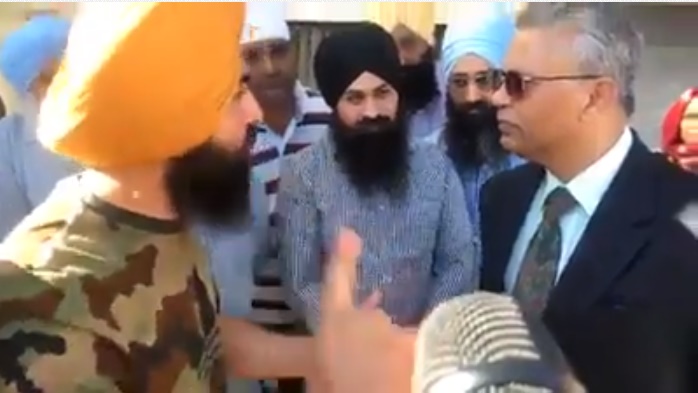
VIDEO GRAB: In November 2017, several Sikhs protested against India’s High Commissioner in Australia, Dr AM Gondane (right, in black suit), when he visited a gurdwara in Melbourne’s west
The Aussie gurdwaras are following the footsteps of their counterparts in the US, Canada and UK by slapping a ban on Indian officials from visiting the Sikh place of worship in their official capacity, adding that they are free to visit as individuals.
Twenty gurdwaras and 15 Sikh organisations have announced a ban on “government activities” by the representatives of the Indian government in the gurdwaras and Sikh events in a joint statement on Sunday (28 Jan 2018), reportsSBS Punjabi.
“This ban would also extend to organisations involved in anti-Sikh activities, such as the Rashtriya Swayamsewak Sangh, Vishva Hindu Parishad and the Shiv Sena’s office bearers,” the report quoted Harkirat Singh Ajnoha of the Supreme Sikh Council of Australia while reading out the joint statement at Gurudwara Miri Piri in Melbourne.
The activists said the “atrocities” against the Sikhs were ongoing and the Indian government was protecting the police officers who “killed” Sikh men in alleged fake encounters. They also alleged that officials of the Indian consulate interfere in the internal affairs of Sikhism and harass those Sikhs who raise issues of human rights, the report said.
The same report added a response form the Indian High Commission in Canberra which had rejected the allegations.
“Indian officials outreach to all communities, associations, groups of Indian origin. There is no question of meddling in their affairs,” an official at the Indian High Commission told SBS Punjabi. “Invitations received by Mission/ Posts are respected and reciprocated.”
In November last year, several Sikh men held a protest demonstration against India’s High Commissioner in Australia, Dr AM Gondane, when he was visiting a gurdwara in Melbourne’s west, raising the issue of arrest of a British Sikh in India.
A spokesman for the Indian High Commission told SBS Punjabi today that what transpired at the Tarneit gurudwara was an “isolated incident” which had not been repeated anywhere. He said the High Commission and other officials attend functions organised by Sikh organisations.
“Recently the High Commissioner attended a function on the launch of a book on Sikh Heritage and Legacy in Sydney at the invitation of Sikh Youth Australia,” the official said.
Ajnoha said the campaign (to ban Indian officials from gurudwaras) began after the protest demonstration against the Indian High Commissioner at the Gurudwara in Tarneit. However, the management committee of the Tarneit gurudwara claims they were not consulted, the report added.
While Sri Guru Nanak Satsang Sabha Gurudwara, Blackburn confirmed that they would implement this decision, Sri Guru Singh Sabha Gurudwara, Craigieburn already has a policy of not allowing any officials or politicians to use the stage of the Sikh temple. Parklea gurudwara in Sydney also told SBS Punjabi that it doesn’t allow any political activities on the temple premises, the SBS Punjabi report said.
[ASIA SAMACHAR is an online newspaper for Sikhs in Southeast Asia and surrounding countries. We have a Facebook page, do give it a LIKE. Follow us on Twitter. Visit our website: www.asiasamachar.com] 17572
[Fastest way to reach Asia Samachar: Facebook message or WhatsApp +6017-335-1399. Our email: editor@asiasamachar.com. For obituary announcements, click here]
The Sikh Manifesto developed by the Sikh Federation (UK)
Today marks the 3rd anniversary of the launch of the 10-point Sikh Manifesto at Sri Guru Singh Sabha, Southall.
Three years later the setting up of the Sikh Network and the development of the Sikh Manifesto by the Sikh Federation (UK) is seen as a masterly political stroke.
The level of progress made against many of the 10-points is such a short period of time is truly remarkable.
All British political parties appreciate the strength of the Sikh Manifesto concept backed by the professionals of the Sikh Network and grassroots support and clout of the Sikh Federation (UK).
Despite constant lobbying by the Indian authorities many politicians in government and the opposition now privately accept this combination is head and shoulders above any other Sikh organisation operating in British political circles.
Preet Kaur Gill and Tanmanjeet Singh Dhesi, the two Sikh MPs elected in June 2017 are directly linked to the Sikh Network and back the Sikh Manifesto.
The role of the Sikh Federation (UK) in influencing the leadership of the Labour Party in getting them elected and persuading the party to include key issues relevant to Sikhs in the Labour Party’s manifesto has not been lost on the Indian authorities who are worried with the direction of travel.
Since the election of these two Panthic-minded Sikh MPs progress against some of the issues in the Sikh Manifesto has been taken to a new level.
First came progress on securing huge cross-party support on the separate Sikh ethnic tick box in the Census 2021 that has made this a real possibility when the Census White Paper is published later this year.
Yesterday there was an unprecedented show of cross-party support at the campaign launch in Parliament for a monument in central London to highlight Sikh Sacrifices in the World Wars promoting the distinct Sikh identity.
These developments attracting support from a very wide ranging cross-section of the Sikh community will be sending alarm bells ringing not only at the Indian High Commission in London but also with the Indian authorities in Delhi.
Bhai Amrik Singh, the Chair of the Sikh Federation (UK) said:
“Plans are afoot for several other major developments on other more critical issues in the Sikh Manifesto in the next 6 months.”
“A Labour government sympathetic and supportive on the full range of issues in the 10-point Sikh Manifesto in the very near future is becoming a real possibility with the Conservative government split and in serious trouble over Brexit.”
“Currently Panthic-minded Sikhs in the Diaspora, especially those in the UK and Canada, are making huge political in roads and causing the Indian state a major headache.”
“The Indian authorities have more or less tried everything to stifle Sikh political progress in the Diaspora, but need to realise we are going from strength to strength and they will be forced to address the long-standing grievances of the Sikh Quam.”
(Statement released by the Sikh Federation UK)
[ASIA SAMACHAR is an online newspaper for Sikhs in Southeast Asia and surrounding countries. We have a Facebook page, do give it a LIKE. Follow us on Twitter. Visit our website: www.asiasamachar.com] 17564
[Fastest way to reach Asia Samachar: Facebook message or WhatsApp +6017-335-1399. Our email: editor@asiasamachar.com. For obituary announcements, click here]
One’s destination is never a place, but rather a new way of looking at things – Henry Miller
ASIA SAMACHAR is an online newspaper for Sikhs in Southeast Asia and surrounding countries. We have a Facebook page, do give it a LIKE. Follow us on Twitter. Visit our website: www.asiasamachar.com] 17560
[Fastest way to reach Asia Samachar: Facebook message or WhatsApp +6017-335-1399. Our email: editor@asiasamachar.com. For obituary announcements, click here]
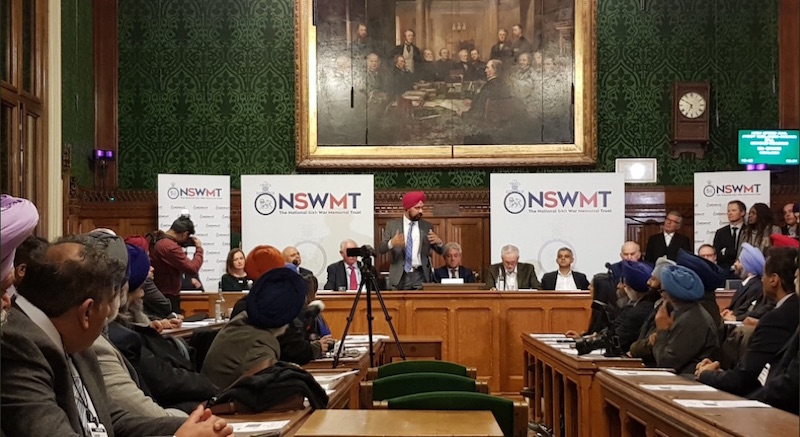
MP Tanmanjeet addressing the meeting at British Parliament on the launch of a Sikh war memorial in central London – Source: Tanmanjeet twitter
A national memorial to honour the sacrifices and contribution of Sikh soldiers who fought for Britain and its allies during the two World Wars is one step closer to reality.
The campaign, led by UK parliamentarian Tanmanjeet Singh Dhesi received government and cross party support, witnessed at an event in British Parliament in London yesterday (30 Jan 2018). They have secured £375,000 in community funding commitments for the project.
“Great launch today in Parliament of a Sikh war memorial in central London remembering sacrifices of Sikh soldiers in world war 1 and 2. Thanks to @TanDhesi for leading on this and the @SikhWarMemorial trust. Great cross party support thankyou to @jeremycorbyn and @MayorofLondon,” tweeted fellow Sikh UK parliamentarian Preet Kaur Gill.
More than 83,000 turbaned Sikh soldiers gave their lives and more than 100,000 were injured during the wars.
“We are indebted to all those servicemen who volunteered to serve and fought to defend the freedoms we enjoy today,” said UK communities secretary Sajid Javid yesterday as he announced government backing for the new memorial in London.
“A Sikh war memorial in our nation’s capital will honour their sacrifice and ensure that this part of our shared history is never forgotten. So, I’m delighted to get behind this campaign and ensure its success,” he said.
In a tweet, London Mayor Sadiq Khan said he ‘looked forward to supporting the work’ of the new trust in ‘lobbying for proper recognition of these courageous individuals’.
Tanmanjeet is Britain’s first turbaned Sikh MP while Preet made history as the first Sikh female. They were both elected in the 2017 snap general elections.
[ASIA SAMACHAR is an online newspaper for Sikhs in Southeast Asia and surrounding countries. We have a Facebook page, do give it a LIKE. Follow us on Twitter. Visit our website: www.asiasamachar.com] 17554
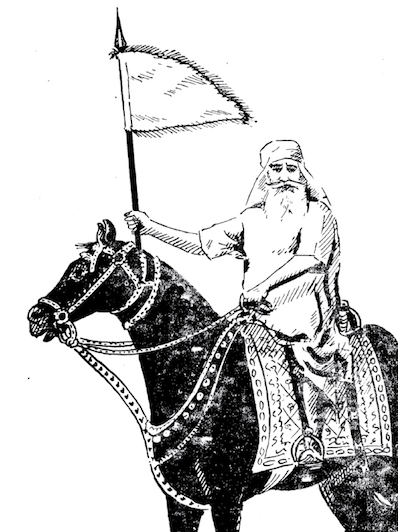
Bhai Maharaj Singh on horse – Digitised by Punjab Digital Library
On 15 May 1850,
A ship named Mohammad Shah left the shores of Calcutta for Singapore. It was transporting two Sikh prisoners fighting for the independence of Panjab. One Corporal and six Privates of HM’s 70th Regiment under one European Sergeant were the military security in charge on the ship. On the orders of the Governor General of India, the prisoners’ fetters were only to be removed when the ship entered the high seas. The prisoners were Bhai Maharaj Singh and his protégé Kharag Singh.
BIRTH IN THE HOUSE OF THE GURU
He was born as Nihal Singh in 1780 in Rabbon village of Ludhiana district of Panjab where the memory of 1762 Vadha Ghallulghara (Greater Genocide) was still fresh in Sikh minds. He was named Bhagvan Singh upon getting initiated by Khande-ki-Pahul to become the member of the Order of the Khalsa.
At that time, Baba Bir Singh instructed him thus:
By taking Amrit you are taking a vow that hereafter you will dedicate each breath of your life in the service of Satguru. In other words, you will live every moment of your life according to the injunctions of Satguru. If your mind always stays alert according to Guru’s instructions then your heart and thoughts will stay free from getting polluted. Gradually your mind will become immaculately clean and you will be able to perceive the presence of Akal Purakh within.
Bhagvan Singh was very humble; he started to address everyone as “Maharaj.” It is a term of great respect which implies Divine-like Sovereign present in all human beings. This soon became his trademark and gradually everyone started addressing him as “Maharaj” too. Before long the devoted Nihal (joyous) who had become Bhagvan (divine), began to be revered by all who started addressing him with the respectful epithet of “Maharaj.” In time, people forgot his earlier names Nihal and Bhagvan and he became known as Bhai Maharaj Singh (the Bhai).
STATE ATTACKS THE SIKHS
Bhai Maharaj Singh was mentored by Bhai Bir Singh of Naurangabad whose Dera (seminary-like space) was a theo-political training center where the culture of Nam prevailed. Miri-Piri (Politics-Spirituality) was taught and lived. The Dera had a force of 1,200 musket men and 3,000 horsemen. It was a sanctuary for political refugees and a center of the Sikh revolt against post Maharaja Ranjit Singh Dogra dominance in the Kingdom of Panjab.
In 1844, Hira Singh Dogra, the Prime Minister of Panjab, attacked the Dera with 20,000 troops and 50 cannons. Several hundred Sikhs, including General Attar Singh Sandhavalia, Prince Kashmira Singh and Bhai Bir Singh were killed. Bhagvan Singh became the head of the Dera.
The British wanted to crush the spirit of the Khalsa to maintain the Empire in South Asia. On 2 June 1847, the first British Resident at Lahore Henry Lawrence admits:
So great is their own pride of race, and of a long unchecked career of victories that if every Sirdar and Seikh in the Punjab were to avow himself satisfied with the humbled position of his country, it would be the extreme of infatuation to believe him, or to doubt for a moment that among the crowd who are loudest in our praise, there are many who cannot forgive our victory or even our forbearance and who chafe at their own loss of power in exact proportion as they submit to ours.
Lord Dalhousie, the Governor General of India, a year later categorically instructed the then British Resident at Lahore Frederick Currie:
Every hostile demonstration against us in every portion of the Punjab must be met, encountered and utterly crushed as such a manifestation of the British power was essential not only for the British stay in the Punjab, but also necessary to its continuance throughout India.
In the aforesaid declared policy of darkness, the light of defiance by Bhai Maharaj Singh shines. A Khalsa came forward to lead the Panjabis against the British: freedom from foreign rule. He left his Naurangabad Dera under the command of Bhai Bir Singh, Jr. and moved to Sri Amritsar Jio. At the Sikh center of Miri-Piri Sovereignty, he set up his headquarters at Samdu Ka Talab. He joined forces with Baba Ram Singh, another protégé of Baba Bir Singh, and toured the Panjab to assess and recruit the Sikhs to save the sovereign kingdom of Sarkar Khalsaji.
REBEL WITH A CAUSE
Bhai Maharaj Singh moved about the Jalandhar Doab, a British territory and aroused the people against the British. He contacted Divan Mul Raj, the Nizam of Multan to raise a banner of revolt against the British administration of Lahore kingdom. He went to Hazara where Sardar Chattar Singh Atarivala was preparing to rebel and ignited a yearlong revolt. He attempted to extend the revolt by involving the Maharaja of Bikaner, Dost Mohammad, the Amir of Afghanistan and Maharaja Gulab Singh of Jammu and Kashmir.
When tensions arose between Maharani Jindan Kaur and the British in 1847 because they were depriving her of her power, it resulted in the Prema plot to assassinate Henry Lawrence, the British Resident. But the plot, and Bhai Maharaj Singh’s role in it, were uncovered and the British confiscated his property and declared him an outlaw. The British governor, General Lord Dalhousie, put a bounty of Rs.10,000 on the Bhai’s head. The Bhai with 600 Sikhs became the leader of the resistance against the British.
The Bhai now had a mass appeal. Raja Sher Singh and his companion Sardars invoked Bhai Maharaj Singh with his consent to recruit the Sikhs in Panjab:
On behalf of Baba Maharaj Singh Ji, the undersigned declare that time has arrived when we must get ready to fight the foreign invaders (the British) who with great cunning and deception are succeeding to usurp the Khalsa Raj. It is therefore the sacred duty of every citizen to join this holy struggle and get ready to sacrifice everything in order to free our motherland.
Incidentally, this very letter was later used to convict the Bhai when Lord Dalhousie, by then the Governor General of India. He wrote, “these battles (Chilianvala and Gujrat) were fought by the Sikhs directly against the English people. The purpose was to destroy the influence of the British from not only Punjab but the entire Indian sub-content.”
In 1848, Bhai Maharaj Singh fought in the Battle of Ramnagar, Chillianvala, and Ravalpindi. At Ravalpindi, Raja Sher Singh surrendered. The Bhai appealed to others and refused to surrender to the British:
You own large estates now which you want to save by surrendering to the British. But let me tell you, even by accepting all the conditions of the British you may not be able to save your estates because you will be on the mercy of the conquerors and will have to accept whatever crumbs they throw towards you. It would be better if you fight and get martyrdom rather than live a wretched life of a slave.
Only Baba Bikram Singh Bedi of Una and Colonel Richhpal Singh Purbia decided to stay with the Bhai and continue the rebellion. Henry Lawrence recorded:
Bhai Mahararaj Singh, a Sikh priest of reputed sanctity, and of great influence, the first man who raised the standards of rebellion beyond the confines of Multan in 1848, and the only leader of note who did not lay down his arms to Sir Walter Gilberts at Rawalpindi.
On 29 March 1849, the Panjab was annexed by the British.
FIVE-POINT PLAN
After escaping from Ravalpindi, and on the run at Devi Batala, in the jungles and ravines of the Chumbi Valley, and finally at Sujoval, Bhai Maharaj Singh developed a five-point plan of action.
To rescue Maharaja Dalip Singh from the Lahore Fort to the Panjab hills and to restart the freedom struggle in his name before the British removed him to a distant place as proposed.
To organize a united front of all persons and interests who suffered at the hands of the British, the jagirdars, the ex-military men, the hill Rajput chiefs and others.
To neutralize the British policy of using the local Muslims against the freedom fighters, by forging an alliance between the rebels in the Panjab, the Pathans of the North West and the Amir of Kabul.
To approach all important Sikh and Hindu priests and saints (due to their extensive jagirs, resources and following) from Kandhar in Afghanistan to Malva in cis-Sutlej for lending their whole-hearted support to the freedom struggle.
To organize disruption of the administrative machinery of the British government, by subversion and surprise attacks on their treasuries and cantonments and to win over the confidence of the Sikh soldiers who were retained by the British in the armed forces.
Bhai Maharaj Singh’s plans were uncovered and Maharaja Dalip Singh was transferred to a safer fort. The British tried to capture the Bhai, but they didn’t succeed because the people of Panjab were with him, helped him and joined him. He became known as Karnivala – The Wonder Worker – for he couldn’t be caught!
The Bhai sought help from Dost Mohammad (Amir of Kabul) and his brother Sultan Muhammad Khan, in Panjab’s struggle for freedom from foreign rule; they refused. The Bhai still attacked the British cantonments of Hoshiarpur, Hajipur and Jalandhar in guerilla-style and looted the Government treasury at Bajvara. Many influential people in the district of Hoshiarpur supported the Bhai, and in November of 1849 he was able to finish his preparations for attacking areas in the Jalandhar Doab. At a public gathering at Sham Chaurasi, Bhai Maharaj Singh proclaimed 3 January 1850 as the date for uprising by attacking Jalandhar Doab: “There will be another National War.”
PRISONER-IN-EXILE
But with help from an informant, the Bhai along with twenty-one Sikhs was arrested on 28 December 1849 by the British near Adampur. Henry Vansittart, the Deputy Commissioner of Jalandhar, who made the arrest, recorded:
The Guru is no ordinary man. He is to the natives what Jesus was to the most zealous of Christians. His miracles were seen by tens of thousands, and are more implicitly believed than those worked by the ancient prophets.
After due investigations Mr. McLeod, the commissioner, wrote his report on the Bhai as follows:
I am convinced that Bhai Maharaj Singh is a remarkable person. He has all the attributes of a saint. He has unusual self-control and self-confidence. He seems to have the power to foresee the coming events and has the qualities of a great leader whom people would like to obey.
The British were afraid of the popular outrage leading to another rebellion due to Bhai Maharaj Singh’s presence in Panjab. Thousands of Panjabis used to come to Jalandhar Civil Jail every day to pay their homage to the Bhai. Afraid, the District Magistrate transferred him to military authorities.
The British decided to move the Bhai out of Panjab. First, he was transferred to the Allahabad fort prison, then to Fort William in Calcutta. They deemed it was too risky to put the Bhai on trial in India. On 23 March 1850, the Governor General issued order to deport the Bhai and his companion Kharag Singh to Singapore with instructions that they were to be kept in solitary confinement for the rest of their lives.
On 15 May 1850, Muhammad Shah ship left Calcutta. On 9 July 1850, they arrived in Singapore and were taken to the New Jail on Outram Road. He was kept in solitary confinement in a cell where the walling up of the windows turned it into “further rendered dark, dinghy and absolutely unhealthy” (Secret Consultation Papers, 28 Feb 1851, #52-57).
In 1853, cataract blinded him. He developed cancer on the tongue, rheumatic swellings and pains in his feet and ankles. The Civil Surgeon’s recommendation for the Bhai to be allowed an occasional walk in the open was turned down by the Government of India. His health continued to deteriorate.
MARTYRDON & MEMORIALIZATION
Bhai Marahaj Singh breathed his last in the jail on 5 July 1856. The last written record on the Bhai was sent by G. M. Blundel, Governor of the Straits Settlements, to the colonial office in the British India. “I have the honour to report to you for the information of the Right Hon’ble the Governor General of India-in-Council, that the State Prisoner, “Bhaie Maharaj Singh” died on the 5th instant.” (Document # 86, 12 July 1856)
The Bhai was cremated outside the prison by Kharag Singh (Kharag Singh was transferred to Penang, Malaya, and he too died in prison later). Locals Hindu Tamils began to revere the spot, marking it with stones. Offerings of flowers found their way there, Sikhs and Muslims joined in. The Sikhs placed a structure on this spot, turning it into a small temple. In 1966, Samadh (tombstone) was relocated to the Silat Road Gurduara. In 1996, an official Memorial next to the Gurduara was erected. In 1999, it was designated a historical site by the National Heritage Board (Singapore). Large number of Sikhs and non-Sikhs continue to come to the Samadh and the Memorial to worship with offerings. I am very sure the Bhai wouldn’t approve of the aforesaid ritual for it is not within Gurmat – the Guru’s Wisdom.
RECORDS, ARTICFACTS & LEGACY
“Documents Related to Bhai Maharaj Singh” in Rebels against British Raj series are of tremendous historical importance. In its preface, author Nahar Singh records:
The fact that Bhai (Gooroo) Maharaj Singh had played a leading role in organising an armed struggle for the overthrow of the British regime in the Punjab during the years 1846 to 1850, has been known to very few scholars. He beat (Gagan Damama) Dharm Dhaunsa or battle drum in the name of religion against the British and declared that the act of driving out the Malech Farangies from the holy land of five rivers was Dharm or sacred duty and a noble deed of piety and righteousness.
Bhai Maharaj Singh was and remains an inspiration to Panjabis. His power and revolutionary activities against the British prompted The Times of London to note:
It is well known in certain circles that the influence of this man is unbounded amongst the Sikh chieftains and the whole population of the Punjab; and there is little doubt but that he has generally been the prime mover in all the conspiracies and revolts which have lately caused so much of the Punjab expense and led to so much bloodshed.
Justice Choor Singh of Singapore in Bhai Maharaj Singh: Saint-Soldier of the Sikh Faith records the official narrative and locates the Bhai as follows:
[It] must not be forgotten that Bhai Maharaj Singh was also the Head of the Religious Order, now known as Hoti Mardan Vali Sant Khalsa Sampardai, which had been established by Bhai Daya Singh, one of the five Panj Piyaras of Guru Gobind Singh … Bhai Maharaj Singh was therefore not only revolutionary fighter who tried to save the Sikh Kingdom but also a recognized religious personage of high standing, true saint of the Sikh faith, who died the death of the martyr.
When I went to Singapore to speak on the Sikh spirit as part of SG50 (50-years of Singapore independence) celebrations, I revisited Bhai Maharaj Singh’s memorial. I asked several visitors what they knew about Bhai Maharaj Singh; overwhelming majority didn’t have a clue and were ritualistically visiting it as just another Gurduara.
Perhaps, the vanishing Sikhs are afraid of becoming the next Bhai of the ‘Culture of Nam’ who led the political resistance borne of rich spiritual heritage.
Note: I chose ‘Bhai’ for referring to Bhai Maharaj Singh because in Sikh tradition initiated by the Ten Guru Sahibs (Nanaks I-X), Bhai remains the historic standard as the honorific title among the Sikhs. Many documents, authored by both Sikhs and non-Sikhs, labelled Bhai Maharaj Singh as Sant, Baba, even Guru, and so on. In excerpts or direct quotes, I retained original titles or spellings; otherwise, for non-English words, linguistically accurate transcriptions are used for consistency without diacritical marks.
[Harinder Singh is an educator, thinker and activist who tweets @1Force. This article was first published at Sikhri.org in 2017]
ASIA SAMACHAR is an online newspaper for Sikhs / Punjabis in Southeast Asia and beyond.Facebook | WhatsApp +6017-335-1399 | Email: editor@asiasamachar.com | Twitter | Instagram | Obituary announcements, click here |





















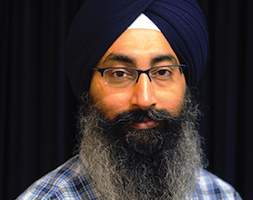 [Harinder Singh is an educator, thinker and activist who tweets