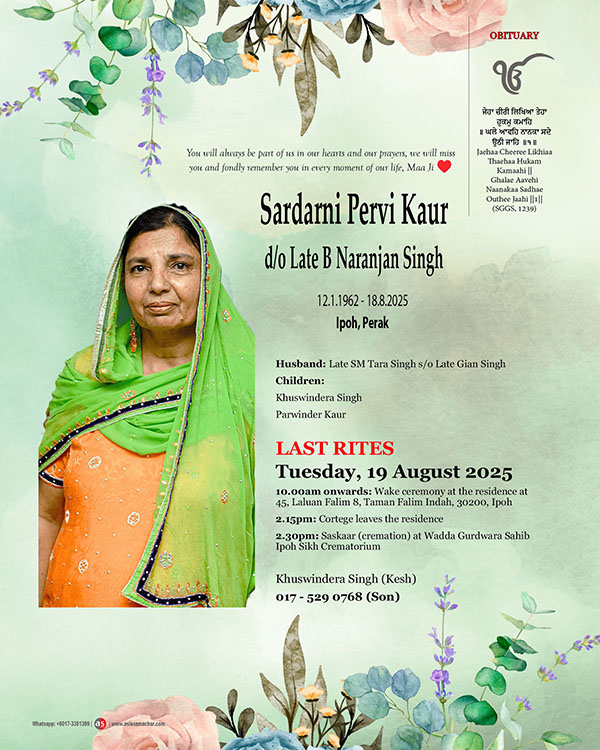
10.00am onwards: Wake ceremony at the residence at 45, Laluan Falim 8, Taman Falim Indah, 30200, Ipoh 2.15pm Cortege leaves the residence 2.30pm: Saskaar (cremation) at Wadda Gurdwara Sahib Ipoh Sikh Crematorium
ASIA SAMACHAR is an online newspaper for Sikhs / Punjabis in Southeast Asia and beyond. You can leave your comments at our website, Facebook, Twitter, and Instagram. We will delete comments we deem offensive or potentially libelous. You can reach us via WhatsApp +6017-335-1399 or email: asia.samachar@gmail.com. For obituary announcements, click here
Aussie Sikh boxer Ishmeet Kaur Sandhu wins Junior Queen of the Ring title – Photo: Ishmeet/SBS Punjabi
By Asia Samachar | Australia |
Sixteen-year-old Ishmeet Kaur Sandhu, who won Junior Queen of the Ring title in a recent competition in New South Wales, has set her eyes on the national prize nect.
Ishmeet won her title in the under-52kg flyweight category at the Hawkesbury event drew more than 300 athletes from across the country.
“I tried netball, dancing and swimming before, but didn’t enjoy any of them. But once I tried boxing, I really liked it,” Ishmeet told SBS Punjabi. Click here for the full story.
Her journey has not been without challenges. In the beginning, I was afraid of boxing and getting injured. But slowly, I built my confidence – and now I’m here. Before this win, Ishmeet competed in the Golden Gloves tournament in Brisbane, where she did not achieve the result she had hoped for, according to the report.
ASIA SAMACHAR is an online newspaper for Sikhs / Punjabis in Southeast Asia and beyond. You can leave your comments at our website, Facebook, Twitter, and Instagram. We will delete comments we deem offensive or potentially libelous. You can reach us via WhatsApp +6017-335-1399 or email: asia.samachar@gmail.com. For obituary announcements, click here
I see the storms I have survived, the steep ascents of struggle and the wide fields of hard-won achievements that lie far below – Manjit Kaur
By Manjit Kaur, UK | Opinion |
There are moments in life when we realise that we are no longer walking the well-worn paths set by generations before us. Instead, we begin to chart our own way. This moment of awakening feels like freedom, yet it is not absolute freedom. It is a freedom tempered by unseen forces.
For me, this realisation comes most vividly through the image of a hot air balloon. In my early years, the balloon was tethered firmly to the ground, held fast by ropes of attachment, be it parents, siblings, cousins, friends, obligations and tradition. Back then, family networks stretched across cities, countries and continents, a vast web of kinship that offered belonging and security. Those bonds still exist, but, as time moves forward, they are far looser now.
As adulthood unfolded, more ropes were added: the weight of work commitments, family responsibilities, community duties and friendships that demanded time and presence. At times, these anchors felt heavy, but they also gave direction, grounding me in a life of meaning and connection.
Yet with time, some of those ropes have loosened. And with a deep breath and a quiet Ardaas, others I have chosen to release. The familiar ground I once stood upon has grown distant, and I now find myself suspended between sky and earth. There is freedom here, but also vulnerability. For I am not entirely in control; the winds carry me where they will.
From this higher vantage point, the view is breathtaking. I see the storms I have survived, the steep ascents of struggle and the wide fields of hard-won achievements that lie far below. The winds have carried me to unexpected places: sometimes into valleys of hardship, sometimes into landscapes of joy. What I once dismissed as coincidence or chance, I now recognise as hukam, the divine will guiding me, even when I could not see the pattern.
Through it all, Gurbani has been my compass. In times of uncertainty, Guru Nanak Sahib’s words resound in my heart:
ਹੁਕਮਿ ਰਜਾਈ ਚਲਣਾ ਨਾਨਕ ਲਿਖਿਆ ਨਾਲਿ Walk in the will of the Divine, for it is written with you.
The balloon may drift, but I am never truly without direction. The Guru’s wisdom is my navigation system, the steady flame that keeps me aloft. It is the light that pierces the storm, reminding me that this journey is not mine alone to chart.
There is also deep joy in this stage of the flight. Looking down, I see my children and grandchildren walking their own paths, weathering their own storms, and growing into their own strength. I take pride in knowing that my journey, my struggles, triumphs, and quiet endurance, have helped lift them higher. For me to experience their love, laughter, resilience and courage is a blessing beyond measure. Their spirit rises like warm air beneath my balloon, keeping me buoyant.
And yet, I am aware of the landing that must one day come. I cannot predict where it will be; a gentle meadow of rest, a fertile field of new beginnings, or perhaps an unfamiliar land where I must build new connections. I have learnt that landings cannot be rushed. The moment must be right; the winds must be still. To force a landing too soon is to risk harm. Life, like ballooning, requires patience and surrender to the forces of nature and the rhythm of creation, or if you like, to the Will of Waheguru.
So, as I seek out possible landing spots, I keep my gaze on the horizon, my heart attuned to the Guru’s wisdom, and my spirit open to the unexpected. The journey itself is my prayer, the view is my gratitude, and the landing, whenever it comes, will be my humble offering back to the One who first lifted me into the skies.
For now, I am content to float a little longer, between sky and earth, knowing that destiny is not just the place where one lands, but the very journey itself. In the vastness of creation, my life may be but a passing breeze, here today and gone tomorrow. Yet while I breathe and remain aware, life is everything, a sacred gift, an opportunity to realise my higher purpose.
“You have obtained this human body. This is your chance to realise your true purpose to unite with Gobind, the universal Divine power.”
And so, I drift. Guided by the winds, steadied by the Guru’s flame, I surrender to the sweetness of whatever is written for me. In these moments, I am reminded of the words of Guru Arjan Sahib:
ਤੇਰਾ ਕੀਤਾ ਮੀਠਾ ਲਾਗੈ ॥ ਹਰਿ ਨਾਮੁ ਪਦਾਰਥੁ ਨਾਨਕੁ ਮਾਂਗੈ “Whatever the Divine does is sweet to me; Nanak asks only for the gift of the Name.”
Manjit Kaur, a UK-based therapist and counsellor, is a presenter at the 1 Show Live at Panjab Broadcasting Channel, UK. She can be contacted via email at manjitkaur1show@gmail.com
ASIA SAMACHAR is an online newspaper for Sikhs / Punjabis in Southeast Asia and beyond. You can leave your comments at our website, Facebook, Twitter, and Instagram. We will delete comments we deem offensive or potentially libelous. You can reach us via WhatsApp +6017-335-1399 or email: asia.samachar@gmail.com. For obituary announcements, click here
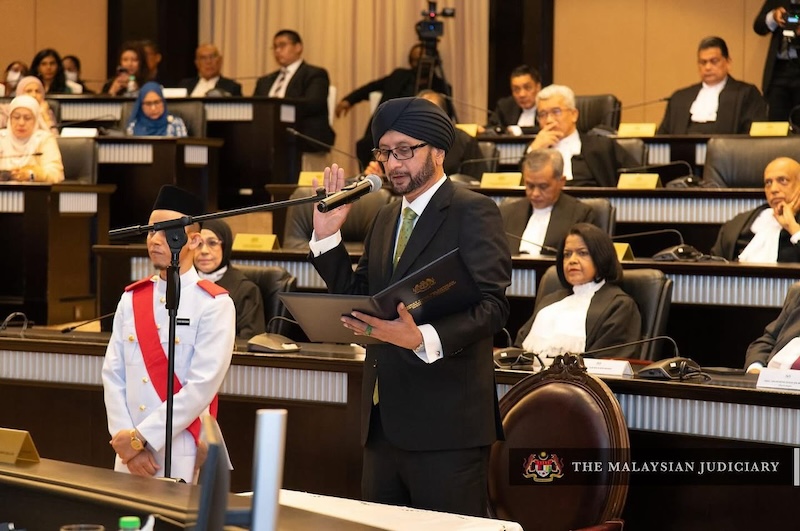
Avinder Singh Gill taking oath of office and allegiance at Palace of Justice on Aug 13, 2025 – Photo: Malaysian Judiciary
By Asia Samachar | Malaysia |
Practicing lawyer Avinder Singh Gill has been appointed to the High Court as a judicial commissioner (JC).
He was one of the 23 individuals who received their appointment letters from Chief Justice Wan Ahmad Farid Wan Salleh at the Palace of Justice on Wednesday (Aug 13).
They took their oath of office and allegiance before Chief Judge of Malaya Hasnah Mohammed Hashim.
Avinder, who has been in active legal practice since May 1994, holds an LLB Honours Degree (University of London), a Masters in Business Administration (La Jolla University, San Diego) and an LL.M (with Distinction) from University Malaya.
He is a qualified mediator and regularly appointed to chair Disciplinary Inquiries by the Advocates & Solicitors Disciplinary Board.
Avinder is also an Advocacy Trainer under the Bar Council Advocacy Training Committee and regularly conducts advocacy training courses for young advocates and periodically prepares and give talks on various areas of the law for young advocates.
In Malaysia, a JC is appointed to the High Court on a non-permanent basis to assist with the court’s workload. They have the same powers as a High Court judge and are appointed when the court requires additional judicial resources.
Among those appointed were former head of the Civil Division in the Attorney-General’s Chambers (AGC) Donald Joseph Franklin and J Kuldeep Kumar, the lawyer who previously defended former chief inspector Azilah Hadri, one of two individuals convicted of the 2006 murder of Mongolian national Altantuya Shaariibuu.
ASIA SAMACHAR is an online newspaper for Sikhs / Punjabis in Southeast Asia and beyond. You can leave your comments at our website, Facebook, Twitter, and Instagram. We will delete comments we deem offensive or potentially libelous. You can reach us via WhatsApp +6017-335-1399 or email: asia.samachar@gmail.com. For obituary announcements, click here
ASIA SAMACHAR is an online newspaper for Sikhs / Punjabis in Southeast Asia and beyond. You can leave your comments at our website, Facebook, Twitter, and Instagram. We will delete comments we deem offensive or potentially libelous. You can reach us via WhatsApp +6017-335-1399 or email: asia.samachar@gmail.com. For obituary announcements, click here
Mahinder Kaur Haer (Mindy) d/o Late Sandagar Singh Haer
(1.12.1953 – 12.9.2024)
Village: Kokri Haer; District: Moga
Husband: Late Narpal Singh Mangat s/o Late Puran Singh Mangat
The family of the late Mahinder Kaur Haer of Air Panas, Setapak, will gather to cherish her memories. Her love, kindness and wisdom will forever live in their hearts, and she is deeply missed beyond words.
Children / Spouse: Manjit Singh / Harwin Kaur Gurdev Singh
Grandchildren: Gurveer Singh, Harleen Kaur
PATH DA BHOG Sunday, 24th August 2025 9am to 11:30am Gurdwara Sahib Titiwangsa
ASIA SAMACHAR is an online newspaper for Sikhs / Punjabis in Southeast Asia and beyond. You can leave your comments at our website, Facebook, Twitter, and Instagram. We will delete comments we deem offensive or potentially libelous. You can reach us via WhatsApp +6017-335-1399 or email: asia.samachar@gmail.com. For obituary announcements, click here
The Human Condition – A Dance Between Reason and Stupidity – Photo: AI aided
By Gurnam Singh | Opinion |
Within the Sikh worldview, the human capacity for reason and discernment, often described through terms such as bibek buddhi (discriminating intellect), is regarded as a sacred gift to humanity from the Divine. This faculty is not merely about the ability to think logically, but also the capacity to distinguish truth from falsehood, the real from the illusory, and the eternal from the transient. In the Guru Granth Sahib, human birth is portrayed as a rare and precious opportunity, for it brings with it the unique potential to seek union with the Creator through conscious reflection, moral action and spiritual awareness. This gift of reasoning is not presented as a self-sufficient end, but as a tool for self-realisation and righteous living, enabling the human being to navigate the complexities of the world while remaining oriented towards the Divine truth (Sat).
Though the emphasis may vary, the general view of the uniqueness of the human species to reason and reflect is universal and cuts across religious and secular tradition. Indeed, the capacity to exercise moral agency, which lies at the heart of all religious belief systems, would be impossible without the belief in our capacity to think, reason and make informed choices. Indeed, it is through this property that, unlike other species, humans possess the ability to question not only how the world works, but also why it exists and what moral responsibilities arise from that understanding.
Sikh thought integrates this critical reasoning capacity with spiritual humility, warning against intellectual pride (haumai) that detaches reason from compassion. Reason, in this view, is to be exercised in harmony with Gurmat, or the Guru’s wisdom, so that human intelligence becomes a servant of higher truth rather than an instrument of ego or exploitation. In this way, the Sikh tradition affirms that our reasoning ability is both a sign of our kinship with all creation and a reminder of our distinctive moral and spiritual calling.
It is often asserted that Sikhi is a scientific belief system. Though there are clear resonances when it comes to reasoning and critical enquiry, given science is only concerned with what can be determined empirically, the truths that each tradition is seeking to uncover are quite different. Science and reason, in themselves, are not repositories of truth. They possess no intrinsic knowledge, nor do they claim infallibility. Rather, scientific reasoning is a disciplined method; a way of thinking whose central purpose is to expose ignorance and replace it with understanding. Ignorance, in all its forms, has been humanity’s oldest companion, shadowing us through every stage of our history.
There is broad consensus amongst evolutionary scientists that, unlike any other known life form on Earth, human beings have developed intricate systems of thought, religions, mythologies, philosophies, to explain the world around them. From the earliest awe-filled gaze at a falling star to the mapping of celestial orbits, from cataloguing the diversity of marine life to unlocking the secrets of atomic structure, our species has been defined by its insatiable curiosity. The very name Homo sapiens, “thinking being”, is itself a testament to this defining trait.
Yet, understanding the world and our place within it is no easy task. Indeed, it may well be impossible to arrive at final, absolute answers. The role of science, therefore, is not to deliver eternal certainties but to strip away error, dismantle illusions and refine our understanding. Across centuries and civilisations, from the ancient Nile and Indus valleys to the indigenous cultures of the Americas, Africa and Australasia, human societies have engaged in systematic observation, experimentation and knowledge-sharing. What the modern West calls the “scientific revolution” is, in truth, only one chapter in a much longer and more diverse human story.
SCIENCE MYSTIFIED
One of the tragedies of our age, not unlike many religious belief systems, is that science has become mystified, commodified and exploited for ulterior motives. Too often, it is seen as the exclusive domain of elite laboratories, multinational conglomerates and prestigious universities. This creates an artificial hierarchy of knowledge as if truth were the sole preserve of institutions with status and power. This separation of what some term ‘authored knowledge’ produced through scientific experimentation and peer review and the wisdom generated through the ‘natural’ experimentation of farmers, healers, artisans, navigators, hunters, and gatherers over hundreds of years, is rendered as mere tradition.
The evolutionary psychologist Steven Pinker argues in Rationality: What It Is, Why It Seems Scarce, Why It Matters (2021), rationality is not the monopoly of modern or technologically advanced societies. It is a universal human capacity, an essential tool for survival. Pinker notes that hunter-gatherer communities, for instance, routinely employ sophisticated reasoning in their daily lives. The suggestion that pre-modern or indigenous peoples were somehow “less rational” is not only inaccurate but a distortion of history.
However, our inherent capacity to reason does not guarantee that we use it wisely. Common sense tells us that humans often behave irrationally. Pinker explains this phenomenon as the misuse of our cognitive tools and a failure to apply the right kind of reasoning in the right context. Another factor is the human tendency to become lazy and succumb to cognitive biases. Just as there is good science, there is also bad science, that is knowledge production distorted by ego, greed, power, or ideology. The same scientific methods that have eradicated diseases, prolonged lifespans, and connected the globe have also created weapons of mass destruction, systems of surveillance, and now artificial intelligence with the potential to reshape the very conditions of life on Earth.
SCIENCE AT MORAL CROSSROADS
Here, science stands at a moral crossroads. For all its power, science cannot tell us what ought to be done; it can only reveal what can be done. The question of why we choose one path over another belongs to the realms of ethics, philosophy, and, at its highest, a spirituality rooted in compassion and humility. In this piece I have argued that science and reason are divine gift, which from a secular viewpoint might be termed gifts of nature. Yet, experience would suggest, along with these capabilities, humans have also been ‘gifted’ (or perhaps cursed!) with stupidity and ego, which probably explains why, despite possessing a supercomputer known as the human brain, humans are responsible for so much death and destruction.
The irony of our times is that, just as science has been commodified, so too has spirituality. Science risks being reduced to a mere instrument for profit and domination, while spirituality is marketed as a quick-fix lifestyle product, promising instant enlightenment without the rigours of moral responsibility. If science is nature’s gift, enabling us to understand the world, then wisdom is the compass that guides how we use it. Without such a compass, even the most brilliant discoveries can become instruments of destruction.
The challenge before us is not simply to advance scientific knowledge but to ensure that it is grounded in a vision of human flourishing, one that transcends greed, prejudice, and short-term gain. The question confronting humanity today is stark: can we align our unmatched capacity for scientific reasoning with an equally deep commitment to ethical responsibility? Or will we, intoxicated by our own cleverness, create the conditions for our own undoing? The answer will determine not only the fate of our species but also the future of the fragile planet we call home.
Gurnam Singh is an academic activist dedicated to human rights, liberty, equality, social and environmental justice. He is an Associate Professor of Sociology at University of Warwick, UK. He can be contacted at Gurnam.singh.1@warwick.ac.uk
* This is the opinion of the writer and does not necessarily represent the views of Asia Samachar.
ASIA SAMACHAR is an online newspaper for Sikhs / Punjabis in Southeast Asia and beyond. You can leave your comments at our website, Facebook, Twitter, and Instagram. We will delete comments we deem offensive or potentially libelous. You can reach us via WhatsApp +6017-335-1399 or email: asia.samachar@gmail.com. For obituary announcements, click here
Harpal Singh, 70, brutally attacked near a gurdwara in North Hollywood – Video grab from ABC
By Asia Samachar | US |
Police have arrested a man who brutally assaulted a 70-year-old Sikh man on an afternoon walk near a gurdwara in North Hollywood.
Harpal Singh was attacked with a golf club on Monday (Aug 11) in the area of Lankershim Boulevard and Saticoy Street, according to the Sikh Coalition.
The Sikh American civil rights group SALDEF said a suspect was arrested Monday at around 9:40 p.m. Los Angeles police identified the suspect as Bo Richard Vitagliano, 44. He was being held on US$1.115 million bail, according to jail records.
The 70-year-old remains in critical condition, unable to communicate, with internal bleeding to the brain. Now, the Sikh community is calling for more police protection.
Los Angeles police said there was a fight between the victim and suspect, who is unhoused, reports ABC.
“Witnesses advised that they did not see how the altercation began, but heard a loud commotion, then witnessed two men swinging metal objects at each other,” police said in a news release, according to the report. “Both individuals were struck. The suspect further assaulted the victim, while he was reportedly on the ground. Witnesses intervened by yelling at the suspect, at which time he rode away on his bicycle.”
An arrest was made when officers spotted Vitagliano with his bicycle on Lankershim Boulevard and Arminta Street, according to the LAPD. Police said a picture of the suspect taken by surveillance cameras helped officers make the arrest.
The report added that the Sikh community has been a frequent target of attacks for decades, often in cases of mistaken identity by anti-Muslim attackers.
Detectives believe the assault was not a hate crime but was “motivated by a dispute over property belonging to the victim.” The Sikh Coalition issued a statement questioning the LAPD’s findings, ABC reported.
“In the Sikh Coalition’s view it is impossible to completely rule out a bias motive at this stage,” the coalition said. “The suspect has been in custody for less than 24 hours, and the victim himself remains unconscious and has thus been unable to sit for a full and comprehensive police interview, with professional translation services, separate from the interview taken immediately after the attack.”
ASIA SAMACHAR is an online newspaper for Sikhs / Punjabis in Southeast Asia and beyond. You can leave your comments at our website, Facebook, Twitter, and Instagram. We will delete comments we deem offensive or potentially libelous. You can reach us via WhatsApp +6017-335-1399 or email: asia.samachar@gmail.com. For obituary announcements, click here
| Entry: 13 Aug 2025; Updated: 15 Aug 2025 | Source: Family
ASIA SAMACHAR is an online newspaper for Sikhs / Punjabis in Southeast Asia and beyond. You can leave your comments at our website, Facebook, Twitter, and Instagram. We will delete comments we deem offensive or potentially libelous. You can reach us via WhatsApp +6017-335-1399 or email: asia.samachar@gmail.com. For obituary announcements, click here
ASIA SAMACHAR is an online newspaper for Sikhs / Punjabis in Southeast Asia and beyond. You can leave your comments at our website, Facebook, Twitter, and Instagram. We will delete comments we deem offensive or potentially libelous. You can reach us via WhatsApp +6017-335-1399 or email: asia.samachar@gmail.com. For obituary announcements, click here