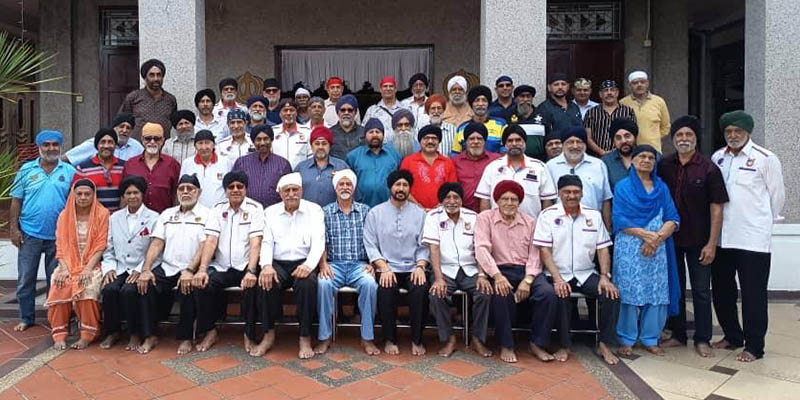
Police and armed forces veterans celebrate Warriors’ Day at Gurdwara Sahib Pulapol, Kuala Lumpur, on Aug 10, 2025
By Asia Samachar | Malaysia |
More than five dozen veterans and serving members of the Malaysian military and police came together for a Warriors’ Day prayer gathering in Kuala Lumpur on Sunday (Aug 10).
“The mood all around was fantastic. This is a gathering of people who have made huge sacrifices for the nation,” Lt-Col (Rtd) Hardial Singh Dhaliwal, who retired from the army in 2012, told Asia Samachar.
The event was held at Gurdwara Sahib Pulalpol, a Sikh gurdwara located within the compounds of the police training ground.
ASIA SAMACHAR is an online newspaper for Sikhs / Punjabis in Southeast Asia and beyond. You can leave your comments at our website, Facebook, Twitter, and Instagram. We will delete comments we deem offensive or potentially libelous. You can reach us via WhatsApp +6017-335-1399 or email: asia.samachar@gmail.com. For obituary announcements, click here
ASIA SAMACHAR is an online newspaper for Sikhs / Punjabis in Southeast Asia and beyond. You can leave your comments at our website, Facebook, Twitter, and Instagram. We will delete comments we deem offensive or potentially libelous. You can reach us via WhatsApp +6017-335-1399 or email: asia.samachar@gmail.com. For obituary announcements, click here
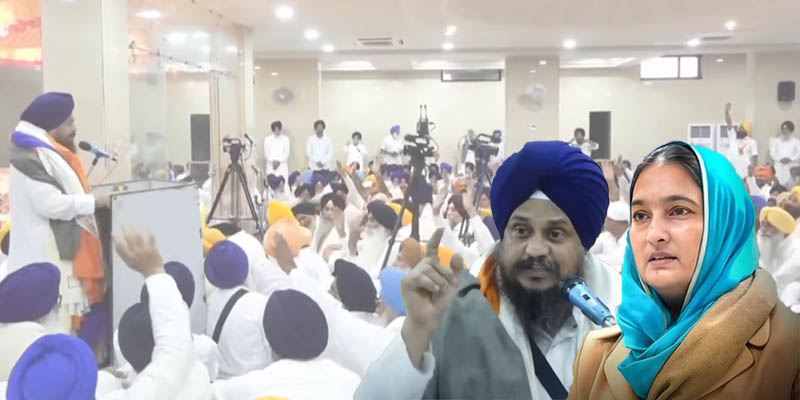
Giani Harpreet addressing the delegates at the Shiromani Akal Dal meeting on Aug 11, 2025 where he was unanimously elected as president while Satwant Kaur (right) was elected as president of its Panthic Council
By Asia Samachar | Panjab |
Former Akal Takht acting jathedar Giani Harpreet Singh has been elected as president of a breakaway faction of the Shiromani Akali Dal in a move to challenge Sukhbir Singh Badal’s already wanning hold on the Panjab political party.
In an election yesterday (Aug 11), the 53-year-old religious leader was elected unanimously after emerging a vocal critic of Sukhbir who now leads a party with mere three Members of Legislative Assembly (MLA) in the Panjab assembly and a single MP.
“I will not run for MLA or MP,” he told those present after his election at Gurdwara Burj Akali Phoola Singh in Amritsar.
Satwant Kaur, daughter of slained Amrik Singh, was appointed chairperson of the Panthic Council of the new party formed by a five-member committee constituted by the Akal Takht.
Also present at the meeting were former SGPC presidents Bibi Jagir Kaur and Gobind Singh Longowal, along with Prem Singh Chandumajra.
The elevation officially splits the Shiromani Akali Dal (SAD) into yet another faction and compounds further Sikh and Panjab politics as Harpreet was the primary force when the Akal Takht-led panj pyarey declared Sukhbir a ‘tankhaya’ in August 2024.
Harpreet, along with thedar Giani Raghbir Singh and Giani Sultan Singh, were among the five to drop the pronouncement on Sukhbir for the various “mistakes” committed by the SAD government in Punjab from 2007 to 2017. See here.
This led to Sukhbir — the son of two-time Panjab chief minister Parkash Singh Badal, a wealthy and politically powerful family — presenting himself at Darbar Sahib, popularly known as the Golden Temple, to perform ‘seva’.
The Shiromani Gurdwara Parbandhak Committee (SGPC) later removed all three of them from their posts – Raghbir as Akal Takhat jathedar, Sultan as Takht Kesgarh jathedar and Harpreet as Takht Damdama Sahib jathedar.
ASIA SAMACHAR is an online newspaper for Sikhs / Punjabis in Southeast Asia and beyond. You can leave your comments at our website, Facebook, Twitter, and Instagram. We will delete comments we deem offensive or potentially libelous. You can reach us via WhatsApp +6017-335-1399 or email: asia.samachar@gmail.com. For obituary announcements, click here
Minister of Digital Development and Information Josephine Teo joined 120 ladies at the Central Sikh Temple to celebrate SG60 on Aug 6, 2025
By Asia Samachar | Singapore |
More than 120 ladies, mainly seniors, celebrated the 60th anniversary of Singapore’s independence (SG60) during their weekly afternoon programme on Aug 6 at the Central Sikh Temple (Singapore), with Minister for Digital Development and Information Josephine Teo as the guest of honour.
Minister of Digital Development and Information Josephine Teo receives degh at Central Sikh Temple to celebrate SG60 on Aug 6, 2025
Befittingly, as Singapore embraces the global challenges ahead, the theme for the afternoon was Sukhmani – Jewel of Peace. Sukhmani Sahib Path, Kirtan, and Ardas, followed by Langar, kept everyone in high spirits and a celebratory mood.
“I thoroughly enjoyed mingling with the congregation and seniors who attended the event,” Josephine wrote in a social media post.
ASIA SAMACHAR is an online newspaper for Sikhs / Punjabis in Southeast Asia and beyond. You can leave your comments at our website, Facebook, Twitter, and Instagram. We will delete comments we deem offensive or potentially libelous. You can reach us via WhatsApp +6017-335-1399 or email: asia.samachar@gmail.com. For obituary announcements, click here
Because of my outward appearance, a beard and a turban (dastar), most people assume I am a follower of Sikhism, and therefore a religious person and a believer in God. Yet over the years, I have come to realise that questions of faith, belief and even the intensity of belief, are far more complex than the simple binaries of “believer” and “non-believer” might suggest.
A common dictionary definition of religion describes it as “a set of beliefs concerning the cause, nature and purpose of the universe, often involving a superhuman agency or deity, usually referred to as God.” In the Abrahamic traditions, God is often anthropomorphised — given human-like attributes and personal characteristics. Such definitions, however, present religion as a neutral, universal category, ignoring its contested history and cultural specificity.
The etymology of the term reveals important nuances. From the Latin religare, meaning “to bind,” religion is framed as the reuniting of estranged humanity with God through divine grace and human devotion. An alternative root, relegere, meaning “to re-read” or “to reflect upon,” suggests a process of learning, critical engagement, and attention to the proper performance of worship. While both roots offer valuable perspectives, neither fully accounts for the complexity and diversity of the phenomena to which the word religion has been applied.
The category of religion as we understand it today is not an eternal or universal concept. Scholars such as Wilfred Cantwell Smith have argued that religion is a modern Western invention, emerging out of post-Reformation Europe and the Enlightenment (Smith, 1962). For Smith, the problem is that the term objectifies complex lived traditions into static “things,” obscuring the personal and dynamic nature of faith.
The Saudi-British anthropologist, Talal Asad (1993), has shown that religion is deeply embedded in Western, and specifically Christian, historical contexts. The Protestant Reformation’s emphasis on inner belief, rather than public ritual, shaped the modern notion of religion as primarily a matter of personal conviction; a notion then exported globally through European colonialism. In this process, vastly different ways of understanding the world were reclassified to fit the European model, often distorting indigenous categories and practices.
Professor of Comparative Literature and History of Religion, Tomoko Masuzawa (2005), further critiques the idea of world religions as a universal taxonomy. She argues that 19th century European scholars codified a list of “major religions , in ways that reflected colonial hierarchies and Christian theological assumptions. This excluded or marginalised many traditions, while forcing those, including Sikhi, into a framework alien to our own self-understanding. The term ‘Sikhism’ which has no reference in Sikh scripture or history, is a good example of the ways in which western theological frameworks were deployed to redefine other traditions.
RELIGION ACROSS THE GLOBE
From the 16th century onwards, European expansion and cultural imperialism spread the category of religion across the globe. The extraordinary diversity of human epistemologies (ways of knowing) and ontologies (ways of being) was flattened into a single, universalising label. Complex traditions, such as dharma in the Indian subcontinent or din in Islamic contexts, were translated as “religion,” even though their conceptual scope and philosophical assumptions differed radically from the European model.
The consequence is that today’s debates about religion, whether in academia, politics or the media are framed within categories shaped by Western secularisation, scientific materialism and the dominance of the Judeo-Christian worldview.
PROBLEMATIC LABELS
Recognising the imprecision and hegemonic nature of the term, I have increasingly distanced myself from it. The labels “believer” and “non-believer” are equally problematic. Without clarifying what is meant by “God” and what it means “to believe,” such labels lack meaning. Indeed, when reasonably educated people are asked whether they believe in God, they often hesitate, replying: “It depends on what you mean by ‘God’.”
Cultural stereotyping compounds the problem. We associate belief with outward symbols, making snap judgements about a person’s religiosity based on their attire. This applies both between and within traditions. Among Jewish communities, for example, distinctions are often drawn between so-called ‘secular’ and ‘orthodox’ Jews. Orthodox Jewish men are often recognised by their kippah, black wide-brimmed hat, dark suit, white shirt, full beard and curled sidelocks (payot).
Similarly, Sikh men also have distinctive markers, such as turban, beard, and, for initiated Sikhs, the five Ks. Yet here the operative term is identity. For many, association with a tradition may be driven more by cultural, ethnic, linguistic or historical affiliation than by doctrinal commitment. Religion, in this sense, is woven into the broader tapestry of identity, alongside class, caste, and nationality.
One cannot deny the cultural relevance of dress and attire, but, there when one begins to make value judgements based on appearance, this becomes problematic. There are many Shabads in Guru Granth Sahib that are critical of the externalising of belief, where the inner being is full of deceit and corruption.
Indeed, ironically – since long hair is a symbol of Sikhi – Bhagat Kabir is particularly scathing the external practices of keeping long hair and shaving one’s head. As he says, Guru Granth Sahib (Ang 1366):
“Kabeer, when you are in love with the One, duality and alienation depart. Whether you have long hair, or you shave your head bald, it is all the same.”
Here, Kabir emphasises that the true spiritual goal is to overcome the “duality” (dubidha) of the mind, which is achieved through love for the One divine (preeti ik siou kie), not through outward displays of piety.
When we assume a person’s “religious belief” from appearance, we ignore the fact that we are engaging with a complex psychosocial phenomenon, not a simple matter of belief or unbelief. The binary framing of belief versus non-belief is, in my view, untenable. All human beings believe in something. Each one of us has a set of values, principles, ideals, but this is very different from the narrow, often crude ways in which religion is popularly understood.
In our increasingly interconnected and fluid world, perhaps the term religion has outlived its usefulness. As someone who identifies as a Sikh, I find it inaccurate and unhelpful to reduce Sikhi to a “religion” in the Western sense of the term. To do so is to misunderstand its essence and to ignore the richer, more nuanced realities of human identity and meaning-making.
References • Asad, T. (1993). Genealogies of Religion: Discipline and Reasons of Power in Christianity and Islam. Baltimore: Johns Hopkins University Press. • Masuzawa, T. (2005). The Invention of World Religions: Or, How European Universalism Was Preserved in the Language of Pluralism. Chicago: University of Chicago Press. • Smith, W. C. (1962). The Meaning and End of Religion. New York: Macmillan.
Gurnam Singh is an academic activist dedicated to human rights, liberty, equality, social and environmental justice. He is an Associate Professor of Sociology at University of Warwick, UK. He can be contacted at Gurnam.singh.1@warwick.ac.uk
* This is the opinion of the writer and does not necessarily represent the views of Asia Samachar.
ASIA SAMACHAR is an online newspaper for Sikhs / Punjabis in Southeast Asia and beyond. You can leave your comments at our website, Facebook, Twitter, and Instagram. We will delete comments we deem offensive or potentially libelous. You can reach us via WhatsApp +6017-335-1399 or email: asia.samachar@gmail.com. For obituary announcements, click here
Kareen Kaur all set to blaze the F4 racing circuit
By Anandpreet Kaur | Singapore |
Young Kareen Kaur is making strides in her budding racing adventure. Her next chapter is right around the corner as she debuts in an FIA-sanctioned Formula 4 (F4) race in India.
“We’re leaving today for India,” her father Kuldeep Singh to Asia Samachar.
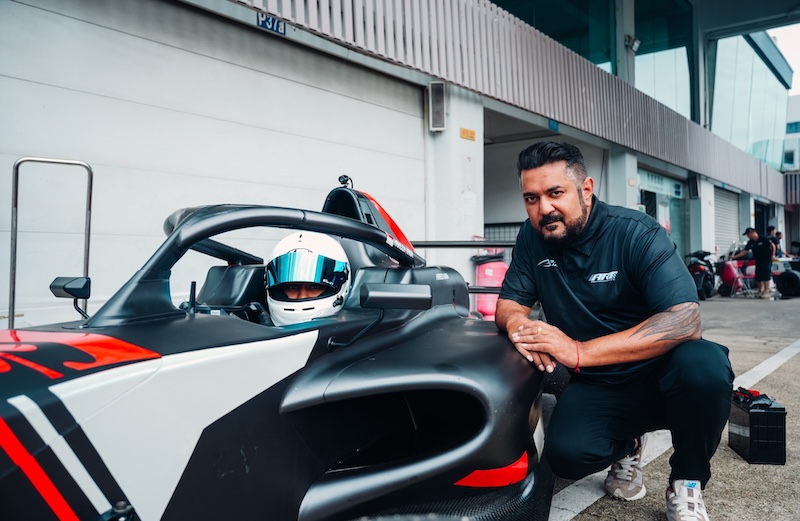
The 15-year-old Singapore karting queen is preparing to get behind the wheels for the F4, widely recognised as the entry-level category in single-seater formula racing, serving as the natural progression for young drivers transitioning from karting to motorsport.
“I’m proud to be a Sikh girl chasing my dream in one of the toughest sports in the world,” Kareen tells Asia Samachar in an interview. (SEE BELOW).
Kareen is set to make history as the first Sikh female and first female Singaporean to dabble in the F4 race.
“As a young Sikh girl in a male-dominated sport, Kareen’s journey is about more than just racing—it’s about representation, resilience, and redefining limits. Her participation on this international platform marks a powerful step forward for diversity in motorsports and serves as an inspiration to aspiring athletes everywhere,” add Kuldeep.
Kareen Kaur with her father Kuldeep Singh
The open-wheel racing industry features a wide range of formats, from traditional high-speed ovals to cutting-edge electric series.
F1 is the premier category in motorsport, attracting more than a billion fans annually. Formula 2 serves as the primary feeder series for Formula 1. Formula 3 (F3) is next up in the motorsport hierarchy, serving as a developmental category for young drivers hoping to climb the ranks of professional racing. Then comes Formula Regional (FR) and F4.
F4 gives young drivers their first taste of single-seater racing. They adapt to the higher speeds, aerodynamics, and handling characteristics of open-wheel cars, laying the foundation for their future careers in motorsport.
Cars in this category are designed with simplified technical specifications compared to higher formula categories, making them more accessible and cost-effective for aspiring drivers and teams. While they offer a significant performance upgrade from karts, F4 cars are also engineered to prioritize safety, reliability, and ease of maintenance.
“The jump from karting to Formula 4 is huge,” says Kareen. “You’re suddenly dealing with aerodynamics and downforce, which totally changes how the car behaves through corners. You’re strapped in tight with a full harness, surrounded by carbon fibre, and the cockpit heat can be intense. There’s a lot more to think about.”
THE INTERVIEW
Q: What are some of the lessons picked up in racing over the years?
One of the biggest lessons I’ve learned is mental discipline. In karting and now in formula car training, things can go wrong quickly. A tiny mistake in braking or positioning can cost you the race. I’ve had to train myself to stay calm under pressure, trust my instincts, and keep learning from every lap. Racing also taught me about resilience. I’ve had weekends where nothing goes right, yet I show up the next day, refocus, and fight back.
Another key lesson is that success in motorsports is a team effort. While I’m the one in the car, I wouldn’t be here without my mechanics, coaches, and especially my family. Behind every driver, there’s a group of people pushing and believing.
Q: What is the biggest challenge when a racer moves to Formula 4?
The jump from karting to Formula 4 is huge. You’re suddenly dealing with aerodynamics and downforce, which totally changes how the car behaves through corners. You’re strapped in tight with a full harness, surrounded by carbon fibre, and the cockpit heat can be intense. There’s a lot more to think about. I have to constantly check my mirrors, manage very high G-forces, and braking becomes a whole new skill. You have to press incredibly hard, almost standing on the pedal. Even clutch control and launching the car off the line are techniques we don’t use in karting.
There’s so much more technical detail and precision in everything from understanding telemetry data to working closely with engineers.
Honestly, my biggest fear is not being able to continue racing because of limited funding. I know I have the passion, discipline, and talent, but motorsports is expensive, and opportunities can disappear quickly if you don’t have financial support.
Q: How do you intend to continue funding your racing?
Right now, my family has been supporting me, and I’m very thankful to them. But we know that going further, especially into full Formula 4 championships and beyond, will require help.
We’re actively seeking sponsorships and brand partnerships. In return, I provide exposure through my international racing presence, media coverage, and community work. I also collaborate with hydration brands and recovery clinics to show how athletes train like professionals even at my age.
We’re also working with organizations that support female athletes in male-dominated sports, and I’m hoping more people see this not just as backing a driver but as investing in representation and breaking barriers.
Q: Anything else you’d like to share?
I’m proud to be a Sikh girl chasing my dream in one of the toughest sports in the world. Being a female, I have to work twice as hard to match a male’s strength. There are times when I overtake or win against male drivers, and I can see they’re not happy. Sometimes, they push harder or get aggressive, but I don’t feel intimidated by that.
I understand that motorsport has traditionally been male-dominated. But I don’t see that as a limitation. It’s actually my motivation. What others see is just me being fast and aggressive on track, but they don’t see the hours I spend relentlessly training in the gym, working on data, and pushing through physical and mental limits.
For now, my goal is to race in the F1 Academy, an all-female international series led by Susie Wolff. I’ve had the chance to personally meet many of the F1 Academy drivers during the Singapore Grand Prix and again in Abu Dhabi during the final race of the season. I was even invited to the F1 Academy workshop at the paddock, where I received valuable advice on what it takes to reach that level, and I’ve been putting in the work ever since.
If I can inspire even one girl to chase a dream that seems too far or too male-dominated, then I know I’ve already made an impact. My ultimate dream is to race in Formula 1 one day and bring Singapore to the world stage.
ASIA SAMACHAR is an online newspaper for Sikhs / Punjabis in Southeast Asia and beyond. You can leave your comments at our website, Facebook, Twitter, and Instagram. We will delete comments we deem offensive or potentially libelous. You can reach us via WhatsApp +6017-335-1399 or email: asia.samachar@gmail.com. For obituary announcements, click here
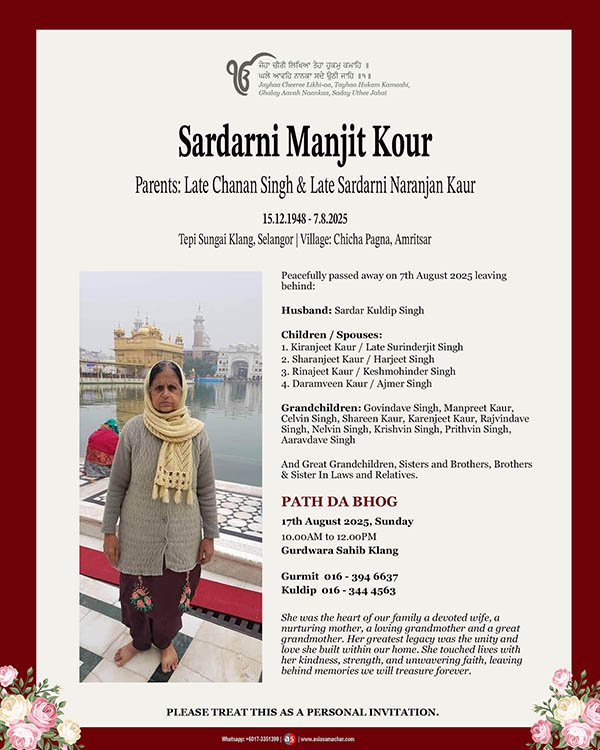
She was the heart of our family a devoted wife, a nurturing mother, a loving grandmother and a great grandmother. Her greatest legacy was the unity and love she built within our home. She touched lives with her kindness, strength, and unwavering faith, leaving behind memories we will treasure forever.
ASIA SAMACHAR is an online newspaper for Sikhs / Punjabis in Southeast Asia and beyond. You can leave your comments at our website, Facebook, Twitter, and Instagram. We will delete comments we deem offensive or potentially libelous. You can reach us via WhatsApp +6017-335-1399 or email: asia.samachar@gmail.com. For obituary announcements, click here
Sri Dasmesh Pipe Band to present historic bagpipe concert at Dewan Filharmonik Petronas in Kuala Lumpur on Aug 31, 2025
By Asia Samachar | Malaysia |
The dashing Sri Dasmesh Pipe Band will stage Malaysia’s first ever bagpipe concert at Dewan Filharmonik Petronas in Kuala Lumpur on the night of Merdeka.
The award winning band will present ‘The Fortress of Dreams: A Sri Dasmesh Original‘ from 8pm to 10pm on Aug 31.
Tickets are on sale.
The band, recognised for excellence in traditional Scottish piping, will make history as they present the first ever full-length bagpipe concert to be staged at the nation’s iconic concert hall.
On Merdeka Night, the band is promising to showcase a bold and imaginative performance that blends the deep roots of bagpipe tradition with local musical heritage.
The Fortress of Dreams is more than a concert. It is a cultural statement. The performance will incorporate an exciting fusion of bagpipes with Malaysian instruments such as the Chinese Tanggu, Indian Urumi and Malaysian Gamelan, alongside global sounds including the Irish flute.
Tickets are available now, with limited seating in B and C Reserve categories offered at 10% off using the promo code “SDPB2025”. For details and purchases, visit www.dfp.com.my.
CHECK THE REPORT AT ASIA SAMACHAR FACEBOOK & INSTAGRAM FOR MORE PHOTOS
Sri Dasmesh Pipe Band to presentbagpipe concert ‘The Fortress of Dreams’ in Kuala Lumpur on Aug 31, 2025
ASIA SAMACHAR is an online newspaper for Sikhs / Punjabis in Southeast Asia and beyond. You can leave your comments at our website, Facebook, Twitter, and Instagram. We will delete comments we deem offensive or potentially libelous. You can reach us via WhatsApp +6017-335-1399 or email: asia.samachar@gmail.com. For obituary announcements, click here
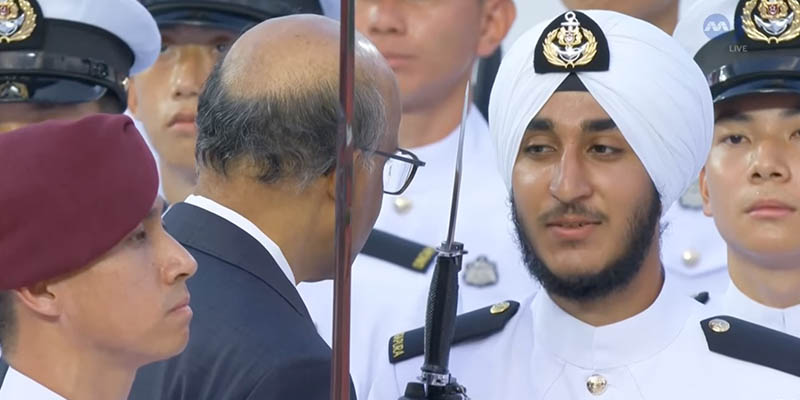
Singapore President Tharman having a word with navy officer Meher Singh at the National Day Parade on Aug 9, 2025 – Photo: Video grab
By Asia Samachar | Singapore |
Singaporeans turned out in force for the National Day Parade at the Padang and Marina Bay today (Aug 9) as the republic celebrates its 60th birthday.
The dazzling event capped the celebration themed Majulah Singapura, or Onward Singapore.
President Tharman Shanmugaratnam inspected the Guard of Honour, stopping to talk to some of the officers. One of them was Sikh navy officer Meher Singh who is currently a naval diver. He was formerly the basketball vice captain in Raffles Institution.
ASIA SAMACHAR is an online newspaper for Sikhs / Punjabis in Southeast Asia and beyond. You can leave your comments at our website, Facebook, Twitter, and Instagram. We will delete comments we deem offensive or potentially libelous. You can reach us via WhatsApp +6017-335-1399 or email: asia.samachar@gmail.com. For obituary announcements, click here
Event organizers, DJs and sound engineers must be educated on safe sound practices. Gurdwara committees should invest in modern sound systems that provide clarity without excessive volume.
By Brother Prof | Opinion |
The vibrant energy of a Punjabi wedding or the soulful devotion of a Gurdwara prayer service are hallmarks of our culture. Yet, an increasingly common element threatens to overshadow these beautiful traditions: dangerously high sound levels. While music is central to these gatherings, its excessive volume has become a pervasive issue, one that we must urgently address for the health and well-being of our community.
We have all been there. At a wedding reception, the music is so loud that conversation is impossible. The bass thumps not just through the floor, but through your chest, leaving a ringing in your ears long after the event ends. Similarly, within the sacred spaces of our Gurdwaras, the sound systems—meant to carry the divine message of Gurbani—are often amplified to a level that is jarring, making it difficult for many to focus on prayer or find spiritual solace.
This practice, while seemingly a matter of taste or preference, carries a serious and often silent cost. Medical experts warn that prolonged exposure to sound levels above 85 decibels—the volume of a busy city street—can cause permanent hearing damage, including tinnitus and hearing loss. Our celebrations and places of worship, ironically, are becoming environments where we risk irreversible harm to ourselves and, critically, to our children and elders, who are particularly vulnerable.
The rationale behind such high volume is often a desire for “bigger” and “better,” a perceived measure of the function’s success or grandeur. But true success lies not in the decibel count, but in the quality of the experience. A wedding should be a place for joyous celebration, where family and friends can connect, laugh, and dance without shouting to be heard. A Gurdwara should be a sanctuary of peace, where the mind can be still and absorb the profound wisdom of our scriptures.
It is time for a cultural shift. We must redefine what a good function sounds like. This change requires collective effort. Event organizers, DJs and sound engineers must be educated on safe sound practices. Gurdwara committees should invest in modern sound systems that provide clarity without excessive volume.
Most importantly, as a community, we must speak up. Let us advocate for an environment where our traditions are celebrated with joy, respect, and a mindful consideration for the health of all who attend. By turning down the volume, we do not diminish our celebrations; we make them richer, safer, and more inclusive for generations to come.
RELATED STORY:
(Asia Samachar, x 2025)
ASIA SAMACHAR is an online newspaper for Sikhs / Punjabis in Southeast Asia and beyond. You can leave your comments at our website, Facebook, Twitter, and Instagram. We will delete comments we deem offensive or potentially libelous. You can reach us via WhatsApp +6017-335-1399 or email: asia.samachar@gmail.com. For obituary announcements, click here