Pingalwara staff working on prosthesis limbs – Photo / Sukdarshen Singh
Capturing the sights and emotions at Pingalwara in Amritsar, Punjab, is no easy task. This is the home to homeless, destitute, orphans, physically and mentally-challenged persons.
The man behind the project, which actually began in Lahore, now in Punjab, Pakistan, is no longer around. Bhagat Puran Singh is known to many.
His first patient was one who could not walk and Puran Singh carries the child who was given the name Piara (The Affectionate One) Singh. He become so close to this child that he was very much part of Puran Singh inspiration.
In April 2017, Canadian defence minister Harjit Singh Sajjan – the first Sikh to be made a defence minister in any nation in the world – had visited Pingalwara’c centre at Manawala, Amritsar.
There, he remarked: “Do not try and be great like me. Remember, you are already great — aim to be great like yourself.”
The centre is registered under the All India Pingalwara Charitable Society (Regd) Amritsar, which is today helmed by Dr Inderjit Kaur as its president.
Some patients at Pingalwara in Amritsar – Photo / Sukdarshen Singh
Sukdarshen Singh, an active Malaysian social worker, had visited the Pingalwara centre in October. He shares his observation:
THE FACILITIES
I spoke to the administrator in two locations. They have 33 acres of land at their biggest centre. It accomodates 850 patients, orphans, aged folks, etc.
In this centre, they have a gurdwara, school for orphans and those who cannot afford to pay fees for normal school. They offer boarding facilities. Within the same location they have a school dedicated for children with special needs and also a school for deaf.
The centre also has a complete solution to offer artificial limbs right to physio exercises to enable patients to be comfortable with these new limbs.
Finance comes from generous donors worldwide and Rp15 lakh from the Shiromani gurdwara Parbandhak Committee (SGPC). They unfortunately have to pay Rp2 lakh of GST, which they trying to seek exemption. So far, not much success.
Some unscrupulous people have used the Pingalwara name to collect donations without any intention of giving to these centres. I saw them standing at toll booths. The Pingalwara have not authorised any person or group to collect on their behalf from the villages or road sides. They have stationed boxes at various places in front of their seven centres where donations can be made. They also enable direct banking facilities.
I spoke to most of the paid employees there. Each one of them have been working easily above five years. Some even over 12 years. The work they do is tough but each person I spoke to displayed commitment and love for their job.
They keep herd of cattle but still find the need to buy milk from outside. They grow most of their vegetables free from pesticide.
At the Pingalwara, they keep their own herd of cattle to provide milk. But they still need to buy milk from outside to feed 850 patients, children and aged souls accommodated in this largest centre. They also grow most of their vegetables free from pesticide.
PROTHESIS
They offer free prothesis arms and legs for those without limbs and cannot afford them.
Pingglewara keeps their treatment statistics. From here, we can appreciate the range of illness they treat for free (see photo).
During this visit – on 6 Nov 2017 – the record of patients at the Bhagat Puran Singh Prosthetic Centre record of patients showed that it had assessed 10,358 patients. The breakdown for patients for fitment were 7,888 males and 1,860 females. On number of aids and appliances fitted, the numbers displayed were 3,654 for prosthesis and 2,876 for ortosis. One hundred and thirty six cases were fabrication at that point of time.
I took photos of some of the patients. After a while I realised they were just too many. I decided to offer a touch, a hug or a smile instead. Best decision I made.
Prothesis limbs being manufactured at the Pinggalwara centre in Amritsar – Photo / Sukdarshen Singh
Bhagat Puran Singh and Piara
What do you pay for what type of services? This is no ordinary centre – Photo / Sukdarshen Singh
Some patients at Pinggalwara in Amritsar – Photo / Sukdarshen SIngh
Pinggalwara staff working on prosthesis limbs – Photo / Sukdarshen SIngh \
ASIA SAMACHAR is an online newspaper for Sikhs in Southeast Asia and surrounding countries. We have a Facebook page, do give it a LIKE. Follow us on Twitter. Visit our website: www.asiasamachar.com] 16367
[Fastest way to reach Asia Samachar: Facebook message or WhatsApp +6017-335-1399. Our email: editor@asiasamachar.com. For obituary announcements, click here]
[ASIA SAMACHAR is an online newspaper for Sikhs in Southeast Asia and surrounding countries. We have a Facebook page, do give it a LIKE. Follow us on Twitter. Visit our website: www.asiasamachar.com] 16360
[The fastest way to reach Asia Samachar is by sending us a Facebook message. For obituary announcements, click here]
Klang Sikhs: Taking part in second division of Selangor hockey league
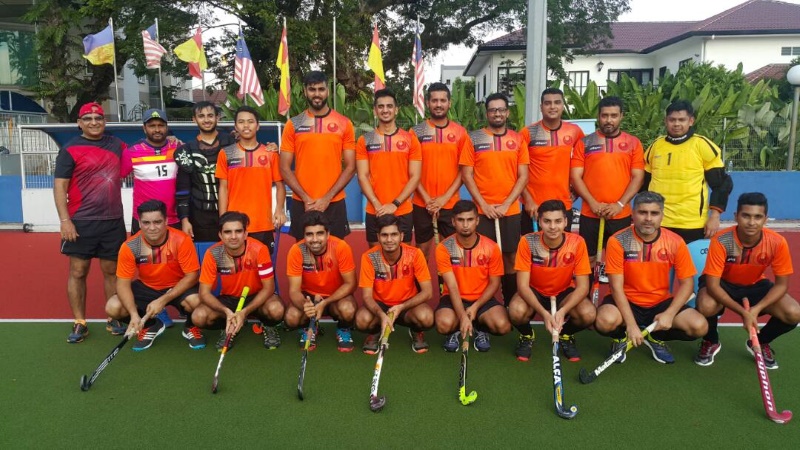
Klang Sikhs has survived the first round of the Selangor League Division Two hockey tourney. On Nov 12, they will compete in the next round, hoping to make it to the finals.
The self-funded team emerged third in the league in 2014, their best performance thus far.
“This time around, the competition is really keen. We have many more teams,” team manager Kuldip Singh tells Asia Samachar.
The second division of the league, organised by Selangor Hockey Association, consists of 23 teams. Six teams have made it to the second stage. Klang Sikhs are up against Selayang and MBPJ Tigers in the next stage.
“We are all self-funded. Our juniors get some funding for Klang gurdwara for the turf booking and a few other items,” he said.
Klang Sikhs emerged champs of the recent Malaysia-Singpore Games (Maspore) 2017 held in Ipoh last month.
ASIA SAMACHAR is an online newspaper for Sikhs in Southeast Asia and surrounding countries. We have a Facebook page, do give it a LIKE. Follow us on Twitter. Visit our website: www.asiasamachar.com] 16341
[Fastest way to reach Asia Samachar: Facebook message or WhatsApp +6017-335-1399. Our email: editor@asiasamachar.com. For obituary announcements, click here]
Prince Charles saying something to Ranjit Ajit Singh, with Sultan Nazrin Shah (middle) hosting the Prince of Wales
Britain’s Prince Charles kicked off his maiden visit to Malaysia with a reception at the Islamic Arts Museum Malaysia, located a stone’s throw away from the National Mosque in the heart of in Kuala Lumpur.
”I must say that I’ve always been fascinated by Malaysia’s rich cultural, religious and racial diversity which, if I may say so, is something to be both cherished and celebrated,” the Prince of Wales said at a reception hosted by the Sultan of Perak, Sultan Nazrin Shah.
“I cannot tell you how delighted I am to be in Malaysia for the first time and in this 60th anniversary year of Malaysia’s independence,” the heir to the British throne said at his first official engagement of the week-long tour, reports Bernama.
Also present was Securities Commission Malaysia chairman Tan Sri Ranjit Ajit Singh.
Prince Charles and his wife Camilla, the Duchess of Cornwall, arrived in the Malaysian capital yesterday on an official visit to this multi-ethnic Southeast Asian nation of over 30 million people, one of the stops of Their Royal Highnesses’ Autumn Tour.
The reception was held at the Islamic Arts Museum Malaysia, located a stone’s throw away from the National Mosque in the heart of the city.
[ASIA SAMACHAR is an online newspaper for Sikhs in Southeast Asia and surrounding countries. We have a Facebook page, do give it a LIKE. Follow us on Twitter. Visit our website: www.asiasamachar.com] 16322
[Fastest way to reach Asia Samachar: Facebook message or WhatsApp +6017-335-1399. Our email: editor@asiasamachar.com. For obituary announcements, click here]
Delhi civil judge Jasjeet Kaur grants ex-parte interim injunction directing Google India to remove offensive videos – Photo grab from document at LiveLaw.In
Google India has been asked by an Indian court to remove videos featuring a girl making offensive remarks and hate speeches against Sikh gurus and Sikh religion.
A Delhi court yesterday (3 Nov 2017) issued the directive to Google India Pvt Ltd to be done within seven days.
The videos had triggered protests in Jamnu and invited many responses, including from Sikhs angered by the tone and language used by the girl known as Sakshi. Some were angry responses, coming out their with own threats, whle others called condemned the girl but called people to ignore the girl.
Here is one response, where the Sikh girl speaks in Hindi, in response to the original videos which were also in Hindi. See here.
In the courts yesterday, civil judge Jasjeet Kaur granted ex-parte interim injunction in favour of petitioner GS Walia, chief commercial inspector in Northern Railways, who had moved court against Google India for removal of the offensive videos in circulation on YouTube and injunction against uploading similar videos, reports legal news portal LiveLaw.
Walia had moved the court after writing in vain to Google India, which has acquired YouTube.
Walia’s counsel Gurmeet Singh told the court that the offensive videos featuring Sakshi, said to be a resident of Ber Sarai in south Delhi, contains hate speeches and offensive remarks against Sikh Gurus and Sikhism and have been on social social media for many days and is likely to spread communal disharmony. Walia had come across the videos in August, the report said.
“After going through the contents of the plaint and watching videos, it prima facie appears that uploader of the videos has made derogatory remarks against Sikh Gurus and their family members and its followers are likely to feel great insult of the religious sentiments by continued circulation of videos of Sakshi Bhardwaj on social media. “Moreover, social harmony and law and order situation is likely to get adversely affected if defendant number 1 (Google India) is not restrained from publication of derogatory videos,” the court observed.
“Accordingly, I deem it fit to grant ex parte interim injunction in favour of the plaintiff,” the court ordered restraining Google India from uploading or publishing any videos containing hate speech and derogatory remarks against any religion and in particular against Sikh religion.
“Google India is also directed to remove all such videos featuring Sakshi Bhardwaj already in circulation on social media including videos on YouTube containing hate speeches about Sikh Gurus within 7 days,” the court ordered, according to the report.
[ASIA SAMACHAR is an online newspaper for Sikhs in Southeast Asia and surrounding countries. We have a Facebook page, do give it a LIKE. Follow us on Twitter. Visit our website: www.asiasamachar.com] 16317
[Fastest way to reach Asia Samachar: Facebook message or WhatsApp +6017-335-1399. Our email: editor@asiasamachar.com. For obituary announcements, click here]
Path Da Bhog: 12 Nov 2017 (Sunday), 10am-12pm, at Wadda Gurdwara Sahib Ipoh |Malaysia
Bachan Singh (1938-2017), Ipoh
Bachan Singh a/l Late Teja Singh
Village: Chud Majara, District Ropar
Age: 79
Birth:26 Oct 1938
Departed:2 Nov 2017
Spouse: Late Narendar Kaur d/o Late Kaka Singh
Children / Spouses:
Rajender Kaur/Sewinder Singh
Jasvinder Singh/Gurmeet Kaur
Hardeep Singh/Karen How
Darvinder Kaur/Jaswinder Singh
Grandchildren and great grandchildren
Saskaar (Cremation): 12.30 pm on 3.11.2017(Friday) at Sikh Crematorium, Wadda Gurdwara Sahib Ipoh
Path Da Bhog (Prayers): 12 Nov 2017 (Sunday), 10am-12pm, at Wadda Gurdwara Sahib Ipoh, Perak
Contact:
Darvinder 016.5515513
Jaswinder 016.5585583
Rajender 014.3022383
Hardeep 012.2113961
Asia Samachar | Entry: 2 Nov 2017; Updated: 7 Nov 2017 | Source: Family
[ASIA SAMACHAR is an online newspaper for Sikhs in Southeast Asia and surrounding countries. We have a Facebook page, do give it a LIKE. Follow us on Twitter. Visit our website: www.asiasamachar.com]
[The fastest way to reach Asia Samachar is by sending us a Facebook message. For obituary announcements, click here]
A literature defines its people, a literature defines a nation.”1 For this reason and more, poet, writer, cultural critic and academic Associate Professor Kirpal Singh remains one of Singapore literature’s foremost proponents.
Kirpal has published four books of poetry, two collections of stories and several scholarly books. He has more than 200 articles, academic papers and a miscellany of essays and reviews. His research focuses on post-colonial literature, Singapore and Southeast Asia, literature and technology, and creative thinking. He is currently an Associate Professor of English Literature and Director of the Wee Kim Wee Centre at Singapore Management University (SMU). Around the world, he is well-known as a creativity guru and a futurist.
Kirpal is the child of a Punjabi father and a Scottish-Jewish mother. His cross-cultural background, rare at the time of his birth, has made him keenly aware of how ethnicity and religion are powerful drivers in human beings. The impact of this on his work is evident, with multiculturalism and diversity being recurring themes he grapples with. Kirpal is convinced that deep-seated biases need to be discussed and actively engaged with if we are to live in harmony and peace in a world that is increasingly becoming conflict-ridden.
Kirpal’s paternal grandfather was a burly policeman, brought to Singapore (along with his pregnant wife) by the British in the late 19th century to help deal with Chinese gangsters. His father, born in 1921 as one of 18 children in the family, became well-known throughout Malaya as an athlete, a marathoner and, later, a champion boxer in the bantamweight category. His parents met ringside while his 16-year-old mother, fresh out of high school in Glasgow, was on a trip to Singapore to visit her property agent brothers, who were fans of his boxer father.
The couple legitimised their marriage shortly after at the gurdwara (Sikh temple) in Queen Street. Kirpal was born a year later in 1949.
Following his mother’s return to Scotland, Kirpal was sent to live with his grandmother from the age of six months to six years in Batu Gajah and Ipoh. He acknowledges that the absence of his mother has been significant in his life. Still, Kirpal recalls the cow-herding and river-wading Malay village part of his childhood with fondness and many of his poems about Malaya express warmth and nostalgia for that period.
During his childhood, an Orwellian incident in which his friends and him were made to dress up and greet a young British district officer on a village inspection made an indelible impression on him. The officer stopped at Kirpal and used his cane to tickle his nose and tease him while all the other villagers stood quietly by and watched. The resentment at that unquestioned power relationship, in part due to a language barrier, made an impact on his decision to pursue the English language and post-colonial psyche. It is Kirpal’s long-standing conviction that colonialism has to be analysed and understood fully if we are to liberate ourselves from its long-term tyranny. In this respect, mastering the colonial language, English, plays a crucial role.
Kirpal was brought back to Singapore by his uncle once his schooling years began. He attended the experimental Jalan Daud School in Eunos, then Tanjong Katong Technical Secondary School (now Tanjong Katong Secondary School) and Raffles Institution. He received his Bachelor of Arts (Honours) and Master of Arts (English) from the University of Singapore. In 1976, he was awarded a Colombo Plan scholarship to complete his Doctor of Philosophy (PhD) at the University of Adelaide in Australia. Kirpal could have gone to Cambridge (United Kingdom) or to Cornell (United States of America) for his PhD but chose Adelaide because he wanted to be close to his sick uncle. Looking back, he muses that perhaps if he had gone to Cambridge, his life’s journey might have been very different but he has no regrets.
Kirpal was the first Asian to receive a PhD in English from the University of Adelaide. While in Adelaide, he took the opportunity to immerse himself in the city’s rich literary and cultural life while writing his thesis on Aldous Huxley, an intellectual who remains one of his greatest inspirations today. Kirpal was also conferred the Distinguished Alumni Award by the University of Adelaide – an honour given to only a handful from around the world.
“Kirpal always has an eye for capturing the vagaries of life beautifully in the written word. His respect for literature is evident in his repertoire of writings which have contributed signi cantly to the diversity and ourishing of the Singapore literature scene. Alongside his literary peers, his dedication to the craft has inspired many aspiring writers to scale greater heights and bring Singapore literature to the forefront of our society. As an academic, his wisdom and sharp insights on Singapore’s culture and the arts has been in uential in nurturing generations of Singaporean literary and critical thinkers.
I have known Kirpal for many years. What comes out clearly in all my interactions with him is his ability to convey the subtleties and nuances of everyday life in the most comprehensible manner for all to enjoy.
Associate Professor Yaacob Ibrahim,
Minister for Communications and Information Singapore
Prof Kirpal Singh
LIFE AFTER ADELAIDE
Upon graduation, Kirpal was faced with a choice of entering the administrative, foreign or academic services. He heeded the advice of much-admired Professor Maurice Baker and chose academia because of his enormous love of books and his passion for writing. After lecturing at National University of Singapore (NUS) from 1978 to 1991, he moved to Nanyang Technological University (NTU) as founder of its Literature and Drama department, which he then headed for seven years. In 1999, he was asked by the founding team of SMU to join it in creating a different, bold, new university. In 2000, he left NTU to become Associate Professor of Communication Skills and Creative Thinking at SMU, where he still teaches.2
MENTOR
Many of Singapore’s/Malaysia’s early writers, such as Edwin Thumboo, Lee Tzu Pheng, Ee Tiang Hong, Wong Phui Nam and K S Maniam, have been influential in Kirpal’s literary growth. Professor Thumboo, in particular, played a significant role as a mentor in shaping his development as a writer, and he readily acknowledges this despite them having grown distant and divergent in their views over the years. Likewise, on his own time, Kirpal has influenced many of the younger writers in Singapore and continues to act both as a mentor and an inspiration.
Although Kirpal explained that he was approached twice to see if he would be keen to enter politics, once when he was 25 or 26 years old and again after his return from Adelaide when he was asked to be the first Sikh Member of Parliament, he declined both offers, stating that he values his privacy and feels he may be better able to serve Singapore, even in political matters, from outside the political realm. This has, indeed, been true as Kirpal’s views have been regularly sought by policy makers on a diverse range of issues but more commonly on Singapore’s arts, cultural and literary priorities. He has also been featured in the world’s major media such as CNN, CNBC, ESPN, BBC, Times, Wall Street Journal and New York Times, among others.
Kirpal is an internationally acclaimed academic. He was a founding member of the Centre for Research in New Literatures, Flinders University, in 1977, the first Asian Director for the Commonwealth Writers’ Prize in 1993 and 1994, and Chairman of the Singapore Writers Festival in the 1990s. He attended the prestigious University of Iowa International Writing Programme in 1997.
In 2004, he became the first Asian and non-American to be made Director on the Board of the American Creativity Association (ACA), of which he is now Vice President. He is also Chairperson of ACA International. Kirpal has conducted seminars, workshops and classes at a host of universities, including leading institutions such as Massachusetts Institute of Technology, Yale, Columbia, New York University, Oxford and Cambridge. His works are taught in various university courses, nationally and internationally. He has been invited to perform and speak at some of the world’s most highly-valued arts and literary festivals such as the Edinburgh, Adelaide, York and Toronto.
POWER DYNAMICS, LITERATURE
As an educator, Kirpal believes the hallmark of the strength of his teaching is when a student outshines him in his achievements. He is cognisant of the power dynamics between him and his students, staff, colleagues and administrators, and power is another very present theme in his literary work. Kirpal believes that, by and large, if a society functions on fear as the basis for respect, it can only be pushed to a certain extent before the human spirit becomes resistant and rebels against it.
Kirpal states: “Literature gives human beings the capacity to think in alternate ways. In Singapore, we tend to be overemphatic about the hard sciences and our post-colonial condition has caused us to respect the literature of other countries more.”3
However, he firmly believes that literature makes and defines its people. He is concerned that ever since it was dropped as a compulsory subject in schools, the level of English language ability in Singapore has been deteriorating. He has advocated for the mandatory teaching of Singapore literature and believes that we should study it first because it will give us a stronger sense of identity.
Literature talks about joy and sorrow, it makes you laugh and makes you cry. Writers often venture into domains that are between the knowing and the unaccepting. Kirpal is one Singapore’s writers who has, indeed, ventured in virtually all domains in his lifetime – in Singapore and around the world. He remains true to the undaunted spirit of his forefathers – voyaging beyond the known, in both reality and imagination.
Endnotes
1 Interview with Associate Professor Kirpal Singh, August 3, 2105.
3 Interview with Associate Professor Kirpal Singh, op cit.
[This article is courtesy of SINGAPORE AT 50: 50 SIKHS AND THEIR CONTRIBUTIONS, a book published in 2015 by the Young Sikh Association, Singapore (YSA) in conjunction with Singapore’s 50th birthday]
ASIA SAMACHAR is an online newspaper for Sikhs / Punjabis in Southeast Asia and beyond.Facebook | WhatsApp +6017-335-1399 | Email: editor@asiasamachar.com | Twitter | Instagram | Obituary announcements, click here |
Maspore Games in Ipoh, Perak – Photo / Photo Mafias
The 3rd Maspore, the Malaysia-Singapore Sikh games aimed at promoting friendship, unity and sportsmanship among the community, were held earlier this month in Ipoh, Perak.
Some 300 Sikh athletes and officials took part in the games which were first started in 2014 in Perak with only one sport.
This time around, they had four sports: netball, hockey, badminton and soccer, said games director Jasbir Singh Nannuan.
The teams taking part in the two-day event were Buntong Sikhs (Perak), Punjabi FC (Kuala Lumpur), Jurong Sikhs (Singapore) and United Bros (Penang and Kedah). The Klang Sikhs took part in hockey.
The 4th Maspore games next year will be held in Penang.
ASIA SAMACHAR is an online newspaper for Sikhs in Southeast Asia and surrounding countries. We have a Facebook page, do give it a LIKE. Follow us on Twitter. Visit our website: www.asiasamachar.com] 16297
[Fastest way to reach Asia Samachar: Facebook message or WhatsApp +6017-335-1399. Our email: editor@asiasamachar.com. For obituary announcements, click here]
Late Fauja Singh Suropada with his wife Pritam Kaur with their first two children in Singapore in early 1950s. Sardarji worked in the Defence forces for the British initially and later as a Security ‘Jaga’. Mahji, who is healthy till today, was a housewife all along.
By Jatinder Singh
‘Paser’ (pronounced Pah-Sir) is a term which in its original Malay form, ‘Pasar (Pah-Sar)’ refers to the ‘marketplace’ in traditional Singapore society.
Sarjit Singh Suropada, 71, who was born in Singapore recalls: “The Paser was where one went to get meat and vegetables for cooking, spices, street hawkers, household items, and everything else that was needed to buy.”
The short narrative by Sarjit, can tell us how apart from retail, the ‘Paser’ was a platform for robust interaction, communication, bargaining, recreation, by all members of the community. The ‘Paser’, hence, was a cultural factory, producing common jargons that the people could identify with. Let us take a look at how Punjabi from its original Amritsari or Jalandhar became ‘Paser’ type in the interesting exchange below:
Son: Mommy, that lady just told me, Lempu Kholke, Pisoh Lehke, Bengku Te Behke, Bayam Nu Ketoh’ – whats that?!
Mother: She spoke to you in Punjabi- Switch on the light, grab a knife, sit on the stool and slice the Spinach in Punjabi.
Son: Punjabi? You got to be kidding me. I know Punjabi!
Mother: This Punjabi is not found in your textbooks. This is our very own Singapore Punjabi!
The dialogue above that took place between a Punjabi teenager and his mother, struck my attention recently (2017) at a local Gurudwara in Singapore. I realised that I had written a research paper in 2002 as an undergraduate at the National University of Singapore (NUS), where I had shed interesting light on the unique Malay vocabulary that could be found spoken by Sikhs in Singapore. Apart from being a unique Punjabi, the hybrid language also functioned as an Identity Marker of being Singaporean.
The thesis that I put drafted titled “Creolization of Cultures in Singapore” under the Department of Sociology, centred around the Socio-Historical trajectory that took off in the early 1930s when Sikh Sojourners arrived at Singapore’s shores from India. Fleets of Sikhs travelled to Singapore via Calcutta (this explains the common referral to Sikhs as Bengali) as part of Defence and Military Forces, Traders and other vocations. The Sikh Sojourners were often males who travelled without their families but did so in patterns parallel to that of their ‘Pind’ settlements back home. I shall attempt for purposes of this essay to delineate the processes that led to the symbiosis and precipitation of the ‘Paser’ Punjabi that we address.
Language Mapping
History informs us that the indigenous people of Singapore were of Malay descent. While, there existed pockets of vernacular Malay languages such as Javanese, Boyanese, Balinese, and so on, a common Malay tongue called Bahasa was carved out to unify the different genres. Likewise, within the Chinese populace, Hokkien, Cantonese, Hakka, Hailam, Teochew, etc., carried along strong allegiances, and it was only later that Mandarin evolved as a common, binding lingua franca for the Orientals.
The Indian realm was predominantly South-Indian, with masses who had arrived in Singapore, mainly as labourers in plantation, agriculture, construction and road building. They had a fairly loud presence in public spheres as compared to the reserved barrack occupying Punjabi troopers (with increased decibels only on special occasions). Their Tamil lingo was also clearly distinguishable vis-a-vis prisoners deployed here from Chennai clad in metallic leg cuffs. Historians have even attributed the popularity of the terms ‘Keling’, the racial brand for Tamilians in Singapore till today to the cling sound of chain cuffs, and Roti-Canai as a derivative of bread from Chennai.
Language Bridging
I really would love to be bestowed with the talent of Cartoon Sketching to include at this juncture, a creative graphic of the Englishman, Chinese, Malay and Indian at the ‘Paser’. I cannot draw, however, but shall posit this next assertion in a simple point chart:
Englishmen- English, sprinkles of Malay.
Chinese- Dialects, sprinkles of Malay & English.
Malays- Malay, sprinkles of English.
Tamilians- Tamil, sprinkles of Malay & English.
Punjabis- Punjabi, Malay, sprinkles of English.
A comparative analysis of the non-exhaustive list above would expose a ‘trending’ overlap- the Malay Language as spoken by all of the ethnic identities, fluently or ‘broken’. Malay was thus a feasible and viable linguistic bridge to connect cross-cultures in Singapore.
Language Exchange
I shall attempt to explain why Malay as an initial bridging linguistic commonality, imperatively grew to be incorporated into the original language mediums such as Punjabi. Malay, we have developed as the language of the natives which in its modernised form, sprung off far from its original ‘Jawi’ script taking a revolutionary rebirth in Romanised English characters. Bo-Boh La-Lah, BOLA forms a classic example of Malay in its most simplified written and pronounced model. Simply put, the acquisition of the Malay vocabulary was thus smooth and viable. Within the Sikh citizenry across time, the Malay vocabulary inception grew and underwent a process of dynamic normalisation as part of spoken Punjabi. Enclosed are some examples:
1930s- 1940s: The Sikh Immigration in Singapore; the start of preliminary ethno-linguistic discoveries.
1940s- 1950s: The Colonialist British & Japanese Interplay; The former engaging ‘Divide and Rule’ paraphernalia thus allowing the polity to continue the perpetuation of their linguistic kinds. The latter influence on local culture deserves to be investigated separately. Narratives actually iterate with the Sikh regard, that the the INA (Indian National Army) was formed in 1943 as allies of the of the Japanese in Singapore. Then this way, there surely would exist a double edged “Lingua Franca” common to the Samurai and the Singh!
1950s- 1970s: Politics of Merdeka- a clean up of blurred linguistic identities with the formalisation of a second -language mother tongue in Singapore schools.
1970s- 1990s: Formalised Punjabi remains to take a backseat in schools and in the workforce while Malay as a second-language gains acceleration as the preferred dominant mother tongue option by Sikhs. The prevalent Malay component in informal Singapore Punjabi that took birth decades back witnesses enhanced comfort and footing in the verbal communication by Punjabis when they meet in the home, public space or telecommunications. The only mode of ‘Gurmukhi’ acquisition in its authentic form took place via lessons by learned maestros at Sikh Gurduwaras or at the home.
Wither the Paser Punjabi Language
So the question that emerges would be thus- What happened post 1990s till now?
As modernity took a new wave in Singapore’s socio-economic fabric, new forms of capital flow, culture, and education crept into our everyday lives. Since the 1990s Sikhs in Singapore have immensely concretised their identities via micro and macro institutions including the linguistic sector. The Student now looks beyond any other second-language and instead sacrifices time off the weekends to be educated in top merit curriculum at Punjabi Centres around the island. The curriculum and that to being examinable till post-secondary levels, is propelled by a universal model and structure just like any other mainstream linguistics.
There lies no incentive of any sort for Punjabi academic heads in Singapore to lobby for ‘Paser’ Punjabi to be recognised and formally assimilated into the syllabus. My peers in response to informal discussion with regard to the reality of ‘Paser’ Punjabi as a Singaporean textbook special component often remark cheekily “only if Singapore was in Canada”.
I completed my second language in Malay up to GCE A-Levels in 1994 and am equipped with a decent ‘Paser’ Punjabi ability but only “Laku” with Sikhs my age and older. Communication with the new wave of ‘Desi Pais’ in Gurduwaras and ad hoc situations is typically an alienating experience for me. Their command of English lags far behind, while their Punjabi boasts of ‘deep’ content where ‘Roti’ (Chapati) is referred to as “Fulkeh” and “Tahu Sambel” appears to be ‘Paneer Masala’!
The process of ‘Paser’ Punjabi’s withering is inevitable’ especially when I discover that my nieces understand what ‘Gaind’ is while “Bo-Boh, La-Lah, BOLA” sound like a comical expression or worse, “ Mamaji you sound like a Caveman”!
Jatinder Singh possesses great interest in culture which he studied at National University of Singapore (NUS). He currently trains students and adults in schools and enrichment centres in a range of topics; including public speaking which forms his forte. Jatinder also extends his flair to host and emcee events.
ASIA SAMACHAR is an online newspaper for Sikhs in Southeast Asia and surrounding countries. We have a Facebook page, do give it a LIKE. Follow us on Twitter. Visit our website: www.asiasamachar.com] 16277
[Fastest way to reach Asia Samachar: Facebook message or WhatsApp +6017-335-1399. Our email: editor@asiasamachar.com. For obituary announcements, click here]
…. Because the minute we jump a step we lose count of what matters in life… It’s always a step by step effort… – Toonistbains
[ASIA SAMACHAR is an online newspaper for Sikhs in Southeast Asia and surrounding countries. We have a Facebook page, do give it a LIKE. Follow us on Twitter. Visit our website: www.asiasamachar.com] 16287
[Fastest way to reach Asia Samachar: Facebook message or WhatsApp +6017-335-1399. Our email: editor@asiasamachar.com. For obituary announcements, click here]























 Jatinder Singh possesses great interest in culture which he studied at National University of Singapore (NUS). He currently trains students and adults in schools and enrichment centres in a range of topics; including public speaking which forms his forte. Jatinder also extends his flair to host and emcee events.