ASIA SAMACHAR is an online newspaper for Sikhs / Punjabis in Southeast Asia and beyond. You can leave your comments at our website, Facebook, Twitter, and Instagram. We will delete comments we deem offensive or potentially libelous. You can reach us via WhatsApp +6017-335-1399 or email: asia.samachar@gmail.com. For obituary announcements, click here
A lady granthi doing the chaur seva at the Ipoh Railway Gurdwara – Photo: Asia Samachar
By Dr. B. S. Bains | Opinion |
It is unfortunate that the English language does not offer a truly fitting term for the Chaur Sahib used in our Gurdwaras. The closest equivalent is “fly-whisk,” but this term fails to capture the sacred significance and reverence associated with the Chaur Sahib in Sikh tradition.
“Chaur Sahib”, is a very important symbol in Sikhism. It is not a ritual, on the contrary, it is used to show respect and reverence for the Sri Guru Granth Sahib Ji, as our eternal Guru. The tradition of waving the Chaur Sahib over the Guru Granth Sahib has deep historical and spiritual significance.
Historical Connection
In ancient India, kings and emperors were often fly-whisked using a chaur made from yak or horse tail-hair by their attendants as a sign of Royalty, Honor, and Sovereignty. This was a common practice in royal courts, where attendants would waive the chaur to show their devotion and service to the King.
When Guru Gobind Singh Ji, the tenth Guru, proclaimed Sri Guru Granth Sahib Ji as the eternal Guru in 1708, he affirmed that its presence in the Darbar would hold the same sovereignty and reverence as a King. The respect, devotion, and service would now be directed toward SGGS, and the tradition of fly-whisking, which dates back to Guru Arjan Dev Ji, when he first referred to SGGS as “Pothi Parmeshwar Ki”, would continue as a mark of honor for the eternal Guru in scripture form.
Spiritual Significance in Gurdwaras
Symbol of Sovereignty – Just as kings were honored with the chaur, waving the Chaur Sahib over Guru Granth Sahib Ji signifies that the Guru is the eternal sovereign of the Sikh faith.
Respect and Devotion – It represents seva (selfless service) and reverence for the Guru, performed by the granthi or a devotee in humility. When the Darbar (court) is in session, and the ceremony is being conducted in the presence of SGGS, the Chaur Sahib is respectfully waved as a gesture of honor, submission, and spiritual service. This practice reinforces the idea that Guru Granth Sahib Ji reigns as the supreme sovereign, and all who enter the Darbar would do so genuflecting and stooping with a sense of devotion, humility and respect.
Purity and Royalty – The Chaur Sahib is traditionally made from yak hair or horse tail-hair, which signifies purity and is associated with royal dignity.
Continuity of Tradition – It connects the Sikh community to their historical and spiritual roots, emphasizing that Guru Granth Sahib Ji is the ultimate authority in Sikhism.
Just as kings were fly-wisked as a mark of their sovereignty, Sikhs use the Chaur Sahib to acknowledge that Sri Guru Granth Sahib Ji is the eternal Guru and the supreme spiritual guide. It is an expression of utmost respect, devotion, and recognition of divine authority in the Sikh faith.
The Chaur Sahib should be waved with grace, humility, and deep devotion over Sri Guru Granth Sahib Ji (SGGS), ensuring that every movement reflects utmost respect and reverence. It is essential to recognize that the Chaur Sahib is not merely a ritual, but a profound act of honor and devotion toward the eternal Guru.
Unfortunately, due to a lack of understanding, many perceive it as just a ceremonial practice without grasping its true significance. When the spiritual essence behind this act is lost—whether due to ignorance or inadequate learning—it risks becoming a mere formality rather than a heartfelt seva.
Therefore, it is imperative that we educate ourselves on the correct practices and etiquette for waving the Chaur Sahib in a Gurdwara, ensuring that this sacred tradition is upheld with the reverence it truly deserves.
Preparation Before Waving Chaur Sahib
a. Wash Hands & Maintain Cleanliness – Ensure hands are clean before handling the Chaur Sahib. b. Dress Modestly – Those performing the seva should be in clean, respectful attire. c. Cover Head – The head must be covered with a turban, chunni, or patka. d. Shoes Removed – One should be barefoot or wear clean socks.
Correct Way to Wave the Chaur Sahib
a. Hold with Both Hands Initially – When picking up the Chaur Sahib, do so respectfully. b. Use your dominant hand, as there is no strict rule regarding which hand must be used. Generally, the Chaur Sahib is held in the dominant hand, but the other hand may be used if necessary. Even a person with an amputated arm can carry out Chaur Sewa with the normal hand.
c. Move in a Slow & Circular Motion – i. The Chaur should be waved in a gentle, flowing motion over Sri Guru Granth Sahib Ji. ii. Start from one side, moving in an arc-like motion to the other side. Tactfully, consciously and gracefully iii. Avoid rapid or erratic movements.
d. Height & Position – The Chaur Sahib should be waved above the SGGS, ensuring it does not touch the Palki Sahib or the angs (pages).
e. Continuous but Relaxed Motion – The Chaur Sahib should be waved at a steady and natural pace, without unnecessary exaggeration.
During Gurbani Recitation or Kirtan
a. While Sri Guru Granth Sahib Ji is being read, the Chaur Sahib is waved as a mark of reverence. b. During congregational Ardaas (prayer), the individual performing Chaur Sahib Seva should either hold the Chaur Sahib with folded hands or gently wave it over Sri Guru Granth Sahib Ji at longer intervals, ensuring that their focus remains on the Ardaas.
After Completion of Seva
a. The Chaur Sahib should be placed respectfully near the Guru Granth Sahib Ji or on a dedicated stand. b. The person performing the seva should bow with humility before stepping away.
Waving the Chaur Sahib is not just a ritual but a sewa (selfless service) and an expression of deep reverence for Sri Guru Granth Sahib Ji, the eternal Guru of the Sikhs. It should always be done with a pure heart, focus, and humility, recognizing that this is a privilege and a sacred duty.
A question naturally arises—why is the Chaur Sahib not waved by devotees when the Darbar Sahib is not in session? Does this practice become just a ritual or formality when the Darbar is in session?
What we often fail to understand is that when the King is seated on the throne, he is a witness to the ceremony. When the Hukamnama is read, it is the Guru’s decree, the divine guidance from Guru Granth Sahib Ji—whom Sikhs revere as Patshah (the True Sovereign), not Batshah (a worldly ruler). The Hukamnama is not just a reading; it is the direct advice and command of our eternal Guru.
Once the session concludes, Guru Ji remains seated, ready to receive anyone who comes into the Darbar. It becomes the duty of the devotee to approach with humility, bow in reverence, wash their hands, and wave the Chaur Sahib over Sri Guru Granth Sahib Ji before reading from it or departing. This sacred gesture should always be performed with love and devotion, not as a formality, but as an expression of deep faith and service.
With this profound practice, Sikhs hold a unique and priceless gift—the Guru in scripture form. This legacy of reverence and devotion, established by Guru Gobind Singh Ji, will continue for centuries to come and remain eternal. Can we not fathom the incredible vision and wisdom our Guru left for his Sikhs?
Dr Balwant Singh Bains is a Malaysia-based kirtan enthusiast and a practicing physiotherapist with a chain of physiotherapy clinics.
ASIA SAMACHAR is an online newspaper for Sikhs / Punjabis in Southeast Asia and beyond. You can leave your comments at our website, Facebook, Twitter, and Instagram. We will delete comments we deem offensive or potentially libelous. You can reach us via WhatsApp +6017-335-1399 or email: asia.samachar@gmail.com. For obituary announcements, click here
Datin Ranjit Kaur w/o Datuk Piara Singh has passed away peacefully on 21st February 2025 surrounded by her loved ones.
~A force of nature who was a granddaughter, daughter, sister, wife, mother, grandmother, aunt, friend, role model for so many far and wide. She built a life of love from nothing, and gave her love freely and generously.~
PATH DA BHOG & ANTIM ARDAAS Sunday, 2nd March Gurdwara Sahib, Jalan Yam Tuan, Seremban from 9:30 a.m. to 11:30 a.m. followed by Guru Ka Langgar (lunch).
| Entry: 21 Feb 2025; Updated 28 Feb 2025 | Source: Family
ASIA SAMACHAR is an online newspaper for Sikhs / Punjabis in Southeast Asia and beyond. You can leave your comments at our website, Facebook, Twitter, and Instagram. We will delete comments we deem offensive or potentially libelous. You can reach us via WhatsApp +6017-335-1399 or email: asia.samachar@gmail.com. For obituary announcements, click here
White House Press Secretary Karoline Leavitt shared the photographs of the flight on X. (X/Karoline Leavitt )
By Gurmukh Singh | Opinion |
A U S military transport plane carrying 104 deported Indian migrants arrived at Amritsar airport after a 40-hour flight from Texas on Wednesday 5 February, 2025. The migrants were in handcuffs and shackles and this was the first time they had been sent back on a military aircraft. President Trump was sending a clear message to India and other countries unable to control own citizens from crossing national borders illegally. In reaction, we saw Indian parliamentarians protesting loudly.
In 2022, the Washington-based Pew Research Center, estimated that nearly 725,000 unauthorized immigrants from India reside in the US. They are the third-largest group after Mexico and El Salvador. More recently, illegal immigrants have been sent back to their countries from UK in a similar way. In defence, UK Home Office ministers said that the decision to publish images of arrests and deportations, is compassionate. The publicity sends a clear message to people who may have been sold lies about what will await them in the UK if they get themselves smuggled in. These are the people who live in squalid conditions, being exploited by vicious gangs. Ministers believe that it is important that the public and the governments concerned understand these ground realities. Laws of the land and rules must be followed.
Moving from one part of the world to another is as old as human history. The urge to explore was always there in human nature. Human progress has depended on that spirit of exploration and discovery. Guru Nanak Dev Ji was an outstanding example of a teaching traveller, a gatherer and distributer of knowledge through discourses while He preached Oneness of all creation and the Creator Being.
However, in those days there were no national boundaries nor laws restricting free movement of people. Today, the national boundaries and laws have to be respected by people and countries. Creating conditions in countries which force people to flee to other countries without proper documentation, brings shame on the governments of the countries concerned. Economic compulsions too force people to cross borders and the distinction between asylum seekers and economic migrations can become blurred.
It takes a careful analysis of the root causes to find solutions to illegal migrations. For example, why are young men and women from even middle class families running from Panjab and India. What are they escaping from? Who encourages them to leave the country without proper documents. Who benefits from this illegal trade in human beings? The solution lies in the answers to such questions. The administrations of Panjab and India carry the ultimate responsibility for creating conditions which compel young men and women of working age to run from own homes and country. The Indian state and central governments are in the dock and not the foreign governments.
Also, I find it sadly amusing when Indian politicians expect legally and successfully settled and well-integrated next generations Indian communities living abroad to use their influence and help in such matters. It is never clear what sort of help is expected in addition to what Indian missions should be providing. In any case, knowingly helping illegal migrants is unlawful.
One view is that, except for indiscriminate Langar and charity sewa, this is not an area for diaspora Sikh political activism. For too long, Panjab and Indian authorities have turned a blind eye to the illegal activities of travel agents.
Genuine skills-based legal means to work abroad should be facilitated.
Gurmukh Singh OBE, a retired UK senior civil servant, chairs the Advisory Board of The Sikh Missionary Society UK. Email: sewauk2005@yahoo.co.uk. Click here for more details on the author.The article first appeared at Panjab Times, UK
* This is the opinion of the writer, organisation or publication and does not necessarily represent the views of Asia Samachar.
ASIA SAMACHAR is an online newspaper for Sikhs / Punjabis in Southeast Asia and beyond. You can leave your comments at our website, Facebook, Twitter, and Instagram. We will delete comments we deem offensive or potentially libelous. You can reach us via WhatsApp +6017-335-1399 or email: asia.samachar@gmail.com. For obituary announcements, click here
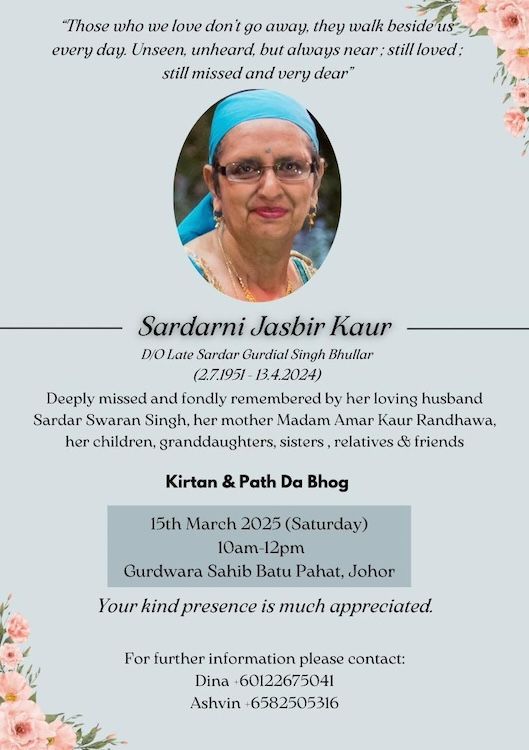
“Those who we love don’t go away, they walk beside us every day. Unseen, unheard, but always near; still loved; still missed and very dear”
SARDARNI JASBIR KAUR d/o Late Sardar Gurdial Singh Bhullar
(2.7.1951 – 13.4.2024)
Deeply missed and fondly remembered by her loving husband Sardar Swaran Singh, her mother Madam Amar Kaur Randhawa, her children, granddaughters, sisters, relatives & friends
KIRTAN & PATH DA BHOG 15th March 2025 (Saturday) 10am-l2pm Gurdwara Sahib Batu Pahat, Johor
Your kind presence is much appreciated.
For further information please contact: Dina +6012 267 5041 Ashvin +65 8250 5316
ASIA SAMACHAR is an online newspaper for Sikhs / Punjabis in Southeast Asia and beyond. You can leave your comments at our website, Facebook, Twitter, and Instagram. We will delete comments we deem offensive or potentially libelous. You can reach us via WhatsApp +6017-335-1399 or email: asia.samachar@gmail.com. For obituary announcements, click here
LAST RITES 20 February 2025 (Thursday) Shamshaan Bhoomi, Jalan Loke Yew Crematorium, KL 3.30pm: Cortège leaves from No 73, Jalan 7/39, Jalan Udang Pasir 3, Taman Megah, 51200 Kepong, KL 5.00pm: Saskaar (cremation) [Timing revised]
ASIA SAMACHAR is an online newspaper for Sikhs / Punjabis in Southeast Asia and beyond. You can leave your comments at our website, Facebook, Twitter, and Instagram. We will delete comments we deem offensive or potentially libelous. You can reach us via WhatsApp +6017-335-1399 or email: asia.samachar@gmail.com. For obituary announcements, click here
It is with great sadness, that we share Lt. Dalbir Singh Dhillon S/O Late Arjan Singh Dhillon has left us on the morning of Feb 19 leaving behind family and friends.
He leaves behind:
Beloved Wife, Madam Harjit Kaur (Pantai Medical Centre, Bangsar)
His siblings, nephews, nieces, in-laws, relatives and friends.
PATH DA BHOG & ANTIM ARDAAS
2 Mar 2025 (Sunday)
9.00am – 11.00am onwards at Gurdwara Sahib Sentul
For those who wish to convey their condolences to the family, kindly contact the following humbers: Melinder: +6016 506 7903 Jagdesh: +6011 2335 8131 Raminder: +6019 388 3982
ASIA SAMACHAR is an online newspaper for Sikhs / Punjabis in Southeast Asia and beyond. You can leave your comments at our website, Facebook, Twitter, and Instagram. We will delete comments we deem offensive or potentially libelous. You can reach us via WhatsApp +6017-335-1399 or email: asia.samachar@gmail.com. For obituary announcements, click here
ENT specialist Professor Dr Balwant Singh Gendeh – Photo: HealthToday
By Lim Teck Choon | HealthToday | Malaysia |
Professor Dr Balwant Singh Gendeh’s journey to becoming a pioneering ENT surgeon was anything but straightforward.
In his early medical career, he was drawn to the fields of obstetrics and gynaecology as well as internal medicine, never imagining that otorhinolaryngology would become his life’s passion and the arena where he would make his most significant contributions.
A Fortuitous Assignment
The turning point came during his internship in Melaka, where he was first introduced to the intricate world of ear, nose, and throat medicine.
However, it was his posting in Jalan Hospital in Kuala Lumpur that truly cemented his path in ENT. This fortuitous assignment not only shaped his professional trajectory but also his personal life, as it was here that he met Dr Pritam Kaur Mangat, the woman who would become his beloved wife and the mother of his 2 children.
At the time, Malaysia was facing a critical shortage of ENT surgeons. Recognizing the need and seeing potential in the young Dr Balwant, his superiors stationed him to learn and assist in this specialized field. This hands-on experience ignited a passion that would drive his career for decades to come.
The Allure of ENT
What drew Professor Balwant to the field of ENT? With his characteristic playful humour, he responds: “It’s the small holes!”
Indeed, our head is a complex network of these small apertures, serving as gateways to 3 of our primary senses. “Hearing, smell, taste,” Professor Balwant points out, his eyes lighting up with enthusiasm.
The significance of ENT further extends beyond these senses, playing a crucial role in our sense of balance, posture and by extension, our touch.
Professor Balwant leans forward, sharing an intriguing insight: “If you survey general practice in Malaysia, about 60% of the common ailments affecting the population are cough, cold, and runny nose. These are all issues affecting the ear, nose, and throat!”
This scenario underscores the pervasive nature of ENT-related health concerns in everyday life. Yet, despite their prevalence, ENT remains an underestimated and often misunderstood medical discipline.
Recognizing this disparity between the widespread occurrence of ENT issues and the limited understanding of the field, Professor Balwant saw an opportunity to contribute significantly into addressing some of the most common health concerns affecting the Malaysian population.
THE JOURNEY AHEAD
From Novice to Expert
In 1989, Dr Balwant graduated as a surgeon from the National University of Malaysia (UKM) in Kuala Lumpur. Upon completion, he found himself in an elite group—one of the few ENT surgeons in the country’s public service at that time.
Pioneering New Techniques
Dr Balwant was not content with merely filling a gap in the medical landscape. He was determined to push the boundaries of his field and bring cutting-edge techniques to Malaysia.
In 1997, he made history by becoming one of the first few surgeons in the country to perform endoscopic sinus surgery. This breakthrough was significant because it offered a far less invasive alternative, reducing patient recovery time, and minimizing complications.
In 1995 and 2007, he patented two inventions in medicine with awards.
Building on this success, in 1998 Dr Balwant became the first to perform endoscopic cerebrospinal fluid (CSF) leakage repair and dacryocystorhinostomy, the endoscopic procedure for the repair of tearing from the eyes, in a university setting in Malaysia.
“I was also the first to introduce the use of biologics for chronic rhinosinusitis with polyps and asthma under the insurance scheme in Malaysia,” he recalls. This is a gamechanger because someone with asthma and nasal polyps can significantly reduce their total steroid load as early as 4 months after the use of biologics.
ASIA SAMACHAR is an online newspaper for Sikhs / Punjabis in Southeast Asia and beyond. You can leave your comments at our website, Facebook, Twitter, and Instagram. We will delete comments we deem offensive or potentially libelous. You can reach us via WhatsApp +6017-335-1399 or email: asia.samachar@gmail.com. For obituary announcements, click here
8 March 2025, Saturday 4pm – 7pm Gurdwara Sahib Perai
With profound grief and sorrow, we are deeply saddened to announce the passing of our Beloved Mother, Grandmother and Great-grandmother on 19th February 2025, Dearly missed by children, Grandchildren, Great Grandchildren, siblings, relatives and friends.
| Entry: 19 Feb 2025; Updated: 2 March 2025 | Source: Family
ASIA SAMACHAR is an online newspaper for Sikhs / Punjabis in Southeast Asia and beyond. You can leave your comments at our website, Facebook, Twitter, and Instagram. We will delete comments we deem offensive or potentially libelous. You can reach us via WhatsApp +6017-335-1399 or email: asia.samachar@gmail.com. For obituary announcements, click here
A scene at Mahakumbh, taken on February 10, 2013 – Photo: Gurpreet Singh
By Raakhi Jagga | The Indian Express |
At the ongoing Mahakumbh in Prayagraj, a nagar kirtan accompanied by a gurbani kirtan and a gatka performance was organised on January 11, marking the presence of the Nirmla Akhara, one of the three Sikh-related akharas (spiritual orders) that are part of the world’s largest religious gathering.
Many Sikh followers visit the three akharas and take holy dips at the sangam, according to Nirmal Akhara followers in Punjab. The other Sikh-related akharas are the Bada (large) Udaseen Akhara and the Naya (new) Udaseen Akhara. Udaseen means neutral. These akharas follow the teachings of Guru Nanak and are guided by the Guru Granth Sahib, the holy scripture of Sikhism. The Udaseen Akhara was established by Baba Sri Chand, son of Guru Nanak Dev, the first Guru of Sikhs. The Nirmala Akhara has centres in various parts of Punjab and elsewhere in the country. The sadhus here revere Hindu scriptures—such as the Vedas, Bhagavad Gita, and Upanishads—as well as the Guru Granth Sahib. Although the akharas bid farewell to the Mahakumbh on February 3, the Kumbh Mela will continue until February 26.
On January 29, Harnam Singh Dhumma, chief of Damdami Taksal, an organisation that teaches Sikh faith, visited the Mahakumbh to take a holy dip. He said that certain Sikh traditions, particularly those belonging to the Udaseen and Nirmala Akharas, participate in the Kumbh.
ASIA SAMACHAR is an online newspaper for Sikhs / Punjabis in Southeast Asia and beyond. You can leave your comments at our website, Facebook, Twitter, and Instagram. We will delete comments we deem offensive or potentially libelous. You can reach us via WhatsApp +6017-335-1399 or email: asia.samachar@gmail.com. For obituary announcements, click here