From Donald Trump’s “America First” policy to Narendra Modi’s Hindutva ideological project, from Vladimir Putin’s expansionist rhetoric to the ultra-nationalist ideologies of Viktor Orbán in Hungary and Benjamin Netanyahu in Israel, nationalism is reshaping global politics. The world continues to be shaped by nationalist forces, whether these are manifest between or within nation states, but what exactly does nationalism offer for ordinary people who struggle to make a living? Does it promise freedom and self-determination, or does it foster division, conflict, and oppression?
The Historical Burden of Nationalism
The history of nationalism is largely one of violence. Just in the 20th Century alone, over 100 million people have died in various wars and conflicts almost entirely fought in the name of nationalism.
Nationalism has often served as a tool for suppressing dissent, marginalising minorities, and justifying war. As Gellner (1983) argues, nationalism is not an inherent human trait but a construct that has gained prominence in modernity. Benedict Anderson (1983) describes nations as “imagined communities,” highlighting that these identities are not natural formations but artificial constructs, often shaped by exclusion and hostility toward the “other.” The creation and sustenance of these nationalist sentiments have led to some of history’s most devastating conflicts, from World War II to contemporary civil wars, territorial disputes and in the present moment, the carnage that has been taking place in Ukraine and Gaza.
Nationalism and the Division of the Earth
Nationalism is arguably one of the most powerful political forces in human history, shaping both the human imagination and the geopolitical landscape. The division of the Earth’s landmass into nation-states is a testament to its pervasive influence. Some of these nations, like Russia, the United States, India, and China, cover vast territories, while others, such as Malta, Singapore, and Luxembourg, are no larger than a single city. Despite the diversity of human cultures and identities, national identity often becomes a rigid political construct that dictates global, regional, and local politics (Smith, 1991).
However, though commonly associated with geography, Ernest Gellner (1983) argues that nations and nationalism should primarily be understood as a sentiment. This sentiment can provoke deep anger when one perceives their ‘nation’ has been violated, or pride when it is celebrated. However, as Gellner notes, nation-states are not static; they emerge and dissolve over time. Most of the world’s nations have been created in the past century, and the birth and death of nation-states continue today (Hobsbawm, 1990).
Nationalism: A Source of Pride or a Threat to Stability?
Nations, as Benedict Anderson (1983) suggests, are built on powerful, man-made utopian myths. They emerge from human imagination but profoundly influence people’s convictions, loyalties, and solidarities. National achievements, such as victories in sports or scientific advancements, can be sources of great pride and euphoria. However, this same fervour for national pride can easily transform into hostility toward those perceived as outsiders and, as in some cases communal violence. The persecution of minorities and refugees throughout history exemplifies this dark side of nationalism (Brubaker, 1996).
Nationalist leaders often claim to act in the interests of their people, but they frequently sideline genuine struggles such as economic inequality, healthcare, education, and human rights. North Korea serves as an extreme example: a state governed by ultra-nationalist dictatorship for decades. The regime’s obsessive focus on national pride and military power has left its people in extreme poverty and isolation. Similarly, Modi’s brand of nationalism in India has marginalised religious minorities, curtailed press freedoms, and eroded democratic norms. In Russia, Putin’s nationalism has led to the invasion of Ukraine, suppression of political opposition, and control over independent media. Orbán’s nationalism in Hungary thrives on xenophobia and anti-EU rhetoric, weakening democratic institutions (Snyder, 2018).
Nationalism and Human Needs
Even in cases where nationalist movements seek independence from oppressive states, their claims often fail to address the real concerns of ordinary people. For example, Khalistani nationalism that advocates for an independent Sikh state, has little resonance among most Punjabis, who are more concerned with access to clean water, fair agricultural policies, quality education, and healthcare (Singh and Shani, G, 2021).
Similarly, nationalist expansionist policies in Israel, justified in the name of security and historical claims, have led to the violent displacement of Palestinians, deepening a cycle of oppression and resistance (Papé, 2007). The current war being executed by the Israelis in Gazza has resulted in terrible suffering. According to the BBC, Gaza has suffered vast destruction with a colossal humanitarian impact with more than 46,000 Palestinians being killed during Israel’s military action.
Nationalism as a Tool of Division
One of nationalism’s most dangerous aspects is its ability to manufacture divisions where none previously existed. Whether through anti-immigrant sentiment in the West, religious majoritarianism in South Asia, or aggressive territorial claims in Eastern Europe, nationalism thrives on creating enemies. This manufactured division fuels social unrest, xenophobia, and violence, often diverting attention from real systemic issues like economic inequality and climate change (Snyder, 2018).
Yet, nationalism persists because it offers a seductive narrative: the idea of a unified people reclaiming past glory. It appeals to emotion rather than reason, to nostalgia rather than progress.
However, history demonstrates that nationalism, often, leads not to freedom but to destruction. It prioritizes the myth of the nation over the well-being of its people, trapping societies in cycles of resentment and repression.
Moving Beyond Nationalist Fantasies
If we are to build a more just and equitable world, we must move beyond nationalist fantasies and focus on real issues; economic justice, human rights, climate change, and social welfare. The question we must ask is not how we can strengthen our imagined communities but how we can uplift humanity as a whole.
References Anderson, B. (1983). Imagined Communities: Reflections on the Origin and Spread of Nationalism. Verso. Brubaker, R. (1996). Nationalism Reframed: Nationhood and the National Question in the New Europe. Cambridge University Press. Gellner, E. (1983). Nations and Nationalism. Blackwell. Hobsbawm, E. J. (1990). Nations and Nationalism Since 1780: Programme, Myth, Reality. Cambridge University Press. Pappé, I. (2007). The Ethnic Cleansing of Palestine. Oneworld. Singh, G. and Shani, G (2021). Sikh Nationalism: From a Dominant Minority to an Ethno-Religious Diaspora. Cambridge University Press Smith, A. D. (1991). National Identity. University of Nevada Press. Snyder, T. (2018). The Road to Unfreedom: Russia, Europe, America. Tim Duggan Books.
Gurnam Singh is an academic activist dedicated to human rights, liberty, equality, social and environmental justice. He is an Associate Professor of Sociology at University of Warwick, UK. He can be contacted at Gurnam.singh.1@warwick.ac.uk
* This is the opinion of the writer and does not necessarily represent the views of Asia Samachar.
ASIA SAMACHAR is an online newspaper for Sikhs / Punjabis in Southeast Asia and beyond. You can leave your comments at our website, Facebook, Twitter, and Instagram. We will delete comments we deem offensive or potentially libelous. You can reach us via WhatsApp +6017-335-1399 or email: asia.samachar@gmail.com. For obituary announcements, click here
Smethwick Gurdwara in February 2025 – Photo: Gurdwara videograb
By Amneet Kaur | Birmingham Mail | Britain |
A member of the Sikh community is inviting anyone who is struggling amid the cost of living crisis to join them for a meal at one of the oldest gurdwara in the UK.
Kuldeep Singh Deol, president at Guru Nanak Gurdwara Smethwick, has asked anyone who is struggling in the current economic climate to join them for langar.
Guru Nanak Gurdwara (GNG) is located on the High Street in Smethwick and it is one of the first and largest gurdwaras in the UK.
It has a langar hall (free kitchen) for the community, same as thousands of gurdwaras up and down the country.
The gurdwara is open to everyone and people struggling can come and have a hot meal there. Kuldeep Singh Deol, speaking to Birmingham Live said: “If you’re struggling in the current economic climate you can come to the gurdwara, you can come and bring your children to partake in langar.
“The gurdwara is open to anyone and everyone, doesn’t matter what faith you’re from or what background you’re from. If you’re a practicing Sikh or not, a practicing faith or not, the kitchen is open to everyone.”
ASIA SAMACHAR is an online newspaper for Sikhs / Punjabis in Southeast Asia and beyond. You can leave your comments at our website, Facebook, Twitter, and Instagram. We will delete comments we deem offensive or potentially libelous. You can reach us via WhatsApp +6017-335-1399 or email: asia.samachar@gmail.com. For obituary announcements, click here
HS Phoolka interviewed by Bhupinder ‘Bo’ Singh at the human right lawyer’s chambers in Delhi on Feb 5, 2025
By Bhupinder ‘Bo’ Singh | Opinion |
Harvinder Singh Phoolka was a young lawyer in Delhi in 1984. At the time of the riots in the month of November he and his family were visiting Punjab, with plans to move back to Punjab from Delhi. Then, on Nov. 20, 1984, they returned to Delhi from Punjab to pick up their belongings to move. But what he witnessed in Delhi moved him to change their plans and to stay back. He decided to provide whatever little legal service he could provide to the victims.
In the ensuing 40 years, the human rights lawyer has become the poster man of the efforts to get justice for the victims of 1984 massacre.
This interview was conducted on February 5, 2025, at his chambers in Delhi.
You have been pursuing cases of the 1984 anti-riots for the last 40 years. Please share your experiences with success, frustrations and disappointments.
As far as success is concerned now, we have been successful in sending the main culprit to jail after 34 years. Sajjan Kumar, an influential Member of Parliament, who was re-elected three times after the genocide. He was awarded life imprisonment in December 2018, now he is jail for the last 6 years. Along with him, Mahender Yadav MLA, was also convicted for 10 years. Additionally, a Delhi Councilor of Congress Party Balwan Khokhar, was also given a life term.
Then in a separate case in 2018 itself, one person was given life imprisonment, and another one was given a death sentence in Mahipal Police Station case. In 2024, the murder case charges against Jagdish Tytler MP were restarted. He was a union minister then and a very powerful leader.
Back in 1995, another very powerful leader and junior minister HKL Bhagat was indicted by Justice Dhingra and sent to jail. He spent few days there but was out on bail, after that our witness, the widow of the Sikh who was killed in 1984 did not support in our efforts to pursue the case, which was very tragic. In my book When a Tree Shook Delhi a detailed account is there, including the dubious role played by some of the Akali leadership and members of Delhi Gurdwara management committee. So, they were ultimately acquitted because of it. Some cases against Sajjan Kumar are still pending.
How far do you think that the struggle to book the abusers of human rights has succeeded?
We can’t call it that we have succeeded. According to the official figures 2,736 were killed in Delhi, so at least 10,000 must have been involved. If out of 10,000 culprits if 5,000 were awarded a jail term, then we could claim that at least some type of justice has been served. However, so far only 50 to 60 have been booked and punished, so this is merely symbolic and this is not significant.
The Congress Party has turned a blind eye to the whole of this tragic saga, how about the other political parties?
It is wrong to say that Congress has turned a blind eye, it was orchestrated, managed and executed by them. If we expect a murderer to implicate himself, it is not going to happen. The perpetrators instead of being punished were rewarded with plum postings. The reality is that the plan was made by deep state, actually it was planned by the intelligence agencies of India. The deep state will always protect its own assets. So whichever government comes, the deep state plays its own game, and the government is dependent on it.
When V. P. Singh came to power in 1989, he tried to do something but was unable. Sajjan Kumar was arrested by CBI, and officers were held as hostages by mobs, and their cars were set on fire. Only after his release were the hostages set free by hooligans. Next, when Chandrashekar became PM he was very keen to do something, but again he could not accomplish much. The reason was that the other parties were not keen on prosecution, as they did not want any beans to spill. Then A B Bajpayee came to power and by that time the cases were over.
So, we recommended that a new commission be set up. Next we had a new government in power, we were expecting more from them, but they did not do much either. Then the new NDA government came into power, and they have been there for 11 years, but even they have not done much either.
On February 7, 2025, the judgement against Sajjan Kumar is to be decided, what are your feelings and expectations?
The unfortunate part of this case is that it has been spoiled by the police right from the initial stages only. Initially, this particular case was closed by police, saying that there is not sufficient evidence to prosecute, consequently the case was closed in court. Then, the case was reopened in 2018/19. So, because of the time gap (34 years), plus the lady victim had grown quite old, hardly remembering and recollecting the details, cumulatively, it impacted on the quality of the details eye witnessed. If the judge takes these factors into consideration, including factoring in the delays in persecution, then justice will be done. But, if on technical grounds it is treated as a normal case, then we can’t expect much.
(Post interview comment by interviewer: The Rouse Avenue court on February 12, 2025, convicted Kumar in the 1984 Anti-Sikh riots case. This case was related to the killing of Jaswant Singh and Tarundeep Singh, two Sikh men in Saraswati Vihar on November 1, 1984. Arguments on the quantum of sentences in the case were heard on February 18, 2025. On February 26, 2025, a Delhi court sentenced former Congress MP Sajjan Kumar to life imprisonment in a murder case linked to the 1984 anti-Sikh riots. Kumar is currently in Tihar Jail, where he is serving a life sentence handed by the Delhi High Court in 2018 for the killings of five Sikh men, in another case of 1984 riots.)
Sajjan Kumar (right) – Montage courtesy of Daily Post India
What can you share with us about the role of law enforcement agencies in abetting and even becoming involved in perpetuating crimes?
Such a large scale massacre is only possible with actual support of law enforcement agencies. In fact, I would say that no mass killing is possible without the active support of the police.
In this case also there is evidence from every source that the police was with the rioters. Wherever any Sikh tried to defend himself sitting in his home, the police came and neutralized him, seized his weapons, or arrested him and handed over the property to the rioters.
I have recently released a video series “1984 Genocide: Unending Quest for Justice”, in which there is a full episode on how Sikhs were disarmed. The instructions were given to the police that wherever Sikhs are being killed don’t record the incident, don’t take any action and don’t go there. But wherever the Sikhs are defending themselves, immediately report to the senior officer, reach there in large numbers and take action with them.
Here is an example. In the Patel Nagar area of New Delhi, there was an Airforce officer Group Captain Mohanjit Singh Talwar, who was awarded Mahavir Chakra for his gallantry and bravery during the 1971 war. The Mahavir Chakra is not a small thing, the person was a highly decorated soldier. When he defended the nation then he was given a very prestigious bravery award. But when sitting in his own home, he defended his children, he was thrown in jail. The mob gutted his house, the police did not come to his rescue. When the ground floor was on fire, he was on the first floor. He had a rifle and ammunition rounds, and he started firing in self-defense. The mob ran away scared, they did not dare to come close. Next, two truckloads of policemen show up. The DCP of the area headed to the scene, and even the Police Chief who was heading to Home Ministry for a meeting went there instead. The Police Chief in his reports wrote that I got a report (from DCP) that one Sikh is firing. So, I requested them to wait for me to come there. So, he went there instead of going to the Home Ministry meeting. There they arrested the Group-Captain Talwar, seizing his gun, along with the remaining 70 rounds. The entire family members were also arrested, but none of the rioters were taken into custody. The mob looted the house and then burnt it down. The Group-Captain was in jail for almost a month. When the SHO of the area came to the witness box of the court, I asked him if the mob was there. He said Yes. Then I asked him why he did not arrest anyone? His reply was that we were outnumbered. The Police Chief had 20 policemen in his security team, DCP had 10 policemen, plus they had two truckloads of personnel. Ironically one Group Captain Talwar alone was enough for the mob, but two truckloads of policemen were outnumbered. This is a sad portrait of the state of affairs.
1984: A Sikh family in front of their dwelling after the rampage. A photo grab from Sikh Genocide Project: Third Sikh Holocaust, Part 3
Did you feel that your efforts were being stonewalled, or deliberately derailed?
There was a big cover up, to cover up all the cases. All the guilty were rewarded and all the cases were quickly closed. We had to get the cases reopened, only to be closed again. The Supreme Court in 2018 had to file a fresh SIT [Special Investigation Team] look into the cases that had been closed for 34 years.
In fact, last Monday, we had a case reopened in Supreme Court. There was an affidavit of a lady, Surjit Kaur of Nand Nagri, near Shahdara, whose six members of the family were killed. The FIR was registered. The Commission said this is the FIR which proves the case, as there is another case which is pending so attach this FIR to that and cancel this FIR. In that FIR, neither those six murders were investigated, nor were any charge sheets made, or were any charges leveled.
Another case. Many different complaints and FIRs were combined together relating to 56 murders, and the charges were framed for only five murders. So, regarding 51 murders, no charges were framed. When the witness appeared she said, “My husband Banta Singh was killed by so and so.” The court said that we don’t have any record about Banta Singh, so what can we do? This is the way the whole cover up was done.
Can you share your assessment of the minorities being “othered” in the name of vote getting and appeasement of the majority?
Unfortunately, in a developing country like India it is not a pure democracy. All the political parties use different kinds of tactics to win elections. BJP used to appease the Hindus, and Congress used to appease the Muslims. Then Indira Gandhi decided that she will get the votes of Muslims, as well as Hindus. So, she decided to target the Sikhs for that purpose, as she cannot target Muslims.
Actually, everything was planned for years together in advance. Operation Blue Star did not happen all of a sudden. It was part of the planning to malign the Sikhs and appease the Hindus. Everyone is playing this kind of politics. Indira Gandhi played it then; BJP is still playing it today. Even the Congress today is playing the old card of appeasement of Muslims.
What is your assessment of Sikh leadership of last 50 years?
Fifty years is a long time, with lots of ups and downs. But today the Sikh leadership has totally failed the community. I have hardly seen any Sikh who is happy with the leadership. Even their (leader’s) own supporters feel that they have let down the community.
In a politically charged environment like this, how can a small minority like Sikhs can protect their aspirations and interests?
Any minority has to make their strategies issue based. On one issue they will get support of one group, one party, on another issue they may get support of another party, and on the third issue it may be yet another party. The minority cannot follow the path of some parties being sacrosanct and untouchable.
When I was an MLA in Punjab Vidhan Sabha, I had moved a resolution in the house that SGPC [Shiromani Gurdwara Parbandhak Committee] elections should be held. The Congress Party supported that. Before moving the resolution, I had handed over a draft resolution to the Congress minister in the assembly hall, that please show this to Chief Minister (CM), and then I will move it in the assembly. The reason is that without their support the resolution would not get passed. He showed it to the CM who concurred, then I formally moved it, and it got passed in the assembly. Then Akali’s came off saying that I had a secret meeting with the Congress Minister, and both the parties were working together behind the scenes. I replied that I met him in the open assembly hall, does it constitute a secret meeting? You have to strategize before moving a resolution and see who will support it.
That is the reality and the scenario we have to understand and adopt. In the cases of 1984 Sikhs killings, if BJP is in power today, I have absolutely no hesitation in taking their support. For SGPC elections, we needed the support of the ruling Congress party in Punjab, and I have no hesitation in taking their support.
I am very clear that we have to make our strategy as the situation and circumstances demands. This is the approach Sikh leadership has to adopt. On one issue they may be taking support of one party, but for another issue it may be another party. The approach that this particular party has not supported us on this issue so, we are not talking to them ever will not work. Such a policy of untouchability with a political party is not going to work in the interests of the community.
The Sikhs with their distinct identity have been in forefront of challenging the status quo, as a result has been called names and labeled as rebellious trouble makers in India. What is your assessment of the situation? How can it be fixed?
Your assessment of the situation is not correct, and it is not true. There is lot of respect for Sikhs as well. You can go out and feel it yourself. There are individuals and groups that are targeted. Now people say Indian actress Kangana Ranaut is targeting Sikhs, so they see all the Hindus through the eyes of Kangana. That is not correct. She has her grievances, so if you bring in the whole Hindu community like that, it is not correct. So, the assessment of the situation is not wholesome.
There are people who crack jokes on Sikhs, and there are people who openly criticize those who crack jokes at the expense of Sikhs. If you check social media you will realize that the people cracking jokes have a lesser following than those opposing it. So, there are always two sides of the situation. Such a perception is only the creation of few people.
How can the Sikh leadership become aligned and put a joint effort instead of being fragmented and working at cross-purpose?
The day they feel that the interest of the community is higher than their own personal interests, the things will change.
Bhupinder ‘Bo’ Singh, Houston. Born in Bhamo, Myanmar, he now lives in Houston, US, where he runs a manufacturing company formed with his son. A mechanical engineer by training, he has authored a number of books, including Connecting with the Master – A collection of essays on topics related to Sikhism (2006) and In Bully’s Eyes – An Illustrated Children’s book on Bullying (2019).
ASIA SAMACHAR is an online newspaper for Sikhs / Punjabis in Southeast Asia and beyond. You can leave your comments at our website, Facebook, Twitter, and Instagram. We will delete comments we deem offensive or potentially libelous. You can reach us via WhatsApp +6017-335-1399 or email: asia.samachar@gmail.com. For obituary announcements, click here
ASIA SAMACHAR is an online newspaper for Sikhs / Punjabis in Southeast Asia and beyond. You can leave your comments at our website, Facebook, Twitter, and Instagram. We will delete comments we deem offensive or potentially libelous. You can reach us via WhatsApp +6017-335-1399 or email: asia.samachar@gmail.com. For obituary announcements, click here
PATH DA BHOG Gurdwara Sahib Johor Bahru (Add: 1B, Jalan Trus, 80000, Johor Bahru) Sunday, 23 March 2025
Agenda: 6am: Langgar sewa begins 8am to 10am: Guru Ka Langgar served (Breakfast) 10am to 12noon: Path Da Bhog & Kirtan (Prayer Ceremony) 12pm to 1pm: Guru Ka Langgar served (Lunch)
| Entry: 28 Feb 2025; Updated: 4 March 2025 | Source: Family
ASIA SAMACHAR is an online newspaper for Sikhs / Punjabis in Southeast Asia and beyond. You can leave your comments at our website, Facebook, Twitter, and Instagram. We will delete comments we deem offensive or potentially libelous. You can reach us via WhatsApp +6017-335-1399 or email: asia.samachar@gmail.com. For obituary announcements, click here
The Ipoh-Singapore Ride2Serve underway – Photo: Ride2Serve
By Asia Samachar | Malaysia |
A group of cyclists left Ipoh, Perak, on Sunday (Feb 23) for Singapore, covering a distance of 650km. These enthusiastic Ride2Serve participants have two wonderful causes in mind? Asia Samachar is a media partner of the event.
They made stopovers at Bidor (Feb 23), Serendah (Feb 24), Port dickson (Feb 25) and Melaka (Feb 26). Their next stop will be Batu Pahat (Feb 27) before they return to Singapore.
The next stretch, from Port Dickson to Malacca, was a familiar to most of the riders keen to dig into cendol and grab some pisang goreng at pit stops.
Malacca will be a good rest stop for the dedicated riders as they prepare for the last stretch back home. And that’s 48 hours before they reach back to Central Sikh Temple for a rousing welcome!
KDM, which operates from its headquarters in Ipoh, is a national Sikh organisation which has taken up the responsibility to implement the PEC programme. It works closely with other Sikh societies, gurdwara management committees and the Sikh community to ensure Punjabi education is made available in all major cities and towns in Malaysia.
Launched in 1995, SIWEC is one of the key Sikh institutions in Singapore. Over the past two and a half decades, it has evolved from providing basic assistance to needy Sikh families to offering a wide range of social, financial, educational and mental health support services, to assist the wider Singapore community as well. More details here.
ASIA SAMACHAR is an online newspaper for Sikhs / Punjabis in Southeast Asia and beyond. You can leave your comments at our website, Facebook, Twitter, and Instagram. We will delete comments we deem offensive or potentially libelous. You can reach us via WhatsApp +6017-335-1399 or email: asia.samachar@gmail.com. For obituary announcements, click here
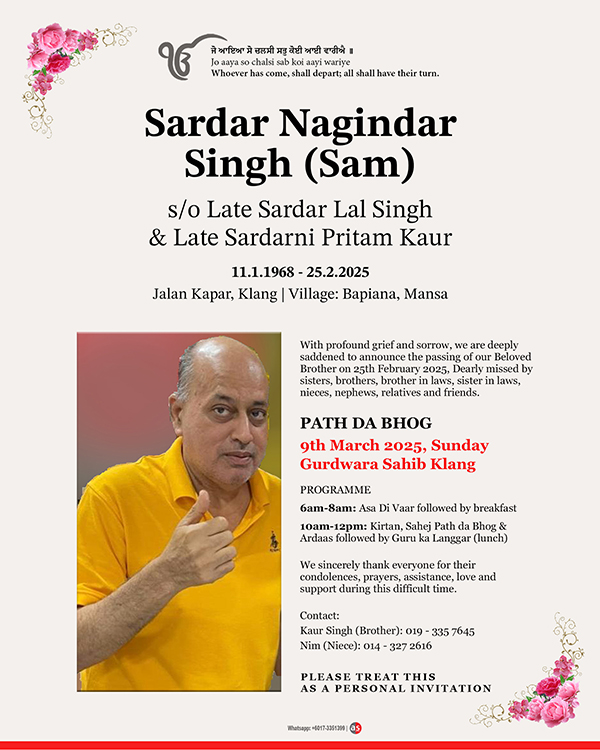
SARDAR NAGINDAR SINGH (SAM) s/o Late Sardar Lal Singh & Late Sardarni Pritam Kaur
(Jalan Kapar, Klang)
Village: Bapiana, Mansa
11.1.1968 – 25.2.2025
With profound grief and sorrow, we are deeply saddened to announce the passing of our Beloved Brother on 25th February 2025, Dearly missed by sisters, brothers, brother in laws, sister in laws, nieces, nephews, relatives and friends.
PATH DA BHOG 9th March 2025 (Sunday) Gurdwara Sahib Klang
6am-8am: Asa Di Vaar followed by breakfast 10am-12pm: Kirtan, Sahej Path da Bhog & Ardaas followed by Guru ka Langgar (lunch)
We sincerely thank everyone for their condolences, prayers, assistance, love and support during this difficult time.
Link to posting at Facebook and Instagram; Updated Facebook and Instagram
| Entry: 25 Feb 2025; Updated: 28 Feb 2025 | Source: Family
ASIA SAMACHAR is an online newspaper for Sikhs / Punjabis in Southeast Asia and beyond. You can leave your comments at our website, Facebook, Twitter, and Instagram. We will delete comments we deem offensive or potentially libelous. You can reach us via WhatsApp +6017-335-1399 or email: asia.samachar@gmail.com. For obituary announcements, click here
The shoulder of the Nishan Sahib at Gurdwara Sahib Taiping damaged in a lightning strike on Feb 24, 2025
By Asia Samachar | Malaysia |
Lightning striked the Nishan Sahib shoulder at Gurdwara Sahib Taiping, Perak, during heavy downpour Monday (25 Feb 2025). No injury was reported.
“It has happened a couple of times in the last few years,” a gurdwara committee member told Asia Samachar. They are looking into fixing a lightning arrester.
ASIA SAMACHAR is an online newspaper for Sikhs / Punjabis in Southeast Asia and beyond. You can leave your comments at our website, Facebook, Twitter, and Instagram. We will delete comments we deem offensive or potentially libelous. You can reach us via WhatsApp +6017-335-1399 or email: asia.samachar@gmail.com. For obituary announcements, click here
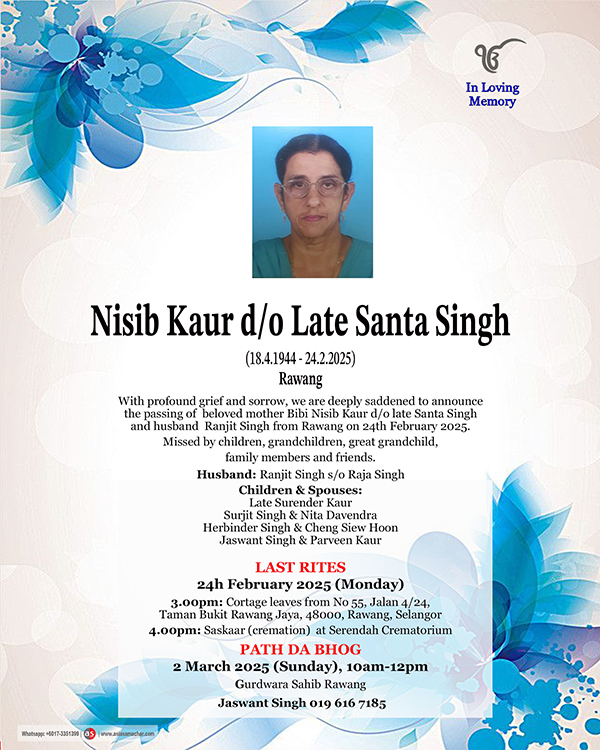
With profound grief and sorrow, we are deeply saddened to announce the passing of beloved mother Bibi Nisib Kaur d/o late Santa Singh and husband Ranjit Singh from Rawang on 24th February 2025.
Missed by children, grandchildren, great grandchild, family members and friends.
LAST RITES 24h February 2025 (Monday) 3.00pm: Cortage leaves from No 55, Jalan 4/24, Taman Bukit Rawang Jaya, 48000, Rawang, Selangor 4.00pm – Saskaar (cremation) at Serendah Crematorium
PATH DA BHOG 2 March 2025 (Sunday), 10am-12pm Gurdwara Sahib Rawang
For details, please contact: Jaswant Singh 019 616 7185
ASIA SAMACHAR is an online newspaper for Sikhs / Punjabis in Southeast Asia and beyond. You can leave your comments at our website, Facebook, Twitter, and Instagram. We will delete comments we deem offensive or potentially libelous. You can reach us via WhatsApp +6017-335-1399 or email: asia.samachar@gmail.com. For obituary announcements, click here
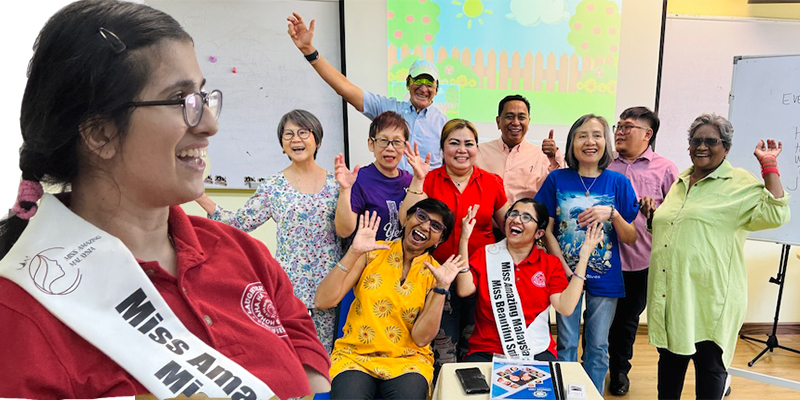
A Session to Remember – Writer Pola Singh in a group photo with fellow participants and Rajvin, celebrating an inspiring and uplifting session
By Dr Pola Singh | Malaysia |
My eye doctor for the last two decades has been Dr Pall Singh, a renowned eye specialist at the Tun Hussein Onn Eye Hospital in Petaling Jaya. I was invited to attend his daughter’s yoga laughter therapy session at the National Cancer Society Malaysia premises. What an enjoyable session it was. Laughter was the order of the day. It was thoroughly therapeutic. The two hours passed just like that! She did not need any slides to guide her on what the next exercise should be. Her memory was super. I was so glad I attended the session meant for cancer survivors and caregivers.
This is a story of true grit and determination. Rajvin Kaur Randhawa, aged 39, was born a premature baby. Due to her underdeveloped lungs she had to be placed in an incubator with oxygen. She also developed jaundice. The lack of oxygen to her brain caused cerebral palsy. Fortunately, only the motor centre of the brain was affected while the rest of her brain functioned normally.
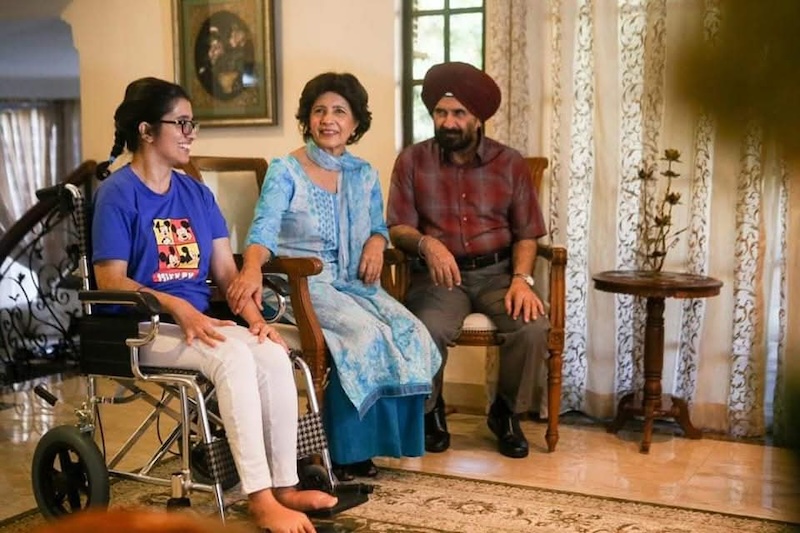
Rajvin has been hyped as a ‘Miracle Child’ who lived to tell. Her amazing survival and well-being could be largely attributed to her god-sent parents. Her father, Dr. Pall Singh, an eye specialist, understood her condition and made every effort to help his physically-challenged daughter pull through. Then there was the loving and tender care of her mother, Sarvan Kaur. Often, mothers do not receive due credit, but in this case, Sarvan deserves full recognition for her unwavering devotion and care. Rajvin’s parents and family have given her unconditional love and support, encouraging her to be more independent instead of overprotecting her and helping her develop confidence and self-worth. They are the true unsung heroes in Rajvin’s challenging life journey.
Rajvin Kaur Randhawa and her parents Dr. Pall Singh and Sarvan Kaur
Like any other person with cerebral palsy, Rajvin experiences difficulty in movement, speech, and coordination. She suffers in silence in terms of emotional and mental struggles, self-acceptance, and confidence and sometimes feels isolated from peers. She also faces mental health issues like anxiety and depression and occasionally struggles with low self-esteem due to being labelled as ‘incapable’ or ‘dependent.’ Making friends and being included in mainstream activities has not been easy for her. Despite limited access to inclusive education during her primary and secondary school years, she overcame these barriers and graduated with a Second Class Upper (Honours) Bachelor of Communication Degree from Sunway University. What a proud day it was for her parents and family at her convocation.
Employment opportunities for persons with disabilities remain scarce due to misconceptions, but instead of being discouraged, Rajvin has chosen the path of self-employment. She is slowly but surely making a name for herself as a motivational speaker and has also spread her wings into the field of yoga laughter therapy.
The first important thing is that Rajvin has adopted a self-acceptance attitude and strives to work on improving her personal development by focusing on her strengths rather than limitations. She has developed skills and talents that boost her confidence, showing remarkable progress. One participant at the Yoga Laughter therapy session remarked that Rajvin was initially shy at her first session, but not anymore. She has gained a lot of confidence, though there is still room for improvement. She wants to lead a normal life and raise awareness by advocating for inclusion, sharing personal experiences to challenge stereotypes, and using social media platforms to educate society.
In case you may want to attend Rajvin’s motivational sessions (which she does for free), please don’t raise your expectations too high; accept the reality that compared to an able-bodied or normal instructor, she will never be able to perform or deliver her presentation like them. Her cerebral palsy condition does not allow her to do so. But what makes her stand out is that she tries real hard to be as impactful as possible—going all out to give her best. Watching her give her best and trying hard to excite the participants and make the interactive session a lively and interesting one—these traits alone were good enough to move my heart, and I was glad that I attended her session. I’m also happy to note that those who attended not only enjoyed the session but gave her more confidence to improve her future sessions. In a sense, we gave her hope and support, which the community and Malaysians should do for disabled persons.
The National Cancer Society of Malaysia (NCSM) ought to be congratulated for giving special needs persons a forum to demonstrate their talent. Should anyone want to attend Rajvin’s laughter therapy session, please contact NCSM at 03-2698 7300 and speak to Adeline.
Hopefully, other parents (upon reading this) will also be motivated and encouraged to develop the latent talent of their special ones, just as Dr. Pall Singh and Sarvan have done for Rajvin. It will be a long, winding, and challenging road, but in the end, it will be worth it, as their child would be above their peers. It is sad to note that many parents just accept the disability of their child as given or a reality that cannot be changed and do not try hard enough to change things for the better. They do try but give up easily.
One thing in Rajvin’s favour is the financial stability of her parents. Fortunately, they do not face financial challenges in terms of medical and therapy costs, assistive devices, home modifications, and the need to employ a full-time caregiver. For that, she feels truly blessed and grateful. Rajvin infuses such values into therapy session.
Rajvin may not be a prominent Sikh in Malaysia right now (and I don’t think she aims to be one), but given her disabilities, she has done much more than the average able-bodied person like being able to address a group of participants face-to-face. She inspires with her true grit, tries her best, and gives her best in her motivational talks. That’s the true test of the sincerity and genuineness of a person who wants to contribute to the community. I came away from the yoga laughter session impressed with the positive way she infused the benefits of laughter into us. She is certainly a good role model for persons with special needs and a budding motivational speaker in the making. Syabas and well done Rajvin. I salute you!
Dr Pola Singh, who retired as Maritime Institute of Malaysia director-general in 2011, is also the author of ‘Uphill — The Journey of a Sikh-Chinese Kampung Boy’
ASIA SAMACHAR is an online newspaper for Sikhs / Punjabis in Southeast Asia and beyond. You can leave your comments at our website, Facebook, Twitter, and Instagram. We will delete comments we deem offensive or potentially libelous. You can reach us via WhatsApp +6017-335-1399 or email: asia.samachar@gmail.com. For obituary announcements, click here
Meharvan Singh delivers address at the graduation day of Sunway University on Feb 19, 2025 – Photo: Sunway University
By Asia Samachar | Malaysia |
Meharvan Singh is active at campus and off-campus. On Wednesday (Feb 19), he was selected to give a valedictory address at the graduation day of Sunway University, a Malaysian private university based in Petaling Jaya, Selangor. Meharvan took home a 1st Class Honours in his accounting and finance degree. He is currently an associate at PwC Malaysia. Well done!
ASIA SAMACHAR is an online newspaper for Sikhs / Punjabis in Southeast Asia and beyond. You can leave your comments at our website, Facebook, Twitter, and Instagram. We will delete comments we deem offensive or potentially libelous. You can reach us via WhatsApp +6017-335-1399 or email: asia.samachar@gmail.com. For obituary announcements, click here