



















By Gurnam Singh | Opinion |
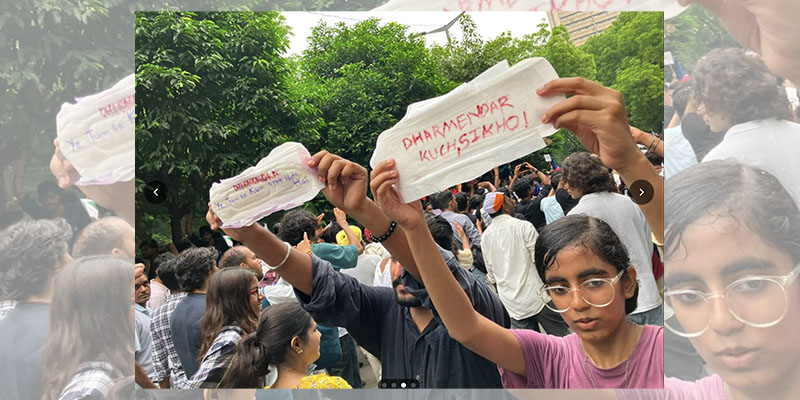
As I woke up to check my social media feed this morning, I was drawn to items concerning the current student protests at Jantar Mantar, New Delhi. The first was news of the resignation of Dharmendra Pradhan as Union Education Minister and the Cockroach Janta Party’s (CJP) nationwide call for a candle march on July 26 in solidarity with victims of police brutality. The second was the following WhatsApp message from an Indian activist friend, giving an eyewitness account of the actions of Sikhs in support of the current student protests taking place in New Delhi and the oppressive actions of the police.
“To my Sikh friends, you will be happy to know that members of the Nihang sects and sardars stood between the police and the students and protected them from being hit. There were lots of human rights violations. When women had their clothes torn, they took off their turbans to clothe them. These are very tough and transformative times here; we have seen what the consequences are.”
Having followed the unfolding events, especially the police brutality, the role of Sikhs in defending and supporting the students, and the wider historical and political context, I was prompted to offer the following reflections.
Events on the ground
As thousands continue to gather in and around Jantar Mantar in New Delhi, the peaceful, secular, student-led protests have become about far more than the immediate political grievances that first brought young activists onto the streets. They have evolved into a broader struggle over democracy, state power, civil liberties and the fundamental right to dissent in India.
Just a short distance away from the main protest site stands the historic Gurdwara Bangla Sahib, one of Sikhi’s most revered sites in Delhi. While the gurdwara is not formally connected to the demonstrations, its proximity carries a symbolism that many Sikhs understand instinctively. Throughout history, Sikh institutions have rarely been passive observers when ordinary people have faced persecution. Whether confronting invading armies, authoritarian rulers or humanitarian crises, Sikhs have repeatedly stood alongside those who could not defend themselves.
This tradition is neither accidental nor a matter of political expediency. It is rooted in the Sikh principle of Sarbat da Bhala (the welfare of all) and in the teachings of the Gurus, who transformed a spiritual community into one prepared to confront injustice wherever it appeared. Throughout their history, Sikhs have historically aligned themselves with the oppressed and downtrodden. As many of the volunteers providing food, medical assistance and relief on the ground testify, they invoke the spirit of Bhai Ghanaiya, the devoted follower of Guru Gobind Singh who is remembered for his compassion and selfless service (seva) on the battlefield, tending to friend and foe alike.
What is the ‘Cockroach’ movement?
The unusually named ‘Cockroach’ movement that now occupies the public imagination began with what many initially dismissed as a publicity stunt and an act of political satire. Yet, like many influential movements throughout history, its origins lay in a deeper sense of alienation that had been building for years.
On 16 May 2026, political communications strategist and former Aam Aadmi Party volunteer Abhijeet Dipke launched the Cockroach Janta Party (CJP). The name was a deliberately provocative and satirical play on the name of the ruling Bharatiya Janata Party (BJP) and a direct response to remarks made the previous day by Chief Justice of India Surya Kant. During proceedings concerning fraudulent educational qualifications, Justice Kant referred to certain individuals as “cockroaches” and “parasites of society”.
Although he later clarified that his comments were directed at those obtaining fraudulent degrees rather than at India’s unemployed youth, and emphasised that young Indians remained “the pillars of a developed India”, many saw the episode as emblematic of a widening disconnect between the country’s institutions and a generation confronting unemployment, repeated examination paper leaks, shrinking opportunities and declining faith in public accountability.
Rather than reject the insult, Dipke and thousands of young Indians reclaimed it. If they were to be dismissed as “cockroaches”, they would become impossible to ignore.
Through the power of social media, the movement rapidly evolved into a broad grassroots mobilisation that brought together students, unemployed graduates, professionals, civil society groups, farmers, workers and ordinary citizens concerned about the health of India’s democracy. Demonstrations centred on Jantar Mantar soon broadened beyond youth unemployment and examination scandals to encompass wider concerns over civil liberties, institutional independence, police conduct and the right to peaceful dissent.
Parallels with contemporary Gen Z grassroots movements across the world
The Cockroach movement has been widely characterised as a Gen Z movement, reflecting concerns and methods that resonate far beyond India. Across the world, young people are demanding greater transparency, accountability, social justice and a meaningful voice in decisions affecting their future. Driven by digital communication and grassroots organising, Gen Z activists frequently challenge traditional systems and employ creative forms of protest to highlight issues such as inequality, corruption, climate change and human rights.
Like many Gen Z-led movements globally, the Cockroach movement reflects a belief that ordinary people can challenge powerful institutions through collective action, creativity and persistence. It also connects with a wider tradition of protest in which symbols, satire and peaceful demonstrations are used to draw attention to social concerns and demand public recognition.
The movement bears striking parallels with the Gilets Jaunes (Yellow Vests) movement that emerged in France in 2018. Triggered by a rapid rise in fuel taxes, it quickly evolved into a broader expression of public dissatisfaction with economic inequality and government policy. In both cases, decentralised organisation and the strategic use of social media enabled participants to coordinate collective action outside traditional political parties and established civic organisations, challenging the state’s ability to control the political narrative.
This pattern is evident across a range of other recent youth-led movements. The 2019–20 Hong Kong pro-democracy protests relied on encrypted messaging platforms and leaderless organisation to resist the increasing centralisation of state authority. Nigeria’s #EndSARS movement used social media to document police abuses and mobilise mass demonstrations against state violence and corruption. Similarly, Kenya’s Gen Z protests in 2024, initially triggered by proposed tax increases, rapidly expanded into a broader critique of political elites, corruption and unaccountable governance, with digital platforms facilitating rapid coordination while amplifying protesters’ demands nationally and internationally.
Although these movements emerged within distinct political and cultural contexts, they share important characteristics: horizontal forms of organisation, digitally networked mobilisation and a rejection of traditional political intermediaries.
Perhaps most significantly, social media functions not merely as a communication tool but as an alternative political arena through which activists construct collective identities, disseminate counter-narratives, document state responses in real time and articulate demands that compete directly with official accounts. Rather than simply opposing individual policies, these movements reflect a wider contest over political legitimacy, representation and the distribution of power in an era of increasingly networked civic mobilisation.
Evoking memories of the farmers’ protests
For many observers, the movement, especially in the way the spirit of Sikhi is manifested on the ground, evokes memories of another extraordinary mobilisation that gripped India only a few years earlier: the farmers’ movement of 2020–21. That protest also began around a specific policy dispute before evolving into a much broader conversation about democracy, citizenship and the relationship between the state and the people. It was during those protests that millions of Indians witnessed the Sikh principles of seva (selfless service), langar (the community kitchen) and Sarbat da Bhala expressed on an unprecedented scale.
To understand why the actions of Sikh volunteers at Jantar Mantar have resonated so powerfully, one must recognise that they are not isolated acts of courage. They belong to a much longer historical tradition stretching back more than three centuries. This is a tradition in which Sikhs have repeatedly stood between power and the powerless, defending not merely their own community but the universal principle that every human being deserves dignity, justice and protection from oppression.
From Guru Nanak’s challenge to political and religious hypocrisy, to Guru Tegh Bahadur’s sacrifice in defence of freedom of conscience, and Guru Gobind Singh’s creation of the Khalsa as a community committed to justice, service and resistance, Sikh history offers numerous examples of moral witness in the face of tyranny. The Sikh response to suffering has never been limited by religious, political or social boundaries. Its emphasis has always been on defending human dignity wherever it is threatened.
Conclusion: We are all cockroaches now
The deeper significance of the Cockroach movement lies not in its unusual name, but in what that name represents and how it has managed to defeat the Godi media. My good friend Harmit Shah Singh from United Sikhs recently commented on how dramatically the communications landscape has changed over the past five years, with ‘Gen Z developing new media’. Reflecting on the 2020–21 farmers’ agitation, he suggests that if that protest ‘turned veteran journalists into influential YouTubers’, the current CJP agitation ‘has given birth to an entirely new breed of communicators. They are not journalists in the conventional sense. They are participants, storytellers, commentators and opinion-makers rolled into one, creating and distributing narratives in their own grammar.’
Throughout history, those who challenge power have, under state pressure or control, often been ridiculed in the mainstream media and therefore marginalised or dehumanised. Labels intended as insults have frequently become symbols of resistance. What began as a disparaging remark has been transformed by a generation unwilling to remain invisible. By embracing the term “cockroach”, protesters have inverted its meaning, turning an expression of contempt into a declaration of resilience.
For Sikhs, there is something deeply familiar in this transformation. Sikh history is filled with examples of ordinary people who refused to be silenced by powerful empires, oppressive rulers and unjust laws. The Gurus taught that spiritual commitment could never be separated from moral courage. Resistance to oppression was not merely a political act but a moral obligation rooted in the defence of truth, justice and human dignity.
This does not mean that Sikhs must agree with every demand of every protest movement. Political questions invariably involve differing opinions and perspectives. Yet Sikh ethics offer a broader principle: when people are denied dignity, when institutions cease to listen, and when power is exercised without accountability, silence is not neutrality. The Sikh response has historically been to stand alongside those whose voices are ignored, to offer service without discrimination, and to defend the rights of others as vigorously as one’s own.
In today’s social media world, where attention spans are fleeting, images and words have great symbolic power. In this regard, the appropriation of the cockroach was a genius move. Cockroaches may be disliked, but they have an uncanny power to survive. They endure. They adapt. They refuse to disappear. Individually, they can be easily overcome, but as a collective, they have immense power. In that sense, the movement’s chosen emblem has become a metaphor for the rights of the ordinary person and for democratic resilience itself.
As for Sikhs, whose history is marked by perseverance in the face of overwhelming odds, there is a familiar lesson: those dismissed as insignificant, troublemakers, criminals, terrorists and anti-nationals today may well become the architects of tomorrow’s change.
Join the conversation on this story on Asia Samachar’s Facebook and Instagram pages.

Gurnam Singh is an academic activist dedicated to human rights, liberty, equality, social and environmental justice. He is a Professor of Sociology at University of Warwick, UK. He can be contacted at Gurnam.singh.1@warwick.ac.uk
* This is the opinion of the writer and does not necessarily represent the views of Asia Samachar.
RELATED STORY:
Heaven, Hell and the Afterlife: What does Sikhi teach us? (Asia Samachar, 3 July 2026)
ASIA SAMACHAR is an online newspaper for Sikhs / Punjabis in Southeast Asia and beyond. You can leave your comments at our website, Facebook, Twitter, and Instagram. We will delete comments we deem offensive or potentially libelous. You can reach us via WhatsApp +6017-335-1399 or email: asia.samachar@gmail.com. For obituary announcements, click here