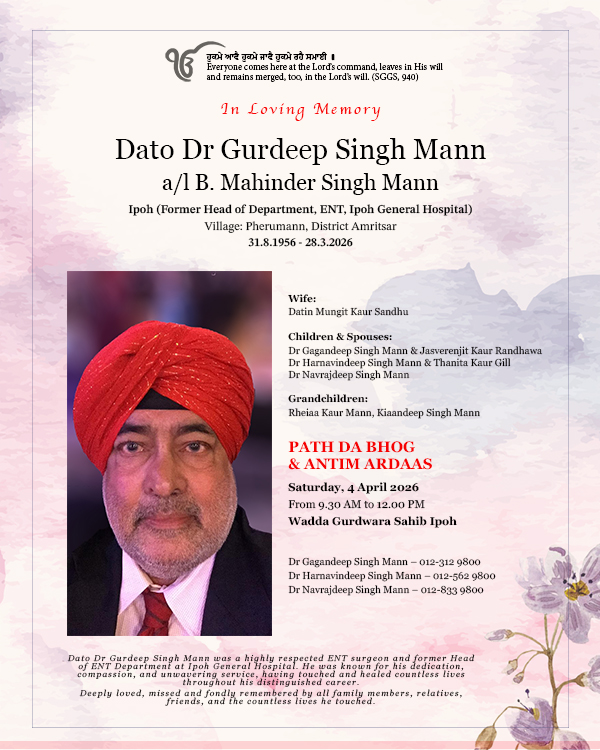
Dato Dr Gurdeep Singh Mann a/l B. Mahinder Singh Mann
Ipoh (Former Head of Department, ENT, Ipoh General Hospital)
Village: Pherumann, District Amritsar
31.8.1956 – 28.3.2026
Wife: Datin Mungit Kaur Sandhu
Children / Spouses: Dr Gagandeep Singh Mann / Jasverenjit Kaur Randhawa Dr Harnavindeep Singh Mann / Thanita Kaur Gill Dr Navrajdeep Singh Mann
Grandchildren: Rheiaa Kaur Mann Kiaandeep Singh Mann
PATH DA BHOG:
Saturday, 4 April 2026 9:30 AM – 11:45 AM Wadda Gurdwara Sahib Ipoh
Contact: Dr Gagandeep Singh Mann – 012-312 9800 Dr Harnavindeep Singh Mann – 012-562 9800 Dr Navrajdeep Singh Mann – 012-833 9800
Dato Dr Gurdeep Singh Mann was a highly respected ENT surgeon and former Head of ENT Department at Ipoh General Hospital. He was known for his dedication, compassion, and unwavering service, having touched and healed countless lives throughout his distinguished career.
Deeply loved, missed and fondly remembered by all family members, relatives, friends, and the countless lives he touched.
| Entry: 28 March 2026; Updated: 2 April 2026 | Source: Family
ASIA SAMACHAR is an online newspaper for Sikhs / Punjabis in Southeast Asia and beyond. You can leave your comments at our website, Facebook, Twitter, and Instagram. We will delete comments we deem offensive or potentially libelous. You can reach us via WhatsApp +6017-335-1399 or email: asia.samachar@gmail.com. For obituary announcements, click here
BJP-led Maharashtra state assembly has passed the Maharashtra Freedom of Religion Bill 2026 – Photo: AI generated / Brut
By Gurnam Singh | Opinion |
The BJP-led Maharashtra state assembly recently passed a bill to regulate religious conversion. Ironically titled the Maharashtra Freedom of Religion Bill 2026, the legislation imposes stringent restrictions on individuals’ rights to convert to another faith tradition, with those found guilty of an “unlawful conversion” facing fines and up to seven years’ imprisonment. Maharashtra is not the only state to have moved in this directions.
Since 2014, under the leadership of the Bharatiya Janata Party (BJP), numerous states have either introduced or strengthened anti-conversion legislation. While such laws have existed since the 1960s in some regions, their recent proliferation signals a coordinated political effort and worrying trend, not least since the evidence for forced conversions is extremely limited, often confined to single cases that have been embellished by biased media reporting and social media eco chambers.
The kinds of laws, such as the one passed in Maharashtra, though mostly a product of media moral panics and identity politics, are often justified through the need to prevent conversions achieved through “force,” “fraud,” or “allurement.” However, the definitions of these terms remain deliberately broad and ambiguous, allowing authorities significant discretion in interpretation.
A key feature of these laws is the presumption that conversions are inherently suspect. In an inversion of habeas corpus, the burden of proof frequently lies on those facilitating or participating in the conversion. Additionally, procedural requirements, such as notifying authorities in advance and undergoing police inquiries, effectively make religious conversion a matter of public scrutiny rather than private conscience.
In practice, these mechanisms enable both state surveillance and intervention by vigilante groups and given that it is BJP dominated states that are favouring these moves, one needs to understand this trend in the context of unfounded Hindu nationalist conspiracy theories alleging mass forced conversions of Hindus by Christians and Muslims. Accordingly, these developments must be seen as symptomatic of a broader ideological currents tied to Hindu nationalism and the governance of religious diversity.
The Sikh Perspective
Examining these trends alongside Sikh perspectives offers a more nuanced understanding of religious freedom, coercion, and identity in contemporary India. As noted, though framed in neutral terms, the application of anti-conversion laws disproportionately affects religious minorities, particularly Muslims and Christians. The rhetoric surrounding “love jihad,” for instance, has been used to justify legal and social policing of interfaith relationships, especially those involving Muslim men.
Similarly, and particularly so in Panjab, there is a growing concern expressed by Sikh activist groups that Christian Deras (religious seminaries) who claim to me motivated by education or charity work for the poor and downtrodden have been accused of inducing conversions through material incentives, placing their activities under suspicion. How, to date, the state of Punjab has refused to adopt laws to regulate religious conversion, making it one of the few states in North India without such legislation. One might suggest this is due to the relative lack of support for the BJP in Panjab and, despite the horrors of the partition in 1947, the long-established secular traditions of the Punjab.
From a Sikh theological perspective, these developments raise profound concerns about religious freedom and state overreach. Sikhi, founded in the 15th century in the Punjab region, has historically emphasised the principles of freedom of conscience, equality, and resistance to oppression. Sikh teachings reject forced conversion and uphold the right of individuals to choose their spiritual path freely. This commitment is rooted in the historical experiences of the Sikh Gurus, particularly Guru Tegh Bahadur, who was executed in 1675 for defending the religious freedom of Kashmiri Pandits against forced conversion under Mughal rule.
Against these deep philosophical and ethical values, there are currents amongst Sikhs who have expressed concern about the scale of Sikhs converting to Christianity. Concerns regarding the scale and nature of Christian conversions in Punjab, particularly in the Malwa belt, have been strongly articulated by a range of socio-religious and political organisations. Groups such as the Punjab Bachao Morcha argue that conversions are occurring on a “large scale” and are often linked to organised missionary networks, including thousands of pastors operating across rural districts.
They allege that methods such as faith-healing claims, material inducements, and “miracle cures” are used to attract economically vulnerable populations, especially among Dalit communities, raising questions about the voluntariness and ethical boundaries of such conversions. These organisations have also expressed concern over the role of foreign funding, non-transparent financial structures, and the proliferation of independent “dera-like” churches.
Academic and policy-oriented studies suggest that these trends are intertwined with deeper structural issues such as caste marginalisation, rural poverty, and the search for social mobility, which make certain populations more receptive to conversion movements. However, Christian organisations counter these narratives by emphasising constitutional protections of religious freedom and warning that the politicisation of the issue risks communal polarisation and worse.
These counter currents and conflicting explanations positions Sikhi and Sikhs in a complex moral and philosophical bind. While Sikhi does not actively proselytise in the same way as some missionary traditions, it strongly defends the right of individuals to convert voluntarily. The increasing criminalisation of conversion, therefore, conflicts with deep rooted Sikh principles of freedom of belief and conscience.
Moreover, the collective nature and deeply politicised and confused nature of anti-conversion laws, raises additional concerns. Though Sikhs have not been primary targets thus far. Sikh institutions, such as gurdwaras, have historically provided social services including education and food distribution (langar) without discrimination. Under expansive interpretations of “allurement,” even such charitable practices may theoretically come under scrutiny.
Another important dimension is the potential erosion of constitutional protections. Article 25 of the Indian Constitution, both recognises the Sikhs as a distinct faith within the broad Indic tradition and guarantees the “freedom of conscience and free profession, practice and propagation of religion.” While the Supreme Court of India upheld the validity of anti-conversion laws in a 1977 judgment, current legal challenges argue that newer provisions violate rights to privacy and personal liberty. For Sikhs, who have historically relied on constitutional safeguards to maintain their distinct identity within a pluralistic framework, any weakening of these protections is particularly troubling, especially in a context where the BJP RSS view has consistently argued that Sikhs are a branch of Hinduism.
The tightening of anti-conversion laws in India reflects broader tensions between majoritarian nationalism and religious pluralism. From a Sikh perspective, these laws risk undermining fundamental principles of freedom, dignity, and coexistence. As legal and political debates continue, the Sikh tradition offers a reminder that the defence of one community’s religious freedom is inseparable from the defence of all.
Though the idea of making it difficult for somebody to convert may, in the face of the developments in the Malvas region seem like a solution, there is a real danger that following the Maharashtra example. May prove to be a poisoned chalice, and undermine the unique attraction that Sikhi has for people of other faiths and none.
As for Sikhs who may for a wide range of reasons feel compelled to abandon Sikhi for another faith, this should serve as a wakeup call for the Panth to strengthen Sikh education for the masses as well as widen the scope of social and educational services for the most disadvantaged, who tend to be the ones most vulnerable to the often false promises offered by others.
Join the conversation on this story on Asia Samachar’s Facebook and Instagram pages.
Gurnam Singh is an academic activist dedicated to human rights, liberty, equality, social and environmental justice. He is a Professor of Sociology at University of Warwick, UK. He can be contacted at Gurnam.singh.1@warwick.ac.uk
* This is the opinion of the writer and does not necessarily represent the views of Asia Samachar.
ASIA SAMACHAR is an online newspaper for Sikhs / Punjabis in Southeast Asia and beyond. You can leave your comments at our website, Facebook, Twitter, and Instagram. We will delete comments we deem offensive or potentially libelous. You can reach us via WhatsApp +6017-335-1399 or email: asia.samachar@gmail.com. For obituary announcements, click here
ਪ੍ਰਗਟਿਓ ਖ਼ਾਲਸਾ ਪ੍ਰਮਾਤਮ ਕੀ ਮੌਜ ॥ Khalsa Emerged by the Will of The Supreme Being (Sarabloh Granth)
Part 1: The Nash Doctrine (ਨਾਸ਼ ਸਿਧਾਂਤ) was a Complete Break, especially from Brahmanic Hinduism, and any other religious background.
Sikh teachings are evergreen, universal and for the world. However, the path of Sikhi followed by the Sikh Panth, which evolved into the corporate entity, the Khalsa Panth by Vaisakhi 1699, is narrow and for the few.
For that reason, Khalsa is not concerned with the numbers game. Quality of Khalsa-living matters more than numbers about which some Sikh leaders are so concerned. Not more children but more quality Sikhs who live truly committed Sikhi lives, is the need.
Sikhi demands a mar-jeevra (living-martyr) life with a complete break from earlier life. The first Panj Pyaray gave their heads to the Guru and gave up their previous lives for new Khalsa living. The Sikhi Nash Doctrine demands that change.
Nash in Panjabi means complete destruction. In the sense used by Guru Gobind Singh ji in 1699, it means total rejection of, or freedom from, five components of the Nash Doctrine. That involves 5 rejections that destroy old traditions, superstitions, lineages, and actions, replacing them with a new life focused on the Creator.
Khalsa must give up previous religion (Dharam Nash). That means renouncing previous religious creeds, rites, and scriptures to follow the Sikh ideology. Karam Nash is freeing oneself from past actions. It is ending reliance on rituals and superstitious karmic systems, replacing them with the Grace of the Guru. Bharam Nash is freedom from superstition. No more belief in rituals and pilgrimages. Idol worship is rejected. Kul Nash is breaking with past family lineage or caste distinctions in order to join the family of the Guru while adopting the name Singh for men and Kaur for women. Krit Nash frees one from past family professions and attached societal stigma.
The Nash Doctrine established a distinct identity for the Khalsa, free from the caste system and rituals of traditional Indian society. It was a psychological and spiritual transformation, allowing people to rise above caste and creed differences. (In the above I have relied heavily on Sikh Research Institute (US) interpretations.)
Amritdhari Khalsa is reminded of the Nash doctrine during the Amrit Sanskar initiation. It is a foundational Sikh principle requiring a complete break from past religious, social, and caste-based identities to create a sovereign Khalsa identity.
From the outset of his revolutionary mission, Guru Nanak Sahib rejected the jeneu as a symbol of Brahmanic caste system which allowed Brahmanic top position in society. The Manuwadic Varna-Ashram caste system had divided human beings from birth into permanent high, low and untouchable groups with the Brahmin on the top of the social hierarchy. That was rejected at the outset of Khalsa revolution. Through the Nash Doctrine, Guru Gobind Singh Ji united human society as equals. The doctrine turned passive masses into active, warrior-scholars (Saint-Soldiers), empowering the lowliest of the low. The Khalsa became an independent theo-political entity ready to face Brahmanical or Mughal domination
Much concern is expressed about the state of the Panth today. The Nash Doctrine reminds us that we continue to follow Bipran ki reet and have moved away from the clear guidance given by the Guru on the Vaisakhi Day 1699.
Gurmukh Singh OBE, a retired UK senior civil servant, chairs the Advisory Board of The Sikh Missionary Society UK. Email: sewauk2005@yahoo.co.uk. Click here for more details on the author.The article first appeared at Panjab Times, UK
* This is the opinion of the writer, organisation or publication and does not necessarily represent the views of Asia Samachar.
ASIA SAMACHAR is an online newspaper for Sikhs / Punjabis in Southeast Asia and beyond. You can leave your comments at our website, Facebook, Twitter, and Instagram. We will delete comments we deem offensive or potentially libelous. You can reach us via WhatsApp +6017-335-1399 or email: asia.samachar@gmail.com.
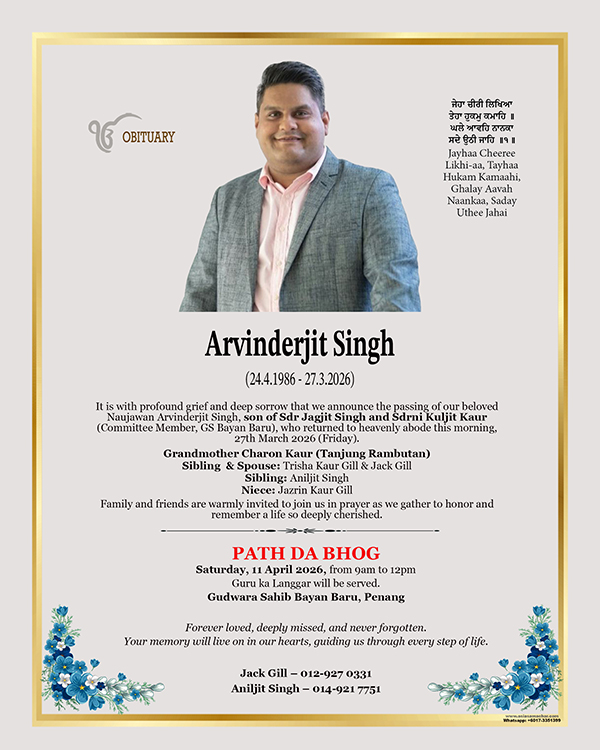
It is with profound grief and deep sorrow that we announce the passing of our beloved Naujawan Arvinderjit Singh, son of Sdr Jagjit Singh and Sdrni Kuljit Kaur (Committee Member, GS Bayan Baru), who returned to heavenly abode this morning, 27th March 2026 (Friday).
Grandmother Charon Kaur (Tanjung Rambutan)
Sibling & Spouse: Trisha Kaur Gill & Jack Gill
Sibling: Aniljit Singh
Niece: Jazrin Kaur Gill
Family and friends are warmly invited to join us in prayer as we gather to honor and remember a life so deeply cherished.
PATH DA BHOG Saturday, 11 April 2026, from 9am to 12pm Guru ka Langgar will be served. Gudwara Sahib Bayan Baru, Penang
Forever loved, deeply missed, and never forgotten. Your memory will live on in our hearts, guiding us through every step of life.
Jack Gill – 012-927 0331 Aniljit Singh – 014-921 7751
| Entry: 27 March 2026; Updated 30 March 2026 | Source: Family
ASIA SAMACHAR is an online newspaper for Sikhs / Punjabis in Southeast Asia and beyond. You can leave your comments at our website, Facebook, Twitter, and Instagram. We will delete comments we deem offensive or potentially libelous. You can reach us via WhatsApp +6017-335-1399 or email: asia.samachar@gmail.com. For obituary announcements, click here
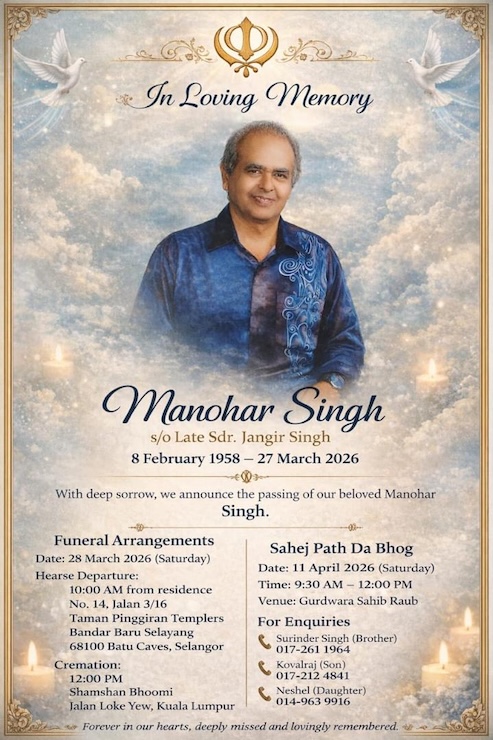
With deep sorrow, we announce the passing of our beloved Manohar Singh.
FUNERAL ARRANGEMENTS Saturday, 28 March 2026
Hearse Departure: 10:00 AM from residence (No. 14, Jalan 3/16, Taman Pinggiran Templers, Bandar Baru Selayang, 68100 Batu Caves, Selangor) Cremation: 12:00 PM Shamshan Bhoomi,Jalan Loke Yew, Kuala Lumpur
SAHEJ PATH DA BHOG Saturday, 11 April 2026 From 9:30 AM to 12:00 PM Gurdwara Sahib Raub
ASIA SAMACHAR is an online newspaper for Sikhs / Punjabis in Southeast Asia and beyond. You can leave your comments at our website, Facebook, Twitter, and Instagram. We will delete comments we deem offensive or potentially libelous. You can reach us via WhatsApp +6017-335-1399 or email: asia.samachar@gmail.com. For obituary announcements, click here
ASIA SAMACHAR is an online newspaper for Sikhs / Punjabis in Southeast Asia and beyond. You can leave your comments at our website, Facebook, Twitter, and Instagram. We will delete comments we deem offensive or potentially libelous. You can reach us via WhatsApp +6017-335-1399 or email: asia.samachar@gmail.com. For obituary announcements, click here
In the competitive world of facilities management, where efficiency often trumps visibility, a Penang-based company led by a Sikh husband-and-wife team is quietly redefining industry standards—anchored not in legacy, but in lived experience.
At the centre of this story is Harvinderjit Singh, founder and director of Olympus Management & Services (M) Sdn Bhd, and Edreena Kaur, who oversees the company’s internal systems and organisational structure. Together, they have built Olympus into an award-winning facilities management and cleaning solutions provider in Penang.
“We wanted to create real impact while challenging the status quo,” Harvinderjit told Asia Samachar.
Their journey, however, did not begin in boardrooms or business families.
Both come from modest, working-class backgrounds. Harvinderjit’s father, Raghbir Singh Najar Singh, served as an airport police officer before working as a JPJ runner, while his mother was a factory supervisor. Edreena’s father, Jasbir Singh Makhan Singh, also worked as a factory supervisor before moving into building management, while her mother was a homemaker who anchored the family.
These early influences—discipline, resilience, and a deep respect for hard work—have become the DNA of Olympus.
“Built not on legacy, but on grit,” is how those close to the company describe its ethos.
Building structure and scale
Harvinderjit serves as the strategic driver of the company, steering its growth, operational direction, and technological adoption. His leadership is notably hands-on, spanning business development, systems optimisation, and the integration of ESG-focused solutions into daily operations.
Complementing this is Edreena’s role in building the company’s internal backbone. She oversees human resources, digitalisation, accounting, certifications, and compliance frameworks, including ISO and SME Corp standards—ensuring the company remains structured and audit-ready.
Olympus Management & Services founders of Harvinderjit Singh and Edreena Kaur wins the Top Asia Corporate Ball 2025
Her administrative pedigree is significant. She previously spent over a decade in public service, including 11 years as Confidential Secretary in the office of former Penang Deputy Chief Minister II Prof. Dr. P. Ramasamy, after starting as an administrative officer. Her service earned her the Anugerah Perkhidmatan Cemerlang in 2018.
That experience now translates into governance discipline within Olympus—an often underappreciated but critical factor in scaling SMEs.
Recognition and repositioning
The company’s steady rise gained wider recognition in November 2025 when Olympus clinched the Company of the Year Award (Best in Facilities Management) at the Top Asia Corporate Ball in Kuala Lumpur.
The company has also bagged the Asia Most Innovative Cleaning Service Company Award, as well as the Asia Best Choice Green Initiatives & ESG Compliance Environmental Management Company Award 2026. In addition, Edreena was honoured with the Asia Most Creative Women Entrepreneur Award 2026.
These accolades underscore its growing reputation as a specialist in commercial and industrial cleaning, landscaping, post-construction work, and sanitation services.
But beyond service delivery, Olympus is positioning itself as a technology-enabled and sustainability-driven operator.
Its operations incorporate high-end machinery, low-chemical cleaning systems, and water-efficient processes aligned with Malaysia’s ESG trajectory. The company also deploys SDS-certified chemical solutions and advanced equipment such as industrial scrubbers and Rotowash systems to improve both efficiency and safety.
Looking ahead, Olympus is pushing into deeper ESG integration, including research into replacing traditional lead-acid batteries with lithium-ion alternatives—part of a broader shift towards cleaner, greener operations.
For Harvinderjit and Edreena, the ambition is clear—to build a company that is not only operationally strong, but future-ready.
EXCERPTS FROM THE INTERVIEW WITH HARVINDERJIT SINGH
What made you start this business?
The journey of Olympus began with a vision to build something meaningful from the ground up—something that would create real impact while challenging the status quo.
Coming from humble beginnings, Harvinderjit was driven by a desire to create value, uplift standards, and build a business rooted in discipline and long-term sustainability. His exposure across multiple industries gave him insight into gaps within service sectors, particularly in facilities management, where consistency and professionalism were often lacking.
Why this business?
The facilities management and cleaning industry presented a unique opportunity—an essential service that was often undervalued and underdeveloped.
Olympus was founded to redefine this space by introducing structure, innovation, and ESG-driven practices. The goal was not just to provide services, but to transform perceptions—positioning facilities management as a professional, high-impact industry driven by quality, systems, and environmental responsibility.
For Harvinderjit and Edreena, the ambition is clear—to build a company that is not only operationally strong, but future-ready.
What are some of the joys of running the business?
One of the greatest joys is witnessing transformation—both in the environments the company manages and in the people within the organisation.
Building Olympus from the ground up into an award-winning company has been a deeply fulfilling journey. Creating opportunities, developing talent, and delivering consistent excellence to clients bring a strong sense of purpose. There is also immense pride in driving green initiatives and contributing to a more sustainable future within the industry.
What are some of the challenges when managing the business?
Managing a service-based business comes with continuous challenges, particularly in workforce management, maintaining consistent service quality, and adapting to rising operational costs.
Additionally, shifting industry mindsets towards ESG adoption and long-term value requires ongoing education and persistence. Scaling the business while maintaining high standards is an ongoing balancing act that demands strong systems, discipline, and leadership.
What are some lessons you’ve learnt when running this business?
One key lesson is that consistency is more important than intensity—sustainable growth is built through disciplined execution over time.
Another is the importance of people; building the right team and investing in them is critical to long-term success. Adaptability, especially in embracing technology and sustainability, is essential to staying competitive.
Above all, resilience remains the defining factor—every challenge presents an opportunity to improve, refine, and grow stronger.
Join the conversation on this story on Asia Samachar’s Facebook and Instagram pages.
ASIA SAMACHAR is an online newspaper for Sikhs / Punjabis in Southeast Asia and beyond. You can leave your comments at our website, Facebook, Twitter, and Instagram. We will delete comments we deem offensive or potentially libelous. You can reach us via WhatsApp +6017-335-1399 or email: asia.samachar@gmail.com. For obituary announcements, click here
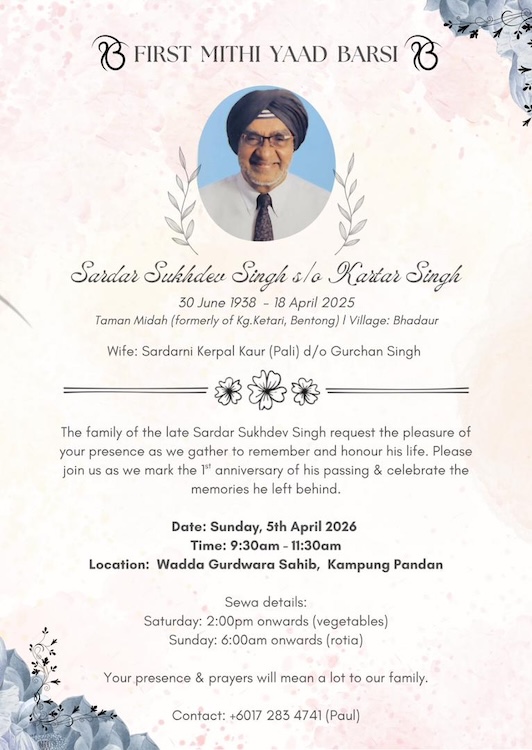
The family of the late Sardar Sukhdev Singh request the pleasure of your presence as we gather to remember and honour his life. Please join us as we mark the lst anniversary of his passing & celebrate the memories he left behind.
Date: Sunday, 5th April 2026 Time: 9:30am – 11:30am Location: Wadda Gurdwara Sahib, Kampung Pandan, KL
ASIA SAMACHAR is an online newspaper for Sikhs / Punjabis in Southeast Asia and beyond. You can leave your comments at our website, Facebook, Twitter, and Instagram. We will delete comments we deem offensive or potentially libelous. You can reach us via WhatsApp +6017-335-1399 or email: asia.samachar@gmail.com. For obituary announcements, click here
Amit Rahav as Yanky and Shira Haasas as Esty in Unorthodox. Photograph: Anika Molnar/Netflix
By Asia Samachar | Movie Review |
As headlines today are dominated by the escalating conflict between Israel and Iran—where missile strikes, air raids and regional instability have once again placed Israel at the centre of global attention —it is worth turning to a quieter, deeply personal story about identity, belonging and choice among people of Israeli and Jewish origin.
This is a story where courage emerges quietly, not through noise or conflict, but through the deeply personal act of choosing one’s own life.
Unorthodox, created by Anna Winger and Alexa Karolinski and directed by Maria Schrader, is inspired by Deborah Feldman’s book Unorthodox: The Scandalous Rejection of My Hasidic Roots. Grounded in real experiences, it offers a rare, intimate portrayal of life inside the Satmar Hasidic community of Williamsburg, New York.
Notably, it became the first Netflix series primarily performed in Yiddish, lending authenticity to its depiction of a world often unseen on screen. At its centre is Esther “Esty” Shapiro, played by Shira Haas, whose performance conveys both vulnerability and quiet defiance.
Esty’s arranged marriage and the intense expectations placed upon her—particularly the pressure to bear children—become suffocating forces. Her eventual escape to Berlin is not just geographic; it is existential. Berlin, historically symbolic for Jewish trauma and renewal, becomes the space where she begins to reconstruct her identity.
Music plays a crucial role in this transformation. It is not merely artistic expression, but a vehicle for autonomy—a way for Esty to articulate a self long suppressed. The series carefully balances empathy for tradition with an unflinching look at its constraints, avoiding caricature while still confronting its emotional costs.
At its core, Unorthodox asks whether freedom can be attained without fragmentation. Its answer is nuanced: freedom carries loss—of community, certainty, and belonging—but it also enables rebirth. Esty’s journey suggests that identity is not abandoned when one leaves tradition; it is redefined through choice.
Ultimately, the series argues that while the price of freedom is steep, the cost of silence is far greater.
Join the conversation on this story on Asia Samachar’s Facebook and Instagram pages.
ASIA SAMACHAR is an online newspaper for Sikhs / Punjabis in Southeast Asia and beyond. You can leave your comments at our website, Facebook, Twitter, and Instagram. We will delete comments we deem offensive or potentially libelous. You can reach us via WhatsApp +6017-335-1399 or email: asia.samachar@gmail.com. For obituary announcements, click here
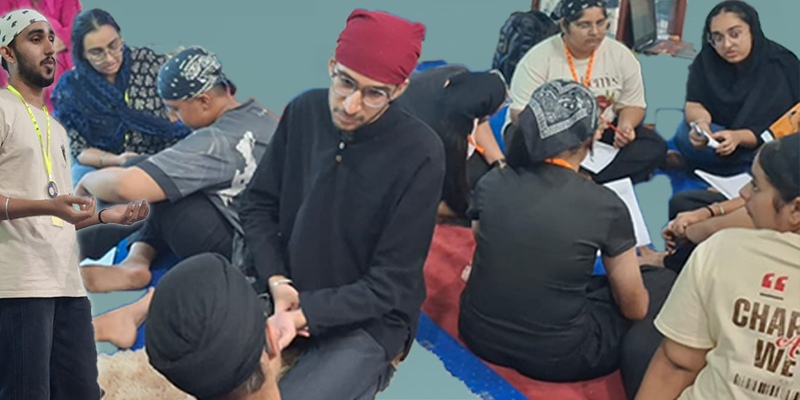
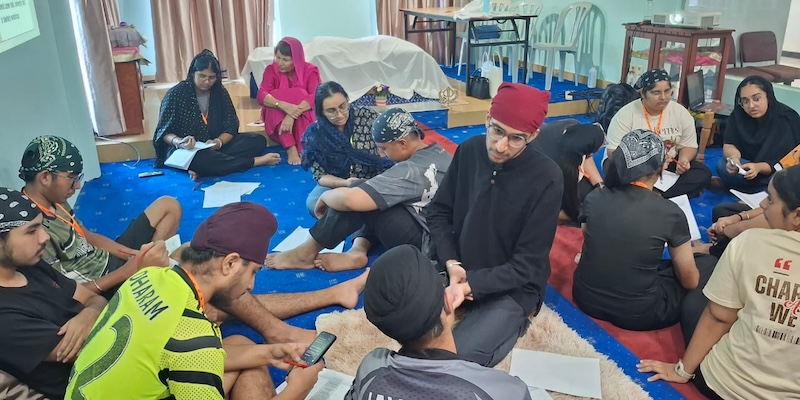
The “Inspiring Youth to Higher Education” at the Gurdwara Sahib Sungai Besi (Shapa) on March 21, 2026 organized by Ekta Club of Kuala Lumpur & Selangor – Photo: Asia Samachar
By Asia Samachar | Malaysia |
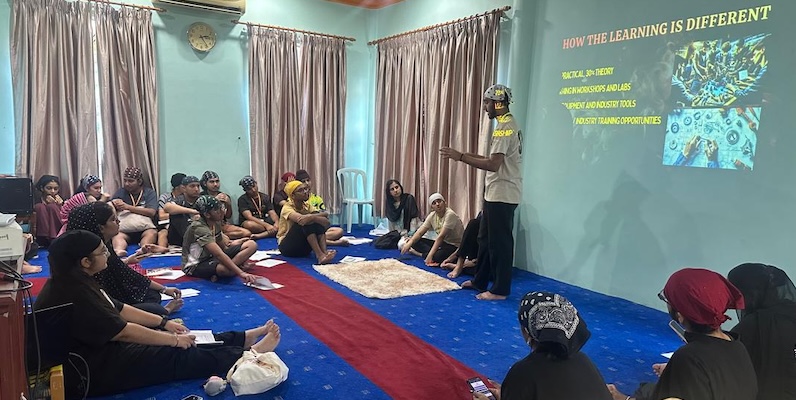
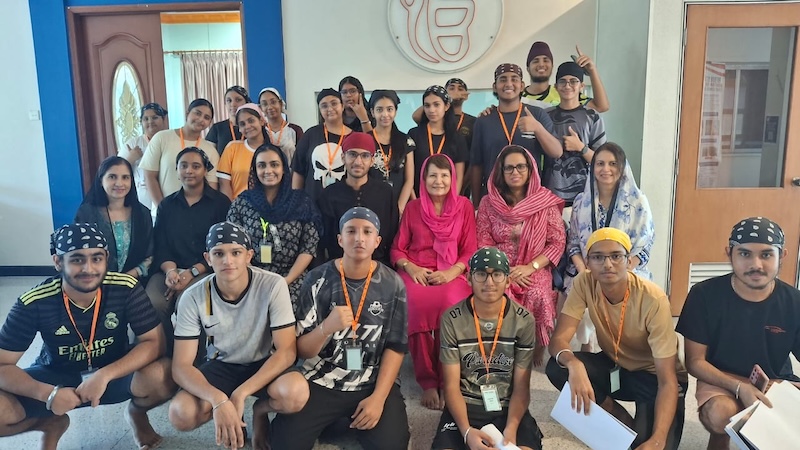
EKTA, in collaboration with Gurdwara Sahib Sungai Besi (Shapa) and Asia Samachar, recently organised a workshop on “Inspiring Youth to Higher Education.”
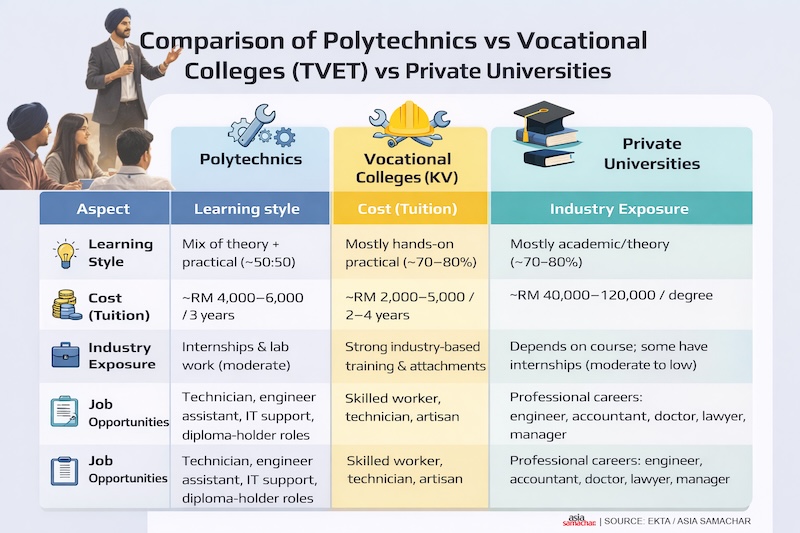
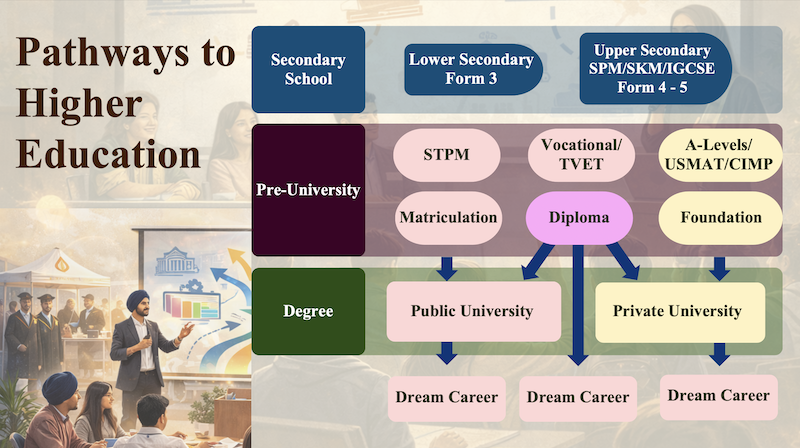
A key point that emerged was the urgent need for the Punjabi Sikh community to be made aware of opportunities in TVET – through Polytechnics and Vocational Colleges in Malaysia.
The Malaysian government is investing billions of ringgit into TVET because many companies desperately need skilled workers, yet too few young people are trained for these jobs. At the same time, many university graduates struggle to find work because they lack practical, hands-on skills.
TVET, short for Technical and Vocational Education and Training, equips students with practical skills that lead directly to employment, allowing them to start working and earning earlier. It is also more affordable than university while offering stable, rewarding career opportunities.
The government encourages parents to see TVET not as a “second option,” but as a smart and reliable pathway for their children to secure a good future.
Path to higher education Malaysia – Graphic: EKTA / Asia Samachar
While there is a quota for the Indian community, including Punjabi Sikhs, community participation remains low. Many still perceive TVET as only for students who “struggle academically.” Parents worry these jobs are low-status, low-paying, or have limited growth. There is also a common belief that only university degrees lead to success, which often causes TVET to be overlooked.
But this thinking needs to change. Today, many skilled jobs in areas like engineering, technology, and construction are in high demand and can offer good salaries and stable careers. TVET students learn practical, hands-on skills that employers are actually looking for, which means they can find jobs faster and grow in their careers. Some even go on to become supervisors, business owners, or continue their studies to higher levels.
The “Inspiring Youth to Higher Education” at the Gurdwara Sahib Sungai Besi (Shapa) on March 21, 2026 organized by Ekta Club of Kuala Lumpur & Selangor – Photo: Asia Samachar
TVET is not a “lesser” path—it is simply a different path. By changing this mindset, parents can open more opportunities for their children to succeed in ways that match their strengths and interests.
Every child learns differently. Some excel in academic classrooms, while others do better with hands-on, practical learning. Polytechnics and vocational colleges are designed for these students.
Eshveenadip’s Brave Choice
Take Eshveenadip from Politeknik Ungku Omar in Ipoh, Perak. She was a strong student who scored five distinctions in Form 5 and went on to STPM, like many others.
The “Inspiring Youth to Higher Education” at the Gurdwara Sahib Sungai Besi (Shapa) on March 21, 2026 organized by Ekta Club of Kuala Lumpur & Selangor – Photo: Asia Samachar
But she struggled—not because she wasn’t capable, but because the learning style didn’t suit her. She realised she learns best by doing, applying, and seeing how things work in real life.
So she made a brave choice. She applied to Politeknik Ungku Omar where the focus is on practical skills and enrolled for a Diploma in Geomatics.
That decision made all the difference. She found the right environment, built confidence, and moved towards a career that fits her strengths.
As parents, our role is not to choose the most popular path—but the right path for our child. TVET is not a second choice. For many, it is the better choice.
Driishnil Opts Vocational College
The second case was Driishnil Singh, a young leader from Gurdwara Sahib Sungai Besi (Shapa). From an early age, he had a natural passion for cars—diagnosing problems, tinkering with engines, and fixing anything that didn’t run smoothly. In Form 4, he discovered that he could enrol at Setapak Vocational College in Kuala Lumpur to pursue his interest formally, choosing Automotive Engineering as his course of study.
The “Inspiring Youth to Higher Education” at the Gurdwara Sahib Sungai Besi (Shapa) on March 21, 2026 organized by Ekta Club of Kuala Lumpur & Selangor – Photo: Asia Samachar
Through hands-on training and practical workshops, Driishnil honed his technical skills and gained a deep understanding of automotive systems. His dedication paid off when he successfully obtained his Sijil Kemahiran Malaysia (SKM) certification, equipping him with nationally recognized qualifications and opening doors to industry opportunities as a skilled automotive technician. He is now studying for the Diploma Vocational Malaysia (DVM) which is Level 4 and focuses on advanced technical skills and is recognsied by industries and can help in supervisory roles.
Path to higher education Malaysia – Graphic: EKTA / Asia Samachar
With the diploma, Driishnil will also be able to apply to a University to study for a degree.
His story shows that following your passion and learning by doing can turn a hobby into a successful career.
The message is clear: TVET is a valuable, practical, and respected route to a secure and successful career—one that deserves attention and pride.
[Dr Saran Kaur Gill, a former deputy vice chancellor of Universiti Kebangsaan Malaysia, is the Chair of EKTA Youth Development and Lifelong Learning, YDLL.]
Join the conversation on this story on Asia Samachar’s Facebook and Instagram pages.
ASIA SAMACHAR is an online newspaper for Sikhs / Punjabis in Southeast Asia and beyond. You can leave your comments at our website, Facebook, Twitter, and Instagram. We will delete comments we deem offensive or potentially libelous. You can reach us via WhatsApp +6017-335-1399 or email: asia.samachar@gmail.com. For obituary announcements, click here