Gurdwara Sahib Menglembu invites a Dhadh Jatha to commemorate the Jothi Joth (passing way) of Guru Hargobind Sahib Ji as well as as Bhai Subeg Singh Ji & Bhai Shahbaz Singh Ji.
A Dhadi Jatha is a traditional Sikh musical ensemble (jatha) that performs Dhadi Vaaran, a form of ballad singing, featuring heroic poetry and stories from Sikh history.
Date: Sunday, 29 March 2026 Venue: Gurdwara Sahib Menglembu Program Schedule: Bibi Sumandeep Kaur Khalsa Dhadi Jatha
Join the conversation on this story on Asia Samachar’s Facebook and Instagram pages.
ASIA SAMACHAR is an online newspaper for Sikhs / Punjabis in Southeast Asia and beyond. You can leave your comments at our website, Facebook, Twitter, and Instagram. We will delete comments we deem offensive or potentially libelous. You can reach us via WhatsApp +6017-335-1399 or email: asia.samachar@gmail.com. For obituary announcements, click here
The Buntong Sikh community will host near-daily programmes from March 27 to April 14 in celebration of Vaisakhi 2026.
Among the highlights for the Annual Vaisakhi Samagam 2026 at Gurdwara Sahib Buntong, Ipoh, is the customary Akhand Path — a continuous three-day recitation of the Sri Guru Granth Sahib.
Langgar will be served throughout the samagams.
See the attached posters for full details.
Join the conversation on this story on Asia Samachar’s Facebook and Instagram pages.
(What’s happening at your local gurdwara for #Vaisakhi2026? Send a WhatsApp to Asia Samachar at +6017-3351399.)
RELATED STORY:
(Asia Samachar, x 2024)
ASIA SAMACHAR is an online newspaper for Sikhs / Punjabis in Southeast Asia and beyond. You can leave your comments at our website, Facebook, Twitter, and Instagram. We will delete comments we deem offensive or potentially libelous. You can reach us via WhatsApp +6017-335-1399 or email: asia.samachar@gmail.com. For obituary announcements, click here
| Entry: 24 March 2026; Updated: 1 April 2026 | Source: Family
ASIA SAMACHAR is an online newspaper for Sikhs / Punjabis in Southeast Asia and beyond. You can leave your comments at our website, Facebook, Twitter, and Instagram. We will delete comments we deem offensive or potentially libelous. You can reach us via WhatsApp +6017-335-1399 or email: asia.samachar@gmail.com. For obituary announcements, click here
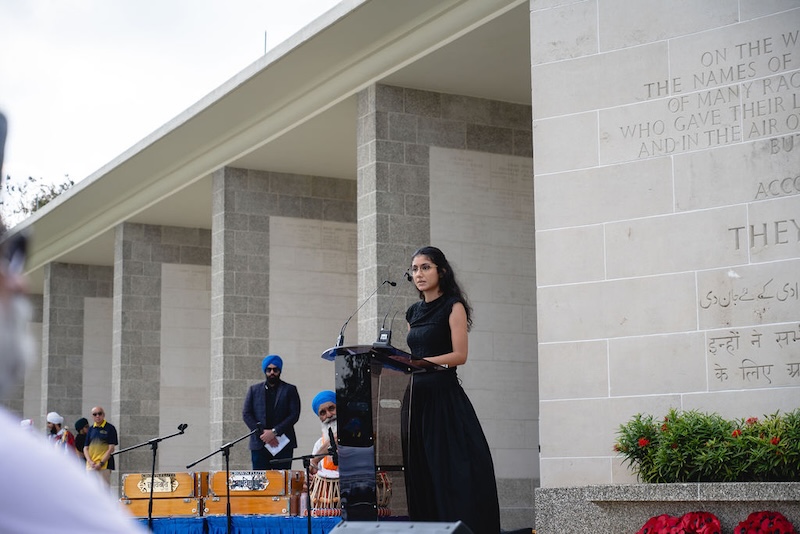
Jasmir Kaur Thiara speaking at the Kranji War Memorial remembrance service
By Jasmir Kaur Thiara | Singapore |
We stand today at Kranji, where the land is quiet, but not empty. It holds names. It holds distances. It holds unfinished conversations.
When you move through this place, you begin to feel what remembrance really is: not a lesson delivered from a podium, but a responsibility shared across generations.
Today, I speak as a young Sikh, representing my community. But first and foremost, I speak as someone grateful to those who gave their tomorrows so that ours could arrive.
1) The fallen Sikh soldiers
Here at Kranji, that gratitude has a shape. It is carved into stone — in names from many places, many backgrounds, many faiths — each one a life that did not get to finish its own story.
Among the many who served and fell in the wars were Sikh soldiers.
Many of these soldiers were young men with simple lives — family responsibilities, familiar routines, and values shaped at home. They were not born into legend. They were ordinary men called into extra-ordinary circumstances.
For many people in the audience, these men were not just “history.” They were the older brother someone still talks about softly. The grand-uncle whose name is repeated at the dinner table. The neighbour from the next lane who showed up when help was needed.
One day, they were sent far from home — into unfamiliar heat, unfamiliar terrain, unfamiliar names on a map — to protect people they had never met, here in Singapore and beyond.
And in the hardest moments, what held them steady was not grand ideology. It was something simpler and stronger: a belief that humanity is worth protecting.
The Sikh tradition has a phrase for that spirit: Chardi Kala — a resilient, forward-facing courage. Not denial of pain, but the strength to move through it with dignity.
2) Teachings and sacrifices of Guru Gobind Singh Ji
And when we ask where that kind of courage comes from, we are led naturally to the teachings of Guru Gobind Singh Ji — who taught that strength must be guided by conscience, and that to stand for justice is not a slogan, but a duty.
One word captures this teaching powerfully: Nirbhau — fearlessness. Not the absence of fear, but freedom from its hold. The strength to face oppression and still stand for justice.
But his teaching was never about aggression. It was about responsibility. He called people to stand up against injustice, without losing compassion, and to defend what is right, not what is convenient.
He created Khalsa so this teaching would not remain only words — it would become a way of life: a disciplined community grounded in service and integrity, committed to upholding righteousness and defending the oppressed.
And he lived these ideals at profound personal cost, showing what it means to stay true to your values even when it demands immense sacrifice.
That is the spirit we recognise in the fallen we honour today.
3) Oneness: teachings of Guru Nanak Dev Ji
After the courage of Guru Gobind Singh Ji, it is important to remember the gentler foundation beneath it: Guru Nanak Dev Ji’s teaching of oneness.
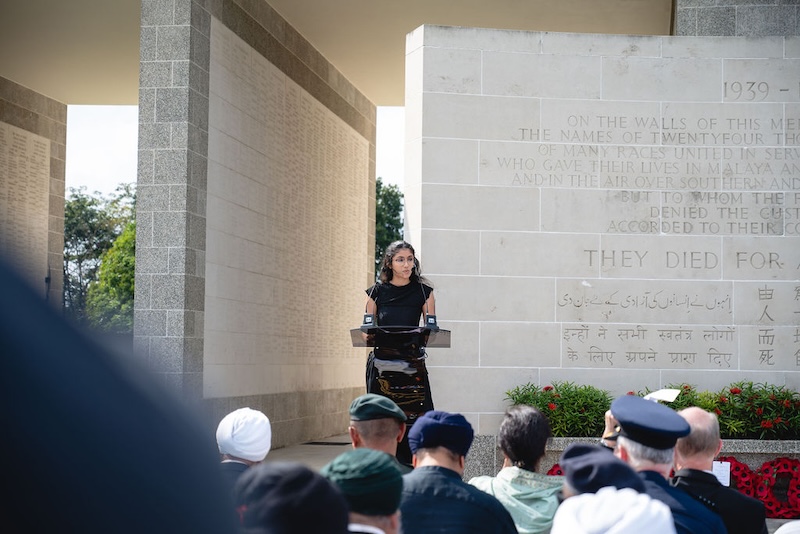
Jasmir Kaur Thiara speaking at the Kranji War Memorial remembrance service
Guru Nanak taught Ik Onkar — one reality, one human family.
In simple terms, it is the refusal to split people into us and them, insider and outsider, equal and lesser. It is a way of seeing that makes hatred harder to justify, and indifference harder to defend.
That teaching matters deeply on a day like this.
Because today’s remembrance is not for one community, one regiment, or one faith — it is for all who fell in the wars — whatever uniform they wore, whatever language they spoke, whatever name they prayed in.
Here at Kranji, the names remind us of a basic truth: loss does not come neatly labelled, and grief does not stop at borders.
4) What this memorial asks of us now
So what do we learn from a day like this?
I belong to a generation that inherited peace as normal. We grew up assuming progress was automatic — that rights would expand, that the world would keep getting safer.
And then we watched how quickly that assumption can break. Societies fracture. People are reduced to labels. Fear turns into hostility.
So remembrance must leave us with more than emotion. It must leave us with wisdom.
First: gratitude, grounded in truth — a clear-eyed respect for what was endured, and how fragile peace can be.
Second: unity, lived with intention — the daily choice, in a diverse society, to treat differences with respect rather than suspicion.
Third: courage, guided by conscience — the courage to choose humanity out loud, every day, and especially when it’s uncomfortable.
Taken together, they turn remembrance into responsibility.
The Sikh prayer ends with a wish for “Sarbat da Bhala” — the welfare of all. Not only those who look like us, vote like us, or pray like us. All.
That is a message worthy of this place.
Closing
So today, we honour the fallen best not only by remembering how they died, but by protecting what they made possible: a society where every person is treated as equal, where difference is not feared, and where dignity is not conditional.
May these names keep us humble, and may the peace we have be the peace we strengthen — together.
(Jasmir Kaur Thiara gave a speech from a young Sikh’s perspective at the Remembrance Day Memorial Service at the Kranji War Memorial on February 8, 2026.The service honours the lives and sacrifices of 3,318 fallen soldiers bearing the name “Singh”, drawn from communities across the undivided Punjab, who served and fell during times of war. The event was hosted by Pardesi Khalsa Dharmak Diwan (PKDD) as part of its centenary celebration which culminates in August 2026).
Join the conversation on this story on Asia Samachar’s Facebook and Instagram pages.
ASIA SAMACHAR is an online newspaper for Sikhs / Punjabis in Southeast Asia and beyond. You can leave your comments at our website, Facebook, Twitter, and Instagram. We will delete comments we deem offensive or potentially libelous. You can reach us via WhatsApp +6017-335-1399 or email: asia.samachar@gmail.com. For obituary announcements, click here
The Sikh community in Bayan Baru is set to celebrate its 10th Vaisakhi at the complex it has called home since June 2016.
Gurdwara Sahib Bayan Baru (GSBB), located in Bayan Lepas, Penang, moved into its purpose-built premises that year, marking a new chapter for the local sangat.
This year’s programme includes an Akhand Path from April 12 to 14, alongside a hi-tea gathering, dental screening and a kirtan darbar.
Join the conversation on this story on Asia Samachar’s Facebook and Instagram pages.
ASIA SAMACHAR is an online newspaper for Sikhs / Punjabis in Southeast Asia and beyond. You can leave your comments at our website, Facebook, Twitter, and Instagram. We will delete comments we deem offensive or potentially libelous. You can reach us via WhatsApp +6017-335-1399 or email: asia.samachar@gmail.com. For obituary announcements, click here
In many Sikh families, the pressure does not arrive wearing the name of ritualism. It arrives more gently.
A wedding is being planned, and someone says the date should be checked properly. A funeral takes place, and someone quietly insists that a few extra things should be done “just in case.” A child is born, and old ideas about impurity, restriction, or prescribed waiting periods begin to shape the house. A family wants to understand Gurbani, but instead of being invited into it, they are left standing at a distance while others perform religion on their behalf.
None of this is usually presented as a rejection of Sikhi. It comes wrapped as respect, tradition, culture, or caution. But the effect can be the same: ordinary Sikhs begin to feel that access to religion depends on specialists, correct procedures, inherited customs, or invisible rules that must be managed for them.
That is exactly the kind of drift the Sikh Gurus challenged.
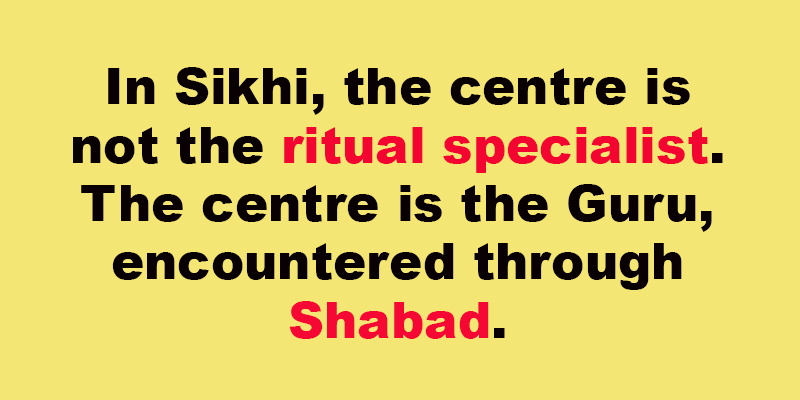
One of the most radical moves in Sikhi was not only theological but social. It broke the idea that spiritual life must be mediated by a hereditary priestly class. It challenged the assumption that ritual expertise, caste status, or ceremonial control could place one human being between another and the Divine. In Sikhi, the centre is not the ritual specialist. The centre is the Guru, encountered through Shabad.
That is why Sikhi’s understanding of Guru matters so much. When Sikhs say that Guru is found in Bani, this is not a poetic slogan. It is a governing principle of Sikh religious life. The authority that forms, corrects, and guides the Sikh is not a family priest, astrologer, ritual broker, or passing personality. It is the Guru’s revealed teaching, received through listening, reflection, and lived practice.
This is not a call for private, self-invented Sikhi. Guidance matters. But in Sikhi, guidance should bring people closer to the Guru, not make them permanently dependent on a middleman.
Gurbani makes this clear. It locates all human beings in the One Light (SGGS, 1349). It recasts the sacred thread in ethical rather than ritual terms, making compassion, contentment, restraint, and truth the marks of spiritual discipline (SGGS, 471). It rejects sootak thinking by shifting impurity from childbirth or contact to greed, falsehood, lust, and slander (SGGS, 472). And it states the principle of authority with striking clarity: Bani is Guru, Guru is Bani (SGGS, 982). Again and again, Gurbani turns the question from outer performance to inner condition: what is happening to the mind? Is ego loosening? Is greed reducing? Is truth becoming visible in conduct?
That remains deeply relevant in the diaspora.
Today, the old priestly structure often returns in altered form: auspicious timing practices entering wedding decisions, funeral expectations inherited from surrounding custom, caste operating beneath the language of respectability, or gurdwara life in which the sangat becomes passive while religion is handled by a few functionaries. It also appears in the outsourcing of understanding itself: people know how to book an Akhand Paath, but not how to sit with one shabad and let it interrogate their life.
This is not a criticism of granthis, raagis, or sevadars as such. Sikh communities need learned people who can read, teach, explain, and serve. The problem begins when such roles harden into something more than seva. A granthi is not a priest in the old hereditary sense. But if the community starts treating him as the only legitimate mediator of religion, the effect becomes priest-like even if the vocabulary remains Sikh.
A community can reject Brahminism in theory and still reproduce priestly habits in practice. The external form may change while the logic stays the same. Religion is no longer something the Sikh receives from the Guru through Shabad and Sangat; it becomes something administered by others, performed at a distance, and guarded by custom.
That drift has consequences. Ordinary Sikhs lose confidence in approaching Gurbani directly. Family ceremonies become heavier but not deeper. Children learn that religion is mostly about compliance, not understanding. Caste and status regain influence because people start looking for socially authorised interpreters of what is proper, pure, or respectable. A community can remain visibly religious while its inner architecture shifts away from what the Gurus were building.
This is why Shabad-Guru should not be treated as abstraction. It has everyday consequences. It means no one can monopolise access to the Guru. It means the path cannot be sold back to the sangat as a package of compulsory extras. It means ceremonies should remain simple, intelligible, and accountable to Gurmat. And it means authority in Sikh life must always be tested against Gurbani, not merely inherited custom or social pressure.
For diaspora Sikhs, this also has a liberating side. Many younger Sikhs are not rejecting Sikhi itself. They are rejecting opacity, performance, and inherited confusion. They do not want religion as theatre. They want to know what it means, what it asks of them, and whether it can still speak truthfully in modern conditions. If Sikh institutions answer that hunger only with more noise, ritual layering, or authority claims, they will fail the very people still trying to come closer.
The answer is not to become thinner, flatter, or more secular in order to seem relevant. It is to become more recognisably Sikh at the point of principle: to return people to the Guru through understanding, practice, and participation.
That can begin in small ways. Families can ask whether a practice is actually Gurmat-based or merely habitual. Gurdwaras can teach meanings, not only organise events. Ceremonies can increase understanding rather than spectator dependence. Children can be introduced to key Sikh words not as slogans but as living categories: Naam, Hukam, Haumai, Seva, Shabad. Sangat can recover the confidence to ask whether an added practice is deepening Sikh life or just burdening it.
None of this requires hostility to culture. Punjabi culture can carry warmth, memory, language, music, kinship, and beauty. But culture cannot outrank Gurmat. The question is not whether a custom is old. The question is whether it trains the mind toward truth or away from it.
That is why the struggle against priestly control in Sikhi is never only about a priestly class. It is about a deeper temptation that returns in every age: the temptation to replace transformation with management, understanding with procedure, and Guru with gatekeeper.
The Sikh response remains both demanding and liberating. Go to the Guru. Hear the Shabad. Let it correct you. Let it simplify what society has made heavy. Let it expose what habit has made respectable. And do not hand over your spiritual agency so easily.
A real Sikh revival in the diaspora will not come only from louder identity claims, better branding, or a busier calendar of events. It will come when more Sikhs recover a direct, disciplined, living relationship with the Guru through Shabad. That recovery would not weaken Sikh institutions. It would renew them from the inside.
And it would remind us of something the Gurus made startlingly clear from the beginning: there is no priest between you and the Guru.
Gurjit Singh Sandhu is an independent Sikh researcher and the founder of PanthSeva (panthseva.com), a publication on Sikh thought, governance, and practice.
Join the conversation on this story on Asia Samachar’s Facebook and Instagram pages.
Gurjit Singh Sandhu, who is based in London, is an independent Sikh researcher and the founder of PanthSeva (panthseva.com), a publication on Sikh thought, governance, and practice.
* This is the opinion of the writer and does not necessarily represent the views of Asia Samachar.
ASIA SAMACHAR is an online newspaper for Sikhs / Punjabis in Southeast Asia and beyond. You can leave your comments at our website, Facebook, Twitter, and Instagram. We will delete comments we deem offensive or potentially libelous. You can reach us via WhatsApp +6017-335-1399 or email: asia.samachar@gmail.com. For obituary announcements, click here
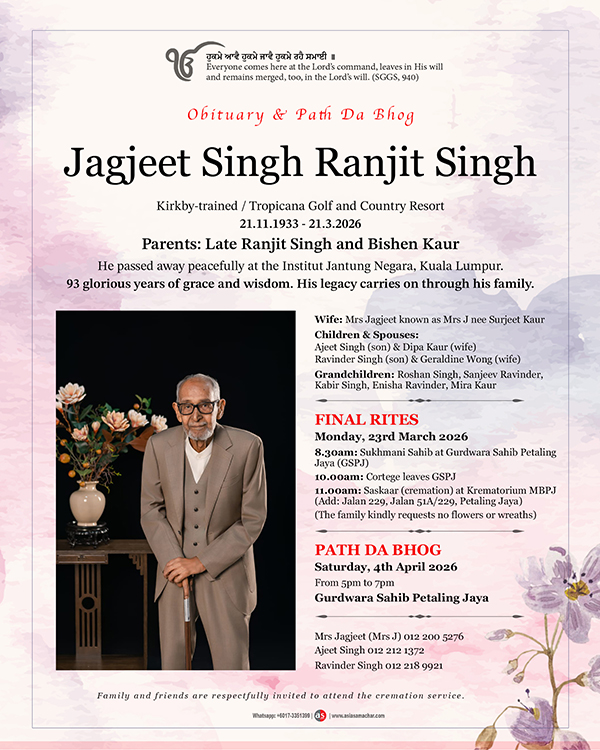
(Kirkby-trained / Tropicana Golf and Country Resort)
21.11.1933 – 21.3.2026
Parents: Late Ranjit Singh and Bishen Kaur
He passed away peacefully at the Institut Jantung Negara, Kuala Lumpur. 93 glorious years of grace and wisdom. His legacy carries on through his family.
Wife: Mrs Jagjeet known as Mrs J nee Surjeet Kaur
Children & Spouses: Ajeet Singh (son) & Dipa Kaur (wife) Ravinder Singh (son) & Geraldine Wong (wife)
8.30am: Sukhmani Sahib at Gurdwara Sahib Petaling Jaya (GSPJ) 10.00am: Cortege leaves GSPJ 11.00am: Saskaar (cremation) at Krematorium MBPJ (Add: Jalan 229, Jalan 51A/229, Petaling Jaya) (The family kindly requests no flowers or wreaths)
PATH DA BHOG Saturday, 4th April 2026 From 5pm to 7pm Gurdwara Sahib Petaling Jaya
ASIA SAMACHAR is an online newspaper for Sikhs / Punjabis in Southeast Asia and beyond. You can leave your comments at our website, Facebook, Twitter, and Instagram. We will delete comments we deem offensive or potentially libelous. You can reach us via WhatsApp +6017-335-1399 or email: asia.samachar@gmail.com. For obituary announcements, click here
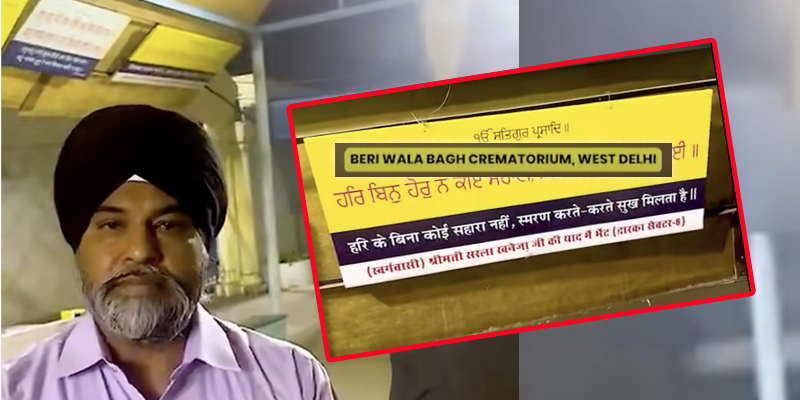
DSGMC’s Tajender Singh Gopa to tackle wrongly AI-generated Gurbani used for posters at the Beri Wala Bagh Crematorium in West Delhi – Photograbs from Kaur & Singh video
By Kaur & Singh | India |
UNITED SIKHS (UK)’s Communications and Advocacy Director Harmeet Shah Singh, also a member of the SGPC’s A.I. subcommittee, was attending the funeral of a neighbour at a crematorium in West Delhi [Beri Wala Bagh Crematorium].
On his way out, after the pyre had been lit, he noticed a series of rectangular posters along a hallway. Each carried text in Gurmukhi beneath Ek Onkar Satgur Prasad, presented as Gurbani.
Something felt wrong.
A closer look confirmed it. The text was not Gurbani. It appeared to be artificially generated.
He immediately contacted the local Delhi Sikh Gurdwara Management Committee member Tajender Singh Gopa, who intervened promptly and ordered the posters to be removed without delay.
Fake sacred writings are no longer confined to screens. AI-generated “bani” is beginning to surface in public spaces.
From chatbots to crematoriums, the spread is real.
ASIA SAMACHAR is an online newspaper for Sikhs / Punjabis in Southeast Asia and beyond. You can leave your comments at our website, Facebook, Twitter, and Instagram. We will delete comments we deem offensive or potentially libelous. You can reach us via WhatsApp +6017-335-1399 or email: asia.samachar@gmail.com. For obituary announcements, click here
Former Indian rally legend Hari Singh, with TT Ashena yacht in the background
By Asia Samachar | India |
Former Indian rally legend Hari Singh has been reported missing, while Indian billionaire industrialist Gautam Singhania sustained minor injuries when a tourist speedboat overturned in the Maldives on Friday.
Search and rescue operations were underway for Hari and another Indian national after the early morning incident near Felidhoo, according to media reports.
Singhania, the Group Managing Director of Raymond Group, is recovering in Mumbai under medical supervision, his spokesperson said.
“The speedboat belongs to his yacht, TT Ashena. The Maldivian Coast Guard is still searching for two individuals reported missing in the accident,” India Today reported, citing unnamed sources who spoke to Maldives-based news portal Adhadhu.
It remains unclear whether Hari was travelling with Singhania at the time of the incident.
Widely known as the “Gypsy King”, the Chandigarh-born Hari began his motorsport journey in 1990 with the Himalayan Car Rally. He went on to win the Indian National Rally Championship five times, with long-time backing from JK Tyre.
“He stood head and shoulders above his peers,” said Hormazd Sorabjee in a television interview.
Join the conversation on this story on Asia Samachar’s Facebook and Instagram pages.
ASIA SAMACHAR is an online newspaper for Sikhs / Punjabis in Southeast Asia and beyond. You can leave your comments at our website, Facebook, Twitter, and Instagram. We will delete comments we deem offensive or potentially libelous. You can reach us via WhatsApp +6017-335-1399 or email: asia.samachar@gmail.com. For obituary announcements, click here
Micky Ahuja, charismatic, connected and in your face – Photograbs from 60 Minutes Australia
By Asia Samachar | Australia |
For years, Micky Ahuja cultivated the image of a self-made success story—charismatic, connected and at the helm of a booming security and cleaning empire in Australia. His company, MA Services Group, secured major contracts across industries, supplying thousands of guards and cleaners to corporations, events and even government-linked operations.
Today, that image lies in tatters.
Australian authorities are now investigating Ahuja over allegations of large-scale fraud, worker exploitation and links to organised crime, in what is shaping up to be one of the country’s most significant corporate scandals in recent years.
The turning point came in December 2025, when MA Services Group entered voluntary administration, abruptly leaving thousands of workers without jobs or unpaid wages. For many, it marked the collapse of a company that had appeared unstoppable.
But behind the rapid growth, investigators now allege, was a deeply flawed business model.
A joint investigation by 60 Minutes Australia, The Age and The Sydney Morning Herald paints a troubling picture: thousands of vulnerable workers—many of them migrants and international students—allegedly underpaid, denied entitlements and, in some cases, intimidated into silence.
Some of those allegedly exploited by Ahuja’s company were international students, including many from India, who were particularly vulnerable due to their visa status and limited awareness of labour rights.
According to the 60 Minutes investigation, these workers were often underpaid, denied basic entitlements and made to work long hours—sometimes in breach of visa conditions—just to make ends meet. In some cases, they were allegedly threatened with being reported to authorities if they complained, trapping them in a cycle of fear and exploitation.
Authorities believe MA Services was part of a broader “phoenix” network, using front companies and proxy directors to evade debts and re-emerge under new entities. Under Operation Hermes, the Australian Taxation Office and partner agencies are probing what they describe as a syndicate that may have siphoned more than A$100 million in unpaid taxes and worker entitlements over the past decade.
The scandal deepened in March 2026 when the Federal Court froze Ahuja’s Australian property portfolio. The move followed a chaotic press conference he held from Dubai, where he had reportedly fled, insisting on his innocence. Instead, the appearance appeared to accelerate legal action against him.
The landing page of Micky Ahuja’s website (www.mickyahujaprofile.com) which was still available when checked in March 2026 – Photo: Asia Samachar
Further allegations have added to the gravity of the case. Investigators and media reports have pointed to alleged links between MA Services and figures associated with outlaw motorcycle gangs—groups long identified by authorities as major organised crime threats. Separate accusations of sexual misconduct, including rape and harassment, have also surfaced.
Despite the mounting claims, Ahuja has strongly denied all allegations.
Yet for former employees and regulators alike, the case raises uncomfortable questions. How did a company accused of systemic underpayment and questionable practices secure high-profile contracts? And were warning signs overlooked in the pursuit of cost savings?
As investigations continue, the Ahuja saga is fast becoming more than just the story of a fallen businessman. It is a test case for Australia’s ability to police corporate misconduct—and to protect the workers most vulnerable to it.
ASIA SAMACHAR is an online newspaper for Sikhs / Punjabis in Southeast Asia and beyond. You can leave your comments at our website, Facebook, Twitter, and Instagram. We will delete comments we deem offensive or potentially libelous. You can reach us via WhatsApp +6017-335-1399 or email: asia.samachar@gmail.com. For obituary announcements, click here