A mother is a non-replacement caretaker who represents a source of nourishment. Honestly, I am excited less about Mother’s Day greetings, a chain of repeatedly forwarded messages from my social contacts that suffocate my mobile phone memory. Such copied messages in the form of images and gifs from various sources are humdrum. Do ever wonder why do we need to have a specific day to wish and reflect the contributions and sacrifices of mothers only? Moreover, why not parents on the same day?
Most importantly, do we ever taken the initiative to learn why such a day exists in the first place? Most of the time, we take the easy way out by following the masses and fall prey to societal trends without knowing why we are doing it. In doing so, we subconsciously expanding differences and stereotypes between genders, especially in the family institution.
Mother’s Day was first celebrated on the second Sunday of May 1908 in the United States of America. The day was founded by Anna Jarvis in memory of her mother Ann Reeves Jarvis, an activist. Anna Jarvis chose the second Sunday in May because it would always be close to May 9, the day her mother had died.
Those who have been emotional with Mother’s Day may not be aware that Anna Jarvis became resentful of the commercialization of the holiday. She believed the companies had misinterpreted and exploited the idea of Mother’s Day. Anna Jarvis argued that people should appreciate and honor their mothers through handwritten letters expressing their love and gratitude, instead of buying gifts and pre-made cards. It seems that Anna Jarvis’ initial idea continues to be plundered through versatile forms of intentions over modernization.
Anna Jarvis may not have thought that social media is now the primary platform for gaining social acknowledgment of how a female parent in a particular family is ‘celebrated’. A bouquet, e-cards, jewelry, home appliance, or a spa day seem to be the standard Mother’s Day gifts. In fact, it has become a convincing (mandatory) ritual for most individuals, especially women who enliven their social account status. For example, updates on WhatsApp, Facebook, and Instagram are filled with photo after photo, with mushy captions attesting to their involvement among family, friends, and random acquaintances.
Regardless of the gender-specific, every female (male) parent deserves to be appreciated. But we should maintain continuity in giving respect and, appreciation any time on every day. Why should we need one scheduled day of the year to express our love to parents, that’s also on Ann Reeves’s death anniversary day?
For many people, this supposedly obligatory celebration has turned into a soul-crushing experience. Society has conditioned women’s lives to be spent with their families while caring for a family system. Women are allegedly taught how motherhood is the most important role and their lives are secured by having children. This is not surprising, considering that for centuries, a woman’s greatest value in a patriarchal society was her ability to produce heirs. However, many special women have longed to be mothers but couldn’t be. What about the children of any age, whose mothers have passed? Mother’s Day can leave a bitter taste and a reminder to some of what’s no more or never was. In the absence of a child’s mother, how will this alleged celebration affect a male parent who is solely responsible for the child’s nutrition?
So, why are we too pumped-up on this day? Do we need a special day to draw close to our mother? More than a decade ago, the second Sunday of May, was a normal Sunday in every Sikh family. In fact, we used to not celebrate trendy Mother’s Day at a gurdwara, but it has now become another purposeful annual agenda item to bring people together.
Father’s Day, on the other hand, has never been observed in any gurdwara. The dekha-dekhi culture has certainly created some stress in the family. Some (young) mothers hoping to walk into a room full of flowers, to receive greeting cards or presents, to close the kitchen, etc. But what if none of these typical Mother’s Day things happen? The blaming game will start in the family and the mothers (not all) will think that they are not being loved or appreciated.
This is how commercialized Mother’s Day has changed our expectations and emotions. Instead, we should regularly engage in her everyday tasks, give her something useful, and keep in touch with our mother regularly. We are hesitant to establish a new norm that everyone in the family should be respected and loved every day.
We should encourage our children to work together as one team and appreciate their parent’s contribution to the well-being, not just half of a parent. Parents who are unconditionally loving expect nothing in return except for a strong bond with their children and the assurance that they will not be forgotten.
As much as our society pays lip service to the importance of family and the moral purpose of mothering, the truth is that we do not really take it seriously. If we took motherhood seriously, we should not keep reminding them to adjust and to sacrifice for the sake of family members. We should not have to act involuntarily by pushing them to majorly perform domestic tasks restlessly and suppress their desires. If we have given a serious thought, we should not even be arguing about whether or not women have the right to choose to be mothers. We wouldn’t even remind a woman who has lost their children; besides we wouldn’t have been questioning women who may choose to walk away from a toxic marriage. We should not put off working on her interests if we truly valued our motherhood, not just only as a mother but also as a human being.
Dr Charanjit Kaur is an Assistant Professor at Malaysia-based Universiti Tunku Abdul Rahman (UTAR). Her area of specialisation is cultural anthropology with a special focus on the Sikh minority community in Malaysia which touches on themes such as religious-cultural conflicts, gender identity and social behavior.
ASIA SAMACHAR is an online newspaper for Sikhs / Punjabis in Southeast Asia and beyond.Facebook | WhatsApp +6017-335-1399 | Email: editor@asiasamachar.com | Twitter | Instagram | Obituary announcements, click here |
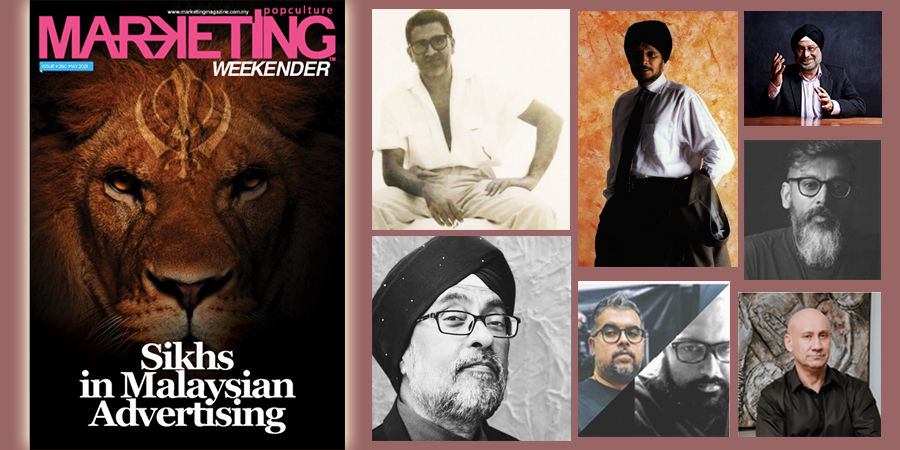
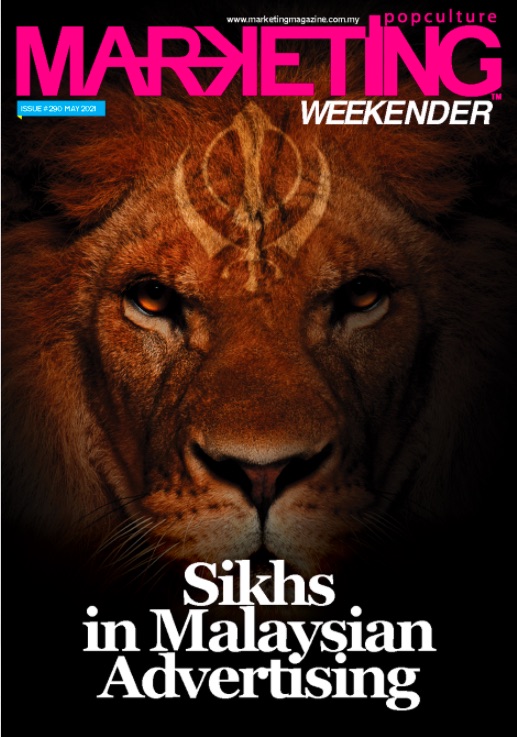
Clockwise, left to right: Marketing Weekend cover for May 2021 issue, Del, Hunter, Harmandar, Rajay, Sheen, Pat and Pete, Malkeet
By Harmandar Singh| Marketing Weekender | Malaysia |
Singh means Lion.
But when I tell my Singaporean friends that Sikhs have a name claim on their country, they are not amused.
But our namesake is everywhere, on brands like Singha Beer to the Singh brothers who are die-hard fans of Manchester United and part of the MU brand at Old Trafford.
As my friend Steve Teoh loves to remind me, Sikh and you shall find.
Their conspicuous turban and bangle (crudely teased as a bottle opener) on their wrists do more than announce that a Lion is in our midst.
From fearlessly helping in open funeral pyres in COVID-stricken New Delhi to providing over 30,000 home-cooked meals to those in self-isolation in New York, Sikhs look like an advertisement about humanity on the move.
Closer to home, a group of Sikh bikers from the Santana Riderz Malaysia Club embarked on a self-funded biking expedition from Malaysia to Pakistan passing through five counties to raise awareness and funds for paediatric cancer patients of the National Cancer Society of Malaysia.
Sikhs remain neutral at all times in all societies and countries, and more often than not, help neutralise conflicts.
The total population of Sikhs in the world is much smaller than the population of Malaysia. As a relatively young religion founded 500 years ago, and now the fifth largest in the world, there only two words Sikhs live by: TO SERVE.
Relax, this is not a piece about religion but I bet a lot of you did not know what defines a Sikh. So there you go, you learnt something new today.
Now back to the story of Sikhs in the Malaysian advertising scene. I am writing this article from memory so I can only talk about Sikhs I know or have met, which believe me is ample enough…
BIGGEST CONSTELLATION OF TURBANS
A good place to start is in the early 1980s with Daljindra Singh Dogra who I wrote about last week. He roared through quite a few agencies as a larger than life Creative Director and he remains the Gold standard for many of us. Del’s son Jonn Dogra is now Creative Director at Entropia.
The 80s also saw the unleashing of the terrifying trio in probably the biggest constellation of turbans in the industry: Malkeet, the Turbanned Stranger and Gurdeep.
Malkeet Singh
Malkeet (this scribe’s early mentor) started in Ogilvy and blazed through Idris Associates, Bates, Foot Cone & Belding before starting his own shop called Bloomingdale Advertising which launched brands like Proton, etc. Malkeet remains a fire-starter of a writer till this day, firing on all cylinders from his one-desk office in Rawang.
Malkeet’s son Gurmeet is a handsome Account Director at Entropia. The Turbanned Stranger got his break in advertising pretending to be Malkeet (and it worked) but he never recovered from a hangover he had in 1986 when he was a creative in McCann-Erickson London. He only remembers he was born in Bukit Besi, Dungun, Terengganu and that his son Sandesh Singh still works with him as a Senior Project Manager.
And Gurdeep (the tallest and youngest in the turbanned trio) started in Ogilvy as an AV Assistant then moved on to amazing things, pioneered Ogilvy’s first sister agency Meridian Advertising before establishing his own successful outfit called Hunter (note the predatory streak in the name). Gurdeep is a super suit (who was suitably mentored by the amazing Bob Seymour).
Through the 90s, there was one intense copywriter called Ram Singh Sandhu, whose first name rhymed with the Turbanned Stranger’s. He always looked up at the sky when walking, and because he wore dark glasses we nicknamed him Blind Man Walking.
Ram had an equally colourful partner called Soon who sounded like a black soul singer if you spoke to him with your eyes closed. They went on to win many awards, including a big one for Nescafé Classic. Between Ram and Soon (they were inseparable) nobody knew who did the actual work. They were just happy being rainmakers!
There was also a great writer called Manjit Kaur aka Rani who found early fame at Peter Beaumont & Friends and subsequently went on to work in Jakarta. According to Linkedin, Nora Manjit is now ECD on Coca-Cola at McCann Worldgroup Shanghai.
At Leo Burnett Malaysia there was a really good award-winning senior writer called Baldish Kaur, who still writes a punch. Today you will find an upcoming talented copywriter called Pia Dhaliwal working there.
But how can I forget Big Su or Surinder Singh Parmar, a deep and strategic thinker on marketing communications, who had an intuitive gift for distilling marketplace intel. Su was a roving advisor highly sought out for new business presentations. Easily recognisable, he is a big big burly Sikh you don’t want to face in a pitch.
We also had one Gurmeet Singh who was a copywriter at a local ad agency called Bob Kappa Advertising in Kelana Jaya. I remember him well and also worked with him for a while. He looked like a more handsome version of Kenny Rogers and was bored of doing property ads all day.
On the advertising film production side, many prominent Sikhs have left award-winning trails…. Sheen Surinder Singh who towered from the ground up in the business and now runs Passion Pictures and Iron Hill Media.
Film-maker Rajay Singh of Directors Think Tank whose exploits have been well documented here. Pat Singh and Pete Singh, Executive Producers Extraordinaire at Think Tank. Dave Singh, who is a truly awesome award-winning senior TVC editor.
Baldev Singh who formed BW Films, then Pumpkin Pics and now does production work mainly for foreign companies.
On the client side, Dato’ Ranbir Singh Nanra served as Chief Marketing Officer at Telekom Berhad for seven years and now remains a senior business advisor.
On the academic front, I wish to recognise the phenomenal work of Kiranjit Kaur (Kiran Ludher), Professor in the Faculty of Communication & Media Studies at University Teknologi Mara.
Finally, when I was doing my research for this piece, a few people asked me why am I writing about Sikhs. I replied ‘Why not?’. Hope you readers enjoyed a little history and humour.
The article first appeared in the Marketing Weekender (May 2021) magazine. Click here to view the full magazine.
ASIA SAMACHAR is an online newspaper for Sikhs / Punjabis in Southeast Asia and beyond.Facebook | WhatsApp +6017-335-1399 | Email: editor@asiasamachar.com | Twitter | Instagram | Obituary announcements, click here |
British Sikh armed forces men and women join Midland Langar Seva Society at its Birmingham feed – Photo: MLSS
By Asia Samachar| BRITAIN |
British Sikh armed forces men and women joined the Midland Langar Seva Society (MLSS) to serve food to the needy. On Wednesday (5 May 2021), MLSS hosted the Defence Sikh Network UK at its Birmingham feed, the Sikh volunteer group shared at its social media networks.
ASIA SAMACHAR is an online newspaper for Sikhs / Punjabis in Southeast Asia and beyond.Facebook | WhatsApp +6017-335-1399 | Email: editor@asiasamachar.com | Twitter | Instagram | Obituary announcements, click here |
Tea sets belonging to Hira Singh Bajaj, with Hira Singh or HS Bajaj inscribed – Photo: Courtesy of Jaspreet Singh Narula, grandson of Hira Singh Bajaj
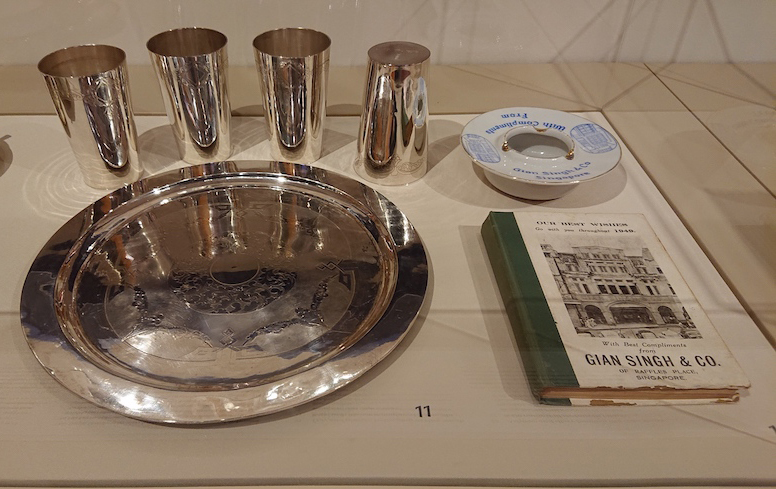
Tray and glasses belonging to Hira Singh Bajaj with his name engraved in Punjabi. On the right, ashtray and diary bearing the Gian Singh & Co name and storefront image. Gian Singh & Co produced special items such as these souvenirs as gifts for their regular customers, or for customers who bought merchandise above a certain value. These gifts carried the store’s name and image and were limited editions. – Photo: Courtesy of Jaspreet Singh Narula, grandson of Hira Singh Bajaj
Receipt from Gian Singh & Co, Singapore, 1951 – Photo: Courtesy of Jaspreet Singh Narula, grandson of Hira Singh Bajaj
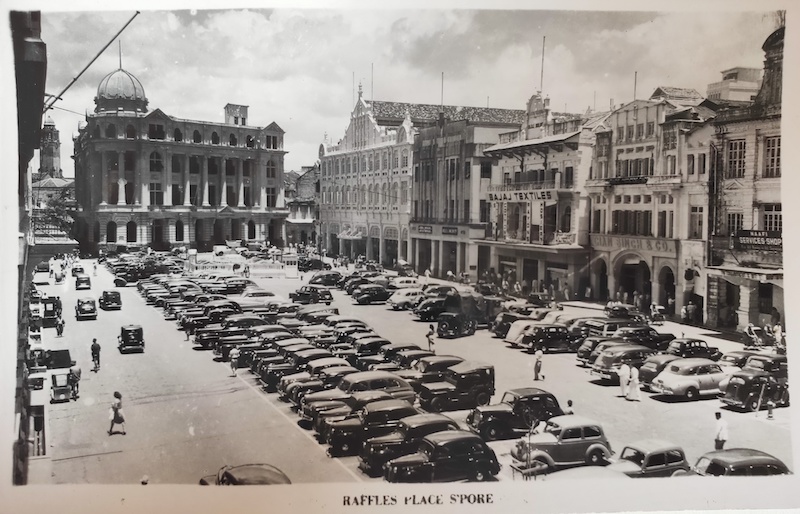
Raffles Place with the Gian Singh & Co and Bajaj Textiles buildings visible on the right. Singapore, mid-20th century – Photo: Courtesy of Jaspreet Singh Narula, grandson of Hira Singh Bajaj
By Asia Samachar | SINGAPORE |
A tea set, an ashtray and a 1951 receipt are part of the Singapore Sikh story now being told in an exhibition on the Sikh heritage.
The ‘Sikhs in Singapore – A Story Untold’ exhibition, which runs until 30 Sept 2021, is organised by the Indian Heritage Centre’s (IHC).
It features more than 450 artefacts from over 50 local and international private collections, institutional collections of 17 Sikh organisations in Singapore, as well as Singapore’s National Collection.
The four artefacts featured here are on loan from Jaspreet Singh Narula, the grandson of Hira Singh Bajaj.
Hardial Singh Bajaj and his brothers – Hira Singh, Inder Singh and Balwant Singh – established Gian Singh & Co in the 1930s. It initially operated out of a shophouse on 4, Battery Road, and later relocated to Raffles Place. During its heydays, the departmental store rivalled Robinsons and John Little, and in 1950s, the brothers established offices in Japan, Thailand and Indonesia.
The family and its company was known for their generosity. During the Japanese Occupation, the company managed supplies for the Indian National Army. Hardial Singh Bajaj also provided jobs or monetary assistance to members of the community. The company eventually ceased operations by the late 1960s and members of the family went on to establish their own businesses, including Hardial Singh & Sons, Hira Singh & Sons, Bajaj Textiles Ltd., etc.
The Bajaj family was also instrumental in the establishment of Sri Guru Nanak Satsang Sabha at Wilkinson Road. In the 1950s, families in the Katong area held prayer gatherings in their homes. To provide the congregation with a proper and permanent place of worship, Inder Singh Bajaj purchased two bungalows in Katong in 1962-63. The properties were later demolished for the construction of Guru Nanak Satsang Sabha which was completed in 1969.
Side Note: IHC’s #SikhsinSingapore film series continues this month with Peering Soul, a documentary exploring the lost heritage of the Sikhs in Pakistan, with filmmaker Amardeep Singh. You can join the screening of the documentary, followed by a discussion with the filmmaker, on Saturday (8 May) at 6 pm. Registration is free, via http://ptix.at/8gsEoJ or click here.
ASIA SAMACHAR is an online newspaper for Sikhs / Punjabis in Southeast Asia and beyond.Facebook | WhatsApp +6017-335-1399 | Email: editor@asiasamachar.com | Twitter | Instagram | Obituary announcements, click here |
Punjab requires 264,000 doses of the COVID-19 vaccine to innoculate those between the ages of 18 and 45 but currently had no shots.
This is coming at a time when the Indian state’s death toll connected to the coronavirus has crossed the 10,000-mark and experts experts the state has to see the worst as the number of cases may hit 10,000 per day in the third week of May, reports Tribune News Service.
Advocate General Atul Nanda told the Punjab and Haryana High Court that the state had written to vaccine manufacturers SII and Bharat Biotech but had not received the doses.
The court has asked the Government of India to consider reorientation of oxygen supply in a manner that the allocated quota reaches all the states within time to avoid loss of life due to oxygen deficit, the report added.
The court said the situation in Chandigarh, Punjab and Haryana appeared to be critical. The central government maintained that the quota of oxygen has been increased and a decision was taken in this regard on May 5.
On Covid-19 numbers, the report said 33% of the fatalities came in the last 40 days. “We are expecting plateau after that and then cases may decline in June,” said Dr Rajesh Bhaskar, state’s nodal officer for Covid.
ASIA SAMACHAR is an online newspaper for Sikhs / Punjabis in Southeast Asia and beyond.Facebook | WhatsApp +6017-335-1399 | Email: editor@asiasamachar.com | Twitter | Instagram | Obituary announcements, click here |
Punjab Kings cricket star Harpreet Brar is on a roll and he is not giving in to troll trying to make fun of his turban.
“Paise k liye nhi Turban nhi pehnte hum,” the Punjab Kings left-arm spinner tweeted recently. Translation: We don’t wear turban for money.
It was in response to an Instagram message which who compared him to Bollywood star Akshay Kumar from the movie ‘Singh Is Bliing’.
On Friday, dismantled the Royal Challengers Bangalore’s (RCB) strong batting line up with a three-wicket haul, reported Times of India. Appearing in his third Indian Premier League (IPL) season, he has played only four matches in his career. Friday’s game was the first in IPL 2021.
ASIA SAMACHAR is an online newspaper for Sikhs / Punjabis in Southeast Asia and beyond.Facebook | WhatsApp +6017-335-1399 | Email: editor@asiasamachar.com | Twitter | Instagram | Obituary announcements, click here |
Sucha and Kashmir Singh are retiring after serving people in Bathgate and Whitburn for over 30 years – Photo: West Lothian Courier
By DEBBIE HALL| Daily Record | Britain |
After over three decades serving the community, popular Bathgate shopkeepers Sucha and Kashmir Singh have decided to retire.
Arriving in West Lothian in 1989, Mr and Mrs Singh first set up a small convenience store/off-licence on Monklands Road, Bathgate.
As one of only a few Asian families living in the town at the time, they put up with their share of troubles.
However very quickly, they embraced this new town and in turn became the heart of the community.
Fast forward several years and four daughters later, Mr and Mrs Singh’s family-run business was a welcome stop for everyday essentials, fresh milk and rolls, with friendly caring chat and banter coming at no extra cost.
Following 15 years in Bathgate, Mr and Mrs Singh then moved premises to Whitburn. Although some would say a tougher crowd to please, Mr and Mrs Singh’s hard working ethic, caring manner and friendly banner quickly won over Whitburn hearts.
During their time in business, Mr and Mrs Singh have given freely to local churches, schools and community projects, across Bathgate, Armadale and Whitburn.
See original story, ‘Popular West Lothian shopkeepers retire after 30 years’, here.
ASIA SAMACHAR is an online newspaper for Sikhs / Punjabis in Southeast Asia and beyond.Facebook | WhatsApp +6017-335-1399 | Email: editor@asiasamachar.com | Twitter | Instagram | Obituary announcements, click here |
By Karminder Singh | Sikhi Concepts | Part 1 of 12 |
If Sikhi was a portrait, then Guru Nanak would be its artist. Our mind is then the canvas on which the painting of Guru Nanak’s Sikhi would be created.
This is a narrative of the portrait of Sikhi. More specifically, it’s a story of the canvas, on which the portrait of Sikhi is brought to life.
When Guru Nanak wanted to create a portrait of Sikhi in 1469, he realized that the canvas on which he intended to paint it – posed a challenge. It posed a problem.
The canvas on which he wanted to create that image of Godly spirituality was neither clean nor blank.
The canvas – that was the human MIND – was already painted on with a thousand images.
How does one paint on a canvas that is already painted? And already contains a thousand images? How does one paint on a canvas that does not have any empty space left?
Guru Nanak discovered that the human mind – that was the spiritual canvas of the people of his times – had images of heaven and hell, 8.4 million life forms to be lived after death, soldiers of death, angels of death, and the cycle of births and deaths (Ava Gaun) and reincarnation.
The existing canvas had images of salvation after death, judgement after death by dharam raj, reports of our deeds to dharam raj by Chitar Gupat. The canvas also had images of punishment, of accounting of our deeds after death, and of our deceased ancestors. The existing canvas further had images of pre-ordained stuff carried over from our past lives, and unfinished activities being carried into our after lives.
It was a canvas that was painted full to the brim. And so much more. There was virtually no space on the canvas that was left unpainted.
Then, there was something else. The existing canvas had a focus on Death. It was a canvas that had an OBSESSION with life after death and a FIXATION with the afterlife.
The existing canvas had a PREOCCUPATION with securing a good and comfortable Afterlife. A life that no one had seen. A life that no one had experienced. A life that no one really knew anything about. A life that no one knew if it even existed in the first place.
The Potrait that Guru Nanak painted was different. It was Starkly different. It was one whose focus was NOT on death, but on Life and on Living.
It was one whose emphasis was on the Here and the Now. Not on life after death.
But there was a major challenge. The canvas that was the human mind was already painted on. So essentially what Guru Nanak had to do, and did – was to Paint Over an Existing Canvas. Paint over an already painted canvas that was the human mind.
The Portrait of spirituality of Guru Nanak focused on Life and Living in the Here and Now. It was painted over an almost 4,000-year-old one that was OBSESSED with life after death. This was the uniqueness of Guru Nanak’s portrait.
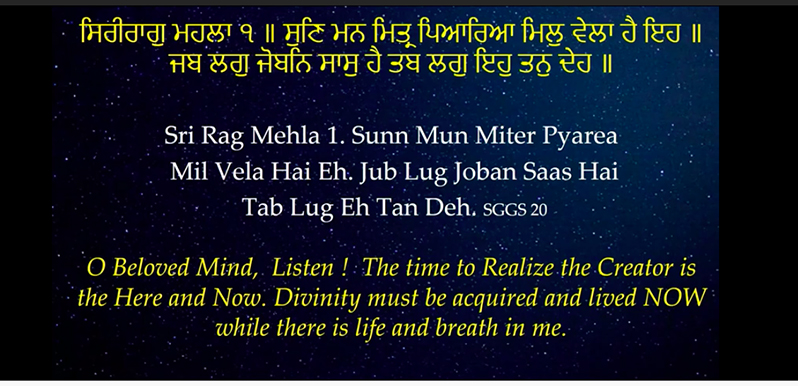
Guru Nanak establishes this primary principle on page 20 of the Sri Guru Granth Sahib (SGGS).
Sri Rag Mehla 1. Sunn Mun Miter Pyariya Mil Veyla Hai Eh. Jub Lug Joban Saas Hai Tub Lug Eh Tun Deh. (SGGS, 20)
This is the meaning of the verse: O Beloved Mind, Listen! The time to Realize the Creator is the Here and Now. Divinity must be acquired and lived NOW while there is life and breath in me.
The Spirituality of Guru Nanak is for the HERE and NOW.
Bhai Gurdas ji puts it this way.
ਨਾਨਕ ਨਿਰਮਲ ਪੰਥ ਚਲਾਇਆ ॥
Nanak Nirmal Panth Chaleya.
The spirituality of Guru Nanak was nirmal. It was unique. It was nirmal because it did not have the contaminants of the existing beliefs. It was nirmal because it was free from the impurities of the old canvas. Free from the FOCUS of the old canvas which was the afterlife.
Above all, it was nirmal because it presented a spirituality to be lived – NOT for some unknown and unknowable FUTURE – but lived in the PRESENT – lived in the Here and Now.
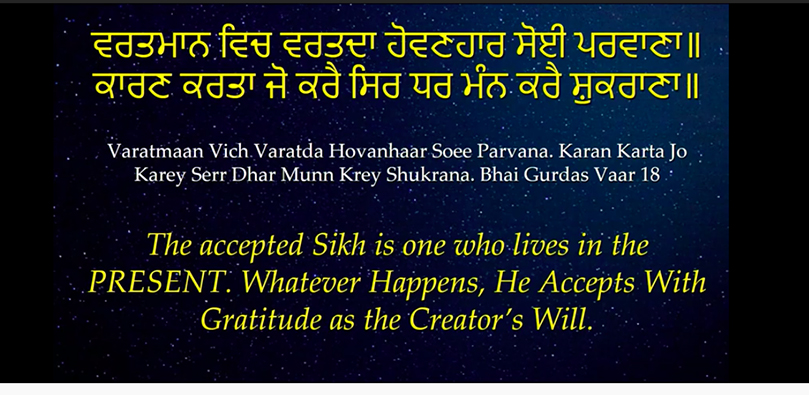
Bhai Gurdas ji writes of the spirituality of Sikhi.
Varthman Vich Vartda Hovannhar Soyi Parvanna. Karann Karta Jo Krey Sir Dhar Munn Krey Shukranna.
The Meaning of the verse is: The accepted Sikh of Guru Nanak is one who lives in the PRESENT. Whatever Happens in the Here and Now, He Accepts with Gratitude as the Creator’s Will.
So this LIVING in the PRESENT, this Living in the HERE and NOW was the UNIQUENESS of Sikhi. This was the Nirmalta of Sikhi.
In doing so, the entire foundation of spirituality had been turned on its head by Guru Nanak. This required an entirely NEW CANVAS. There was a need for NEW concepts. There was a need to DISCARD the concepts of the Old Canvas.
THEN WHY – you may ask – are ALL the concepts of the old canvas mentioned in the SGGS. IF the old canvas had indeed been painted over, why is the old portrait still visible within the pages of the SGGS?
Well, the canvas is not a physical canvas. A physical canvas can be destroyed. It can be crushed and discarded. It can be painted over. Once painted over, the original colors and images are no longer visible. But the canvas we are talking about is a MENTAL canvas. It’s a canvas that exists in our MINDS. It’s a canvas that sits as our MIND-SET.
Believe it or not, even though Guru Nanak’s sikhi has been with us for more than five and a half centuries – a large percentage of us Sikhs are still walking around with that old canvas within our spiritual psyches. A vast majority of our granthis, ragis, parcharaks, clergy, our thinkers, our intellectuals, our writers – subscribe to the old canvas, hold on to the old canvas and believe and accept the old canvas.
A vast majority of us SIKHS are SIKHS on the exterior. Unique in our looks. But our MINDSETS are framed by the 4,000 year-old Canvas.
It’s a mental canvas we are talking about. And we are talking about painting over a mental canvas.
The manner of painting over it that was employed by Guru Nanak – is novel, innovative and marvelous. It’s a manner that speaks of Guru Nanak’s spiritual genius, his inner wisdom and his devotional enlightenment. It’s called REDEFINING.
Guru Nanak painted over the 4,000 year-old canvas by REDEFINING EVERYTHING that was on it. It was REVOLUTIONARY redefining. All the existing concepts are REDEFINED. Each one of them is given new meanings. They are mentioned by Guru Nanak and in Gurbani, because people identified spirituality with those concepts. Removing them from the canvas was not an option.
These concepts had been INGRAINED within the deepest recesses of the human mind. They have been carved within the deepest portions of the spiritual psyche. They had settled within the inner depths of the human conscience and the human soul.
REDEFINING was the way. The appropriate and correct way. This was the only way to provide people with a NEW MINDSET. Guru Nanak re-defined them all. He gave NEW meanings to EVERYTHING that existed on the Old Canvas – meanings to fit HIS canvas of life and the here and the now. The defining is revolutionary.
And if you are asking where exactly are the REDEFINED meanings of these concepts recorded – the answer is: within the pages of the SGGS.
It’s a voluminous text. Massive by any standards. It is a wholesome text. A complete text. Any and every concept that is used in the text is defined WITHIN the text. Any and all concepts that are borrowed from the pre-existing canvas are re-defined.
So the question is plain.
When we want to understand Gurbani, to interpret it or translate it, then do we resort to the 4-thousand-year old dictionary that was discarded by Guru Nanak, or use that dictionary that is embedded within the pages of the SGGS itself?
It may seem like a rhetorical question. But the reason it has to be asked is simple. Virtually all our Gurbani translations use the 4,000 year-old discarded dictionary to explain the concepts of Gurbani as used within the SGGS.
The outcome is that, by and large, Sikhs have reverted Sikhi to the old canvas.
WHY LIVE THE DISCARDED CANVAS?
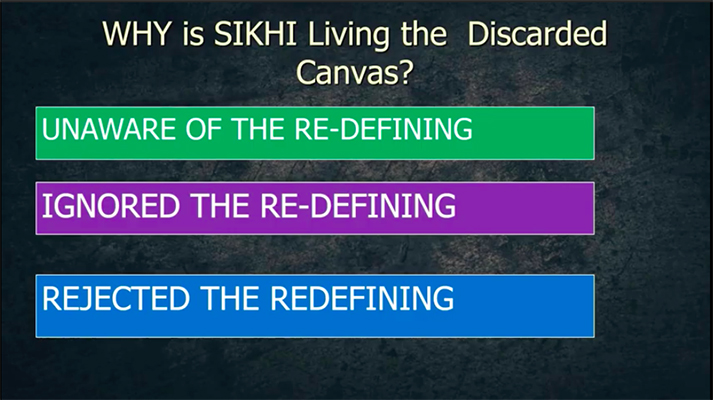
And the question is: WHY are SIKHS Living the Discarded Canvas? Why are Sikhs living the old canvas and accepting the old canvas as Sikhi? Why have we Reverted to it?
Why has this Old and Discarded canvas become our spiritual canvas?
Now There can be three reasons for this.
We are UNAWARE OF THE RE-DEFINING
We are aware, but have chosen – consciously or otherwise – to IGNORE THE RE-DEFINING.
We choose to REJECTED THE REDEFINING – for purposes that are clear. Those who reject it are those who desire to take the Sikhi of Guru Nanak back into the clutches of the old canvas. These are people whose purpose is to prove that Sikhs belong to the 4-thousand-year old canvas. That Sikhi is not unique and not NIRMAL. But that Sikhi is merely an offshoot of the old canvas. That Sikhi is simply a branch of the old canvas.
There are of course dire consequences of such a state of affairs.
One glaring one is that While all of us Sikhs are Living Physically in the 21st C. A vast majority of us are living in 1468 in the Spiritual sense. In other words, for a vast majority of us, Guru Nanak has yet to be born into our lives. For a vast majority of us, Guru Nanak’s portrait of Sikhi has NOT been REPAINTED over our old canvas. We are still living the old canvas and thinking (wrongly of course) that the old canvas is what Guru Nanak’s sikhi really is.
So, how do we know if we are living the old canvas?
We can ask ourselves if the Sikhi we practice is one of FEAR. Fear of god, fear of guru, fear of pain, fear of sorrow and fear of all things negative.
We can ask if our spirituality is one of making deals with God or Guru – that we will make so many offerings, so many langgars and so many akhand paths IF and AFTER our demands are met.
We can ask if our spirituality is one of BEGGING, of constantly asking for this and that, of rubbing our noses to plead to be given this and that.
We can ask ourselves if our spirituality is a spirituality on BEHALF – where we ask our clergy – granthis to do our ardas asking for this and that, the pathis to do our paaths for us upon payment.
We can ask if our Spirituality is driven by concerns of LIFE AFTER DEATH, of heaven and hell, of 8.4 mill life forms, and of reincarnation.
We can ask if our Spirituality is one of RITUALS
We can ask if our Spirituality is one in which we expect MIRACLES to take place.
If the answer to any of the above questions is yes, then we need to know that these are the pillars of the discarded canvas. These are foundation blocks of the 4-thousand-year old canvas.
A vast majority of the practices in our gurdwaras, a good deal of Sikhi that is preached in our gurdwaras by our clergy, and a good deal of Sikhi stuff on the social media and our published literature is based on the 4-thousand-year-old and discarded canvas.
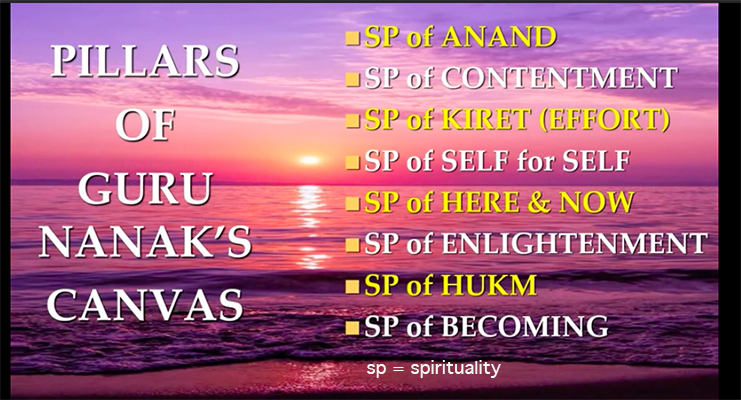
PILLARS OF GURU NANAK’S CANVAS
The pillars of Guru Nanak’s canvas are starkly different.
Spirituality of FEAR is replaced by the Spirituality of Joy, Bliss and Love. Gurbani calls it SOHELA, VIGAS OR ANAND.
Spirituality of making deals with god and guru is replaced by the Spirituality of CONTENTMENT. Gurbani calls it Santokh.
Spirituality of getting clergy to do it on our behalf is replaced by the Spirituality of KIRET, spirituality our own effort. Apey Beej Apey Hi Khah (ਆਪੇ ਬੀਜਿ ਆਪੇ ਹੀ ਖਾਹੁ ॥ SGGS, 4).
Spirituality of outsourcing to the clergy is replaced by Spirituality of SELF, by the self for the SELF. Apan Hathi Apna Apey Hi Kaaj Swareay (ਆਪਣ ਹਥੀ ਆਪਣਾ ਆਪੇ ਹੀ ਕਾਜੁ ਸਵਾਰੀਐ ॥੨੦॥ SGGS, 474). Guru Nanak forbade us from having a clergy class.
Spirituality that is driven by concerns of life after death is replaced by the Spirituality of HERE & NOW
Spirituality of Rituals is from the Old canvas. In Guru Nanak’s canvas it is replaced by Spirituality of Enlightenment.
Spirituality of expecting miracles of the old canvas is discarded. In its place Guru Nanak puts the Spirituality of HUKM – of abiding in His will. Hukm Rajayi Chalna (ਹੁਕਮਿ ਰਜਾਈ ਚਲਣਾ, SGGS, 1)
Guru Nanak’s spirituality tells us to stop waiting for miracles to happen. And to BECOME the miracle that we seek, in the HERE and NOW. Sikhi is the Spirituality of BECOMING. Becoming DIVINE.
WHAT WENT WRONG?
Now the question you might want to ask is this: How did Sikhi revert to the discarded Canvas? Especially when it comes to understanding Gurbani within the SGGS?
The answer is this. The Canvas of Sikhi that Guru Nanak gave us within the SGGS got lost in translation. This is how it happened.
We had the 4,000-year-old Canvas. In Guru Nanak’s Sikhi terms, it’s the canvas of DISCARDED beliefs.
It was discarded from within the messages of the Sri Guru Granth Sahib. The method of discarding it was through Revolutionary Redefining of existing concepts and the introduction of NEW CONCEPTS.
Then came the translations. The first one was done by a group of Benares based vedantic intellectuals. It was called the Freedkoti Translation – named after the royal household that sponsored it. Virtually all subsequent translations – in Punjabi and English – were based on this Fareedkoti Teeka.
What the translations have done is this. They have fallen back on the concepts within the discarded canvas. And inserted them right back into Gurbani – THROUGH the translations.
Now, we know that Sikhs – in the last 300 years especially – have lost the ability to understand Gurbani on their own. All of us need translations. Given the Fareedkoti Translation, our understanding of Gurbani has been infiltrated with the old discarded canvas. Our understanding is adulterated by the concepts of the discarded canvas.
Then we have dozens of writings that we call “classical texts” which are primarily sakhis and stories about the lives of our Gurus that ingrain the concepts from the REJECTED canvas. Texts such as Gurbilas, Suraj Parkash and the Janam Sakhis.
We have in these classical texts, what are essentially tall tales disguised as sakhis about our Gurus acting and living very much in accordance with the 4-thousand-year-old canvas.
For example, we have fake sakhis of Gurus constructing a well with 84 steps to represent the 8.4 million life forms, concocted Sakhis of Gurus talking to wolves which were reincarnated Sikhs, and feel good Sakhis of Gurus pulling out Sikhs from the fires of hell by their long hair.
Such corruption – conducted, condoned, accepted and preached over long periods of time has this effect. The Canvas of Guru Nanak, the canvas of Sikhi of Guru Nanak got discarded. The RE-PAINTED canvas was the one that got discarded. In its place the old canvas has gotten re-established within the psyche of the Sikh. THE OLD CANVAS HAS BECOME OUR SIKHI OF TODAY.
A vast majority of Sikhs make claims that Sikhs believe in heaven and hell, believe in reincarnation, believe in 8.4 million, believe in judgement day, believe in dhram raj etc – all of which are from the old canvas.
Our clergy, granthis, ragis, kathakars, preachers and writers not just hold on to the old canvas, they preach the old canvas on grounds that it is MENTIONED in the SGGS. Mention is equated to acceptance. Without understanding the context. And without understanding the REDEFINING.
The outcome is stark indeed. What we have done is that we have brought ourselves to the Same Junction that Guru Nanak stood in 1469.
And we have chosen to travel the road he chose NOT to take. We are travelling the road he TOLD us NEVER to travel. We are travelling the road he discarded.
What’s worse, we are travelling the discarded road claiming that he – Guru Nanak – told us to travel this discarded road because he MENTIONED it in Gurbani.
We have reverted to the DISCARDED canvas. We have returned to the old canvas. We have regressed to the 4-thousand-year old canvas. We have lapsed to the REJECTED canvas.
And this is because we have ignored the fact that all the existing concepts in the discarded canvas are REDEFINED. We ignored the fact that Guru Nanak gave them new meanings – to FIT HIS CANVAS of life and the here and the now.
But what are the re-defined meanings of these concepts? Concepts such as Death, After Life, Heaven and Hell. Concepts such as 8.4 million, Ava gaun, Reincarnation. And concepts such as Jum Doot, Chitar Gupat, Dargah and Dharam raj.
This 12-part series of videos titled SIKHI CONCEPTS, will attempt to provide the new, redefined, and Gurbani meanings of these concepts as outlined within the 1429 pages of the SGGS.
The next video – Part 2 of 12 – will deal with the concept of DEATH. Death as Redefined within the Canvas of Guru Nanak.
SIKHI CONCEPTS SERIES BY DR KARMINDER SINGH DHILLON: COMPLETE LINKS TO VIDEOS & LECTURE NOTES
Sikh thinker, writer and parcharak Karminder Singh Dhillon, PhD (Boston), is a retired Malaysian civil servant. He is the joint-editor of The Sikh Bulletin and author of The Hijacking of Sikhi. He can be contacted at dhillon99@gmail.com.
* This is the opinion of the writer, organisation or publication and does not necessarily represent the views of Asia Samachar.
ASIA SAMACHAR is an online newspaper for Sikhs / Punjabis in Southeast Asia and beyond.Facebook | WhatsApp +6017-335-1399 | Email: editor@asiasamachar.com | Twitter | Instagram | Obituary announcements, click here |
Keerat Kaur Wathan emerged as runner-up of the English Speaking Union Malaysia (ESUM) – Taylor’s College Public Speaking Competition.
The 17-year-old Keerat, who hails from Ipoh and is studying at Taylor’s College, received a cash prize of RM1,500. Her topic for the day was “Best route to change engages all voices”.
ESU is an independent, non-political, educational charity with members throughout the United Kingdom, United States and branches in 50 countries. It aims to promote international understanding and human achievement through the widening use of the English language. ESU Malaysia (ESUM) was founded in 2000.
This competition was open to students from various schools and universities between the ages of 16-20.
ASIA SAMACHAR is an online newspaper for Sikhs / Punjabis in Southeast Asia and beyond.Facebook | WhatsApp +6017-335-1399 | Email: editor@asiasamachar.com | Twitter | Instagram | Obituary announcements, click here |
Since the pandemic began volunteers of UNITED SIKHS have cremated more than 350 victims of the COVID crisis to hit #Delhi. In the last month alone more than 200 bodies have been taken from homes to funeral pyres. A team of eight brave volunteers led by Pritam Singh, Director of UNITED SIKHS, Delhi, are activated by calls from helpless families through social media. This is a last resort for the families after calls to the Municipal Corporation of Delhi, Delhi Police, Sub-Divisional Magistrates, or even to the swamped Hospitals for Ambulances remain unresponsive. – United Sikhs Facebook page
By Jagdesh Singh | OPINION |
The situation in India is really dire. Reports coming in paint a picture of chaos, despair, and helplessness. It’s as if a huge bomb of the Covid-19 exploded within her walls and there’s no way to hide or protect yourself from it. While she tries to vaccinate her citizens fast, her sheer size unfortunately disables her outreach. Stories of makeshift cremation grounds, of funerals conducted while being attended by close family and friends through their digital and virtual devices are now appearing in our daily lives.
Not unlike many catastrophes that have happened within our lifetimes, there’s the ray of humanity that shines piercingly through the despair, giving many like us hope. Sikh Gurudwaras in the larger Indian metropolitans have provided daily langgar with oxygen tanks as their main offering. Thousands of people of all faith have desperately flocked to these oxygen oases, their faces show desperation and relief at the same time as they gasped for oxygen from the tanks.
Meanwhile, the vaccines to help us avoid suffering from the deadly symptoms of the Covid-19 are now getting more and more available in almost every country. In Malaysia, as well, albeit at a slower vaccination rate compared to our neighbors.
However, some of us are a little hesitant about vaccinating ourselves. The way these vaccines were brought into use at such a rapid speed has sown doubts in many of us. Then there’s this distrust we have on the greedy Big Pharmas, imagining that they’re milking the pandemic for a whirlwind of profit.
Some of us have seen people within our circles of community hardly experiencing any debilitating symptoms after having contracted the Covid-19, and seem to hedge our bets that we would be able to weather it like the common cold. This is despite the mountain of evidence proving that our chances of suffering and even dying, no matter our age or how healthy we are, from Covid-19 can be pretty high and random.
Then there’s the side effects from the vaccination, because something that normally takes longer to make is usually half-baked when rushed. Especially vaccines. Would the new vaccines’ side effects be more harmful? There’s no evidence either way, at the moment.
It’s a numbers game now. The more of us get vaccinated, the lesser the chance or risk that someone close to us will contract the coronavirus. While getting ourselves vaccinated will definitely decrease the chances of us contracting the deadly disease, even more to decrease the severity of it if we do contract after, the more important reason is that it significantly decreases the risk of those close to us contracting it. The more vulnerable ones like your parents, grandparents, uncles, aunties, close elderly neighbors, diabetic family member, asthmatic cousin, etc. When we vaccinate ourselves, we’re actually saving these beloved people of ours.
If you think about it, when we’re doing everything we can to avoid those around us to suffer and die from a horrible disease, like vaccinating ourselves, we are actually performing our duty or sewa as a son, a daughter, a brother, a sister, a friend, a human, and as a Sikh.
But, of course, like any other service or sewa, you are neither obliged nor compelled to do it. You have the freedom of choice. You will need to arm yourself to make that choice, you also have a duty to understand implications to yourself and your family. If you’re unsure, exploring and researching more with your friendly doctor or anyone in the medical line is the least you can do before you embark on this sewa. Be comfortable when making that decision.
To me personally, this sewa is as vital or as important as being that same sewadar in a Gurudwara in Delhi now rushing to carry a tank of oxygen to his dying neighbor waiting in his car outside of the Gurudwara. You’re saving a life, just like how this sewadar is.
I can’t wait to get vaccinated.
Jagdesh Singh, a Kuala Lumpur-based executive with a US multinational company, is a father of three girls who are as opinionated as their mother
* This is the opinion of the writer, organisation or publication and does not necessarily represent the views of Asia Samachar.
ASIA SAMACHAR is an online newspaper for Sikhs / Punjabis in Southeast Asia and beyond.Facebook | WhatsApp +6017-335-1399 | Email: editor@asiasamachar.com | Twitter | Instagram | Obituary announcements, click here |






















 Dr Charanjit Kaur is an Assistant Professor at Malaysia-based Universiti Tunku Abdul Rahman (UTAR). Her area of specialisation is cultural anthropology with a special focus on the Sikh minority community in Malaysia which touches on themes such as religious-cultural conflicts, gender identity and social behavior.