Savinder Kaur during the 30th SEA Games Philippine 2019 – Photo: Personal Instagram page
By Asia Samachar Team | MALAYSIA |
Middle distance runner Savinder Kaur Joginder Singh bagged the gold for Selangor in the women’s 800m at the Malaysia Open Athletics GP Championships at the National Sports Council (MSN) Mini Stadium in Bukit Jalil yesterday (10 April).
She was trailed by Padhmaloshini from Johor and V. Shankari from Selangor.
Some of her recent major victories was when she won the same event at the Thailand Open Track and Field Championships in 2019. The 22-year old athlete, who had earlier undertaken a self-underwritten 40-day training stint in Kenya, clocked a season best 2:14.13 but her efforts was off her then personal best of 2:11.95.
ASIA SAMACHAR is an online newspaper for Sikhs / Punjabis in Southeast Asia and beyond.Facebook | WhatsApp +6017-335-1399 | Email: editor@asiasamachar.com | Twitter | Instagram | Obituary announcements, click here |
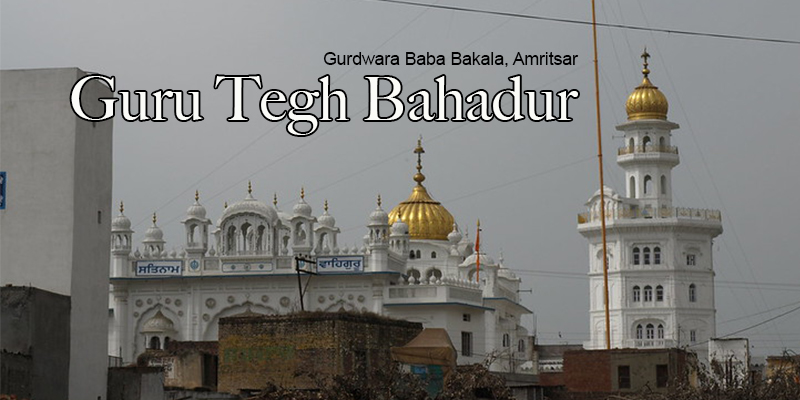
Gurdwara Baba Bakala – Photo: Gurmit Gill / Flickr
By Nirmal Singh | Sikh History | Part 1 |
BACKGROUND
The year 2021 marks the passing of 400 years since the birth of Guru Tegh Bahadur, our 9th Guru, in April 1621. Sikhs at that time were just 15 years past the martyrdom of the 5th Guru and nascent Sikhi was passing through a difficult period. Since the difficulties persevered through a century under ministries of the later Gurus and following several decades of struggle under evolving Sikh leadership before the community could look to some relief, it may help develop a clearer perspective of the role of Guru Tegh Bahadur, if we took an overview of the lead events since Guru Arjun’s martyrdom.
Historians mostly agree that robust growth of Sikhi made segments among Hindus and Muslims turn increasingly inimical towards the Sikh Gurus. Additionally dissonance in the Guru families provided sharper focus to those hostile towards Gurughar. One effect of action by Jahangir to impose death penalty on Guru Arjun at the behest of orthodox coterie among his courtiers was that it demonstrated the reversal of Akbar’s ‘policy of religious neutrality and eclecticism’ [1] under the new Emperor. The internment of Guru Hargobind, successor of Guru Arjun, would have confirmed the change in policy. Post that Jahangir tried to moderate his relations with the Guru.
Guru Hargobind, while he maintained friendly relations with Jahangir, did not forget to explore other means to strengthen and consolidate the Sikh community. The Guru had accompanied Jahangir to Kashmir and Rajputana and subdued rebellion by Tara Chand of Nalagarh.[2] He however discretely continued to organize and train his band of armed Sikhs and tried to bring the community together by attempting toheal the divide [3] with the Minas. He did not succeed to turn Mina divide round but another opening came up.
In 1624, a few days after his eldest son Gurditta was married, Guru Hargobind with his four sons went to meet Sri Chand at Baarath. Baba Tegh bahadur was three and was not with them. During their stay at Baarath, Sri Chand asked Guru Hargobind to give a son to him. Guru replied ‘if you desire, they all are available’. Sri Chand gave Udasi bekh to Gurditta. After the Guru left, Gurditta stayed back. Sri Chand explained Udasi Mat and bestowed the Gadi of Pramukh Guru of Udasi Sampardai on him before Gurditta left [4]. It helped heal a divide in the Sikh community going back to the passing of Guru Nanak and Udasis soon became an active component of the Sikh parchar missionary.
In 1627, Jahangir fell ill in Kashmir and decided to go back to Lahore but died on the way. Shahjahan, known to be close to orthodox groups, succeeded in the struggle for succession to the throne and the Sikh-Mughal relations again turned inimical. Sikhs too were not any more hesitant to cross swords with adversaries. Guru Hargobind fought four battles with Mughal forces after which to avoid recurring conflicts, c. 1634 he moved to the hilly area of Shiwaliks and set up base at Kiratpur, outside the territory under direct Mughal control. [5] But Amritsar slipped into Mina hands.
Gopal Singh [6] records that under Guru Hargobind seats of Sikhism were consolidated from Kabul to Dacca — His son Baba Gurditta, as the Pramukh Guru of Udasis, set up four Dhuans that supplemented the system of sangat and masand to further spread teachings of Guru Nanak. Encyclopedia of Sikhism, Entry Dhuan, PUP, adds that these Dhuans were initially assigned to different areas but later each of the branches spread out and established their preaching centers over the country. The Dhuan headed by Bhai Almast, with its headquarter at Nanak Mata had branches in Eastern India including at Dhaka. A couple of decades later the sangats in Eastern India provided not only strategic depth to the Sikh community but also became the source of support and funds to the Gurus in the difficult times – notwithstanding the dislocation forced by adverse disposition of the Mughal Government and family rebels.
Guru Hargobind, before he passed away in 1644, installed Har Rai, the younger son of Gurditta, as the successor Guru. Gurditta had predeceased his father in 1638 and none of other children of the Guru ‘seemed suitable for the position’. Dhir Mal, elder brother of Har Rai was rejected because he had ‘formed an alliance with Emperor Shāh Jahān’. Dhir Mal also claimed to possess the original copy of Adi Granth to support his claim to Gurgadi and continued to intervene in later succession too [7]. After the ceremony, Guru Hargobind asked everyone to bow to Guru Har Rai and Baba Tegh Bahadur, 24 and by passed, was the first to do so. [8]
Guru Har Rai had a peaceable disposition and he moved further into the interior close to Sirmor and stayed there most of the time. During his ministry, three new branches of Udasis known as Bakshishes were added to the already large Udasi order. Guru Har Rai had blessed the Bakshishes known as Suthrashahis, Bhagat Bhagwanias and Sangat Sahibis. This was helpful to Guru’s constrained missionary in Shiwaliks.
Guru Har Rai’s relations with Shahjahan had improved after he helped treat his favorite son, Dara Shikoh. But Aurangzeb’s ascension to the throne ‘in 1658 marked beginning of long, consistent and active policy to gain a control over the Sikh religious affairs [9]’- foreboding the testing times in the half century ahead.
Aurangzeb sent a message to Guru Har Rai ‘to deliver his son Ram Rai as a hostage for the Guru’s reputed support of Dara Shikoh’. Aurangzeb asked Ram Rai after his arrival in Delhi, to explain a verse from Asa ki Var in Adi Granth. Ram Rai replied that the text had been miscopied and should have been mitti beiman ki, the dust left after cremating the bodies of faithless people. Guru Har Rai, on hearing of this, decided not to see Ram Rai again for changing the word of Guru Nanak [10]. Before his passing in October 1661, Guru Har Rai installed his younger son, age five, Har Krishan as Guru.
Ram Rai was rewarded by Aurangzeb with land grants in Dehra Dun region. After few years, in Jan 1664, Aurangzeb summoned Guru Har Krishan, through Raja Jai Singh, to appear at his court [11]. The Guru came to Delhi and was lodged at the house of Jai Singh.
When Guru Har Krishan was summoned, Kunwar Ram Singh was present with Guru the first day. [12] In the session Ram Rai was emphatic that decision of his father to install his brother was based on cogent reasons. It went well but the next session planned for the following day could not be held because Guru Har Krishan passed away that night. Gandhi says that appearance with Aurangzeb was fixed for 28th March but the Guru went into a retreat for 5 days on 25th March due to which, the appearance did not take place at all.
When Guru Har Krishan was sick with small pox, Baba Tegh Bahadur arrived in Delhi on 21st March from his visit, at the urging of Guru Har Rai, to sangats in Patna and the East from 1656 to 1664. He was on way back to Bakala and with his mother visited Guru Har Krishan to offer condolences on passing of Guru Har Rai. [13]
Guru Har Krishan passed away on 30 March, 1664 and his dying words were, “Baba Bakala”, indicating that his successor Guru was in Bakala. This was considered by many as a cryptic utterance but those in the know had no doubt who was the person in view of Guru Har Krishan. [14]
TEGH BAHADUR TO MAHAL IX
Sikhs had witnessed the happenings over the decades since the martyrdom of the fifth Guru and had no doubt that the Mughal Kings had made continued attempts to contain the activities of each of the Gurus and possibly install a person who would take the cue from them – an effort in which they succeeded only to distract but in the process firmed up the resolve of the Gurus and Sikhs to resist Mughal interference.
Baba Tegh Bahadur had stayed in touch with Guru Har Rai and had undertaken parchar to Patna at the Guru’s suggestion. His brother in law, Kirpal, a soldier in Guru Har Rai’s armed guard is also said to have kept Tegh Bahadur informed of the Sikh developments periodically.[15] It is reasonable to infer that Tegh Bahadur had stayed sensitive to Sikh happenings but without at any time interfering in the matters. It is also possible that the Mughals with their ears to the ground, would have been conscious of the possibility of Tegh Bahadur becoming the Guru, with some trepidation, at a juncture when they were closing in to control of the Guru institution.
Sangat Singh has speculated that the delay in announcing ascension of Tegh Bahadur to Gurgadi by months was a strategic ploy to keep Aurangzeb and his close coterie from guessing who was going to succeed the 8th Guru to Gurgadi [16] lest they try to harm or in any way compromise the person.
As soon as news got out that the dying words of Guru Har Krishan were Baba Bakala, there was flurry of activity in Bakala as local as well as outside aspirants of Gur Gadi set up shop as potential Guru choice. The total number is put at 22 that included Sodhis of various lineages like Minas, Dhir Mal, Sodhis of Lahore, and descendents of Suraj Mal plus a crop of local impostors [17]. Tegh Bahadur judiciously stayed aloof from this rush. Per Surjit Singh Gandhi, Dhir Mal was the most vociferous of the claimants.
After over four months, a Delhi Sangat led by Diwan Durga Mal and others including Mata Sulakhni, mother of Guru Har Krishan, Baba Gurditta son of Baba Budhha came to Bakala and Baba Gurditta performed the ritual ceremony of installing Tegh Bahadur as Guru. Sangat Singh says that the Guru asked for promise to maintain silence for the time being. Ranbir Singh records that it was a quiet, private ceremony. Surjit Gandhi’s version is that it was an open ceremony where grandson of Bhai Mohan, son of Guru Amardas, was also present. [18]
The news finally became public on the Diwali day, 9 October 1664, when Makhan Shah Lubhana came to make his mannat – promised offering to the Guru for saving his prized merchandise on high seas and was aghast at so many people posing as Guru. Each one of them accepted two gold coins he offered but when Makhan Shah got to Guru Tegh Bahadur, he asked for the 500 coins he had promised. That became the ‘gur ladho re’ moment – the joyful, spontaneous expression that Lubhana is said to have uttered and has since become a part of Sikh memory. It continues to be retold by the kathakars and ragis lauding the miraculous finding and thankful acceptance of the true Guru by Sikhs. Gopal Singh sees the process of elevation of Tegh Bahadur to have been ‘an election by consensus’ [19]- a speculation because consensus of aspirants was invariably sought but its absence did not change the choice that the earlier Guru has made!
Dhirmal continued to be sullenly skeptical and his Masand Sihan made a gun assault on the Guru one night. The Guru suffered a minor injury, was calm but Sikhs were upset. They plundered Dhir Mal’s house and took away the Saroop of original Adi Granth that he had appropriated. The Guru did not approve of the revenge attack and asked Sikhs to return the sacred Text to Dhir Mal which was done. [20]
Tegh Bahadur was now the publicly acknowledged successor to Guru Hari Krishan. He appointed Bhai Mati Das and Sati Das as Dewan and Minister and Bhai Dayal Das as household minister. [21]
(To be continued)
FOOTNOTES
[1] Harbans Singh, The Heritage of the Sikhs, Manohar, New Delhi, 1999, p. 44.
[2] This assertion is found in several accounts. Surjit Singh Gandhi, History of Sikh Gurus Retold: 1606-1708, p. 506, has attributed it to Sikh tradition.
[3] Prithia died in 1618. Guru Hargobind met Meharban and talked of need to get past the differences that existed between their fathers. Meharban was adamantly opposed to reconciliation. For more, read Gandhi, Ibid.
[4] Life History: Baba Sri Chand Ji & Founding of Udasi Sect, Giani Ishar Singh Nara, Translated into English by Harinder Singh Bedi, MS, pp. 274-76
[5] Encyclopedia Brittanica site – accessed 16 March 2021.
[6] Gopal Singh, A History of the Sikh People, Allied Publishers, 2002, note on p. 228. See also Gandhi, ibid, from challengers, the Udasis had turned supporters, p.631.
[7] This account is per Encyclopedia Brittanica site, accessed 20/3/2021.
[9] Sangat Singh, The Sikhs in History, New Delhi, 1999, p. 53
[10] Ibid, Brittanica
[11] Ibid, Sangat, p. 55
[12] Ibid, Sangat, p. 56; Gandhi, quoting Malcom’s Sketch of the Sikhs, says in note 23 on p. 626, ibid, that the dispute between Ram Rai and the Guru went to Aurangzeb and he had ruled that Sikhs were allowed to elect their own priest [Guru]. They picked Guru Har Krishan.
[13] See Sangat, ibid, p. 55: Gopal Singh ibid, note* on p. 249; for a detailed account see Gandhi, ibid, p. 622
[14] See DSGMC site and Wikipedia entry Guru Har Krishan. In any case, the insiders present in Delhi knew about the call by Baba Tegh Bahadur on the Guru and that he was headed to Bakala.
[15] Gandhi, ibid, p. 621.
[16] Sangat, ibid, p. 57
[17] ibid
[18] See Sangat, ibid, p. 57; Ranbir Singh, ibid; Gandhi, ibid, p. 623.
[19] See Gopal Singh, ibid, pp. 244-45 and note*
[20] See Gopal Singh, ibid, p. 245
[21] See Gandi, ibid, p. 625.
[Nirmal Singh has written six books on Sikhs and Sikhi and several of his articles have been published in journals like Sikh Review, Journal of Sikh Studies and Comparative Religion and Abstracts of Sikh Sudies (IOSS) as well as in the US mainstream news media. Resident in Orlando, he spends considerable time in Delhi. The article will also appear in The Sikh Review‘s Special 4th Centenary of Birth of Guru Tegh Bahadur issue due 1 May 2021]
ASIA SAMACHAR is an online newspaper for Sikhs / Punjabis in Southeast Asia and beyond.Facebook | WhatsApp +6017-335-1399 | Email: editor@asiasamachar.com | Twitter | Instagram | Obituary announcements, click here |
Sewa Healthcare volunteers at work – Photo: Sewa Healthcare facebook
By Asia Samachar Team | SINGAPORE |
Sewa Healthcare volunteers are conducting health screening in collaboration with Diabetes Singapore at Bukit Batok East community club. It will be conducted today (April 10) and tomorrow.
The Singapore non-governmental organisation bands together a group of healthcare professionals in the allied health, medical and nursing fields from the Sikh and the Indian diaspora. Among others, they intend to pay special attention chronic and terminal illnesses.
SEWA Healthcare volunteers aim to provide education, counselling and support to people with chronic and terminal illnesses, as well as their families and the community in order to empower them to lead quality, healthy and productive lives.
ASIA SAMACHAR is an online newspaper for Sikhs / Punjabis in Southeast Asia and beyond.Facebook | WhatsApp +6017-335-1399 | Email: editor@asiasamachar.com | Twitter | Instagram | Obituary announcements, click here |
Auckland-based Sikh talk radio host Harnek Singh made an online comeback after a near fatal attack on Dec 23.
As he appeared on Radio Virsa, he described himself as a ‘Sikh reformer’, making it plain that he is bent on discussing issues that may be contentious to some segments of the Sikh community.
The 53-year old who runs the online radio in his spare time while holding down a full-time job in New Zealand had sustained serious injuries when he was stabbed in his home driveway on Glenross Dr, in Wattle Downs.
Six men have appeared in court charged with the attempted murder of an Auckland radio host in February.
Jagraj Singh, Hardeep Singh Sandhu, Jobanpreet Singh, Sarvjeet Sidhu, Jaspal Singh and Gurbinder were charged earlier this year with his attempted murder, and appeared at the High Court at Auckland on Wednesday in front of Justice Simon Moore, reported news website Stuff exactly two months ago on 10 Feb. All six defendants were remanded in custody to next appear in court in April ahead of a four-week trial set for February next year.
The talk radio has garnered a strong following. He talks about anything and everything on the Sikh faith and the Panjabis. His strong views views have garnered both admiration and ire. Over time, he has been roundly condemned by some segments who believe he is promoting a ‘wrong’ version of Sikhi. They claim he is blasphemous or bordering it, according to an opinion piece at Asia Samachar.
ASIA SAMACHAR is an online newspaper for Sikhs / Punjabis in Southeast Asia and beyond.Facebook | WhatsApp +6017-335-1399 | Email: editor@asiasamachar.com | Twitter | Instagram | Obituary announcements, click here |
The circular shaped vadda chakkar is a colourful sight to behold but it can be a dangerous weapon. Right: Gurkiran (left) is one of the handful of Sikh women in Malaysia trained in gatka – Photo: The Star/Art Chen
By Sheela Chandran | The Star | Malaysia|
LAW student Gurkiran Kaur, 22, is proud to be one of the few Malaysian women skilled in gatka, an ancient martial art form that’s still practised in the Sikh community.
Gurkiran spends much of her free time trying to master the art of gatka, a martial art system that combines spiritual, mental und physical training and uses various shastars (weapons) such as bam-boo sticks, axes and kirpan (a sword or knife).
“I spend about one or two hours practising different gatka self-defence techniques. What’s interesting about gatka is that it relies on feet movement as well as body and arm strength. Gatka, just like other martial arts, is a good all-body workout which helps build both my upper and lower body strength.
“As a girl, it is important to learn the art of self-defence so I can protect myself without having to rely on others for help,” says Gurkiran who lives in Subang Jaya.
Gurkiran also wants to learn gatka because it is a part of her culture and heritage.
“Not many Sikh youths are keen to learn gatka. They prefer to sign up for martial arts that are deemed trendier like muay thai, karate or mixed martial arts.
“I choose gatka over the other forms of martial arts because it’s a part of my religion and culture. I want to go tie to learn this martial art as it can help me to increase my spirituality as well as my knee of self defence,” explains Gurkiran.
Gatka – based on the Indian martial art shastar vidyaa (the science and art of weapons) – is an ancient north-western Indian martial art developed by Sikh priest Baba Budha Ji in the 17th century.
Read the full story, ‘These Malaysians are giving the dying Sikh martial art gatka a fighting chance’ (The Star, 9 April 2021), here.
ASIA SAMACHAR is an online newspaper for Sikhs / Punjabis in Southeast Asia and beyond.Facebook | WhatsApp +6017-335-1399 | Email: editor@asiasamachar.com | Twitter | Instagram | Obituary announcements, click here |
Warrant Officer 1 (Rtd) Pak Singh Johal resplendent in his military ceremonial uniform while in service as an air-quartermaster. – Photo courtesy of Warrant Officer 1 (Rtd) Pak Singh Johal
By Adrian David | New Straits Times | Malaysia |
Retired Warrant Officer 1 Pak Singh Johal probably knows the Royal Malaysian Air Force’s Sikorsky S-61A-4 Nuri helicopter like the back of his hand.
For Pak Singh, who will turn 74 on June 26, had been groomed as an air-quartermaster (AQM) several years after the arrival of the first of 43 Nuri in January 1968.
He practically ate, slept, trained and flew in the helicopter that has been dubbed the ‘iron bird’ by military aviators, owing to its durability as a workhorse for over five decades until being phased out from service in January last year.
The Nuris were the mainstay of the armed forces for aerial transport, at a time when British troops withdrew from the East of Suez in 1967, ending the Anglo-Malaysian Defence Agreement.
Pak Singh is among the earlier batch of AQMs, who on Sept 7, 1968 joined the RMAF to be trained initially as an armaments technician, after completing his Form Five from Ledang Secondary School in Tangkak, Johor, a year earlier.
Owing to great demand for experienced aircraft personnel, Pak Singh was roped in to be trained as an AQM for the Nuri fleet’s arduous tasks.
Warrant Officer 1 (Rtd) Pak Singh Johal (centre, standing) quenching his thirst with his crew at the crash site of a Nuri helicopter that killed 23 onboard near Fort Chabai in Gunung Gerah close to Ipoh, Perak oon Nov 9, 1989. – Photo courtesy of Warrant Officer 1 (Rtd) Pak Singh Johal
He went on to serve the RMAF, king and country in thousands of perilous sorties deep into the jungles at the height of the communist insurgency, the two Emergency periods and other missions.
“I had the opportunity to have clocked nearly 4,500 flying hours as an AQM in various missions – from search and rescue, medical, body and casualty evacuations, recce (reconnaissance), disaster relief and the like.
“I was tasked to assist the pilots in flight and operational safety of the Nuri. My duties included winching and dropping of supplies and personnel, extended under-slung of heavy cargo and abseiling via rapid deployment in the deep jungles,” said the burly Pak Singh, who retired on Sept 6, 1990 after 22 years of dedicated service.
He related his episodes to the New Straits Times in conjunction with the Vasakhi Sikh new year reunion organised by the Sikh Veterans Association, to be held on Saturday at the Gurdwara Sahib Parliament, adjacent to Padang Merbok, Kuala Lumpur.
Pak Singh added that as an AQM, he also had to master the mechanics, flight operations and technical aspects of the helicopter.
“At that time, some of us senior AQMs were also provided with some flying skills as a backup measure, in times of exigencies should the pilots be incapacitated while in flight.
“Should such a scenario occur, it is crucial for a non-pilot crew member to steer the helicopter for a safe landing expeditiously to save limbs and lives of those onboard,” said Pak Singh, who later became an AQM instructor.
Warrant Officer 1 (Rtd) Pak Singh Johal with his wife Goh Eng Chwee. – Photo courtesy of Warrant Officer 1 (Rtd) Pak Singh Johal
He recalled many a harrowing moment during his operational days, where he and other crewmen miraculously escaped from enemy gunfire.
“There was this instance when we came under heavy gunfire from the ground, when a young pilot had misjudged his rapid take-off from a jungle landing point.
“It resulted in the helicopter’s rotor blades clipping some tree branches but we managed to safely fly away to avoid being shot.
“Later, during a check-ride (test flight) of the helicopter, the pilot reported of a warning light in his cockpit alerting of a hydraulic oil leak while cruising at 5,000ft.
“I had to pacify the pilot to continue flying cautiously, while at the same time to extend the undercarriage (wheels) before the hydraulic fluid was drained out.
“Had this happened, we would not have been able to lower the wheels (through the hydraulic mechanism) for a proper landing.
“The quick action enabled the pilot to safely make an emergency landing at the nearest check-point,” said Pak Singh.
He also recalled assisting in follow-up operations in retrieving the remains of 11 onboard a Nuri that crashed in Gubir, Kedah on April 26, 1976.
Pak Singh was also one of the Nuri crewmen in locating and securing Swallow Reef, or better known as Terumbu Layang-Layang (now Pulau Layang-Layang) off the Sabah coast in the South China Sea on Nov 12, 1977.
It was the beginning of Malaysia’s serious attempts to secure initially up to eight reefs, atolls and shoals in the Spratlys archipelago, within the country’s exclusive economic zone of 200 nautical miles off the mainland, that were hotly disputed by several regional countries.
“In follow-up missions, we encountered a fully-armed foreign helicopter hovering menacingly at our troops, including naval special forces, who were guarding Station Lima on Terumbu Layang-Layang.
“We were fortunate to have a naval gunboat in the vicinity and stood our ground to shoo away the foreign helicopter,” said Pak Singh.
Another mission he was involved in was to rescue the then home minister Tan Sri Ghazali Shafie, whose Cessna aeroplane had crashed in the jungles of Janda Baik, Genting Highlands, on Jan 11, 1982.
The aircraft, co-piloted by Ghazali, had taken off from the Royal Selangor Flying Club at the RMAF Sungai Besi station a day earlier. Ghazali was the sole survivor, while the pilot and Ghazali’s bodyguard perished.
Pak Singh recounted another episode on July 26, 1983 when he and his crew were tasked to evacuate two soldiers in Karak, Pahang who were seriously injured from gunshots during an operation to weed out communist terrorists.
But his saddest moment was in discovering the site of a horrific crash involving his Nuri squadron mates near Fort Chabai on the slope of Gunung Gerah close to Ipoh, on Nov 9, 1989.
A total of 23 soldiers, including the three crew, perished in the mishap when returning from Fort Lasah near Sungai Siput during “Operation Bamboo”.
Pak Singh, who migrated from Punjab, India to Malaya at the age of five in 1953, is married to Goh Eng Chwee, the younger sister to popular asli singer Datuk Andre Goh.
Read the full story, ‘Pak Singh’s daring episodes on the ‘Iron-Bird’ Nuri’, (New Straits Times, 6 April 2021), here.
ASIA SAMACHAR is an online newspaper for Sikhs / Punjabis in Southeast Asia and beyond.Facebook | WhatsApp +6017-335-1399 | Email: editor@asiasamachar.com | Twitter | Instagram | Obituary announcements, click here |
(Letter dated 5 April 2021 from Malaysian Gurdwaras Council to gurdwaras in Malaysia)
Sardar Ji / Sardarni Jio,
Waheguru Ji Ka Khalsa, Waheguru Ji Ki Fateh
Subject: SOP for Celebratin Vaisakhi 2021 in Gurdwaras
1. The Malaysian Gurdwaras Council (MGC) had written in to the National Security Council (Majlis Keselamatan Negara) and Ministry of National Unity (kementerian Perpaduan Negara) for an SOP specifically for the celebrations of the Vaisakhi from 12/04/2021 to 14/04/2021.
2. The MGC had requested to be allowed to do Akhand Paath by reciting the Sri Guru Granth Sahib Ji continuously from 12/04/2021 to 14/04/2021. Had also explained to Ministry of Unity officers that after 11.00 PM the reciting of the Sri Guru Granth Sahib Ji will be continued throughout the night and a few helpers (Sewadars) remaining. The Devotees (Sanggat) will all go for Prayers between the hours of 6.00 AM to 11.00 PM at night.
3. The MGC had also requested approval for langar to be served.
4. The Ministry of Unity approval letter dated 3hb April 2021 has allowed all Rumah Ibadat (Gurdwara) for prayers from 6.00 pagi hingga 11.00 malam”.
Only packed food can be distributed. There can be no “jamuan makan dalam Rumah Ibadat”.
Kindly note that those Gurdwaras who are in PKPB (CMCO) and PKPP (RMCO), this applies to them.
5. All Gurdwaras should note the above SOP is for Vaisakhi from 12/04/2021 to 14/04/2021.
6. Acopy of the above referred MGC letter dated 26/03/2021 is attached for information.
ASIA SAMACHAR is an online newspaper for Sikhs / Punjabis in Southeast Asia and beyond.Facebook | WhatsApp +6017-335-1399 | Email: editor@asiasamachar.com | Twitter | Instagram | Obituary announcements, click here |
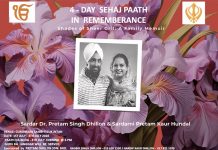
Path Da Bhog / Antim Ardas: 17 April 2021 (Saturday), at Gurdwara Sahib Jalan Kampung Pandan, Kuala Lumpur from 6.30 pm onwards.
Contact: Hargobind 012-3075008
| Entry: 8 April 2021; Updated: 12 April 2021 | Source: Family
ASIA SAMACHAR is an online newspaper for Sikhs / Punjabis in Southeast Asia and beyond.Facebook | WhatsApp +6017-335-1399 | Email: editor@asiasamachar.com | Twitter | Instagram | Obituary announcements, click here |
#Vaisakhi2021 | We are one week away to the release of ‘I AM KHALSA’, a special documentary in conjunction with Vaisakhi.
Produced by Malaysian-based Sri Saheb Production Sdn Bhd, it will be released on various social media platforms on 13.4.21 (Tuesday) as the Sikh Nation celebrates Vaisakhi the next day.
The documentary will also be made available at the Asia Samachar Facebook page. So, stay tuned!
ASIA SAMACHAR is an online newspaper for Sikhs / Punjabis in Southeast Asia and beyond.Facebook | WhatsApp +6017-335-1399 | Email: editor@asiasamachar.com | Twitter | Instagram | Obituary announcements, click here |
Tasvinderjit Singh, a Malaysian-based futures broker with more than two decades industry experience, continues to sharpen his skills at a futures firm now equally owned by a major China securities company.
He was recently promoted to director for sales and dealing at CGS-CIMB Futures Sdn Bhd, according to an update at his LindkenIn profile.
CGS-CIMB Futures is a wholly-owned subsidiary of CGS-CIMB Securities Sdn Bhd, a 50-50 joint venture between CIMB Group Sdn Bhd and China Galaxy International Financial Holdings Ltd, a wholly-owned subsidiary of China Galaxy Securities Co Ltd (CGS).
Tasvinderjit, previously an associate director for sales and dealing, joined the company in 1995.
In 2017, CIMB’s securities business caught the eye of CGS, one of the largest securities companies in China. It led to the JV with stockbroking business spanning Malaysia, Indonesia, Singapore, Thailand, Hong Kong, South Korea, India, the UK and the US.
The joint venture marked the first foray by a Chinese stockbroker into Southeast Asia.
ASIA SAMACHAR is an online newspaper for Sikhs / Punjabis in Southeast Asia and beyond.Facebook | WhatsApp +6017-335-1399 | Email: editor@asiasamachar.com | Twitter | Instagram | Obituary announcements, click here |