
















UA-56202873-1
Page 520

Legacy of Guru Gobind Singh: Bhagti with Shakti (political power)

0

By Gurmukh Singh | OPINION |

In May 2018, a Sikh journalist wrote an article with the heading: Winter is coming: Why Sikhs need to prepare for the imminent storm. With global Sikh experience and the most recent events in India and Pakistan in mind, that heading seems even more relevant today.

The journalist, Sunny Hundal, wrote about the mission of his brother Jagraj Singh and concluded: Jagraj Singh said something important: Guru Sahib has told us – where ever we are, take hold of power and change! For whom? Change not for our benefit but… working for the benefit of everyone. Sikhs are the ones who are willing to put their lives on the line to give other people freedom.

Sunny Hundal predicted that the clash between Indian state and diaspora Sikhs will grow as the Sikh diaspora matures and becomes more powerful&hellip. Modi also knows a clash with Sikhs in India is inevitable. The aim of the Indian government to split the Sikh community will intensify. Therefore, Sikhs need think-tanks, advocacy groups, research organisations. They need Political Action Committees.

His advice is that Sikhs need to get much better at managing internal disagreement. Those in positions of influence within the community or with the establishment, should not exploit ideological disagreements but find common solutions or ring-fence unresolved differences.

Unlike other reform movements led by the great saints of India, the Sikhi movement started by Guru Nanak Sahib towards the end of the 15th century, survived against all odds. According to historian philosophers, this was due to the unique combination in Sikhi of bhagti (spiritual living) backed by shakti (political power). This miri-piri combination gives the Sikhs their qaumi or national identity.

This is the gift of the Guru Jot-Jugat Light which guided the Sikhs from Guru Nanak Sahib to Guru Gobind Singh and now resides in the twin institution of Shabd Guru enshrined in Sri Guru Granth Sahib and the Guru Khalsa Panth. In the governance of the Sikh nation, Guru Granth Sahib is the Constitution from which are derived the laws and the executive functions and objectives of the Khalsa nation. Yet, due to the inclusive universal ideals enshrined in Guru Granth Sahib the objective of such a regime is not a one-religion state. This was amply illustrated by the Khalsa Raj under Baba Banda Singh Bahadur and Maharaja Ranjit Singh. All communities become equal partners (bhaiwaal) in such a just regime (halemi raj).

Advocate Gurmit Singh Sirsa in his, A Critique of Sikhism, quoted two philosophers of history, Oswald Spengler and Ernest Renan to show that what ultimately makes a group a nation (a qaum) is not any material or temporal factor but the will to be one. This will is the spiritual urge, an impulse to form a union, on the basis of a certain way of life.

The legacy of Nanak X, Guru Gobind Singh ji, is the niara Khalsa nation empowered to gain political influence and to bring about change. For whom? As late Bhai Jagraj Singh concluded, Change not for our benefit but… working for the benefit of everyone. For example, Sikhs in India can do much for the disadvantaged classes of India and win their support at the same time.


Gurmukh Singh OBE, a retired UK senior civil servant, chairs the Advisory Board of The Sikh Missionary Society UK. Email: sewauk2005@yahoo.co.uk. The article appeared here.

* This is the opinion of the writer, organisation or publication and does not necessarily represent the views of Asia Samachar.


RELATED STORY:

Guru Nanak’s Revolution (Asia Samachar, 6 Nov 2019)

Annexation of Jammu & Kashmir and the unfolding Hindutva Imperial Project (Asia Samachar, 21 Aug 2019)


ASIA SAMACHAR is an online newspaper for Sikhs / Punjabis in Southeast Asia and beyond. Facebook | WhatsApp +6017-335-1399 | Email: editor@asiasamachar.com | Twitter | Instagram | Obituary announcements, click here |
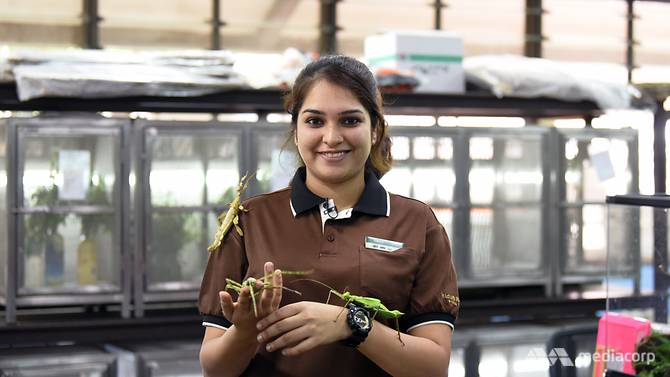
Singapore’s accidental female zookeeper

1
Delvinder introduces a butterfly. Photo: Marcus Ramos / CNA
By Cindy Co | CNA | SINGAPORE |

SINGAPORE: When Ms Delvinder Kaur signed up for a stint as a show presenter at the Singapore Zoo in 2013, she expected nothing more than a fun holiday job of playing with animals and speaking to visitors before moving on to do her university degree.

Fast forward six years, Delvinder, 28, hopes to retire in the zoo.

“I’ve seen a lot of my seniors who have retired here, and even after retiring, they still come back. You see the passion, and I think that’s the same passion that I would want in myself as well,” she said.

The Life Science Associate is just one of the many zookeepers who joined the Singapore Zoo without a related degree.

“Like most young kids at that point in time, I was just looking for a fun job, something that was just out of the ordinary, and Singapore Zoo was one of the areas,” she said.

Show presenting gave her the opportunity to work with a variety of animals, such as sea lions and elephants, and develop her understanding of them. And it was this understanding that allowed her to appreciate the animals a lot more.

In fact, she enjoyed her post-A levels holiday job so much that she never stopped.

“I fell in love with the job,” she said, “and I dragged it on a bit longer to find out what it is that I wanted to do.”

Despite having no background in life sciences, on-the-job training helped Delvinder learn the ins-and-outs of zookeeping. (Photo: Marcus Ramos)

A few months turned into another three years before she decided to continue the studies that she had put on hold.

In 2015, Delvinder moved from being a show presenter to the zoology department, where she got her first taste of working with invertebrates – specifically, insects.

She explained that she found the classification of animals – the different species and subspecies – one of the most challenging things about the job initially.

“I think not being from a life science background, zoology background, did make it a bit difficult initially … but the thing about Singapore Zoo and being a zookeeper, a lot of things happen with on-the-job training.

“Being on the field and working with different teams and with the guidance of your seniors, it allows you to develop the needed skills to manage and take care of animals and to understand the animals we have under human care as well,” she said.

All the guidance and hard work paid off when she managed to move from her part-time position to a full-time junior zookeeper position in 2016. At the same time, she started her English Language and Communications degree with the Singapore University of Social Sciences, which she is due to complete in a year.

“I feel like I grew up in the zoo. I became a bit more mature in this environment, because I understand it a bit more,” she said.

“It maybe started off as something very childish, (but) it’s something more important and valuable to me now – it’s a greater cause.”


RELATED STORY:

Mighty Sikh woman at helm of Singapore trains (Asia Samachar, 2 June 2019)

ASIA SAMACHAR is an online newspaper for Sikhs / Punjabis in Southeast Asia and beyond. Facebook | WhatsApp +6017-335-1399 | Email: editor@asiasamachar.com | Twitter | Instagram | Obituary announcements, click here |

Amarjeet Singh Gill (1963-2020), Siemens

PATH DA BHOG: 26 Jan 2020 (Sunday), 10am to 12pm, at Gudwara Sahib Sungai Besi (Shapha) | Malaysia

Amarjeet Singh Gill (1963-2020), Siemens

AMARJEET SINGH GILL S/O DHIA SINGH GILL (SIEMENS)

Village: Rumi

Wife: Jasbeer Kaur d/o Prem Singh

Children: Manvirjeey Singh Gill, Jasraj Singh Gill

Siblings: Inderjeet Singh Gill, Rajinder Kaur Gill, Devinder Kaur Gill


Path da Bhog: 26 Jan 2020 (Sunday), 10am to 12pm, at Gudwara Sahib Sungai Besi (Shapha), Kuala Lumpur

Contact:

Amar 012-3897062

Inderjit 016-6219914

Manjit 010-5527565


| Entry: 12 Jan 2020; Updated. | Source: Family

ASIA SAMACHAR is an online newspaper for Sikhs / Punjabis in Southeast Asia and beyond. Facebook | WhatsApp +6017-335-1399 | Email: editor@asiasamachar.com | Twitter | Instagram | Obituary announcements, click here |

Oregon man charged with hate crime for beating 70-year-old Indian woman

0
James Lamb in a jail photo.Deschutes County, Oregon, Jail
By Asia Samachar Team US |

Another day, another hate crime in the United States. But these stories may start to have better endings for the victims.

Earlier this week, an Oregon court charged a 53-year old man with hate crime.

James Lamb was accused of breaking into a motel office on New Yesr’s eve and attacking a 70-year-old immigrant from India who owns the business. He was a guest at the motel.

On Monday (6 Man 2020), the Deschutes County grand jury returned an indictment charging attempted murder and hate crimes in the assault at the Hub Motel in Redmond.

The owner suffered broken bones, remains in the hospital, and is expected to survive.

“The victim of this unprovoked assault provided heroic testimony to the grand jury from her hospital bed. Too many people in Oregon are silenced by intimidation and violence because of how they look, who they love, or to whom they pray,” District Attorney John Hummel said in a statement released on 6 Jan.

Specifically, he statement said the grand jury charged Lamb with: one count of attempted murder in the second degree, two counts of bias crime in the first degree, one count of assault in the second degree, one count of burglary in the second degree, one count of strangulation, one count of menacing, and one count of criminal mischief in the second degree.

The grand jury charged Lamb with bias crimes based on his statements regarding the victim’s country of origin being India and his expressed desire to rid America of people like her.

Charging Lamb with bias charges was possible because of Oregon’s revised “hate crime” law that was passed last year by the Oregon Legislature, the statement added.

Lamb acted alone during this unprovoked assault. Oregon’s revised hate crime law allows a felony hate crime to be charged when a defendant acts alone to harm another because of that person’s race, color, religion, sexual orientation, disability or national origin.

Previously, felony charges were only authorized if two or more people harmed another based on these motivations, the statement noted.


ASIA SAMACHAR is an online newspaper for Sikhs / Punjabis in Southeast Asia and beyond. Facebook | WhatsApp +6017-335-1399 | Email: editor@asiasamachar.com | Twitter | Instagram | Obituary announcements, click here |

Khalsa Diwan Malaysia powers ahead with original Nanakshahi calendar

6
Nanakshahi calendar 2020 published by Khalsa Diwan Malaysia – Photo: Asia Samachar
By Asia Samachar Team MALAYSIA |

One Malaysian organisation has been diligently producing a Sikh calendar as per the dates published in the original Nanakshahi calendar.

Khalsa Diwan Malaysia (KDM), an Ipoh-based body running more than four dozen weekend Punjabi schools nationwide, has been publishing calendars according to the Nanakshahi calendar dates since 2004.

“We have stuck to the original dates when it was first adopted in 2003,” KDM president Santokh Singh told Asia Samachar.

As in the past years, KDM has printed some 5,000 copies of the calendar, which are made available free to the 2,500 students attending its Punjabi Education Centres (PECs) around the country.

“We are the only producers of the calendar in Malaysia. It goes around the nation. We send it to all gurdwaras. This year’s calendar has already gone out,” he said.

How does this matter? The Sikh community is currently divided between the Nanakshahi and lunar Bikrami calendars to decide the dates for key Sikh festivals and gurpurabs (important days connected to the Sikh Gurus).

Hence, you may get two gurdwaras celebrating the birthday of Guru Gobind Singh on different dates, depending which calendar they have opted to follow.

“Some changes were done to the approved Nanakshahi calendar, but we had stuck to the original one,” he said.

KDM publishes the calendar in collaboration with the Malaysian Gurdwaras Council (MGC). Another collaboration partner, Sikh Naujawan Sabha Malaysia (SNSM), had opted to be left out since 2018 in the aftermath of an acrimonious Bachitar Natak/Dasam Granth debate locally.

The Nanakshahi calendar, with fixed dates throughout the year for all Sikh celebrations, was the handiwork of Canada resident computer engineer Pal Singh Purewal. See his article here and here.

On 5 Jan 1998, Shiromani Gurwara Parbandhak Committee (SGPC) had announced that the birthday of Guru Gobind Singh Sahib would be celebrated in 1999 as per the new Nanakshahi calendar.

Coming towards the year-end, this is one of the key commemorations that has attracted much attention. The Bikrami calendar can dictate two celebrations a year for some years, and none in next.

The need for the Sikhs to have their own calendar and a proposal for such a calendar was sent to the then acting Jathedar Sahib Akal Takht Sahib in 1994, according to Purewal in an article he wrote.

The Nanakshahi Calendar is based on the length of the tropical solar year, similar to the Common Era Calendar generally used today.More specifically, the Bikrami is based on Sidereal year of 365 days, 6 hours, 9 minutes and 10 seconds , while the Nanakshahi is based on the length of Tropical year of 365 days, 5 hours, 48 minutes and 45 seconds.

With the Nanakshahi, one key feature is that Sikhs can pencil permanent dates for key events, and not have them moved around every other year.

With the Bikrami calendar, for example, you cannot have permanent dates for the martyrdom of Guru Gobind Singh’s children, unlike the permanent date etched in the minds of the community as to when the Indian army attacked the Harmandar Sahib, popularly known as the Golden Temple, in 1984.

However, the calendar introduction became a controversial issue when some segments of the Sikh society voiced their opposition towards it.

SGPC initially implemented it in December 1999, despite an Akal Takht directive to wait till a general consensus within the Sikh community emerged on the issue, noted retired academic and writer Nirmal Singh. See his article here.

He wrote: Later, SGPC back-tracked but it finally implemented the calendar with the consent of leading Sikh organisations in March 2003. In the implemented calendar Parkash Guru Nanak, Diwali and Hola Mohalla were to continue to be observed as per the Bikrami calendar and all other events as per the proposed Nanakshahi Calendar.

Resistance to the new calendar by some groups, however, continued. Consequently executive committee of SGPC agreed to change the birth and death anniversary of Guru Gobind Singh, martyrdom day of Guru Arjan Dev, Gurta Gaddi Diwas of Guru Granth Sahib and sangrands also to be observed as per Bikrami calendar. The above changes were announced by Giani Gurbachan Singh, jathedar of Akal Takht in January 2010.

The Sikh community is still divided on the issue. In December 2017, a large number of Chicago-based Sikh organisations and gurdwaras took a decision to adopt the original ‘Mool Nanakshahi’ calendar.

The decision was taken at the Chicago Mool Nanakshahi Calendar Implementation Conference which was also supported by several other Midwest gurdwaras from the states of Illinois, Ohio, Michigan, Indiana, Iowa, and Wisconsin

The KDM Nanakshahi calendars are sold at RM2 per copy. Those interested to get copies can contact KDM office (05-5275181) or Santokh (016-5670810).

WHAT PUREWAL SAID ABOUT THE NANAKSHAHI CALENDAR:

The Nanakshahi Calendar is not a copy of the Common Era calendar. We have not adopted the Common Era calendar. The Nanakshahi calendar has its own character. The number of days in the months of the Common Era have been arbitrarily fixed, anywhere from 28 to 31. But in the Nanakshahi Calendar the first five months have 31 days each, based on the fact that the number of days from the spring equinox to the autumn equinox is greater than from the autumn equinox to spring equinox,, and the last seven have 30 days each. In a leap year the extra day has been added at the end of the year. The days in the months of the Common Era Calendar vary from 28 to 31, while Nanakshahi Calendar months have 31 or 30 days. These points make the Nanakshahi Calendar even more scientific than the Common Era calendar. We have adopted the correct length of the tropical year as the basis of Nanakshahi Calendar.


ASIA SAMACHAR is an online newspaper for Sikhs / Punjabis in Southeast Asia and beyond. Facebook | WhatsApp +6017-335-1399 | Email: editor@asiasamachar.com | Twitter | Instagram | Obituary announcements, click here |

Bizarre twist to Sikh youth murder in Peshawar story

0
By Asia Samachar Team MALAYSIA |

In a bizarre twist to the murder story of a Sikh youth in Peshwar, the authorities now believe that it was a ‘contract killing’ involving the fiancee of the 25-year old Pakistani.

In a report today, The Express Tribune said the police had ‘cracked the mystery’ of the murder of Ravinder Singh, the brother of Pakistan’s first Sikh television anchor.

Quoting an unnamed senior security official, the newspaper said it was a “contract killing” allegedly paid for by Ravinder’s fiancé who didn’t want to marry him.

“She promised the hitmen Rs700,000 for Ravinder’s murder,” the newspaper quote the official. “Part of the committed money was paid in advance, while the rest had to be paid after the murder.”

It added that the investigation team said Ravinder was murdered in Mardan and later his body was shifted to Peshawar by the hitmen. Prem Kumari has been taken into custody at Mardan, one investigator told The Express Tribune.

The report also said that the media had earlier erroneously identified him as Parvender, saying he was in Peshawar for his wedding shopping.

Ravinder Singh had lived in Malaysia and had returned home for his wedding.

In an earlier report in another newspaper, the body of the victim, then identified as Parvender, was found on Sunday. An FIR had suggested that he had travelled to Peshawar to complete last-minute errands for his wedding, including buying gold.

Taking onto the social media, Harmeet had lambasted the authorities for not doing enough to protect the minorities. His brother’s murder came on the heels of a mob demonstration in front of Gurdwara Janam Asthan, Nankana Sahib, for which the perpetrator has now been arrested and booked.

The Peshawar incident had ignited a minor diplomatic row between India and Pakistan, with Pakistan taking exception to Indian media reports that had portrayed the incident as a religiously motivated “target killing” to malign Pakistan for alleged persecution of religious minorities, the newspaper noted.

The report said Pakistan’s Foreign Office spokesperson had said on Monday: “Indian attempts to politicise the tragic killing of [the] Pakistani Sikh youth are mischievous and reprehensible.

“As this crime was reported, a case was registered immediately and a high-powered committee constituted to investigate the matter. The law will take its course and those responsible will be brought to justice.

“Rather than feigning any dishonest concern for minorities elsewhere, the BJP government would do better by focusing on the ongoing human tragedy at home and protecting India’s minorities from ‘Saffron terror’.”


RELATED STORY:

ASIA SAMACHAR is an online newspaper for Sikhs / Punjabis in Southeast Asia and beyond. Facebook | WhatsApp +6017-335-1399 | Email: editor@asiasamachar.com | Twitter | Instagram | Obituary announcements, click here |

The position of Sikhs in India and Pakistan

0
Photo: Google Map
By Network of Sikh Organisations (NSO) UK | PRESS STATEMENT | UK |

As Sikhs, we should recognise that those in power and authority often abuse human rights to perpetuate their authority, and see the egalitarian teachings of Sikhism with their emphasis on human rights and freedom of belief as a threat.

This was the situation in India at the time of our Gurus who incurred the active hostility of both the Mughals and the Hindu Hill Rajas. Today, the governments of India and Pakistan, while viewing Sikh teachings as a threat to Muslim or Hindu domination, are both playing on the supposed naivete of Sikhs to strengthen their positions in sub-continent rivalry. We have seen this in the overtures to Sikhs in the construction of the Kartarpur Corridor for Sikh pilgrims to Sikh heritage sites in Pakistan, and the widespread participation of the Indian government in the celebration of Guru Nanak’s 550th birth anniversary in India and many countries abroad.

Sikhs are not that naïve. India has waxed indignant about some stones thrown at the gurdwara in Nankana Sahib following an incident in which a Sikh girl apparently chose to marry a Muslim boy. Indian newspaper headlines and broadcast news has expressed outrage at the religious bigotry of Muslims, while being totally silent about the more serious destruction of a gurdwara and dozens of Sikh homes by Hindu extremists in Madya Pradesh. The Indian government has maintained a deafening silence over Hindu extremists targeting Sikhs, while actively promoting Hindu extremism in its discriminatory Citizenship Amendment Act.

Some Sikhs looking through one eye rail against the government of Pakistan. Some looking through the other eye, condemn the Indian government. The reality is that the governments of both countries are trying to manipulate Sikh sentiment for their own ends and, in the case of India, destroy our independent Sikh identity.

As Sikhs we should recognise the very real difficulties faced by Sikhs on the sub-continent. We cannot match the physical strength of either India or Pakistan, let alone both. But, through diplomacy and skill, along with adherence to our Gurus’ teachings, we can do much to reduce the hostility between India and Pakistan to the advantage of people of both countries, including Sikhs. Both countries are suffering economically in maintaining huge armies against supposed threats from the other. Both countries would gain enormously in the reduction of tension and the creating of a common economic zone. A freer movement of people would help reduce ignorance and prejudice that gives rise to religious bigotry. It is a distant dream, but it is the direction in which our Guru given guidance requires us to go.

The press release, ‘The position of Sikhs in India and Pakistan’ (7 Jan 2020), can be found here.


ASIA SAMACHAR is an online newspaper for Sikhs / Punjabis in Southeast Asia and beyond. Facebook | WhatsApp +6017-335-1399 | Email: editor@asiasamachar.com | Twitter | Instagram | Obituary announcements, click here |

India to punish Malaysia for Dr Mahathir’s criticisms

Narendra Modi (left), Dr Mahathir Mohamad
By Asia Samachar Team | MALAYSIA |

India has taken steps to punish Malaysia for what is believed to be a retaliation to the audacity of the Malaysian leader to criticise the regional power house on its actions in Kashmir region and its new citizenship law.

News reports originating from India and Malaysia said India has instituted measures to reduce palm oil imports from Malaysia, its second largest source after Indonesia.

In a report yesterday, Reuters said India has imposed restrictions on imports of refined palm oil and palmolein.

Quoting unnamed sources, the Mumbai-based report said the move was a retaliation against top supplier Malaysia after its criticism of India’s actions in Kashmir and a new citizenship law.

It said the Indian Ministry of Commerce and Industry had issued a notification declaring that the import of refined palm oil “is amended from ‘Free’ to ‘Restricted.’”

Four industry sources told Reuters that the memo was an effective ban on imports of refined palm oil, meaning India can now only import crude palm oil. It will hit Malaysia, the main supplier to India of refined palm oil and palmolein, but is likely to help Indonesia, the biggest exporter of crude palm oil. Palmolein is a liquid form of palm oil used in cooking.

Indian government and industry sources told Reuters that Prime Minister Narendra Modi’s Hindu nationalist government was seeking to target Malaysia after recent criticism of India by Malaysian Prime Minister Mahathir Mohamad.

The relations between the two nations came under watch when Dr Mahathir made pointed remarks in a United Nation’s address on India’s handling of the Kashmir issue.

In his speech during the general debate of the 74th session of the United Nations General Assembly in New York, Dr Mahathir said: “The helplessness of the world in stopping atrocities inflicted on the Rohingyas in Myanmar had reduced the regard for the resolution of the UN. Now, despite UN resolution on Jammu and Kashmir, the country has been invaded and occupied. There may be reasons for this action but it is still wrong. The problem must be solved by peaceful means. India should work with Pakistan to resolve this problem. Ignoring the UN would lead to other forms of disregard for the UN and the Rule of Law.”

Following the 28 Sept 2019 speech, there had been calls in India for the country to drop Malaysian palm oil.

The next salvo came on 20 Dec 2019 when Dr Mahathir at the sidelines of the Kuala Lumpur Summit, badged as an international platform for Muslim leaders, intellectuals and scholars. At the last minute, Pakistan Prime Minister Imran Khan had cancelled his scheduled attendance, supposedly due to pressures from Saudi Arabia. Saudi Arabia and Indonesian leaders were also notably absent.

Speaking out against India’s recently-approved citizenship legislation, which appears discriminatory towards Muslims, he said: “I am sorry to see that India, which claims to be a secular state, is now taking action to deprive some Muslims of their citizenship.

“If we do that here, you know what will happen. There will be chaos, there will be instability and everyone will suffer.

“Already people are dying because of this law, so why is there a necessity to do this when all this while, for 70 years almost, they have lived together as citizens without any problems.”

This remarked saw a swift response from India. First, it issued an official statement urging the Malaysian leader to refrain from commenting on India’s internal affairs, “especially without a right understanding of the facts”.

The next day, the Malaysian envoy in India was summoned for a meeting with the nation’s Ministry of External Affairs (MEA).


“The third in command went for the meeting, as the high commissioner and his deputy were away,” one source told Asia Samachar.

Indonesia traditionally corned around two-third of India’s palm oil imports, but a lower duty on refined palm oil helped Malaysia to overtake Indonesia as India’s biggest supplier in 2019, Reuters reported.

Palm oil is crucial for the Malaysian economy as it accounts for 2.8% of gross domestic product and 4.5% of total exports. State-owned and private Malaysian refineries will likely have to scramble to find new buyers for their refined product.


ASIA SAMACHAR is an online newspaper for Sikhs / Punjabis in Southeast Asia and beyond. Facebook | WhatsApp +6017-335-1399 | Email: editor@asiasamachar.com | Twitter | Instagram | Obituary announcements, click here |

From fear to anticipation

0
By Ravinder Singh| OPINION |

My good friend Chetandeep Singh and I often have longish conversations on the phone. For him, the call is a good way to relieve the tedium of his hourly drive to work. For me, it is a welcome opportunity to kill an hour after lunch – since a three hour time zone separates us.

For several years now, we have participated in an online discussion forum called KHOJGURBANI, a motley group located in different parts of the globe that converges in cyberspace every week to engage in a dialogue and discussion of Gurbani.

My telephonic conversations with Chetandeep are – more often than not – carryovers from the previous online discussion.

What begins as a clarification or a disagreement invariably spills over to the larger existential questions in life. We find ourselves meandering through the lanes and by-lanes of history, touching on seemingly unrelated topics in diverse fields like psychology, quantum physics, neuroscience. Neither one of us is an expert in any of these fields but our interest simply underlines the fact that being a Sikh means being a lifelong learner.

Our age difference – I could be his dad – is a non-issue, but I suspect that I have the better end of the deal: Chetandeep is young, bright and razor-sharp and I am an old blade in need of some sharpening. I also have the advantage of pulling rank on him. When all is said and done, I find that in our (Sikh/Indian) culture, age still trumps intelligence!

What prompted me to write this piece and share it was a note Chetandeep sent me after our last conversation.

“After talking to you this morning, few things dawned on me,” he wrote.  “You spoke about how you have fallen in love with the process of reading, discovering depths, meanings and nuances of SGGS. You spoke about the honing of skill and craft.”

Chetandeep was alluding to a “life-project” that I have undertaken. You see, I have been foolish enough to embark on a translation (into English) with a commentary of the Guru Granth Sahib. Why on earth would I want to engage in intellectual forgery on such a grand scale – as translations of scriptural texts have been called – is another matter.

Chetandeep had called to inquire about my progress.

I explained to him that having begun, I was overcome by a sense of my inadequacy in the face of such a huge undertaking. Translating the Guru Granth Sahib was more than just looking up a dictionary. There is, to begin with,  the underlying linguistic structure and grammar to contend with; then there is the poetic and musical structure in which literary text of incomparable beauty (often lacking English equivalents) has been captured to shine a knowledge that radiates like white heat!

The translation project is daunting and has very quickly exposed my feeble capacities, filling me with anxiety.

Yet, the thought of being engaged in this process (conceivably for the next decade) also fills me with the rush of anticipation. Love of Gurbani has turned feelings of fear into one of the expectations, of possibilities! It reminds of the expression “chao” in Gurbani. I better appreciate Newton’s comment about himself being like a boy playing on the seashore, diverting himself here and there for a better-looking pebble, while the ocean of Truth lay undiscovered before him.

Chetandeep continues, “I took the hint about the translation process and applied to my own work, life. When I am at work, a lot of times I am anxious – when the problems are hard or areas are unknown or people are strangers. At home, life ain’t much easy – when the conversations are hard, voices are raised, kids act out, the usual stuff.”

He goes on to add that “the realization I am having is that at some point, (I don’t know when) that life – work, home, children etc – in some sense had become a burden. Even though I never thought of it that way, but looking at my own statements and attitude:  life had become a burden.”

Most of us can relate to Chetandeep’s angst and free-floating anxiety. We feel overwhelmed.

But, what if? And here is the insight that Chetandeep has, “What if I fell in love with work – yes it is/will be hard – but just fall in love with the work itself – the problems, the solutions, instead of viewing them as hard and burden – take it for what it is – a process, an art – changing my own viewpoint. Instead of doing it because I have to do it, enjoy doing it, fall in love with what is being done.”

Falling in love with the process. Life is a process, “And the same thing with life in general. Instead of living for the sake of being alive – just enjoy the process – the process of sleeplessness, process of arguing and conflict and tension and arguing and knowing all the while in my heart – that this is life – this is the process.”

Viewed thus, life becomes a game to be enjoyed, not feared. More importantly, such an approach helps to unhitch ourselves from our Haumai (ego). Chetandeep again: “and there’s nothing personal here. No matter how it is – just looking at it with reverence and enjoying every facet of it – fully. Every facet – including crying, heartbreaks, ups and downs, and even death. Just looking at life and enjoying the process of living – fully knowing that “this is life” – and that’s how it is. In love with living life.”

What if we fell in love with life and plunged into what it had to offer with anticipation instead of fear?

Ravinder Singh spent his formative years in Singapore and Delhi and has lived in the U.S. since 1976. Having with multinationals in Singapore, London and New York, he runs his own management consulting company. His consuming passion is Sikhs and Sikhi – in all its flavors and dimensions. He is linked to Talking Stick (a weekly online colloquium at Sikhchic.com) and Khoj Gurbani.


RELATED STORY:

Khoj Gurbani at two (Asia Samachar, 2 April 2016)

ASIA SAMACHAR is an online newspaper for Sikhs / Punjabis in Southeast Asia and beyond. Facebook | WhatsApp +6017-335-1399 | Email: editor@asiasamachar.com | Twitter | Instagram | Obituary announcements, click here |

Kampar-lad returns to alma mater as principal

1
Hardave Singh Virk
By Naginder Kaur MALAYSIA |

It was a gratifying moment for Hardave Singh Virk when he received the letter of appointment to helm the highest leadership position of his alma mater, SMK Methodist ACS Kampar, effective 2 January 2020. He has been the acting principal of the school since May 2019.

The appointment is especially meaningful and strikes a chord as he received 11 years of his primary and secondary school education at SMK Methodist ACS Kampar, together with his six male siblings.

A missionary school founded in April 1903, it is one of the oldest and most storied schools in Perak.

Hence, it’s only fitting to return the nurturing he had received at his alma mater.

A graduate of Bachelor of Arts from Universiti Sains Malaysia (USM) Penang, and Master of Malay Language from Universiti Putra Malaysia (UPM), he has also acquired the National Professional Qualification for Headship (NPQH) at Institut Aminuddin Baki (IAB).

Hardave has accumulated 30 years of teaching experience under his belt and has established a reputation as a revered Bahasa Melayu teacher. He started his teaching career in Lubok Antu, Sarawak in 1989, and returned to SMK Methodist ACS Kampar in 1998, where he has faithfully served for nearly two decades with intermittent postings at other schools in Kampar to assume Assistant Principal duties.

Hardave views his appointment as a blessing from Waheguru Ji to shoulder the heavy responsibility to lead his alma mater. He owes appreciation to the ACS Board of Governors for investing faith and confidence in him to carry out this mandate as well as appreciates the unending support he has received from his wife Saranjit Kaur, also a teacher, and his family.

As a booster for the Punjabi community, he wishes to inspire others in the community to join the ‘noble’ teaching profession and become a trailblazer in their own way.

With a steady decline in the number of Punjabi teachers over the years, it is hoped the recognition will continue to empower the younger generation intending to join the education fraternity.

As an original Kampar lad, Hardave is the son of the late Tanah Singh Virk and the late Ajmer Kaur of Kampar, Perak, and the younger brother of Bukit Aman Narcotics CID (Property Forfeiture) Principal Assistant Director SAC Dalbir Singh Virk.


ASIA SAMACHAR is an online newspaper for Sikhs / Punjabis in Southeast Asia and beyond. Facebook | WhatsApp +6017-335-1399 | Email: editor@asiasamachar.com | Twitter | Instagram | Obituary announcements, click here |