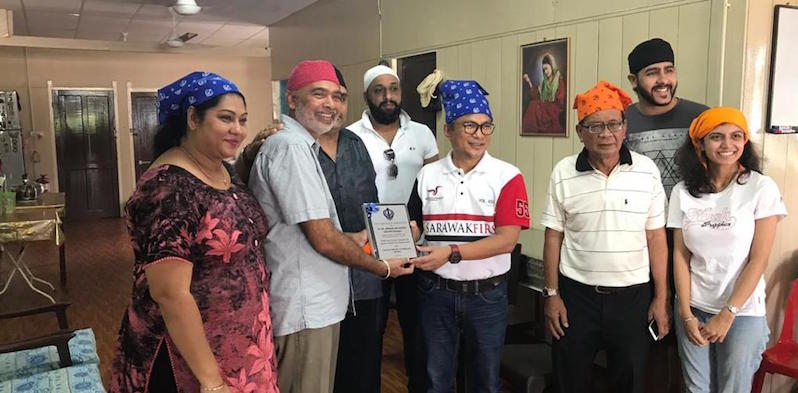
Jagjiwan (2nd left), flanked by gurdwara committee members, presenting a memento to Dr Annuar – Photo: Supplied
By Asia Samachar Team | MALAYSIA |
The only gurdwara in Sibu, a Sarawak city located at the confluence of Rajang and Igan Rivers, will soon get a hostel for the use of outstation worshippers.
And this is thanks to the support of the state government.
The hostel, located adjoining the Gurdwara Sahib Sibu building on Jalan Awang Ramli Amit in Kuching, is expected to be completed within the next month or two.
Sarawak Housing and Public Health Assistant Minister Dr Annuar Rapaee, who visited the gurdwara on Saturday (May 25, 2019) to monitor the progress of the construction of the hostel, said the project received the green light under the Rural Transformation Programme (RTP) fund.
The total construction cost for the hostel is RM200,000, according to a statement released by Sibu Sikh Temple Association (SSTA) which manages the gurdwara.
“The government approved the hostel project under the RTP fund for Nangka….I am also distributing funds to other places of worship like mosques and churches,” said Dr Annuar.
He said the government wants to ensure that all worshippers in the state, irrespective of their beliefs, have a place to practise their faiths.
SSTA president Jagjiwan Singh said the gurdwara was built in 1920 and renovated 40 years later in 1960.
“At that time the gurdwara committee a hostel for devotees from Miri, Kuching and Sabah coming for Akhand Path prayers at the temple.
“In 2011 we decided to use a piece of land at the back of the gurdwara for the hostel project as it has been empty for years.
“Thanks to Dr Annuar, who has been consistent in his support for the gurdwara, renovations were able to be carried out since 2015,” he said in the statement sent to Asia Samachar.
He said the gurdwara has its own plan to build at least five apartment-style single-storey units. Each unit will have two bedrooms, a living hall, a kitchen and a bathroom.
“The Public Works Department (JKR) followed the detailed temple plans and informed the temple committee that with the RTP budget, they will be able to build two complete units with utilities and build a separate access road at the side of the temple,” Jagjiwan said.
Approval was given in December 2018 with JKR appointed as the contractor. Construction works commenced February 2019 and are due for completion in June or July.
Jagjiwan said the gurdwara committee planned to have the official opening in either August or September.
ASIA SAMACHAR is an online newspaper for Sikhs / Punjabis in Southeast Asia and beyond.Facebook | WhatsApp +6017-335-1399 | Email: editor@asiasamachar.com | Twitter | Instagram | Obituary announcements, click here |
A judge on Friday (24 May) ordered an Oregon man to learn about the Sikh religion and submit a report to the court as part of his sentence for an attack on a Sikh shopkeeper in Salem, reports AP.
Andrew Ramsey pleaded guilty to misdemeanour counts of intimidation and assault in the Jan. 14 incident targeting Harwinder Singh Dodd, the Sikh Coalition, the largest Sikh civil rights organisation in the U.S., said in a release.
The intimidation count is considered a hate crime, the civil rights group added.
Witnesses said Ramsey pulled on Dodd’s beard after he refused to sell him cigarettes without an ID, punched him and pulled him to the ground. Bystanders restrained Ramsey until police arrived.
Dodd, who came to the U.S. from India and owns the convenience store, noted in a written statement to the court that hate crimes are on the rise in America. The FBI says hate crimes increased by 40 percent in Oregon from 2016 to 2017.
“He didn’t see me as a person,” Dodd said of Ramsey. “He attacked me because of how I look. Because of my turban and beard — my religious articles of faith.”
Police said Ramsey also threw his shoe at Dodd and snatched his turban. Sikh men don’t cut their hair and cover it with a turban for religious reasons, the report added.
ASIA SAMACHAR is an online newspaper for Sikhs / Punjabis in Southeast Asia and beyond.Facebook | WhatsApp +6017-335-1399 | Email: editor@asiasamachar.com | Twitter | Instagram | Obituary announcements, click here |
PATH DA BHOG: 1 June 2019 (Saturday), from 3pm to 5pm, at Gurdwara Sahib Johor Bahru, Jalan Trus, JB|Malaysia
Jugar Singh Rakmo (1945-2019), Johor Bahru
SARDAR JUGAR SINGH RAKMO
Son of Late Puran Singh Rakmo
& Son in Law of Late Kartar Singh (Penang)
Passed away peacefully on 20th May 2019
A Loving Husband, Father and Grandfather.
Deeply missed and cherished by:
Wife: Sarjit Kaur d/o Kartar Singh
Sons & Spouses:
Sanjeev Singh Rakmo & Kalaiselve Kanesan
Manjeev Singh Rakmo & Sandy Geraldine Maman
Daughter & Spouse:
Paramjit Kaur & Sarjit Singh Sidhu
Daughters:
Jasbir Kaur (JessyJezz)
Balpreet Kaut (Preeti)
6 grandchildren, brother Harbans Singh (Rocky-JB), 5 sisters, close family relatives & friends.
Sahei Path Da Bhog: 1 June 2019 (Saturday), from 3pm to 5pm, at Gurdwara Sahib Johor Bahru, Jalan Trus, JB
Please treat this as a personal invitation
Contact: Harbans Singh (Rocky-JB) 013 350 7678
| Entry: 26 May 2019 | Source: Family |
ASIA SAMACHAR is an online newspaper for Sikhs / Punjabis in Southeast Asia and beyond.Facebook | WhatsApp +6017-335-1399 | Email: editor@asiasamachar.com | Twitter | Instagram | Obituary announcements, click here |
A stroll down Google Lane tells us that the term sound-bite originated around 1980. Sound-bites holds your attention for about 30 seconds, a time span critical to catching a reader’s eye and focusing it quickly but sharply on a topical concern. I offer you a uniquely simple example: KISS for “Keep it simple, stupid.”
In the 1980 Presidential campaign, Ronald Reagan repeatedly threw There You Go Again in the face of President Jimmy Carter as a most effective sound bite. Twelve years later in 1992, it was Bill Clinton’s turn to leave President George H. W. Bush speechless with It’s the economy stupid. Then in 2008 Barak Obama turned the tables with Don’t do Stupid Stuff with telling effect. And then he swallowed Hillary Clinton’s rejoinder that Don’t do Stupid Stuffis not an Organizing Principle.
Now sound bites, starting with Make America Great Again are Trump’s main arsenal aimed to pulverize his victims into rapid submission rather than unnerve them with the acute sharpness of a precisely-aimed idea. His darts are more in the class of Rumsfeld’s Shock and Awe that captured the spirit of the American misadventure in Iraq.
Such is real-politic; what goes around comes around. Sound bites — of recent vintage; short on words, long on meaning, easy to remember. They have a dominating presence in the world of sports, politics and even religion?
PANTH IN DANGER
“Panth in Danger.” Panth (in Punjabi) indicates the collective Sikh community. Panth in Danger is a slogan that we have heard over a lifetime. Hypnotically catchy like a call to arms, this well-crafted sound bite dares us to respond viscerally, not analytically. That’s exactly what soundbites do. The kernel of truth in them gives them life, urgency and potency.
I don’t really know when Panth in Danger gained currency. Could it have been during Mughal rule in the 18th century when Sikh survival literally hung in the balance? I heard it ad infinitum during the 1950s. Sikhs were then pushing the Indian government to carve out a Punjabi-speaking state as was being done for a plethora of the other Indian languages. But was/is Sikhi really in danger then or now? That’s whole different matter for another time.
A hundred years ago, during Dayanand’s fulminations against Sikhi and their Gurus, the clarion call of Panth in Danger acquired poignancy. It arose to counter a campaign designed to deny Sikhi an independent and equal place in the nominally secular but, in fact, increasingly partisan Hindu India — a reality that has become progressively worse. India seems to be developing alarming intolerance for non-Hindu cultures, be it Buddhism, Christianity, Islam or Sikhism.
Sample, for instance, Bollywood; its cultural humor is surfeit with Sikhs and Sikhi. With few exceptions, it hits at Sikhi via pointless banter, the easy laugh and the cheap joke, devoid of clever logic, intellectual gymnastics, rich or pointed play on words. Luckily Sikhs retain their ability to laugh at themselves. I write this not as a Hindu-hater or Hindu-baiter but from sadness because it cheats India of both its history and its promised tryst with destiny.
Around 40 years ago, a strident Hindu political party in India won the national election and ruled for some years. This led to a great unease in the Sikh community (barely 2 percent of India’s teeming billion plus) on how a partisan Hindu political party would treat minorities. At a pre-election meeting where Sikhs were tinkering with which party to support, a leader of the North American Sikh community advised Sikhs, to vote for the Hindu partisan party. His argument: Sikhs should help elect them even though their leaders do not recognize Sikhi as a distinct religion separate from Hinduism. When we asked why, his answer was beyond simplistic, not even remotely real. “The Hindu fundamentalist government, he claimed, will achieve nothing and would self-destruct. That will fragment the country and Sikhs will be able to wrest their own nation – Khalistan – from the internal mess.” So much for rational analysis!
Now once again, India is governed by a similar political elite and this time they won big. Don’t forget that Hindus, the largest vote bank in India, constitute better than 80% of the population.
Today, I step aside from the material and socio-economic impact of the election on India to engage briefly with Indian nation’s internal structure.
The new sound bite in India is “Hindu, Hindi, Hindustan.” This came forcefully and unmistakably home to me the night of the BJP celebration some years ago where I was one of the few Sikhs in a sea of Hindus, and reverberates more strongly today. Hindi is the language of Hindus even though a majority of Hindus finds it a foreign tongue because modern India is a mélange of many independent nation-states, each with its own language, culture and cuisine. Hindustan, literally land of the Hindus, is how the Indian Subcontinent has been labeled in history. The Constitution of free India does not list this name but refers to India as Bharat.
NOVEL TWIST
The ruling clique has added a novel twist to the mess. Political luminaries with scholarly pretensions argue that Islam and Christianity came to India with very few people from foreign lands who brought foreign ideology with them. Ergo, the overwhelming majority of all Indians who are now Sikhs, Muslims or Christians converted from Hindu stock and that’s a legacy that they must return to. They should reconvert and revert to their Hindu roots. So goes this argument.
Such reasoning muddles the realities for minorities in India, such as Sikhs. Clearly, the first four Sikh Guru-Founders of Sikhism came from Hindu stock. A growing Hindu view ignores the unmistakable renunciation of Hinduism’s defining practices by the Gurus. Similar reasoning is applied to Jains and Buddhists. By this logic there are no minorities in India, except for a small countable number of Jews and Parsees, and perhaps fewer Christians and Muslims. On this dubious logic rests India’s government-supported initiative ambitiously dubbed “Ghar Wapsi” to pressure minorities to return to Hinduism.
But I wonder!
True that very few Christians came into India from outside, so most Indian Christians are converts from Hindu stock. The conclusion that, therefore, they remain Hindus — today, tomorrow and forever flies in the face of all reason. Apply similar reasoning to the world to see the absurdity. Since Jesus was born a Jew as were his early followers, should these upstarts be reclassified as Jews today? By this logic there are and can be few, if any, Christians in the world. In India, most Indian Christians likely converted from Hindu roots and should then return to the Hindu fold. And since Jesus was born a Jew, no matter what he taught and that his teachings are now known as Christianity all over the world, his movement remains Judaism and he remains a Jew. Such reasoning would surely be labeled asinine and rightly so. No thinking person should buy it.
This virulent campaign goes further and self-righteously asserts that it is fair to pressure all the Indian Sikhs, Christians and Muslims to return to the Hindu fold because that would only be returning to their roots – their original home and base, from where no can walk away in good conscience. In other words, once a Hindu, always a Hindu – through eternity.
A softer version of this proclaims that all Indians are Hindu by definition and by culture. Labels such as Muslim, Christian or Sikh are just weak identifiers of their particular sect of Hinduism — a minor branch of the enormously vast Hindu mythological tree, forever inseparable from the parent root and stem.
Hence the Indian government-inspired campaign and demand that all ‘Indians’ come home to their Hindu reality – Ghar Wapsy or “Return Home” in translation. This idea of retuning to roots has gained enormous currency in modern India. It is an emotionally powerful wrenching slogan. Yet, India has the audacity to define itself as secular.
And I wondered a bit further!
Some social anthropologists suggest that the word “Hindu” is a variant of “Sindhu,” the river in the northwest of the Subcontinent, and that’s how the people became Hindus. Hindus insist that their rich scriptures and mythology, included the Vedas, originated in India
Some fundamental questions remain: What were the people of the Subcontinent before their scriptures were elaborated? Certainly, there was intelligent life in India even during the many eons when the rules, dicta, and traditions of Hinduism were still in the making, when the Vedas were incomplete or not yet fully elaborated. Life existed then. Were the Indian people unclassified tribal perhaps?
By the logic of “Ghar Wapsy” don’t they all remain unchangeably whatever they were – forever and more before the Hindu label was even coined to define them. To return to what one was eons ago requires that we first search for the sect or tribe of apes that Hindus belonged to so that they can return to it. Only then we can decide of how to reclassify other (non-Hindu) natives of India.
Perhaps the largest mass conversion of peoples from age-old Hinduism to another religion in modern times occurred in mid-20th century when B.R. Ambedkar led almost 400,000 low caste (untouchables) Hindus into Buddhism. Earlier episodes of mass exodus out of Hinduism were likely prompted by the messages of Buddhism, Christianity, Islam, and Sikhism.
But now that caste-riven India is politically free, a nominally secular India is being driven back in time by the demand and soundbite that free people return to their old slave reality of a divisive society.
This in short is the message of “Ghar Wapsee.” In other words, Come back little children. Return to the system – unjust as it was and unjust as it will likely remain, for such is God’s will. Suffer and enjoy. What is being sold here: Colossal ignorance or masochism?
A simple factoid from the New York Times is pertinent: Over the last decade, between two contiguous census periods, over 10 million Americans changed their religious identity in their census data. A free people have that freedom. Home is where the heart is.
I wonder how India, the world’s largest functioning secular democracy, would deal with such an earth-shattering event.
[I.J. Singh is a New York based writer and speaker on Sikhism in the Diaspora, and a Professor of Anatomy. Email: ijsingh99@gmail.com]
* This is the opinion of the writer, organisation or publication and does not necessarily represent the views of Asia Samachar.
ASIA SAMACHAR is an online newspaper for Sikhs / Punjabis in Southeast Asia and beyond.Facebook | WhatsApp +6017-335-1399 | Email: editor@asiasamachar.com | Twitter | Instagram | Obituary announcements, click here |
There is a saying: Choose and consume food like medicine or else medicine will become your food. So for good health it is imperative that we watch what we eat and drink.
Sikh philosophy is fairly open-ended as far as food is concerned. Other than the fact that food in gurdwaras (and also private kirtan programmes or where Guru Ji, Sri Guru Granth Sahib holds court) vegetarian food shall be served, and besides references to not consuming meat killed in a religious manner, like halal, Sikhs generally have a free reign as to what they eat. And most take liberties where ‘drink’ too is concerned!
There are, of course, those who will vehemently declare that Sikhs, or those who seek emancipation must be vegetarians like most Bhai Sahibs and Sants. Some even insist that garlic should not be used in langgar! I have seen vegetarian Bhai Sahibs and Sants and Khalsa Jis gorge themselves on samosas and jalebian with extra sweet cha when they could and then declare that it is Waheguru Ji’s Hukm that they have diabetes and/or high blood pressure and other ailments!
Baba Nanak Ji left it fairly open by firstly declaring that ‘maas maas kar murakh jhegeday…‘ which simply explained means that only fools argue about whether one should eat meat or not. Further Baba Nanak writes: Baba hor khana khushi khwar. Jit khadai tan pidiyai mun meh chelai vekar. O Baba, the pleasures of other foods are false. Eating them, the body is ruined, and wickedness and corruption enters the mind.
A little further in Guru Granth Sahib Ji, Guru Raam Das Ji says: Jit peetai mat door hoe, baral pevai vich aye. Drinking which intelligence departs and madness enters the mind… etc . All fairly clear.
Though it is generally agreed that taking one or two lines within the Guru Granth Sahib Ji out of context could give the wrong impression, suffices to say that these lines I have quoted do give the gist of logical Sikh thought that where eating and drinking is concerned, treat food like medicine for good healthy living. I am happy with these broad guidelines! The rest is up to me.
With excesses of youth in eating and drinking I am lucky that my only ailment at almost 70 years of age is weight, besides age of course! I have not yet been reduced to consuming medicine as food! Guru Ji has been kind.
While I was on kirtan duty in south India a few years ago, a sangat (congregational) member in Kerala booked me for two weeks of ayurveda treatment at a centre. In two weeks I lost 5kgs. in weight and came away without a recurring back pain and generally rejuvenated!
So impressed was I that the following year I publicised the fact and we arrived as a jatha of over 30 from far flung places like Canada, UK, USA and even Dubai besides north India and Malaysia! Nitnem at dawn and dusk and occasional kirtan plus ayurveda massages, very good south Indian food (not overly spicy or hot) and herbal medicine for whatever ailments we had, the rest of the day.
I found that with the special massages and other treatment, herbal medicines and light vegetarian food, I lost 8kgs. The second time round … and then promptly put it all back when I returned home to Australia after a two week stopover in Malaysia. The food in Malaysia is irresistible! The nasi lemak, teh tarik, cendol, rojak, bakuteh, chi cheong fan, chicken/pork rice, dhosai, idly, etc. The mouth waters just writing these down!
After an absence of three years, I am back with my wife strictly for a good detox and weight loss besides tranquility, simran and some writing. I tipped the scales at 110kgs when I arrived! My original weight before I went to the centre the first time! I need to lose at least 10kg. I know the good clean south Indian vegetarian food, and medicated water plus expert massages and herbal medicines will play a great part in putting me back on my feet.
I shall report halfway as to how I am going as encouragement (I hope) to you the reader that good health is important and one needs to be proactive especially as the years roll by. Sadly we pay scant attention to health consciousness as part of Sikhi practices, so I shall do my bit in encouraging you.
Back pains, joint aches, high blood pressure, over-weight, diabetes, skin conditions – almost any ailments, need body pampering like good food and herbal medicine to rejuvenate the body through thorough detoxification and massaging. It is one thing to go in as an outpatient. It is another to actually stay at such a place in the hope that at least one’s eating and sleeping patterns change for the better and one can take that away from here.
Some very dear friends have come here on my advice and benefitted immensely. You can, too. Giani Sukdaiv Singh Ji of Gurpuri (Malaysia) and wife have also been here for treatment. So has shotay veer, Veer Manpreet Singh Ji, our young kirtenia.
Write in to Asia Samachar if you have any pertinent questions. I shall give more details, especially of my own and my wife’s improvements besides other details of procedures etc. which might be of interest to you. Part 2, the interim report will be in Asia Samachar in about one and a half week.
Malaysian-born Dya Singh, who now resides in Australia, is an accomplished musician and a roving Sikh preacher. The Dya Singh World Music Group performs full scale concerts on ‘music for the soul’ based on North Indian classical and semi-classical styles of music with hymns from mainly the Sikh, Hindu and Sufi ‘faiths’. He is also the author of SIKH-ING: Success and Happiness. He can be contacted at dyasingh@khalsa.com
* This is the opinion of the writer and does not necessarily represent the views of Asia Samachar.
ASIA SAMACHAR is an online newspaper for Sikhs / Punjabis in Southeast Asia and beyond.Facebook | WhatsApp +6017-335-1399 | Email: editor@asiasamachar.com | Twitter | Instagram | Obituary announcements, click here |
Indian youth in Penang feel marginalised and deprived of opportunities as they negotiate their daily lives.
This is one of the findings of a recent survey of the younger segment of the 165,000 strong Indian community in the state located on the north of Peninsular Malaysia.
The study, entitled titled ‘Indian Youths: Opportunities, Challenges and Solutions’, also revealed the ‘overwhelming’ expectations of their parents, the community and themselves.
A joint partnership effort between Penang Institute, Malaysia and Massey University, New Zealand under its CARE (Culture-Centred Approach to Research and Evaluation) Centre, the study has released a 103-page report. See here.
Based on interviews of 45 Tamil-speaking participants, the study found that marginalisation and deprivation of opportunities emerged as key underpinning principles to inequality and to being treated unfairly – directly and/or indirectly so.
“It showcased distinctive forms of marginalisation consistently faced by the Indian community perhaps not faced by the other ethnic groups,” the report said.
“Marginalisation” in this study is defined broadly as processes of social exclusions – that is, failure of society to provide certain individuals and groups with those rights and benefits normally available to its members in matters such as employment, adequate housing, health care, education and training. Marginalisation has taken place in the past, across many histories, and continues till today, according to the study report.
Since the 1969 racial riots, it noted that marginalisation has increased for Indians as well as other minority ethnic groups due to the provisions in the Federal Constitution that saw the setting up of the affirmative action Bumiputera policy which favours the Malays over other ethnic groups.
The Indians and the Chinese continue to contribute though they are not seen as being on par with the Malays. It is worse off for the Indians, as many interviewed in the study saw themselves as being third in society, after the Malays and the Chinese; and in some instances fourth, coming after migrant workers, it noted.
When discussing the impact of marginalisation on Indian youth, the report had made reference to the Sikh community. It said: “But because the minority Indians – be they Punjabi-Sikh Gujarati, Telugus – are a minority within a minority, perhaps, their acute marginalisation becomes also a great source for looking out for each other and a build-up of higher adaptability levels to fit into any context, survive and improve. Smaller Indian communities have their own “temple” that they go to, their own community get-togethers and their own language. There is “alienation within alienation” among the Indians – with each feeling that they are not Indian enough for the other – to be a community of just Indians in Penang. There are both positive and negative elements in this phenomenon of being a minority – and a marginalised community at that.”
The study also revealed distinctive forms of challenges steadily faced by the Indian community which are perhaps not faced by the other ethnic groups at the same level of intensity.
The youth revealed impacts on their lives in terms of education attainment, limited employment opportunities, coping with racism and the community, and some recalibrations on their culture and identity.
It also noted that that what was overwhelming to most was handling the expectations of their parents, the community and themselves.
“In many cases too, there was the intrusive, excessive management and governance that parents assert over their children. It did give rise to, in some youths, a nonchalance to engage in committing themselves to widening social circles or to pick up other learning opportunities as they knew their parents were not open minded enough, did not offer trust to them, and were weak in parent-child communications. This curtailed the development of some of the youths – a small number – to develop faster into more confident and street-smart adults,” it said.
The aim of the study was to find out the opportunities, challenges faced by Indian youths in Penang; and the solutions that they seek. It attempted to explore and document key aspects of an Indian youth’s life and to hear their thoughts on a number of key thematic issues.
ASIA SAMACHAR is an online newspaper for Sikhs / Punjabis in Southeast Asia and beyond.Facebook | WhatsApp +6017-335-1399 | Email: editor@asiasamachar.com | Twitter | Instagram | Obituary announcements, click here |
The defeat of Bibi Paramjit Kaur Khalsa is due to the Badal Akali Dal refusing to step down and therefore splitting the Panthic vote in Khadoor Sahib. This further confirms that the Akali Dal has lost all credibility when it comes to representing the Panth; indeed, given their closeness to Modi and the BJP, we must consider them as a Hindutva faction within the Sikh fold. This also explains why the Sanantanist and Nirmala’s sadhus are 100% behind Badal. Paramjit Khalra’s defeat is a serious set back for the struggle for justice and human rights in Panjab. It also perhaps shows how alienated voters have got from the Panthic agenda.
There are many complex reasons for this but I am convinced the main one is the embarrassing behaviour of ‘our’ jathedars, be they the Badal stooges or those ‘selected’ by the Sarbat Khalsa. There is a serious need for introspection for all of those who have concern for the prosperity of the Panth. If we are to engage in 21st Century politics, then we really need to project an image that we are sophisticated, serious and secular. Sadly, at the moment we come across as an illiterate rabble incapable of offering any serious leadership.
If there is a silver lining in what is otherwise a terrible result it is that though Indians have overwhelmingly voted in the Hindu Nationalist BJP, still the Panjabi people have rejected the politics of religion. Yes, there are huge levels of corruption and state brutality and yes, the media is not on our side, but I have to sadly accept my fellow Panjabis, because of apathy, alienation or depression, have elected the very same people that are responsible for their destruction. It’s no use to keep blaming the RSS or anybody else; sometimes you have to take some responsibility for your actions.
As for the pro Khalistan candidate, Simranjit Singh Maan, he received a pathetic 2500 votes And lost his deposit. You can what you want of this, but I draw two conclusions; Maan is personally discredited and second, there is no appetite in Panjab for his version Khalistan. The truth is that, and this is the only positive to come out of the elections, Panjabis are staunchly secular. What we need now is to mobilise the masses and build a grass roots secular Panjabi Nationalist movement where all sections of the community are represented. Its agenda must be 100% secular and its main policy programme should be based on the Anandpur Sahib Matta and the 20:20 Panjab referendum. The people behind the 20:20 referendum should make it clear that they are a secular movement for Panjab liberation and that their aim is to establish a secular social democratic independent state, where equality and ecology with the mainoriority. We must not obsess over the name of our independent Panjabi nation state, as this is of minor significance.
In terms of the future if the Panth, I think we need to concentrate on building global Sikh institutions, such as the World Sikh Parliament and as for our struggle in Panjab, this should be focussed on establishing a Panjab Referendum. The other alternative is to carry on as we are and spend the next 35 years shouting slogans whilst what is left of the Panjab, its land, people, language and culture is totally obliterated.
[Gurnam Singh is an academic activist dedicated to human rights, liberty, equality, social and environmental justice. He is a Visiting Fellow in Race and Education at University of Arts London and a Visiting Professor of Social Work at University of Chester as well as a presenter at UK-based Akaal channel. This views were shared on his Facebook page]
ASIA SAMACHAR is an online newspaper for Sikhs / Punjabis in Southeast Asia and beyond.Facebook | WhatsApp +6017-335-1399 | Email: editor@asiasamachar.com | Twitter | Instagram | Obituary announcements, click here |
Current destruction and construction at Kartarpur Sahib Gurdwara as of May 20, 2019
PRESS RELEASE | 23 May 2019 | PAKISTAN |
The American Sikh Council (ASC) has put in a tremendous amount of effort to highlight that the Kartarpur Sahib Gurdwara, Kartarpur, Punjab, Pakistan and its surrounding 104 acres remain untouched and absolutely not be turned into a tourist attraction through complete destruction and then modernization by the Pakistan government.
Since December 2018 ASC and its representatives has done the following in trying to safeguard and preserve Guru Baba Nanak Sahib’s 500 year old living legacy:
Phone calls made to various dignitaries and officials in Pakistan, requesting them to reconsider the type of preservation being implemented currently.
Letters mailed January 15, 2019; to Prime Minister Imran Khan; General Q. Bajwa, Chief Minister of Punjab, Chair of the ETBP Board, Chair of the Planning and Development Board, Pakistan’s Ambassador in Washington, D.C.
Requested State Minister Navjot Singh Sidhu of East Punjab to send letter to PM Imran Khan.
After all the concentrated work that has been put in by ASC representatives, it seems that everything has gone to waste, because the Pakistani authorities have decided to turn a deaf ear to all our pleas and no amount of common sense or logic seems to wake up their conscience. Rather all the sleazy businessmen from the diaspora have their ears and the only thing that is driving this massive erasure of the holy Guru’s legacy is greed.
The Pakistani authorities need to be reminded that Guru Baba Nanak Sahib’s birthday was on April 14 and absolutely not in November, since the current rush to completely destroy and construct the new modern Kartarpur Sahib to meet an arbitrary self-imposed deadline based on the erroneous birth day celebration of Guru Sahib in November 2019.
The Shiromani Gurdwara Parbandhak Committee (SGPC) in Amritsar, a body which is responsible for the management of gurdwaras, in (East)Punjab, Haryana, Himachal Pradesh and Chandigarh has not put out a single statement in reference to the preservation of the Kartarpur Sahib (Pakistan), because they have been culpable in the destruction and modernizing of many gurdwaras in East Punjab themselves!
The American Sikh Council (ASC) hoped and prayed that the government of Pakistan would use this opportunity to truly make its mark in the annals of religious history by using a very sensible approach of preserving the five century old religious site instead they seemed to have got sucked into the same pattern as the East Punjab marbleizing brigade.
It will be a travesty that the ASC will not be in a position to promote ‘Kartarpur Sahib’ to all the Sikhs in the diaspora, because no sensible Sikh wishes to spend thousands of dollars to visit a marbleized monstrosity in place of the original simplicity which existed just six months ago at Kartarpur Sahib!
As Vice President of ASC Jasbir Kaur stated, “Constructing on this domain destroys the deep sanctity, the spirit of the sacred site of an independent world faith and any chances of archeological revival of the lost heritage associated with Guru Baba Nanak.”
PM Imran Khan and General Bajwa still have an opportunity to correct this path of destruction and be remembered by every Sikh for saving and preserving the sacred legacy of the founding prophet of the Sikh Faith and not for destroying it. It is still not too late to stop this madness and move all construction away from the original 104 acres of land tilled by Guru Baba Nanak Sahib the prophet who preached honest hard labor, love for humanity and peace.
The American Sikh Council is the umbrella organization representative of Sikhs in the United States. It is an elected body of Sikh Gurdwaras and institutions. Currently 73 Gurdwaras and other Sikh institutions across the nation are members of ASC. The major governing purpose of the organization is to represent the collective view of Sikhs in the United States. ASC works to promote Sikh interests at the national and international level focusing on issues of advocacy, education, and well-being of humankind.
ASIA SAMACHAR is an online newspaper for Sikhs / Punjabis in Southeast Asia and beyond.Facebook | WhatsApp +6017-335-1399 | Email: editor@asiasamachar.com | Twitter | Instagram | Obituary announcements, click here |
PATH DA BHOG: 2 June 2019 (Sunday), 10am-12pm, at Gurdwara Sahib Rawang followed by Guru Ka Langgar|Malaysia
Rajinder Singh (1964 – 2019), Bandar Country Homes, Rawang
RAJINDER SINGH S/O DAVINDER SINGH
16 September 1964 – 23 May 2019
Leaving behind:Wife: Jasbir Kaur Jeswant Singh
Mother: Amarjit Kaur
Brother: Ravinder Singh (Butterworth)
Son: Surinderjeet Singh
Daughters: Neelamjeet Kaur, Gurpreet Kaur
Deeply missed by Nephew, Nieces, Uncle and Aunties, Cousins, Relatives and Friends near and far.
Path Da Bhog: 2 June 2019 (Sunday), 10am-12pm, at Gurdwara Sahib Rawang followed by Guru Ka Langgar
Contact:
Surin 017 264 8912
Jas 019 646 5639
| Entry: 23 May 2019; Updated: 27 My 2019 | Source: Family |
ASIA SAMACHAR is an online newspaper for Sikhs / Punjabis in Southeast Asia and beyond.Facebook | WhatsApp +6017-335-1399 | Email: editor@asiasamachar.com | Twitter | Instagram | Obituary announcements, click here |
Houston Sikhs raise funding for Guru Nanak documentary initiative by National Sikh Campaign
PRESS STATEMENT | HOUSTON, US |
Houston: Over 125 Sikh community members joined to support Guru Nanak Documentary and raised funds of $100,000 to back the project.
All the five major Gurdwaras of Houston area showed their collective solidarity with this initiative. Dr. Kawaljit Singh of Sikh Center of Gulf Coast, welcomed the audience to the event.
Dr. Rajwant Singh, Co-founder and Senior Adviser to NSC, said, “It was a wonderful show of Sikh unity of the community in this Southern city of the United States. Every Sikh feels that it is about time that we spread message about our Great Guru!”
He added, “Most of the Americans have no clue or have never heard Guru Nanak’s name. National Sikh Campaign has been working with the Auteur Productions to produce a high level one hour documentary to be shown on PBS stations all across America.
Dr. Paul Likhari, President of the Sikh Gurdwara in Sugarland, said, “Sikhs all across the world are enthusiastic about this project. We felt that this is truly an investment for our community to support this worthwhile project.”
Dr. Hardam Singh Azad, Co-founder of the Sikh National Center of Houston, said, “This is most important task for all of us to use this opportunity of the 550th birth-anniversary to introduce Guru Nanak on the world stage.”
Dr. Kawaljit Singh of the Sikh Center of Gulf Coast said, “This was an amazing that people from all over the city came to support this project.”
Jasmeeta Singh choreographed the program and she said, “It is important for our younger generation to feel supported by the community and this documentary will give them a tool to share with their teachers and educators to spread awareness about the Sikh faith and Guru Nanak.”
Rani Paras sang a song on Guru Nanak and enthralled the audience. In addition, Tarlok Singh Chugh, king of laughter, from Calgary especially came to create laughter and joy during the evening. He has become a sensation on the social media in the recent times. Sukhpreet Kaur provided the catering services to the entire group for free and Hardyal Singh Mangat of Guru Tegh Bahadur Gurdwara Sahib offered his banquet hall for the event.
NSC launched a major campaign to create awareness about the Great Guru and it is also engaging a reputable marketing company to start a social media campaign to reach to the younger audience besides the documentary on PBS. offered his banquet hall for the event.
ASIA SAMACHAR is an online newspaper for Sikhs / Punjabis in Southeast Asia and beyond.Facebook | WhatsApp +6017-335-1399 | Email: editor@asiasamachar.com | Twitter | Instagram | Obituary announcements, click here |