UA-56202873-1
Page 578

What happened to my ‘model’ Sikh community at Subang?

The new lineup elected to lead SSAS at its EGM on 4 May 2019 led by Amrick SIngh (standing, 3rd from left) as president. Others are VP 1 – Amanjeet Singh, VP 2 – Bhajan Kaur, VP 3 – Darshan Kaur, Hon Sec – Ranthir Kaur, Asst Sec – Jasbir Kaur, Treasurer – Kulwant Kaur, Asst Treasurer – Tervander Singh; Committee Members: 1. Balvinder Singh 2. Harjinder Kaur 3. Jugindar Kaur 4. Preton Singh 5. Amarjit Singh – Photo: Asia Samachar?
By Hb Singh | OPINION | MALAYSIA |

I’ve always admired the Subang Sikhs. A segment of this Malaysian urban Sikhs has worked hard to build a community, and eventually put up a much needed gurdwara building. In my mind, they were close to a model Sikh community for their vision and drive to uplift the community, going way beyond running a gurdwara.

But things have soured in the last one year since the inauguration of their four-storey gurdwara building in 2018. This was evident from the intense rivalry for control of Subang Sikh Association Selangor (SSAS). Two pioneering sevadars led two equally formidable teams to manage SSAS that runs the Subang gurdwara.

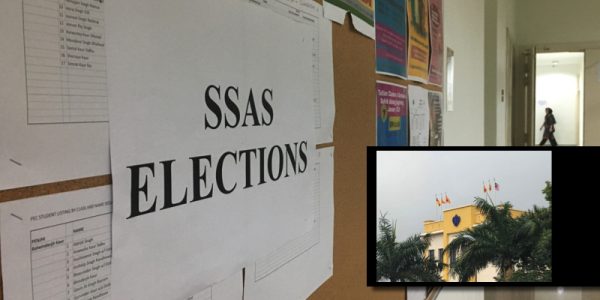
What happenned? This question made me take a drive to the gurdwara building where the election was being conducted. I wanted to hear first hand from the people involved and some of the members.

Both sides had engaged in active lobbying. They circulated via Whatsapp and Facebook their respective lineup and their manifesto. They made their case and canvassed for votes.

“The week has been intense,” one of the candidates told me when I bumped into her just days before the Subang Sikhs D-Day.

In a nutshell, two things. One, growing pains of a group running an association that has now added a gurdwara of their own making. Running an association is challenging, running a gurdwara even more so. This band of sevadars now face the reality of running a gurdwara and the all that comes with it. Ask anyone who has done it and they will tell it’s no walk in the park.

Second, managing the fallout of an on-going debate on the reinterpretation of what is Sikhi. The debate is global and has been making its round for some time now. And the debate is real, regardless whether you are plugged into it or not. The change proponents want to effect changes immediately, others say go slow. On the other opposite side of the divide are those who do not agree with the reinterpretation and desire status quo.

“Why the need to make all these maryada changes? Let’s us just stick to what our forefathers have been practicing,” another contendor told me.

The maryada debate has taken its toll on this local community. You can sense the after-effects. I think we need to go slow on the changes, if warranted. We must first educate ourselves on issues at play. But that’s a topic on its own, perhaps for another day.

But not everyone is concerned with  maryada. “I’m voting for people who have been serving at the gurdwara over the past year,” said one member. “No votes for faces I don’t recognise.”

And the members spoke at emergency general meeting yesterday (4 May 2019).

Now, the more important bit. How will this winning side rally as many members of the Sanggat to common objectives? Let’s not talk about the elusive unity. I would settle for a good portion of Sanggat coming together to make a difference in their lives and the lives of their fellow seekers.

In the past, the Subang Sikh team talked about running more than a gurdwara. Time to make it happen.

RELATED STORY:

Amrick Singh’s team make clean sweep of Subang gurdwara elections (Asia Samachar, 4 May 2019)

Subang gurdwara built for RM4.8m, no cost overrun (Asia Samachar, 21 April 2018)


ASIA SAMACHAR is an online newspaper for Sikhs / Punjabis in Southeast Asia and beyond. Facebook | WhatsApp +6017-335-1399 | Email: editor@asiasamachar.com | Twitter | Instagram | Obituary announcements, click here |

What is the role of the Khalsa today?

0
Sikh army at Toronto Vaisakhi parade 2019 – Photo grab from Global News video
By Gurnam Singh | UK | OPINION |

What is the role of the Khalsa today?

Seeing pictures of Canadian Sikh Soldiers marching at the recent Basakhi parade in Toronto reminded of a thought I had about the role of ‘Khalsa’ Sikhs in today’s world.

In its original constitution the Khalsa army served under the leadership of Guru Gobind Singh and Banda Singh Bahadur fighting Mogul imperialism. After the Guru period, the Khalsa Army was reconstituted during the rule of Ranjit Singh. Their role was to defend the essentially secular and inclusive system that Ranjit Singh established, and this led to 50 years of relative stability. One might say it was the high point of the Khalsa Army.

Following annexation of the Panjab in 1849 much of the Khalsa Army was incorporated into the British India Armed forces under the guise of Sikh Regiments. And after partition, there was a steady decline with the absorption, dismantling and diminishing of Sikh Regiments and the Sikh presence in the Indian Army.

Today, with what might be seen as the remnants of the ‘original’ Khalsa, we are left with a motley crew of Nihang Singh’s roaming across India and now further afield, claiming to be the true Khalsa fauj/Army. Whilst they have managed to preserve some of the old traditions of the Akali Nihangs, it is absurdly obvious that, like the Japanese Samurai, the Nihangs are a ceremonial relic and totally incapable of fighting any modern armed conflict.

And so the question emerges, how can a Sikh who wants to literally live the warrior lifestyle, as saints and soldiers, do so in today’s age of modern warfare? There are three options;

One is to dress up in the Nihang robes and participate in festivals and perform Gatka and Shastar Vidiya. There is a place for this, but much of its value is related to cultural heritage and personal fitness and self esteem.

The second option is for Khalsa Sikhs to engage in social and political activism and fighting for human rights. It is not enough simply to participate in religious rituals and still claim to be a Khalsa. Today, we have a real possibility that climate change will destroy the lives of millions in the near future, and we therefore can/should become eco-warriors and participate in direct action. Indeed, the Khalsa should be leading the struggle for social and environmental justice.

The third and perhaps most controversial option is, like those young Canadian Sikhs in the picture, to join the respective armed forces of ones adopted country. Now that the Khalsa is spread throughout the world, it is incumbent on us to serve our adopted countries, but in doing so we must maintain the highest moral and ethical standards. Remember, the primary aims of an Armed force is ‘defence’ and this should never be compromised by the Khalsa. In defending our respective adopted countries we should always fight to defend the innocent, weak and freedom.

If the Khalsa is to retain some relevance as a force capable in the modern age, then perhaps it needs to develop a much broader canvas on which to fight against injustice. This does not mean disposing of old traditions, but rather to see these in the right context. Many regiments in the British Army, for example, have deep traditions, which they celebrate on ceremonial occasions. However, when it comes to preparing for battle, they deploy the most modern training, technology and weaponry.

And so perhaps it’s wrong to suggest the Khalsa has to chose from the options presented earlier and in reality the Khalsa should tick all three boxes, that is; to remain true to tradition, never shun from fighting for good causes, and finally, whilst being loyal ones adopted country, never compromising on ethics.

[Gurnam Singh is an academic activist dedicated to human rights, liberty, equality, social and environmental justice. He is a Visiting Fellow in Race and Education at University of Arts London and a Visiting Professor of Social Work at University of Chester as well as a presenter at UK-based Akaal channel. This views were shared on his Facebook page on 4 May 2019]


RELATED STORY:

Subang gurdwara built for RM4.8m, no cost overrun (Asia Samachar, 21 April 2018)


ASIA SAMACHAR is an online newspaper for Sikhs / Punjabis in Southeast Asia and beyond. Facebook | WhatsApp +6017-335-1399 | Email: editor@asia

Amrick Singh’s team make clean sweep of Subang gurdwara elections

By Asia Samachar Team | MALAYSIA |

Amrick Singh, the long-standing chief of the Subang Sikh Association Subang (SSAS) until he resigned in December 2018, and his team made a clean sweep of a keenly contested elections today (4 May 2019).

Amrick and his team secured between 132 and 150 votes each from the 256 members who turned up to vote for SSAS management commitee which manages the one-year old Subang gurdwara.

The alternate team was led by Awtar Singh Gill, another SSAS veteran sewadar.

“Let us move forward together,” Amrick told the house immediately after the results were announced by Amar Singh, the retired Malaysia police commissioner.

“We are the servants of the community,” he added.

On his part, Amar said: “Be the cohesive voice rather than a divisive entity. Bind everyone together. The purpose of standing for elections is to do Guru Ji’s work.”

The top 13 elected members will decide among themselves their respective roles.

UPDATE: The lineup, as shared online by Autar Singh who chaired the meeting of the 13 elected SSAS exco members to define the committee roles: President – Amrick Singh, VP 1 – Amanjeet Singh, VP 2 – Bhajan Kaur, VP 3 – Darshan Kaur, Hon Sec – Ranthir Kaur, Asst Sec – Jasbir Kaur, Treasurer – Kulwant Kaur, Asst Treasurer – Tervander Singh; Committee Members: 1. Balvinder Singh 2. Harjinder Kaur 3. Jugindar Kaur 4. Preton Singh 5. Amarjit Singh


RELATED STORY:

Subang gurdwara built for RM4.8m, no cost overrun (Asia Samachar, 21 April 2018)


ASIA SAMACHAR is an online newspaper for Sikhs / Punjabis in Southeast Asia and beyond. Facebook | WhatsApp +6017-335-1399 | Email: editor@asiasamachar.com | Twitter | Instagram | Obituary announcements, click here |

Malaysia’a highest ranking Sikh federal counsel now a judicial commissioner

Amarjeet Singh Serjit Singh – Photo: Malaysia AG’s Chamber website
By Asia Samachar Team | MALAYSIA |

The highest ranking Sikh federal counsel Amarjeet Singh Serjit Singh in Malaysia has been appointed as a judicial commissioner (JC).

Amarjeet, who headed the civil division at Attorney-General’s Chambers (AGC), was a household name in Malaysia for appearing on behalf of the government in various high profile cases.

At the division, their vision was to guarantee all civil actions taken by or against the Government of Malaysia being handled professionally and efficiently by ensuring a high standard of advocacy and ethics.

After the change of government following the May 2018 general elections, Amarjeet got a new boss in Tommy Thomas as the AG.

The AG is the principal legal adviser to the Government of Malaysia as well as the highest ranking public prosecutor in the country.

Amarjeet was one of the 11 JCs to receive their appointment letters from newly appointed Chief Justice Tengku Maimun Tuan Mat. They took their oath of office and allegiance before Chief Judge of Malaya Zaharah Ibrahim and Chief Judge of Sabah and Sarawak David Wong Dak Wah.

Across the causeway, Singapore’s ace intellectual property litigator Dedar Singh Gill was appointed as the republic’s Supreme Court as a judicial commissioner. His two-year appointment is effective 1 August 2018.


RELATED STORY:

Singapore IP ace lawyer Dedar Singh Gill made judicial commissioner (Asia Samachar, 18 June 2018)


ASIA SAMACHAR is an online newspaper for Sikhs / Punjabis in Southeast Asia and beyond. Facebook | WhatsApp +6017-335-1399 | Email: editor@asiasamachar.com | Twitter | Instagram | Obituary announcements, click here |

News, Good & Bad

0
By I.J. Singh | OPINION |

A la Cassandra, the legendary seer of ancient Greek mythology, I bring you news, good and bad; welcome and not so welcome.  Even though her predictions were true she was cursed by Apollo so that no one would believe her.

My simple purpose today is to foster a conversation.

I came to America in 1960 well before the eras of Jack Kennedy or Martin Luther King.  There were perhaps three recognizable Sikhs in the New York area, and obviously no gurduara. When people asked if I and my kind had a place of worship nearby my response depended on the company and the questioners.   A flip answer was “Yes there is but it’s about 3000 miles away in California.”

During my years in Oregon in the heady 1960’s I learned that several neighboring states had no gurduara and perhaps a rare Sikh or two.  I mean here Oregon, Washington, Idaho, Utah, Wyoming, Montana, the Dakotas and many more in the Midwest that had no gurduara. Things have changed but not all that much.  Oregon and Washington now have two or three gurduaras each, and I am not so sure about the others.

On the eastern seaboard where I now live there are presently perhaps 20 or more within commuting distance.  And many more are sprouting every day.  I have lost count of how many exist and flourish in the United States and Canada but I know that the number is larger than 200.

As an aside we do need a comprehensive directory of gurduaras in North America but the landscape changes in a trice.

We have dissected minutely and ruefully how disorganized gurduara management often is, how distasteful their organizational shenanigans, and how poor and largely irrelevant their programs and activities.  (I know there are some exceptions to my overarching judgmental tone but that’s not the issue today.)

We unfailingly pick up on such matters and these then lead us to passionate disagreements and divisions within the community.  Of course, we are weighing them from the perspective of our place in the diaspora far from the comfortable (?) cocoon of Punjab and India.

But one thing we can all agree on.

The investment, financial as well as of blood sweat and tears, in our gurduaras is phenomenal for an immigrant community.  Keep in mind that our formidable presence here dates to barely 40 years, even though Sikhs have been in the U.S.A. since the Panama Canal was constructed in 1903-04.

I remember when in New York’s Big Apple we held worship services, first monthly and sometime later weekly, in a small rental hall — the cheaper the better.  I remember when we looked for abandoned churches to buy and convert to gurduaras.  Nothing surprising in this, shifting demographics made these buildings available and our growing presence hungry for suitable space made it necessary.

How things have changed.

I see now that the new gurduaras going up are majestic gilded palaces – multimillion dollar shining marble monuments on the hill guaranteed to grab your attention.  But they remind me of “White Elephants.”

Emotions and sentiments are hard to compromise.  I see that when the Sikh community feels flush and pushed for a more spacious or attractive place the idea is floated that perhaps we can sell the old, smaller, more modest gurduara building to others – even to non-Sikhs.

But such proposals are squashed faster than an irritating bug, often without a community debate. The logic (or ill-logic) pushed forward is simplistic to the extreme; to wit, that no gurduara building is ever sold; it is irreverent or sacrilegious even to entertain the idea.  Money may be raised to expand and renovate, even demolish and renew but to never abandon the old facility or the land that was once a gurduara, hence hallowed ground.  Incidentally, I know of a Midwestern gurduara that is now painfully wrestling with the choice to sell or not to sell its building.

I have thought some about these matters and, but recently the related attitudes resurfaced in The New York Times.

After more than two centuries in New York the Roman Catholic Church is re-examining its place in a new changing world and how its goals are best served.  The administrative structure is being reconfigured.

Historically, parish is the territorial unit of a church; it covers a given geographical area and its people.  Such diocesan administrative units are commonly seen in the Roman Catholic, Anglican and some other denominations of Christianity.

New York is a large territory with 2.8 million Catholics in 368 parishes.  Economy has shrunk, money is tight, church attendance is not what it used to be, and skilled clergy not as plentiful.  The focus naturally has shifted to reorganization.

The plans are that out of 368 parishes 112 be merged to recreate 55 new parishes.  Clearly as many as 57 parishes would be shuttered and, sooner or later, many may be sold.

How is the Church responding? Most community churches are not mega-churches, not white elephants, not majestic like St. Patrick’s Cathedral or others of that ilk.  The historical cathedrals speak of history and tradition and will be preserved; many storefront churches serve the community and may be reorganized and recombined, opened or closed as needed.

Of course, this is unsettling old traditions and many church goers are becoming increasingly uncomfortable.

Now look at this: In building gurduaras in America the emphasis seems to be on bigger is better, the gaudier it is the more traffic it would have.  Do we think the gurduara is an advertisement of the financial success of the community?  We also need to re-explore the immigrant community in the diaspora outside the cocoon of Punjab and how best will their needs be served now and in time.

An aside I am intrigued by the Orthodox Jewish idea of building synagogues that are no more than a 15-minute walk for anyone; this promotes learning, neighborliness and a better esprit de corps in the community.  The mega-gurduaras would always have a place but small store front gurduaras would nurture congregational cohesiveness.

Keep in mind that what distinguishes a great university from Podunk College is not so much the marble or the gold but the content and quality of the faculty, students and academic programs.

My purpose today is not to scare Sikhs into a passive-aggressive stance or a defensive crouch but to put our thinking turbans on.

I suppose as long as there is a substantial wave of new immigrant Sikhs arriving in North America there would remain a growing need for new gurduaras to capture the ambiance of a glorious Punjab but what would happen when demographic trends change, as they eventually will.

Will we abandon and sell our old gurduaras that no longer fill our need?  Will they re-emerge as churches and temples again to cater to a new bloc of immigrants from a different culture and religious calling?


[I.J. Singh is a New York based writer and speaker on Sikhism in the Diaspora, and a Professor of Anatomy. Email: ijsingh99@gmail.com]

* This is the opinion of the writer, organisation or publication and does not necessarily represent the views of Asia Samachar.

RELATED STORIES:

Pride Before A Fall? (Asia Samachar, 7 March 2019)

The narcissism of small differences (Asia Samachar, 11 Feb 2019)


ASIA SAMACHAR is an online newspaper for Sikhs / Punjabis in Southeast Asia and beyond. Facebook | WhatsApp +6017-335-1399 | Email: editor@asiasamachar.com | Twitter | Instagram | Obituary announcements, click here |

14 Sikh high schoolers get waivers to enter US army basic with beard, turban

Army Lt. Col. Kamal Kalsi, president of Sikh American Veterans Alliance (SAVA), and Manav Sodhi, a high school student who received a religious accommodation from the Army to wear the Sikh turban and beard. — Photo: Matt Thorn/Military.com
By Matthew Cox | MILITARY.COM | US |

Following graduation this June, Manav Sodhi will help lead a new wave of Sikh soldiers enlisting in the U.S. Army who will be allowed to wear the traditional turban and beard in Basic Combat Training.

Sodhi, who is currently attending Kings Park High School in New York, was recently granted a religious accommodation by the Army, according to the Sikh American Veterans Alliance (SAVA).

“I wanted to join the Army ever since I was a kid,” Sodhi said in a recent SAVA news release. “My great grandfather served in the Army, and I wanted to follow his footsteps.”

Practicing Sikhs serving in the Army are nothing new, but SAVA’s release states that Sodhi is the first high school student to receive a religious accommodation so he can enlist in the Army as a Sikh.

He is at least among the first. There are currently 60 religious accommodations that have been granted to Sikhs entering the service, according to Hank Minitrez, a spokesman for the Army. Fourteen of those were granted as pre-accession waivers to high school students like Sodhi.

Army Lt. Col. Kamal Kalsi, who is the president of the non-profit advocacy group that promotes Sikhism and military service, was surprised to learn there are 13 other high school students who will be allowed to enlist in the Army and openly serve as Sikhs.

This is a new milestone, he said.

“It shows progress,” Kalsi told Military.com, adding that he has been involved in this effort since he was granted the first such accommodation in 2009. “I was the first to get the accommodation for turban and beard way back in the day.”


Read full story, ’14 Sikh High Schoolers Get Waivers to Enter Army Basic With Beard, Turban’, (Military.com, 2 May 2019), here.


RELATED STORY:

Rakhvinder Singh shines at Malaysian navy cadet officer graduation (Asia Samachar, 18 March 2019)

Dashing new front for UK Sikh police (Asia Samachar, 11 Feb 2019)

I’m a Sikh American. I’m proud to serve. (Asia Samachar, 9 June 2017)

He’s now Lt-Col Kamal Singh Kalsi (Asia Samachar, 5 Feb 2017)

US Army fitting present for Guru Gobind Singh birthday (Asia Samachar, 6 Jan 2016)


ASIA SAMACHAR is an online newspaper for Sikhs / Punjabis in Southeast Asia and beyond. Facebook | WhatsApp +6017-335-1399 | Email: editor@asiasamachar.com | Twitter | Instagram | Obituary announcements, click here |

Ipoh-born Alinder made VP for innovation at Malaysia’s transport infrastructure provider

Alinder Kaur Chall – Photo: LinkedIn Profile
By Asia Samachar Team | MALAYSIA |

Alinder Kaur Chall has been appointed as a vice president at Prasarana Malaysia Bhd, the state-owned company driving the transformation of Malaysia’s public transport systems and services.

As the Vice President for Innovation (Human Capital Division), the Ipoh-born trainer will be focussing on talent development for the mammoth entity with a work force of some 9,600 people.

“I am responsible to design and recommend accelerated talent development programmes, tools, and contents across multiple platforms, including classroom training, e-learning, blended learning and webinars for identified emerging leaders of Prasarana that are tied to Prasarana business strategies,” according to an entry at her LinkedIn profile.

Alinder’s father is a retired air force officer and mother is a retired teacher. They live in Ipoh, Perak.

Alinder has a Master’s in Environmental Sciences from Universiti Putra Malaysia and a Bachelor’s in Biotechnology from USCI. She was most recently a life skills trainer at Taylor’s Education Group.

Transport infrastructure provider Prasarana owns and operates the country’s urban rail services that include three LRT networks and the KL Monorail, in addition to operating the MRT line.

Prasarana also owns and operates the stage bus services in Kuala Lumpur, Selangor, Penang, Perak and Pahang. It also provides management and engineering consultancy services locally and abroad, undertakes commercial and transit-oriented development projects within its assets, as well as key public transport infrastructure projects in the country.


RELATED STORY:

Bersih activist Zoe Randhawa appointed to Malaysia’s Election Commission (Asia Samachar, 4 Feb 2019)


ASIA SAMACHAR is an online newspaper for Sikhs / Punjabis in Southeast Asia and beyond. Facebook | WhatsApp +6017-335-1399 | Email: editor@asiasamachar.com | Twitter | Instagram | Obituary announcements, click here |

Piar Kaur (1934-2019), Petaling Jaya

AKHAND PATH: 2-4 May 2019 | Malaysia
Piar Kaur (1934-2019), Petaling Jaya

MATA PIAR KAUR D/O ALA SINGH 

WIFE OF CHATAR SINGH (LLN)

Mata Ji passed away peacefully with her family by her side. She leaves 7 children, 14 grandchildren and 7 great grandchildren to celebrate the life she led.

Her name means Love and she was the embodiment of love and compassion, giving inspiration and solace to so many people in their time of need.

Akandh Paath will commence at her residence at 8pm, 2 May 2019 (Thursday) with Path Da Bhog at 7pm, 4 May (Saturday)

Antim Ardas will be at Gurudwara Sahib Petaling Jaya on 5 May (Sunday) at 12 noon. Program will commence at 10am.

Contact: Manmohan 019-380 9315, Ajeet 012-212 4007

SEE ALSO ‘The Grand Lady of No 81, Jalan Templer passes away’ (Asia Samachar, 29 April 2019), here.


| Entry: 1 May 2019 | Source: Family |

ASIA SAMACHAR is an online newspaper for Sikhs / Punjabis in Southeast Asia and beyond. Facebook | WhatsApp +6017-335-1399 | Email: editor@asiasamachar.com | Twitter | Instagram | Obituary announcements, click here |

Mender Singh (1937-2019), Serendah

SASKAAR / CREMATION: 3pm,1 May 2019 (Wednesday), at Serendah crematorium. Cortege leaves residences No 1, Stesyen Road, Serendah, at 2.30pm | Malaysia
Mender Singh (1937-2019), Serendah

SARDAR MENDER SINGH A/L PAN SINGH 

Departed: 1 May 2019

Saskaar / Cremation: 3pm,1 May 2019 (Wednesday), at Serendah crematorium

Contact:

Darshan Singh 017 311 3152

Gurmeet 012 239 7767


Leaving behind a host of beloved family, relatives, children and grandchildren

WE MISS YOU MUMMY AND DADDY 


| Entry: 1 May 2019 | Source: Family |

ASIA SAMACHAR is an online newspaper for Sikhs / Punjabis in Southeast Asia and beyond. Facebook | WhatsApp +6017-335-1399 | Email: editor@asiasamachar.com | Twitter | Instagram | Obituary announcements, click here |

Khalsa Aid founder Ravi Singh in Mosul

0
Ravi Singh from Khalsa Aid with students near Mosul, Iraq – Photo: Khalsa Aid

Empowering the ladies in Iraq.

“Their school near #Mosul was damaged & closed by ISIS. I visited the school last year & gave the go ahead for renovation. School is now open and providing education to 100s of children. Let’s keep making the world a better place for everyone and give a future to those who are struggling,” Khalsa Aid founder/CEO Ravi Singh shares in a recent social media posting.

To donate, click here.


RELATED STORY:

Start by doing service locally, urges Khalsa Aid founder (Asia Samachar, 24 Dec 2018)

Ravi, does publicity get to your head? (Asia Samachar, 17 Aug 2016)


ASIA SAMACHAR is an online newspaper for Sikhs / Punjabis in Southeast Asia and beyond. Facebook | WhatsApp +6017-335-1399 | Email: editor@asiasamachar.com | Twitter | Instagram | Obituary announcements, click here |