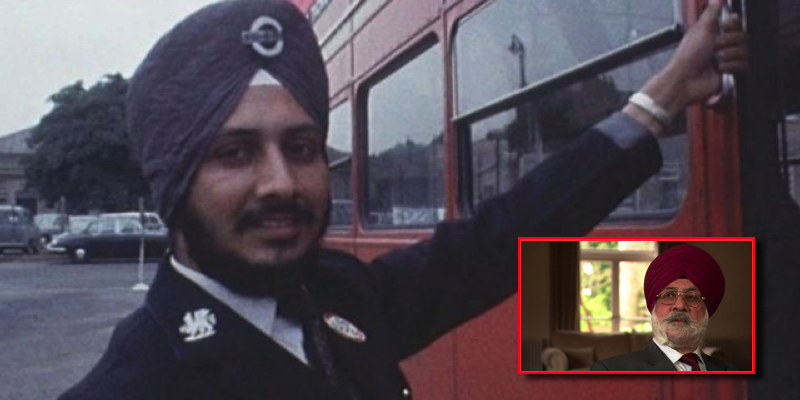
Fifty years ago, Sikhs working on Wolverhampton’s buses won the right to wear the turban at work. It followed a long-running dispute during which one Sikh man threatened to set himself on fire.
It was a time when racial tensions there were high, with the city’s most famous MP Enoch Powell saying the country was “heaping up its own funeral pyre” by permitting mass immigration.
The Express and Star newspaper reported the turban dispute “could bring chaos to the town’s bus services”, but it was not just public transport that faced upheaval.
Refusing to remove his turban or shave his beard, Tarsem Singh Sandhu sparked a row that spread across the world and saw the nation’s racial tensions and identity politics played out on Black Country double-deckers.
At 23, he began working as a bus driver with Wolverhampton Transport Committee which at the time employed 823 drivers, 411 of whom were Indian.
“I couldn’t see anyone in Wolverhampton at that time with a turban,” remembers Mr Sandhu, who arrived in the Midlands in his 20s more than 50 years ago.
Wolverhampton was different back then, he said. He remembers the racism, the teddy boys, and when he plucked up the courage to wear his turban, colleagues wearing crude mockeries on their heads.
Wolverhampton is now home to the UK’s second largest Sikh population. “Somebody has to take a stand whenever something is not being done right and put it right,” Mr Sandhu said. “I was proud I did that.”
Read the story, The turban-wearing British bus driver who changed the law (BBC, 30 April 2019), here.
ASIA SAMACHAR is an online newspaper for Sikhs / Punjabis in Southeast Asia and beyond.Facebook | WhatsApp +6017-335-1399 | Email: editor@asiasamachar.com | Twitter | Instagram | Obituary announcements, click here |
Brothers, Sisters, Brothers-In-Law, Sisters-In-Law, Newphes, Nieces, a host of relatives and friends
Path Da Bhog: 11 May 2019 (Saturday), 9.30am-12pm, at Gurdwara Sahib Alor Star, Kedah. Guru Ka Langgar will be served thereafter.
Contact: 016-4638510 / 016-4711912 / 019-4270724
| Entry: 30 April 2019 | Source: Family |
ASIA SAMACHAR is an online newspaper for Sikhs / Punjabis in Southeast Asia and beyond.Facebook | WhatsApp +6017-335-1399 | Email: editor@asiasamachar.com | Twitter | Instagram | Obituary announcements, click here |
FIRST BARSI: 19 May 2019 (Sunday), 9am – 12pm, at Gurdwara Sahib Sitiawan |Malaysia
Shamsher Singh (1930-2018), Sitiawan
SARDAR SHAMSHER SINGH S/O LAKHA SINGH
Village: Dholpur Batala
Born: 16 April 1930
Departed: 29 May 2018
Don’t let the sadness of our fathers passing fill your heart with sorrow. Instead, fill it with happy memories of him, for he was a good man with an incredibly good heart, a good husband, a brilliant father and most of all, a genuine person and that memory will keep him alive in our hearts till eternity.
Great Grandchildren: Liam Singh, Shay Cooper, Courtney Fitzgerald, Ryan Fitzgerald, Demi Palmer
Path da Bhog: 19 May 2019 (Sunday), 9am – 12pm, at Gurdwara Sahib Sitiawan
Contact:
Ravi +60124227012
Govin +60124955881
| Entry: 30 April 2019 | Source: Family |
ASIA SAMACHAR is an online newspaper for Sikhs / Punjabis in Southeast Asia and beyond.Facebook | WhatsApp +6017-335-1399 | Email: editor@asiasamachar.com | Twitter | Instagram | Obituary announcements, click here |
Family medicine physician Dr Jasmeet Kaur Bains has been honoured by the California-based medical fraternity as an hero.
At its recent event, California Academy of Family Physicians (CAFP) had honoured the Taft-based physician as the CAFP 2019 Hero of Family Medicine.
“Dr Bains is a force for good, a force for Family Medicine, a force for justice,” CAFP twitter qouted a fellow medical practitioner.
“She’s an amazing physician in terms of being able to take great care of patients but also does that in the context that it really differentiates her,” CAFP president Dr. Walt Mills was quoted in a report in Bakersfield.com. “She sees her patients as being part of families and even more part of the community, so she’s actively engaged in working on improving the health of the community that her patients live in.”
Jasmeet works as a family medicine physician means she is involved in “all aspects of healthcare,” including pediatrics, geriatrics, gynecology. Her mission has been to provide care for underserved populations.
In an effort to connect with more patients, she speaks English, Spanish and Punjabi. She also works closely with the developmentally disabled population of Kern County and is focused on continuity of care.
“My vision of a family med physician is someone that is able to see you (and) … knows you from the day you were born until the day you hit the ground,” she told the newspaper.
The report captured her story, noting that Jasmeet was working at her father’s car dealership in Taft, selling cars and doing accounting work, when the stock market crash in 2008 forced her to come to a few realizations.
The report added:
She had planned to spend her life working in business and the automotive industry until she witnessed the effects of the recession. She saw parents unable to afford trips to the doctor and having to forgo healthcare for their children. It reminded her of a scene out of John Steinbeck’s novel “The Pearl.”
Around the same time, Bains’ close friend suffered a heart attack in his home. With no hospital in Taft, the friend’s only option was to call emergency services. He died in the 20 to 30 minutes it took them to arrive, Bains said.
“It angered me that such basic level of healthcare cannot be provided for people at the time that they need it most,” she said.
Bains decided to reverse course and go to medical school to become a doctor. She attended medical school at the American University of Antigua, graduating in 2013, and then returned to Kern County to do her residency with the Rio Bravo Family Medicine Residency Program at Clinica Sierra Vista in Bakersfield.
See full story, ‘Taft doctor honored as ‘hero’ for work in family medicine (Bakersfield.com, 31 March 2019), here.
ASIA SAMACHAR is an online newspaper for Sikhs / Punjabis in Southeast Asia and beyond.Facebook | WhatsApp +6017-335-1399 | Email: editor@asiasamachar.com | Twitter | Instagram | Obituary announcements, click here |
She may not have been the face of major Sikh activities and events, but Piar Kaur Ala Singh has played a momentous behind-the-scene role for the Malaysian Sikh community.
Bibi Ji, as many fondly call her, passed away yesterday (28 April 2019). She was 85.
She was the wife of Chatar Singh, an active Sikh volunteer and a former Jathedar (chief) of the Sikh Naujawan Sabha Malaysia (SNSM), from 1974 to 1977.
For a good part of the 1970s, their bungalow opposite the Assunta Hospital in Petaling Jaya served as the headquarters of the SNSM.
“No 81, Jalan Templer was an iconic address. Many Sabha exco meetings were held here. The Sabha magazine was also printed from our home,” Piar’s son Manmohan Singh tells Asia Samachar.
“My dad used to type out the pages and then print the magazine on the cyclostyle machine. It was hand-driven. I used to operate the machine,” he added.
With all the meetings and gatherings, Bibi Ji would play a pivotal role in ensuring hospitality at the bungalow which the family occupied in 1961.
“Everyone would come over to our home – family and extended family members as well as friends. Many had stayed here, some up to a year, when they moved into the city from their hometowns. My mum made would make sure that everyone was comfortable, that they got their meals,” he said.
Manmohan and his six other siblings had also played active roles in the Sikh community affairs. Manmohan himself served SNSM in various capacities, including as a Meet Jathedar (deputy chief) in 2017.
His younger brothers Sarabjeet Singh and Inderjeet Singh had served the SNSM as exco member and secretary, respectively. They both now live in Canada.
Born in Punjab in 1934, Piar moved to Malaya when she was just three years old. Her dad, Ala Singh, was handling accounts for the national train company Keretapi Tanah Melayu (KTM). She grew up in Sentul, Kuala Lumpur.
“He got so many Sikhs a job in KTM,” said Manmohan.
Bibi Ji would meet her future husband in Sentul when he did kirtan at the gurdwara that was then known as the Railway gurdwara. Born in Taiping, Perak, Chatar was active in athletics and rugby. He was a staunch Tiger (old Edwardian).
Chatar had moved to Kuala Lumpur after his studies. They married in 1954.
She leaves behind 14 grandchildren and eight great-grandchildren.
The saskaar (cremation) will be at MBPJ Crematorium in Kampung Tunku at 3pm, Thursday (2 May 2019). (Date corrected).
The SNSM Jathedar listing on a plaque found at its national headquarters in Kuala Lumpur – PHOTO / ASIA SAMACHAR
ASIA SAMACHAR is an online newspaper for Sikhs / Punjabis in Southeast Asia and beyond.Facebook | WhatsApp +6017-335-1399 | Email: editor@asiasamachar.com | Twitter | Instagram | Obituary announcements, click here |
For centuries, we have been made to believe that God created man in His image. However, when Nanak took over to tell us the truth, he began to tell me that it was the other way around. In fact man created God in his image, an anthropomorphic god.
I am using this term, anthropomorphism, to describe a God with the attributions of a superhuman who exhibits humanistic characteristics; he is a perfect, all-powerful, and all-knowing superhuman. This God has a place of residence several skies away, with the capability of knowing everything that is happening with everyone on earth. Such God possesses powers to do justice through punishments and rewards.
He listens to prayers and accepts gifts to grant favors to the favorites or punish adversaries, and he also punishes those who do not believe. He determines and changes the destinies of people and nations. He has the ability to appear or disappear at will. He may be born outside of the womb and die at will.
Such an anthropomorphic God manages humanity through staff like angels, messengers, demons, devils, etc. His representations in various physical forms, such as prophets, scriptures, statues, and paintings need and accept materials that are there to meet human needs. They include clothing, food, temperature-controlled environments, flashy means of transportation, courtiers, fine music and dancers, etc.
To create an anthropomorphic God was man’s sure way to appoint himself as God’s agent and as his administrative authority. Further, this opened the way to create and deepen communal identities. It permitted retreat into the very segregated wedges and fractions between and among various faiths and faith communities.
The worst of all is that this anthropomorphic God made it easier to keep Man apart from the real Creator, God that was manifested in all creations. Nanak called it Ek Ongkaar.
Since the time that Nanak came on this earth, he began telling the truth. He gave me and others, without any discrimination, new and innovative eyes of knowledge with vision and wisdom. He let me examine the question of God more logically.
He taught me and given me the healing eyedrops of spiritual wisdom so that with my spiritual eyes, I visualize the Creation
As the benefactor of the new wisdom, I began to call myself a Sikh, meaning a wisdom seeker. Then, I felt no need to be obsessed with an anthropomorphic god sitting on his throne in heavens and loaded with extensive secretariats as well as numerous other means of enforcing obedience among us to their god.
In contrast to man’s earlier exploits, Guru Nanak told me of the single virtual reality. Also, it was not far from my eyes; I could see it in nature and in the creations all around me, and all within me. He named this reality, Ek Ongkar, meaning, one virtual reality manifested in all creations. That, the forces of creations and the laws of nature actually maintained a beautiful world for me to relish. Here everything has been functioning meticulously since the time immemorial.
And, above all, I need not live in a fear of the angels of death, haughty and cruel, waiting to take me to imaginary heavens and hells. They are not there anymore to scare me and to torture me. Instead, Nanak told me that this world is created for me to relish, and, that it will be always there in my service, not to fear but to rule. Nanak said,
Other living forms are your water carriers (servants); in this world, you are the ruler.
Guru Nanak told me that life was an opportunity to seek and merge with the Divine and her creation.
Harbans Lal, Ph.D.; D.Litt (Hons) is the Professor Emeritus & Chairman at the Dept of Pharmacology & Neurosciences, University of North Texas Health Science Center. He is also the Professor Emeritus at the Amritsar-based Guru Nanak Dev University as well as President of the Academy of Guru Granth Studies. He can be reached at Japji2050@gmail.com. Link to the original article.
* This is the opinion of the writer, organisation or publication and does not necessarily represent the views of Asia Samachar.
ASIA SAMACHAR is an online newspaper for Sikhs / Punjabis in Southeast Asia and beyond.Facebook | WhatsApp +6017-335-1399 | Email: editor@asiasamachar.com | Twitter | Instagram | Obituary announcements, click here |
Kiranjit Ahluwalia (centre) upon being released by the courts – Photo: SBS
By Gurnam Singh | UK | OPINION |
Exactly 30 years ago a Panjabi Sister decided to do what we Panjabis take pride in, and that was to fight back against tyranny and oppression.
On April 1989, following more than 10 years of physical and psychological abuse at the hands of her cruel tyrant husband, and fearing for her death after a incident when he pressed a hot iron to her face, Kiranjit decided to set fire to him. For her ‘crime’ she was given life imprisonment, but following a massive campaign, she was eventually released and the law was changed.
The biggest tragedy of Kiranjit’s case, and many others like this of domestic violence, is that our religious organisations either turn a blind eye or protect the offenders, especially so if they have an outwardly ‘religious’ appearance.
Without the wonderful work of organisations like Southall Black Sisters (SBS), who have been fighting both British state racism and oppressive myogenic attitudes and practices within the South Asian community for decades, I fear that freedom fighters like Kiranjit would either have not lived to tell their story or languished in prisons.
And perhaps for me the biggest sense of shame is with my own, especially those who claim to be ‘true Khalsa Sikhs’ for their indifference to the rampant patriarchy and mysogeny that exists within the community and its institutions.
I have no hesitation is saying that it is groups like the Southall Black Sisters that have done most in putting into practice the teachings of Guru Nanak who confronted the oppression of women in times where even ISIS would have been deemed to be a moderate organisation.
Whilst feminist and anti-racist activists have been working in the community and corridors of power to get justice, we have become imprisoned in caste based temples where women are treated as second class, and perverted Baba’s (God men) are free to abuse all and sundry.
[Gurnam Singh is an academic activist dedicated to human rights, liberty, equality, social and environmental justice. He is a Visiting Fellow in Race and Education at University of Arts London and a Visiting Professor of Social Work at University of Chester as well as a presenter at UK-based Akaal channel. This views were shared on his Facebook page]
On a spring evening in 1989, Deepak Ahluwalia pressed a hot iron to his wife’s face, her hair gripped tightly in his fist.
The iron burned her skin as she struggled in his grasp, leaving a mark on her face. Kiranjit Ahluwalia said the incident – after what she says was a decade of abuse at her husband’s hands – tipped her over the edge.
“I couldn’t sleep, I was crying so badly. I was in pain, physically and emotionally,” she told the BBC, 30 years on. “I wanted to hit him. I wanted to hit him the way he hit me. I wanted to hit him so he could feel the same pain I was feeling. I never thought further. My brain had totally stopped.”
That night, while he slept in bed, she doused her husband’s feet in petrol and set him alight. She grabbed her son and ran out of the house.
“I thought, I’m going to burn his feet, so he won’t be able to run after me. I will give him a scar so he will always remember in the end what his wife did to him. So every time he sees his feet with a scar, he will remember me.”
Kiranjit maintains she did not mean to kill her husband. But 10 days later, Deepak died from his injuries. In December that year, Kiranjit was convicted of his murder and sentenced to life in prison.
Her case was taken up by Southall Black Sisters (SBS), an advocacy service for black and Asian women.
Her release set a historic precedent – the court accepted that women who are victims of abuse may have more of a “slow-burn” reaction when provoked, rather than an immediate response.
Kiranjit’s appeal remains SBS’s most notable case since it was established 40 years ago. As the group celebrates its anniversary, it screened the film made about the case, called Provoked, over the weekend as part of the UK Asian Film Festival, which will run across the country until May.
Capturing Kiranjit’s story, SBS says that it was the outfit’s first case where it supported and campaigned on behalf of a battered woman who had killed her husband. It noted:
At her appeal hearing in July 1992 which was presided over by the then Lord Chief Justice, Taylor, Kiranjit’s barristers put forward new defences of provocation and diminished responsibility. Although the Court of Appeal rejected the grounds of provocation as a basis of her appeal, nevertheless it accepted that the defence of provocation, and in particular the requirement of a ‘sudden and temporary loss of self-control’ had been traditionally interpreted in ways which excluded the experiences of battered women. It recognised the notion of cumulative provocation and also accepted that as a matter of law, the time lapse between an act of provocation and the fatal act need not be construed as a cooling-off period. Instead, the Court accepted that the time lapse could be seen as a ‘boiling over’ period and as a factual matter that could be left to the jury to determine.
Kiranjit won her appeal on the grounds of diminished responsibility based on new psychiatric evidence of her long-standing depression due to her experiences of violence and abuse. A retrial was ordered.
However, at her new trial at the Old Bailey in London, in September 1992, the Crown accepted her plea of manslaughter on the basis of diminished responsibility and she was sentenced to three years and four months imprisonment, exactly the time she had already served. Kiranjit, therefore, walked out of Court a free woman to scenes of jubilation from the large number of supporters who had gathered outside the court.
See the full BBC story here and SBS’s account here.
ASIA SAMACHAR is an online newspaper for Sikhs / Punjabis in Southeast Asia and beyond.Facebook | WhatsApp +6017-335-1399 | Email: editor@asiasamachar.com | Twitter | Instagram | Obituary announcements, click here |
Tanmanjit Singh Dhesi, resplendent in his colourful turbans, is becoming a familiar figure in the House of Commons. Similarly, Preet Kaur Gill has made rapid progress and proven herself through her contribution to debates. Both have paved the way for many more Sikh men and women Members of Parliament in future.
Going by the UK Sikh population, the number of marginal seats and the general political environment, the political cake for aspiring British Sikhs is large. Continuing from last week, the need is for community (ਕੌਮੀ) spirit which should celebrate and build on past successes. That is a pre-condition for Sikhs who have any political ambition. Yet, regrettably, there are some who think that the only way to succeed is to first bring down those already making a significant contribution and have opened the doors to next generations.
Despite the seriousness of the topic, one is reminded of a joke — the type Sikhs invent about themselves — about Sikh prisoners in Pakistan during the Indo-Pak war, who were kept in an enclosure with a low fence while the other Indian soldiers had a high barbed wire fence around them. The logic of the Pakistani general was that while other Indians will co-operate to get over even a high fence, the Sikhs, despite their great military tradition but true to their habit, will pull down one another trying to get over it! Regrettably, such habits are in our blood.
Tanmanjeet Singh Dhesi: First turban-wearing Sikh MP.Preet Kaur Gill: UK first Sikh female MP
When entering a new field, sabat surat (full identity) Sikhs represent the community. Examples are: the first turban wearing Sikh bus driver (50 years ago), later Sikhs in uniform (army, police etc), the first judge (1982), the first turban-wearing civil servant representing UK abroad (1987), the first Lord (2011), the two MPs mentioned above (2017) and many more in other fields. The feeling when opening a new door for the community should be that of humility and pride at the same time. Humility before the Guru for the success and pride in own community and heritage. Let the community own such achievements and build on them. For the above reasons, it is most disappointing to read any negative comments from Sikhs about Sikhs who have succeeded in politics in recent years.
A related topic mentioned in communications is Machiavellian politics being adopted by individuals or small groups bent on holding on to their positions. The dictionary tells us that it is behaviour analyzed in Machiavelli’s The Prince, in which political expediency is placed above morality and the use of craft and deceit to maintain position or authority. It is characterized by subtle or unscrupulous cunning, deception, expediency, or dishonesty.
Such tactics cause divisions and general disillusionment with Sikh organisations despite their past successes. So much so, that some prefer to serve outside organisations or Panthic jathebandis. Yet, to quote a colleague, Jathebhandis and organisations, for all their flaws, are still bound by a Panthic mandate and should be supported. We keep building on the Panthic foundation and past successes.
Gurmukh Singh OBE, a retired UK senior civil servant, chairs the Advisory Board of The Sikh Missionary Society UK. Email: sewauk2005@yahoo.co.uk. The article first appeared at The Panjab Times, UK
* This is the opinion of the writer, organisation or publication and does not necessarily represent the views of Asia Samachar.
ASIA SAMACHAR is an online newspaper for Sikhs / Punjabis in Southeast Asia and beyond.Facebook | WhatsApp +6017-335-1399 | Email: editor@asiasamachar.com | Twitter | Instagram | Obituary announcements, click here |
“The shortest way to yourself is around the world.” – Richard Hoffman. Growing up in Kuching, Sarawak, I always wanted to travel and explore cultures around the world that I only knew about through movies as well as social media. Well, it is everyone’s million dollar dream to live in another country and see for themselves how true are the things that we see in such platforms about certain places.
I would have never imagined myself being living that dream in this point of life as it may sound unbelievable for an 18-year-old to spend six months living in one of the world’s most diverse country, The United States of America! All these thanks to an amazing exchange program that I came across from my high school seniors.
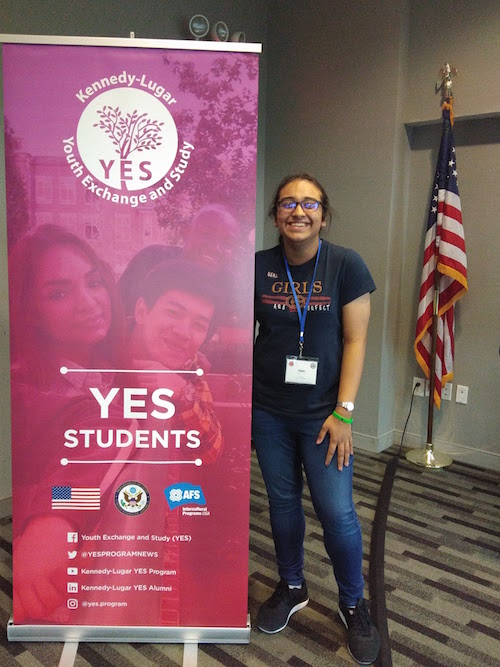
The Kennedy-Lugar Youth Exchange and Study (YES) program is an exchange program funded by U.S. Department of States and sponsored by Bureau of Educational and Cultural affairs (ECA) for high school students from countries with significant Muslim population to spend an academic year in the United States.
Established by Congress in 2002, this program is introduced as a response to the events of September 11, 2001. This program aims to bridge gap between the US and Muslim majority countries through the youth in order to create a mutual understanding among the communities around the world. Today, high school students from 38 countries such as Albania, India, Indonesia, Lebanon, Malaysia, Thailand and many others are living with host families, attending high schools, volunteering in local communities, exchanging values and cultures as well as discovering themselves in this journey throughout the US.
I am currently hosted in a small and welcoming town called Kamuela in Hawaii. Well, as exciting as it sounds to be in Hawaii, I am enjoying my time here to the fullest. I live with my wonderful host family of four and I am also attending a local school, Parker School as a senior for 6 months!
Well, I know that I mentioned earlier about the program being a year long, but for Malaysians exchange students, we only join the program in January for six months due to the SPM examination that we have to sit the year before in November. So, we have half of the program than all the other students on the program to adjust in, learn new things and cope up with homework again (It’s still fun).
But looking at the bright side, these six months help us to appreciate the given opportunity and make every single day count. I am on this life-changing journey with exceptionally awesome 39 other students who are currently hosted all around the United States making the best of their times.
EXCITING ADVENTURES
My time here has been exciting and full of adventures so far! Thanks to my host family who decided to bring me in the family, teaching new things, being patient with me and encouraging me to try new things! They seriously made my exchange wonderful and easy! Not forgetting my school! Parker is actually a family-based school with only more than 100 students which is actually very different from a lot of the school’s in Malaysia.
Everyone here knows each and I genuinely made friends with the whole school! School is fun here as I get to experience a totally different education system where I get to choose my classes and really different classes which I never heard of at least as well as engage in various different school activities!
Being here for four months now, I have done various things such as taking part in Hawaii Debate and Speech tournament, volunteering at a local library, doing an internship with Hawaii State Senator, learning Japanese dye art, taking part in school musical, performing at a charity event, visiting volcano national park, doing a half marathon, going to the beaches, trying different cuisines, learning the Hawaiian language and many more. I feel so contented with the fact that not only that I had fun, but I was also able to expand my understanding and view about the different cultures around me here.
Tejbir Kaur
WORTH THE TIME?
Many people asked me, is it worth it? The only answer I can give is yes! I understand that there was, is and always will be a stigma around exchange programs which categorize them to be just a waste of time as students who are a part of them can actually enroll colleges earlier rather than two months later. However, the thing that a lot of people do not comprehend is that such programs open doors for students to discover themselves and shape them to adapt better to this ever-changing world.
I am blessed to be encouraged by my family and friends to take this chance as it is not every day that a 18-year-old is able to live in another country for 6 months, building new relationships, learning new things as well as being the person who makes a small change in a community.
For more information and application details, please click here. Application closes on April 30th 2019!
ASIA SAMACHAR is an online newspaper for Sikhs / Punjabis in Southeast Asia and beyond.Facebook | WhatsApp +6017-335-1399 | Email: editor@asiasamachar.com | Twitter | Instagram | Obituary announcements, click here |
As Singapore marks its bicentennial anniversary in 2019, the nation also prepares itself for the opportunity for personal micro stories to emerge. Even though at the national level Singapore finds value in commemorating the two centuries since Sir Stamford Raffles set foot in Singapore, many segments of the society here are using this opportunity to look beyond – in celebrating their personal journeys and stories in Singapore and their family histories.
One such family is the Wasan family – one of the Singapore Sikh community’s eminent and recognised families. The family of the Late Sunder Singh Wasan has published a book on their family history titled ‘Wasans – Our Pride and Joy’, which they launched in March 2019. The impressively researched and compiled 108-page book narrates the journey, achievements, trials and tribulations of three generations of the family from the mid-1800s to 2018.
The Wasan family is no stranger to the Singapore Sikh community landscape. Sunder Singh Wasan, for instance, was a founding member and President of the Singapore Khalsa Association (SKA) in 1931. An educator by profession, who first moved from Amritsar to Singapore in 1924, Sunder Singh was also the Chairman of the Sikh Advisory Board (SAB) in 1948. Sunder Singh’s eldest son, Wazir Singh Wasan, followed his father’s footsteps closely and was a part of the same team as his father in founding the SKA where he served as its Secretary. When his father led the SAB, again Wazir Singh, also an educator, was a part of the same team.
In his speech at the launch of the publication, former Member of Parliament Inderjit Singh, who is currently Chairman of the Coordinating Council of Sikh Institutions (CCSI), said: “The Wasan family has contributed much to Singapore and the Sikh community here. This book documents their contributions and their journeys. I hope it will inspire current and future generations of Wasans, as well as many other Singaporeans and Sikhs, to do the same.”
Wasans and some guests at the family book launch
Besides community leadership, the Wasans are also a family of well-known and accomplished educators. Besides Sunder Singh and Wazir Singh, the Wasan family have 13 other members who have been in the education profession or continue to do so.
One of Wazir Singh’s students was Singapore’s distinguished intellectual extraordinaire and Ambassador-at-Large Prof Tommy Koh. “Mr Wazir Singh was my form master in Secondary 1 (in Raffles Institution in 1952). I will always be grateful to him because he had the confidence in me and encouraged me to aim high. Wazir Singh was a good teacher in mathematics and a good form master,” an excerpt from Prof Koh, from another publication quoted in the Wasan book, stated. “He taught me to work hard and to enjoy learning. He also taught me the virtues of honesty and compassion. The fact that he is a Sikh and a Punjabi and a good man is fortuitous.”
Indeed, the Wasan family book contains many such interesting facts and anecdotes as well as heartwarming stories. According to the publication’s project team, made up of Surjit Singh, Amarjit Singh and Amarjit Kaur, the book is essentially meant for the generations of the Wasan family to learn of the journeys and stories of their forefathers, “their struggles during and after Partition, the diaspora that followed, and how they created new homes for their families away from India.” “It is a rich tapestry woven together with lots of love and kinship,” they wrote in the book’s Preface.
However, it is much more than a family tome. The detailing of the family’s move from India to Singapore and other parts of the world, the kinship with other migrant families and the importance of Sikhi and education in their lives, will undoubtedly resonate with many other Sikh migrant families as well as inspire them.
As Yale-NUS President and former Nominated Member of Parliament Prof Tan Tai Yong explains, the Wasan book has the potential to have a wider public impact than it is perhaps put out to achieve. “Their heartwarming stories encapsulate the essence of Sikhism, as well as the pioneering spirit and work ethics of a close-knit and successful diaspora family,” Prof Tan, who is closely associated with the Singapore Sikh community, writes in a blurb to the book.
To this end, and a considerable extent, the Wasan publication mirrors the stories of many migrants families, Sikhs or otherwise, to Singapore. It is hopeful that, in this year of reliving memories and histories, that others too will take a leaf out of the Wasan family book to share their own personal and family journeys – as that would make for a rich social tapestry in Singapore.
The core team that worked on the book Wasans: Our Pride and Joy
ASIA SAMACHAR is an online newspaper for Sikhs / Punjabis in Southeast Asia and beyond.Facebook | WhatsApp +6017-335-1399 | Email: editor@asiasamachar.com | Twitter | Instagram | Obituary announcements, click here |

























 By Harbans Lal |
 [Gurnam Singh is an academic activist dedicated to human rights, liberty, equality, social and environmental justice. He is a Visiting Fellow in Race and Education at University of Arts London and a Visiting Professor of Social Work at University of Chester as well as a presenter at UK-based Akaal channel. This views were shared on his Facebook page]
 By Gurmukh Singh OBE | PANJAB TIMES | OPINION |

 By Tejbir Kaur | HAWAII |