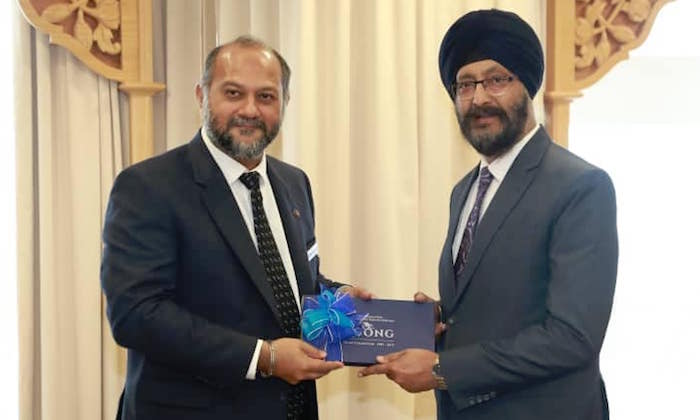
Gobind Singh Deo (left) and Kanwaljit Singh Bakshi -Photo: Gobind Singh Deo facebook page
By Asia Samachar Team | MALAYSIA |
The growing number of Sikh lawmakers globally should come together to bolster the community’s lobbying power, says a New Zealand long serving parliamentarian.
“We should forge links to boost our efforts to help the community,” Kanwaljit Singh Bakshi, the first Sikh MP in NZ, told Asia Samachar in Kuala Lumpur.
On Tuesday, the four-term MP from the National Party, who is on an official visit with two fellow MPs to Malaysia, paid a courtesy call on Minister of Communications and Multimedia Gobind Singh Deo, the country’s first Sikh to be made a minister.
“It was an absolute honour to meet Honourable Gobind Singh Deo Minister of Communication in Malaysia and his brother Ramkarpal Singh both sons of veteran Lawyer and MP Karpal Singh during my visit to Kuala Lumpur,” Kanwaljit shared on his Facebook page.
Over the last few years, there have been a growing number of Sikhs being elected as lawmakers, with Canada taking the lead.
In 2015, Canada made history when then newly elected Prime Minister Justin Trudeau appointed four Sikhs into his Cabinet, including Harjit Singh Sajjan as the national defence minister.
In the United States, while there are no elected Sikh lawmakers in the congress, but a number of Sikhs have been elected to key positions.
For example, Gurbir Singh Grewal became the 61st Attorney General of the State of New Jersey in January 2018.
Prior to his selection, Grewal served as Bergen County Prosecutor, the chief law enforcement officer of the most populous county in New Jersey and home to nearly 1 million residents living in 70 municipalities
The US also has a American Sikh Congressional Conference.
Formed by Representatives Judy Chu (D) and David Valadao (R) on 24 April 2013m, the caucus seeks to educate members of Congress and the general public about Sikh issues and support the American Sikh community.
The UK has two Sikh MPs in the House of Commons and a Sikh Lord.
In 2017, Preet Kaur Gill became the first Sikh woman MP and Tanmanjeet Singh Dhesi became the first turban-wearing Sikh MP, boosting the presence of Indian-origin presence in the House of Commons to a record 12.
The All Party Parliamentary Group (APPG) for British Sikhs is chaired by MP Preet Kaur Gill MP. Its two vice chairs are Conservative MP Dominic Grieve and Labour MP Pat McFadden, both former Ministers.
The latest to join the list of Sikh lawmakers globally is Narender Singh Khalsa, son of a slained Afghanistan Sikh leader, who seems to have secured a seat on behalf of Sikhs and Hindus community in the nation’s parliamentary elections, pending final confirmation.
ASIA SAMACHAR is an online newspaper for Sikhs / Punjabis in Southeast Asia and beyond.Facebook | WhatsApp +6017-335-1399 | Email: editor@asiasamachar.com | Twitter | Instagram | Obituary announcements, click here |
#KYOCERA#document solutions allows your business to optimize on KYOCERA’s product performance and capabilities to achieve maximum return on your company’s investment. With KYOCERA’s suite of solutions you will be able to streamline your business by integrating and customizing a document management solution to fit your needs.
The American Sikh Council (ASC) is appalled at the threatening nature by which human rights activist Jagtar Singh Johal (aka Jaggi) a British born citizen who happens to be a Sikh has been targeted by the Indian government for continued illegal detention under the pretext of arresting a suspected terrorist. It has been over 14 months with no end in sight!
Laws in India are very malleable and are used selectively depending on the religion, caste and then class of the person being targeted to be taught a lesson. Yes – a lesson! The application of the ‘law’ for all minorities of different faiths (Sikh, Muslim, Christian, etc) and/or ethnicities, especially those belonging to the lowest caste order among the Hindus, namely Shudras and especially the outcastes which consist of Dalits, Tribals and ‘Other Backward Classes’ (OBC) is very different than how the law is applied to the three upper caste Hindu groups, namely the Brahmins, Khatris and Vashiyas.
Jagar Singh Johal is being made an example by the Indian Hindutva forces to show the Sikh diaspora that they are not safe anywhere if they speak up for ‘human rights’ or ‘Sikh rights’ and will be persecuted and prosecuted for standing up for basic human dignity and liberty.
Adding to all this, the arcane laws of India can easily be used to obfuscate the target and everyone else. The central government enacted draconian laws to silence and snuff out legitimate dissent by the minorities, particularly targeting the Sikhs of Punjab, the Muslims of Kashmir, and several states in the North-East part of India starting in the 1980. There are so many comprehensive laws enacted, all in the name of national security as it is hard to keep track of them all!
Some of them are; Terrorist and Disruptive Activities (Prevention) Act (TADA) (1985–95), Prevention of Terrorism Act, 2002 (POTA), National Security Act (NSA), Special Public Protection Act (SPPA), Armed Forces (Special Powers) act 1958 (AFSPA), etc. Under some of these special laws, targets can be kept in incommunicado for up to three years. During this long time of illegal incarceration, most targets are brutally tortured, family members targeted separately till the target makes a false confession under duress and/or done away with permanently if required.
If Jagtar Singh Johal was ‘white – Christian’ the likelihood of action taken by the British government would be very different than their current lackadaisical attitude in his case and not to overlook the very cozy economic ties with India which Britain cannot afford to have disrupted.
India must and will continue to beat on the ominous drum of ‘Khalistan’ till all reverberations and vestiges of self-determination by Sikhs are completely crushed and removed, because that is the way of the Hindutva juggernaut which does not acknowledge any constitutionally legal dissent, legitimate long-standing socio-economic grievances, especially by minorities like the Sikhs who have been hounded for generations because their ‘universal humanistic’ ideology is contradictory to the belief system of the Brahminical Hindu leaders at the helm in India.
According to Amnesty International as reported by Al Jazeera, “Three decades after the U.N. Convention against Torture imposed measures to eradicate the practice, torture still happens in 141 countries — many of which are signatories to that convention.” Medieval style torture is still used commonly in India, which includes electric shocks, mock executions, water torture, rape and sexual violence, crushing body parts, boiling, roasting and the pulling of teeth. With this level of cruelty any kind of confession can be extracted from anyone. India of course is not a signatory to this UN Convention against Torture, which is not surprising!
With the judiciary a slave of the legislature most of the time, corruption running rampant, cronyism the norm, with the new wave of Hindutva peer pressure to conform, so rare is the judge who can honestly say that he/she is completely unbiased to perform their duties and safe from the piercing eyes of the Hinduvta forces. In this kind of vitiated atmosphere even ‘God’ cannot get justice!
Jagtar Singh continues to get the judicial run around – Indian style! The judiciary for the most part is thoroughly corrupt and any semblance of justice can drag on for 15 years to culminate. Further, there is no system of a ‘jury’ rather a single judge decides the fate of the alleged suspect. With India being #81 on the global corruption scale out of 180, its little wonder the much touted democracy is more of a demon-cracy!
Mr. Johal’s crimes according to the Indian authorities reportedly include, ‘running a magazine’ in the UK of atrocities during the 1984 Sikh Genocide and ‘influencing the youth through social media’.
Mr.Johal the alleged owner of the www.neverforget84.com has a fairly comprehensive website outlining all the serious human rights abuses meted out to hundreds of thousands of Sikhs in Punjab and elsewhere. There is absolutely nothing on the website that can be construed as subversive or influencing anyone in any negative manner. There are many websites in the diaspora focused on the ‘Sustained Sikh Genocide 1984 -1998’ detailing the atrocities perpetrated by the Indian Government on the Sikh collective.
Conflating genuine concerns about these flagrant human right violations with alleged terrorism combined with a global disinformation campaign is something the Indian regime specializes in regularly, in order to brow beat the Sikhs into submission.
The Indian government and its leaders love ‘mainstreaming’ all and any disruptive minorities, so that they fall in line with ideology fascist Hindutva. This type of behavior by a government will only further alienate the common citizen, especially religious minorities rather than unifying people, but they do not seem to care!
The Indian Government must release Mr. Jagtar Singh immediately and the police officials, politicians and anyone else involved be taken to task for devising this degenerate plot against an innocent British-Sikh citizen.
According to Jaspal Singh Manjhpur, the lawyer representing Jagtar Singh, the Indian police have subjected him to third degree torture while in illegal custody. There is no merit and the Indian authorities have no real evidence in their 1,000 page concocted dossier, except a web of lies.
Attorney Manjhpur further stated, “The latest twist is India’s National investigation Agency (NIA) worried about the lack of evidence and to delay matters further has appealed to the Supreme Court to transfer many of the cases to Delhi.”
According to Mark McLaughlin of the Times newspaper January 5, 2018, “Gareth Peirce (a well-known human rights attorney) claims that the British authorities are secretly colluding with India’s counterterrorism agency in the investigation into Jagtar Singh Johal, a Scottish Sikh.”
Both lawyers also agreed the raids by anti-terror police in the UK on the family homes of five British-Sikh activists in the UK were conducted to appease the Indian authorities. The Indian establishment has become desperate to find anything to try and implicate Jagtar Singh and exert further pressure on him. The disclosure of personal details and photographs of the British-Sikh activists in Indian newspapers has uncovered further blunders by the British police for which there will be consequences.
No matter what, the Hindutva government of India will never let the Sikhs be at peace, unless and until they have been cowed down, ‘mainstreamed’ and brought to heel, underneath and at the bottom of the diabolical Brahminical Hindu caste system. According to Article 25(2)(b) in The Constitution Of India 1949, Explanation II, “In sub clause (b) of clause reference to Hindus shall be construed as including a reference to persons professing the Sikh, Jaina or Buddhist religion, and the reference to Hindu religious institutions shall be construed accordingly.” No wonder the Hindu government of India relentlessly continues to meddle in the internal affairs and refuses to acknowledge the ‘Sikh Faith’ as independent and distinct from Brahminical Hinduism.
Sikhs in the diaspora are keenly aware that weekly intelligence reports are generated on every gurdwara in the US, Canada, Australia, UK, Germany and other countries with large populations of Sikhs. Sikhs are tired of the incessant meddling by the Indian intelligence in the internal affairs of the Sikh Faith.
The American Sikh Council (ASC) reiterates its call to all gurdwaras across the diaspora to absolutely not allow any Indian government official(s) to speak from their platforms.
#####
The American Sikh Council is the umbrella organization representative of Sikhs in the United States. It is an elected body of Sikh Gurdwaras and institutions. Currently 74 Gurdwaras and other Sikh institutions across the nation are members of ASC. The major governing purpose of the organization is to represent the collective view of Sikhs in the United States. ASC works to promote Sikh interests at the national and international level focusing on issues of advocacy, education, and well-being of humankind.
American Sikh Council
P.O. Box 932, Voorhees, NJ 08043, USA
Phone: 607-269-7454
email: contact@americansikhcouncil.org
https://www.facebook.com/AmericanSikhCouncil/
www.AmericanSikhCouncil.org
ASIA SAMACHAR is an online newspaper for Sikhs / Punjabis in Southeast Asia and beyond.Facebook | WhatsApp +6017-335-1399 | Email: editor@asiasamachar.com | Twitter | Instagram | Obituary announcements, click here |
Guru Gobind Singh ji completed the religio-social and political revolution started by Guru Nanak Sahib to reveal the Khalsa Panth as a sovereign nation.
Award winning historiographer, Dr J S Grewal, wrote, “By the beginning of the seventeenth century, the socio-religious community of Guru Nanak’s followers became a state within the state.” (The Sikhs of Punjab, p 42.) The Sikh right to nationhood was openly asserted over 400 years ago by Guru Hargobind Sahib when he formally sat on the temporal-spiritual (miri-piri) throne at Akal Bunga on 15 June 1606. Twice in history the Sikhs established their own sovereign state.
Following partition of the Indian subcontinent in 1947 and certain assurances by Indian leaders, the Sikhs voluntarily decided to remain in India, the secular state. They rejected siding with Pakistan, an Islamic religion state, and they will reject joining the Hindu Rashtra, the declared objective of one of the main political Indian parties.
Essentially, Guru Nanak Sahib made social activism in this world a precondition to achieving the main objective of human life. He was more concerned with here-and-now than hereafter in accordance with the Gurbani maxim: Wich dunyia sev kamayiay. Tan Dargeh baisan paayiay. (ਵਿਚਿ ਦੁਨੀਆ ਸੇਵ ਕਮਾਈਐ ॥ ਤਾ ਦਰਗਹ ਬੈਸਣੁ ਪਾਈਐ ॥ SGGS, 25).
So, unlike any other religion (mazhab), an Abrahamic concept, or an Eastern other-worldly sect, Guru Nanak Sahib’s revolutionary Panth had social, religious and political objectives from the outset. Guru Gobind Singh gave final shape to Sikh identity, decision-making processes and organisation in 1699.
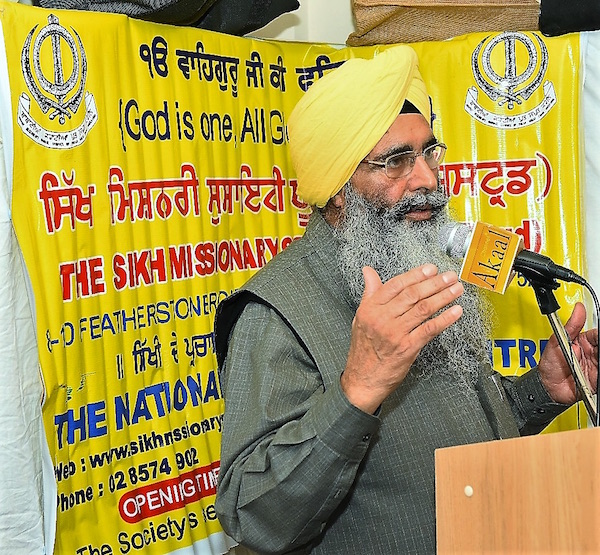
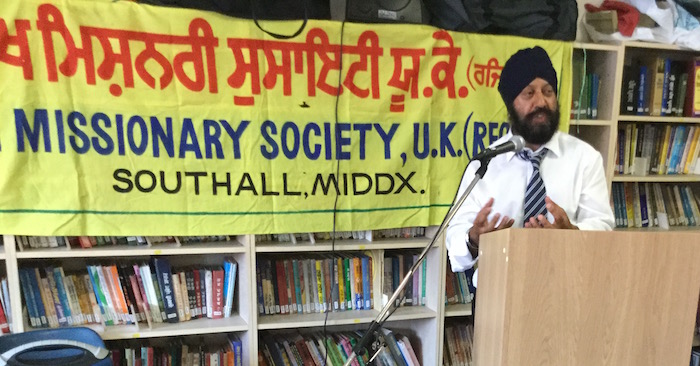
On Saturday 29 December, 2018, the topic of Sikh Ik Vakhri Qaum Hai (Sikhs are a separate nation), was discussed at the Sikh Missionary Society UK to clarify the revolutionary nature of the Panth of Guru Nanak-Guru Gobind Singh. Sardar Gurmel Singh Kandola MBE (ex-Secretary General, the Sikh Council UK), Jathedar Mohinder Singh Khaira, S. Avtar Singh Journalist and S Amarjit Singh Khalra led the seminar.
Gurmel Singh Kandola aT Sikh Missionary Society, UK event
Those who keep on insisting that Sikhi is a religion only need to study Sikh tradition more closely. As a colleague observed recently, “Sadly, some, otherwise well-educated Sikhs in UK are so highly Anglicised that they can only view the world from western Abrahamic paradigm. They wish to come across as progressive and objective liberals. It is not in their destiny to contribute positively to the aspirations of the Panth towards an independent and distinct people who are a force for good in the world.”
The Sikhs were created and organised as a nation, a distinct qaum: a community of people who share a common language, culture, descent, or history. In this definition, a nation has no physical borders (wikipedia.org/wiki/Qaum).They were given own independent ideological, social and political objectives and provided the resources by the Guru through the daswandh system, to sustain a prolonged campaign to achieve those objectives. The political objective of a just halemi raj in which no one inflicted pain on another, was also clear from the outset.
Today the Sikh Qaum is global and attracts many to their egalitarian religio-social values. All those who join, become members of the Khalsa Panth, the Sikh nation. They own and share the same history, tradition, literature, institutions and identity.
In the UK, the House of Lords too came to the same conclusion in 1983 in the famous Mandla case when deciding that, in addition to being a religion, the Sikhs are also an ethnic (non-biological social) community just like Indians, Pakistanis, Bangladeshis etc under the current community classification system.
Securing own Sikh qaumi (ethnicity) box in the Census 2021 classification, continues to be a high priority objective for British Sikhs.
Gurmukh Singh OBE, a retired UK senior civil servant, chairs the Advisory Board of The Sikh Missionary Society UK. Email: sewauk2005@yahoo.co.uk. The article first appeared at The Panjab Times, UK
* This is the opinion of the writer, organisation or publication and does not necessarily represent the views of Asia Samachar.
ASIA SAMACHAR is an online newspaper for Sikhs / Punjabis in Southeast Asia and beyond.Facebook | WhatsApp +6017-335-1399 | Email: editor@asiasamachar.com | Twitter | Instagram | Obituary announcements, click here |
Street Help Homeless Centre administrator Christine Wilson-Furlonger, centre, thanks Windsor Sports and Culture Centre members Sukhpal Banga, left, Jatinder Rai and other members during their annual donation of three truckloads of food, as well as money and other goods and clothing, on Thursday. Nick Brancaccio / Windsor Star.
By Doug Schmidt | WINDSOR STAR | US |
Three truckloads of food on Thursday were just part of the mountain of donations to Windsor’s Street Help Homeless Centre this week by the local Sikh community.
“They’re such a wonderful group of people with a wonderful spirit of giving,” Street Help administrator Christine Wilson-Furlonger said of the Windsor Sports & Culture Centre’s holiday donations. “We are very grateful — they show us so much love.”
In addition to filling up the homeless centre’s depleted pantry shelves, the WSCC, in its 14th year of giving to Street Help, also donated more than 75 sleeping bags, 70 blankets and comforters, 40 pairs of winter boots, hygiene products and a $1,000 cheque.
This week’s offerings to Street Help were the result of the WSCC’s winter holiday donation drive, said Sukhpal Banga, secretary of the social organization.
Sikhs don’t celebrate the religious meaning behind Christmas, but “we celebrate with our Christian friends,” said Banga. “The main thing is, we help the community through the Christmas holidays.”
Banga estimates there are about 1,000 Sikh families in the Windsor area. Additionally, he said, there are several thousand foreign students from the Indian subcontinent currently taking classes in Windsor, a large number of them enrolled at St. Clair College.
Windsor Sports & Culture Centre, established in 2005, organizes and participates in sports, education, culture and volunteer work across Windsor and Essex County. While heavily rooted in the Punjabi community, the club welcomes all members of the community to join and participate in its events and activities. According to the WSCC, sport is its passion and culture is its identity.
Read full story (Windstor Star, 28 Dec 2018), here.
CAMPAIGN POSTER: Narinder Singh with a photo of his late father Avtar Singh in the background
Narender Singh Khalsa, son of the slained Afghanistan Sikh leader has secured a seat on behalf of Sikhs and Hindus community in the nation’s parliamentary elections.
His name was among the names announced so far by the Independent Election Commission of Afghanistan (IEC), reports the Khaama Press News Agencys.
The parliamentary elections were conducted on 20 October 2018 but the commission has so far failed to fully announce the poll results, the report added.
IEC also said the initial poll results may change once the commission completes the review of complaints filed regarding the process.
A suicide bombing on 1 July in Jalalabad killed a dozen Sikhs and Hindus, including Narinder’s dad Atvar Singh Khalsa, the only Sikh candidate running in elections this year.
The incident happened when the Afghan Sikhs and Hindus community leaders were arriving to meet President Ashraf Ghani in Jalalabad, the capital city of eastern Nangarhar province.
ASIA SAMACHAR is an online newspaper for Sikhs / Punjabis in Southeast Asia and beyond.Facebook | WhatsApp +6017-335-1399 | Email: editor@asiasamachar.com | Twitter | Instagram | Obituary announcements, click here |
The Times Scotland frontpage. Right: Advocate Jaspal Singh Manjhpur and human rights solicitor Gareth Peirce
The plight of a Scottish Sikh still languishing in Indian prison for some 14 months made the front page of the The Times Scotland today (5 Jan 2019).
The newspaper carried a story on a lawyer who fought for justice for the Guildford Four and Birmingham Six accusing the British government of ignoring evidence that Jagtar Singh Johal, a Scottish terrorism suspect, has been tortured in India.
Gareth Peirce claims that the British authorities are secretly colluding with India’s counterterrorism agency in the investigation into Jagtar, the Scottish Sikh who is being held in connection with the murder of Hindu nationalists in 2016 and 2017, reports The Times.
Ms Peirce’s previous clients include Gerry Conlon, who spent 15 years in prison after being wrongly convicted of the Guildford pub bombing. She is investigating how photographs of Sikh activists apparently seized by British police ended up in the hands of Indian interrogators, the report said.
The newspaper front-paged the case of Jaggi, as he is popularly known, in a report entitled ‘Britain is ‘ignoring torture of Scots Sikh’, with a subhead ‘Lawyer alleges secret collusion with India’.
Mr Johal, 31, from Dumbarton, was arrested, put in a hood and forced into an unmarked police vehicle in November 2017. He was held for six months without hearing the charges against him. Police broadcast a televised “confession” which Ms Peirce said was coerced and provably false. Mr Johal claims that police tortured him and threatened to burn him alive.
The newspaper quoted the 78-year old human rights solicitor as saying: “Reports of a British citizen being taken hooded to court, the broadcast of a coerced, probably false ‘confession’ and marks of his injuries noted by a consular official should have generated exceptional and energetic activity by his own government.
“Do the clues to this inertia lie in the emerging evidence of close co-operation between the UK and the Indian authorities?
“In repeated cases and worldwide, it has been such covert collusion, belatedly acknowledged, that has accounted for the seeming impotence of official government expressions of concern.
“The urgent need is for Jagtar’s government to apply those lessons from this country’s recent past before it is too late.”
Narendra Modi, India’s prime minister, is under pressure from opponents to bring the Hindu nationalists’ killers to justice. Mr Johal fears that he is being used as a political pawn in the forthcoming general election, the report added.
Peirce had also met Jagtar’s lawyer Jaspal Singh Manjhpur who was in the UK for a 10-day visit.
In a statement released by the Sikh Federation UK (SFUK), Jaspal said: “The latest twist is India’s National investigation Agency (NIA) worried about the lack of evidence and to delay matters further has appealed to the Supreme Court to transfer many of the cases to Delhi.”
“Apart from the inevitable delay this is causing they are also pushing for Jagtar to be transferred to a prison in Delhi making it difficult to regularly meet with me, his wife and her family who are based hundreds of miles away in Punjab.”
In the statement, it was mentioned that Jagtar also met with Martin Docherty-Hughes their SNP MP and Preet Kaur Gill MP, the Chair of the All Party Parliamentary Group for British Sikhs to update them on the latest legal position in India and raised questions on whether the UK Government were doing enough for their citizen.
They agreed to work with the family and keep up pressure on the UK Government to exert appropriate political influence to secure Jagtar’s release, it added.
The statement added:
“Jagtar’s case has involved one gaffe after the other. The first mistake was the police abducted, tortured and threatened to kill a UK national and the second was the controversial Chief Minister of Punjab and the Director General of Police (DGP) politicised the case from the outset by holding a press conference and pre-empted court proceedings.
“Within 3 days of Jagtar’s abduction, torture and police threats of being burnt alive or shot dead at point blank range they made a fundamental error of holding a press conference. Sitting side by side they claimed that they had “solved” a series of high-profile “targeted killings” over the previous two years for which there was pressure on them from those in Delhi to secure arrests.
“The Chief Minister named Jagtar Singh Johal (or Jaggi) as one of those who was in police custody and would be charged. However, it took the police six months to file the 1,000+ page charge sheet after Jagtar’s abduction and torture. Given all the publicity the 1,000+ pages remarkably only had 12 lines that relate to Jagtar that his lawyer has clarified during his UK visit are inadmissible in court.
“The next major blunder came a month after Jagtar’s abduction. Indian police were so worried by the #FreeJaggiNow international campaign, strong political lobbying in the UK with over 250 MPs contacted and tough words of ‘extreme action’ by UK Foreign Office Minister, Rory Stewart on the floor of the House of Commons that they resorted to continue the trial by media.
“The Punjab police no doubt under pressure from their political masters released so-called police video confession tapes of Jagtar exclusively to an Indian TV station to try and ‘demonise’ and show him in a negative light knowing this could never be evidence that would be admissible in court.
“The 12 lines in the charge sheet that came five months later provided nothing more than what was shown to tens of millions on Indian TV and widely reported in the Indian press.
“The legal process in India is extremely slow at the best of times and more than 425 days after Jagtar’s imprisonment the courts have yet to examine the charge sheet and the information collected by the police to decide whether there is substantial material to start a trial against Jagtar. Only if the court is satisfied that the material is enough to start the trial will it frame charges and issue a summons order to start proceedings.”
ASIA SAMACHAR is an online newspaper for Sikhs / Punjabis in Southeast Asia and beyond.Facebook | WhatsApp +6017-335-1399 | Email: editor@asiasamachar.com | Twitter | Instagram | Obituary announcements, click here |
First and foremost, let me start my first article of the year by wishing all our wonderful readers a very Happy New Year. Indeed for many of us, the arrival of the New Year brings about a fresh resolve to accomplish new and exciting things in the coming future, in the hopes of bettering ourselves in the long run. However, being the mere mortals that we are, tainted by the essence of humanity, we occasionally falter behind our own hopes and dreams and our once steely determination to achieve targets we ambitiously set out occasionally remains unresolved and, over time, sadly forgotten.
However, being human, there are times we need not be too hard on ourselves and sometimes the very ones we need to be kind and compassionate to are in fact our very own selves, and realize perhaps that we can always try again and even let certain things remain unfinished.
I am reminded of a wise quote by the sage and poet Kahlil Gibran, in which he said he was told by God to “love your enemies” to which he obeyed and said he would start by loving himself (implying that we are our own worst enemies by being simply too hard on ourselves, and we need to show care and mercy to our own selves before we can be compassionate and merciful to others).
After all, we are, as Agent Smith from The Matrix once said, only human.
Reflecting on the notion that for so many of us, a good deal of our well intentioned new year resolutions remain unfulfilled over the course of the year, I began to contemplate on how occasionally things that are left incomplete or unfinished may not necessarily be bad thing. A beautiful philosophical concept in Japanese art and poetry comes to mind, referred to as Wabi – Sabi, which loosely translates to finding ‘perfection in imperfection’ in all things you seek and do.
Based on this idea of finding ‘perfection in imperfection’, meaning to see how things or even objects left unfinished could appear beautiful in its own way, the concept for a design for a modern Gurdwara was born, simply entitled as “The Unfinished Gurdwara”.
It is to be noted that the word ‘unfinished’ in this context does not refer to unusable or unfit for human usage or occupancy, but refers to leaving the appearance of building materials as it is and not be superficially covered in anyway, so in this Gurdwara, brick walls are left unpainted, concrete walls are left unplastered and so forth.
As stated ‘The Unfinished Gurdwara’ is a Gurdwara complex that celebrates the idea that things that remain incomplete can be beautiful in its own way. In this Gurdwara, the appearance of the brick walls are left unpainted, as to expose the richness of colour and texture these bricks possess, and the concrete walls too are left unplastered to showcase the rawness of the material and the innate strength concrete projects by design.
Financially too, by leaving these materials as they are uncovered in any way, a good chunk of the construction budget set aside for painting can be saved and therefore this approach in design can provide valuable savings in building costs as well.
Unfinished Gurdwara: Design by Vishal J Singh
The front of the Gurdwara complex, where the main entrance to the Darbar Sahib on the first floor and the Langgar Hall on the ground floor are shown in the image above, are on the left and is covered by exposed bricks of multiple shades of red and decorative screens all around. The Nishan Sahib Plaza is covered with grass with a huge brick wall with both the Ek Ongkar and Khanda emblems incorporated onto its structure, creating a powerful visual marker for the sanggat.
Unfinished Gurdwara: Design by Vishal J Singh
The Darbar Sahib is accessible from the front through an open staircase situated on a pool of water, which can be approached from the main entrance from the right side, where a flat metal roof is placed above, signifying a protected entrance point. Again all the brick walls are left exposed and the beautiful display of bricks creates a rich visual tapestry of red, maroon and vermilion to enjoy and appreciate.
Unfinished Gurdwara: Design by Vishal J Singh
The Nishan Sahib Plaza, where the Nishan Sahib soars high, is located in front of an adjacent structure to the Darbar Sahib and the Langgar Hall, where the offices are located on the ground floor and where the living quarters to house guests are located on the first floor. This adjacent structure is physically connected to the Darbar Sahib and the Langgar Hall through an elevated covered pedestrian bridge and follows the same look as the rest of the Gurdwara complex.
Unfinished Gurdwara: Design by Vishal J Singh
On the right elevation of the Gurdwara complex where the offices are located on the ground floor, the appearance of the brick walls left exposed continues throughout the structure of the building. Here however, on the first floor where the living quarters are located and where privacy is prioritized, the walls are left as bare concrete with imprinted alternating patters of lines and grooves, again to highlight the beautiful ‘unfinished’ quality of the building. The concrete walls create a powerful ‘fort-like” appearance, keeping the interior rooms secured and private for its guests.
The design strategy for the ‘Unfinished Gurdwara’ seeks to celebrate the beauty of materials left in its raw and unadorned state. Although savings in building costs can be attained through this strategy, one cannot deny that the rich visual delight projected by the striking mosaic of red bricks is truly a beautiful component in construction to showcase, and the concrete walls too project a powerful building element when looked as a uniquely designed singular complex. Indeed, some things could remain better if there were unfinished and incomplete, which even includes buildings, as leaving them as such reminds us human beings that as long as we breathe, we too are incomplete and should always yearn to do better to improve ourselves. And again, to remain incomplete and unfinished as we continuously strive to do better … well, that may not necessarily be such a bad thing.
We are, after all, only human.
Waheguru Bless.
The next Gurdwara design will explore the idea that a Gurdwara can also act as a cultural centre for the sanggat to enjoy and learn from. It will look into ideas of how art, language and music can be taught and propagated for the benefit of the public, especially the young, within a Gurdwara complex.
Vishal J.Singh, an aspiring architect, holds a Bachelor of Architecture Degree from Infrastructure University Kuala Lumpur and enjoys engaging in architecture and its theories as his first love.
* This is the opinion of the writer, organisation or publication and does not necessarily represent the views of Asia Samachar.
ASIA SAMACHAR is an online newspaper for Sikhs / Punjabis in Southeast Asia and beyond.Facebook | WhatsApp +6017-335-1399 | Email: editor@asiasamachar.com | Twitter | Instagram | Obituary announcements, click here |
Simran Jeet Singh teaches a class at Trinity University in San Antonio, Texas, on Jan. 12, 2017. Photo courtesy of San Antonio Express-News/Ray Whitehouse
To his knowledge, Simran Jeet Singh believes that he was the first Sikh hired to teach Islamic Studies at an American university.
“I loved my time at Trinity University and remain forever grateful to my friends and colleagues there for the opportunity.
“Here’s a reflection on my time teaching Islam in Texas, including some of the uncomfortable moments that I hadn’t anticipated,” he writes on Facebook when sharing an article he wrote for Religion News (see below).
Commenting on the sharing, Selena Suttner writes: “I loved your class as well as your patience. I has a hard semester when I took your class but you were so honest and accommodating, I genuinely appreciate it. Thank you!”
By Simran Jeet Singh | RELIGION NEWS | US |
(RNS) — As far as I know, I was the first Sikh hired to teach Islamic studies at an American university. I loved every minute of it, especially because my employer, Trinity University, was located in my beloved hometown of San Antonio, Texas.
My first real job also shed new light for me on what it’s like to be an underrepresented minority in this country. Most Americans, in short, don’t know who Sikhs are. Typically they presume we are Muslims, mostly as a result of Islam being racialized in the past few decades: It’s not just a faith, it’s also a look, and the resulting stereotypes square with the appearance of many Sikh men — brown skin, turban, beard. That’s me.
Of course I had long since learned what “looking Muslim” meant in post-9/11 America. I knew firsthand the violence that came with misguided understandings of Islam, and as a Sikh especially, I felt compelled to do something about it. It’s precisely what sent me down the path of studying religious communities and addressing the racism they experience. I decided to make allyship with Muslims and those affected by anti-Muslim hate a centerpiece of my life.
Because my path seemed so obvious to me, I never considered my field of study to be odd. Only when I began interviewing for jobs did I realize that some might find it strange for a Sikh to teach Islam. “How can you teach a religion you don’t even practice?” people would ask, including the president of a university during a job interview.
I wanted to point out to the president that the scholars in his own religion department, like most of the religion scholars I knew, did not practice the faiths they taught. It’s considered normal for white scholars to be interested in traditions other than their own. I didn’t alert him to his bias — I wanted the job, after all. But ever since I’ve wished I could have asked why it was problematic for me to express the same interest — because I’m a person of color? Because I identify as a religious minority?
ASIA SAMACHAR is an online newspaper for Sikhs / Punjabis in Southeast Asia and beyond.Facebook | WhatsApp +6017-335-1399 | Email: editor@asiasamachar.com | Twitter | Instagram | Obituary announcements, click here |
People queue up in Walsall town centre to be served food by the Midland Langar Seva Society. (Image: Midland Langar Seva Society)
By Gurdip Thandi | BIRMINGHAM MAIL | UK |
A Sikh organisation – which has grown from feeding a handful of needy people in Walsall into a global service – fears it is being driven out of its home town.
The Midland Langar Seva Society serves hundreds of hot meals to homeless and poor people every day across the UK as well as India, Germany and Bangkok.
But Randhir Singh, one of the founders of the society, said they have been stunned by complaints from Walsall Council about the mess their evening town centre feeds leave behind.
Mr Singh said: “It is really sad that Walsall Council appear to be trying to stop the feeds we put on.
“They say we are leaving a lot of mess and they are getting complaints from market traders but we are only there for an hour and we have volunteers designated to clearing up any rubbish.
“We believe it is just an excuse. Perhaps they are embarrassed at how bad poverty and homelessness is in Walsall and that we are doing their job for them.
“We do this to follow the Sikh principle of ‘seva’ – serving humanity and helping those who are less fortunate than us. It is what our founder Guru Nanak Ji did.
“It is not just homeless people who come to us, it is people with a range of problems including mental health issues, poverty, families who are struggling to put food on the table.
“You also get professional people whose lives fell apart or those who were in the army. We try to help people get back on their feet. It is heartbreaking to see people cannot afford to buy food.”
As well as serving vegetarian meals, the society has distributed clothes, nappies, baby milk and toiletries.
To read the full story, ‘Sikh helpers fear being driven out of town by ’embarrassed’ council’ (Birmingham Mail, 3 Jan 2019), click here.
ASIA SAMACHAR is an online newspaper for Sikhs / Punjabis in Southeast Asia and beyond.Facebook | WhatsApp +6017-335-1399 | Email: editor@asiasamachar.com | Twitter | Instagram | Obituary announcements, click here |



























 The newspaper quoted the 78-year old human rights solicitor as saying: “Reports of a British citizen being taken hooded to court, the broadcast of a coerced, probably false ‘confession’ and marks of his injuries noted by a consular official should have generated exceptional and energetic activity by his own government.