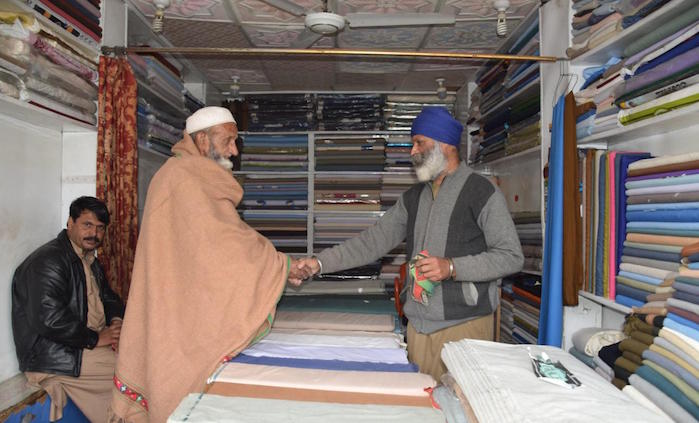
Santh Singh has been dealing in fabrics for the last three decades in the middle of a bustling street of Peer Baba Bazaar. Photo: Geo News
By Anwar Zeb | GEO TV | PAKISTAN |
The far-flung district of Buner in Khyber Pakhtunkhwa is an oasis of interfaith harmony.
For years, Muslims in the area have been trusting Sikh businessmen and shopkeepers living in the area with their money and valuables.
“We are like mini banks for Muslim brothers with no interest or profit and no service charges”, said 50-year-old Santh Singh who has been dealing in fabrics for the last three decades in the middle of a bustling street of Peer Baba Bazaar. “Muslim brothers travel from villages of Buner to deposit cash with us,” he continued.
He explained, “We, Muslims and Sikhs, trust each other and that is the finest form of interfaith harmony.”
Singh’s ancestors were also businessmen and spent their entire lives in the area. Reminiscing about the past, Singh shared that when he was younger, Muslims would deposit money and other valuables with his Uncle Tirath Ram. When his uncle passed away and the closets where he kept the valuables were opened, people were surprised to find several rolls of money tied with colorful threads and nameplates.
“When banks first established in the district, people were reluctant to keep their valuables there, worrying about interest and other issues. It was easier to keep cash and other valuables with us,” the 50-year-old added.
Syed Wahid, who owns a general store in the same street as Singh shared that when he established his business he would entrust his money to Sikh shopkeepers. “There are two reasons why we would keep our valuables with the Sikhs. One is that they are businessmen and they keep cash handy and the second is that they are honest,” Wahid said.
He added that the custom of depositing money with Sikhs in Buner still exists today, with little changes since the practice started. Those who live abroad, send money to their families by transferring them into the bank accounts of Sikh businessmen.
Wahid, who has spent this entire life in Peer Baba, recalled that throughout his life there has only been one incident which shocked the entire district. In the aftermath of the Babri Masjid incident, some unknown people burnt a Gurdwara in Peer Baba. “But during that crucial time, the villagers provided shelter, food and security for their Sikh brothers,” he said.
“People designated their Hujras for them. Sikhs are like brothers to us and we share everything from grief to religious events and cultural events,” Wahid continued.
Jatinder Singh a pharmacist by profession who also belongs to Buner said that interfaith harmony is vital for a peaceful environment. “The trust created by our forefathers is exemplary. They were very careful about these things and never even changed currency notes and tried to keep the same ones that the owners gave,” he said.
“My grandfather Sobha Ram used to keep valuables of Muslim brothers and we still have notebooks where my grandfather had written down the names of those people who had deposited money with him,” he added.
According to a survey conducted by minority leaders in 2016, there are more than 3,000 Sikhs living in various villages of Buner. Most of them reside in Peer Baba, Sawari, Ghurghato and Diwana Baba.
To read full story – Buner — where Sikhs and Muslims live in harmony, GeoTV, 2 Jan 2019 – go here.
ASIA SAMACHAR is an online newspaper for Sikhs / Punjabis in Southeast Asia and beyond.Facebook | WhatsApp +6017-335-1399 | Email: editor@asiasamachar.com | Twitter | Instagram | Obituary announcements, click here |
Butterworth Sikhs are all set to welcome their spanking new gurdwara building, the fourth for the local community whose gurdwara history trails back to the 1920s.
A three-day programme starting from Jan 19 (Saturday) has been prepared for the opening ceremony of the new home for Gurdwara Sahib Butterworth (GSB) at Lot 5702, Jalan Todak, Seberang Jaya, Seberang Perai Tengah in Penang.
Among the events planned are kirtan darbar, akhand path, amrit sanchaar and dental checkup.
The programme will begin with an Asa Di Vaar at the present gurdwara building starting 4.30am on Jan 19. At 7am, a 4km nagar kirtan will be held the present building to the new building.
At 12.30pm on Jan 21 (Monday), GSB president Narinder Singh will unveil the commemorative plaque.
The Butterworth gurdwara building till now – Photo: Gurdwara website
The gurdwara website has this to say on its history:
By the beginning of the 20th Century, there were a few Sikhs employed as watchmen by the Straits Trading Company Ltd. in Butterworth. These Sikhs and their families were provided with living, quarters in the ‘Sikh Lines’ near the vicinity of the company’s smelting works along what is now known as Jalan Pantai.
In the 1920’s, the British management of the company allowed one of its quarters in the Sikh Lines to be used by the Sikhs as a place of worship. This small Gurdwara Sahib was able to accommodate the Sikhs and their families during prayers. There were no regular Granthis, and as such, the Sikhs managed the Gurdwara Sahib by rendering voluntary service.
In 1934, a piece of land, was purchased along Chain Ferry Road. The Sikhs built a Gurdwara Sahib building, a single storey brick structure with a tiled roof, which was completed by the end of 1934. Gradually, the Sikh sangat started to grow and this Gurdwara Sahib could not accommodate everyone. Finally in 1968, this Gurdwara Sahib was demolished to make way for a new building.
In 1968, building plans were approved to construct a three-storey Gurdwara Sahib building. The foundation stone was laid by the then Chief Minister (Ketua Menteri) of Penang, Tan Sri Wong Pow Nee on 3rd October 1968.
On 12′ December 1971, the new Gurdwara Sahib building was officially declared open by the then Deputy Minister to the Prime Minister, Y.B. Datuk Patinggi Haji Abdul Taib Mahmud (presently the Chief Minister of the State of Sarawak). This Gurdwara Sahib is an imposing landmark for the Sikh community of Butterworth.
ASIA SAMACHAR is an online newspaper for Sikhs / Punjabis in Southeast Asia and beyond.Facebook | WhatsApp +6017-335-1399 | Email: editor@asiasamachar.com | Twitter | Instagram | Obituary announcements, click here |
Leadership and human resource (HR) Heera Singh consultant has released a definitive HR guide book for Malaysian companies.
Human Resources Documentation is the third book by the retired Malaysian army officer.
Lt-Col (Rtd) Heera is also the author of Simple Steps to Leadership Excellence and Inspiring Anecdotes on Management.
The 600-page book is designed as a one-stop human resource management (HRM) guide.
Dealing with people issues have always been a challenge for human resource (HR) practitioners and having relevant documentation to address them is another, the author said in a statement emailed to the Asia Samachar.
The book contains HR templates, sample documents and tools to assist not only the HR department but line managers as well.
It covers all functional areas of HRM and tackles various HR scenarios that an employer needs to deal with, at the workplace.
While previous books on HR documentation have concentrated on disciplinary and domestic inquiry aspects, the scope of the book has been enlarged to include other HR functional areas such as employment matters, organizational surveys, performance management and recruitment.
The book contains 14 different HR topics with almost 350 sample documents and templates as a reference guide.
In the statement, Heera said the book aims to enable all Malaysian organisations to have a relevant HRM resource at their fingertips, to guide HR processes and hence save time and cost.
He believes that this in turn will reduce industrial relations issues while improving over all efficiency and productivity at the work place.
The book is priced at RM290 for Malaysia (free shipping). Click here to purchase.
ASIA SAMACHAR is an online newspaper for Sikhs / Punjabis in Southeast Asia and beyond.Facebook | WhatsApp +6017-335-1399 | Email: editor@asiasamachar.com | Twitter | Instagram | Obituary announcements, click here |
EVENT LISTING | SINGAPORE: Sri Guru Singh Sabha (SGSS) Singapore will be holding a Youth Tea Session to kickstart our Youth Engagement Project. This project aims to bring the youth back to the Gurdwara, through various events and activities. During the tea session, we hope to hear from the youth themselves on ways we can help and provide for them as a Gurdwara.
The event details are as follows: Sunday, 6th January 2019 | 2pm to 4.30pm | SGSS Hall B (adjacent to langar hall)
ASIA SAMACHAR is an online newspaper for Sikhs / Punjabis in Southeast Asia and beyond.Facebook | WhatsApp +6017-335-1399 | Email: editor@asiasamachar.com | Twitter | Instagram | Obituary announcements, click here |
Members of the Houston Sikh community responded to Hurricane Harvey last year with trucks filled with supplies from all across the nation. The Sikh tradition teaches that service to humanity is a core part of being a good person – Photo: Source unidentified (If you know the source of the photograph, we will be happy to provide the credit)
By Manpreet K. Singh | HOUSTON CHRONICLE | OPINION |
Members of the Houston Sikh community responded to Hurricane Harvey last year with trucks filled with supplies from all across the nation. The Sikh tradition teaches that service to humanity is a core part of being a good person.
Members of the Houston Sikh community responded to Hurricane Harvey last year with trucks filled with supplies from all across the nation. The Sikh tradition teaches that service to humanity is a core part of … more
On Saturday, nearly 30 million Sikhs around the world will celebrate Vaisakhi, one of the most important Sikh occasions. Vaisakhi historically marks the harvest festival in Punjab, and for Sikhs it has special significance as the day that much of the Sikh religion was formally institutionalized in the way we know it today. For the past 320 years, Sikhs mark this day by gathering in our communities, reflecting on our values and recommitting to our core principles of service and justice.
I have been thinking about service a lot this year, especially given recent events in my native city of Houston.
When Hurricane Harvey struck the region, it was heartening to see people around our city rush to help those in need. The Sikh community of Houston played a particularly noticeable role in relief efforts, which is remarkable given that there are only approximately 5,000 Sikhs in the Greater Houston area. For those who know Sikhs and their commitment and commandment to service, this was not a surprise.
The Sikh tradition teaches that service to humanity is a core part of being a good person. From a young age, Sikhs are taught that God is present in everything and everyone. As we say in our scriptures, “The Creator is in the creation and the creation is in the Creator.” As Sikhs, we believe that the best way to serve God is to serve the world around us. The specific term Sikhs use — seva — has no direct English translation. My interpretation of the term seva is a selfless service inspired by love and a sense of community.
The founders of Sikhism, who we refer to as our gurus (teachers), give us beautiful examples of what seva looks like in our communities. One of the first stories I shared with my own kids was that of Guru Nanak, who famously took all the money his father gave him to invest in a business and instead donated it to the needy. When his father chastised him, Guru Nanak simply replied by asking: “What better investment is there than giving to those who need it?”
My parents taught me similar lessons while raising me here in Houston. There were not many Sikhs here when I was growing up, but there were plenty of opportunities to serve. We started from a young age volunteering at Star of Hope, a shelter in downtown, participating in community cleanups and donating whatever we could to those who needed it more than we did. It was the Sikh tradition of seva that inspired me to become a lawyer and help protect people’s dignity, and it’s also why I continue to remain involved in my community.
My Sikh faith teaches me that being a good person means serving the world around us and confronting any injustices and inequities we encounter. No matter how difficult it might be, we are always expected to do this work as a labor of love.
I am reminded of our values every morning as I tie turbans on my boys, Gahven and Mahnek, before sending them to school. I reflect on these values every time I look at my kara, a steel bracelet that makes up one of the five articles of faith that Sikhs wear. And on Sundays, when our family goes to our gurdwara (Sikh house of worship), I look around and marvel at how resiliently my community deals with discrimination, and how deeply committed they remain to the ideals of service and justice.
As we live in this world today, it’s difficult to overlook the deep fractures and divisions that are ripping our communities apart. Religious minorities and communities of color are being denigrated, and people I know and care about have been physically attacked because they are seen as different.
The Sikh idea of seva is a helpful model for addressing these challenges. Its premise of oneness helps us go beyond the mentalities that divide us and helps us to see how we are all interconnected. Its focus on justice also compels us to take these theoretical ideas and put them into action. Yes, we believe that all people should be treated with dignity, but it’s not enough to just believe that. We have to make this a reality.
In response to Hurricane Harvey, the Sikh community mobilized and came with massive trucks filled with supplies from all across the nation. They delivered the supplies to our gurdwara where our community members bridged the gaps of additional supplies. These supplies were delivered not just to Greater Houston, but more importantly to the outlying areas like Richmond, Crosby and Beaumont, places where many people had never seen a Sikh man wearing a beard and a turban, which are some of the other Sikh articles of faith that represent our commitment to justice and equality for all.
Finally, the concept of seva ensures that we are reimagining and rebuilding our society on the foundations of unity and love. Doing so is the only way we can ensure that our broken and inequitable systems are replaced with more just and sustainable models.
In the Sikh tradition, there is no room for complacency; to be religiously committed is to be socially engaged and devoted to justice. I have seen in my own life how this practice has made my hometown of Houston a better place, and I promise that our community will continue to do this here, and wherever else we may be because this is who we are. We invite you to join us, in whatever capacity you might be able, to change the world we live in.
The article first appeared at Houston Chronicle on April 8, 2018. Manpreet K. Singh is a board member of US-based Sikh Coalition
ASIA SAMACHAR is an online newspaper for Sikhs / Punjabis in Southeast Asia and beyond.Facebook | WhatsApp +6017-335-1399 | Email: editor@asiasamachar.com | Twitter | Instagram | Obituary announcements, click here |
SASKAAR / CREMATION: 8 January 2019 (Tuesday) at 2.30pm at Florey Chapel, Centennial Park Crematorium, 760, Goodwood Road, Pasedena, SA 5042 (Followed by cha-pani at Adelaide Gurdwara Sahib (10 Mt. Barker Road, Glen Osmond, SA 5064) |Australia
Passed away in Adelaide, South Australia, on 25 December 2018
Daughter: Surgvasi Sarandeep Kaur
Sons: Pr. Gurmukh Singh OBE (UK)
S. Baldev Singh Dhaliwal (Australia)
Ragi Dya Singh (Australia)
and families request your presence to celebrate Bebay Ji’s life.
Cremation: 8 January 2019 (Tuesday) at 2.30pm at Florey Chapel, Centennial Park Crematorium, 760, Goodwood Road, Pasedena, SA 5042 (Followed by cha-pani at Adelaide Gurdwara Sahib, 10 Mt. Barker Road, Glen Osmond, SA 5064)
Paath Bhog and Antim Ardaas: 12 January 2019 (Saturday) at (Adelaide Gurdwara Sahib, Glen Osmond.
The Bhog shall be completed first from 10am. Followed by kirtan by Ragi Dya Singh Ji with Patti Bibian dha Jatha from Taran Taaran.
ASIA SAMACHAR is an online newspaper for Sikhs / Punjabis in Southeast Asia and beyond.Facebook | WhatsApp +6017-335-1399 | Email: editor@asiasamachar.com | Twitter | Instagram | Obituary announcements, click here |
Amar Singh, at 71 years of age, is a stalwart of the community garden at the Takanini Sikh temple. – Photo: CHRIS SKELTON / STUFF
By Mei Leng Wong | NZ GARDENER |
I was not prepared for the odd feeling of homecoming I felt when I drove through the gates of the Sikh temple grounds in the south Auckland suburb of Takanini, roughly 30km from the city centre.
I am not of the Sikh faith, and was not quite sure what to expect when I went to see their community garden.
We had heard vague reports of volunteers planting acres of vegetables and fruits to feed thousands, and projects to share knowledge about food production and sustainability. There was talk of working with offenders and educators, and helping the needy.
It all sounded idealistic, yet complicated, so I had to see it for myself. It turns out that the Sikh Temple Gurudwara Sri Kalgidhar Sahib Takanini & Otahuhu does all that and more.
They do feed thousands of people (specifically, an average of 300 on weekdays, 1000 on Saturdays and 2000 on Sundays).
No, you don’t have to be Sikh. You don’t have to pray at the temple. You don’t even have to pay for the food.
“We welcome everyone and we don’t ask where you come from or what you do,” says Supreme Sikh Society of New Zealand spokesperson Daljit Singh.
Read full story, Sikh temple community garden growing food to share, here.
RELATED STORY:
(Asia Samachar, 11 Dec 2018)
ASIA SAMACHAR is an online newspaper for Sikhs / Punjabis in Southeast Asia and beyond.Facebook | WhatsApp +6017-335-1399 | Email: editor@asiasamachar.com | Twitter | Instagram | Obituary announcements, click here |
End of a long life. Some reflections. Happy Festive season!
Happy festive season to all readers of Asia Samachar. The editorial team had asked me to write a special note for this very auspicious period – Christmas, and New Year and most importantly for us Sikhs the Shahidhis of Sahibjadays. I leave you with some very sobering thoughts but thoughts which might probably help you to reflect on your own individual lives, as I am doing… about the year that passed and some resolutions for 2019.
I am sitting beside my venerable mother, Bebe’s death bed in palliative care, in a hospital in Adelaide, South Australia. It is Christmas Day (2018), or for us Sikhs the day between the shahidhis of the younger Sahibjadays and the older Sahibjadays. She is about 105 years old.
Bebe is in a morphine induced coma. She is not eating nor drinking. She became very agitated two days ago and was not able to communicate to us as to what was wrong. So naturally the specialists have put her on morphine.
We brothers have kept a constant vigil by her bed for almost a week since we realised that she was too weak to take any kind of care of herself.
We three brothers have experienced the passing of three elders – our Nana Ji (old age), our venerable father Giani Harchand Singh Ji (enlarged heart) and our only sister (cancer).
Our Nana Ji passed away peacefully at the age of 110 in virtually the arms of our Bebe. So did Bapu Ji. Bebe tells us that Bapu Ji put a ‘borki’ of roti with saag into his mouth, but lay back and died without eating it. He was about 79. Our sister was morphined as she was in pain and passed away peacefully in Bai Ji’s presence, aged just over 80.
We were reflecting about the end of this human life, about euthanasia, and truly, how much do we ‘play God’ these days especially in western countries.
A ‘religious’ Sikh would say that we humans should not in any way meddle with the ‘bhana’ of Waheguru. Accept His Hukm without question.
With Nana Ji and Bapu Ji, everyone followed the ‘letter of the Law’ (Hukm), so to speak. Natural deaths as we presume they were ordained. Our sister was in great pain, stricken with cancer. But even though morphined, she was still conscious and we were all able to say our ‘good byes’.
Now I come to the present moment. Till three days ago, Bebe was able to still recognise close ones and even force a smile and bless us all. Today, there is no physical sign of any awareness, just laboured breathing. She has not had any food or drink for three days and for all intents and purposes she will pass away … of natural causes, supposedly, of old age.
We were discussing this with the geriatrician and how different races react at this time. Generally, the Italians and Greeks, for example, will insist that the elder be put on a life support system to prolong the life. Generally, western and northern European races would want the life to end quickly, of natural causes of course, because to the ‘religious’, the word euthanasia is a bad word! The liberals or basic non-believers want euthanasia to be made law. In most western countries euthanasia is still illegal. Man has no right to take ones life. That would be playing God! And fiery debates and litigation takes place against those who advocate euthanasia.
The question is, how much are we already playing God? Is morphine already not cheating God of the pain one must supposedly suffer? And does morphine not induce a quicker death to a supposedly natural death?
We have Sukhmani Sahib paath and Nitnem banis playing most of the time, thanks to recordings (!!!). The overly religious would say that we should be sitting by her and actually ‘doing’ the paath, notwithstanding the fact that she is very hard of hearing and at present she appears oblivious to whatever is happening to and around her.
Just moral, religious and spiritual questions as we place ourselves in the hands of the medical experts… and God?
Meanwhile Bebe’s mouth is a little open. She has just been given a bed bath. She is changed. Her mouth has been swabbed with mint liquid. Her breathing gets slower and there really is no expression on her face.
Yet, if you move close to her, somewhere deep down, I can hear …
Any thoughts or comments are welcomed and shall be published.
[POSTSCRIPT: Bebe Ji was still alive at the time of writing. She passed away peacefully just before midnight on Christmas Day. Harminder Kaur w/o Giani Harchand Singh Bassian. Village Dhandra. Ghot – Grewal, 1914-2018]
The Bhog and Antam Ardaas will be on Saturday, 12 January, 2019 starting 10am at Gurdwara Sahib Glen Osmand, 10 Mount Barker Road, South Australia]
ASIA SAMACHAR is an online newspaper for Sikhs / Punjabis in Southeast Asia and beyond.Facebook | WhatsApp +6017-335-1399 | Email: editor@asiasamachar.com | Twitter | Instagram | Obituary announcements, click here |
PATH DA BHOG: 5pm-7pm, 6 January 2019 (Sunday), at Gurdwara Sahib Rawang |Malaysia
Jitho Kaur (1923-2018), Rawang
Kalae Uthe Nanaka, Sedhe Uthe Jaey
MATA JITHO KAUR A/P KESITHA SINGH
We miss you every moment of our lives. Your presence continues to surround us. You still live in our hearts and thoughts of your loving family you left behind.
Born: 18 February 1923
Departed: 22 December 2018
Village: Kalra, Hoshiarpur
Husband: Late Sardar Jawala Singh
Dearly missed by: Sons & Daughter In laws, Daughters & Son in laws, Grandsons & Grand Daughters in laws, Granddaughters & Grand Son in laws, Great Grandsons, Great Granddaughters, Relatives & Friends
Path da bhog: 5pm-7pm, 6 January 2019 (Sunday), at Gurdwara Sahib Rawang, Selangor
Contact:
Sukdev 012-6182745
Simran 012-2745501
Arvin 012-6801786
| Entry: 31 Dec 2018 | Source: Family |
ASIA SAMACHAR is an online newspaper for Sikhs / Punjabis in Southeast Asia and beyond.Facebook | WhatsApp +6017-335-1399 | Email: editor@asiasamachar.com | Twitter | Instagram | Obituary announcements, click here |
The superstructure of the Varna Ashrama Dharma/caste system is supported by karma and reincarnation (transmigration). In other words, both karma and reincarnation are part of the trilogy invented by the Brahmans and they both are designed to justify the caste base factor. The Brahman invoked divine sanctions to perpetuate the caste system for eternity. Hindu scriptures proclaim that Prajapati (God) ordained the four castes. This was followed by the invention of the doctrine of “karma and reincarnation” to desensitize people’s sense of justice and compassion against the atrocities committed on the masses to enforce the caste system.
According to the law of karma, one reaps the fruit in this life for the deeds performed in the previous life. So, if a person is subjected to injustice and cruelty in this life, it is due to one’s own actions in previous life, not due to the perpetrators of cruelty and injustice. By observing the caste rules strictly and serving the superior castes faithfully one can earn the reward for the next life.
In spite of the categorical and unequivocal rejection of reincarnation in the Aad Guru Granth Sahib (AGGS) why do many Sikhs believe in reincarnation?
The main reason for this misunderstanding is the subversion of Nanakian philosophy (Gurmat) by its opponents. The anti-Gurmat Bipran (Brahmanical) literature from the 18th century to the present depicts Sikhism as part of Hinduism, its sword arm against the onslaught of Islam. Further, Christian missionaries and Western writers also relied solely on Bipran literature at the exclusion of AGGS which is the only authentic source of Gurmat. They treated Sikhism as an offshoot of Hinduism or a mixture or hybrid or religious syncretism of Hinduism and Islam.
Besides, as pointed out by Prof. Puran Singh, Sikh scholars/writers have not been able to extricate themselves from Brahmanical influence, and they have followed in the footsteps of Bipran and Western writers without undertaking a serious study of the AGGS:
The words Brahman (Brahm) and Para-Brahm also come in Guru Granth, but as Cunningham says “by way of illustration only”; similarly the names of all gods and goddesses of Brahmanical Pantheon.
It is to be regretted that Sikh and Hindu scholars are interpreting Guru Nanak in the futile terms of the color he used, the brush he took; are analyzing the skin and flesh of his words and dissecting texts to find the Guru’s meaning to be same as of the Vedas and Upanishads! This indicates enslavement to the power of Brahmanical tradition.
Dead words are used to interpret the fire of the Master’s soul! The results are always grotesque and clumsy translations, which have no meaning at all. Macauliffe’s almost school boy-like literal rendering into English, following possibly the interpretations given him by the Brahmanical type of gyanis, the unilluminated theologians who lacked both the tire of inspiration, and the modern mental equipment and who were decayed and eaten up by the inner fungus of the Brahmanical mentality, has made the live faith of the Sikh a dead carcass. It has produced neither the beautiful artistic color of the idol and the shrine, nor the fervor of the inspiration of love. And from his translations, one thinks Sikhism is weak Brahmanism. Much that is redundant is put before a world audience, without the light that made every straw and every little dust particle, every pretty detail even, radiant and beautiful.
More recently, after an in-depth study of AGGS and Varna Ashrama Dharma, Jagjit Singh concludes:
The grounds for the differentiation of the Gurus’ message from that of caste ideology and the caste society were far more basic. The caste ideology was the antithesis of humanism, and the caste society was extremely parochial in its outlook. To belong to it, it was necessary to be born within it. The land where the Varna Ashrama Dharma was not established was regarded impure. and the Aryavarta, the pure land, was at one period circumscribed within the limits of river Sindh in the North and river Carmanvati in the south. The Gurus rejected almost all the cardinal beliefs of the caste society. They repudiated the authority of the Vedas and allied scriptures, discarded the theory of avtarhood. disowned all its sectarian gods, goddesses and avtars, and condemned idol worship, formalism, ritualism, and ceremonialism [5].
Nanakian philosophy (Gurmat) categorically rejects the incarnation of God in human or any living form. The Commencing Verse of AGGS describes God as Ajuni, meaning God does not come into anthropomorphic forms (does not incarnate/beyond death and birth):
ਸਤਗੁਰੁ ਨਿਰੰਜਨੁ ਸੋਇ ॥ ਮਾਨੁਖ ਕਾ ਕਰਿ ਰੂਪੁ ਨ ਜਾਨੁ ॥
Satguru (God) is Nirhnjan (without material content). Do not believe that It is in the form of man. AGGS, M 5, p. 895.
ਸੋ ਮੁਖੁ ਜਲਉ ਜਿਤੁ ਕਹਹਿ ਠਾਕੁਰੁ ਜੋਨੀ ॥੩
May that mouth burn which says that God incarnates! AGGS, M 5, p. 1136.
Sikh Gurus used the terminologies of other religions but their meanings are not necessarily the same in the AGGS. There are frequent references to Hindu and Muslim beliefs and practices as the Gurus’ audience was made up of Hindus and Muslims, but the Gurus did not endorse or accept their beliefs or practices. There are expressions like aavan jaan, aavai jaavai, janam janam, jamai marai and bhavayai which are often interpreted as cycle of birth and death or cycle of transmigration.
However, in the AGGS, these expressions are used as metaphors for spiritual (moral) degeneration and regeneration human beings experience in their lives or pain and suffering or being entrapped in ignorance and falsehood or wandering aimlessly or they represent the Hindu belief of reincarnation/transmigration.
Besides, there are other words and terms that are often misunderstood and misinterpreted like poorab means past, not one’s previous life; poorab janam means past generations, not one’s previous birth, jeev jeev mue or jeevat mare means control of haumai, mue jeeva means transformation of manmukh to gurmukh, jo tis bhaavai means according to Hukam, and God’s Will mean Hukam.
Further as discussed in Chapter 1, Guru Nanak rejected the caste system categorically; so why would he accept the concept of karma and reincarnation /transmigration that was invented to justify the caste system? Moreover, Guru Nanak rejected the concept of soul as a separate entity from God as discussed earlier in this chapter. Nanakian philosophy makes it clear that “Soul” is Hukam, the invisible form of God that pervades the Cosmos. Hukam is Eternal, so what is there that incarnates?
Furthermore, in his composition on the creation of the Cosmos, Guru Nanak makes it clear that the caste system, reincarnation, heaven and hell are man’s invention:
There was neither heaven nor Earth nor the nether world.* There was neither hell nor heaven* nor time, the destroyer: There was neither hell or heaven nor birth or death nor anyone transmigrating. There was neither Brahma, nor Vishnu nor Shiva. There was no one else except the “One and only”. There was no woman or man, no caste or birth or anyone experiencing pain or pleasure. There was no ritual purification or self-restraint or rosary made of basil seeds. There were no milkmaids or Krishna or cows or cowherds. There was no deceit/ hypocrisy of Tantra and mantra or playing of the flute. There was no karma (deeds) or dharma (religious duties) or enchanting Maya (corrupting influence of the world). There was neither caste nor caste-based birth. AGGS, M 1, p. 1035.
*Guru Nanak rejected both Hindu and Muslim ideas of hell and heaven. Guru Nanak’s successor, Guru Angad amplifies the same message by pointing out that the authors of Vedas are responsible for creating the concepts of karma and transmigration, hell and heaven, ritualistic sin and virtue, and caste and gender inequality:
ਕਥਾ ਕਹਾਣੀ ਬੇਦੀਬ਼ ਆਣੀ ਪਾਪੁ ਪੁੰਨੁ ਬੀਚਾਰੁ ॥
ਦੇ ਦੇ ਲੈਣਾ ਲੈ ਲੈ ਦੇਣਾ ਨਰਕਿ ਸੁਰਗਿ ਅਵਤਾਰ ॥
ਉਤਮ ਮਧਿਮ ਜਾਤੀਂ ਜਿਨਸੀ ਭਰਮਿ ਭਵੈ ਸੰਸਾਰੁ ॥
It is the teachings of Vedas, which has created the notions of hell and heaven, karma and transmigration and ritualistic sin and virtue; One reaps the reward in the next life for the deeds performed in this life = goes to hell or heaven according to one’s deeds. ‘Ihe Vedas have also created the fallacy of inequality of caste and gender for the world. AGGS, M 2, p. 1243.
Additionally, the Gurus have pointed out that ritualistic deeds (karam kaand, krm ka) and vices and virtues are also the invention of the authors of Hindu texts.
Further, AGGS rejects the law of karma and reincarnation, when it urges humans to rise above animal level to become gurmukhs/moral enlightened-beings, and stresses the freedom of action and responsibility for the consequences. Besides, contrary to the law of karma and reincarnation that determines one’s caste and status in society, it is one’s deeds that determine one’s worth and respect in society:
ਸਾ ਜਾਤਿ ਸਾ ਪਤਿ ਹੈ ਜੇਹੇ ਕਰਮ ਕਮਾਇ ॥
It is one’s deeds that determine oneis respect and social status in society. AGGS, M 1, p. 1330.
Furthermore, AGGS rejects the concept of past or future life when it lays utmost stress on the present life with a clear warning that this is the only opportunity to realize God:
ਸੁਣਿ ਮਨ ਮਿਤ੍ਰ ਪਿਆਰਿਆ ਮਿਲੁ ਵੇਲਾ ਹੈ ਏਹ ॥
ਜਬ ਲਗੁ ਜੋਬਨਿ ਸਾਸੁ ਹੈ ਤਬ ਲਗੁ ਇਹੁ ਤਨੁ ਦੇਹ
O my mind, my dearfriend listen, this is the only time for you to meet God. Moreover, this opportunity will last only as long as the body is healthy and full of vitality. AGGS, M 1, p. 20.
Here Guru Nanak emphasizes that a healthy mind is a must for the realization of God:
ਮਤੁ ਕੋ ਜਾਣੈ ਜਾਇ ਅਗੈ ਪਾਇਸੀ ॥
ਜੇਹੇ ਕਰਮ ਕਮਾਇ ਤੇਹਾ ਹੋਇਸੀ ॥
One must not think that the benefit of deeds done here will be rewarded in the next life. It is here in this life that one reaps what one sows. AGGS, M 1, pp. 729-730.
ਭਈ ਪਰਾਪਤਿ ਮਾਨੁਖ ਦੇਹੁਰੀਆ ॥
ਗੋਬਿੰਦ ਮਿਲਣ ਕੀ ਇਹ ਤੇਰੀ ਬਰੀਆ ॥
Being born as a human is a blessing as this is your only chance to meet God. AGGS, M, 5, p. 378.
ਆਗਾਹਾ ਕੂ ਤ੍ਰਾਘਿ ਪਿਛਾ ਫੇਰਿ ਨ ਮੁਹਡੜਾ ॥
ਨਾਨਕ ਸਿਝਿ ਇਵੇਹਾ ਵਾਰ ਬਹੁੜਿ ਨ ਹੋਵੀ ਜਨਮੜਾ ॥੧॥
Look ahead; don’t look backwards. O Nanak, this is your only chance to realize God, because you won’t be born again. AGGS, M5, P. 1096.
ਇਹੀ ਤੇਰਾ ਅਉਸਰੁ ਇਹ ਤੇਰੀ ਬਾਰ ॥
ਘਟ ਭੀਤਰਿ ਤੂ ਦੇਖੁ ਬਿਚਾਰਿ ॥
This is your only opportunity, this is your only time to meet God, ponder and seek within. AGGS, Kabir, p. 1159.
ਜੇ ਜਾਣਾ ਮਰਿ ਜਾਈਐ ਘੁਮਿ ਨ ਆਈਐ ॥
ਝੂਠੀ ਦੁਨੀਆ ਲਗਿ ਨ ਆਪੁ ਵਞਾਈਐ ॥੨॥
When we know that after death we are not going to come back then why waste our lives by clinging to the world of falsehood. – Bhagat Sheikh Fareed Ii, Raag Aasaa, p. 488
These verses clearly emphasize that one’s current life is the only chance to realize God. On the other hand according to the theory of karma and transmigration there could be many chances to meet God, theoretically unlimited chances.
GURMAT: Guru Nanak’s Path of Enlightenment by Baldev Singh PhD
Abridged from an chapter in ‘GURMAT: Guru Nanak’s Path of Enlightenment’ authored by Baldev Singh PhD (1938-2009). Published by Hardev Singh Shergill, President Khalsa Tricentennial Foundation of North America Inc. Publisher and Editor-in-Chief, the Sikh Bulletin
ASIA SAMACHAR is an online newspaper for Sikhs / Punjabis in Southeast Asia and beyond.Facebook | WhatsApp +6017-335-1399 | Email: editor@asiasamachar.com | Twitter | Instagram | Obituary announcements, click here |






















 Butterworth Sikhs are all set to welcome their spanking new gurdwara building, the fourth for the local community whose gurdwara history trails back to the 1920s.

 EVENT LISTING | SINGAPORE: Sri Guru Singh Sabha (SGSS) Singapore will be holding a Youth Tea Session to kickstart our Youth Engagement Project. This project aims to bring the youth back to the Gurdwara, through various events and activities. During the tea session, we hope to hear from the youth themselves on ways we can help and provide for them as a Gurdwara.


 By Dya Singh | OPINION |
 The superstructure of the Varna Ashrama Dharma/caste system is supported by karma and reincarnation (transmigration). In other words, both karma and reincarnation are part of the trilogy invented by the Brahmans and they both are designed to justify the caste base factor. The Brahman invoked divine sanctions to perpetuate the caste system for eternity. Hindu scriptures proclaim that Prajapati (God) ordained the four castes. This was followed by the invention of the doctrine of “karma and reincarnation” to desensitize people’s sense of justice and compassion against the atrocities committed on the masses to enforce the caste system.