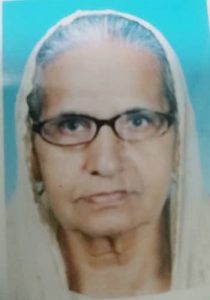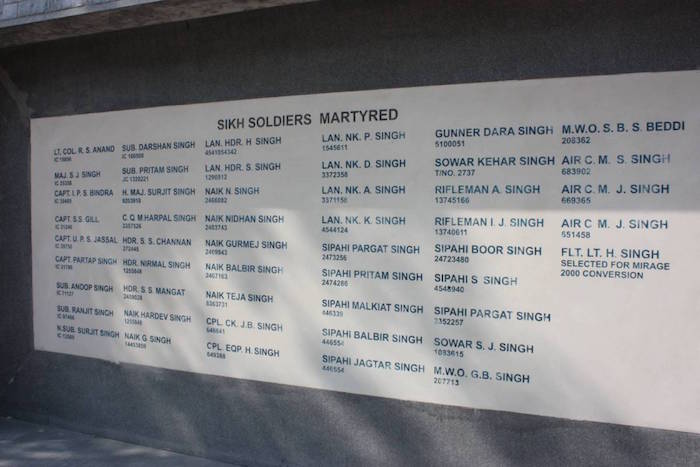
















SASKAAR / CREMATION: 3pm, 29 Sept 2018 (Saturday) at Jalan Loke Yew Crematorium, Kuala Lumpur. Cortege leaves residence No 43, Jalan 18, Taman Bukit Kuchai, 47100 Puchong Selangor at 2pm | Malaysia
Balbir Singh Virk (1945-2018), Formerly Balai Polis Brickfields
BALBIR SINGH VIRK S/O PRITAM SINGH VIRK
(Formerly from Brickfields, Kuala Lumpur)
Police No: Kpl 40585 ( Balai Polis Brickfields)
Born: 12 Aug 1945
Departed: 27 Sept 2018
Wife: Sukhdev Kaur
Children:
Kiranjit Kaur / Ajeetpal Singh (Spouse)
Dalvinderjit Singh
Grandchildren: Jaspreet Kaur, Juhipreet Kaur
Saskaar / Cremation: 3pm, 29 Sept 2018 (Saturday) at Jalan Loke Yew Crematorium, Kuala Lumpur
Cortege Timing: Cortege leaves residence No 43, Jalan 18, Taman Bukit Kuchai, 47100 Puchong Selangor at 2pm, 29 Sept 2018 (Saturday)
Path Da Bhog: 7 October 2018 (Sunday), 9.30am-12noon, at Gurdwara Sahib High Street, Kuala Lumpur
Contact:
Kiran 012- 2049667
Darshan 012-2353707
| Entry: 28 Sept 2018 | Source: Family |
ASIA SAMACHAR is an online newspaper for Sikhs / Punjabis in Southeast Asia and beyond.Facebook | WhatsApp +6017-335-1399 | Email: editor@asiasamachar.com | Twitter | Instagram | Obituary announcements, click here |
By Surinder Kaur Sohan Singh |SIKHI STUDY | OPINION
Dheeva balai andaera jaae (SGGS 791)
Dheeva means lamp. Andaera means darkness. Meaning: When the lamp is lit, the darkness is dispelled.
Which lamp is Guruji talking about? Where is the darkness? The lamp is the lamp of giaan / knowledge. The darkness is the ignorance in our minds.
Guru Nanakji came into this world to take us out of the world of darkness / ignorance into the world of light / Knowledge where there is eternal PEACE and BLISS.
Most of us are not even aware that our mind is in darkness. We are not able to recognise it. We have accepted the darkness as light. When someone comes to this world to help us get rid of this darkness, we treat that person as an enemy because we have got used to living in the darkness. That is the reason why many prophets and holy people have been tortured to death by ignorant minds.
Andhee kamee, andh Man, Man andhai tan andh (SGGS 1287)
Andhaa means being blind. Meaning: A person whose mind is blind / ignorant, cannot perform right actions with his body.
An ignorant mind will use his body to perform the wrong actions. Guruji says that when the mind is blind, then the actions cannot be right.
The Bhagti done by an ignorant mind will also be done wrongly.
To get rid of this blindness, our inner lamp must be lighted. Guruji came to this world to teach us how to light our inner lamps and get rid of the darkness in our lives.
What are some of the actions that we perform with our blind minds?
Meaning: Guruji’s Bani tells us repeatedly that water cannot clean our minds of the sins. Water can be drank to get rid of our thirst. It can be used to wash our clothes and it can do many other things but it cannot reach the mind to clean it. This is because mind is non-physical.
Yet millions of people go to theeraths and bathe in the pools of the Gurdwaras hoping to get rid of their sins. Guruji calls this a blind action performed by a blind body. Guruji’s Bani says:
Theerath naavan jaao Theerath NAAM hai.
Theerath SHABAD beechaar antar Gian hai. (SGGS 687)
Meaning: Guruji says people go to places of pilgrimages to bathe and get rid of their sins but for me NAAM is the sacred place. NAAM is the spiritual wisdom from God and by contemplating on it I get rid of my sins.
2) Another blind action that most of us are guilty of is paying others to do Paths for us. We listen only to the first 5 Pauris and the Bhog. The rest of the Path is done by the Giani.
How is the Path that we never listen to going to make us wiser?
This is just like a student paying someone else to study for him. He is definitely doomed to fail his exams and so are we.
We are taking a bigger risk than the student. The student can always sit again next year. For us , there is no next chance. This life is the only chance we have, according to SGGS.
Eihee thaeraa aousar eih tharee baar (SGGS 1159)
Meaning: This is your only chance, this is your only time.
Kabir Maanas janam dhulanbh hai hoey na baarai baar. (SGGS 1366)
Meaning: Kabirji says to be born into a human form is a very rare opportunity. It is a blessing from God and it does not happen again and again. If you lose this opportunity to reach your goal you will not get it again.
The only goal of human life is to become like the Creator and merge with Him. Gurbani teaches us how to do that. We have to read it ourselves to learn the way. It cannot be done by sourcing it out to others.
Surinder Kaur Sohan Singh is a Malaysia-based Gurbani enthusiast. This is an edited version of her regular articles shared within a circle of fellow Sikhi seekers. The articles appear on Mondays and Thursdays.
* This is the opinion of the writer, organisation or publication and does not necessarily represent the views of Asia Samachar.
ASIA SAMACHAR is an online newspaper for Sikhs / Punjabis in Southeast Asia and beyond.Facebook | WhatsApp +6017-335-1399 | Email: editor@asiasamachar.com | Twitter | Instagram | Obituary announcements, click here |
Atar (left) and Charan Singh (right) in the last remaining Gurdwara (Sikh place of worship) in Lashkar Gah. – Photo: Franz J. Marty / The Diplomat
By Franz J. Marty | THE DIPLOMAT |
LASHKAR GAH, HELMAND, AFGHANISTAN (26 Sep 2018): Like many other Afghans, Satnam Singh rides on a bicycle to work in his hometown of Lashkar Gah, the capital of the southern Afghan province of Helmand; that’s what he was doing on one day in early summer 2018.
“But that day, a man on a motorcycle deliberately hit me and I fell,” Satnam recounts. The reason that he got knocked over was apparently because the style of his turban clearly shows that he belongs to Afghanistan’s Sikh minority, members of a religion that has its center in India and Pakistan.
The incident might be small, but the seemingly never-ending nature of such harassment is – together with more serious threats and the dire economic situation – one of the main reasons that almost all Sikhs have left Lashkar Gah. In fact, as of summer 2018, only two Sikhs remain in Helmand, which is considered the Taliban’s heartland. The province is where U.S. and British forces suffered the highest casualties during the long Afghan war’s latest ongoing chapter, which started with the U.S..-led intervention after 9/11.
The Sikhs have always been a small but native minority in Afghanistan; according to one account, prior to 1992, there were about 220,000 Hindus and Sikhs in Afghanistan with another putting that number as low as 50,000. By now, the very few remaining are concentrated in the provinces of Nangarhar, Kabul, and Ghazni.
Until a few years ago, there was also still a tiny community of Sikhs in Lashkar Gah. During the Taliban regime in the 1990s, about 60 Sikh families were living in Lashkar Gah, Satnam remembers. They held out there despite the extremist Islamist rule of the Taliban, who forced non-Muslim Sikhs to identify themselves by wearing yellow patches. Satnam asserts though that, while the time under the Taliban was tough for Sikhs, things were worse in the preceding civil war – and the situation is also worse now. This was corroborated by other reports citing Afghan Sikhs.
Hence, the exodus of Lashkar Gah’s Sikhs only began after the overthrow of the Taliban regime by the U.S.-led intervention, which was supposed to bring greater freedom for all Afghans, including minorities. “Since 2001 many left. And about three years ago, almost all of the remaining around 30 families of Sikhs decided to leave together,” Satnam said during an interview in July 2018. Virtually all of them, like the Afghan Sikhs that had emigrated before, went to India. “About two years ago, I sent my wife and daughter to my father-in-law in Kandahar [the capital of the neighboring province with the same name] and about a month ago from there to my father in India,” Satnam added. By now, he and his friend and neighbor Charan Singh are the only two Sikhs left in Lashkar Gah.
When asked why all the other Sikhs, including his family, had left, Satnam’s first reply is, “It is the harassment by the people.”
“They throw stones at our houses, smash windows, and spray nasty graffitis on our walls,” he continues. Those allegations are proven by the dents and washed out scribblings on the wall of the house in a sleepy dusty street, where Satnam and Charan live and where they renovate the last remaining Gurdwara (Sikh place of worship) in Lashkar Gah. Such continued harassment is also confirmed by a 2017 report from the U.S. State Department, showing that the (albeit limited) freedom of religion that the Afghan constitution guarantees exists on paper, but hardly in reality.
“And this harassment is not done by Taliban, but by ordinary local people,” Satnam adds, voicing desperation about the fact that he and his fellow Sikhs are treated like unwanted strangers in their own birthplace. Slowly, over time, this has become intolerable.
“We have complained to the police about this, but they cannot prevent it,” Satnam alleges. This was contested by Mohammad Zamon, the spokesman of the police in Helmand: “There are no problems between the Sikhs and other residents of Lashkar Gah. And if there should be any, the Sikhs can call the police and the police will – as in the case of any other resident – help them.”
Satnam Singh, one of the two last Sikhs in Lashkar Gah, in his herbal medicine shop in his hometown. Photo by Franz J. Marty / The Diplomat
In view of the aforementioned damage, however, this sounds like whitewashing the problems of Lashkar Gah’s last Sikhs by a police force that arguably needs almost all hands on deck to keep the insurgency at bay.
In any event, Satnman also indicates many other issues that Sikhs face. For example, they would not be able to cremate the bodies of deceased Sikhs, the usual funeral method in their religion, as their Muslim neighbors see this as a sin.
There are also threats. One letter that Satnam received demands all remaining Sikhs to pay a tax for non-Muslims and threatens that “bad things” will happen otherwise, with the original Pashto language implying that this is a death threat. The letter was sent in the name of insurgents, but its authenticity is unclear.
The fact that on July 1 a suicide bomber specifically targeted Sikhs in an attack in Jalalabad, the capital of the eastern Afghan province of Nangarhar, that killed at least 19 people (most of them Sikhs) and wounded 20 more, shows that threats have to be taken very seriously. It should be noted, though, that said attack was claimed by the self-declared Islamic State, a group that is known for much more ruthlessly targeting civilians and religious minorities than the Taliban. Hence, as the self-declared Islamic State has no known presence in Helmand, such an attack against Sikhs appears significantly less likely here than in Nangarhar.
Be that as it may, in the wake of the July 1 attack, Afghan President Ashraf Ghani assured Afghan Hindus and Sikhs that the government is not indifferent and will protect them. However, before this presidential assertion, Satnam stated that he does not have much confidence that the government can effectively protect them.
Franz J. Marty is a freelance journalist based in Afghanistan. He writes on a broad range of topics, but focuses on security and military issues. Follow him on twitter:m @franzjmarty.
ASIA SAMACHAR is an online newspaper for Sikhs / Punjabis in Southeast Asia and beyond.Facebook | WhatsApp +6017-335-1399 | Email: editor@asiasamachar.com | Twitter | Instagram | Obituary announcements, click here |
I started this business of shoe-making in 1955, I was twenty years old then. My father was a farmer. I finished my matric in ‘54, it amounted to a lot in those days. I was offered a job of land revenue officer. But I didn’t take it because I saw an officer being beaten to death in a nearby village due to his corrupt dealings.
The only motive of my life is to keep myself busy at all times. If I sit idle I get tired. If I keep doing something, I’m good. I lost strength in my knees fourteen years ago due to an accident. I don’t do much now because I can’t sit on the ground. So, to keep my hands at work I make twines by twisting the cloth and cane strips and distribute it among the needy.
I also prepare free Ayurvedic medicine. Years ago, a group of yogis were travelling to Naina Devi Temple and stopped by my shop in the evening. I asked them to stay at my place as it was getting dark. They stayed up all night reciting their mantras and, in the morning, I didn’t even see a hint of sleep in their eyes. When they left one of them gave me a book comprising the formulas to make Ayurveda medicines.
I live with my daughter now. I had three sons and two daughters. You’ll be fortunate if your kids are good to you when they grow up. My eldest son doesn’t talk to me at all, the middle one is almost like him as well. The youngest one who was the closest, passed away a year ago. He even learned this work of shoe-making from me. Later he became a contractor and built a big house in Delhi.
Now all I do is get up at two and pray, and come to shop after breakfast. I sit here all day making this twine, sell a pair sometimes or a passing friend visits and we talk about the good old times.
Be good and keep yourself busy, that’s all I can pass.
Shoemaker from Anandpur Sahib – Photo: KIRRT / Gurdeep DhaliwalShoemaker from Anandpur Sahib – Photo: KIRRT / Gurdeep Dhaliwal
Shoemaker from Anandpur Sahib – Photo: KIRRT / Gurdeep Dhaliwal
The article first appeared at Kirrt Facebook page on 17 August 2018. Go here for more photos. Kirrt is an online gallery, showcasing the works of artists and artisans of Punjab. The team members are concerned about Punjabi community and Punjab region regardless of boundaries nation state, religion, and caste.
ASIA SAMACHAR is an online newspaper for Sikhs / Punjabis in Southeast Asia and beyond.Facebook | WhatsApp +6017-335-1399 | Email: editor@asiasamachar.com | Twitter | Instagram | Obituary announcements, click here |
Canadian Academy of Health Sciences inducts Dr Baljit Singh
Dr Baljit Singh, a veteran in veterinary medicine and biomedical sciences, has been inducted into the Canadian Academy of Health Sciences (CAHS).
The dean of the Faculty of Veterinary Medicine at the University of Calgary (UCVM) is believed to be the first Sikh to land the honour with the prestigious Ottawa-based outfit, the counterpart to the US National Academy of Medicine.
“This is the highest honour in Health Sciences in Canada!,” said McGill University associate professor Dr Jaswinder Singh in a message on social media.
In the academy citation, CAHS noted that Dr Baljit has a long and distinguished record of serving veterinary medicine and biomedical sciences with passion and distinction.
“Based on his experiences as student, teacher and researcher and leader in many countries and education systems, he has forged collaborations to develop integrated teaching, learning, research, and service platforms and increasingly, in various leadership roles.
“The core essence of his academic work is development of better and integrated education and research models and engagement of the academy with societal and policy issues. His peers, students and numerous stakeholders have appreciated and recognized his work through many awards and honors,” it said.
His formal education includes a Bachelor of Veterinary Science and Animal Husbandry (BVSc and AH) and Master of Veterinary Science (MVSc) from Punjab Agricultural University in Punjab and a PhD from the University of Guelph; postdoctoral training at Texas A&M University and Columbia University, New York.
He completed licensing requirements set by the Canadian Veterinary Medical Association (CVMA) and American Veterinary Medical Association (AVMA) for foreign veterinary graduates.
ASIA SAMACHAR is an online newspaper for Sikhs / Punjabis in Southeast Asia and beyond.Facebook | WhatsApp +6017-335-1399 | Email: editor@asiasamachar.com | Twitter | Instagram | Obituary announcements, click here |
Bangkok-based Davinder Singh, better known as Tony Veerji, will conduct two sessions in Kuala Lumpur next month. He will be conducting what is called Inspiration Sessions, a combination of kirtan and preaching, at Gurdwara Sahib Titiwangsa (Tues, 2 Oct 2018, 7.30pm-8.30pm) and Gurdwara Sahib Petaling Jaya (Wed, 3 Oct 2018, 7.40pm-8.40pm).
ASIA SAMACHAR is an online newspaper for Sikhs / Punjabis in Southeast Asia and beyond.Facebook | WhatsApp +6017-335-1399 | Email: editor@asiasamachar.com | Twitter | Instagram | Obituary announcements, click here |
By Surinder Kaur Sohan Singh |SIKHI STUDY | OPINION
ਜਉ ਸੁਖ ਕਉ ਚਾਹੈ ਸਦਾ ਸਰਨਿ ਰਾਮ ਕੀ ਲੇਹ ॥
Jo Sukh ko chaahai SEDA saran Ram ki laeh (SGGS 1427)
The only way to eternal peace and bliss is by seeking the sanctuary of God.
Worldly happiness is temporary. It comes for a while and then disappears. Most of us are yearning to remain happy all the time. All our efforts are to be happy but most of the time this happiness eludes us.
ਕਹੁ ਨਾਨਕ ਸੁਨਿ ਰੇ ਮਨਾ ਦੁਰਲਭ ਮਾਨੁਖ ਦੇਹ ॥੨੭॥
Kahu Nanak sun rae manaa dhuralab manukh dhaeh (SGGS 1427)
Guruji says you have obtained the gift of a human life from God. Use this blessing that has been bestowed on you to attain the BLISS and PEACE that you are yearning for all the time. The only way to get it is through the guidance of the Guru. The key to this bliss is with the Guru.
Guru is the master sculpture and goldsmith send by God to guide us.
A goldsmith is very skilled in his work. He has the ability to take a brick of gold and sculpture it into a beautiful and intricate piece of jewellery.
The Guru also has the same skills as the goldsmith but the material He works with is our minds.
Our human mind is the brick that needs to be sculptured by the Guru. Kabirji says in His Bani: Kahu Kabir eihu Ram ki ans. Ans means offspring.
Kabirji says the human beings are offsprings of God. Therefore they have the same virtues of God. These virtues bring forth what they desire most, that is peace and bliss. However this treasure of virtues is buried deep in their minds. At the moment we are not manifesting these virtues because the surface of our mind is covered with negativity. The negativity is of the vices that we have. With the guidance of the Guru this negativity can be removed from the mind and then the jyot/ life force energy shines forth and bring about bliss.
When will this transformation occur?
The Guru says He is always ready to help in the process of transformation. The delay is on our part. The greatest block to this transformation is created by our own minds.
Why? Because the mind is always in duality. One half of it wants to carry on with its old habits. The other half is desiring the greatest gift from GOD. Guruji says:
ਨਾਵੈ ਜੇਵਡੁ ਹੋਰੁ ਧਨੁ ਨਾਹੀ ਕੋਇ ॥
Naavai jaeved hor dhaath naahee koey. (SGGS 364)
The greatest gift in the world is NAAM.
The condition to receive it is you must be ready for it. Once you have made the bold decision that you want this gift at all costs and stick to that decision, then you are on the way to the transformation which brings with it eternal BLISS and PEACE.
Surinder Kaur Sohan Singh is a Malaysia-based Gurbani enthusiast. This is an edited version of her regular articles shared within a circle of fellow Sikhi seekers. The articles appear on Mondays and Thursdays.
* This is the opinion of the writer, organisation or publication and does not necessarily represent the views of Asia Samachar.
ASIA SAMACHAR is an online newspaper for Sikhs / Punjabis in Southeast Asia and beyond.Facebook | WhatsApp +6017-335-1399 | Email: editor@asiasamachar.com | Twitter | Instagram | Obituary announcements, click here |
FAIR BLUFF, NORTH CAROLINA (September 23, 2018) – UNITED SIKHS, a global humanitarian non-profit affiliated with the United Nations, has partnered with local Baptist churches and organizations throughout the state to provide thousands of residents bottled water, warm meals, personal hygiene products and canned food supply. To date, the organization has helped package 6,250 meals with Second Harvest Food Bank in Charlotte for families in need after Hurricane Florence set record flood levels throughout the East Coast.
In addition, UNITED SIKHS have provided donations of bottled water, juice and food supply to the J.F. Hurley Family YMCA in Salisbury, Morgan Elementary School in Gold Hill and Mt. Olive Baptist Church in Whiteville. The non-profit also continues to provide aid packages to hundreds of residents daily at ongoing food distributions set up at the Sandy Grove and Butler Branch Baptist Churches in Fair Bluff.
UNITED SIKHS Operations Manager Rajesh Singh stands with Pastor Lance at Mt. Olive Baptist Church Food Distribution
“After thoroughly surveying several affected areas throughout the state, the need for continued support is clear,” said Rajesh Singh, UNITED SIKHS Operations Manager. “With the support of interfaith leaders, we look forward to serving food and water daily and offering medical assistance to residents in need. In times of disaster, it is these interfaith partnerships that have exemplified the true meaning of humanitarianism and Southern hospitality.”
UNITED SIKHS Volunteers Purchase Food Supplies for Residents in need
While roads remain waterlogged throughout the state, many stores in Whiteville, including Walmart, are completely sold out of food, water and basic necessities. To supplement continued aid distributions, UNITED SIKHS volunteers based in Raleigh purchased resources and drove 100+ miles to Sandy Grove Baptist Church on Sunday. About 100 residents were able to receive much-needed food and water supply because of this effort. Videos of additional distribution drop offs hosted by UNITED SIKHS are available below:
UNITED SIKHS has put out a call for more volunteers, with a specific need on doctors, cooks and drivers. To join as a volunteer or donate to ongoing relief efforts, or bring your donation to one of the following collection centers:
Issued by:
Gurvinder Singh
Director, UNITED SIKHS
E:sikhaid@unitedsikhs.org
ABOUT UNITED SIKHS: UNITED SIKHS is a United Nations-associated global charity that advocates for civil and human rights, registered in 11 chapters. Our International Civil & Human Rights Advocacy helps advance the economic, social and spiritual empowerment of minorities and other marginalized groups and individuals in need, regardless of race, religion, gender, sexual orientation, social status, age or ability. We achieve this by protecting and enforcing the civil and human rights of minorities and marginalized groups in the Americas, Europe and Asia. Visit us at www.UNITEDSIKHS.org.
ASIA SAMACHAR is an online newspaper for Sikhs / Punjabis in Southeast Asia and beyond.Facebook | WhatsApp +6017-335-1399 | Email: editor@asiasamachar.com | Twitter | Instagram | Obituary announcements, click here |
News inundating us these days tell us that the President of the Delhi Sikh Gurduaras Management Committee (DSGMC), Manjit G.K. Singh was attacked by pro-Khalistani Sikhs in California.
Clearly such matters are disturbing and we need to look at them with a cynical but analytic and peaceful eye.
I know that Indian Government’s agents were not welcome in most Sikh gatherings in America. But physical altercations were few, if any. Why the new surge in such incidents – real or staged – 34 years after the events of 1984. Why such excitement in India, when Manjit G.K’s incidents occurred 10, 000 miles away in California.
Why my cynical reaction to the news?
My first reaction to all the imbroglio is that the report begins and ends by connecting the MGSK event to the brazen killings of Sikhs by the Indian army and by the government inspired killings and crimes – always labeled anti-Sikh riots, in 1984. One could write a book about that time and many have been written. I take a pass on those events today except to emphatically and clearly state that the word “riot” implies violence from both sides and aimed at both sides. Furthermore, in a riot there is a spontaneity to the killings and lootings without organized planning. Also “riot” excludes (denies) the collusion of the police or government. And yes, the 10 Investigation Committees that failed so miserably to complete an honest inquiry; hence they speak of “riots” but NEVER of a planned massacre.
My one paragraph above requests that we proceed with some basic honesty here. Please look up a reasonable dictionary for the definition of “riot”.
1984 was attempted genocide. Don’t deny it. Work to correct those who do. Such dishonesty doesn’t become us and misleads the record.
I am no fan of our current American President, Donald Trump, but here I bow my head to his tactics (not in appreciation but in frustration); he is a crook but he is shrewd, and the Indian political apparatus seems to have a learned a lesson or two in how to create fake news, and how to twist and dominate the fake news cycle. Dumb he is not, but remains superbly manipulative.
The violence against Manjit G.K. Singh occurred in California in the USA, a country where I have lived for almost 60 years. As I said, the Indian operatives seem to have learned a lot from Donald Trump.
Here item one is that an American is expected to remain aware of the goings on in the world. If I am allowed to and expected to be able to talk about Vietnam, Cuba, China, or North Korea, apartheid in South Africa of some years ago, or what have you, why should I hold my tongue when it comes to India? Because I came from there? That is utter nonsense.
Before 1984, any honest poll of Sikhs in India or anywhere would have been able to count ‘Sikhs for Khalistan’ on the fingers of one hand with room to spare. After 1984, any poll of Sikhs on Khalistan anywhere in the world would have counted those who were NOT for Khalistan on the fingers of one hand with room to spare.
Why such a dramatic shift? The tone-deaf policies of the Indian political leadership.
The easiest way to deal with Khalistan supporters outside India would be to ignore their small minority. Remember that expatriate Sikhs have the right to their opinions, but they are small minority. India needs to deal with and work with Sikhs who are Indian citizens and live in India.
Undoubtedly, things have changed. And that is welcome. But bitterness still persists because the Indian political bureaucracy and its cultural myopia persist.
The Sikh connection to Pakistan is another matter. India, more than anyone else needs to realize that the Sikhs, a very small minority – barely two percent of a billion plus nation of India — are a dynamic community. During India’s struggle for independence, around two-thirds of all who were sentenced to death or life-imprisonment were Sikhs. Sikhs are not anxious for a Khalistan unless the Indian government treats them shabbily — as a minority that is easily discarded. That is not what a sensible government should do.
Dating from India’s division in 1947, matters have largely deteriorated between the two nations that resulted from the partition of Subcontinent. The issues between India and Pakistan are politically long-standing dating from 1947. Punjabis and Sikhs were the losers – they suffered the most in lives and property during independence and partition. Yet, in its many wars with Pakistan, the Punjabi and Sikh soldiers came to India’s rescue.
To think of Sikhs as disloyal to the unity of India shows ignorance of Indian history, and is stupid beyond imagination.
We need to look at the current imbroglio re Manjit G.K. Singh. I see two possibilities, neither one very welcoming.
First: Yes, there is a handful of Sikhs who remain angry and suspicious of the India government because of the events of 1984 and India’s ham-handed approach to resolve events that good sense would have easily managed long ago. My advice is that it is not too late. Good sense should not be so rare in India; using it will not diminish its supply.
Second: The shenanigans re Manjit Singh, the DSGMC leader might reveal a broader conspiracy against the Sikhs that, in the long run, will do no good to India, Pakistan or Sikhs. At a personal level, we need a cultural cleanup of backstage manipulations of secretive cabals and governmental dals with a handful of selected Sikhs who remain close to government leaders — well this is not grand strategy or a road anywhere progressive. It is dumb for governments as well as for their people. It is true that Sikhs and Punjabis suffered the most economic loss and loss in lives in 1947. But it never is a good or grand policy to stoke religions and religious issues to further drive a wedge between neighbors.
My questions: Are the attacks on Manjit G.K. Singh really based on issues of 1984, or some other matters? Is the attack by Khalistanis or is it faked for India’s secret services and domestic political perceptions? Keep in mind that the Indian political parties are trying to run away from the responsibilities of the injustice and silence on killings of Sikhs in and since 1984. (Here the question is not whether Rahul Gandhi is personally responsible but what his political party is and what is its new leadership doing about it.) Are these attacks on Manjit G. K. Singh staged to divide the diaspora Sikhs and their thinking on Indian politics etc.? Look at the rumors that connect such incidents to Jagdish Tytler, a notorious figure from the 1984 Sikh killings. Don’t be shocked at such possibilities. Indian political parties have a flagrant record of such shenanigans against Sikhs, Muslims, and untouchable Hindus – perhaps other people as well. An honest enquiry will do more good for both us Sikhs and India – but don’t hold your breath for it.
If such reports are meant to rile us up, well don’t do it! The Indian government should know that Sikhs are not the enemy – history teaches that lesson.
Better to remember the adage: Keep your friends close and your enemies closer.
I.J. Singh is a New York based writer and speaker on Sikhism in the Diaspora, and a Professor of Anatomy. Email: ijsingh99@gmail.com.
* This is the opinion of the writer, organisation or publication and does not necessarily represent the views of Asia Samachar.
ASIA SAMACHAR is an online newspaper for Sikhs / Punjabis in Southeast Asia and beyond.Facebook | WhatsApp +6017-335-1399 | Email: editor@asiasamachar.com | Twitter | Instagram | Obituary announcements, click here |