Trained nurse Parminder Kour saves life of a crew on Malaysia Airlines flight
By Asia Samachar | Malaysia |
A young Sikh nurse is being hailed as a hero after saving the life of a Malaysia Airlines (MAS) crew member who collapsed during a flight from New Delhi to Kuala Lumpur today (Sept 15).
Parminder Kour, 25, a trained nurse currently working in Britain, was on board when urgent calls for medical assistance rang out. Without hesitation, she stepped forward to assist the stricken crew member, who had reportedly suffered a cardiac arrest.
A fellow passenger told Asia Samachar that Parminder remained calm under pressure and managed to revive the crew member before the flight landed safely in Kuala Lumpur.
In a message from a flight crew to her, Malaysia Airlines praised her swift and selfless response: “When one of our crew members suffered a sudden cardiac arrest, a young Sikh nurse immediately stepped forward without hesitation. With extraordinary calm and skill, she revived our colleague and kept her stable until further medical assistance was available. Her quick thinking and courage reflect the true spirit of humanity and service.”
The message added that Parminder’s actions were “an inspiration, and a reminder that everyday heroes walk among us.”
(Article was edited to clarify the message received by the nurse.)
CHECK OUT THE STORY AND COMMENTS AT ASIA SAMACHAR FACEBOOK & INSTAGRAM
ASIA SAMACHAR is an online newspaper for Sikhs / Punjabis in Southeast Asia and beyond. You can leave your comments at our website, Facebook, Twitter, and Instagram. We will delete comments we deem offensive or potentially libelous. You can reach us via WhatsApp +6017-335-1399 or email: asia.samachar@gmail.com. For obituary announcements, click here
ASIA SAMACHAR is an online newspaper for Sikhs / Punjabis in Southeast Asia and beyond. You can leave your comments at our website, Facebook, Twitter, and Instagram. We will delete comments we deem offensive or potentially libelous. You can reach us via WhatsApp +6017-335-1399 or email: asia.samachar@gmail.com. For obituary announcements, click here
Guru Nanak Gurdwara Smethwick installs 195kW rooftop solar power system
By Asia Samachar | Britain |
Guru Nanak Gurdwara Smethwick, just 15 minutes from Birmingham city centre, has unveiled what it says is the world’s largest solar power installation at a Sikh place of worship.
The West Midlands gurdwara has fitted a 195kW rooftop system comprising 420 high-performance panels. According to the gurdwara, the installation will cut around 78,000 kilograms of carbon emissions annually — equivalent to planting 3,500 trees.
In terms of energy output, the system can generate enough clean electricity each year to power about 50 homes. The project was announced on the gurdwara’s social media platforms, where leaders highlighted it as a milestone in combining faith with sustainability.
In Malaysia, Asia Samacharreported that the sole gurdwara in Klang, a city in the state of Selangor, had installed a 68.58kWp rooftop solar panel system.
ASIA SAMACHAR is an online newspaper for Sikhs / Punjabis in Southeast Asia and beyond. You can leave your comments at our website, Facebook, Twitter, and Instagram. We will delete comments we deem offensive or potentially libelous. You can reach us via WhatsApp +6017-335-1399 or email: asia.samachar@gmail.com. For obituary announcements, click here
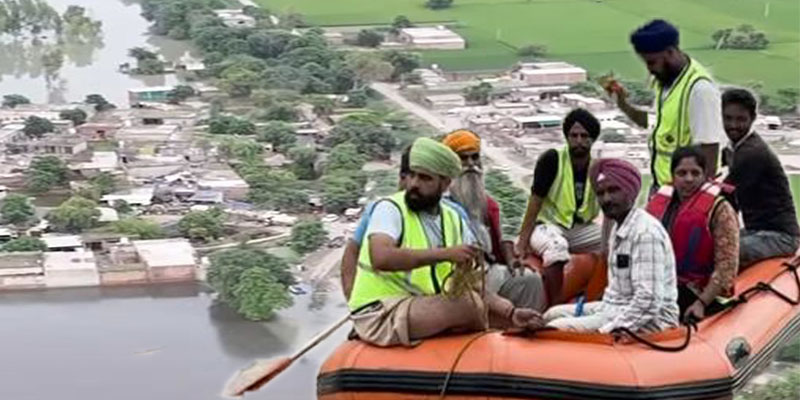
Floods in Panjab, 2025 – Photos: Khalsa Aid International
By Asia Samachar | Panjab |
The devastating floods sweeping through Punjab this year are increasingly being described not only as a natural calamity but also as a man-made tragedy. Experts and local leaders argue that poor infrastructure planning, drainage obstructions, and mismanagement of dam releases have compounded the crisis, leaving towns, villages and agricultural lands submerged for weeks.
A major culprit is the obstruction of surface water flow. The NITI Aayog’s 2021-26 flood management report had already warned that poor drainage and embankments worsen flooding in states including Punjab.
Despite this, elevated highways and insufficient culverts have created barriers that trap floodwaters in fields and settlements, reportedDown To Earth, an environment portal with a print magazine produced forthrightly.
The Parliamentary Committee on Agriculture, Animal Husbandry and Food Processing, chaired by former Punjab chief minister Charanjit Singh Channi, has flagged highways as a key factor. On September 2, it summoned officials from the National Highways Authority of India (NHAI) to explain why proper drainage was not incorporated in road projects.
Local MP Sukhjinder Singh Randhawa has accused NHAI of negligence, particularly along the Kartarpur Corridor, where a three-kilometre highway stretch lacks culverts. Residents told the state governor that waterlogging there could have been avoided with basic drainage infrastructure.
Earlier, a Public Works Department survey identified 346 spots across Punjab’s highways where drainage had been blocked. Activists note that elevated highways running northeast to southwest act like “water walls”, preventing rainwater from dispersing. Past floods, such as those in Muktsar in 2013, similarly destroyed thousands of acres due to blocked canals and drains.
The role of agriculture also complicates the crisis. Floodwaters sit stagnant in paddy fields, where compacted soil layers slow natural absorption. Combined with heavy monsoon downpours—rainfall in August was 74% above normal, with Gurdaspur and Pathankot seeing up to 181% excess rain—this has created widespread waterlogging.
At the same time, dam management has come under fire. Water releases from the Bhakra and Pong dams during peak flooding overwhelmed already saturated districts like Rupnagar and Amritsar. Randhawa, in a letter to Prime Minister Narendra Modi, criticised outdated infrastructure such as manually operated gates at the Madhopur barrage, which collapsed under extreme flows.
Experts warn that Punjab’s flood risk is amplified by encroachment on floodplains, illegal sand mining, silted rivers, and the destruction of wetlands and village ponds. Policy reforms—ranging from stricter floodplain protection to transparent dam release protocols and modern early-warning systems—are seen as essential.
As Vishnu P of humanitarian group Sphere India noted, “Only through integrated planning, climate adaptation and accountability of agencies can Punjab protect its people and agricultural economy from recurring tragedies.”
ASIA SAMACHAR is an online newspaper for Sikhs / Punjabis in Southeast Asia and beyond. You can leave your comments at our website, Facebook, Twitter, and Instagram. We will delete comments we deem offensive or potentially libelous. You can reach us via WhatsApp +6017-335-1399 or email: asia.samachar@gmail.com. For obituary announcements, click here
Engineer Jasvinder Singh in action during the installation of the rooftop solar panels at Gurdwara Sahib Klang – Photo: Supplied
By Asia Samachar | Malaysia |
The Klang gurdwara has taken a major step toward environmental sustainability with the installation of a 68.58kWp rooftop solar panel system.
The project is expected to generate substantial savings on electricity bills while contributing to a cleaner environment. It aims to cut electricity costs, lower carbon emissions and set a model for community-driven environmental action rooted in the Sikh principle of sewa (selfless service).
Technical oversight was provided by engineers Arminder Singh and Jasvinder Singh, with research guidance from Dr Baljit Singh of Universiti Teknologi MARA’s Solar Research Institute.
The system, comprising 108 Jinko Solar panels and Huawei inverters, is projected to deliver significant monthly savings under Malaysia’s Net Energy Metering (NEM) 3.0 scheme while ensuring long-term reliability.
As a call to action for the community, Gurdwara Sahib Klang (GSK) hopes the initiative will inspire other gurdwaras, religious institutions and community organisations to explore solar energy solutions.
“This project reflects our commitment to environmental stewardship and financial prudence,” said GSK committee president Sirendar Singh. “We hope other gurdwaras and institutions will be inspired to adopt similar initiatives.”
The project was supported by GSK committee members Rajinder Singh and Mahinder Singh.
ASIA SAMACHAR is an online newspaper for Sikhs / Punjabis in Southeast Asia and beyond. You can leave your comments at our website, Facebook, Twitter, and Instagram. We will delete comments we deem offensive or potentially libelous. You can reach us via WhatsApp +6017-335-1399 or email: asia.samachar@gmail.com. For obituary announcements, click here
Voltaire, the eighteenth-century philosopher, is often associated with the defence of free speech through the famous line: “I disapprove of what you say, but I will defend to the death your right to say it.” Though not his exact words, the phrase captures the essence of his writings on liberty and tolerance. For Voltaire, the measure of a civilised society lay not in silencing voices we dislike, but in upholding the principle that even our fiercest opponents must be free to speak without fear of persecution or violence.
It is through this lens that we must confront the tragic assassination of the American right-wing political activist, author, and media personality Charlie Kirk, co-founder of the conservative organisation Turning Point USA. Kirk was killed while addressing an audience at Utah Valley University in Orem, Utah, on 10 September 2025, by a single gunshot to the neck.
This cruel and horrendous act of violence must be condemned without equivocation. More than the death of one individual, it represents a wounding of democracy and a further erosion of our claim to be a civilised species. When political violence becomes a means of settling disputes, society descends into barbarism.
Kirk’s record, however, is no secret. He promoted racist ideas such as the so-called “Great Replacement” theory, argued that immigration was designed to diminish white demographics, and rejected the concept of white privilege. He spun racist tropes about Black men as predators, circulated antisemitic theories about “Jewish money,” and was deeply insulting to gay people.
These were not simply controversial positions. They were cruel, dehumanising, and served to legitimise violence. They gave cover to those who thrive on division and hatred. Yet even so, his murder is not the answer. To kill Kirk is not to silence his ideology but to reinforce the very cycles of extremism and hate that feed upon violence.
At the same time, this assassination cannot be viewed in isolation. It must be understood within a wider political culture in which violence has become normalised. Donald Trump and his right-wing allies have not only encouraged extremism but openly sanctioned it, be it through the storming of the Capitol or the tacit endorsement of genocidal violence against civilians in Gaza. In such an environment, the line between words and deeds becomes dangerously blurred.
Kirk’s assassination is therefore less an aberration than a symptom of a deeper crisis: the erosion of democracy, truth, and tolerance. To defend free speech, as Voltaire urged, is not to defend hateful ideas themselves but to safeguard the principle that words, however odious, must not be met with bullets.
Kirk’s death must be recognised both as a personal tragedy and as a wider indictment of a political culture that trades in hatred and violence. If we fail to learn from this moment, we risk losing not only democracy but also our very claim to be a civilised humanity.
Gurnam Singh is an academic activist dedicated to human rights, liberty, equality, social and environmental justice. He is an Associate Professor of Sociology at University of Warwick, UK. He can be contacted at Gurnam.singh.1@warwick.ac.uk
* This is the opinion of the writer and does not necessarily represent the views of Asia Samachar.
ASIA SAMACHAR is an online newspaper for Sikhs / Punjabis in Southeast Asia and beyond. You can leave your comments at our website, Facebook, Twitter, and Instagram. We will delete comments we deem offensive or potentially libelous. You can reach us via WhatsApp +6017-335-1399 or email: asia.samachar@gmail.com. For obituary announcements, click here
Once again, recent floods have shown that India has no long-term plans for the devastating impact of global climate change. In addition to loss of life, floods cause massive damage to infrastructure and property. Crops are destroyed, livestock lost, travel is affected and floods cause disease. The economic cost at national level is huge.
With the floods, starts the blame-game, with politicians, official planners and senior bureaucrats pointing fingers at each other. Massive scale agro-industrial pollution, poor planning of water flows and dams, cleaning of river beds to keep water flowing, de-forestation, short-term policies by an inefficient bureaucracy and polluting habits of an increasing population are linked to climate change.
Colonial style administrators to the highest positions have hardly any work ethic or personal conviction that honest and hard work is a reward in itself. There are no performance measure and they seem to have no moral compass to do their duty as public servants. Often, their excuse for taking direct or indirect bribes is that this is how things are done here.
Otherwise, there is no shortage of well-qualified people and there is no shortage of expert advice. Economically, Indian skills, private sector enterprise, a large home-market, and a very large cheap and young labour force have pushed India to a respectable global position. However, the success of India hides the longer-term consequences of short-term gains.
According to one estimate, northern parts of the Indian subcontinent are the worst areas affected by annual floods accounting for over one-fifth of all flood-related deaths globally. Heavy rainfall starts landslides and flash floods. Roads are broken and blocked and much property, structures like bridges and agricultural land are submerged in water. In addition to human suffering, the economic cost is enormous and will keep on increasing due to climate change for which India is ill-prepared.
Quite interestingly, public debates about the floods have linked many aspects of Indian way of life and negative consequences for the environment. For example, the environmental and food-chain consequences of rubbish carelessly thrown on the roads and public places is discussed. It is sadly amusing for diaspora Indians to receive impressive photos of lavish-style houses from wealthy Indian relatives and friends, knowing fully well what lies outside! Rubbish heaps and broken roads are accepted as part of the environment. The domestic servants they boast about, have hardly anywhere to live a life with dignity. Essential toilet facilities for all, proper drainage and disposal of rubbish are often missing.
The average Indian, especially travellers and tourists, believe it is their right to throw rubbish anywhere. The most attractive tourist sites and sacred shrines in the beautiful hills and mountains are littered with rubbish. Yet, the same people change their habits when they come abroad (or maybe not when I look at own town, Southall, the UK Panjabi Town!)
The floods have also brought out the best and the worst in the people. For example, the Panjabi farmers are distributing food while elsewhere the Indian shop-keepers are exploiting by raising prices of goods in affected areas.
The inefficiency of the Indian system becomes obvious annually through floods and crumbling structures. The economic, employment and social consequences for an ever-increasing population will continue to be even more disastrous. As we have seen in recent decades, migrations from Panjab and India will continue to increase.
Environmental and climate change issues are complex and require long term policies and systematic planning and implementation over decades.
Gurmukh Singh OBE, a retired UK senior civil servant, chairs the Advisory Board of The Sikh Missionary Society UK. Email: sewauk2005@yahoo.co.uk. Click here for more details on the author.The article first appeared at Panjab Times, UK
* This is the opinion of the writer, organisation or publication and does not necessarily represent the views of Asia Samachar.
ASIA SAMACHAR is an online newspaper for Sikhs / Punjabis in Southeast Asia and beyond. You can leave your comments at our website, Facebook, Twitter, and Instagram. We will delete comments we deem offensive or potentially libelous. You can reach us via WhatsApp +6017-335-1399 or email: asia.samachar@gmail.com.
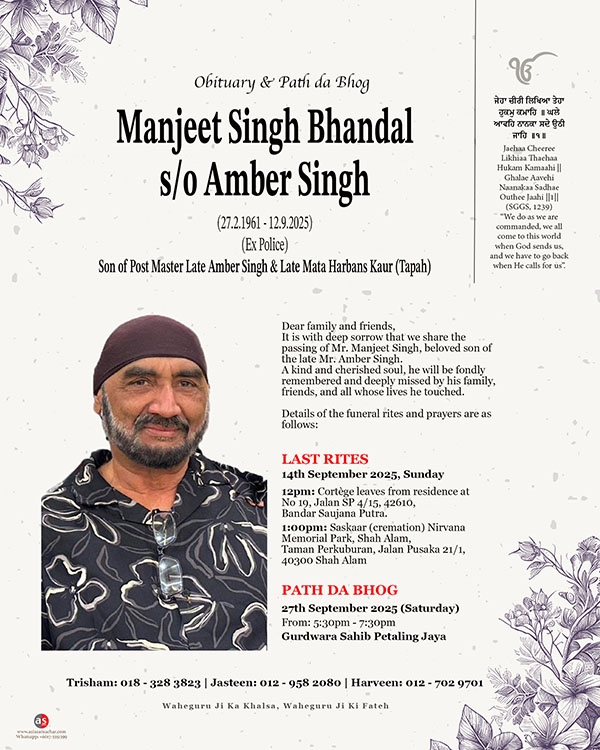
Son of Post Master Late Amber Singh & Late Mata Harbans Kaur (Tapah)
Dear family and friends, It is with deep sorrow that we share the passing of Mr. Manjeet Singh, beloved son of the late Mr. Amber Singh. A kind and cherished soul, he will be fondly remembered and deeply missed by his family, friends, and all whose lives he touched.
Details of the funeral rites and prayers are as follows:
FUNERAL 14th September 2025, Sunday
12pm: Cortège leaves from residence at No 19, Jalan SP 4/15, 42610, Bandar Saujana Putra. 1:00pm: Saskaar (cremation) Nirvana Memorial Park, Shah Alam, Taman Perkuburan, Jalan Pusaka 21/1, 40300 Shah Alam
PATH DA BHOG 27th September 2025 (Saturday) From: 5:30pm – 7:30pm Gurudwara Sahib Petaling Jaya
ASIA SAMACHAR is an online newspaper for Sikhs / Punjabis in Southeast Asia and beyond. You can leave your comments at our website, Facebook, Twitter, and Instagram. We will delete comments we deem offensive or potentially libelous. You can reach us via WhatsApp +6017-335-1399 or email: asia.samachar@gmail.com. For obituary announcements, click here
Irfan Zaini takes the lead as ‘Ajeet’, a character inspired by Malaysian rally legend Karamjit Singh. — Picture by Sayuti Zainudin / The Malay Mail
By Ian Jeremiah Patrick | The Malay Mail | Malaysia |
In the world of rallying — a high-octane motorsport battled across both closed and public roads — Karamjit Singh is a name that sparks instant recognition.
Fondly known as the ‘Flying Sikh’ and competing professionally since 1985, he became the first Malaysian — and the first Asian — to win an international rally world title. His victories include the 2001 Asia Pacific Rally Championship, the 2002 FIA Production Car World Championship, and the FIA Asia-Pacific Rally Championships in 2002 and 2004.
Malaysian production house Astro Shaw, in collaboration with Woohoo Pictures, is set to bring Karamjit’s extraordinary story to life in a film titled Terbang, directed by none other than Chiu Keng Guan — the acclaimed filmmaker behind Malaysian favourites The Journey (2014) and Ola Bola (2016).
“We believe the story of an icon like Karamjit Singh, fondly known as the ‘Flying Sikh’, deserves to be immortalised on the big screen,” said executive producer and head of Astro Shaw, Raja Jastina Raja Arshad.
“His historic victory at the 2001 FIA Asia Pacific Rally Championship was not only a proud achievement but also a defining moment that placed Malaysia firmly on the world stage.
“With Terbang, we hope to deliver not only adrenaline-pumping rally action but also to inspire pride and confidence in the belief that Malaysian films can stand tall as globally compelling stories, while staying true to their local soul,” she added.
Director Chiu said, “I wouldn’t say it’s a biopic, but it’s inspired by real events — something like Ola Bola.
“This story means a lot to Malaysians, and we want to share it with the whole country.”
The film also aims to shed light on Malaysia’s once-thriving rallying scene, which once captivated the nation but has since faded from the spotlight.
ASIA SAMACHAR is an online newspaper for Sikhs / Punjabis in Southeast Asia and beyond. You can leave your comments at our website, Facebook, Twitter, and Instagram. We will delete comments we deem offensive or potentially libelous. You can reach us via WhatsApp +6017-335-1399 or email: asia.samachar@gmail.com. For obituary announcements, click here
Left: The Samadh (tomb) of Mahan Singh in an earlier photo (source: Asian Historical Architecture website). Next three photos were taken from a recent video after the heavy rainfalls and floods in Panjab
By Asia Samachar | Pakistan |
The Samadh (tomb) of Mahan Singh, built by his son Maharaja Ranjit Singh in 1837 at Sheranwala Bagh of Gujranwala, has been partially damaged due to recent heavy rainfalls. In the early 1900s, the building was converted into a Gurdwara Sahib.
“I understand that one side section of the octagonal base has collapsed, and now there is a risk of the tall middle section with the dome collapsing over the nearby school.
“I have visited the site and documented it. It is a site of historical importance not only for Sikhs but also for the people of Gujranwala and Punjabis in general,” said US-based interfaith activist Tarunjit Singh Butalia.
Tarunjit has called on the community to ‘respectfully email’ the chairman of the Evacuee Trust Property Board (ETPB) at chairman@etpb.gov.pk requesting information on what is being done to stabilise the structure for the short term and what the long-term plans are for renovation and preservation of the structure.
This samadhi marks the cremation site of Mahan Singh (r. 1770-92), the father of Maharaja Ranjit Singh who founded the Sikh Empire, according to an entry at the Asian Historical Architecture website, a photographic survey of Asian architecture heritage, history and styles.
During his life, Mahan Singh served as ruler of the Sukerchakia Misl, one of 12 such Misl in the Punjab region. Each of the Misls was an independent sovereign entity within the Sikh Confederacy that predated Ranjit Singh’s unification. Under his rule, Mahan Singh captured the sprawling Rohtas Fort from the forces of Ahmad Shah Durrani, the founder of the Durrani empire, and later allied with Jassa Singh Ramgarhia (leader of the Ramgarhia Misl) to overcome the Kanheya Misl at the Battle of Batala.
He died in April 1790 of dysentery during the siege of Sodhra, about 32 kilometers north of Gujranwala, in a battle against the Bhangi Misl, it added.
ASIA SAMACHAR is an online newspaper for Sikhs / Punjabis in Southeast Asia and beyond. You can leave your comments at our website, Facebook, Twitter, and Instagram. We will delete comments we deem offensive or potentially libelous. You can reach us via WhatsApp +6017-335-1399 or email: asia.samachar@gmail.com. For obituary announcements, click here