






















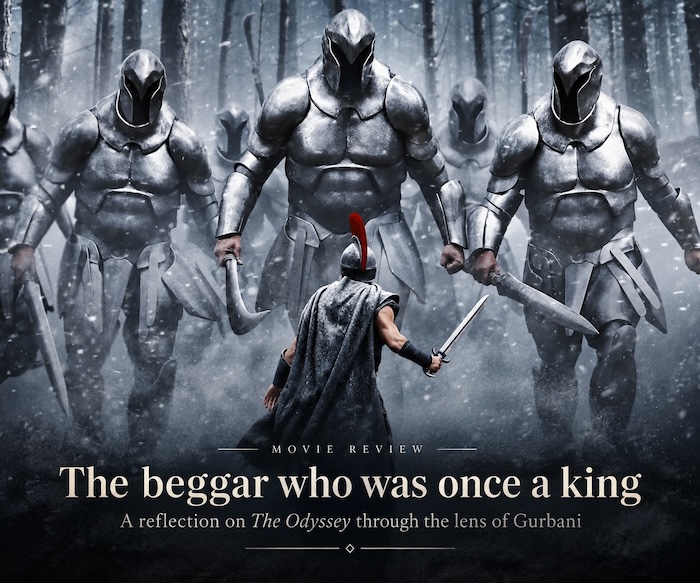
By Sharan Kaur | Movie Review |
Watching The Odyssey recently, I believe there’s a reason myths like this have survived for thousands of years, retold in every generation — and I don’t think it’s only the adventure. Like scripture, these stories work on more than one level at once: there’s the surface tale, entertaining enough to hold an audience for a few hours; there’s the moral lesson beneath it, about pride, patience, or restraint; and beneath even that, I think, is an allegory for the soul’s own journey — the trials a person must pass through to come home to themselves.
Here are parallels I found looking at Odysseus’s journey (the original story and not the condensed version of the movie) through the lens of Gurbani:
Odysseus leaves Troy the way every conqueror imagines leaving — twelve ships, a fleet of men, a name already turning into legend. Ten years later he crawls onto the shore of his own kingdom alone, naked, unrecognised, disguised as a beggar. The distance between those two men is the entire poem. Read a certain way, it is also a map of the Panj Chor — the five thieves the Sikh tradition names as what stands between a person and their own truth: Kaam, Krodh, Lobh, Moh, Hankar.
The first theft comes almost gently. On the island of the Lotus-Eaters, some of his men taste the lotus flower and simply stop wanting to go home. They have to be dragged back to the ships in tears — not because the island is dangerous, but because it is comfortable enough to make them forget what they were sailing toward. As Guru Nanak Dev Ji observes in Sidh-Ghost (SGGS, 931) Maya acts as a toothless serpent (dant hīṇnāgaṇ)—swallowing you whole in her gummy jaws without ever needing to bite. This is Moh, attachment: not a trap that seizes you, but a softness that makes you forget you were ever going anywhere.
Then the Cyclops’s cave, where the poem shows two vices in a single act. Blinding Polyphemus is Krodh — fury answering violence with violence. But the deeper theft happens moments later, as they sail to safety and Odysseus cannot resist turning back to shout his real name to the blinded giant. That is Hankar — pure ego, needing the credit, needing to be known. It is also the single choice that curses the rest of his journey: Polyphemus prays to his father Poseidon, and the god of the sea becomes Odysseus’s enemy for the next decade.
Lobh, greed, appears next, and tellingly it belongs to the crew (the sangat he keeps) rather than to Odysseus alone. King Aeolus gives them a bag containing every contrary wind, sealed, with home already in sight — and his men, suspecting it hides treasure kept from them, open it while he sleeps. The winds scatter them back to where they started. Suspicion and appetite undo in a moment what ten days of hard sailing had earned.
On Circe’s island, Kaam takes its clearest form: a year dissolves into pleasure before his men have to remind him there is still a journey to finish. But Circe also sends him somewhere none of the vices can follow — the edge of the world, to consult the dead. There he meets his mother, Anticleia, who tells him she died of grief and longing for him, and who, when he tries three times to embrace her, slips through his arms like smoke. And he meets Achilles, the greatest warrior who ever lived, who tells him plainly that he would rather be a landless servant to the poorest man alive than rule as king over all the dead. The man who chose glory over a long life at Troy tells Odysseus, from beyond it, that the glory was not worth what it cost. This is close to what the Rehat Maryada asks of a Sikh — to live fully while never forgetting death is certain, so that life is not spent chasing what death will make meaningless anyway. Odysseus returns from the underworld not with a weapon or a treasure, but with that.
Back at Circe’s island to bury a crewman, he’s given warnings for what’s ahead — and the two trials that follow are less about vice than about the discipline it takes to survive one’s own nature. Approaching the Sirens, he has himself bound to the mast rather than trusting his own willpower against their song, plugging his crew’s ears and keeping his own open only because he wants to hear it and knows he cannot be trusted to hear it safely. It is restraint chosen in advance, not virtue in the moment — a kind of humility about his own limits. Then Scylla and Charybdis: forced to choose between a whirlpool that could sink the whole ship and a monster that will take exactly six men and no more, he knowingly sacrifices six lives to save the rest, and does not tell his crew what’s coming until it’s already happening. It is the least heroic decision in the poem, and possibly the wisest.
Lobh returns for a final, fatal turn on Thrinacia. Starving despite every warning, his crew slaughter the sacred cattle of the sun god for a single feast. It costs them everything: the ship is destroyed by storm and every man but Odysseus drowns. He alone survives to wash up, half-dead, on Calypso’s island.
There he stays seven years, and Kaam makes its subtlest appearance yet — not as a trap he must escape but as a temptation he must refuse. Calypso offers him immortality itself: an undying lover, an end to struggle, a life with no more sea and no more grief. He says no, and weeps on the shore each day for a home he has not seen in a decade. Refusing paradise for something smaller and mortal is its own kind of humility.
When Calypso finally lets him go, he builds his own raft — his last act of self-reliance — and Poseidon tears it apart plank by plank. He clings to what’s left of it, refusing to let go, until the sea goddess Ino appears and tells him to strip off his clothes, tie on her veil, abandon the wreckage entirely, and trust the water to carry him. He resists at first. Only once there is truly nothing left to cling to does he let go. It is surrender, but not passive — the specific, hard-won surrender of someone who has tried everything else first. Something close to accepting Hukum: not resignation, but trust extended only after struggle has exhausted itself.
He washes ashore on the island of the Phaeacians, who owe him nothing and give him everything anyway — a bath, a feast, a ship, safe passage, asking only for his story in return. And his final journey home is one he does not make himself at all: their ship sails itself while he sleeps through the entire crossing. The last leg is the one leg he does not walk but is carried by the Grace of virtuous strangers.
In Ithaca, he realises the safest way to homecoming is as a begger, and the disguise becomes its own quiet test of everyone meets. The swineherd Eumaeus, his own servant, shows the stranger genuine hospitality without knowing who he is, revealing more about Eumaeus’s character than about Odysseus’s. His old dog, Argos, now flea-ridden and dying, is the only one in the whole kingdom to know him instantly, and dies moments later having finally seen his master come home. His nurse Eurycleia recognises him by an old scar on his leg while washing his feet — identity carried in the body, beneath every layer of disguise.
And when it finally comes time to reclaim his house, the proof isn’t a crown or a claim — but his own authenticity. It’s a bow that only his exact strength and skill can string, and a marriage bed he alone knows is built around a living, rooted olive tree, immovable, because he built it that way himself years before. Both are tests no impostor, however convincing, could pass. The self, in the end, is not a title. It’s the one thing that can’t be faked.
And so the man who left as a king returns as a beggar — deliberately disguised, but the disguise fits almost too well. Only stripped of every title, every soldier, every trace of the ego that sailed for Troy, does he finally reclaim his Home. The war was never the real journey. The five thieves were.
CHECK OUT MORE FEEDBACKS FOR THIS REPORT AT FACEBOOK AND INSTAGRAM
RELATED STORY:
What to watch: Unorthodox brings a quieter Israeli story into focus (Asia Samachar, 26 March 2026)
ASIA SAMACHAR is an online newspaper for Sikhs / Punjabis in Southeast Asia and beyond. You can leave your comments at our website, Facebook, Twitter, and Instagram. We will delete comments we deem offensive or potentially libelous. You can reach us via WhatsApp +6017-335-1399 or email: asia.samachar@gmail.com. For obituary announcements, click here