






















By Gurnam Singh | Opinion |
Introduction
For more than forty years, I have observed the Khalistan movement closely, both as an activist committed to the cause of Sikh sovereignty and human rights and as an academic interested in questions of nationalism, identity and political power. In terms of Sikh activism during that time, I have witnessed periods of intense mobilisation, international advocacy and political transformation. The Indian state, too, has sought actively to suppress the movement through a wide array of strategies, from extrajudicial killings of activists and false imprisonment to propaganda, transnational repression and geopolitics.
The map of the world is not static and, through the passage of time, all nations and even empires rise and eventually fall. Likewise, all movements that aspire to nationhood rise and fall, and sometimes rise again, and in this regard the Khalistan movement is no exception. That said, I think a fair assessment of the current movement, which was born in 1984 following Indian state repression of Sikhs in India, culminating in the Sikh Genocide of November 1984, is that the cause for an independent state of Khalistan struggles to command widespread support, most particularly within Punjab and India. This raises a difficult but necessary question: has the dream of Khalistan become politically unattainable?
Asking this question does not require one to dismiss the historical injustices experienced by Sikhs, nor does it imply acceptance of the increasingly centralised political order promoted by the Indian state. Rather, it requires an honest assessment of political realities, changing public sentiment and the practical challenges facing movements for self-determination in the contemporary world.
The reasons for this decline are complex and involve both internal and external factors. Political movements often evolve in unexpected ways, particularly when shaped by changing social, economic and geopolitical conditions. Consequently, any assessment of Khalistan’s future must be approached with caution. Nevertheless, the apparent reduction in support for the idea of an independent Sikh state should not be interpreted as evidence that Sikhs, Punjabis more broadly, or indeed many citizens across India, are content with the increasingly centralised and majoritarian tendencies associated with the Bharatiya Janata Party (BJP) and its Hindutva-inspired political project.
Recent political developments demonstrate that significant discontent with the central government remains. The election to the Lok Sabha of figures such as Amritpal Singh and Sarabjit Singh Khalsa, both associated with Sikh nationalist sentiment, suggests that sections of the electorate continue to express dissatisfaction with the political status quo. Similarly, the Farmers’ Protest of 2020-21 represented one of the most significant popular mobilisations in contemporary Indian history and revealed widespread opposition to government policies among many rural communities, particularly in Punjab. More recent youth-led protest movements also suggest that anti-establishment sentiment remains alive among younger generations.
At the same time, Prime Minister Narendra Modi and the BJP have continued to consolidate political power at the national level. This creates a paradoxical situation in which growing dissatisfaction has not yet translated into a meaningful weakening of the political dominance of the ruling party. As a result, the prospects for radical constitutional change, including the creation of an independent Khalistan, appear limited in the short to medium term.
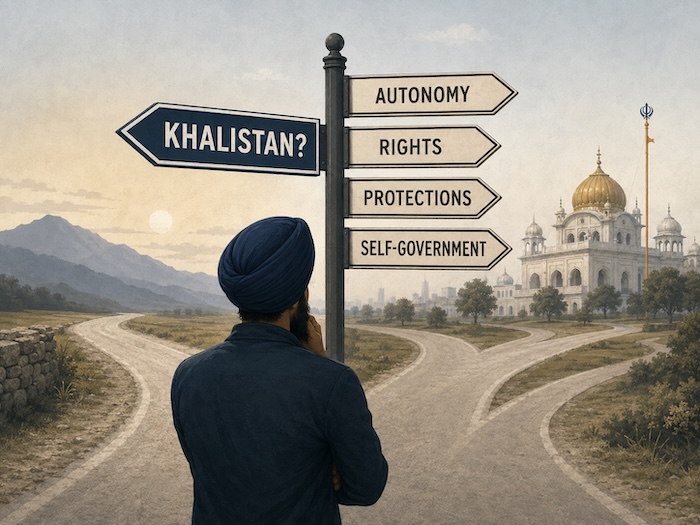
The purpose of this article is not to advocate either for or against Khalistan. Rather, it is to provide an independent assessment of its contemporary feasibility and to consider alternative political arrangements that fall short of complete independence. These alternatives include enhanced federal autonomy, stronger constitutional protections, greater recognition of minority rights and new forms of regional self-government. Whether such arrangements can adequately address long-standing Sikh grievances remains an open question, but they warrant careful consideration alongside debates about sovereignty and statehood.
Assessing the structural feasibility of Khalistan
Political science literature generally identifies several conditions necessary for the successful creation of a new state: a supportive population, territorial control, economic viability, international recognition and a favourable geopolitical environment. When examined against these criteria, the prospects for an independent Khalistan appear highly uncertain. The key considerations are demography, geopolitics, international legitimacy and political momentum. Each of these aspects is explored below, followed by a consideration of alternative options short of an independent nation.
Demographic constraints
One of the most significant challenges concerns demographics. According to the Census of India (2011), Sikhs constituted approximately 58 per cent of Punjab’s population, while Hindus represented approximately 38 per cent. In addition, sizeable migrant populations from other Indian states contribute to the province’s increasing diversity.
While Sikhs remain the majority community, this demographic reality complicates proposals for a state explicitly grounded in Sikh political identity. Unlike many successful nationalist movements that emerged from overwhelming popular support within a clearly defined territory, contemporary Punjab does not appear to possess a clear democratic consensus favouring secession.
The priorities of Punjab’s electorate also appear to be focused elsewhere. Telford (1992) argued that economic concerns have often played a central role in shaping political behaviour within Punjab, while Singh (2000) noted that issues such as agrarian distress, unemployment and governance have frequently displaced separatist demands in mainstream political debate. This analysis is supported by the huge level of support for, and mobilisation by, Punjab’s farmers in the 2021 Kisani Morcha, which, despite attempts by Khalistani elements to hijack it, was staunchly secular. Contemporary electoral politics and the ongoing support for secular parties in Punjab largely support this assessment.
Geopolitical realities
The geopolitical environment poses an even greater challenge. A sovereign Khalistan would be a landlocked state positioned between two nuclear powers, India and Pakistan. Such a state would likely face significant security vulnerabilities and would remain heavily dependent upon its neighbours for trade routes, transit agreements and regional stability.
 Crawford (2006) argues that modern state formation is closely tied to effective territorial control and international legitimacy. International law generally favours the preservation of existing state boundaries and grants recognition to secessionist entities only under exceptional circumstances, such as decolonisation, foreign occupation or state collapse. None of these conditions currently apply to India.
Even if a successful independence movement were to emerge, the practical challenges of securing territory, governing populations and maintaining diplomatic relations would remain immense.
International recognition and legitimacy
Statehood is not simply a matter of declaring independence. The viability of any new state depends significantly upon recognition by the international community. As Buchanan (2004) observes, international actors generally prioritise stability and territorial integrity over unilateral secessionist claims. While exceptions have occurred, such cases are relatively rare and often linked to extraordinary humanitarian or geopolitical circumstances.
Despite sustained campaigning by sections of the Sikh diaspora, no major state or international organisation has formally endorsed the creation of Khalistan. Diaspora-led referenda have succeeded in generating publicity and political debate, but they have not translated into diplomatic recognition or meaningful international support.
Without such recognition, an independent Khalistan would face profound economic, political and legal challenges from the outset.
The question of political momentum
Another factor affecting the feasibility of Khalistan is the apparent decline in mass mobilisation. During the 1980s and early 1990s, Sikh militancy and separatist politics occupied a prominent place in public discourse. Today, while support for Khalistan certainly survives among some sections of the Sikh community in Punjab and the diaspora, the movement lacks the widespread mobilisation that characterised earlier decades.
This does not mean that Sikh grievances have disappeared. Far from it. Questions concerning the events of 1984, accountability, federalism, minority rights and political representation continue to resonate deeply across sections of Sikh society. What appears to have changed is not necessarily the existence of grievances but rather the preferred political means of addressing them.
Alternative pathways to Sikh self-determination
If territorial independence appears highly improbable under current conditions, the question arises as to whether meaningful forms of Sikh self-determination can be pursued within a number of existing constitutional arrangements. Each one of these is discussed below.
Reasserting federalism
One possibility lies in renewed demands for a more genuinely federal India. Many elements of the Anandpur Sahib Resolution focused not on outright secession but on devolving powers from the central government to the states. Brass (1990) argued that India’s constitutional order already contains significant federal features, although political developments have often strengthened central authority at the expense of regional autonomy.
From this perspective, Sikh political organisations could seek greater control over natural resources, agricultural policy, water rights and internal governance while remaining within the Indian Union. Such an approach would shift the debate from territorial sovereignty to constitutional reform.
Fiscal autonomy and economic self-governance
Economic concerns have long shaped Punjab’s relationship with the Indian state. According to Singh (2000), disputes concerning economic policy, resource allocation and agricultural development have frequently contributed to political tensions between Punjab and the centre.

Advocates of greater autonomy could therefore focus on expanding Punjab’s fiscal authority and strengthening local economic decision-making. Enhanced control over taxation, investment strategies and regional development may offer a practical route towards greater self-governance without requiring political separation. This would represent a form of functional sovereignty rather than territorial sovereignty.
Institutional self-governance
Another potential strategy involves strengthening Sikh institutions themselves. Grewal (1998) emphasised the historic importance of Sikh religious and social institutions in preserving collective identity during periods of political uncertainty. Organisations such as the Shiromani Gurdwara Parbandhak Committee (SGPC) already exercise considerable influence in religious matters and could potentially play a larger role in education, healthcare, community welfare and cultural preservation.
Another related option, as advocated by Rai (2023), is to work towards Vatican-like status for the Akaal Takht, with the Darbar Sahib complex becoming a de facto Sikh seat of sovereign power. Similarly, one could envisage diaspora-supported educational networks, charities, investment funds and cooperative enterprises that could contribute to a stronger and more self-reliant Sikh civil society. This approach focuses on building autonomy from within rather than seeking sovereignty through statehood.
International human rights advocacy
A further avenue involves greater reliance upon international human rights frameworks.
The United Nations Declaration on the Rights of Persons Belonging to National or Ethnic, Religious and Linguistic Minorities (United Nations, 1992) affirms the right of minority communities to enjoy their culture, practise their religion and protect their identity.
Advocacy based upon religious freedom, minority rights and historical accountability may offer greater international legitimacy than demands for secession. While such mechanisms are often slow and imperfect, they may nevertheless help secure practical protections and international attention for unresolved Sikh concerns.
Conclusion
The aspiration for Khalistan continues to possess emotional, historical and political significance for many Sikhs, particularly those whose political consciousness was shaped by the traumatic events of 1984 and their aftermath. Those experiences cannot simply be dismissed or forgotten, nor can the legitimate grievances that emerged from them.
However, a sober assessment of contemporary realities suggests that the creation of an independent Sikh state currently faces substantial demographic, geopolitical, legal and diplomatic obstacles. The absence of a clear domestic mandate, the difficulties of international recognition, the strategic realities of South Asia and the priorities of contemporary electoral politics all combine to make the realisation of Khalistan highly improbable in the foreseeable future.
At the same time, the decline of secessionist politics should not be confused with satisfaction with existing political arrangements. As the unprecedented farmers’ movement of 2021 demonstrated, concerns regarding land and territorial rights, centralisation, democratic accountability, minority rights, cultural security and historical justice remain significant and continue to resonate across Punjab and beyond.
Consequently, the most pressing question may not be whether Khalistan is achievable today, but whether alternative forms of Sikh self-determination can deliver meaningful political, cultural and economic autonomy. Enhanced federalism, stronger community institutions, greater fiscal independence and international rights-based advocacy may not fulfil every nationalist aspiration, yet they arguably offer more realistic pathways towards securing Sikh interests in the twenty-first century.
The future remains uncertain. Political realities can change rapidly, often in ways that observers fail to anticipate. Nevertheless, any serious discussion of Sikh sovereignty must engage honestly with both the enduring power of historical grievances and the practical realities that shape political possibility in the contemporary world.
References
Brass, P.R. (1990) The Politics of India Since Independence. Cambridge: Cambridge University Press.
Buchanan, A. (2004) Justice, Legitimacy, and Self-Determination: Moral Foundations for International Law. Oxford: Oxford University Press.
Census of India (2011) Population by Religious Community – Punjab. Office of the Registrar General & Census Commissioner, India.
Crawford, J. (2006) The Creation of States in International Law. 2nd edn. Oxford: Oxford University Press.
Grewal, J.S. (1998) The Sikhs of the Punjab. Cambridge: Cambridge University Press.
Rai, J.S. (2023) Supremacy Sri Akal Takht Sahib: De Jure. New Delhi: Partridge Publishing India.
Singh, G. (2000) Ethnic Conflict in India: A Case-Study of Punjab. London: Palgrave Macmillan.
Telford, H. (1992) ‘The Political Economy of Punjab: Creating Five Rivers of Wheat and an Ocean of Violence’, Asian Survey, 32(11), pp. 969-987.
United Nations (1992) Declaration on the Rights of Persons Belonging to National or Ethnic, Religious and Linguistic Minorities. A/RES/47/135. New York: United Nations.
Join the conversation on this story on Asia Samachar’s Facebook and Instagram pages.

Gurnam Singh is an academic activist dedicated to human rights, liberty, equality, social and environmental justice. He is a Professor of Sociology at University of Warwick, UK. He can be contacted at Gurnam.singh.1@warwick.ac.uk
* This is the opinion of the writer and does not necessarily represent the views of Asia Samachar.
RELATED STORY:
Forty-two years after Blue Star: How 1984 transformed the Sikh struggle (Asia Samachar, 7 June 2026)
ASIA SAMACHAR is an online newspaper for Sikhs / Punjabis in Southeast Asia and beyond. You can leave your comments at our website, Facebook, Twitter, and Instagram. We will delete comments we deem offensive or potentially libelous. You can reach us via WhatsApp +6017-335-1399 or email: asia.samachar@gmail.com. For obituary announcements, click here




Jasdev, I think your comment raises an important challenge to my analysis, particularly your point that international, diplomatic and legal barriers should not be treated as permanent or insurmountable. History certainly shows that territorial and political realities can change, sometimes quite dramatically, when political will, strategic leadership and favourable international circumstances come together.
Where I would differ is in your conclusion that “working with Sikhs is impossible” because of an alleged endemic culture of jealousy and a lack of intellectually capable individuals. I think that moves from a potentially useful historical observation into a much broader generalisation about an entire community. Factionalism, rivalry and competing interests have no doubt been our Achilles heel, but these are hardly unique to Sikhs. I take a more optimistic view that we can learn from past failures . In reject the implication of an inherent “pathology” of the Sikh community rather than through identifiable historical and institutional factors
Good general analysis. However property or in this case territory, once acquired can always be justified or legally defended if there are genius lawyers or political brains within the community or helping with its struggle. International community gives way. Plenty of examples.
The institutional (mostly international) and ideological blocks as well as diplomatic barriers are not difficult to get around. However working with Sikhs is a heroic task, in fact an impossibility. Moreover there isn’t a reasonable strata of intellectually capable individuals within the Sikh community to make it possible. The community is driven by economic gains and more perniciously, a pathological culture of jealousy. This was observed as early as 1782 by a European studying Misls. His conclusion was, they are brave, strong, never give up, but can never make a nation, because jealousy is endemic. So there are deeper reasons than international barriers etc. No one gives away territory. It requires genius, guile, political will and capability to prize territory away from another power. So Khalistan is not impossible, working with Sikhs is impossible