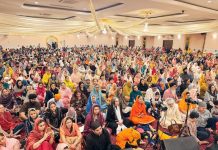
Let us be the voice of Punjab. Just for a minute, let’s look at the bigger picture. Our 10th Guru, Guru Gobind Singh Ji, encouraged us to learn about different faiths, beliefs and politics. This is so we can stand against injustice and oppression.
Look, oppression has existed for generations and there have been multiple attempts to eradicate, erase and wipe out the Sikh community from existence, even today. The fight for justice continues.
1984 was a horrific example of how the current situation can get. Think about it, our elder generation is still traumatised by those events that they witnessed. And even today, some of them have remained silent and will continue to remain silent.
CLICK HERE FOR THE VIDEO So history is yet again repeating itself. Almost 40 years later, Punjab is experiencing a media blackout. Multiple Sikhs are being arrested to unknown locations.
To sum this up, this is another attempt to silence us. For how long should any Sikh knowing this information, remain silent.
Speak up and don’t be silent.
Ranjeet Kaur is a UK-based artist and creator of Sikh Colouring Books. This entry first appeared at her LinkedIn page towards the end of March 2023 when Panjab was gripped with fear and uncertainty with the imposition of various restrictions and the arrests of Sikh activists as the authorities purportedly was searching for young activist Amritpal Singh
ASIA SAMACHAR is an online newspaper for Sikhs / Punjabis in Southeast Asia and beyond. When you leave a comment at the bottom of this article, it takes time to appear as it is moderated by human being. Unless it is offensive or libelous, it should appear. You can also comment at Facebook, Twitter, and Instagram. You can reach us via WhatsApp +6017-335-1399 or email: asia.samachar@gmail.com. For obituary announcements, click here.
Please treat and accept this as a personal invitation from our family.
| Entry: 8 April 2023; Updated: 17 April 2023 | Source: Family
ASIA SAMACHAR is an online newspaper for Sikhs / Punjabis in Southeast Asia and beyond. When you leave a comment at the bottom of this article, it takes time to appear as it is moderated by human being. Unless it is offensive or libelous, it should appear. You can also comment at Facebook, Twitter, and Instagram. You can reach us via WhatsApp +6017-335-1399 or email: asia.samachar@gmail.com. For obituary announcements, click here.
Siropa, a 14-minute film released last year, is a wonderful attempt at bringing underlying the true meaning behind the word sirapo (robe of honour).
At gurdwaras or Sikh functions, you would have encountered instances where people are called up and honoured, usually with a robe placed around their neck. They call this a siropa.
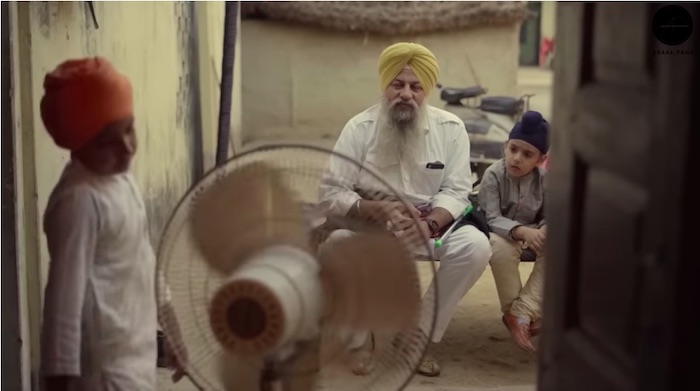
In this short film by an Australian production house Akaal Fauj, the short film depicts the annual journey of wealthy businessman Randhir Singh and his family to their ancestral village.
Ah, if you’re a driving safety freak, then you would have noticed the kid in the front passenger seat. Safety wise, he should be seated in the back, and buckled. But that’s has nothing to do with the storyline.
As with many such wealthy individuals, folks like Randhir make big donations to their village gurdwaras or other outfits, usually to stroke their ego. Of course, some do it for the betterment of their ancestral village.
Randhir is looking forward to the siropa he will get when he makes yet another big donation.
On the way to the village, they encounter an incident, which instructs him on the true meaning of the siropa.
Well, as with many such short films, it carries a message, but you can more or less guess how the story would unfold. Still, worth a watch if you can spare the time.
ASIA SAMACHAR is an online newspaper for Sikhs / Punjabis in Southeast Asia and beyond. When you leave a comment at the bottom of this article, it takes time to appear as it is moderated by human being. Unless it is offensive or libelous, it should appear. You can also comment at Facebook, Twitter, and Instagram. You can reach us via WhatsApp +6017-335-1399 or email: asia.samachar@gmail.com. For obituary announcements, click here.
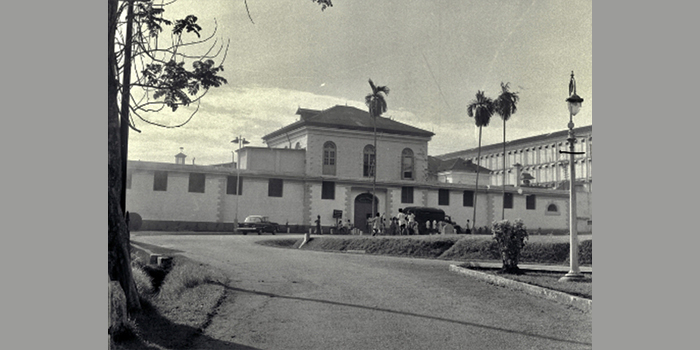
Much has been written and also a documentary produced in 2019 about Punjab’s revolutionary and freedom fighter Bhai Maharaj Singh and his subsequent incarceration at the Outram Road Jail in Singapore in 1850, and his present commemoration at the Bhai Maharaj Singh Memorial, Silat Road Gurdwara in Singapore.1,2,3. He arrived in Singapore on board the ship Mohamed Shah on 9 May 1850, together with his tehlia (personal attendant) Khurruck Singh, also spelt as Kharak Singh. Bhai Maharaj Singh died in prison on 5 July 1856. Khurruck Singh has been depicted in colonial documents as Bhai Maharaj Singh’s servant and little else has been known and written about him. This article seeks to elucidate his background and affiliation with Bhai Maharaj Singh, and, more importantly, his time in Singapore.
Malaysian historian Dr. Ranjit Singh Malhi disputes this arrival date, and his research on British records reveals that Bhai Maharaj Singh and Khurruck Singh instead landed in Singapore on 9 June 1850. This fact is confirmed in a despatch dated 21 June 1850 from the Governor of the Straits Settlements to the Secretary to the Government of India.
Khurruck Singh has been variously described as Bhai Maharaj Singh’s chela. Chela is a Sanskrit word that literally means servant or slave. It also loosely means disciple, follower, or devotee. Ahluwalia (1972) states that “Kharak Singh was to Maharaj Singh, as the latter was to his master Bhai Bir Singh. Nothing is known about this man beyond the fact that he was a Jat by caste and preferred to remain with his guru even beyond the high seas where he served him faithfully till his last breath.”4 He has also been described as one of Bhai Maharaj Singh’s closest advisers and personal attendant.5 When the Government decided to banish Bhai Maharaj Singh to Singapore, Khurruck Singh offered to go with him, and the colonial authorities in India would have been only too glad to get rid of one more trouble maker in the name of Khurruck Singh.
While there were a considerable number of Sikh convicts present at the Outram Road Jail in Singapore, it must be remembered that Bhai Maharaj Singh and Khurruck Singh were considered and treated as political prisoners. “The special status of the Singhs also came with tangible benefits, notably access to better rations. Their diet consisted of rice, flour, ghee (clarified butter), dal (lentils), sugar, salt, coffee, curry spices, onions, chillies, vegetables, dry dates, dry milk, and firewood, many more items than allocated to rank-and-file convicts, as the senior administrator in Singapore noted in characterising their allowance as liberal.”6 However, the Singhs did not consider these allowances as sufficient and in asking for more, they requested and received a small stipend to hire a cook because Khurruck Singh did not wish to fulfil this role any longer. Less successful was Khirruck Singh’s attempt to add a small quantity of bhang (marijuana) to his list of dietary needs.7
While Bhai Maharaj Singh remained quiet and silent throughout most of his time in jail, seldom speaking when spoken to or questioned by his visiting officer, Khurruck Singh by contrast was rarely bashful about speaking up and even frequently lashing out at his jailors. Bhai Maharaj Singh would have been witness to Khurruck Singh’s behaviour, but it is not clearly known “whether he (Khurruck Singh) played this part because he was the mouthpiece for both men cannot be ascertained from the Colonial archives.”8 It is reported that a senior administrator did speak to Khurruck Singh about his behaviour in January 1851, almost a year into their exile. Two years into the harsh and dismal conditions of their captivity, Bhai Maharaj Singh was already described as being in failing health, whereas Khurruck Singh was a picture of “good health, somewhat better behaved, but occasionally verging on disrespect.”9
While it is not clearly known whether it was in direct response to their request, Bhai Maharaj Singh and Khurruck Singh were given the opportunity in June/July 1853 to send messages to their dera at Naurangabad. It is reported that while these letters were in transit, Khurruck Singh expressed a desire to become a Christian. Apparently, he had earlier had conversations and discussions with his jailor John William Ganno about the similarities between the Christian and Sikh faiths. This news was treated with scepticism by Governor-General Lord Dalhousie who considered this as “a very shallow desire’’ to seek a release and made it known “that if he is playing a part and hopes to obtain liberty by adopting Christianity, is deluding himself and that, Christian or Sikh, he will equally remain in Singapore gaol.”10
By early 1854 Bhai Maharaj Singh was literally going blind from his cataracts, and it is not clearly known on when and who made a request to the authorities for reading materials. In January 1855, they received a “Bible Hindoo in 2 volumes, New Testament in one volume’’, and other items, for example a 115 years old manuscript copy of the Guru Granth Sahib that was procured in Lahore and then conveyed by bullock train to Calcutta from where it was shipped.11 It is reported that the then Governor-General of the Straits Settlements, Lord Butterworth, arranged for this manuscript to be brought to Singapore at his own expense. Though currently untraceable, it is believed to be the first copy of the Guru Granth Sahib that was brought to Singapore.12
Bhai Maharaj Singh passed away on 5 July 1856. “Most probably, Khurruck Singh, his disciple, must have been allowed to perform the last rites of his Guru, the Ardas, and recitation of the Sohila.”13 Khurruck Singh was released from jail in January 1857 and was given permission to live wherever he pleased in Singapore, but remained under the surveillance of the Singapore Police Force. When the Indian Mutiny broke out in May 1857, he applied for permission to return to India to help the British authorities, and this request was denied.14 In August 1857, he was alleged to have hatched a plot with fellow Sikhs to attract and massacre the European community in Singapore while they were at church. He pleaded innocence.15
Contrary to earlier reports that “Khurruck Singh also died in prison in Singapore sometime later, but there is no record of the date of his death.”16 As Bhai Maharaj Singh’s disciple, he was held in high regard by the local Sikh community in Singapore,and it was decided that he be deported and would be less of a threat and unable to create any mischief should he feel so inclined.17 He was deported after this alleged plot on board the steamer HMS Hoogly to Fort Cornwallis in Penang.18 It is reported that in 1861 he petitioned the authorities for his family to join him in Penang, and this request was denied.19 There is no colonial record of the date of his death in Penang.
The present whereabouts of the 115 years old manuscript copy of the Guru Granth Sahib remain a puzzle. While some of Bhai Maharaj Singh’s scarce personal possessions have been preserved at the British Library, was this manuscript also one of them? Or was Khurruck Singh allowed to take this manuscript with him to Penang? If so, where is it now? This remains a mystery waiting to be solved!
References
Sidhu, C.S. (n.d.). Bhai Maharaj Singh; Saint-Soldier, Martyr of the Sikh Faith. Singapore, Central Sikh Gurdwara Board.
Bhai Maharaj Singh Ji & Gurdwara Sahib Silat Road; A historical journey. (2006). Singapore, Central Sikh Gurdwara Board.
Usma, G. S. & Singh, D. (2015). Compilers and editors. Bhai Maharaj Singh Ji & Gurdwara Sahib Silat Road; A historical journey. 2nd rev. ed. Singapore, Central Sikh Gurdwara Board.
Ahluwalia, M.H. (1972). Sant Nihal Singh, alias Bhai Maharaj Singh: A saint revolutionary of the 19th century Punjab. Patiala, Punjabi University, p.98
Ibid, p.49
Ricci, R., Anand, A., & Matteson, K. (2016). Exile in colonial Asia. University of Hawaii Press, p. 80
Ibid
Ibid, p.81
Ibid, p.82
Ibid, p.85
Ibid, p.86
Bhai Maharaj Singh: The man, the legend. The Tribune, December 21, 2019.
Usma, G. S. & Singh, D. (2016). Compilers and editors. Bhai Maharaj Singh Ji & Gurdwara Sahib Silat Road; A historical journey. 2nd rev. ed. Singapore, Central Sikh Gurdwara Board, p.23
Turnbull, C.M. (1970). Convicts in the Straits Settlements, 1826-1867. Journal of the Malaysian Branch of the Royal Asiatic Society, 43 (1), p.93
Ricci, R., Anand, A., & Matteson, K. (2016). Exile in colonial Asia. University of Hawaii Press, p.85
Usma, G. S. & Singh, D. (2015). Compilers and editors. Bhai Maharaj Singh Ji & Gurdwara Sahib Silat Road; A historical journey. 2nd rev. ed. Singapore, Central Sikh Gurdwara Board, p.23
Ricci, R., Anand, A., & Matteson, K. (2016). Exile in colonial Asia. University of Hawaii Press, p.87
Pieris, A. (2011). The “other” side of labour reform: Accounts of incarceration and resistance in the Straits Settlements penal system,1825-1873. Journal of social history, 45 (2), p.466
Ricci, R., Anand, A., & Matteson, K. (2016). Exile in colonial Asia. University of Hawaii Press, p.87
Rishpal Singh Sidhu is a semi-retired casual academic at the School of Information and Communication Studies, Charles Sturt University, Wagga Wagga, Australia. He has a passion for research, writing, and teaching and is the compiler and editor of the book, Singapore’s early Sikh pioneers; Origins, settlement, contributions, and institutions, published by the Central Sikh Gurdwara Board in Singapore in 2017. He is currently based in Sydney, Australia.
* This is the opinion of the writer, organisation or publication and does not necessarily represent the views of Asia Samachar.
ASIA SAMACHAR is an online newspaper for Sikhs / Punjabis in Southeast Asia and beyond. When you leave a comment at the bottom of this article, it takes time to appear as it is moderated by human being. Unless it is offensive or libelous, it should appear. You can also comment at Facebook, Twitter, and Instagram. You can reach us via WhatsApp +6017-335-1399 or email: asia.samachar@gmail.com. For obituary announcements, click here.
Ben Barnes and Jessie Mei Li as Alina and Alexander Kirigan in “Shadow and Bone” on Netflix. David Appelby/Netflix
By Movie Addict | Movie Review |
If you like fantasy, you’re going to love American fantasy streaming television series Shadow and Bone. The second season has just been released on Netflix.
What stands out from this series? You have an extremely cool villain with a great back story. One of the first few villains in a while that captures the heart while making us hate him at the same time. It’s a real love hate relationship with the darkling, the villain.
The series adapts the story of young Alina Starkov, an orphan and cartographer of the Ravka nation’s First Army, as she discovers she is a Grisha, one with special gifts, and one long awaited to address a dire need in the universe.
The first season adapts Shadow and Bone (2012), and adds an original storyline featuring the Crows, a criminal gang for which the eponymous duology is named. The second season adapts Siege and Storm (2013) and Ruin and Rising (2014), along with elements of Crooked Kingdom (2016) in the Crows’ storyline.
The series is based on two series of books in the Grishaverse by Leigh Bardugo, the Shadow and Bone trilogy and the Six of Crows duology.
The plot is incredible and you will never get bored, provided that you’re fantasy fan.
ASIA SAMACHAR is an online newspaper for Sikhs / Punjabis in Southeast Asia and beyond. When you leave a comment at the bottom of this article, it takes time to appear as it is moderated by human being. Unless it is offensive or libelous, it should appear. You can also comment at Facebook, Twitter, and Instagram. You can reach us via WhatsApp +6017-335-1399 or email: asia.samachar@gmail.com. For obituary announcements, click here.
SARDAR HARPHAJAN SINGH (MIKKI) S/O LATE SARDAR CHARAN SINGH
4.11.1974 – 1.4.2023
Taman Putri Kulai, Kulai, Johor
Forever loved and cherished by his family, relatives and friends. We will miss you everyday. You will never be forgotten. The memories of your will live forever in our hearts. Until we meet again.
Grandparents:
Dadaji: Late Sardar Ram Kishen Singh of Sungai Siput Utara, Perak
Path Da Bhog: 15 April 2023 (Saturday), from 10am t0 12pm, at Gurdwara Sahib Johor Bahru (Add: No 1b Jalan Trus, 80000 Johor Bahru). Programme: Kirtan Darbar, Sri Sahej Path Da Bhog & Antim Ardaas.
ASIA SAMACHAR is an online newspaper for Sikhs / Punjabis in Southeast Asia and beyond. When you leave a comment at the bottom of this article, it takes time to appear as it is moderated by human being. Unless it is offensive or libelous, it should appear. You can also comment at Facebook, Twitter, and Instagram. You can reach us via WhatsApp +6017-335-1399 or email: asia.samachar@gmail.com. For obituary announcements, click here.
Many at times people come up to me with questions such as what is Prayers? Spirituality? Meditation? Religion?
Here are some distinctive differences.
Prayer is a form of communication or conversation with a higher power or divine being by oneself. It is often considered a way to express gratitude, ask for guidance, seek forgiveness, or offer praise. Prayers can take many different forms, depending on the religion or spiritual tradition they come from, but they typically involve some combination of words, thoughts, and feelings directed towards a deity or spiritual force. Prayer can be practiced individually or in a group setting, and can involve various physical and mental practices, such as chanting, or ritualized gestures. Sikh way of prayers is in Ardas (Supplication before SGGS) that has all the components of gratitude, guidance, forgiveness and praises as mentioned above.
Meditation involves training the mind to focus on a specific object, thought, or activity with the intention of achieving a calm and stable state of mind, which leads to acceptance. In the Sikh religion, the focus is on the Gurus or Gurbani (Verses of our Gurus in SGGS) during meditation. This practice is commonly utilized to promote relaxation, decrease stress, and increase self-awareness and can be performed in various positions, including sitting, standing, walking, or lying down. Traditionally, in the Sikh faith, meditation is done in the early morning during “Amrit Wella,” a time when most people are sleeping, and the collective mental vibration and consciousness are at its lowest frequency.
So, during meditation, one typically sits in a comfortable position and focuses their attention on a specific object, such as the breath, a mantra, or an image. As the mind wanders, the meditator gently brings their attention back to the object of focus, without judgment or attachment to the thoughts or emotions that arise.
Meditation has been shown to have numerous health benefits, including reducing stress, improving mental clarity and focus, boosting immune function, and lowering blood pressure. It is often used in conjunction with other practices, such as yoga, mindfulness, or spiritual rituals, as a way to deepen one’s connection to the inner self or higher power. When this becomes a practice one would live in a state called “Constant State of Meditation”. Meditation thus becomes an automatic phenomenon, which the Sikh Gurus described it as “Musical” –“Atam Ras –Dhunn”).
Religion on the other hand is a set of beliefs, practices, rituals and human duty that relate to a higher power or divine being and offer a framework for understanding the nature of existence, the purpose of life, and the meaning of human experience. It is a cultural system that provides a way for people to connect with something greater than themselves, and to seek answers to the fundamental questions of human existence.
Religion can take many forms and can be organized or unstructured, institutional or individualistic, and can encompass a wide range of beliefs, practices, and traditions. Some of the major world religions include Christianity, Islam, Judaism, Hinduism, Buddhism, Sikhism, Taoism, Jainism, Baha’i and etc. each with its own unique set of beliefs, practices, and values.
Religion can play an important role in shaping people’s world views, values, and behaviors, and can offer a sense of community and belonging. It can also be a source of conflict with fundamentalist ideologies that can bring about division within its own religion, or outside of its believe, as different religious groups may hold conflicting beliefs and values.
Spirituality is a broad and multifaceted concept that relates to the search for meaning, purpose, and connection to something greater than oneself. It can encompass a wide range of beliefs, practices, and experiences, and is often associated with a sense of inner peace, transcendence, and personal growth.
Spirituality can be practiced within or outside of a religious framework, and can involve a wide range of practices, such as prayer, meditation, mindfulness, yoga, or other forms of contemplative practice. It can also involve engaging with the natural world, connecting with others, or pursuing creative or artistic endeavors.
Spirituality can play an important role in people’s lives by providing a sense of purpose, meaning, and fulfillment. It can also help people cope with stress, anxiety, and other challenges by providing a source of support and resilience.
However, spirituality can mean different things to different people and can be shaped by a variety of cultural, social, and personal factors. Some people may find spirituality through organized religion, while others may find it through personal experiences or exploration. In Sikhism spirituality begins with Love, we call it “Prema-Bhagti”, spirituality is a deeply personal and subjective experience that can evolve over time and may change in response to life circumstances and individual needs
Dr Balwant Singh Bains is a Malaysia-based kirtan enthusiast and a practicing physiotherapist with a chain of physiotherapy clinics.
ASIA SAMACHAR is an online newspaper for Sikhs / Punjabis in Southeast Asia and beyond. When you leave a comment at the bottom of this article, it takes time to appear as it is moderated by human being. Unless it is offensive or libelous, it should appear. You can also comment at Facebook, Twitter, and Instagram. You can reach us via WhatsApp +6017-335-1399 or email: asia.samachar@gmail.com. For obituary announcements, click here.
It is profound sadness that we, the family of Gurcharan Singh, announce his peaceful passing surrounded by his loved ones.
Wife: Late Asprit Kaur
Son of Late Karnail Singh Khosa and Late Gurdev Kaur Khosa (Lam Soon)
Children:
Gurprit Singh Toor
Rashvin Kaur Toor
Manprit Singh Toor
Sibling
Harchan Kaur (Klang) / Late Shinder Singh
Nephew/Nieces
Jaswant Singh Maan / Parwin Kaur
Ramandeep Kaur / Happy Singh Kaler
Baljit Singh Maan
Path da Bogh: 22 April 2023 (Saturday), from 10am to 12pm, at Gurdwara Sahib Petaling Jaya
Contact:
Gurprit Singh – 0166420661 (Son)
Rashvin Kaur – 0164430667 (Daughter)
Manprit Singh – 01123870691 (Son)
Akbal Singh – 0123941027 (Brother In Law)
Baljit Singh – 0102850557 (Nephew)
Please treat and accept this as a personal invitation from our family.
| Entry: 7 April 2023; Updated: 12 April 2023 | Source: Family
ASIA SAMACHAR is an online newspaper for Sikhs / Punjabis in Southeast Asia and beyond. When you leave a comment at the bottom of this article, it takes time to appear as it is moderated by human being. Unless it is offensive or libelous, it should appear. You can also comment at Facebook, Twitter, and Instagram. You can reach us via WhatsApp +6017-335-1399 or email: asia.samachar@gmail.com. For obituary announcements, click here.
SARDAR KEHAR SINGH (DEEPA) S/O LATE GURDIT SINGH & LATE BIBI UTTAM KAUR (Batu Gajah)
Greatly loved, deeply missed, forever in our hearts.
Please join us for Jodh Mela on 8th April 2023 (Saturday) from 10am – 12pm at Gurdwara Sahib Guru Nanak Shah Alam
Kindly treat this as a personal invitation.
Contact: 016 239 1826 (Ravin)
| Entry: 6 April 2023 | Source: Family
ASIA SAMACHAR is an online newspaper for Sikhs / Punjabis in Southeast Asia and beyond. When you leave a comment at the bottom of this article, it takes time to appear as it is moderated by human being. Unless it is offensive or libelous, it should appear. You can also comment at Facebook, Twitter, and Instagram. You can reach us via WhatsApp +6017-335-1399 or email: asia.samachar@gmail.com. For obituary announcements, click here.
ASIA SAMACHAR is an online newspaper for Sikhs / Punjabis in Southeast Asia and beyond. When you leave a comment at the bottom of this article, it takes time to appear as it is moderated by human being. Unless it is offensive or libelous, it should appear. You can also comment at Facebook, Twitter, and Instagram. You can reach us via WhatsApp +6017-335-1399 or email: asia.samachar@gmail.com. For obituary announcements, click here.