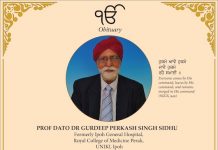
Husband: Late Sdr Rangit Singh (Pindh Bhai Ke Feffre), Klang
Children: Nerinder Kaur
Son in Law: Sathiswaranji
And Family members
Funeral Details: 16 Sept 2021 (Thursday). Arrival at Jalan Loke Yew Crematorium, Kuala Lumpur. at 1pm. Last respects and Japji Sahib path at 1pm to 2.30pm. Saskaar / Cremation at 2.30pm
Due to the current MCO and prevailing SOPs, we have to comply with a restricted number of attendees.
Path da Bhog: 25th September 2021 @ Gurdwara Sahib Selayang Baru 9am to 11.30pm
Contact:
Harjit Singh Thunda 011 – 1627 9054
Nerinder Kaur (Daughter) 012 – 222 2413
| Entry: 16 Sept 2021 | Source: Family
ASIA SAMACHAR is an online newspaper for Sikhs / Punjabis in Southeast Asia and beyond.Facebook | WhatsApp +6017-335-1399 | Email: editor@asiasamachar.com | Twitter | Instagram | Obituary announcements, click here |
J. Levine Judaica midtown Manhattan 30th Street store closed in June 2019. The store, which Levine calls the oldest Jewish bookstore in the country and was the last of its ilk in Midtown, did not fall victim to soaring rents but to two other powerful trends: assimilation and the growing prevalence of online sales, reported The Online Jewish Week – Photo: Levine Facebook page
By I.J. Singh | Opinion |
This essay is a revised version of one written some years ago. The Big Apple – New York City’s Manhattan – now has a brand new gurduara; I think it is the first community space for Sikhs in the city. My regret is that, having spent many decades in it, it happened after I moved out of the city.
Just two blocks from it stands a musty old building, with its best days behind it, with the modest logo: J. Levine Co. 1890, Judaica.
I entered and a whole new world opened.
Years ago, the New York Times (November 25, 1991) noted: “J. Levine & Company is not the typical old-fashioned religious bookstore. The showroom has marbled floors, polished chrome and glass cases with blue neon trim. On display are hand-painted mezuzahs, Batman and Ninja Turtle yarmulkes, and gold and silver menorahs.”
It’s a place where they still love books. Arts Judaica for all your Jewish needs. Danny Levine, the fourth-generation scion of the family now manages this richly embellished labor of love that claims to house the world’s largest collection of Judaic books and paraphernalia.
“I’ve found that people are looking today for presentation or atmosphere,” said the owner. “His sales,” he said, “had doubled over the last three years and went up 10 percent in one year.” The store also carries religious articles and furniture for synagogues and operates a successful mail-order service. Apparently, diversification has made the store recession-proof.
The store is chock full of books on a variety of topics from the Jewish perspective. Themes range the gamut, from serious theology and cook books to gay and lesbian Jew, to intermarriage in Soviet Jewry, humor and photography. A new book on or about Judaism or Jewish life is published every month or less.
The many “Christian Book & Gift” shops that dot the landscape of this country and continent are the Christian counterparts to J. Levine, the place for the Jewish world of arts.
Walk into any Christian book store; the kindness and smiles of the staff will overwhelm you. Piped in music greets you and soothes the soul; the aura instantaneously awakens the senses and transports you into a different universe with pleasant aromas that waft in to welcome you.
What better greeting for a visitor?
There are books and religious gift-items galore. Everything is tastefully displayed such that even “window shopping” becomes both pleasant and instructive. The plethora of medallions and artifacts can become preachy but one can find books on the variety of human experience and issues that confront us in life – from drug addiction, psychosocial and sexual issues to bioethical concerns or the history and interpretation of Christian doctrines like the import of Crucifixion. The staff is most helpful and knowledgeable. I briefly encountered such lasting ruminations not so long ago.
Now for a very different experience. Amidst a brutal winter, I was in India at a conference for a week. At my request the sponsors arranged my stay in the YMCA – right in the shadow of the historic Bangla Sahib Gurduara in Delhi. I wanted the proximity of the gurduara to be refreshing, energizing and available; Bangla sahib was barely a five-minute walk from the Y.
What caught me was the stark contrast in energy, attitude and worldview exemplified by the two adjoining centers – the Christian YMCA and the Sikh Gurduara Bangla Sahib. Keep in mind that my observations are a few years old.
Half a dozen YMCA or YWCA buildings abut the entrance to Bangla Sahib. Every Christian edifice displayed huge, larger than life billboards that you couldn’t miss if you tried. They advertised services – from the religious with cake and bake sales (I was there during the Xmas season) to books and lessons in sewing for women, ESL (English as a second language) classes, tutorials in mathematics and science, driving lessons and instruction in tennis, golf, swimming and self-defense; even computer skills could be learned for a nominal sum. Signs touted a safe modestly priced residence for single working women, irrespective of religion, caught in the din and hyper-madness of the big city.
And the books, both fiction and non-fiction, ranged from poetry to cooking and, of course, a large choice on or about Christianity; they were not just modestly priced but cheap, like 3 or 4 for a hundred Rupees — about two for a dollar.
Who wouldn’t be attracted? To get customers a business has to first catch and hold the eye; religion is no different. And then the seller works on building loyalty and repeat business.
In contrast, Bangla Sahib had a special strongbox on display and a larger-than-life sign to solicit donations for gold plating of the building. True, that this may have been there only for a few weeks or so. There were billboards nearby within the gurduara premises – for prayer services at various deraas or other gurduaras for warding off evil spirits and bad omens. Heaven only knows what they have to with Sikhi.
There were a few private business stalls just outside the gurduara perimeter hawking CD’s of hymns, breviaries (gutkas), patkas, kirpans, karras and other paraphernalia of a Sikh life. The space was small and crowded, the merchandize not attractively or openly displayed but piled on top of each other – only the sales staff could handle it; they alone knew where to find something. One had to know exactly what to want and ask for; there was no room to sit or browse. It is as if “window shopping” is an alien idea. User friendly these stalls are not.
As large and rich as it is Bangla Sahib has no bookshop in or near it but another massive historical gurduara nearby – Rakabganj — does. So, I trekked out to that. It’s also the headquarters of the Delhi Sikh Gurdwara Management Committee (DSGMC) — an eye-catching, expensively constructed monument fashioned largely in marble and granite.
No signs directed me to the bookshop which is in the basement and reached via a wide swirling and majestic marble staircase. I don’t know the amount of space allocated to the book shop in square feet but it is beyond impressive.
Books were stacked in one huge hall in several spacious aisles. But the lighting was so dim that reading seemed both difficult and unwelcome. Books were in cloth-wrapped bundles with a couple of copies from each bundle sitting atop of each package. I failed to detect any order to their display – by author, title or topic. One would be lucky to find something one is looking for.
In summary, the bookshop was housed in a poorly lit basement, with no cataloging. Pick a book and stroll around and you just won’t remember where to put it back or pick another copy.
Only one man seemed to know where any and every book could be found, and that is a credit to his phenomenal memory and dedication. But pity the poor visitor if he saw a book somewhere and now wanted to revisit that area again.
On content I would rate the shop near a ten on a scale from one to ten but in being user friendly I would be falling off the chart on the other end.
I wish this bookshop was in a busy public space where Sikhs and non-Sikhs congregate or travel about and, even more importantly, if it could become user friendly in presentation and organization. To start even minimal cataloguing and signage, a few comfortable chairs and good lighting would do wonders.
There is no functioning lending library in Bangla Sahib, Rakabganj or any other gurduara anywhere in this wide world that I know of. Dear readers, before you take umbrage at my angst keep in mind that the operative idea here is “functioning lending library.”
Parenthetically, I have to add that both these historic gurduaras do have a functioning and busy medical clinic. I also heard of a multi-million dollars plan for a huge state of the art medical facility near Rakabganj. I celebrate this much needed facility in today’s India.
North America boasts of over 200 gurduaras but I have yet to see one with a functioning library or a book shop. Yes, many gurduaras have a collection of books that remain uncatalogued and behind closed doors inaccessible to everyone except for an hour or two on Sundays. In time, most books slowly but surely disappear. And I wonder who selects the books; there appears to be little thinking directing their acquisition.
I am aware of only one facility that I would dub half-way decent book shop for Sikh literature and artifacts in North America and that is the Sachha Sauda in downtown Toronto – not attached physically to any gurduara.
Once again, because it has many books and other paraphernalia – the contents rate an “A” but not always the presentation. In user friendliness it pales. One has to cover one’s head to walk in and remove one’s shoes, even though it is a bookshop and not a gurduara.
Because of its location it can and does attract people off the street as any shop should — mostly Sikhs but a fair number of non-Sikhs, too. Unfortunately, its organization and lay out does not encourage the casual and the curious to walk in and just thumb through what is available. Window shopping is not the norm. Sachha Sauda, our one-of-a-kind book shop in North America, like J. Levine, has a healthy mail order business as well.
Mind you, and I want to emphasize this, with Sachha Sauda we have come a long way forward. It’s just that we have a longer way to go. My brief negative notations about it here are not meant to disparage or diminish it but to propel it further forward.
Keep in mind that just about every town in North America has a Christian bookstore. Also, don’t forget that every two-bit town in this country has a secular book shop, and a lending library; practically all of them have a section on religion where Christian and Jewish literature is easily found. One can also find a book or two on Hinduism and Islam, with a growing collection on Buddhism, but it is as if Sikhism doesn’t even exist.
The story of most public libraries is similar. They may stock a few books on Sikhism that are mostly dated or poor representations of Sikhi. We have, at times, undertaken to donate and deliver collections of often poorly chosen books to libraries. They were gratefully accepted and then a year or two later, junked. Why? Simply because they were taking valuable shelf space and showed no evidence of usage. No one ever took them out. Frankly our community does not make for habitual readers.
Considering that in my house books seem to grow like crab grass I should have heeded the dubious axiom that “books like friends should be few and well chosen.” But I never have. Ergo, I thirst for the Minerva Book Shop in Shimla, India that whetted my appetite for books over 60 years ago, and sometimes I think longingly of the musty smells of the Strand in New York City that boasts of eight miles of books.
My mind went to a pithy and brief comment by Danny Levine, the manager of the 121 years old J. Levine Company with which I started this column today: “I want the store to be the Henri Bendel of Judaica,” he said. “People should feel, wow, this is Judaism at its best.”
What a wonderful idea!
Exactly as I envision how Sachha Sauda and the Rakabgunj Book Shop might be transformed with a bit of imagination and a modicum of effort – and soon. And then may they clone rapidly all over the world.
But should we not be working on awakening the love of books first? And where does that start except in a family and school? And secular schools are not going to encourage the reading of and about Sikhi, nor should we expect them to.
The easiest way to teach the love of reading is to show that you have that love of reading within you. The most difficult, almost impossible, task is to try to teach what one does not know, does not do, or does not value.
Forget not, words come in books and that Sikhi is a way of life for which the Word is the eternal living Guru.
I.J. Singh is a New York based writer and speaker on Sikhism in the Diaspora, and a Professor of Anatomy. Email: ijsingh99@gmail.com.
* This is the opinion of the writer, organisation or publication and does not necessarily represent the views of Asia Samachar.
ASIA SAMACHAR is an online newspaper for Sikhs / Punjabis in Southeast Asia and beyond.Facebook | WhatsApp +6017-335-1399 | Email: editor@asiasamachar.com | Twitter | Instagram | Obituary announcements, click here |
A nasty brawl involving some 40 people armed with ‘golf clubs, baseball bats, poles’ have got the police actively engaging the local community to get to its bottom.
On Monday (13 Sept), two groups confronted each other at Daw Street in Brisbane’s southern suburb in what resulted in ‘a very confronting scene’, according to the police. It resulted with a number of people hospitalised and the police taking into custody eight men. The men, between 22 and 38, were later released.
“We don’t understand the motive of how it escalated to 40 people behaving like that last night…..What we know at this stage is that they are two groups that are known to each other,” Queensland Police Service (QPS) acting superintendent Simon Tayler said in a press conference. “We know that there were golf clubs, baseball bats, poles – different aspects of weapons.” Click here for link to QPS Press Conference:
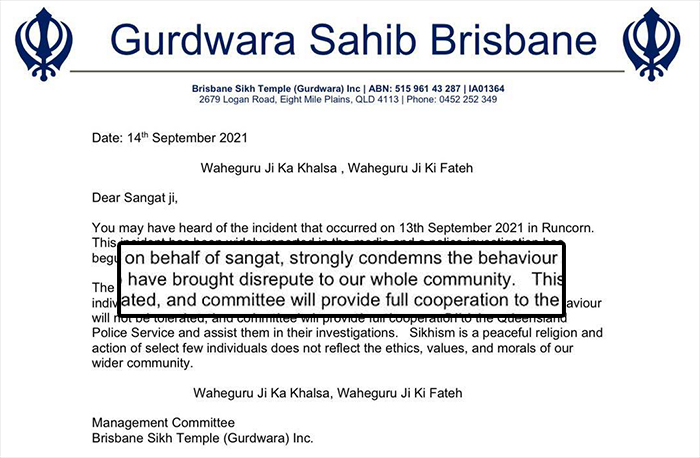
In a two-paragraph statement released on its social media platforms yesterday, Sikh Temple Brisbane (Gurdwara) Inc said the gurdwara committee ‘strongly condemns the behaviour of these individuals’ who brought disrepute to the whole community.
“This type of behaviour will not be tolerated, and the committee will provide full cooperation to the Queensland Police Service and assist them in their investigations. Sikhism is a peaceful religion and action of select few individuals does not reflect the ethics, values, and morals of our wider community,” it said.
In the press conference, Tayler said: “It is totally unacceptable to be a part, even passively, of a fray of 40 people in a suburban area. We really need to push that message that the behaviour, whether they’re known to each or not, is unacceptable.”
Asked if the incident was due to religious or philosophical differences, he said they were not sure at this juncture.
“The reality is, it is very early on. We have been engaging with members of this community….We don’t understand the motive of how it escalated to 40 people behaving like that last night…..What we know at this stage is that they are two groups that are known to each other,” he said.
He added that preliminary investigation had indicated that there had been ‘some social media chat’ in relation to the incident.
The gurdwara is scheduled to have its annual general meeting (AGM) on Sept 25 as indicated by the notice shared on its social media platforms. It is not clear if this has anything to do do with the brawl.
In an earlier note shared at its social media platforms, the management committee said the gurdwara’s membership drive in March 2021 received unusually high number of membership applications which has never happened before. The applications have jumped from 245 last year to excess of 3,000 this year.
“This has raised a serious question about authenticity of the membership application this year. The Management Committee has obligation to carefully consider each application before approving for Membership,” according to the note attributed to the ‘management committee’. Again, it is not clear if the note shared on 20 May 2021 has any bearing to the brawl.
Update for clarity: The brawl occurred on the streets of a suburb in Runcorn away from the gurdwara, between two parties in a dispute.
ASIA SAMACHAR is an online newspaper for Sikhs / Punjabis in Southeast Asia and beyond.Facebook | WhatsApp +6017-335-1399 | Email: editor@asiasamachar.com | Twitter | Instagram | Obituary announcements, click here |
Saskaar / Cremation: 12.30pm, 16 September 2021 (Thursday) at Jalan Loke Yew Crematorium, Kuala Lumpur
Contact: 019-2128340 / 019-3415017
| Entry: 15 Sept 2021 | Source: Family
ASIA SAMACHAR is an online newspaper for Sikhs / Punjabis in Southeast Asia and beyond.Facebook | WhatsApp +6017-335-1399 | Email: editor@asiasamachar.com | Twitter | Instagram | Obituary announcements, click here |
In Raag Nat Naraan (Guru Granth Sahib, p982), Guru Raam Das proclaims that ‘Bani is Guru and Guru is Bani, within Bani Amrit (sweet nectar) flows’.
Literally interpreted, these lines have no meaning whatsoever. And to truly appreciate what Guru Raam Das is expressing, one would need to reflect on the meaning of each word separately and the meaning that emerges when they are blended into the form of the Shahad. Who is the Guru that is referenced here? Is it the divine transcendental, formless being we call Paramatma/Akaal Parakh? Is it Guru Nanak? Or is it the divine that exists within us all?
Similarly, what is meant by ‘Amrit’ or ‘sweet nectar’? Is it a reference to a literal taste of sweetness in the mouth as some argue? Based on the meaning of ‘Amrit’ as ‘beyond death’/’immortal’, is the line seeking to express the intensity and depth of experience one can gain through understanding the bani?
Elsewhere Gurbani talks about Amrit residing in the body; what is that Amrit? Or Amrit as Naam, which itself can be interpreted in so many different ways, from the repetitive utterance of one of the various names associated with the divine (e.g. Waheguru, Waheguru, Waheguru….!), through to it being a hidden invisible force that holds the whole universe together. As Guru Arjan Ji Raag Gauri, Guru Grant Sahib p284 states, “Naam sustains all species, Namm sustains the planets and solar systems”.
And last, what is the ‘Bani’ that is being referred to here? Is it the sounds from within, or the specific utterances of the Gurus and Bhagats in the form of the Shabads? Or is it a reference to Akaal Purakh, or the divine universal formless/timeless entity, as in the case of the following lines from Guru Amard Das in Raag Gauri (Guru Granth Sahib, p515), “Praise, praise, Bani is the formless, self-existent entity.”
Even this brief attempt at understanding even one ‘tuck’ or line of Gurbani raises so many considerations, which just underlines the importance of not jumping prematurely to any one meaning. Gurbani is a bottomless ocean of wisdom and divinity that offers new insights, poses new challenges, and marks our new currents of thought everyone engages with it. Furthermore, since Gurbani is written in poetic form that is to be sung in specific raags or scales corresponding to a specific time of day and season, it cannot simply be read through the realm of rationality; emotion also plays a critical function in realising the message being conveyed. The purpose of Gurbani is to convey ‘Brahmgian‘, which is a concept that can be loosely translated as ‘divine wisdom’. Accordingly, Gurbani can be viewed like the torch that leads its readers on a dark path of existence. It offers the possibility of realisation of one true essence or purpose. But tragically, go to any Gurdwara and listen to any ‘kathavacak’ or preacher, and, more often than not, all one is presented with is a set of calcified and confusing rhetoric that appears to be designed to secure monetary returns than to genuinely open up new streams of consciousness for the listeners.
Since embracing Sikhi in my late teens, I thought I was following the Shabad Guru that is embodied in the teaching of the living Guru of the Sikhs, namely, Guru Granth Sahib. When I participated in the ‘Khande di Pahul’ ceremony, or Initiation into the Khalsa order, I gave vows to follow Guru Granth Sahib and no other; and for over 40 years I thought I had been pretty good at keeping my vows. But, it is only in recent times that I have begun to realise this is/was not the case, and that in all honesty, all I was doing was uncritically following/mimicking others rather than trying to cultivate an intimate relationship with and understanding of the Guru. I don’t completely blame myself as I had become dependent on the advice of so-called ‘elders’ on the one hand, and on the other, translations of the Guru Granth Sahib that to a large extent were influenced by older dominant belief systems, most notably, Vedanta, Hath Yoga, Sufism, and Islam more generally.
But in recent years, I have come to realise that Guru Nanak’s mission was not, as is often said, to “pick the best of all the traditions”, or to “offer a middle ground”, but to offer a clean break with the past.
Again, uncritically following some of the published literature, I had understood Guru Nanak as a reformer, when in fact he was a total revolutionary who rejects all previous religious dogmas. Guru Arjan in a long Shabad in Raag Bhairon (SGGS, p1136), through the words of Kabir, offers perhaps the clearest evidence for this assertion. Here I produce a summary of the essence. The Guru begins by categorically rejecting fasting associated with the Muslim festival of Ramadan. He then proclaims that he only serves the one, “ek Gosai“, who does not discriminate against Hindus, Muslims. This is followed by a rejection of pilgrimages and prayer rituals, be they to Muslim or Hindu deities or shrines. The Shabad then once again affirms the emphasis on ‘Nirankaar‘ or ‘formless entity’ and ends with Kabeer Ji categorically rejecting the label Hindu and Muslim. To fully comprehend Kabeer Ji’s thoughts, one would need to take into consideration his lived experience and much more, but the significant thing is that Guru Arjan has curated such a powerful and direct rejection of both major traditions.
It is only in more recent times that, as I have embarked on (re)reading Gurbani, it has dawned upon me that Sikhi is a unique and original system of thought that addresses many realms of human experience, both physical (sargun) and metaphysical (nirgun). The challenge as I understand it is now how can we realise the uniqueness of Gurbani, especially so in contexts where we constantly resiting the influence of the major dominant traditions? It does not mean that we should retreat into some enclave and stop studying other theological and philosophical traditions. Indeed, is only through understanding the great philosophical traditions of the world that one can begin to appreciate the uniqueness of Guru Nanak’s conception of practical metaphysics/spirituality, ethics, and politics. But this can only be a starting point and, at some point, we will need to deploy a Sikhi-centered methodology for reading Gurbani. But sadly today, we appear to have lost sight of the Sikhi perspective. A perspective that should be centered on Shabad Guru has succumbed to ritualism and ‘shaksi pooja‘ or worship of ‘self-proclaimed godmen. Whereas the Guru Granth Sahib explicitly instructs the Sikh to sing, read, understand, consume, live and embody Gurbani, we have outsourced this to a professional clergy evidenced by the almost exponential rise of Babas and Brahmgianis amongst the Sikh diaspora.
And so the first challenge for us is to confront the anti-Gurmat practices that are propagated by these Dera’s, most significantly the ritualist reading practices that have crept into the Panth. These constitute a combination of paying others to do this reading, long continuous recitation of selected bani’s for specific occasions, etc. It does mean reading Gurbani with ‘Sehj’ or equipoise and ‘budh/bibeik’ or ‘discerning intellect’. In this regard, I am very impressed with the methodology advanced by Sikh scholar Dr. Karminder Singh Dhillon who advocates an approach he terms “The Gurbani Framework.” This framework comprises of paying attention to the following ten elements.
1) Crossing over from the Literal to the Spiritual. 2) The Rahao Principle. 3) Context. 4) Inner Rationality. 5) Conceptual Consistency. 6) First Person Interpretation. 7) Spirituality of the Shabad. 8) Spirituality of Realising the Divine Within. 9) Spirituality of the Self. 10) Using Gurbani to define Gurbani concepts.
Each one of these principles needs much more explanation, and I would therefore refer you to the work of Dr. Dhillon which regularly appears in Asia Samachar. However, I think, in the context of the determination of some Sikhs to give almost equal importance to secondary texts, I think it is worth emphasising that, other than the Vars of Bhai Gurdas, the only way one can unlock the true meaning of Gurbani and the concepts within it, is through the Guru utterances. That is in effect a lock and key mechanism, where one section of Gurbani is deployed to unravel the meaning of the other sections and so on… A perfect example is the concept of ‘Raam Naam’ which is often misunderstood as a reference to the Ram of the Mahabharata. Though there are references to the mythical God Raam, here ‘Raam Naam’ is deployed as a reference to the universal entity that pervades (ramya) all of existence.
Recently, rather than lazily relying on translations offered by others, I have begun to apply these principles in my (re)reading of Gurbani and it is amazing how fresh new understandings emerge. Ultimately the relationship between Gurbani and the reader is a personal one. In terms of laying down social-political ethical rules for the society, personal reading, or dialogue with self is insufficient. Here one will need to engage in ‘samvaad‘ or collective reading in dialogue with others. Because Gurbani is timeless and because the world is in constant movement, then reading cannot be a one-off, but with time, new readings and ongoing reflection, and engagement with the guru will be required. But no doubt, there will be those who will view (re)reading as a threat, as a threat to tradition, as a perversion of revealed truths. But as the Sikhs who are committed to following in the footsteps of Guru Nanak, who, as Bhai Gurdas ji, created a paradigm shift, we should not be afraid to challenge and question.
Gurnam Singh is an academic activist dedicated to human rights, liberty, equality, social and environmental justice. He is an Associate Professor of Sociology at University of Warwick, UK. He can be contacted at Gurnam.singh.1@warwick.ac.uk
* This is the opinion of the writer and does not necessarily represent the views of Asia Samachar.
ASIA SAMACHAR is an online newspaper for Sikhs / Punjabis in Southeast Asia and beyond.Facebook | WhatsApp +6017-335-1399 | Email: editor@asiasamachar.com | Twitter | Instagram | Obituary announcements, click here |
Unveiling the Saragarhi bronze statue: (L-R) Wolverhampton Mayor Greg Brackenridge, Major General Celia Harvey, Guru Nanak Nishkam Sewak Jatha’s Bhai Mohinder Singh, Akal Takht jathedar Giani Harpreet Singh, Saragarhi Foundation founder president Dr Gurinderpal Singh Joshan, West Midlands deputy Lord Lieutenant Dr Satish Sharma and Wolverhampton Council leader Ian Brookfield
By Kamal Preet Kaur | Britain |
The reverberation of Sikh battle cry ‘Bole So Nihal, Sat Sri Akal’ in the multicultural town of Wednesfield, Wolverhampton, on Sunday (12 Sept 2021), must have held a deeper, firmer resonance and resolve thousands of miles away on the North Western Frontier of the British India, 124 years ago. On this day, the 21 brave hearts of Saragarhi laid down their lives, bravely fighting a 10,000-strong Afghan enemy tribe.
As the saffron covering over a large piece of sculpture was slowly removed, an impressive and imposing bronze statue of Havildar Ishar Singh, the commanding officer of the 36th Sikh Regiment of the British Army, drawing out his sword, was unveiled in the presence of Jathedar Sri Akal Takht Sahib Giani Harpreet Singh.
Speaking on the occasion, Harpreet said: “The bravery of these Sikh soldiers of Saragarhi reflects the historic battle of Chamkaur Sahib where 40 Sikhs, under the guidance of Guru Gobind Singh, fought and ultimately sacrificed themselves facing the 10 lakh-strong enemy. The soldiers at Saragarhi had a choice to leave their post and save their lives, but they chose to fight. They fought for Sikhi, they fought for their turban, they fought for their faith.”
This anniversary celebration of one of the greatest last stands comes at the time when the eyes of the world are glued to the current situation in Afghanistan and concerns are being raised for its minorities.
“As we remember those who gave their lives in the line of duty, the site of the battle reminds me of the current plight of Afghan Sikhs, who have had over 500 years of association with that country and many have had to leave everything behind,” said Birmigham EdgbastonMP Preet Kaur Gill.
The cost of the bronze statue, standing on a granite plinth that has the names of the 21 soldiers and a brief history engraved on it, is said to be over £100,000. The amount was raised after a massive public campaign and contribution, especially, through the local Guru Nanak Gurdwara, Wednesfield, its trustees and congregation, efforts of Saragarhi Foundation founder president Dr Gurinderpal Singh Joshan, local councillor Bhupinder Singh Gakhal and others.
Bakhtavar Singh (the 4th generation descendant of Havildar Ishar Singh and from Sikh Regiment) who, along with descendants of other Saragarhi martyrs, had been specially invited to the UK to attend this event, said, “Eighty percent of Punjabis do not know about Saragarhi. My great grandfather’s statue has been put here, but it is not just him, but it symbolises all others who fought and got martyred with him.” He expressed regret that the Punjab government back home had not shown such respect to the brave martyrs like his great grandfather.
Balraj Singh Sandhu, descendant of Naik Lal Singh, said the Gurus have shown us the way to live and they way to die and the Saragarhi martyrs emulated Guru’s teachings. He said he was extremely proud of his lineage and was honoured to be part of the event in the UK.
Mayor Greg Brackenridge, who, along with the other dignitaries had welcomed the Jathedar, and had escorted him to the venue, also lauded the efforts of the community for the success of the event. “I am extremely proud to recognise, celebrate and remember the brave, brave men named on the Saragarhi monument,” he said, addressing the gathering.
Wolverhampton Council leader Ian Brookfield lauded the “brotherhood of the 21. West Midlands deputy Lord Lieutenant Dr Satish Sharma, representing Her Majesty the Queen, said, “The Sikh community had always stood for justice.”
Major General Celia Harvey added that “the unflinching physical and mental courage, discipline, integrity of soldiers to refuse to surrender and their selfless commitment that prevented further killings of hundreds of other soldiers, are the traits that reflect their Sikh faith, are cherished and celebrated in the British Army.”
Hundreds of locals, especially the Sikh congregation, had gathered on the occasion, where the unveiling of the statue was preceded by a religious programme in the gurdwara, an Army and cadet parade led by the Panj Piaras and a canon fire to mark a minute’s silence in the remembrance of the martyrs. There was hardly a soul who didn’t seem touched by the sacrifice and bravery of the Saragarhi Sikh soldiers.
In an address at a local gurdwara before the unveiling, Harpreet said it was not right to call it ‘manmat’ because Sikhs were not going to worship it, it was a remembrance monument. To the question that it was not a ‘dharam yudh morcha and they were fighting for the British’, he said: “They were asked to leave the post and save their lives. They had that option to do so, but they chose to stand and fight. Why did they do so? They did it for their faith, for their turban and for the lessons taught by the Guru. They knew that if they ran away, no one will say British ran away, they would say, Sikhs ran away.”
Regarding the ‘gurbani’ reference on the plinth, the jathedar instructed it to be removed from the monument. Gurdwara committee member Paramjit Singh Dhadi confirmed that the mistake would be rectified earnestly and added that it had been an inadvertent oversight.
ASIA SAMACHAR is an online newspaper for Sikhs / Punjabis in Southeast Asia and beyond.Facebook | WhatsApp +6017-335-1399 | Email: editor@asiasamachar.com | Twitter | Instagram | Obituary announcements, click here |
Sardul Singh Narula came to Singapore from Bangkok, Thailand. In Singapore, he established Inder Sons & Co in the late 1930s. Inder Sons & Co was a wholesaler and commission agent of textiles and leather goods. It operated from a shop in Arab Street before relocating to 88 High Street. During the Japanese Occupation, the company remained in operation before finally closing down in the 1960s.
Sardul Singh was actively involved with the Sikh community, serving as the Chairman of the Sikh Advisory Board and President of the Sri Guru Nanak Satsang Sabha.
Some of the photos below are on display at the ‘Sikhs in Singapore – A Story Untold’ exhibition, now going on at Indian Heritage Centre (IHC). The exhibition features more than 450 artefacts from over 50 local and international private collections, institutional collections of 17 Sikh organisations in Singapore, as well as Singapore’s National Collection.
Photo 1: Sardul Singh Narula and family – Photo: Courtesy of Jaspreet Singh Narula, great grandson of Sardul Singh Narula
Photo 2: Sardul Singh Narula receives invitation to attend the ceremonial departure of the Duke of Edinburgh from the Singapore Harbour Board Terminal Building on 25 Feb 1959 – Photo: Courtesy of Jaspreet Singh Narula, great grandson of Sardul Singh Narula
Photo 3: Sardul Singh Narula seated behind Singapore Prime Minister Lee Kuan Yew at a gurdwara function – Photo: Courtesy of Jaspreet Singh Narula, great grandson of Sardul Singh Narula
Photo 4: News report and photo of the wedding of Sardul Singh Narula’s son Ranjodh Singh Narula and Awtar Kaur Bangkok, Thailand, that appeared in the Indian Daily Mail Singapore (19 Sept 1956) – Photo: Courtesy of Jaspreet Singh Narula, great grandson of Sardul Singh Narula
ASIA SAMACHAR is an online newspaper for Sikhs / Punjabis in Southeast Asia and beyond.Facebook | WhatsApp +6017-335-1399 | Email: editor@asiasamachar.com | Twitter | Instagram | Obituary announcements, click here |
Authored in 1843 by ‘Kavi Churamani’ Bhai Santokh Singh, a shining star and doyen of the nirmla sect, the Sri Gur Partap Sooraj Granth commonly known as simply ‘Sooraj Parkash‘ (Epicentre of Enlightenment) is perhaps the most voluminous and largest text of Sik history and philosophy. It stands as the root instrument pertaining to the nirmla (also spelt: Nirmala) hijacking and distortion of Sikhi.
It is written in complicated Brij poetry language – with an almost complete brahmanical and Vedic twist. The subject matter of the Sooraj Parkash comprises the Ten Gurus and the story of Banda Singh Bahadur.
The Sooraj Parkash was translated exhaustively into prose Punjabi, by nirmla Bhai Vir Singh in a 14-volume annoted edition published during the period 1927-35. It is a tragedy that Vir Singh is held in such high esteem in the Sikh Panth, when his biggest contribution is to popularise the distortion of the lives of our Gurus. In essence, Vir Singh first brought the elitist Sooraj Parkash into the grasp of the lay Sikh.
Vast number of Sikh historians such as Principal Satbir Singh have merely regurgitated the Sooraj Parkash without making any attempt to weigh its contents against its principles of Sikhi, Gurmat and Gurbani.
As an indication of the deep rooted nature of the nirmla infiltration into Sikh thought, despite its massive adulteration, the original Sooraj Parkash remains the standard text for all dera and taksal trained Clergy – granthis and kathakaars in particular. It is usual for these kathakaars to hold serial discourses on the text of Sooraj Parkash in the gurdwaras, normally in the afternoons or evenings. The same is done in the Darbar Sahib Complex on a daily basis.
A sampling of the fake, mischievous and utterly blasphemous of the Sooraj Parkash in in order.
ONE: Guru Hargobind “eloped” with a married woman named Kaulan, brought her to his Darbar and married her. Her father, a Kazi comes to collect money for horses that were owed to him by the Guru. Baba Buddha received the Kazi and says: Sunn Bidh Bhakhyo Sehj Subhaye. Tumrey Gur Jvayi Bann Jaye. To Kaisey Dhan Laibo Dharey Arpub Nij Tanja Kre (5th Raas, 17th Ans). Meaning: Listen calmly to what I say. The Guru is now your son-in-law. Why then would you be entitled to any money. Dedicate to him on behalf of your daughter. The Guru used to abandon the recitation of Sukhmani bani midway to see Kaulan whenever she desired the Guru.
TWO: Guru Har Rai had 8 wives, all of whom were sisters. His first marriage when was 10. Youngest wife was 6 years of age. His son Ram Rai was born out of Guruji’s relations with his servant girl.
THREE: Guru Amardas ji did not wash his hair for a long time. Head lice and worms developed to the point of dropping out of his hair, whence he would pick up and place them back onto his head.
FOUR: Guru Angad developed leprosy on his thumb, it was cured by Sri Chand.
FIVE: After arguing about the futility of the practice, and after composing Gurbani to that effect, Guru Nanak ultimately wore the Janeyu (sacred Hindu thread) upon being convinced by the Pandit. Some 35 years later when he visited Bhai Lalo, his Janeyu was still on his body.
[The author shares 15 more such examples in the book].
Nirmla Santokh Singh thus stands as the lead hijacker of the Sikh belief system and the Sooraj Parkash Granth as his primary weapon. He stands as the one nirmla doyen, an icon and epitome of the massive and deepest corruption of the Sikh psyche. His success is unmated. Permanent perhaps.
His adulteration of Sikhi of our Guru sits within the deepest recesses of the Sikh mind, institutions and our clergy. It is difficult to imagine that Sikhs would be able to free themselves form the shackles of the darkness that nirmla Santokh Singh transmitted through Sooraj Parkash.
(Extracted from writer’s book The Hijacking of Sikhi published in 2020]
LINKS TO VIDEOS AND LECTURE NOTES FOR ‘THE HIJACKING OF SIKHI’
Hijacking of Sikhi – Part 1 (The Plot): Video | Notes
Hijacking of Sikhi – Part 2 (Udasis): Video | Notes
Hijacking of Sikhi – Part 3 (Udasis): Video | Notes
Hijacking of Sikhi – Part 4 (Nirmlas): Video | Notes
Hijacking of Sikhi – Part 5 (Nirmlas): Video | Notes
Hijacking of Sikhi – Part 6 (Nirmlas – Sooraj Parkash): Video | Notes
ASIA SAMACHAR is an online newspaper for Sikhs / Punjabis in Southeast Asia and beyond.Facebook | WhatsApp +6017-335-1399 | Email: editor@asiasamachar.com | Twitter | Instagram | Obituary announcements, click here |
Wife: Jagdish Bhain @ Jagdev Kaur D/O R. Sarmukh Singh
Children / Spouse:
Ratanjit Singh / Raveena Kaur
Late Amrita Kaur
Grandchild: Ravjeet Singh Veriah
Brothers, Sisters, Brother-In-laws, Sister-in-laws, Relatives and Friends.
Once again, we thank everyone for their kind support, messages of condolences and prayers.
In light of the current MCO and SOPs, the cremation and Sehaj Path Da Phog will be a private affair. Cremation will be held on Saturday, 11th September 2021 at 11am in Shamshan Bhoomi Hall (Loke Yew Crematorium) and Phog will be announced later.
We thank you for your kind understanding and prayers.
For enquiries, please contact: Mohanvir Singh (017-8895815) or Parabvir Singh Sarmukh (0173390808)
A true Gentleman, Husband, Father, Grandfather and a Genuine Friend.
What a glorious journey! To quote your life’s tagline “You See You Act”. You lived every moment of it. You led a principled, dedicated and exemplary life fulfilled with great experiences, accomplishments, charity and happiness. There are no words to fully describe the impact that you have made on the lives of your loved ones and so many other people in which you were held in such high regard.
| Entry: 10 Sept 2021 | Source: Family
ASIA SAMACHAR is an online newspaper for Sikhs / Punjabis in Southeast Asia and beyond.Facebook | WhatsApp +6017-335-1399 | Email: editor@asiasamachar.com | Twitter | Instagram | Obituary announcements, click here |
MCCBCHST STATEMENT NO TO BILL ON CONTROL AND RESTRICTIONS ON DEVELOPMENT OF NON-MUSLIM RELIGIONS
1. The Malaysian Consultative Council of Buddhism, Christianity, Hinduism, Sikhism and Taoism (MCCBCHST) welcomes the Statement by the Law Minister yesterday (07/09/2021) that there were no proposals to enact law to restrict or control the development of the non-muslim religions and neither was the matter brought to the cabinet yet.Thus this statement clearly contradicts with the earlier statement made by the Deputy Minister in the Prime Minister’s Department (religious affairs), Ahmad Marzuk Shaary who had stated that the government was drafting four new Syariah laws “including the control and Restriction on the Propagation of “Non-Muslim Religions Bill.” This Deputy Minister’s statement had caused great anxiety amongst the Non-Muslims and thus the clarification by the Minister helps to calm things down.
2. Since the Deputy Minister has not withdrawn his statement, the MCCBCHST wishes to point out that there are many flaws in his statement and wishes to remind that Article 11 (1) of the Federal Constitution clarity gives the right to every person:
“to profess and practise his religion and, subject to clause (4), to propagate it”.
THIS MEANS EVERY PERSON has the FUNDAMENTAL RIGHT to PRACTISE and PROPAGATE his religion, subject to clause (4).
3. What does than clause (4) of Article 11 provide. It only deals with a very narrow area and provides that federal law may control or restrict PROPAGATION of other religious doctrines to Muslims, that is:
“…federal law may control or restrict the propagation of any religious doctrine or belief among persons professing the religion of Islam.”
Thus, where there is no PROPAGATION of other religions doctrine or belief to Muslims, clause (4) will not apply. Where there is practise and Propagation of Non-Muslim religions amongst themselves only, clause (4) will have no application again.
4. In fact, the right of freedom of Religion is so Fundamental that it cannot be curtailed even during an Emergency. This is provided for Article 150 (6A).
5. The MCCMCHST therefore wishes to remind the Deputy Minister that the basic structure of the Constitution will not allow for a Theocratic Islamic State for Malaysia. In our case all religions are subject to the Constitution. In view of the apparent contradictions between the statement by the Law Minister and the earlier Statement by the Deputy minister.
6. The MCCBCHST calls upon the YAB Prime Minister Datuk Seri Ismail Sabri Yaakub to clarify the issue before causing further anxiety among our citizens.
Statement issued and endorsed by:
1. Sardar Jagir Singh Arjan Singh,
Malaysian Gurdwaras Council (MGC),
President MCCBCHST
2. Dao Zhang Tan Hoe Chieow
Federation of Taoist Associations Malaysian (FTAM)
ASIA SAMACHAR is an online newspaper for Sikhs / Punjabis in Southeast Asia and beyond.Facebook | WhatsApp +6017-335-1399 | Email: editor@asiasamachar.com | Twitter | Instagram | Obituary announcements, click here |