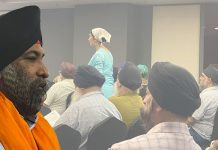
Kisan Mazdoor Sangharsh Committee (KMSC) rail blockade now into fifth month – Photo: Gurmeet Singh / The Indian Express
By Kamaldeep Singh Brar | The Indian Express | Amritsar |
For almost five months now, a rail blockade by the Kisan Mazdoor Sangharsh Committee has ensured that no trains ply between Amritsar and Beas. Even when there is no Rail Roko call by farmer unions, this blockade near Jandiala Guru for the past 149 days now has hit 60 per cent train traffic from the border town of Amritsar.
In fact, KMSC is the only farm union in Punjab that is continuing with its indefinite dharna on railway tracks, while the others ended their rail blockades in Punjab in the last week of November to focus on the Delhi Morcha.
“Our protest near the Jandiala Guru station will continue. Our dharna at Jandiala Guru had started on September 24 and it has completed 148 days. Soon, it will complete five months. We have no objection over goods trains. But we will not allow passenger trains,” said KMSC general secretary Swaran Singh Pandher. The dharna is near the Jandiala Guru station but not on the railway track.
Meanwhile, the Railways has been running some trains on alternative route via Tarn Taran. However, the blockade has prevented the Railways from running its operations on full-throttle from Amritsar station.
“Our 60 per cent business from Amritsar station is affected. Shatabadi and many other important trains are suspended for last five months. There are some trains which run from Ambala instead of Amritsar. But most of the trains are suspended. Our alternative route via Tarn Taran hasn’t got the capacity to take all the load for us to run all the trains,” said Sudhir Kumar, DMO, Ferozepur Range of the Railways.
Read full story, ‘60% train traffic from Amritsar hit for 5 months thanks to one farmer union’s indefinite dharna on tracks’ (The Indian Express, 20 Feb 2021), here.
ASIA SAMACHAR is an online newspaper for Sikhs / Punjabis in Southeast Asia and beyond.Facebook | WhatsApp +6017-335-1399 | Email: editor@asiasamachar.com | Twitter | Instagram | Obituary announcements, click here |
Gurdwaras and other non-Muslim places of worship have been greater leeway to operate between Feb 19 and March 4.
The latest guidance note from the National Unity Department still subjects them to strict standard operating procedures – be it the under the movement control order (MCO), conditional movement control order (CMCO) and recovery movement control order (RMCO).
For states under MCO / PKP, allowed prayer times are between 6am to 2pm and 4pm to 10 pm, with a maximum of 30 persons at on time.
For states under CMCO / PKPB, maximum capacity is half the capacity of the place of worship.
“Length or duration of the prayer to be decided by the Gurdwara Management Committee (GMC),” according to a guidance note released by the Malaysian Gurdwaras Council (MGC).
For states under RMCO / PKPP, the the number of persons allowed is according to the size of the place of worship while the length or duration of each prayer session is to be fixed by the GMC.
The note added that only 20 people are allowed for a marriage ceremony in the gurdwara.
ASIA SAMACHAR is an online newspaper for Sikhs / Punjabis in Southeast Asia and beyond.Facebook | WhatsApp +6017-335-1399 | Email: editor@asiasamachar.com | Twitter | Instagram | Obituary announcements, click here |
PATH DA BHOG:Sahej Paath da Phog will be at Wadda Gurdwara Sahib Ipoh on Sunday, 21st Feb 2021. While observing the SOP only family members will be attending | Malaysia
Sahej Paath da Phog will be at Wadda Gurdwara Sahib Ipoh on Sunday, 21st Feb 2021. While observing the SOP only family members will be attending
Contact: Harcharanjit Singh 019-3629402
| Entry: 20 Feb 2021 | Source: Family
ASIA SAMACHAR is an online newspaper for Sikhs / Punjabis in Southeast Asia and beyond.Facebook | WhatsApp +6017-335-1399 | Email: editor@asiasamachar.com | Twitter | Instagram | Obituary announcements, click here |
UK’s Trade Secretary Liz Truss, announced “Enhanced Trade Partnership” with India. The expectation is to build on the current baseline of £23 billion to raise it to £100 billion. The Trade Secretary said, “India is the world’s biggest democracy and a nation that shares our belief in free enterprise….Deeper trading ties will create opportunities for UK businesses that were simply not there as part of the EU, and set the stage for a much closer partnership with one of the economic powerhouses of the present and future.”
Yet, there is an international obligation to ensure that trade deals are not at the expense human rights abuses. As an Indian writer put it, “While trade can be an engine for the economic growth needed to combat poverty and promote development, it can also threaten human rights in some situations.”
The UK government regards the current Indian farmers protest as an “internal” matter between the farmers and the Indian state. However, the issue has been discussed at length by prominent Indian experts to show how the livelihoods of hundreds of millions of farmers, labourers and local businesses in the agricultural supply chain will be affected. The so called “Black Laws”, ostensibly intended to bring about agricultural reforms, will destroy the independence and way of life of the sons of the soil. So, it is arguable if the farmers protest is entirely an “internal” issue to be avoided by other states dealing with India.
Trade deals are important in today’s world for employing increasing populations. They are vital for our livelihoods and standard of living. International trade increases productivity massively by allowing countries to make the best use of their natural and human resources. Theoretically, all should benefit from global trade through multilateral and bilateral trade agreements provided the terms of trade are fair. International trade brings the world closer together by making countries inter-dependent. There is even a theory that international trade empowers the ordinary people against tyrants and dictators.
However, in the real world, the above theories work only with strict safeguards in place as recognised by the United Nations. The caste system in India is a sort of division of labour in a negative sense. The system has created large populations of the so-called lower castes and classes trapped by the system to work under harsh condition to enrich the middle and the upper classes. Many work from childhood to death as labourers working long hours just to be able to live. The multinational companies make billions by trading in goods made by them. International trade has not stopped authoritarian regimes, and dictators from rising to power.
Despite United Nations regulations, trade policy civil servants and ministers tend to overlook human rights abuses when striking multibillion pound trade deals. More so when the deals are with other so called “democratic” countries.
The Indian farmers and workers protest against alleged “black farm laws” started in Panjab. The protests are led quite visibly by the Sikhs. The danger is that black lists of suspected activists can also become unannounced part of trade deals. Interpol arrangements assume uniformity of legal safeguards in the membership countries. That is patently untrue. British Sikhs have historical reasons to be concerned about trade deals.
Gurmukh Singh OBE, a retired UK senior civil servant, chairs the Advisory Board of The Sikh Missionary Society UK. Email: sewauk2005@yahoo.co.uk. Click here for more details on the author.
* This is the opinion of the writer, organisation or publication and does not necessarily represent the views of Asia Samachar.
ASIA SAMACHAR is an online newspaper for Sikhs / Punjabis in Southeast Asia and beyond.Facebook | WhatsApp +6017-335-1399 | Email: editor@asiasamachar.com | Twitter | Instagram | Obituary announcements, click here |
I am an advocate & solicitor by profession. My area of speciality is commercial, property, probate, corporate and tort.
I am also a legal committee member of EKTA Club and have given talks at Subang, Ulu Klang and Kota Kinabalu gurdwaras on advance care planning and also rendered free legal advice at Sentul gurdwara on the last Wednesday of every month. However, due to the movement control order, EKTA’s legal activities have to be temporarily put on hold.
I am married to Dato Harpal Singh Grewal also an advocate and solicitor by profession and have 3 children namely Jesrina Kaur Grewal, Ivanpal Singh Grewal, the former political secretary to Datuk Seri Mah Siew Keong, the Minister of Plantation Industries and Commodities and now a practising lawyer and Karina Kaur Grewal.
My husband and I are blessed with 3 grandchildren namely Anaayah, Shayaan and Arshaan who are the light of my life and my every heartbeat.
My late father Harbhajan Singh of Medan Damansara, Kuala Lumpur was formerly with the Ministry of Defence.
My late brother Lt (U) Patvinder Singh, a fighter pilot was with the Royal Malaysian Air Force (RMAF) and passed away whilst on duty in a plane crash in Kuantan on 4-5-1979.
As a child, my late mother Madam Ajit Kaur used to tell me stories about the Sikh religion and sacrifices made by our Gurus for our religion, which stories inspired me throughout my growing years that we have to persevere in life, which perseverance requires sacrifice.
My late father used to always encourage me to reach for the stars and he used to say “that if someone can do it, it is you”.
My late father, mother and my late brother are my guardian angels, my strength, inspiration and determination in life and their belief in me has kept me moving forward in life.
On 1-7-2018, I was appointed (for a three-year period) as a President of the Strata Management Tribunal (SMT), which Tribunal was established under the Strata Management Act, 2013 (SMA) and is under the purview of the Ministry of Housing & Local Government.
I am on a contract with the Government of Malaysia and am Grade L54. On this contract, I am allowed to continue with my legal practice.
I am the first Sikh lady in Malaysia to be appointed as a President of the SMT and I preside in the Putrajaya & Kuala Lumpur Tribunals.
Under the SMA, I hear disputes commenced or defended by developers, purchasers, proprietors of properties, joint management bodies, management corporations or their subsidiaries, managing agents or such other persons or bodies who have obtained special permission from the SMT.
I further hear disputes over a person or body’s failure to perform a function, duty or power imposed by the SMA, disputes over costs or repairs of a defect, claims for recovery of maintenance, sinking fund charges or such other charges under the SMA, claims for an order to convene general meetings, invalidate meetings or nullify resolutions passed at the general meetings, compel a party to supply information or documents, give consent to effect alterations to common property, affirm, vary or revoke decisions of the Commissioner of Buildings.
I am also empowered under the SMA to make such awards to vary or set aside a contract or additional by laws which are inconsistent with the bylaws or in house rules of a stratified building.
Pursuant to Section 123 of the SMA, any party who fails to comply with an award made by the SMT commits an offence and shall on conviction be liable to a fine not exceeding RM 250,000.00 or to imprisonment to a term not exceeding 3 years or to both and in the case of a continuing offence, to a further fine not exceeding RM5,000 for every day thereof during which the offence continues after conviction and such prosecution shall be instituted by the Public Prosecutor under Section 136 of the SMA.
As a President hearing disputes, I believe in granting leeway to litigants who appear before me to fully ventilate their arguments as most of the litigants do have genuine disputes and grievances and as such, I do not believe in shutting out any party from fully presenting their case although the hearings can take place over several days.
For me to be where I am today, I thank my husband, children, son in law and daughter in law for all their unwavering support and being my pillars of support in handling 2 demanding jobs whilst being a wife, mother and grandmother at the same time.
I hope that my journey in life will inspire other women, especially my Sikh sisters, to break barriers and strive to realise their dreams as nothing is impossible.
As Michelle Obama said, “there is no magic to achievement. It’s really about hard work, choices and persistence.” I believe we can all do very well if we put our minds to it.
(The writer, Harwinder Kaur d/o Harbhajan Singh, is the first Sikh lady to be appointed as a president of Malaysia’s Strata Management Tribunal)
ASIA SAMACHAR is an online newspaper for Sikhs / Punjabis in Southeast Asia and beyond.Facebook | WhatsApp +6017-335-1399 | Email: editor@asiasamachar.com | Twitter | Instagram | Obituary announcements, click here |
Although they are being called the “farmer protests,” the collective protest by millions of Indians — cutting across religion, caste and income lines — is about much more than any agriculture legislation. It is a coming together of desperate people to resist being subjected by their government to increased economic vulnerability.
In India, millions of farmers are protesting to overturn three new agriculture laws the government says are designed to reform India’s agricultural sector to make it less state-controlled and more market-based — what economists call liberalizing the sector.
The need for reforms is urgent, and farmers themselves would generally agree that change is sorely needed. My 14 years of doing development economics work in rural India have shown me that farmers face crushing debt, unsustainable groundwater depletion and an epidemic of suicides.
So why, then, are they protesting their own deliverance?
Read the full article, ‘India’s farmers are protesting authoritarianism disguised as capitalism. Sound familiar?’ (NBC News 17 Feb 2021), here. Supreet Kaur is an assistant professor of economics, University of California, Berkeley
ASIA SAMACHAR is an online newspaper for Sikhs / Punjabis in Southeast Asia and beyond.Facebook | WhatsApp +6017-335-1399 | Email: editor@asiasamachar.com | Twitter | Instagram | Obituary announcements, click here |
Hardeep Singh Dibdiba has approached the Delhi High Court for a court-monitored and time-bound investigation in the death of his grandson Navreet Singh, who had died on 26 January 2021 in Delhi during a tractor rally to mark the ongoing farmers protests. Navreet’s family believes that the police shot and killed him. The Delhi Police has denied this allegation.
In his petition, Dibdiba asked for a “court appointed and court monitored Special Investigation Team comprising police officers with a demonstrable impeccable record of professional integrity, honesty, and efficiency, to carry out a time bound investigation” into his grandson’s death. He also sought directions from the court for the authorities to provide his family with copies of an X-ray report of the body and the video recording of the post-mortem, which was conducted in Rampur district of Uttar Pradesh, as well as a first-information report mentioned in the post-mortem report. Dibdiba also asked for the raw CCTV footage from the area where Navreet died to be placed on record. The court of the judge Yogesh Khanna heard the petition on the afternoon of 11 February and issued notice to Uttar Pradesh police and the chief medical officer of the District Hospital in Rampur.
Rahul Mehra, the standing counsel for the Delhi Police, assured the court of the police’s cooperation and promised to provide the petitioner with the CCTV footage. “We don’t have a difficulty in sharing the documents, including the CCTV, with the petitioner, but I would like to seek some time to file a detailed status report,” Mehra told the court.
Vrinda Grover, arguing for the petitioner, apprised the court in detail on the grounds of the petition. She referred to testimonies of eyewitnesses Harmanjeet Singh and Balwinder Singh, both farmers from Uttar Pradesh, who were quoted in a report by The Caravan, detailing the circumstances and the aftermath of Navreet’s death. Both eyewitnesses had told The Caravan that they saw police personnel fire at Navreet’s tractor, which overturned seconds later. Grover also quoted the opinion of Dr Basil Purdue, a pathologist in London, offered to The Guardian after examining the Navreet’s post-mortem report. The Caravan report discussed the port-mortem over six paragraphs, quoting an Indian forensic expert at length. Grover read out these paragraphs verbatim in court. She noted that both forensic experts, who spoke independently to different publications, found the injuries on Navreet’s body to be consistent with bullet wounds. Grover also noted that the post-mortem record did not include any injuries that would be consistent with a road accident, such as grazes or abrasions.
Grover further argued that the Delhi Police had committed grave procedural errors after Navreet’s death, and that it had prematurely concluded that Navreet died as a result of tractor accident. She stated that the police had not conducted a mandatory inquest into the death—a violation of the Code of Criminal Procedure. “The police cannot decide on its own that it is a death by road accident,” she said. Even if the police was certain of the fact that Navreet had died in a road accident, Grover pointed out, it was duty-bound to conduct inquest proceedings. “Delhi Police cannot abandon the Code of Criminal Procedure at will and make unverified and unsubstantiated claims,” she said.
Read the full story, ‘”I have the right to know how my grandson died”: Grandfather of farmer Navreet Singh approaches Delhi High Court‘ (TheCaravan, 12 Feb 2021), here.
ASIA SAMACHAR is an online newspaper for Sikhs / Punjabis in Southeast Asia and beyond.Facebook | WhatsApp +6017-335-1399 | Email: editor@asiasamachar.com | Twitter | Instagram | Obituary announcements, click here |
MELAKA: High demand for the free vegetarian meals at the only Gujarati-themed Hindu temple here has its management planning to double its output.
Melaka Gujarati Association president Bharat Ajmera said hundreds of the packets a day have been snapped up in less than an hour since the service began two weeks ago.
“We started the free meal campaign as part of our social responsibility during the movement control order.
“We will continue to provide the free meals until the end of March by placing additional packets,” he said on Sunday (Feb 14).
Bharat said the food packets are distributed outside the Shree Ambaji Temple along Jalan Ujong Pasir starting 6pm on a daily basis.
He said the meals are distributed to locals regardless of their ethnicity.
“Volunteers will hand out the packets to anyone stopping over. We don’t mind when some ask for additional packets for their family members,” he added.
Read the full story, ‘Gujurati Hindu temple in Melaka to double free vegetarian meal service output after overwhelming demand’ (TheStar, 14 Feb 2021), here.
ASIA SAMACHAR is an online newspaper for Sikhs / Punjabis in Southeast Asia and beyond.Facebook | WhatsApp +6017-335-1399 | Email: editor@asiasamachar.com | Twitter | Instagram | Obituary announcements, click here |
A climate activist is the latest to be arrested by the Indian authorities in what may be a dragnet to those who want to express support to farmers protesting against new agricultural laws.
Disha Ravi, a 22-year old student and one of the founders of the Indian branch of the Fridays for Future climate strike, was picked up by Delhi police for questioning yesterday (Feb 13).
She is accused of sedition and criminal conspiracy. The document she shared – a “toolkit” which suggests ways of helping the farmers – was first posted by the prominent campaigner Greta Thunberg, according to media reports.
Police said the toolkit suggested a conspiracy in the run up to a huge #tractorparade rally on 26 January.
In an immediate response, Karuna Nundy, an Indian supreme court lawyer, tweeted: “Disha’s the daughter of a single mother. Allegations of criminality are ludicrous, to arrest in such a case more so.”
She also told the Financial Times: “To accuse a young climate activist of sedition — even if it’s true that she had some part in a social media ‘toolkit’ — is deeply egregious. This comes at a time when those who disagree with government policy are being systematically targeted for saying so.
“Going after perhaps the youngest and most vulnerable of the activists sends out a chilling message.”
The Indian farmers, who have camped out at a number of Delhi border points in chilling winter since Nov 26, received a huge boost to their campaign when pop star Rihanna and Thunberg tweeted their plight last week.
On Feb 2, Rihanna tweeted the following terse message to her more than 100 million followers: “Why aren’t we talking about this?! #FarmersProtest.” It was linked to a news story about the internet blockade at the protest sites.
The next day, environmental activist Thunberg weighed in on the issue when she shared the same report picked up by Rihanna, with a terse statement “We stand in solidarity with farmers protests in India.”
This was then followed by a surprise response from India’s external affairs ministry. Hitting out at the pop star and the Swedish activist, it said: “The temptation of sensationalist social media hashtags and comments, especially when resorted to by celebrities and others, is neither accurate nor responsible.”
ASIA SAMACHAR is an online newspaper for Sikhs / Punjabis in Southeast Asia and beyond.Facebook | WhatsApp +6017-335-1399 | Email: editor@asiasamachar.com | Twitter | Instagram | Obituary announcements, click here |
Just like every other student in their school life, sometimes, they tend to brag about themselves and take pleasure in doing so; I was no exception to this. Everyone in my friends circle was good at something. Someone was good at comedy, someone was good at the piano and I tried to look good and I started bragging about how good I was at the guitar. But the truth was I didn’t even know how to hold the instrument. Everyone started praising me and even asked me to teach them. This euphoria was short lived. I was in year six then, just twelve years old.
This brag lingered on in my brain till I reached home. It hit me hard that this lie would make it difficult to face them. If one day, they give me a guitar to play, I would be caught having told them a lie and be painted a liar. I was just horrified by the thought; I realized the huge blunder I had made. The coming year seven is when the music mart would start teaching guitar and for sure my friends would ask me to play the instrument. I started sweating.
I come from a family of musicians and my father is an accomplished teacher of music. He had a room filled with various musical instruments including a guitar. That very night I got into the room and I picked up my dad’s old guitar collecting dust in the corner. After much of thoughts, I finally brought it upon myself to learn the instrument as I needed to prove to my friends and so I instilled in me a sense of confidence and said to myself that I could do it and finally I started fidgeting with the guitar and soon began my journey with this instrument..
My first teacher was Mr. YouTube and in the first few weeks I couldn’t even make a sound out of the instrument and my fingers were filled with blisters. I used to get discouraged and disappointed. It was impossible to learn this instrument in a few months, but I kept pushing myself harder by days. On the other hand every single day I went to school, everyone at school would ask me to bring my guitar and play to them. This was also a driving force pushing and motivating me. Soon I started playing some chords and even sang along while strumming. There was no turning point from then on. I kept pushing harder and learnt everything about the guitar.
When I finally went to school the next year, like the typical Harsimran, as I am, I started showing off and everyone started praising me. It truly felt satisfying to be able to do this in a month. That’s when I decided that I wanted to take up playing guitar seriously and go further into advance and proper coaching.
So I went up to my dad and asked him to put me up for some guitar lessons. He, being a music enthusiast, didn’t hesitate at all. He got me trained under Mr. Gary, a great teacher I must say. He surfaced this hidden talent inside me in no time. He is in fact the reason of what I am today. Mr. Gary first started teaching me in 2017 and since then he has taken upon himself to make me an amazing musician. He would teach me all kinds of music theory and make me practice for long hours. I still recall me practicing for four hours every day. This made me better by leaps and bound. To be the 2nd best in Malaysia at the Rock School Examination 2019 is an achievement I could never dream of. I am indeed very proud of this achievement. The credit goes to Mr. Gary who made it happen. Till today, he still teaches me and motivates me to keep moving forward with each step making me better. Another platform that really helped me was the Tuesday prayers I used to participate at my school. This routine performance made me lose my stage fright and for that I really thank Sri Dasmesh International School in Kuala Lumpur
To where I am today, my parents had played a very big role. Their support, perseverance, confidence and encouragement cannot be paralleled in making me a passionate guitarist. Hopefully, I improve further and one day I could score higher and break my boundaries in the world of performance.
I can’t even imagine in my wildest dream that one lie of my life could change everything in me.
ASIA SAMACHAR is an online newspaper for Sikhs / Punjabis in Southeast Asia and beyond.Facebook | WhatsApp +6017-335-1399 | Email: editor@asiasamachar.com | Twitter | Instagram | Obituary announcements, click here |