Dubai gurdwara set-up Covid-19 vaccination centre – Photo: Supplied
By Asia Samachar Team | DUBAI |
The only Sikh place of worship in Dubai threw open its door anyone who needed the Covid-19 vaccination.
Where you would normally see drivers, carpenters, contractors or even professionals like doctors and engineers turning up for a free hot meal, this time around, they came forward for the vaccine jab.
In the three-day drive earlier this week, Gurudwara Guru Nanak Darbar assisted 5,100 to get their first jab of the China’s Sinopharm vaccine. The second jab will follow.
“We felt the need and decided to roll out this programme to support the goverment’s vaccination efforts. We kept it open to people of all nationalities, all religions, to stay true to the teaching’s of Guru Nanak,” gurdwara chairman Surender Singh Kandhari told Asia Samachar when contact.
Gurudwara Guru Nanak Darbar is the only gurdwara, a Sikh place of worship, in the United Arab Emirates (UAE). It serves the thousands of Sikhs who work in the emirates. Its programmes, including free meals, are open to all.
Across the UAE, the authorities are pushing hard its vaccination campaign in its efforts to reach out to its 10 million population.
As at Feb 12, the National Emergency Crisis and Disasters Management Authority (NCEMA), the agency overseeing the vaccination programme, said the total number of vaccines doses given so far has reached 4.9 million, with a rate of 49.56 doses per 100 people in terms of vaccine distribution.
Dubai gurdwara set-up Covid-19 vaccination centre – Photo: SuppliedDubai gurdwara set-up Covid-19 vaccination centre – Photo: Supplied
ASIA SAMACHAR is an online newspaper for Sikhs / Punjabis in Southeast Asia and beyond.Facebook | WhatsApp +6017-335-1399 | Email: editor@asiasamachar.com | Twitter | Instagram | Obituary announcements, click here |
“The conscience is the court. The conscience is the dargah within….To a Sikh of Gurbani, the so called Dargah, or Court of judgement in the afterlife is as frivolous as it is irrelevant.”
This is the central argument that Sikh writer and speaker Karminder Singh Dhillon puts forward in the eight installment of the Sikhi Concepts discussion series. The topic covered is ‘Court of Judgement’ or Dargah.
It flies in the face of commonly held belief that humans will be judged somewhere, sometime, after death.
In this latest series, Karminder once again reminds listeners that to truly appreciate the Sikhi of Guru Nanak, “we will need to understand the new meanings or the redefined meanings of the concepts as contained within the Sri Guru Granth Sahib Ji.”
He says that Sikhi is premised on two primary principles: One, primacy of hukm. Second, Sikhi is for here and now and Gurbani therefore concerns itself with the life that we are living in the here and now.
The primacy of Hukm in Sikhi is laid out in a verse Guru Nanak verse on Page 1 of the Sri Guru Granth Sahib (SGGS): ਹੁਕਮਿ ਰਜਾਈ ਚਲਣਾ ਨਾਨਕ ਲਿਖਿਆ ਨਾਲਿ (hukam razaai chalnaa).
“Every word of this verse is revolutionary. Every word carries a concept of spirituality that did not exist in the pre-1469 period,” he says.
On the deep seated belief of a court of judgment awaiting for everyone after this life ends, Karminder has this to say:
“Life is difficult enough without having to believe that the entire universe is just waiting to consign us to an eternal hell. And that is exactly what the old Canvas and our clergy want us to believe. That we are given an extremely short span for our life and that what awaits us in the afterlife is a terrifying judgment that confines us into 21 hells for eternity for some petty wrongdoings and have us to go through 8.4 million life forms of cats, rats, bats and cockroaches.
“This is the fear from which Guru Nanak and Gurbani seek to liberate us from. There is no court of judgement, no Dargah, no kacheri, no saynyamni in the afterlife. The only court is the one within us. In the here and now. The court of judgement is our conscience. Every thought, every word, every action of ours is judged right within us, in the very instant, and a judgement delivered by our conscience right there and there. We have to listen to our conscience. We have to silence the background noises in our mind that tell us to ignore our conscience. We have to refrain our attempts to silence our conscience.”
Hukm (with Sihari) means Within the confines of His Hukm. Rajayee – translates as Rzaa Walla; meaning the Creator. Chalnaa – Lit means to Walk, Flow. Abide in Sehej. Then we have the phrase Likhiya Naal. The word Lekha means an accounting. So Likhya Naal means – the Hukm is contained within, accounted for within. The meaning of the verse is Nanak, The Way to Realize the Creator Within Is to Remain Within the Confines of, and Abide in Sehej (Chalna) Of His Hukm, As Contained Within Me.
Guru Nanak is saying the Creator is Within ਨਾਲਿ. Since the Creator is within and realization of the Creator is within; it follows that His Hukm for us is in operation within ਨਾਨਕ ਲਿਖਿਆ ਨਾਲਿ. It cannot be that the Creator is within us but that His Hukm is not, or that His Hukm is Without.
Four points are worth noting.
1) The Creator is Within.
2) Realization of the Creator is Within.
3) His Hukm for us is therefore Within
4) The accounting of our deeds is therefore Within too.
Pre-existing and pre-1468 notions of judgement IN THE AFTER LIFE by external “entities” such as Dharam-raj, Chitergupat, Lekha etc. are thus REJECTED. They are then REDEFINED in Gurbani as processes that occurs WITHIN and in the Here and Now.
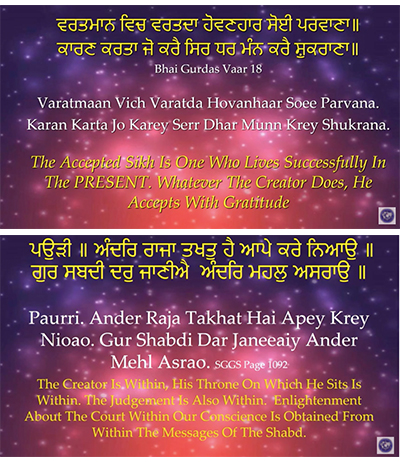
The narrative of Dargah within Gurbani. The direct evidence from within Gurbani that the Court is Within.
Paurri. Ander Raja Takhat Hai Apey Krey Nioao. Gur Shabdi Dar Janeeaiy Ander Mehl Asroa
Guru Amardas ji is saying. The King is Within ਅੰਦਰਿ ਰਾਜਾ His Throne on which he sits is Within ਅੰਦਰਿ ਰਾਜਾ ਤਖਤੁ ਹੈ The Justice, the law, the rules, the judgement is also Within ਅੰਦਰਿ ਰਾਜਾ ਤਖਤੁ ਹੈ ਆਪੇ ਕਰੇ ਨਿਆਉ.
Enlightenment about the Court within, within which the Creator Reigns, sits on the throne, and executes judgement within ਅੰਦਰਿ ਮਹਲੁ ਅਸਰਾਉ is to be obtained from within the messages of the shabd ਗੁਰ ਸਬਦੀ ਦਰੁ ਜਾਣੀਐ ਅੰਦਰਿ ਮਹਲੁ ਅਸਰਾਉ.
The phrase ਅੰਦਰਿ ਮਹਲੁ ਅਸਰਾਉ means Within the Conscience. It is our CONSCIENCE that is the DARGAH. It is the Conscience that is the court.
Keep in mind that all of Gurbani’s concepts are grounded in the HERE and NOW. In our present life. ਵਰਤਮਾਨ ਵਿਚ ਵਰਤਦਾ ਹੋਵਣਹਾਰ ਸੋਈ ਪਰਵਾਣਾ॥
Similarly, the concepts of Dargah and Judgement in Dargah are grounded in the HERE and NOW.
In that context then, the phrase ਅੰਦਰਿ ਮਹਲੁ ਅਸਰਾਉ means Within the Conscience. It is our CONSCIENCE that is the DARGAH. It is the Conscience that makes judgements about our thoughts, speech, acts and deeds. These are instant judgements in the here and now.
The meaning of the verse then is this: The Creator is Within, His Throne on which he sits is Within. The Justice, the law, the rules, the judgement is also Within. Enlightenment about the Court within Our Conscience is obtained from within the messages of the shabd.
Khrey Parkh Khajaneiy Payien Khotia Nahi Thao. Sabh Sach Scho Sach Vartda Sda Sach Niao. Amrit Ka Rus Aiya Mun Vasiya Nao.
The translation of the verse is: The Judgement Within My Conscience Is I Inculcate the Good and I Discard the Bad. The Creator Reigns Supreme Within the Court of Justice of the Creator Within. The Essence of Spiritual Life Is Realized Upon The Realization Of Divine Virtues Within.
Putting it all together then, the message of the verse is: The judgement within our Conscience is of essence. The good and the bad, the truth and the falsity, the real and the unreal – I judge within my Conscience on the basis of ਗੁਰ ਸਬਦੀ ਦਰੁ ਜਾਣੀਐ.
I inculcate the good ਖਰੇ ਪਰਖਿ ਖਜਾਨੈ ਪਾਈਅਨਿ. I discard the bad ਖੋਟਿਆ ਨਾਹੀ ਥਾਉ. The essence of Spiritual life is realized upon the realization of Divine virtues within.
What all the above means is that Guru Amardas ji is telling us that for Divinity to come into existance within our minds in the HERE and NOW– we need to appreciate that the Creator is Within, His Court or Dargah is within, and so is the Judgement which comes through the voice of the conscience which is the voice of the Creator within.
On the other hand, if we accept that the Dargah is an external entity in the After Life, and that the judgement is done by an entity out there –also in our afterlife – then the essence of it will NOT be DIVINITY, but fear, anxiety, worry and dread. These are not the building blocks of spirituality in the Here and Now.
Pauri. Jis Kaiy Ghar Diban Har Hoveiy Tis Ki Muthi Vich Jagt Sabh Aiya. Tis Kao Talki Kiseiy Di Nahi Har Diban Sabh Aann Pairi Paya
A Sikh of the SGGS, a Sikh of Gurbani does not subject himself or herself to any COURT, any Diban, any Dargah that is under the jurisdiction of any entity OTHER than the Creator Within.
The Outome of Realization that the Court of the Omnipresent Creator is within is the REMOVAL of subjugation to any OTHER entity. Any entity other than the Creator within.
The message is crystal clear – The Sikh discards all the external entities such as the Dargah of the afterlife, Dhrm raj, Chitergupt etc. A Sikh is NOT subject to any such concocted entities.
So Aisa Har Diban Vasiya Bhagtan Kaiy Hirdaiy Tin Rehndey Kuhndey Aanm Sabh Bhagtan Agaiy Khalvaiya
Meaning : Such is the court of the Creator that is located within the conscience of Divine Seekers (Bhagats) that all other insignificant courts vanish in such realization. So much so that all other insignificant courts vanish in such realization .
The message is crystal clear. Once Realization of the Court of the Creator Within comes, settles in, and becomes a reality of our Spirituality in the HERE and NOW – all other courts become insignificant, become inconsequential, become irrelevant. Guru ji uses the words ਰਹਦੇ ਖੁਹਦੇ ਦੀਬਾਨੁ in comparison to ਹਰਿ ਦੀਬਾਨੁ. The idiom ਰਹਦੇ ਖੁਹਦੇ means trivial, petty, frivolous and irrelevant remnants.
SIKHI CONCEPTS VIDEO SERIES BY KARMINDER SINGH DHILLON
ASIA SAMACHAR is an online newspaper for Sikhs / Punjabis in Southeast Asia and beyond.Facebook | WhatsApp +6017-335-1399 | Email: editor@asiasamachar.com | Twitter | Instagram | Obituary announcements, click here |
A Sikh youth flashed three-finger salute that has come to symbolise resistance to Myanmar military coup during a demonstration in Mandalay today – Photo: Mandalay Sikh Youths Facebook page
By Asia Samachar Team | MYANMAR |
Local Sikhs today held a demonstration in Mandalay to protest against the Myanmar military coup, with some of them flashing the three-finger salute that has come to symbolise resistance to the Feb 1 coup that ousted the Aung San Suu Kyi’s government.
“Myanmar Sikh Community join the protest against Myanmar Military Coup In Mandalay, Today. Almost 80 members of Sikh in Mandalay participate the peace protest. This protest is lead by Mandalay Sikh Youths,” read an update at the Mandalay Sikh Youths Facebook page.
Yesterday, it said the group had served drinks and breads to protestors.
On Feb 1, Myanmar’s military stormed into power when they detained Suu Kyi and president Win Myint in the country’s first coup since 1988, bringing to an end a decade civilian rule.
In 2015, the Suu Kyi-led National League for Democracy came to power. In November 2020, it won another landslide victory in a general election. However, the victory was short lived as the military claims that the election was marred by fraud and demanded an investigation.
Since the coup, there had been numerous protests around the country in defiance to warnings from the military regime led by army chief Min Aung Hlaing. In some places, the protestors banged pots and pans outside buildings, now becoming a nightly phenomenon, mimicking a traditional custom to drive out evil.
So far, the generals remain undeterred by the widespread condemnation on the streets – and overseas. They justified seizing power with claims of widespread voter fraud in November’s election won.
Sikhs demonstrate against the Myanmar military coup in a protest in Mandalay on 13 Feb 2021 – Photo: Mandalay Sikh Youths Facebook page
ASIA SAMACHAR is an online newspaper for Sikhs / Punjabis in Southeast Asia and beyond.Facebook | WhatsApp +6017-335-1399 | Email: editor@asiasamachar.com | Twitter | Instagram | Obituary announcements, click here |
A farmer at Delhi’s Singhu border in early January 2021 – Photo: BSB Photography
By Hannah Ellis-Petersen | The Guardian |
Puffing out his chest, his lime green turban luminescent in the morning sun, Surinder Singh made it clear he was a man who would not easily be moved. “We will stay here five years, 10 years if we have to,” the farmer said with a steely smile. “As long as it takes.”
A roar of approval greeted his words from fellow farmers who had gathered for breakfast at Singh’s chai stand at the Singhu camp, one of three main protest camps on the outskirts of Delhi. Singh, a small-scale farmer from India’s northern state of Punjab, is just one of hundreds of thousands to have made Singhu his home since November, living out of the back of his now fully furnished tractor trailer.
The farmers object vociferously to new laws that constitute the most sweeping reform to agriculture in India for decades. The government of the prime minister, Narendra Modi, says the laws will bring necessary modernisation and private competition to an ailing sector that has left millions of farmers destitute.
Farmers say the laws were passed without consultation and will allow for private corporations to control the prices of crops, crush their livelihoods and take away their land.
“I was born on my land, my father was also a farmer. I will not let Modi take it away from us,” said Singh, echoing a widespread belief among those in the camps that the new laws will result in them losing their farms. “The government must abolish the black laws. Modi says bad things about us but we are simply protesting peacefully here and eventually we know we will win.”
Eleven rounds of negotiation between farmers and the government have failed to reach any compromise. The government has offered small amendments, but for the farmers, it is a black and white issue: the “black laws” must go, and until it happens they are prepared to stay put – indefinitely.
Read the full article, ‘Roaring crowds, roti and Rihanna: the view from a Delhi farm protest camp’ (The Guardian, 12 Feb 2021), here.
ASIA SAMACHAR is an online newspaper for Sikhs / Punjabis in Southeast Asia and beyond.Facebook | WhatsApp +6017-335-1399 | Email: editor@asiasamachar.com | Twitter | Instagram | Obituary announcements, click here |
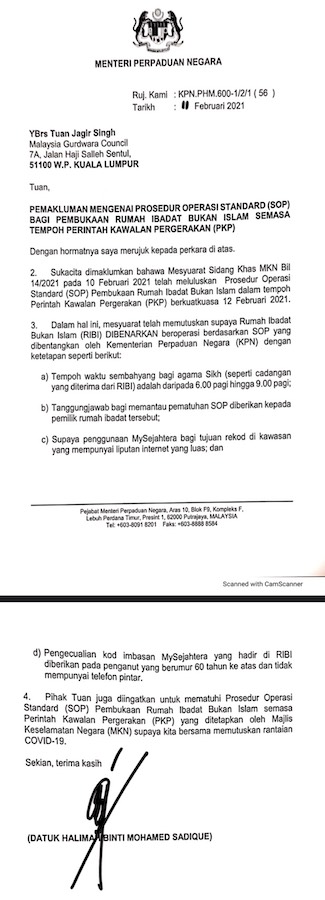
The Minister of National Unity has written to Non-Muslim places of Worship separately conveying NSC approval for them to open for limited hours from tomorrow 12/02/2021.
The Gurdwaras are allowed to reopen from 12/02/2021 on the following conditions:
Gurdwaras can open from 6am to 9 am daily
There must be strict compliance with SOP and the Gurdwara Parbandaks are responsible to ensure compliance with SOP.
To maintain a record of devotees attending. My sejahtera to be used or register book.
There can be a maximum 30 persons attending at any one time
and wearing masks and observing social distancing. This is not stated in the ministry letter. I had enquired from ministry official as to above and ministry official had said a maximum of 30 persons allowed at one time.
We were contacted by phone by the ministry official to obtain our views. I had also requested for evening prayers from 6pm to 8.30 pm daily. This is not included in the Ministry letter.
The Ministry letter is attached below.
From: Jagir Singh MGC
11/02/2021.
(The above guidance note was confirmed by the sender)
ASIA SAMACHAR is an online newspaper for Sikhs / Punjabis in Southeast Asia and beyond.Facebook | WhatsApp +6017-335-1399 | Email: editor@asiasamachar.com | Twitter | Instagram | Obituary announcements, click here |
When I was at university, another South Asian asked me what my caste was.
I replied that I didn’t know.
But as Jasbeer Mustafa, an academic from Western Sydney University, told me: “If you don’t know your caste, it’s most likely you’re upper caste.”
As a new migrant to Australia I was surprised when I learnt caste discrimination exists in a country so far removed geographically and culturally from South Asia.
I grew up in Mumbai, and it wasn’t until the Dalit Lives Matter movement was retriggered by the murder of a Dalit in India last September that I started to question the caste system and the role I played in it.
I was curious to know more about how casteism impacts people in Australia, so I started speaking to a number of migrants who had first-hand experience with the caste system.
‘Australia is no exception’
The Hindu caste system is made up of four tiers — at the very top are Brahmins or priests and teachers.
The next tier is Kshatriyas, who are the descendants of warriors and rulers or kings.
Then come Vaishyas, who are farmers, traders and merchants.
In the last tier are Shudras, or labourers.
And beneath that last tier are Dalits.
According to the system, Dalits are tasked with manual scavenging and street cleaning, are considered “untouchable” and are often outcast by India’s society.
Iterations of the hierarchy exist within most South Asian groups — from Tamils and Punjabis, to Nepalese and Bhutanese people.
Melbourne-based academic and filmmaker Vikrant Kishore says “caste goes where South Asians go”.
“Australia is no exception,” Dr Kishore says.
He says some South Asians in Australia even personalise their car’s number plate to display their caste pride.
“It is all about the privilege, it’s all about boasting of their background,” he says.
“Most of the Australians, they wouldn’t even be knowing what it is doing — but Indians generally know what the person is trying to announce to the world.”
Aparna Ramteke, a human resources professional, Dalit woman and advocate for Dalit rights, says diaspora South Asians in Australia can be obsessed with finding out each other’s caste.
She says it is common for Indians who meet in Australia to end their conversation by asking each other their last name.
“Why are we asking the last name — to understand which caste system you come from. It’s such a casual discrimination,” she says.
“It’s just amazing to note how intricately this has divided people on the basis of the caste system.”
San Kumar Gazmere changed his last name when he arrived in Australia to avoid caste discrimination among the Nepalese community in Cairns.
In Australia, Mr Gazmere manages a fast food restaurant and remembers when he first moved here people from the community laughed at his surname.
“Some Nepalese people … pronounce it in a very weird voice, and they yell really loudly with that name,” Mr Gazmere says.
“We feel embarrassed because people who had that last name have got bad memories and bad experiences.”
Mr Gazmere says people from his caste are not allowed into people’s homes in Nepal — and in Australia too.
“They keep dogs, cats, everything inside the house, but they don’t let people go inside because of only that [their] last name.”
Those who can evade discrimination, and those who can’t
I’m Sindhi, and Sindhis don’t follow a typical caste hierarchy — rather, we divide ourselves on class lines.
That’s why when I asked my dad recently what caste we were, he was really vague about it.
He said we might be Vasihyas — the traders — due to our family’s history of running businesses.
This confused me even more. If I’m not as high up in the hierarchy, how am I able to evade the impacts of the caste system?
Ms Ramteke says because of her professional HR job, she has not experienced typical caste discrimination in Australia.
“Somebody who has got a good house, a good family, they wouldn’t talk about the caste system,” she says.
She says in cases such as hers, any discrimination is not in your face, but behind your back.
But for recently arrived migrants from lower castes, casteism is not that subtle.
A Nepali Dalit man, who wanted to remain anonymous, told me he was evicted from his rental in Brisbane after the owner, an upper caste Nepali, found out he was an “untouchable”.
When he complained about the eviction, the owner told him to shut up, and that he should be ashamed about not disclosing his caste.
Melbourne filmmaker Girish Makwana had a similar experience as an international student in Australia.
“[The landlord] asked me: ‘Where are you from, what’s your caste?’ And then very nicely just brushed me off,” he says.
Mr Makwana then found out that the landlord had accepted five other applicants, but not him, because he is a Dalit.
“Later one of the guys living there told me it’s because they have a protocol in their house. Then I decided I will not live with any Indians any more.”
Dating outside of your caste
Caste also seeps into our dating lives. There is a dating app called Dil Mil, which means meeting of hearts.
The app has a filter option allowing those from top tier caste groups to find matches within their own caste — but there are no options for lower caste groups.
Rather than a meeting of hearts, it is more a meeting of castes.
On finding this out, it made me ill-at-ease. Are young South Asians so obsessed with caste that we come up with apps by upper castes for upper castes?
Kushal, whose name I have changed to provide anonymity, is a Nepalese migrant in Tasmania who fell in love with an upper caste girl.
“After a few years, maybe, her parents figured it out,” he says.
Her family would not let them get married.
“She was beaten by her parents, saying that: ‘Why do you want to stay in a relationship with those kinds of people?'”
They ran away together, but Kushal says there was no respite.
“Her parents used to call her, saying, ‘Come back, we’ll find a better guy for you.'”
Read the full story, ‘They’ve left South Asia, but they can’t escape the discrimination and division of its caste system’ (ABC Radio National, 11 Feb 2021), here.
ASIA SAMACHAR is an online newspaper for Sikhs / Punjabis in Southeast Asia and beyond.Facebook | WhatsApp +6017-335-1399 | Email: editor@asiasamachar.com | Twitter | Instagram | Obituary announcements, click here |
Panjab witnessed its first first ever mahapanchayat as farmers up the ante in their battle against an unrelenting federal government to repeal three agriculture laws passed late last year.
Estimates of the people attending the event at the Grain Market at Jagroan ranged from 20,000 to 50,000.
Mahapanchayat is not a common scene in the Indian state of Panjab. Hence, today’s (Feb 11) gathering should mark yet another seismic shift on the ground support for the farmers cause.
Since Nov 26, the action has been focussed on protests at the multiple Delhi borders.
“This (mahapanchayat) usually happens in Haryana, Rajasthan, Uttar Pradesh and other Jat belt areas, but never ever in Panjab,” an editor of a Panjabi newspaper told Asia Samachar. “The religious fringe is not finding foothold despite trying very hard. The same with politicians. None of them were on the stage.”
A mahapanchayat is a congregation of people from several neighbouring areas, led by local leaders in rural areas, explainsFree Press Journal.
A panchayat is a village council to which elections are held routinely, and the leader is often called the mukhiya or sarpanch.
A massive mahapanchayat took place in Haryana, the state neighbouring Panjab.
In his speech at that gathering, Bharatiya Kisan Union (BKU) leader Rakesh Tikait warned the BJP-led federal government could face an exit at the next polls.
“We have so far talked about “bill wapsi” (repealing the farm laws). The government should listen carefully. What will you do if the youth call for “gaddi wapsi” (removal from power)?” he said, as quoted in the FPJ report.
The farmers are demanding Prime Minister Narendra Modi to repeal the three laws which they deem promotes the interests of large corporations at the expense of farmers.
The in-going mahapanchayats are mainly led by farmer leaders.
The Jagroan event today was attended by various leaders from the Samyukt Kisan Morcha (SKM) – which literally means Joint Farmers Front – which bands together over 40 Indian farmers unions formed in November 2020 to coordinate the farmers’ movement against the three farm laws.
Among them were Balbir Singh Rajewal, Surat Singh Dharamkot, Kulwant Singh Sandhu, Manjit Dhaner, Nirbhai Singh Dhudike and Harinder Singh Lakhowal.
On Feb 10, Rajewal told the gathering at the Kundali Singhu border that he farmers’ call for a ‘chakka jam’ on Sarutday (Feb 6) protest saw its observance at more than 3,000 spots nationwide.
Farmers’ unions had given a call for a three-hour nationwide ‘chakka jam’ protest, from 12pm to 3 pm, during which the protestors would block key roads to protest against the central government’s new farm laws.
“Modi may still view this as a Panjab and Haryana (driven) affairs, but it is a nationwide movement….We have farmers from the entire country. Some 2000 farmers walked to here from Maharashtra. Kerala, too. Some 1,000 walked all the way from Udissa. For them to walk all the way tells us what this morcha means to them,” he said.
“Outwardly, (Modi’s) government is behaving as though nothing is happening. But let me tell you. Internally, they are shaken.”
In the past 11 meeting between farmer unon representatives and ministers, he said they have gone through the laws and pointed out, clause by clause, all the flaws. “When the entire laws are flawed, what is the need to amend them. What need is there for the laws,” he said.
“This is the world’s largest movement. I’ve been saying this from the start, and I say it again: As long as the movement stays peaceful, victory will be yours. If you allow violence (hinsaa), then you will lose, Modi will win.” (Updated)
ASIA SAMACHAR is an online newspaper for Sikhs / Punjabis in Southeast Asia and beyond.Facebook | WhatsApp +6017-335-1399 | Email: editor@asiasamachar.com | Twitter | Instagram | Obituary announcements, click here |
A protest in Mandalay on 8 Feb 2021- Photo: Tony Ye Htet Aung
Photos by Tony Ye Htet Aung | MYANMAR |
Myanmar protests going strong. Asia Samachar has received photos of the action in Mandalay captured by Tony Ye Htet Aung. Myanmar Sikhs are also taking part in the protests against the military coup. For more photos, go to Asia Samachar Facebook page
ASIA SAMACHAR is an online newspaper for Sikhs / Punjabis in Southeast Asia and beyond.Facebook | WhatsApp +6017-335-1399 | Email: editor@asiasamachar.com | Twitter | Instagram | Obituary announcements, click here |
This year, we celebrate the 400th anniversary of the parkaash (birth) of Ninth Nanak, Guru Tegh Bahadur (1621–1675). However, the farmers’ protest against what they see as unjust farm laws, has interrupted initiatives to commemorate the Guru’s life and martyrdom in some meaningful way.
Yet, lessons from the Guru’s history can be learnt to show a constructive way forward for both: a resolution of current conflict and memorialisation of the Guru’s Parkash centennial.
Prompted by Sardar Tarlochan Singh, ex-MP and Chair Indian Minorities Commission, the author forwarded some thoughts as below.
There is an echo from Guru Tegh Bahadur’s life mission and martyrdom as we see a flood of green turbans leading the farmers’ protest to save their livelihood and way of life. Although, the rather narrow traditional reason given for the Guru’s martyrdom is the defence of the Hindu religion, there were many other reasons which become clearer as we study the life of the Guru. There is little doubt that he was concerned with the wellbeing of all and not just of any one community or creed.
During the Guru’s time, the oppressive Mughal system of state used jagirdars and mansabdars to exploit the small as well as the larger farmers, the jamindars. For that reason, the agrarian relations between the state through the state appointed mansabdars/jagirdars, and the actual tillers of the land, the farmers, were always strained and led to rebellions, especially by the larger independent-minded jamindars. According to one source, “Agrarian relations were seriously disturbed. The whole economy in the countryside was in danger of giving way under the heavy weight of relentless exploitation by the State’s Jagirdars and Mansabdars.” (The system is explained by Fauja Singh and G S Talib in Guru Tegh Bahadur Martyr and Teacher (Punjabi University, pp 55-58).
The Guru’s liberating ideology of “fear none and frighten no-one” found popularity with the rural populations including the farmers and larger land owners who rebelled against the system from time to time. Many names are mentioned during the preaching tours of the Guru. Naturally, the Guru’s message of a life of dignity and freedom, which attracted large rural audiences and followers, troubled the Mughal state.
Today, the jagirdars, can be compared with profit-making large corporations threatening the farmers’ independence. They are least concerned about the way of life or livelihood of the average man (aam aadmi).
Quite amusingly as we see green turbans of farmers from all over India, we are reminded of the green turban of Gobind Das (later Guru Gobind Singh) in Bhat Vahis in connection with his dastaar ceremony! The place was Lakhnaur (now in Haryana). Little Gobind Das was seated on a cot. The colour of his turban was zamurdi (green).
As we celebrate 400th Parkash Year of Guru Tegh Bahadur, prominent Sikh Indians have been urging the Indian government to memorialise the Guru’s mission and unique martyrdom. Sardar Tarlochan Singh suggested, “a martyrdom museum in Delhi which should become a tourist attraction so that lakhs of foreigners and the local Indians who come to Delhi should know that [Sikhi] martyrdom concept is unique in the world and they should realise the history of the Sikhs especially Guru Arjan Dev and Guru Teg Bahadur. We will try to convince the government to agree to this proposal.”
The above suggestion is a good proposal and should be followed through. However, when invited recently, my additional suggestion took into account the present crisis which challenges the diversity and unity of the country. Singhu border on Delhi-Chandigarh road, is the command centre of farmers’ demonstration. This is where the farmers’ representatives were selected to hold discussions with the government to resolve their issues after three farm laws, now called the “Black Laws”, were enacted.
It is also the site of an existing memorial to Guru Tegh Bahadur. Sardar Tarlochan Singh wrote, “I may inform you that a proper memorial was built 8 years back by the Delhi government which is very impressive and everyone who enters Delhi it is visible on the left side. Interestingly till few days back this was being used by the farmers and there were lot of facilities made available for them. This is a huge complex in two acres area.”
Quite remarkably, the present “state versus people” conflict circumstances recall an episode in Guru Tegh Bahadur’s history. The Guru negotiated peace between Raja Ram Singh representing the Mughal empire and the Ahom ruler Chakradhwaj Singh of Assam, at a place called Hajo, also known as Teghpur or Tegh Parbat in memory of the Guru.
Another related point as discussed above, is the background to Guru Tegh Bahadur’s martyrdom which was at least partly due to the conflict between jagirdars and farmers (jamindars). The latter were independent minded, and many, especially in the Malwa belt, became devout followers of the Guru. The Mughal suspected rebellion and that resulted in the first arrest of Guru Tegh Bahadur eventually leading to his martyrdom after the third arrest.
Therefore, following in the footsteps of Guru Tegh Bahadur, Prime Minister Modi needs to show a clear vision of One Nation and One People united in their diversity as equal citizens. This is not a matter of personal prestige nor will it diminish his image as a world class leader.
The following steps are suggested for memorialising the life, vision and mission of the Guru:
1. Immediate announcement revoking the “black” farm laws and removal of all police barricades blocking the roads to Delhi.
2. PM Modi should then walk up to the Indian diversity united by the Farmers’ protest at Singhu border and announce the broad terms of an accord for the next steps to bring about the agrarian reforms needed in the states and by the states and the farmers and workers unions. The objective should be to ensure complete security for small farmers and workers while giving a major boost to farm produce through diversification and national/international marketing infrastructure while saving the environment.
3. Announce a museum as suggested by Sardar Tarlochan Singh and colleagues as an annex to existing Guru Tegh Bahadur memorial at Singhu Border to mark the accord and the occasion.
Thus, PM Modi can take a bold step to memorialise Guru Tegh Bahadur’s 400th Parkash anniversary while uniting the country. He has an opportunity to return the country to democratic rule with real separation of powers in a federal type of government.
Gurmukh Singh OBE, a retired UK senior civil servant, chairs the Advisory Board of The Sikh Missionary Society UK. Email: sewauk2005@yahoo.co.uk. Click here for more details on the author.
* This is the opinion of the writer, organisation or publication and does not necessarily represent the views of Asia Samachar.
ASIA SAMACHAR is an online newspaper for Sikhs / Punjabis in Southeast Asia and beyond.Facebook | WhatsApp +6017-335-1399 | Email: editor@asiasamachar.com | Twitter | Instagram | Obituary announcements, click here |
Any review of new books that translate the verses of Sri Guru Granth Sahib (SGGS) must first describe the vacuum they fill.
An in-depth look at the most recent Gurbani translations gives rise to several concerns, issues, and approaches. Most render Guru Nanak’s messages as regurgitations of the missives already in vogue in India’s religious traditions and teachings. Most old concepts mentioned in Gurbani remained intact in most translations to date. The examples are: mantras, heavens, hell, lives after death, transmigration of the soul, angels of death, dharma raj, place of ancestors, dasam duar, and dozens of other concepts, stories, and rituals concocted by clerics or priests.
Review of: 1. Understanding Nitnem: Jup, Sodar, and Sohela. 308 pages. 2. Understanding Sidh Goshat. 271 pages. 3. Understanding Anand. 162 pages. 4. Understanding Asa Di Vaar. 289 pages. 5. The Hijacking of Sikhi. 420 pages.
However, a few scholars did realize that if Gurbani merely meant to regurgitate what was already in the existing religious texts, then what was the real need of Guru’s spending years of work to compose Gurbani? Or what was the absolute necessity for Gurus to take birth or their promoting the path of Sikhi?
Some recent scholars started looking for the answers to the above questions. They believed in Sikhi and Guru Nanak’s uniqueness and that of his successors and thus the message of the Gurbani hymns or Sabd. They realized that there are definite approaches, methods, and manners in which Guru’s teachings must be unique and so understood. Their research, then, discovered the newness in Gurbani.
The purpose of this book review is to write a tribute to one of today’s true Gurbani translation luminaries, Dr. Karminder Singh Dhillon. Dr. Dhillon writes and regularly speaks on Gurbani matters. He is currently the Joint Editor of The Sikh Bulletin and a board member of Sikhi Vichar Forum. This review of mine is a composite review; the book titles are explicit about what is specified in each book.
Dr. Dhillon took the challenge of Gurbani translation with several highly desired and revolutionary tributes. He recently published five books that translate certain sections of SGGS. They are Understanding Nitnem: Jup, Sodar, and Sohela; understanding Sidh Goshat; Understanding Anand; Understanding Asa Di Vaar; and The Hijacking of Sikhi.
Gurbani translations by Karminder will open your eyes to the principles, the methods, the processes, and the intricacies of translating the Gurbani into language that communicates clearly, accurately, and powerfully to readers of many countries and many cultures. It will deepen your understanding of and appreciation for the priceless gift of Guru’s written Word. The books are in English – a language of the great majority of the current world population and indeed the educated Sikhs.
Dr. Dhillon employed the following approaches extensively to accomplish the translations under review.
Gurbani Grammar
I remember my student days when I used to listen to Bhai Jodh Singh’s lectures and Prof. Sahib Singh in Khalsa College Amritsar that harped on the use of Gurbani grammar while translating Gurbani. It is their motivation that I took college courses in Sanskrit Grammar, which is extensively used in Gurbani.
Even when Prof Sahib Singh published his ten volumes of Gurbani translation, the English translations were not yet based on the same guidelines. The proof on hand is Dr. Sant Singh’s translation, which most diligently derived his translation from the then existing non-grammar based English translations of SGGS. Not knowing Gurbani Grammar himself, he could not take advantage of the newer approaches.
From Literal to Spiritual
Dr. Dhillon successfully crossed over from the literal translation to the spiritual translation in his recent books. He argues that the spirituality of Gurbani does not have a language intrinsic and inherent to it. The objective and focus of the messages of Gurbani are to bring about a realization of the Creator within the human conscience. The language of our daily usage may not have the required vocabulary for the core Gurmat concepts, for its process, outcome, and objectives. This objective, then, is the challenge that Dr. Dhillon accepted.
He crossed over from the literal and to the domain of spiritual messages. It necessitated a substantial intellectual leap from the little pond’s banks to the other side where the vibrant and intended spiritual messages lied. Such is a task that is arduous and challenging, but the composers of Gurbani were aware of those difficulties. Thus, they provided necessary milestones and signboards along our spiritual journeys within Gurbani to ensure we get to the envisioned messages’ intended destinations. Our task is to look for them to assist us in our understanding. Dr. Dhillon successfully took that into account.
The Rahao Principle
The second principle that Karminder used in his translations of Gurbani is the Rahao Principle. The basic premise here is that the Rahao verse or its equivalent is critical in interpreting or attempting to understand Gurbani.
Translated literally, Rahao means pause. But such a translation begs the question: Pause for what purpose? The attempted answer is to pause to allow contemplation and research to get to the central message of the Sabd and transform the literal message into the spiritual message. Rahao also may serve as the title of the subject of the SABD.
First Person Interpretation
Most Gurbani is composed in first-person terms and is thus, in essence, a narrative of the experiences, processes, choices, consequences, and outcomes for the writers themselves. Guru Nanak walked the journey of realization and gave us the path of Sikhi. Thus, Gurbani translations must be interpreted in the terms, the messages referring to me as the reader, for me as a Sikh of Gurbani, and not for someone out there. Our failure to grasp this principle has lead to defective translations.
Using Gurbani to Translate Gurbani
The SGGS is a voluminous text. Its subject matter is devoted to revolutionizing humankind’s spiritual quest. Such a volume will require the extensive use of spiritual concepts, beliefs, idioms, metaphors, etc., that were already within the use and within the psyche of spiritual seekers of the time. They had to be used but explicitly with new meanings and understanding to fit the new spiritual paradigms of Sikhi and Gurmat. Thus, the redefining of the existing concept must be made available within the voluminous text that is the SGGS, not outside. Our gurus so did it. Thus, the spirituality of the SGGS was not permitted to revert to the old meanings of the concepts and beliefs. Dr. Dhillon strictly adhered to translating Gurbani with the definitions and concepts as detailed and expounded within SGGS.
Recommendation
These remarkable volumes under review marshal the understanding of the Gurus’ teachings. These books shed so much light on Gurbani translation in so accessible a fashion. This compendium gives scholars, students, and interested readers an unprecedented grasp for a new respect for the diligence, knowledge, and care required to produce a meaningful, beneficial and accurate translation. Gurbani and the Gurbani researchers’ readers will find a rich and hitherto unavailable treasure of knowledge about their interests.
The books are available as a complete set for purchase here.
Harbans Lal, Ph.D.; D.Litt (Hons) is the Professor Emeritus & Chairman at the Dept of Pharmacology & Neurosciences, University of North Texas Health Science Center. He is also the Professor Emeritus at the Amritsar-based Guru Nanak Dev University as well as President of the Academy of Guru Granth Studies. He can be reached at Japji2050@gmail.com. Link to the original article.
* This is the opinion of the writer, organisation or publication and does not necessarily represent the views of Asia Samachar.
ASIA SAMACHAR is an online newspaper for Sikhs / Punjabis in Southeast Asia and beyond.Facebook | WhatsApp +6017-335-1399 | Email: editor@asiasamachar.com | Twitter | Instagram | Obituary announcements, click here |