Sukhcharan Singh on his walnut farm in Yuba City, California. Photograph: Salgu Wissmath/The Guardian
By Summer Sewell | The Guardian |
Sukhcharan Singh grows walnuts in Yuba City, California, about 40 miles north of Sacramento. Like many Sikh farmers in this small Central Valley city, Singh’s thoughts are occupied by the ongoing protests in India.
“I lose sleep over this. When I was there, it was a poor country, yes, but it was a good country,” said Singh, 68, flipping through notes he has taken on the latest news out of India. “Last night I finally slept at 11.30.”
Since the end of November, hundreds of thousands of farmers, mostly from the agricultural states of Punjab and Haryana, have been protesting on the outskirts of Delhi, making the nation’s capital inaccessible for miles. They are demanding that the Hindu nationalist prime minister, Narendra Modi, repeal three laws passed hurriedly by parliament – “shoved down the throats of the people,” as Singh puts it – in September that farmers fear will eliminate regulation, leaving their earnings and livelihoods vulnerable to private investors.
“It’s very unfortunate,” Singh said, looking down past the tip of his long white beard. “On one hand I feel glad I’m here, on the other I feel guilty I’m not there.”
The ties between there and here are self evident. Outside of India, Yuba City is home to one of the largest groups of farmers from Punjab, the birthplace of Sikhism. Roughly half of the 500,000 Sikhs in the US live in California, with the largest concentration living in Yuba City. Nicknamed “Mini Punjab”, the city elected the US’s first Sikh mayor in 2009, and the country’s first female Sikh mayor in 2017. In the first week of November, the city hosts an annual festival honoring the birthday of the first Sikh prophet, attracting over 100,000 people.
It’s no surprise, then, that the largest rally outside India in support of the farmer protests took place not far from here. On 5 December, people from Yuba City and other Central Valley cities including Fremont, Fresno, Stockton and Manteca beat drums, shouted over bullhorns and waved flags that read “No farms, no food”. Thousands of big rigs, cars, and trucks departed from Oakland and snarled traffic for hours on the Bay Bridge, before arriving at the Indian consulate in San Francisco. Other large rallies happened in Washington DC, New York, Chicago, Texas, and Michigan that week; throughout December and January, solidarity demonstrations and caravans of various sizes occurred in at least 16 US states.
Naindeep Singh, executive director of the Jakara movement, a youth-focused non-profit organization that advocates for the Sikh community, spearheaded the protest. “I feel inspired. I see elderly people, my own family members, sleeping in the cold and they’ve been there for months. I feel a deep will to support the efforts in any which way I can,” he said.
Community members have also raised funds to support billboards drawing attention to India’s protests throughout the Central Valley, where Punjabi is the third-most spoken language, after English and Spanish. And there are further plans to advertise on the sides of 500 big rigs.
“I went to the rally in San Francisco in December to show my support for my brothers there,” said Kulwant Johl, 70, a Sikh farmer in Yuba City who leases out his farmland in Punjab. “The farmers [in India] say they don’t need any money, so right now it’s just moral support and talking to local politicians here and seeing if they can help.”
He constantly watches Indian news coverage of the protests on satellite and social media, like many of his neighbors – it has consumed conversations in the community. “That’s all we talk about now,” Johl said.
An estimated 95% of peaches and 70% of prunes in Yuba City are grown by Punjabi Sikh farmers. Johl farms peaches, prunes, pomegranates and almonds. His 800 acres are quite an expansion from the 20-acre plot of his grandfather Nand Singh Johl, who is believed to be one of the first Punjabi men to have settled in Yuba City.
Read the full story, ‘’This has to end peacefully’: California’s Punjabi farmers rally behind India protests’ (The Guardian, 8 Feb 2021), here.
ASIA SAMACHAR is an online newspaper for Sikhs / Punjabis in Southeast Asia and beyond.Facebook | WhatsApp +6017-335-1399 | Email: editor@asiasamachar.com | Twitter | Instagram | Obituary announcements, click here |
Some members of the small Sikh community in Myanmar have joined fellow citizens in protesting against a recent military coup that has ousted Aung San Suu Kyi’s government.
“We would like to see the elected government back in power,” a Myanmar Sikh told Asia Samachar in a conversation today. “Protests are happening in many places.”
In the latest development today (Feb 8), police in Myanmar’s capital Naypyidaw used water cannon against thousands of protesters who had gathered. In Yangon, the nation’s largest city, protesters were reported to have held up Wanted posters featuring the image of Myanmar’s Commander-in-Chief Senior General Min Aung Hlaing.
On Feb 1, Myanmar’s military stormed into power when they detained state counselor Suu Kyi and president Win Myint in the country’s first coup since 1988.
The move brings to an end a decade civilian rule. In 2015, the Suu Kyi-led National League for Democracy came to power. In November 2020, it won another landslide victory in a general election.
However, the victory was short lived as the military claims that the election was marred by fraud and demanded an investigation.
A group of Myanmar Sikh youth protesting the military coup
ASIA SAMACHAR is an online newspaper for Sikhs / Punjabis in Southeast Asia and beyond.Facebook | WhatsApp +6017-335-1399 | Email: editor@asiasamachar.com | Twitter | Instagram | Obituary announcements, click here |
Many definitions have been advanced to describe the disturbing surge of far-right nationalism in India today. One of those is that India under the rule of Mr Narendra Modi and the ruling Bhartiya Janata Party (BJP) is rapidly descending into a fascist state. It is one thing for political enemies of the BJP to criticise them, but when prominent mainstream politicians, academics, and activists in India and across the world, with no party-political axe to grind contemplate the spectre of Indian fascism, then one is compelled to listen. On 26th November 2020, prominent politicians, journalists and human rights activists, met in a roundtable discussion, that was co-sponsored by the New South Wales Parliament and Amnesty International, to discuss if India was turning into a fascist state?
Such discourses are taking place across the world and the worrying conclusion of many is, if not completely there, the BJP Government has certainly turned India into a proto-fascist state, i.e., one that is displaying many of the features of fascism. However, the question is, given that the idea of fascism emerged in Europe during the 20th Century, to what extend can we usefully deploy this idea to characterise the current political changes taking place in India? Though the discussion about Indian fascism is not new, the current farmers movement centred on the borders of the national capital Delhi, and the government’s heavy handed response, has raised the sense of concern and urgency amongst many observers. This article seeks to explore the question of Indian fascism within the context of the challenge from the Indian farmers movement.
THE FARMERS PLIGHT MEDIA WARS
Despite the BJP Governments attempts to diminish the plight of the Indian farmers and the scale of the movement, we have seen a groundswell of solidarity and support from citizens across India and the world, including prominent celebrities and public figures with huge followings on social media. One such figure is the environmental activist Greta Thunberg who, linked to a news article on heavy-handed measures being used against the protesting farmers, tweeted: “We stand in solidarity with farmers protests in India,” Prior to this US pop star Rihanna had tweeted an article on the crackdown against the farmers by asking: “Why aren’t we talking about this?!”
By drawing global attention to the plight of the farmers and Indian Government tactics of violence and intimidation, these interventions have without doubt turbo-charged the farmers’ campaign. But they have also drawn the wrath of the BJP Government. Along with the regular tirade of ‘official’ rebukes by the Indian foreign ministry, there has been the now familiar campaign of abuse and intimidation in the pro Modi media (referred to as ‘godhi media’) directed towards those who have the courage to ask questions about the plight of farmers. Displaying a degree of desperation, we have recently seen carefully choreographed public protests by BJP supporters where effigies of Greta Thunberg and Rihanna were burnt, and demands were made on the police to issue arrest warrants! But despite the government’s efforts, by for example, blocking internet facilitates where activists have been congregating, the hashtag #farrmersprotest has been drawing widespread attention. In a piece looking at the role that twitter is playing in denting India’s attempts at censorship, the activist blogger, Sukhraj Singh, argues that “Rihanna’s tweet was a huge setback for the Indian state and others trying to silence the farmer protests because it broke the monopoly of power and influence held by highly positioned stakeholders in the media and state apparatus, distributing it instead to those across the spectrum of impact and control.’
AN EMBOLDENED NARENDRA MODI
For sure, emboldened by his landslide victory at the last General Election in May 2019, where the BJP-led National Democratic Alliance (NDA) won 353 seats, PM Modi seems to be exuding a level of confidence (or perhaps arrogance) that was not evident during his first term. Modi’s growing assertiveness is manifest in some of the bold and cavalier policies he has enacted since his re-election, most notably, the Citizenship (Amendment) Act 2019. This was quickly followed by the revoking of Article 370 and 35A of the Indian constitution which annulled the semi-autonomous status of Kashmir.
But perhaps the boldest move of all was in June 2020, under the cover of the COVID 19 epidemic, the passing of three farmers ordinances, which opens the real possibility of the total control of Indian farming passing into the hands of large-scale corporate farming. The reason why this is the most significant is that, whereas the previous moves were targeted against specific minorities, the farming reforms, impact over 50% of the Indian population, cutting across religious, linguistic, regional, and caste-based differences.
Each of Modi’s audacious moves, as well as drawing praise from his sycophantic supporters, has drawn criticism and protest, but it is the scale and temperament of the farmers protest, and their ability to galvanise cross community support, that appears to have stopped the Modi RSS bandwagon in its tracks. In response, the government has distinctly ratcheted up is authoritarian stance targeting activists directly involved in the various occupations around Delhi, and most significantly through crack downs on journalists, intellectuals, cultural workers, and sympathetic ordinary citizens of all communities. In what is in effect an undeclared emergency, we can see tactics being deployed against the activists and those who seek to defend the right to peaceful protest, or simply expose the excesses of the state, that would not be out of place in a fascist dictatorship. But this raises an important question, namely, given it was elected with a massive majority in a democratic election, does it make any sense to describe Modi and his BJP government as fascists?
THE RISE OF EUROPEAN FASCISM
The term ‘fascism’ emerged in the context of the rise of far-right, authoritarian ultranationalism and dictatorial power that emerged in Europe during the early part of the 20th Century. As a political ideology, fascism became associated with deployment of violent suppression of opposition, majoritarianism and centralisation of power by a small elite. The first fascist movements are identified with the rise of the Italian politician and journalist Benito Mussolini who founded and led the National Fascist Party.
This was followed by the rise of the Nazi Party in Germany led by Adolf Hitler, who notably came to power through a so called ‘democratic election’. On the 5 March 1933, the elections took place in Germany, the Nazi Party led by Hitler secured 43.9% of the vote, but not an overall majority in the German Parliament. However, in a bold move on the 23 March 1933, Hitler proposed the ‘Enabling Law’ which would give him the power to rule by decree. The cadres of Nazi supporters immediately embarked on a month-long campaign of violence to intimidate and even detain opponents to the party, along with offering bribes and patronage to the German Centre Party, a lay Catholic political party, whose vote was crucial. The Bill passed by a landslide of 444 votes for to 94 against. It is important to record this history, not least because it reveals the weaknesses of the democratic system, which Donald Trump exposed during the past five years. Given the system’s vulnerabilities to violent political forces, one can never take democracy for granted; it always must be fought for, and there is no doubt the struggle of the farmers is not only about the three ordinances, but the very future of Indian democracy.
One of the popular narratives about the Nazi period is that it was uncharacteristic with the general thrust of Western civilisation and the European enlightenment. This thesis also allows the European nations to conveniently characterise the rise of fascism as the work of a small group of well organised but essentially bad individuals. However, this argument was blown out of the water by German political thinker and Holocaust survivor Zygmunt Bauman, who in his prize-winning book, Modernity and the Holocaust, argued that far from being an aberration or even failure of the European enlightenment, the Nazi project was highly predictable. It was a product of the underlying culture of white Christian European moral supremacy coupled with scientific racism and the application of years of industrial and technological development, that Bauman argues made the project possible. In short, the Holocaust was a product of modernity, where the (Nazi) state was able to deploy its monopoly of violence to introduce effective technological solutions to social problems through a policy of ‘racial hygiene’, ‘social cleansing’ and genocidal violence.
BJP leaders: (L-R) Yogi Adityanath, Amit Shah and Narendra Modi – Photo: Yogi Addityanath Facebook page
THE UNIQUENESS OF HINDUTVA FASCIS
Coming back to India, though there are many common features between the rise of European fascism in the first half of the 20th Century and the present-day BJP Hindutva government, to really understand the uniqueness of Indian fascism, it is necessary to delve a little into the ideological thinking of the RSS.
Sidharth Bhatia, writing in the Wire on 4th Feb 2021 argues that a good place to start is with the iconic poster boy of the BJP Chief Minister of Utter Pradesh state and Godman, Yogi Adityanath. If one examines the kinds of rhetoric being put out by the Yogi, it becomes clear that the Hindutva fascists are fermenting something quite different. As Bhatia argues, “though it may be stating the obvious, it is important to realise that RSS fascism is classically Indian, completely homegrown and born out of Indian tradition and social conditions and psyche”.
The Hindutva/RSS founder V.D. Savarkar was indeed well read and, as an admirer Hitler, he did have a fascination with European fascist ideas of the 1930s, such as the Aaryan myth and theories of racial superiority, but his organisation had to be weaned on Indian mythology and history, especially if as the RSS claim, they are the guardians off ‘Indian civilisation’ – note the emphasis on the singular, implying there is such a thing as a bounded Indian cultural essence or civilisation. Interestingly, Yogi Adityanath is not from the RSS, he belongs to the Gorakhnath school of thought, which once was eclectic and syncretic, with even Muslim yogis among its adherents. It is estimated that Gorakhnath lived in 11th- to 12th-century. Most importantly his influence is found in the numerous references to him in the poetry of Kabir and of Guru Nanak within Sikhism. Some texts suggest Gorakhnath was originally a Buddhist influenced by Shaivism, but that he drifted towards Shiva and Yoga. One of the strategies of all ideologues of authoritarian nationalism is revisionism, that is to construct history to fit into their narrative of ethnic, religious, racial, or cultural purity. And just like the European fascists, who constructed all kinds of myths about racial types, lineage, heritage, and morality, we see amongst RSS ideologues, the plurality of traditions being erased, corrupted, and co-opted into one overarching Hindutva ideology.
Writing in the Wire, American scholar Christine Marrewa-Karwoskiis argues “While today Adityanath, the most recognisable face of the sampradāy, uses his clout to occlude the diverse history of the Nath yogis, the political shift towards the Hinduisation of the Nath sampradāy is very much a 20th century construct. Although Nath yogis had been involved in politics for centuries, it was only under the direction of Mahant Digvijay Nath (c.1934-69) that the Gorakhpur Temple Complex began to turn violently away from its inclusive political past.’ May I suggest that another staunchly inclusive and secular tradition, Sikhism, itself is currently being subject to the same treatment as the Nath tradition, through the establishment of the Rashtrya Sikh Sangat, an affiliate of the Rashtriya Swayamsevak Sangh (RSS), which according to Sanjeev Kelkarhas in his book Lost Years of the RSS has an estimated some ’450 units predominantly in the states of Rajasthan, Punjab, Delhi, Uttar Pradesh, Madhya Pradesh and Maharashtra. Amongst other claims, the RSS has been determined to portray the Sikh Gurus as ‘desh bhagats’ (Indian nationalists), whereas the whole essence of Sikh teaching is based universalism and humanism.
FAKE DECOLONISING CREDENTIALS OF THE HINDUTV
The RSS does not take its lead from Moscow, or historic Berlin, but from Nagpur. RSS was founded in 1925 by Keshav Baliram Hedgewar, who was a doctor based in Nagpu. He was active in the anti-colonial movement and he passionately believed that it was due to disunity amongst Indians that resulted in British hegemony. His solution was to (re) build unity by focussing on uniting Hindu and giving them back a sense of pride and organisation. Not dissimilar to the thinking behind Hitler Youth, he recruited energetic Hindu youth with revolutionary fervour, gave them a distinct outward identity in the form of a black cap, khaki shirt, and khaki shorts, and he ordered them to be taught martial arts. To instil emotional allegiance, he deployed Hindu ceremonies and rituals and discourses on the Hindu nation, it’s history, and heroes.
Inevitably, like most attempts to build a national identity, one needs to not only construct but also demonise the ‘other’; which for the RSS was not only the Muslims and British, but also their apparent corrupting influences onto an imagined pristine pure Hindu past tradition. In this regard, one key distinction between the European fascists and the Hindutva RSS is that, whereas the former saw the task was to scientifically build a super race, the latter was seeking to rediscover the super Hindu subject from the past.
The often-brutal methods of dealing with dissidence that we are seeing in India under the influence of the BJP are steeped in Indian patriarchal traditions, the caste structure, feudalism, and a strong anti-Muslim bias and the demonisation of inter religious marriage. Here we are specifically talking about a move by various BJP dominated states to introduce a law on “love jihad”, which is a derogatory term to describe inter-faith marriages involving Muslim men and Hindu women, the implication being that marriage is being used as a backdoor to conversion of Hindus into Muslims.
As well as religious chauvinism, another aspect of Hindutva fascist ideology is its defence of the caste system where we see the merging of Hindutva nationalism and caste-based oppression. For the RSS, the influence of Western egalitarianism has corrupted the natural order of Manu, where everybody has a divinely ordained place, and the task in hand is therefore to re-establish that ‘perfect balance’ and thus restore people’s sense of belonging! This bizarre regressive vision is one of a ‘free’, decolonised, self-confident and assertive India where, as Sidharth Bhatiae, suggests, “everyone knows their place – the oldest man in the house takes all decisions and his word is final. The others follow his instructions, no questions asked. He is supposed to be the font of all wisdom, kindly and fair and patriotic, and cannot be opposed or defied. The women do housework, tend to the cows, obey their husbands and male elders, and strive to please and satisfy. The men earn for the family. The children listen to their parents.”
Mass movement in Mahapanchayat in protest against lathi charge on the ongoing dharna against black laws in Baraut tehsil, Baghpat! Photo tweeted by Jayant Chaudhary on 31 Jan 2021
RECONSTRUCTION OF AN IMAGINARY IDEALISED PAST NATURAL ORDE
It is such idealised conceptions of Indian society that resides at the centre of RSS Fascist ideology and, certainly on the question of gender one can see overlap between European fascism and Indian fascism. It was Hitler who proclaimed that the natural role for women was to serve and nurture their family while men were in charge and had to protect their family. Hitler said this was “the natural order”. For the RSS, Hindu society is built on rigid hierarchies and clearly defined roles, which are not derived from sociological or social scientific endeavours, but pre-ordained set of laws, that spell out the precise roles and tasks for everyone. It is the law of Manu that determines that the natural order is built around two fundamental and immutable divisions, that is the division between men and women, and the ‘varna’ system that determines human beings are divided into 4 main castes, from which any number of subdivisions exist. Thus, Brahmins are the repository of all knowledge and information, Kshatriyas rule and fight battles, Vaishyas trade and Shudras clean up everyone’s dirt. Everyone knew their place and were content as a result.
Once you establish this ‘natural order’, then constitutions and laws simply are a secondary matter; after all what can be greater than the law of Ram or God? In such a society, one should not be surprised if those perceived as ‘outsiders’ are an alien wedge, a threat either to be eliminated or assimilated. Those who question, dissent, who chose different lifestyles are labelled as deviant, dangerous, anti-national elements, Naxals, Khalistani, Islamist, Pakistani etc.
And the obvious facts that challenge this imagined Hindutva narrative, such as the fact that not all Mogul Emperors came to loot and destroy the indigenous culture, as illustrated by the great Emperor Akbar, or the wondrous Mogul architectural heritage. Another powerful example is the Sikh tradition whose sacred scriptures, the Guru Granth Sahib ji, contains the writings of Muslim saints, and where history shows that some of the closest devotees of the Sikh Gurus were Muslims.
What we saw with the criminal and violent destruction of the ancient Babri Masjid in Ajodhya and its replacement with the ‘Ram Mandir’ by supporters of the RSS, is a perfect example of Hindutva revisionism manifest in such a brutal form. However, if this act could not be kept under the radar, one needs to ponder, what else have they been doing behind the scenes, and indeed, what else are they planning to do to further the cause of the absurd imaginary idealised Hindu nation?
Though fascism is directly linked to violence – the word itself means the use of force (fascia – stick) for political ends – often form it takes can vary, from psychological terror, through to deliberate and systematic state sponsored killings. It is this combination of often hidden emotion and physical violence with a self-celebratory populism that is the hallmark of Hindutva fascism. Take for example the introduction off the notorious Citizenship Amendment Act (CAA) and the National Register of Citizens, which, Narendra Modi sought to argue strengthened the rights of citizens, even whilst it stripped away citizenship rights to hundreds of thousands of people in Assam who have been rendered stateless. We saw a similar strategy with the removal of Article 370 of the Indian Constitution, which was designed to undermine mainly Muslim Kashmiris, and thus wipe out their identity and their lands.
TO CHALLENGE THE HINDUTVA IS TO GO AGAINST NATURE
The farmers’ protest, too, flouts the ingrained Hindutva false sense of natural order. Indeed, even challenging the authority of the BJP Government is often characterised in the pro government media as an act of national betrayal, which can result in being arrested and worse. Take for example the eight journalists who were arrested, their crime being that they were seeking to report on the farmer protests in India and violence in Delhi on January 26, 2021. Human Rights Watch has argued that “The Indian authorities’ response to protests has focused on discrediting peaceful protesters, harassing critics of the government, and prosecuting those reporting on the events.”
Another characteristically authoritarian feature of the BJP is to criticise the farmers for ‘getting above themselves’, and that ‘as (simplistic) farmers, they don’t understand the new law and that are being manipulated by enemies of India’. The government in effect is saying, you do the labouring and leave it up to the higher caste corporates and money men to deal with the economics! It is this very same feudal mindset that is behind the inhumane behaviour of the notorious Delhi police. The liberal use of lathis (long brass tipped bamboo lances), the shutting down of the internet, setting up concrete barriers to stop traffic, the laying down of barbed wire fences and spikes in what is de facto now a protest site turned into a ghetto, all stem from an authoritarian impulse on how rulers should deal with a rebellion.
THE HINDUTVA IS THE REAL THREAT TO ORDER AND CIVILITY
RSS Hindutva fascism is no doubt a real threat to most of the citizens of India and indeed the peoples of the neighbouring states. Gone unchecked, given the size of India, and the unstable geopolitics surrounding the whole region, we could end up with a disaster that is beyond imagination. Through various strategies, including media censorship and manipulation, threats, and imprisonment of independent journalists, refusing to give broadcasting licences, control of large sections of the media and pressuring of social medial giants like Facebook and Twitter, the Hindutva fascists have a big hold on a large proportion of the population. Moreover, the RSS, an organisation that has been around for over 100 years, has a phenomenal network of cells and millions of devotees ready to blindly follow them. And like the white supremacist devotees off Trump, fed by half-truths, conspiracy theories and fabrications, many are equally out of touch but very angry and resentful of how the world excludes them!
But like all such regimes, it will end, and end badly for its perpetrators. As we saw with Trump, the sheer hubris and drunken power seen will ultimately consume them; the problem is, what damage will be caused in the interim? History will judge, but it does seem like with the devious passing of farming ordinances, they may just have made their most fatal error. In this respect, the continuous defiance of the Indian farmers, led by the Panjabis, who have a history of confronting imperialists and oppressors, and the growing global reaction to the BJP provides room for optimism.
[Gurnam Singh is an academic activist dedicated to human rights, liberty, equality, social and environmental justice. He is an Associate Professor of Sociology at University of Warwick, UK. He can be contacted at Gurnam.singh.1@warwick.ac.uk]
* This is the opinion of the writer and does not necessarily represent the views of Asia Samachar.
ASIA SAMACHAR is an online newspaper for Sikhs / Punjabis in Southeast Asia and beyond.Facebook | WhatsApp +6017-335-1399 | Email: editor@asiasamachar.com | Twitter | Instagram | Obituary announcements, click here |
Capt Ranesh Sandhu, a seasoned shipping industry executive, has been appointed as the new managing director at Singapore-based BTS Tankers.
Capt. Ranesh has over 30 years of maritime experience and most recently headed the shipping arm of Marathon Petroleum Corporation as Managing Director for close to 21 years, according to a statement at the company’s website. He takes over from Jesper Klarup.
Incorporated as Petroships Pte Ltd by Singaporean entrepreneur Alan Chan, the company exchanged hands a few times. In 2013, it took on the name BTS Tankers Pte Ltd after Brostrom Tankers Singapore was acquired by Integra Holdings and CLdN Cobelfret.
ASIA SAMACHAR is an online newspaper for Sikhs / Punjabis in Southeast Asia and beyond.Facebook | WhatsApp +6017-335-1399 | Email: editor@asiasamachar.com | Twitter | Instagram | Obituary announcements, click here |
The huge farmers’ protests in Delhi, now entering into its third month, saw another symbolic win for the farmers. In the days after the #TractorParade on Jan 26 – coinciding with India’s Republic Day – the police placed ‘iron nails’ at the Ghazipur protest site.
This is one of the few Delhi entry points where protestors have been converging in the hundreds of thousands since Nov 26. They are also at the Tikri and Singhu borders.
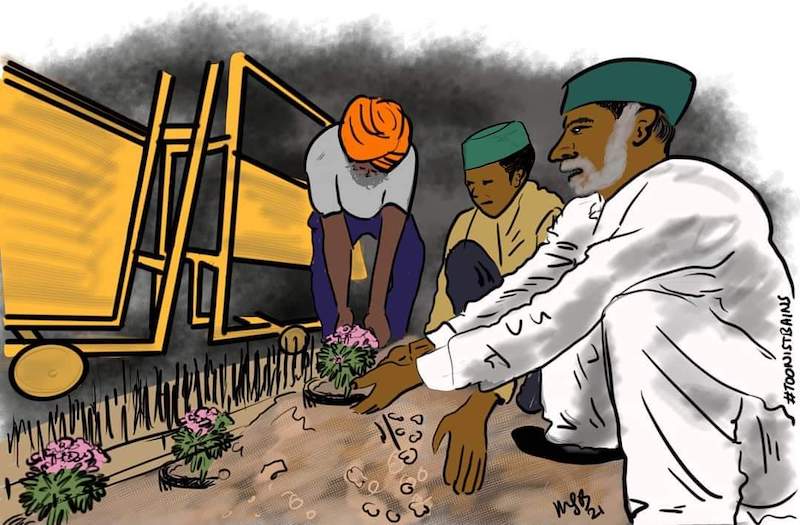
So what was the response of the farmers at Gazipur which is the Delhi-Uttar Pradesh border? No, they did not throw tantrums or went berserk to the heightened security measures which also included multi-layered barricading and concertina wires. Instead, they planted flower saplings near the iron spikes fixed by the Delhi Police.
“The police had fixed iron nails for farmers but we have decided to plant flowers for them,” Bharatiya Kisan Union (BKU) leader Rakesh Tikait was quoted in media reports.
ASIA SAMACHAR is an online newspaper for Sikhs / Punjabis in Southeast Asia and beyond.Facebook | WhatsApp +6017-335-1399 | Email: editor@asiasamachar.com | Twitter | Instagram | Obituary announcements, click here |
Exposed: India’s Disinformation Campaign Against Canada’s Sikhs
By World Sikh Organization of Canada | STATEMENT |
Ottawa (February 3, 2021): The World Sikh Organization of Canada has released a report shedding light on Indian disinformation campaigns targeting Sikhs in Canada. The report entitled “Exposed: India’s Disinformation Campaign Against Canada’s Sikhs” looks at the history of Indian interference and disinformation in Canada, including after the recent resignation of MP Navdeep Bains from his role as Minister of Innovation, Science and Industry.
Last week when MP Ramesh Sangha was expelled from the Liberal caucus for making “baseless and dangerous” accusations against a number of his colleagues, Mark Holland, chief government whip, said “we will not tolerate conspiracy theories, or danger and unfounded rhetoric about Parliamentarians or other Canadians”.
Many in the Canadian media reacted with confusion over these comments and the apparent lack of clarity as to what had caused Sangha’s expulsion. Canadian Sikhs however recognized this as the latest chapter in a lengthy chronicle of India’s interference in Canada. Sangha’s expulsion was the result of his echoing baseless accusations of extremism that originated in India and which had repeatedly been pushed by the Indian media about Canadian Sikh politicians.
The WSO report looks at the history of Indian disinformation campaigns targeting Sikhs in Canada and examines their roots, techniques and motivation. The report exposes how in recent years Indian misinformation attacks have become more coordinated and aim to influence Canadian politicians, media and society. The goal of these efforts has been to malign and marginalize Canadian Sikhs, including elected officials, with allegations of extremism and to have the community regarded with suspicion and distrust. Recent examples of this include during the 2018 Trudeau trip to India as well as in the Indian media coverage related to Navdeep Bains’ resignation.
WSO President Tejinder Singh said today, “The report “Exposed: India’s Disinformation Campaign Against Canada’s Sikhs ” exposes Indian interference and disinformation campaigns targeting Sikhs in Canada. In the aftermath of the farmer protests in India, we are seeing escalated attempts by actors in India to push disinformation, particularly about Sikhs here in Canada. The report reveals that a standard methodology has developed to push false narratives with respect to Sikhs in Canada. There is also evidence to now suggest that India’s intelligence agencies are active in Canada and actively target Canadian politicians and media.
It is our hope that this report will shed light on what is happening and that Canadians- whether government, intelligence agencies, media or average citizens, will be vigilant with respect to being fed fake news and disinformation by Indian actors about the Sikh community in Canada.”
The World Sikh Organization of Canada (WSO) is a non-profit organization with a mandate to promote and protect the interests of Canadian Sikhs, as well as to promote and advocate for the protection of human rights for all individuals.
ASIA SAMACHAR is an online newspaper for Sikhs / Punjabis in Southeast Asia and beyond.Facebook | WhatsApp +6017-335-1399 | Email: editor@asiasamachar.com | Twitter | Instagram | Obituary announcements, click here |
Prof Kirpal Singh (Insert: Cover of The Partition of the Punjab – 1947
By Hardev Singh Virk | OPINION |
Introduction: The Sikhs were sovereign power and rulers of Punjab under Maharaja Ranjit Singh for half a century (1799-1849). Punjab was the last province to be merged in British India. After the merger, the Sikhs served the British empire as the loyal citizens fighting against the Indian mutineers in 1857. The British won the World Wars on the basis of sacrifices made by the Sikh soldiers. However, they failed miserably to get an independent homeland, call it “Sikhistan or more popularly, Khalistan” because of the follies of their leaders. Many Scholars have studied the Partition of Punjab on the eve of British departure from the Indian sub-continent during 1947 and this process continues as there are some gaps to be investigated in view of Partition Documents released after 50 years of Indian independence.
Akhtar Hussain Sandhu [1] concludes in his paper “Sikh Failure on the Partition of Punjab in 1947“: “The All-India Muslim League achieved Pakistan, the Indian National Congress secured India but the Shiromani Akali Dal got nothing on the eve of the British departure in 1947 although the Sikh community had collaborated closely with the colonial power. The demand of the Sikh community for a separate Sikh state and accession of more territories to this state came to naught as a consequence of partition of Indian subcontinent. The decision of joining India by the Akali leadership enslaved this community to a mammoth majority in which they were only one per cent.”
To view all previous articles by Prof Hardev Singh Virk, click here
I am a Nuclear and Radiation Physicist by training but Sikh History attracted me in School & College days. The spark was ignited by the ballad singers (Dhadis) in Punjab and my earliest motivation came from Dhadi Sohan Singh Seetal.
The present article is based on the investigations of Dr Kirpal Singh, a well known Sikh Historian, who published his Ph.D. thesis under the title “The Partition of the Punjab”. His views on Partition of Punjab are summarized as under:
The Idea of a Sikh State: The Shiromani Akali Dal put forth the demand of a Sikh State along with the Muslim demand for a sovereign Muslim State. It was based on the argument that “the Panth demands the splitting up of the existing province of the Punjab with its unnatural boundaries so as to constitute a separate autonomous Sikh State in these areas of the central, north-eastern and south-eastern Punjab in which the over-whelming part of the Sikh population is concentrated and which because of the proprietors in it being mostly Sikhs and its general character being distinctly Sikh, is the de facto Sikh Homeland.” The proposed Sikh State was to consist of the territories of “Central Punjab with Divisions of Lahore, Jullundur, parts of Ambala and Multan Divisions with the area comprised of Sikh States and Maler Kotla with certain hills in the North and North-East” [1].
The Idea of Azad Punjab: In order to make their position clear, the Shiromani Akali Dal put forward the Azad Punjab Scheme [2]. According to this scheme a new Punjab was to be carved out after separating the overwhelming Muslim majority areas. It was argued that it was to be an ideal province with about an equal proportion of Hindus, Muslims and Sikhs. In the event of partition of the country it was to remain in the Indian Union. Master Tara Singh explained the basis of this province in his letter to Sir Stafford Cripps [3].
Low Representation to Sikhs in Punjab: The Constituent Assembly proposed to be set up for Punjab, NWFP, Sind and Baluchistan (Provinces in Section B), the Muslim representatives were 22, Hindus 9 and the Sikhs 4. The Sikhs protested against this compulsory grouping and in a letter, dated May 25, 1946, to the Secretary of State, Master Tara Singh, the Akali Leader wrote, that “a wave of dejection, resentment and indignation has run through the Sikh community. The Sikhs have been thrown at the mercy of the Muslims”[4]. S. Baldev Singh, the Defence Member of the Interim Government, wrote to the Prime Minister of Britain, seeking his intervention to remedy the wrong done to the Sikh community [5].
Proposal for a New Sikh Province: In a memorandum submitted to the Cabinet Mission, the Shiromani Akali Dal stated, “As an alternative to the existing province of the Punjab, a new province may be carved out as an additional provincial unit in the united India of the future in such a way that all the important Sikh shrines (Gurdwaras) be included in it as also a substantial majority of the Sikh population of the existing province of the Punjab” [6].
Congress accepted the Partition of Punjab: But the division of Punjab could only be conceded after the Congress had reconciled itself to the creation of Pakistan. By this lime, Mountbatten, the new Governor-General had discussed his tentative plan with the Congress leaders and Mr. Jinnah. The Congress high command, barring Maulana Azad, had tentatively accepted the partition of India. This laid the foundation of the Partition Plan, which was basically a Partition of Punjab, Bengal and Assam.
The Sikh Leaders accepted the Partition of Punjab: The Sikh leaders jointly with the Hindus as well as separately insisted upon the division of the Punjab and the Shiromani Akali Dal asserted that partition of the Punjab was “the only remedy to end communal strife”[7]. Master Tara Singh, Sardar Baldev Singh and Giani Kartar Singh expressed similar views during their interviews with the Viceroy on the April 18, 1947 [8].
Jinnah offered a Sikh State within Pakistan: Consequently, meetings between Mr. Jinnah and Liaquat Ali Khan and the Maharaja of Patiala and Sardar Baldev Singh, the Defence Member of the Interim Government, were arranged. Since the Sikhs had already put forth the demand of a Sikh State, the talks naturally centered on that issue. Mr. Jinnah and Liaqat Ali Khan agreed to the formation of the Sikh State with its separate military establishment within Pakistan, provided the Sikhs did not insist on the partition of the Punjab and agreed to join Pakistan [9]. The Sikh leaders demanded the right of opting out of Pakistan for the Sikh State to which the Muslim League leaders did not agree [10].
Sikh Leaders failed to bargain with Congress: Master Tara Singh told the writer that if Mr Jinnah had agreed they would have negotiated with the Congress for better terms. It is difficult to visualize what better terms the Congress could have offered short of creating of an independent Sikh State in the portion of Punjab which fell to India’s share. But Master Tara Singh and Sardar Baldev Singh or Maharaja of Patiala did not contact Congress after Mr. Jinnah’s refusal to concede their demand.
Failure of Penderel Moon Mission: Mr. Jinnah wanted the Sikhs to join Pakistan and gave assurances of good treatment towards them. The Sikh leaders insisted on some constitutional rights when they met Jinnah in 1946 and 1947 which obviously Jinnah would not concede. The later failure of the Moon mission was from the very beginning foreseen. Mr. Jinnah’s Islamic State had no place for zealous and aggressive non-Muslims.
Sikh Leaders were Confused: The Working Committee of the Shiromani Akali Dal and thePanthic Pratinidhi Board jointly passed a resolution on June 14, 1947, emphasizing that, “in the absence of the provision of transfer of population and property, the very purpose of partition would be defeated”[11]. Giani Kartar Singh, President of Shiromani Akali Dal, said on July 16, 1947, “The Sikhs will not rest contented till the boundary line is demarcated in such a way that it leaves at least 85 per cent Sikhs in India and both the States of Pakistan and India are committed to facilitate the transfer of the remaining 15 per cent from Pakistan to India [12].
Baldev Singh committed a Blunder: S. Baldev Singh accepted the 3rd June Plan with partition of the Punjab on the basis of contiguous majority areas. Subsequently he said in a statement, “If the verdict of the Boundary Commission went against the Sikhs, they should be prepared to make all sacrifices to vindicate the honour of the Panth”[13].
He did not foresee that actual boundary line could not be much different from the notional division included in the 3rd June Plan. The issue of the Sikh shrines, the question of transfer of Sikh population and the exchange of the property for which the Sikh leaders struggled subsequently should have been pressed before agreeing to the 3rd June Plan. But the Sikh leader thought that for his consenting to the plan which affected the Sikhs adversely, the British Government would assert its influence to give them concessions.
Partition was an ill-conceived Plan: According to Lord Ismay, the Mountbatten Plan was a case of “Hobson’s choice’’[14]. No one in India thought that it was perfect. Lord Mountbatten himself admitted this in a radio broadcast on the day of its announcement. He said : “The whole plan may not be perfect, but like all plans, its success will depend on the spirit of goodwill with which it is carried out [15]. The boundary between India and Pakistan, known as Radcliffe Line, was marked on 17th August, 1947, two days after the Partition.
Sikhs were recognized as Equal Partners with Hindus & Muslims: Though these (Hindus and Muslims) were the major contenders for receiving power when it was likely to be transferred, yet the Sikhs had been recognized as the third important community for the transference of power, as it was stated in the Cabinet Mission proposals: “It is sufficient to recognise only three main communities in India, General, Muslims and Sikhs, the General Community including all persons who are not Muslims or Sikhs” [16].
Sikhs Failed to get Sikhistan: “You ask if I found the Sikhs liked that plan and if not, what did I do about it. My impressions on getting to Delhi on the 22nd July, 1947, were these: the Sikhs did not like the plan; they had only agreed to it to meet us more than half-way and to make it easier for us to go out of our way to meet their wish for some sort of Sikhistan [17]. I reported accordingly to our authority in Delhi. They felt as I did, too, that they could not now alter course; but in so far as they could trim a trifle to meet the Sikhs, they would. And so it was left”.
Sikhs were losers on all Fronts: The Partition of Punjab was based on the census figures of 1941, with Muslim majority of 54 %, Hindus constituting 30% and Sikhs just 13%. Tehsil was considered as the basic unit for allocation of territory. The Sikhs had majority population in two tehsils of Tarn Tarn and Jagraon only. Hence, they were losers on population basis in Punjab vis a vis Muslims and Hindus.
According to 1941 census figures, Gurdaspur district was a Muslim majority area by a small margin of 50.4%. Both Batala and Gurdaspur tehsils were clearly Muslim majority areas. The same was true for Fazilka, Zira and Ferozepur Tehsils. Muslim members of Boundary Commission (Justice Munir Ahmad & Justice Din Mohammad) were dead sure of their inclusion in Pakistan. In private conversation, Tarlochan Singh (Ex-MP) explained to me that Master Tara Singh and Giani Kartar Singh prevailed upon Lord Mountbatten to cancel this allocation and make transfer in favour of India at the last moment. However, there is no written record to establish this story.
Lord Mountbatten blamed the Sikhs for their Folly [18]: “It must point out that the people who asked for the partition were the Sikhs. The Congress took up their request and framed the resolution in the form they wanted. They wanted the Punjab to be divided in two predominantly Muslim and non-Muslim areas. I have done exactly what the Sikhs requested me to do through the Congress. The request came to me as a tremendous shock as I like the Sikhs, I am fond of them and I wish them well. I started thinking out a formula to help them but I am not a magician. It is up to the Sikhs who are represented on the Committee to take up the case. It is not I who is responsible for asking for partition”.
REFERENCES
1.Akhtar Hussain Sandhu, International Journal of Punjab Studies September 2012, https://www.researchgate.net/publication/273602638.
Justice Harnam Singh, The Idea of Sikh State, page 27 & 46.
Congress te Sikh (Punjabi), by Master Tara Singh (1945), pages 3-4.
Swagati Address Azad Punjab Conference, Amritsar (Punjabi), 28th February, 1944.
Papers relating to the Cabinet Mission Plan in India, p. 61
V.P. Menon, Transfer of Power in India, Calcutta, 1957, p. 291
Memorandum submitted to Cabinet Mission, Sikh History Records (S.H.R.) Folio No. 1815, Khalsa College, Amritsar
8 . Indian Annual Register 1941, Vol. I, Calcutta, p. 244
Ibid
“Mr. Jinnah’s offer of Sikh State,’’ Maharaja Patiala’s article. The Tribune Ambala, July, 19, 1959. This would have left the Hindus of the Punjab in Pakistan either of its Punjab part or in the newly created Sikh Province of Pakistan.
Statement of Master Tara Singh, The Tribune, Ambala, July 23, 1959
Punjab Partition (PP), Vol. I, pp. 6-7
C. &. M. Gazette, June 15, 1947
The Hindu, Madras, July 16, 1947
C. & M. Gazette, July 10, 1947
Lord Ismay, Memoirs of Lord Ismay, London, 1961, p. 420
Para 18, Cabinet Mission Plan, S.D.I C, Vol. II, p. 581
S.H.R, Folio No. 3755, Khalsa College, Amritsar. It is based on author’s interview with Major J.M. Short in UK.
Justice Din Mohammad, 5 August 1947, in: Kirpal Singh, Select Documents on the Partition of the Punjab, p. 377.
Scholar and scientist Hardev Singh Virk retired from Amritsar-based Guru Nanak Dev University in 2002 after serving as Founder Head Physics Department and Dean Academics. Ex-Professor of Eminence, Punjabi University, Patiala. He is the present Professor of Eminence, SGGS World University, Fatehgarh Sahib (Punjab), India (E-mail: hardevsingh.virk@gmail.com)
ASIA SAMACHAR is an online newspaper for Sikhs / Punjabis in Southeast Asia and beyond.Facebook | WhatsApp +6017-335-1399 | Email: editor@asiasamachar.com | Twitter | Instagram | Obituary announcements, click here |
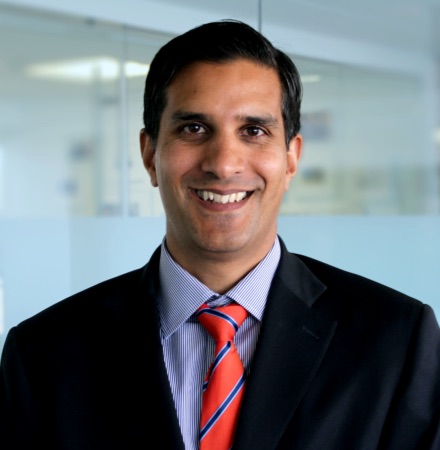
President Joe Biden plans to name New York Federal Reserve markets chief Daleep Singh to serve as deputy national security adviser, a move the White House says reflects a commitment to prioritizing U.S. workers in foreign policy, reports Bloomberg.
Singh oversaw implementation of the New York Fed’s emergency facilities during the Covid-19 pandemic, and previously served in domestic finance and international affairs roles in the Treasury Department during Barack Obama’s administration.
In his new role, it was reported he will serve as deputy National Economic Council director in addition to his post on the National Security Council, a structure the White House says is meant to break down silos. Singh will report to both National Security Adviser Jake Sullivan and NEC Director Brian Deese.
“Daleep will be tasked with refocusing U.S. international economic policy on the needs of working Americans,” Sullivan told Bloomberg in an emailed statement.
Singh is executive vice president and head of the Markets Group at the Federal Reserve Bank of New York. In this role, he oversees the group’s full portfolio, including implementing monetary policy, monitoring and analyzing global financial market developments, executing lender of last resort operations, providing financial services for foreign and international monetary authorities, providing capital market-related services to the U.S. Treasury as their fiscal agent, and administering and producing several reference rates for the U.S. money markets, according to his profile at its website.
It added that he plays a key role in developing and implementing the Bank’s strategic direction and priorities, and is a member of the bank’s executive committee.
Prior to joining the New York Fed, it said Singh was senior partner and chief U.S. economist at the global investment firm SPX Capital, from 2017 to 2019. Before that, he worked at the U.S. Department of the Treasury from 2011 to 2017, serving as acting assistant secretary for Financial Markets and deputy assistant secretary for International Affairs, helping to shape the Treasury Department’s crisis response to Ukraine, Russia, Greece, and Puerto Rico. Singh also directed the Treasury Department’s Markets Room, which provided real-time and thematic analysis for senior officials.
Prior to his tenure at the Treasury Department, Singh worked for Goldman Sachs, with a focus on U.S. interest rates and currency markets, from 2003 to 2007, and again from 2008 to 2011. He was also a partner at Element Capital Management from 2007 to 2008.
Singh a former adjunct senior fellow at the Center for New American Security and the Atlantic Council. He was also an adjunct professor of geoeconomics at Johns Hopkins School of Advanced International Studies.
He holds a bachelor’s degree with Duke University in economics and public policy. He also holds a master of business administration/master of public administration from the Massachusetts Institute of Technology, and Harvard University, with a focus on international economics.
ASIA SAMACHAR is an online newspaper for Sikhs / Punjabis in Southeast Asia and beyond.Facebook | WhatsApp +6017-335-1399 | Email: editor@asiasamachar.com | Twitter | Instagram | Obituary announcements, click here |
IN MEMORIAL:Passed away peacefully on 19 Jan 2021 after a short illness. Path da Bhog was held on 30 Jan 2021 at Gurdwara Sahib Johor Bahru in the presence of immediate family members| Malaysia
RANJIT KAUR RANDHAWA @ BEE BEE
D/O LATE SARDAR BANTA SINGH RANDHAWA & LATE SARDARNI SANTA KAUR RANDHAWA (Jalan Pegawai, Batu Pahat, Johor)
Formerly Seberang Jaya (Penang) & Batu Pahat (Johor)
Village: Dhunda
Passed away peacefully on 19 Jan 2021 after a short illness
Husband: Late Sardar Banta Singh Sandhu @ Bali Singh Sandhu ( Bramphur )
Children:
Avtar Singh
Satvinder Kaur
Sukhvinder Singh
Parvin Kaur
Grandchildren:
Trishkaran Singh
Chireenjeev Singh
Jasmeet Singh
Shri Priya
Navin Singh
Mandev Singh
Path Da Bhog: The Path da Bhog was held on 30 Jan 2021 at Gurdwara Sahib Johor Bahru in the presence of immediate family members. Due to Emergency Rules & MCO, the funeral, Antim Ardaas and Path Da Bhog was kept private.
In her younger days, she used to be a Punjabi teacher at Gurdwara Sahib Batu Pahat and has done a lot of Seva including taking part in reading of Guru Granth Sahib, especially during Akand Paths, at Gurdwara Sahib Butterworth
Message from the Family:
We would like to thank all of our relatives and friends from Malaysia and abroad for their heartfelt words, blessings and kind support especially to our Mama and Mamiji Mr. Jeswan Singh Randhawa and his wife Mdm Jasbeer Kaur Randhawa (Jessy), our masis Mdm Avtar Kaur (Thari), Mdm Mendor Kaur (Chani), Mdm Jasbir Kaur, Late Mdm Amar Kaur Randhawa; also not forgetting our mamiji Madam Minder Kaur Randhawa for being with us when the time we needed them the most.
For all the sewadar and sewadarni of Gurdwara Sahib Johor Bahru, we would like to thank all of them too, not forgetting all the Hospital Sultanah Aminah (JB) staffs especially Dr. Wee Jack Son, Dr. Danny Yap, Dr. Shobana and the team including all the nurses for their countless effort to give the best treatment for our dearest mom.
Each and everyone’s dedication are very much appreciated and thank you very much again. May Waheguruji Bless All Of You.
Regards: Ms. Parvin Kaur Sandhu
WE MISS YOU MOM. Our heart still ache with sadness and many tears still flow. What it meant to lose you, No one will ever know. In life we loved you dearly, In death we love you still ….. In our hearts you hold a place , No one else will ever fill ….
| Entry: 5 Feb 2021 | Source: Family
ASIA SAMACHAR is an online newspaper for Sikhs / Punjabis in Southeast Asia and beyond.Facebook | WhatsApp +6017-335-1399 | Email: editor@asiasamachar.com | Twitter | Instagram | Obituary announcements, click here |
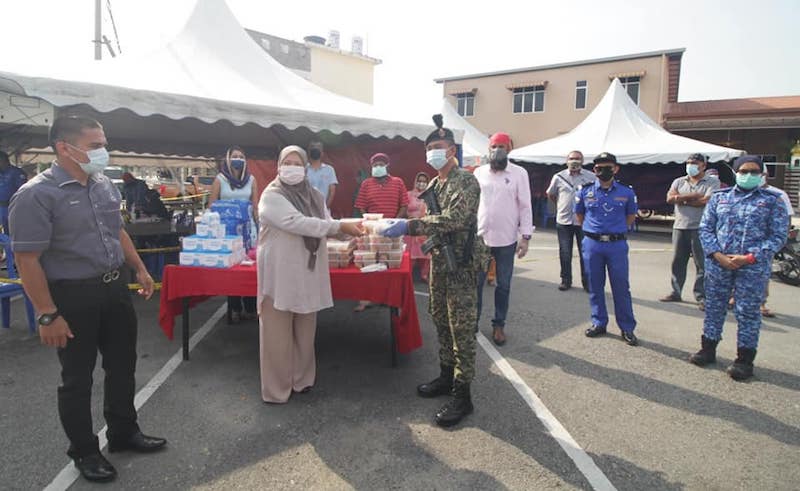
Aida Munira handing over a parcel to a frontliner. On left is Mohd. Zulkifli and Jasvir (5th from right)
By Asia Samachar Team | MALAYSIA |
A Sikh businessman and councillor is organising daily hot food for the Covid-19 frontliners at a village in Bentong, Pahang.
The frontliners have been manning their posts at Kampung Kemansur which was placed under lockdown in Wednesday (3 Feb) due to the spread of the pandemic.
“We will provide them hot food until the lockdown is lifted,” Jasvir Singh Ram Singh told Asia Samachar.
Jasvir is a councillor at Bentong Municipal Council (BMC) and a special officer to the Pahang menteri besar. At the same time, he also leads the Bentong gurdwara management committee.
A symbolic handover was attended by Bentong district officer Mohd Zulkifli Hashim, BMC president Aida Munira Abdul Rafar and Bentong police district chief Supt Zaiham Mohd Kahar.
ASIA SAMACHAR is an online newspaper for Sikhs / Punjabis in Southeast Asia and beyond.Facebook | WhatsApp +6017-335-1399 | Email: editor@asiasamachar.com | Twitter | Instagram | Obituary announcements, click here |